
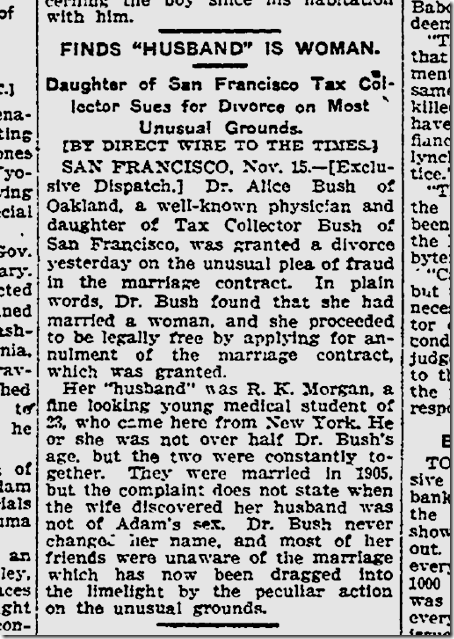
In light of the Supreme Court ruling, here are some posts from the old Daily Mirror blog.
Clerk Refuses to Marry Chinese Man to White Girl, July 11, 1899.
Finds Husband Is a Woman, Nov. 15, 1909
Christine Jorgensen Tries to Marry, March 31, 1959.
In light of the Supreme Court ruling, here are some posts from the old Daily Mirror blog.
Clerk Refuses to Marry Chinese Man to White Girl, July 11, 1899.
Finds Husband Is a Woman, Nov. 15, 1909
Christine Jorgensen Tries to Marry, March 31, 1959.
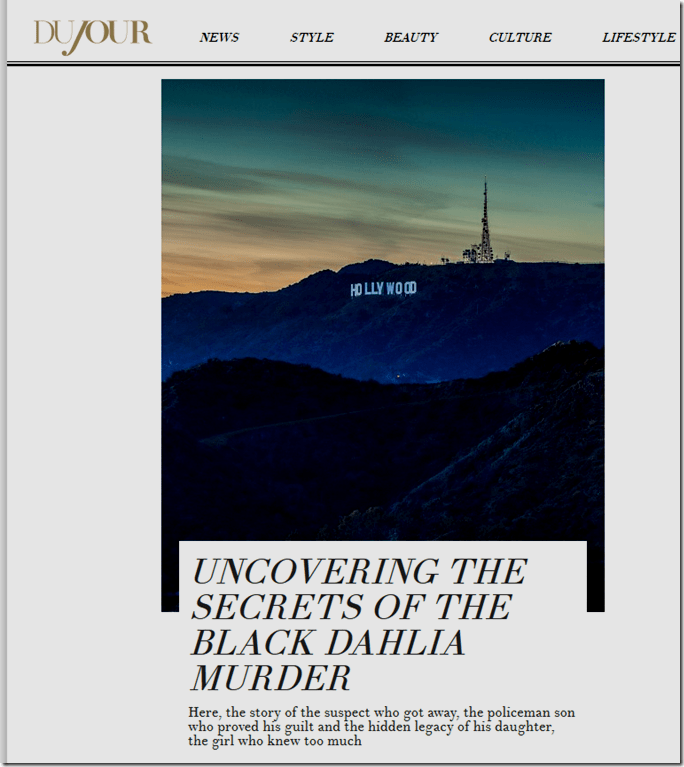
The ever-vigilant Eve Golden forwarded an article by Sheila Weller from Dujour.com reporting that Tamar Hodel, who accused Dr. George Hodel of molestation in the 1940s, is in a hospice. Tamar Hodel is the half sister of retired LAPD Detective Steve Hodel and figures prominently in the claims that Dr. Hodel killed Elizabeth Short and committed many other unsolved murders in Los Angeles.
I have already devoted a great deal of space to refuting Steve Hodel’s claims, – and I have posted the complete transcripts of the bugs placed in Dr. Hodel’s house by detectives, so I won’t go through it all again.
The George Hodel files Part 1 | Part 2 | Part 3 | Part 4 | Part 5 | Part 6 | Part 7 | Part 8 | Part 9 | Part 10 | Part 11 | Part 12 | Part 13 | Part 14 | Part 15 | Part 16 | Part 17 | Part 18 |Part 19 | Part 20 | Part 21 |Part 22 | Part 23 | Part 24 | Part 25 | Part 26 | Part 27 | Part 28 | Part 29 | Part 30 | Part 31 | Part 32 | Part 33 | Part 34 | Part 35 | Part 36 | Part 37
The article recycles the same old scenario from the “Black Dahlia Avenger” franchise. Otherwise, there is nothing new except more information on Tamar Hodel’s troubled life.

Fannie Ward in “The Cheat.”
For the 18th year in a row, the Niles Essanay Silent Film Museum is holding their Broncho Billy Silent Film Festival in Niles’ historic 1913 Edison Theatre this weekend from Friday, June 26 to Sunday, June 28. They will be running silent rarities seldom seen on the big screen, including G. M. “Broncho Billy” Anderson Essanay shorts, a Baby Peggy feature, and Universal silents, all with wonderful live accompaniment by such pianists as Frederick Hodges, Jon Mirsalis, David Drazin, Greg Pane, and Bruce Loeb.
Festivities kick off Friday with an opening reception, followed at 8 pm by the tinted1924 Dorothy Devore romantic comedy, “The Tomboy.” Devore runs a boarding house for her eccentric father when a new handsome boarder, Herbert Rawlinson arrives. Two 1915 Essanay shorts precede the film, “Broncho Billy and The Claim Jumpers,” and the Snakeville Comedy, “When Slippery Slim Went For the Eggs,” featuring the comic antics of Victor Potel, Harry Todd, and Margaret Joslin.
Saturday morning kicks off with an informative walking tour of the little town of Niles, now part of Fremont, strolling down Niles Boulevard past former Essanay Film Company locations, and visiting quaint little bungalows. A $5 donation covers the walking tour, which begins at 11:30 a.m. at the Museum.
At 1 p.m. that afternoon, Cecil B. DeMille’s sensational 1915 feature, “The Cheat,” screens, starring the intense Sessue Hayakawa and the lovely Fannie Ward. Vain, selfish stockbroker wife Ward finds herself in debt to Hayakawa, with desperate results.
The 3pm show features Essanay film shorts shot in and around the little town of Niles, featuring Broncho Billy, Ben Turpin, Harry Todd, Margaret Joslin, and Victor Potel. The comic, cross-eyed Turpin appears in two films: “Broncho Billy Steps In” (1915), and “Snakeville’s Champion” (1915), in which he plays a boxer squaring off against Lloyd Bacon. During the short, the Niles’ Edison Theatre can actually be glimpsed in the distance.
That evening at 7:30, the Ray Hubbard Award will be presented to a special honoree, followed by a salute to Universal Pictures Centennial with the screening of “Skinner’s Dress Suit” (1926) and two shorts, “Behind the Screen” (1915) and “City of Stars” (1925), which present tours of the Universal City lot. “Skinner’s Dress Suit” stars Reginald Denny and Laura La Plante.
Sunday morning, guests are invited to ride the train through historic Niles Canyon before afternoon screenings. Kicking off Sunday afternoon screenings at 1 p.m. is a showing of the Library of Congress’ recently restored Baby Peggy feature, “The Family Secret” (1924). Baby Peggy (Diana Serra Cary) stars as a child of a secretly married couple who are separated by her rich grandfather. Schedule permitting, Cary herself will appear at the screening.
The Festival closes at 4 p.m. with a presentation of Helen Holmes and Helen Gibson action-packed adventures. Holmes, one of the great serial queens, stars in the short, “In Danger’s Path” (1915), directed by her husband, J. P. McGowan, and the feature, “Mistaken Orders” (1925), also directed by McGowan. Gibson appears in the short 1920 short, “The Ghosts of the Canyon.”
Festival passes cost only $65 for nonmembers, with different ticket prices for individual screenings. Passes and tickets can be bought online through the Museum’s website, or at the door.
Come enjoy the little town of Niles, the main western headquarters of the Essanay Film Company, and a pleasing small town atmosphere!
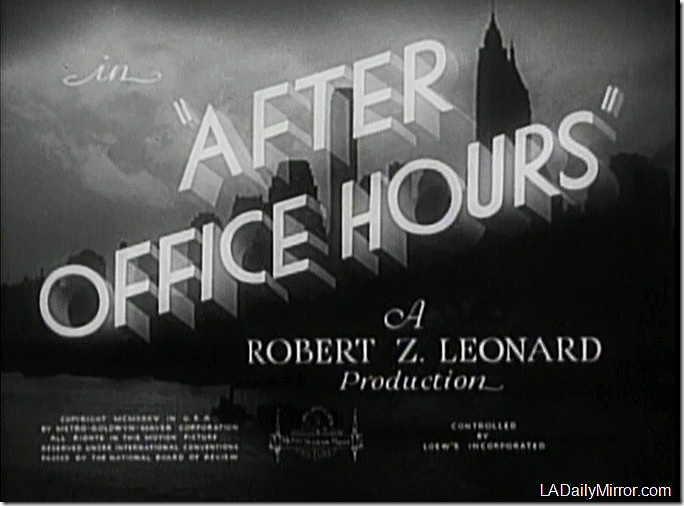
This week’s mystery movie has been “After Office Hours,” a 1935 MGM picture starring Constance Bennett (Thursday’s mystery woman), Clark Gable (Friday’s mystery fellow), Stuart Erwin (Friday’s mystery guest), Billie Burke (not shown), Harvey Stephens (Wednesday’s mystery guest) and Katharine Alexander (Tuesday’s mystery guest). The screenplay was by Herman J. Mankiewicz from a story by Laurence Stallings and Dale Van Every, and directed by Robert Z. Leonard. It is available on DVD from Warner Archive.
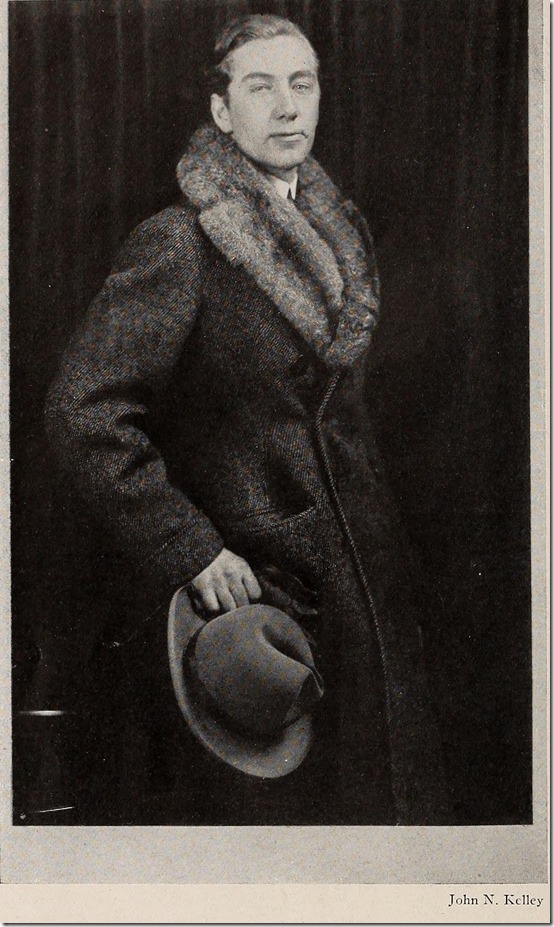
Max Ree , in an undated photo.
Mostly forgotten today thanks to his short film career, Danish architect turned costume and set designer Max Ree fashioned elegant artistry in the motion picture field from the mid-1920s through the mid-1930s. He served as a respected consultant, teacher, mentor, and commentator for his erudite comments on design as well as serving the industry on various councils. Neither flashy nor forward, Ree followed the dictum that form followed function, allowing easy access, mobility, and cost.
Born October 7, 1889 in Copenhagen, Denmark, Ree studied law and philosophy before earning his degree in architecture from the Royal Academy of Copenhagen. He worked as an architect for several years, designing fine homes around the country before discovering theatre and the great German theatre producer, Max Reinhardt. The two men began a long collaboration producing such influential stage works as “The Miracle,” “Orpheus,” and “The Midsummer Night’s Dream” in Berlin and Vienna during the late 1910s-early 1920s, with Ree serving as costume and set designer. Ree was renowned around Europe for his elegant lines and subdued but striking design obtained through deep research and study.
Mary Mallory’s “Hollywood land: Tales Lost and Found” is available for the Kindle.
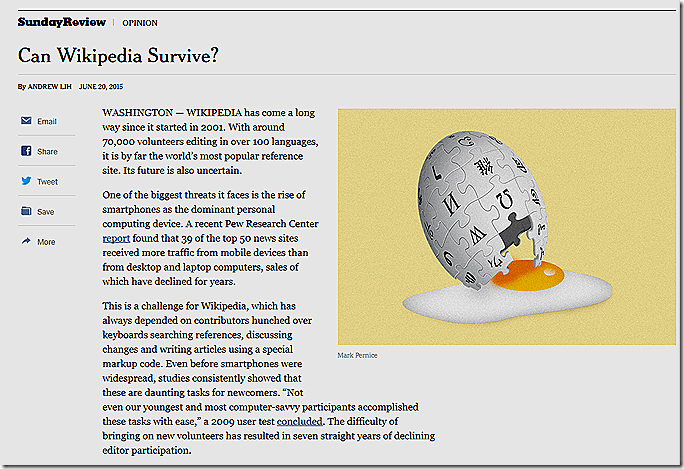
Behind the boosterism of this opinion piece by Andrew Lih in the New York Times (“it is by far the world’s most popular reference site” – notice that he doesn’t call it the world’s most accurate reference site) are some interesting tidbits:
–The rising popularity of smartphones threatens Wikipedia (editing Wikipedia on a cellphone is problematic).
–The “peak years” of Wikipedia were about 2005.
–Promotion from editor to administrator is at best one a month, compared to 60 a month in 2005.
–Wikipedia has a budget of $60 million and fund-raising is no problem.
ALSO
Me vs. Wikipedia
Wikipedia Hoax Exposed
Wikipedia: Murder and Myth
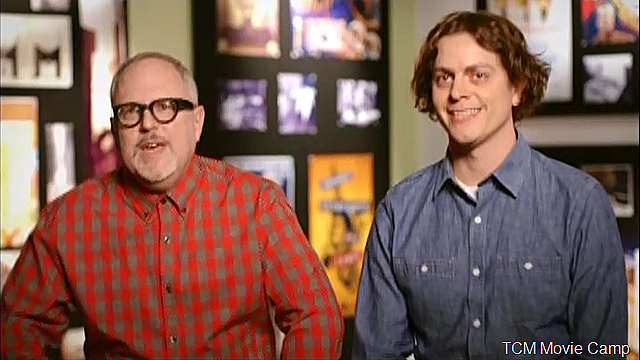
TCM’s “Movie Camp” hosts William Joyce, left, and Brandon Oldenburg.
I tuned in to TCM’s “Movie Camp” over the weekend, not to watch these two fellows, but to catch “Hoppity Goes to Town” also known as “Mr. Bug Goes to Town,” by the Fleischer studio.
I like some of the TCM hosts, particularly David Edelstein’s presentations of Francois Truffaut and Orson Welles, and Eddie Muller’s “Summer of Darkness,” although I can do without the commercial tie-ins of fedoras and cocktail shaker sets.
But these guys, William Joyce and Brandon Oldenburg, not so much.
Continue reading
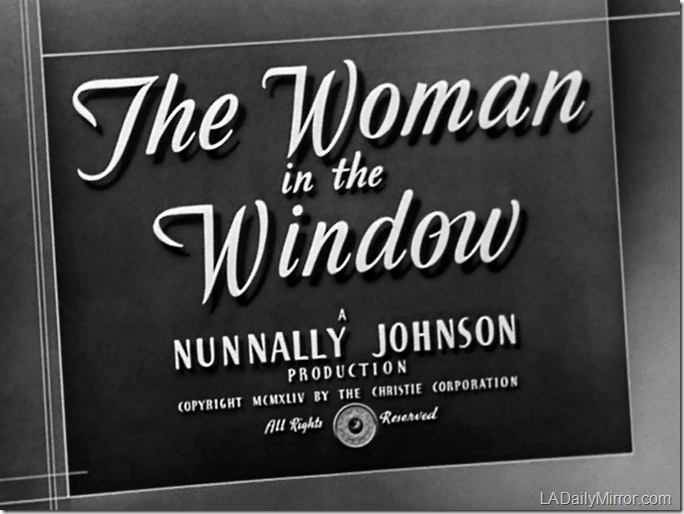
This week’s mystery movie has been the 1944 picture “The Woman in the Window,” directed by Fritz Lang, starring Edward G. Robinson (Friday’s mystery chap), Joan Bennett (Thursday’s mystery painting), Raymond Massey (Friday’s mystery chap), Edmond Breon (not shown), Dan Duryea (not shown), Thomas E. Jackson (not shown), Dorothy Peterson (Monday’s mystery guest), Arthur Loft (Tuesday’s mystery guest) and Frank Dawson (not shown). It was photographed by Milton Krasner, with music by Arthur Lange, and produced and written for the screen by Nunnally Johnson, from a novel by J.H. Wallis.
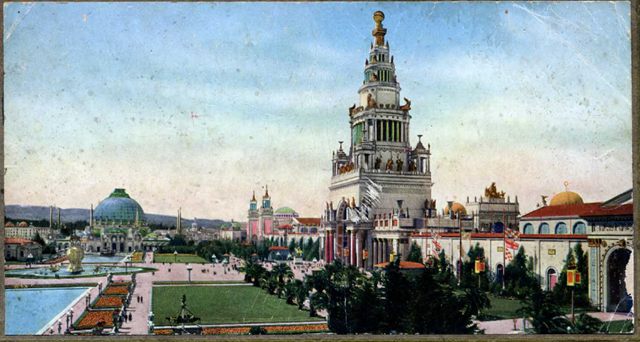
The Tower of Jewels, in an image from the Los Angeles Public Library.
One hundred years ago, San Francisco hosted the most elaborate and and fantastic World’s Exposition until that time in celebration of the opening of the Panama Canal and the opening of the grand Pacific Coast to the world. The metropolis intended the event to help reinvigorate San Francisco by showing off its beauty, spirit, and cosmopolitan atmosphere, helping to speed up reconstruction by adding new streetcar lines and creating new residential districts. Over 18,000,000 people visited the fair during its long run that year, bringing much needed revenue to the city, still struggling to rebuild after the 1906 great earthquake. As the book, “Empress of San Francisco: The Pacific Rim, the Great West, and California at the Panama-Pacific International Exposition” relates from local news reports, “We are discovered now. With the close of the exposition has come the awakening to the fact that tourist travel means dollars raining down on every line of business.”
Motion pictures played a major part in the 1915 Exposition, employed as both educational tool and entertainment medium for fair guests, as well as providing much needed advertising to people around the world. The use of film at this fair demonstrated how important the medium had become to American society, inaugurating how media would come to dominate the telling and shaping of public events and stories.

This amazing “objet d’art” has been listed on EBay for $39. I mean, really?

This week’s mystery movie is the 1931 RKO picture “Men of Chance,” starring Ricardo Cortez, Mary Astor (Friday’s mystery guests) and John Halliday (Wednesday’s mystery guest). It was directed by George Archainbaud and written by Louis Weitzenkorn and adapted by Louis Stevens with additional dialogue by Eddie Welch.
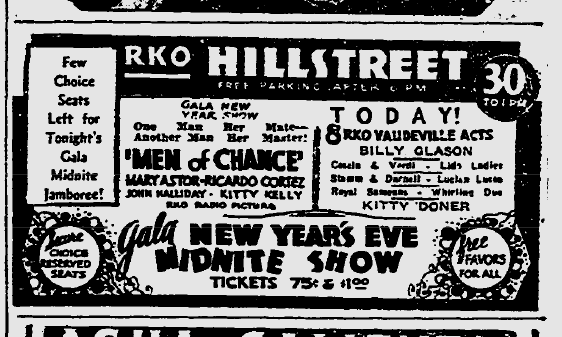
The movie opened in Los Angeles on New Year’s Eve 1931, against “Frankenstein,” “Ladies of the Big House,” “Hell Divers,” “The Woman From Monte Carlo,” “Delicious” and “Dr. Jekyll and Mr. Hyde,” which was playing for a second week. This pre-code film has apparently never been released on VHS or DVD. I recorded it from TCM in 2012.
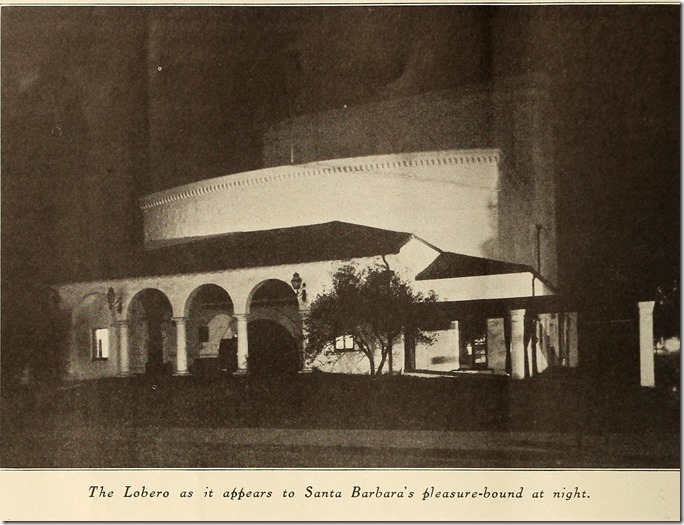
Santa Barbara’s beautiful Lobero Theatre has long operated as Hollywood’s go-to location for theatrical tryouts and performances since its opening in 1924. California’s oldest continuous operating theatre, the Lobero was founded in 1873 by Jose Lobero, before being completely renovated and remodeled in 1924 following George Washington Smith’s grand design. The elegant showcase has functioned as Hollywood’s theatrical home away from home, close enough for family and friends to attend, celebrities to appear, and for society scions to visit. It offered a safe haven for those trying their wings on the stage or those coming back after a long break.
From its reopening as a Spanish Revival jewel, the theatre has offered high class entertainment in an intimate setting. A few years after opening, management hired actor/producer Irving Pichel away from his own Pichel Playhouse in Oakland to serve as artistic director and star. Under his influence, the theatre hosted such actors as Tallulah Bankhead, Lionel Barrymore, and a young Bela Lugosi on its stage.
Mary Mallory’s “Hollywood land: Tales Lost and Found” is available for the Kindle.

Isabel Vincent and Melissa Klein of the New York Post do some fact-checking on the bestselling book “Primates of Park Avenue,” by Wednesday/Wendy Martin.
Executive summary: “Holes big enough to drive an Escalade through.”
An excellent Sunday read and a tip of the Daily Mirror’s fact-checking hat.


The headline and map by Charles Owens from The Times.
Reposting from 2014.
June 6, 1944: Complete radio coverage of the D-Day Invasion. This was pool coverage using correspondents from various news organizations. By 10 a.m., CBS had resumed regular programming with news bulletins, so I’ll only post up to noon. The full day is at archive.org.
It’s worth noting that German radio was the source for most of the information in the early hours of the invasion. The eyewitness accounts are vivid and it’s worth listening to Quentin Reynolds’ analysis on how the Allies learned from disastrous surprise invasion at Dieppe in 1942.
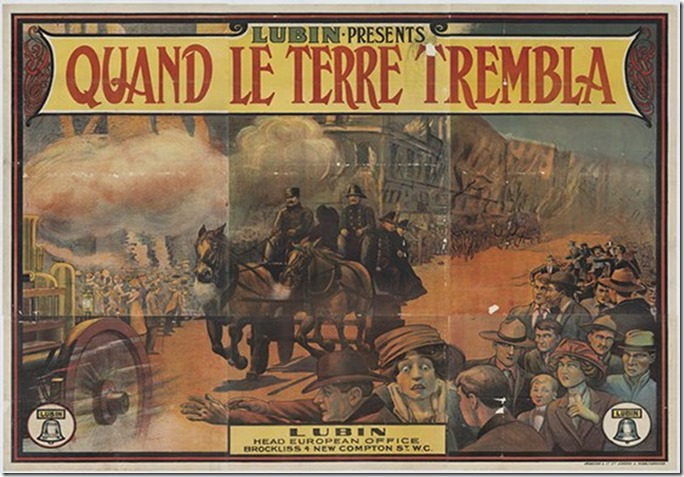
“When the Earth Trembled,” courtesy of the San Francisco Silent Film Festival.
The San Francisco Silent Film Festival offered a little something for everyone during their recently concluded 20th anniversary festival. From presentations by renowned historians and archivists to screenings of recently restored pictures, the Festival highlights the range and breadth of silent film through the power of live cinema. Live musical accompaniment by a diverse group of artists provided a strong emotional undercurrent to each presentation.
I missed Thursday night’s grand opening of the festival, the powerful World War I film, “All Quiet on the Western Front,” Universal’s strong antiwar conclusion to the silent era, which was introduced by Library of Congress curator, Mike Mashon. Universal chairman Ron Meyer announced that Universal and a consortium of archives will restore 15 Universal silent films over the next few years. Mont Alto Picture Orchestra performed actual music cues of the period in giving the moving film voice.
“Figures de Cire” is online here.
Reconstruction of “When the Earth Trembled.”
Mary Mallory’s “Hollywood land: Tales Lost and Found” is available for the Kindle.
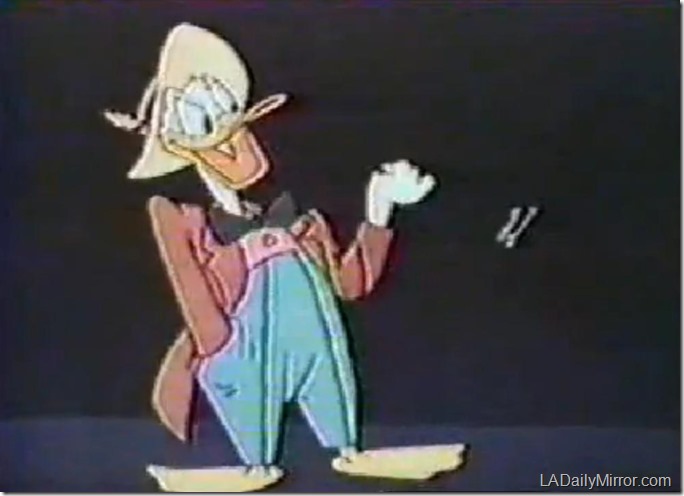
A hipster duck wears a zoot suit in Disney’s “The Spirit of ‘43.”
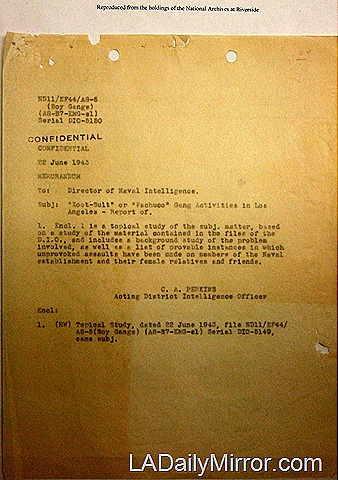
In 2011, I took a look at the official Navy documents on the Zoot Suit Riots. Here they are:
“Zoot Suit” and History, Part 1| Part 2 | Part 3 | Part 4 | Part 5 | Part 6 | Part 7 | Part 8 | Part 9 | Part 10 | Part 11 | Part 12 | Part 13 | Part 14
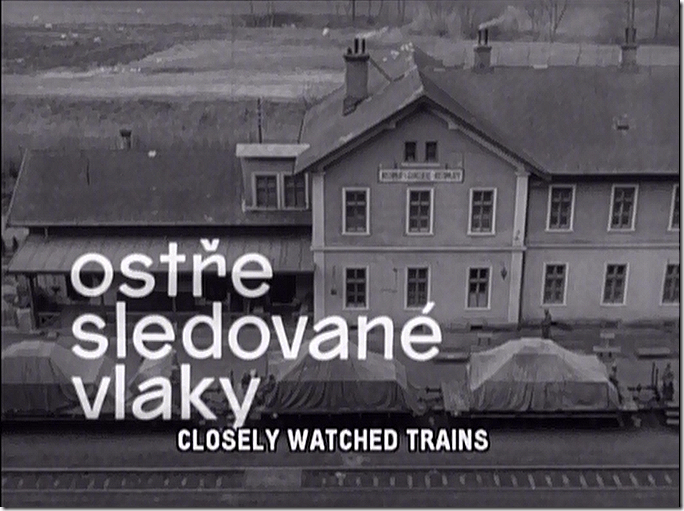
This week’s mystery movie has been the 1966 Czech film “Closely Watched Trains,” which won the Academy Award for foreign film in 1968. It was directed by Jiri Menzel and written by Menzel and Bohumil Hrabal from a novel by Hrabal. It was released on DVD by the Criterion Collection.
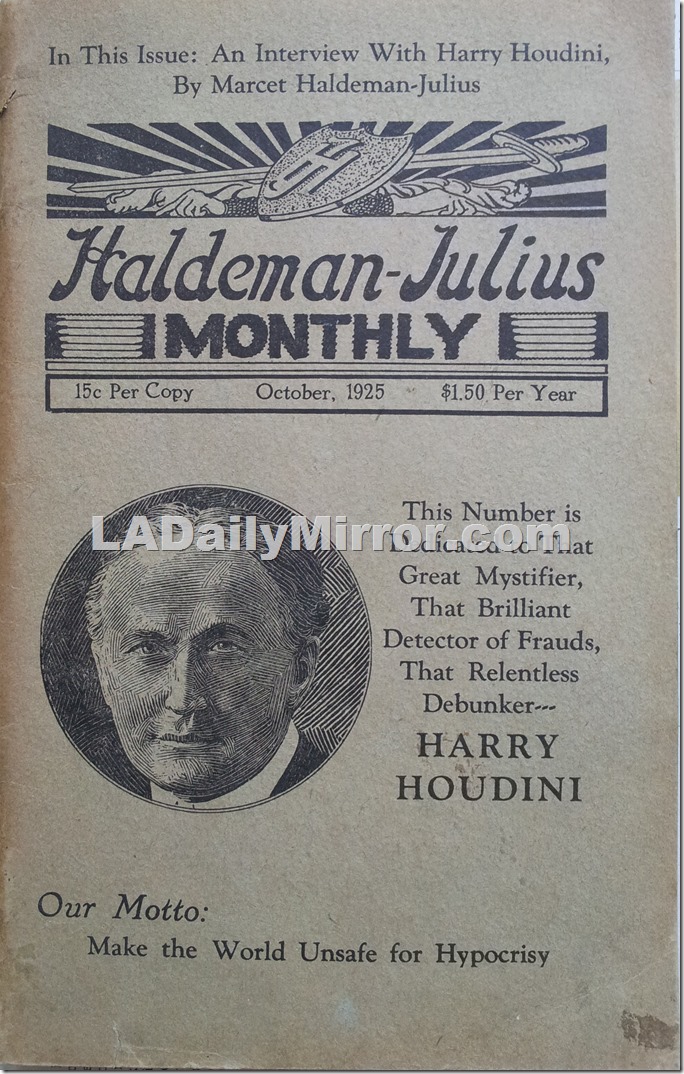
We have been collecting issues of Haldeman-Julius Monthly for several years, but one issue was particularly elusive: The October 1925 number featuring an interview with Harry Houdini, written by Marcet Haldeman-Julius, which was published a year before his death and is apparently keenly desired by collectors.
A copy of this issue was recently added to the archives and we are pleased to present the interview, which appears nowhere else online, refuting the argument that “everything is on the Internet.”
The paper is old and brittle and would not stand up to a scanner, so I photographed the article (Pages 387-397) instead. The images are watermarked because of prevalent practice of swiping pictures on the Internet without attribution or acknowledgement of a source. Pinterest and Skyscraperpage.com, this means you.
Haldeman-Julius Monthly was published by Emanuel Haldeman-Julius with the motto “Make the World Unsafe for Hypocrisy.” It changed names to “The Debunker” in 1928 and apparently ceased publication about 1931.
Emanuel Haldeman-Julius loved to debunk charismatic religious figures of the day and Louis Adamic wrote a series of articles for the magazine about Los Angeles evangelist Aimee Semple McPherson’s mysterious disappearance and miraculous return in 1926. In this vein, the bulk of the Houdini interview is devoted to the charlatans of the day posing as mediums who could communicate with the dead and frequently duped grieving and gullible survivors. There is also a detailed of description Houdini’s New York brownstone, which was crammed with books and memorabilia, and a cameo appearance by Mrs. Houdini.
Previously in the L.A. Daily Mirror
Aimee Semple McPherson’s Fight With Satan
C.B. DeMille: Movie Evangelist
Enjoy.
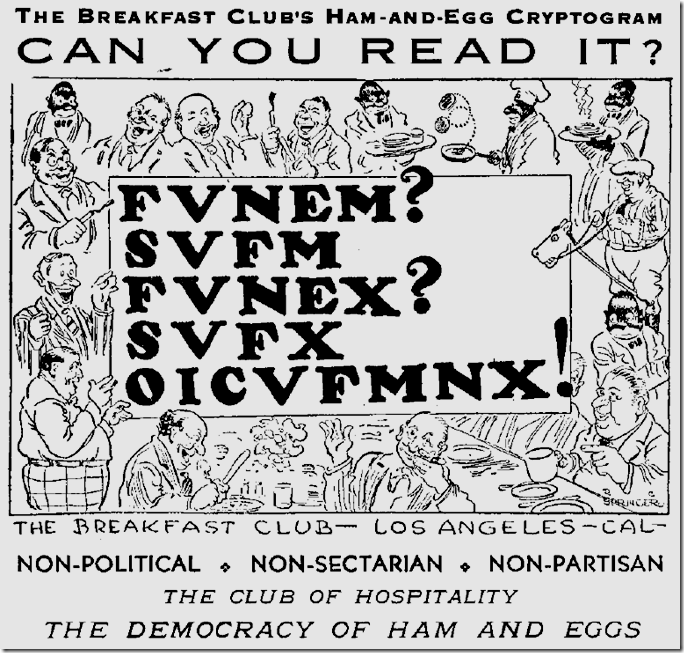
Leading up to the twentieth century, few social organizations existed, except for those of wealth or higher class, or working for a charitable organization. Most people attended a religious organization of some kind. Military veterans honored those who died in service, and fraternities were organized on college campuses to serve the needs of those both within the group and the greater community. As the United States became more urban, more clubs were organized among like-minded individuals looking for companionship outside of those they worshipped or worked with.
Los Angeles saw handfuls of clubs formed in the late 1890s-early 1900s. State groups, service groups like the Elks, Moose, Knights of Columbus, and Scottish Rite Masons, high end clubs like the Los Angeles and Hollywood Athletic Clubs, Jonathan Club, and City Club, these and more were organized as social opportunities to fill the hours when not working. Many served the community in charitable ways, while others simply served the cause of fun. The Los Angeles Breakfast Club was founded both to entertain and inform its members in 1925, and still operates as an active group 90 years later.
Mary Mallory’s “Hollywood land: Tales Lost and Found” is available for the Kindle.
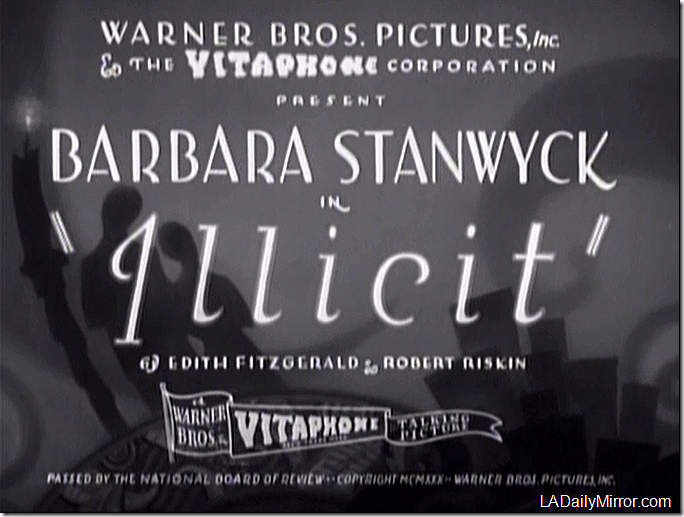
This week’s mystery movie was the 1930-31 Warner Bros. pre-code film “Illicit,” starring Barbara Stanwyck (Friday’s mystery woman) with James Rennie (Thursday’s mystery chap), Ricardo Cortez (not shown), Natalie Moorhead (Tuesday’s mystery woman), Charles Butterworth (Wednesday’s mystery chap), Joan Blondell (Friday’s mystery woman) and Claude Gillingwater.
The film was directed by Archie Mayo, with a script by Harvey Thew, whose next picture was “The Public Enemy.” The script was adapted from the 1930 Broadway play “Many a Slip” by Edith Fitzgerald and Robert Riskin. “Illicit” was photographed by Robert Kurrle with wardrobe by Earl Luick.
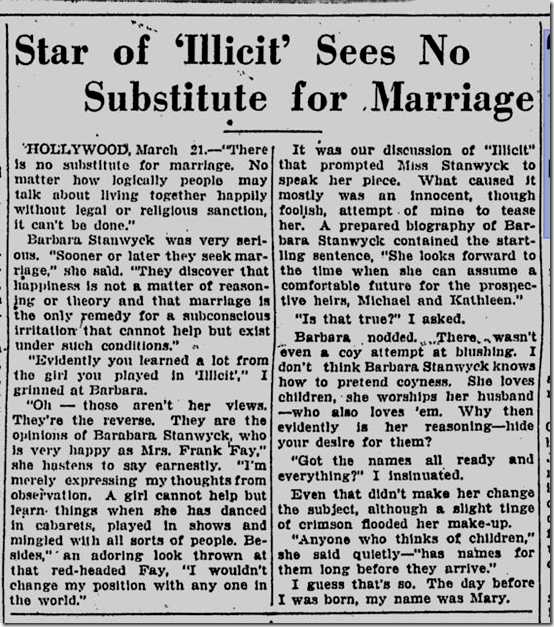
“Illicit” star Barbara Stanwyck is a strong advocate of marriage, St. Petersburg Times, March 21, 1931.
Note that imdb gives the date of 1931, while the print gives the copyright date of 1930. It was in production in September 1930 and released in Los Angeles in February 1931. Edwin Schallert of The Times wrote (Jan. 18, 1931) “Marriage versus free love receives interpretation in ‘Illicit’ — a picture which judging by all past precedents, is due for a popular reign, even though it may not pass the censors in all localities.”
The DVD is available from Warner Archive packaged with “Girl Missing.”
 ladailymirror.com