
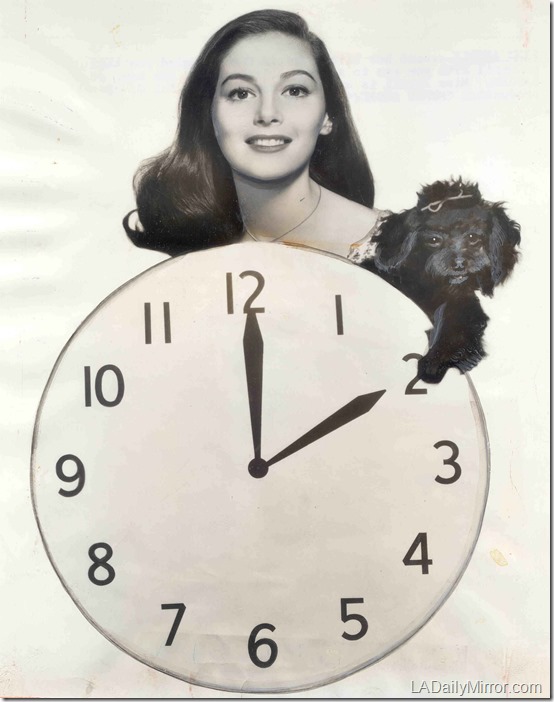
Pier Angeli and her little friend remind Daily Mirror readers to turn back their clocks this Sunday.
Pier Angeli and her little friend remind Daily Mirror readers to turn back their clocks this Sunday.
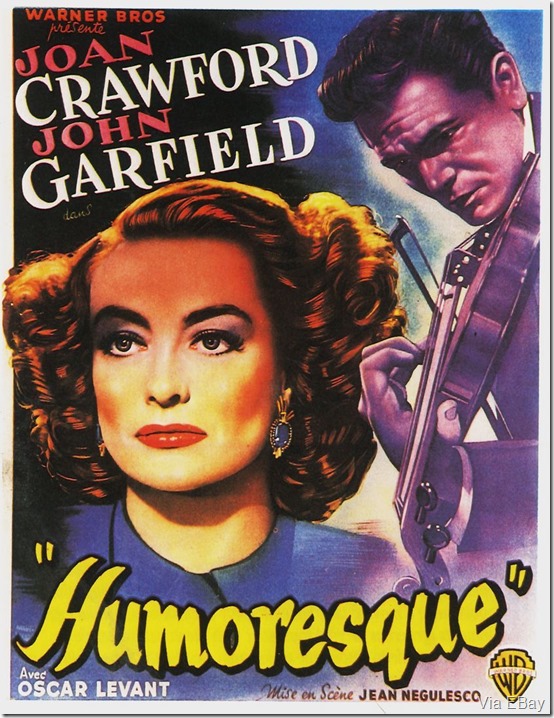
A Belgian poster for “Humoresque,” listed on EBay for $6.99.
I am going to spoil two films for you, so stop reading now if you have not seen What Price Hollywood? (1932) and Humoresque (1946).
Lowell Sherman and Joan Crawford, respectively, commit suicide at the end of the films. And these are my favorite movie suicides: one of them gritty and brutal and realistic, and the other over-the-top Movie Magic.
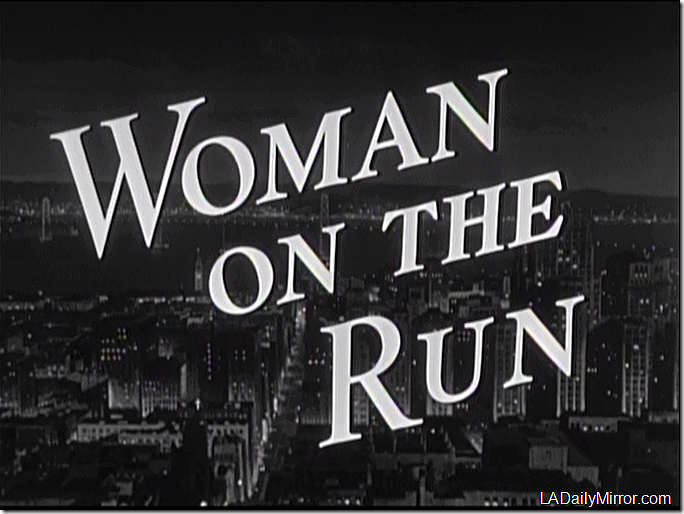
This week’s mystery movie has been the 1950 Universal International film “Woman on the Run,” with Ann Sheridan, Dennis O’Keefe, Robert Keith, John Qualen, Frank Jenks, Ross Elliott, Jane Liddell, Joan Fulton, J. Farrell MacDonald, Steven Geray, Victor Sen Yung, Rako Sato, Syd Saylor and Thomas P. Dillon. The screenplay was by Alan Campbell and Norman Foster from a story by Sylvia Tate published in American Magazine. The film was photographed by Hal Mohr, with art direction by Boris Leven, set decoration by Jacque Mapes and music by Emil Newman and Arthur Lange. The film was produced by Howard Welsch and directed by Norman Foster.
The Film Noir Foundation’s restoration of the movie, released in May 2016, is available from Flicker Alley in a Blu-ray/DVD package for $34.59 from Amazon.

Frank Mayo as drawn by Mon Randall.
In the world of popular culture, everything is about the sell. Photos, posters, graphics, all becomes a means of ballyhoo in attempts to lure consumers to purchase or view product. In the early decades of the twentieth century, master showmen employed artists to design striking advertising key art to lure audiences into theatres, be it posters on the street or alluring advertisements in magazines.
While some of these artists gained widespread recognition, like Batiste Madalena, Henry Clive, James Montgomery Flagg, or John Held, many toiled in obscurity though they too were creating eye-catching designs. Mon Randall drew gorgeous ads, heralds, and even title art in the style of old masters, but never gained great fame for his work.
“Hollywood Celebrates the Holidays” by Karie Bible and Mary Mallory is available at Amazon and at local bookstores.
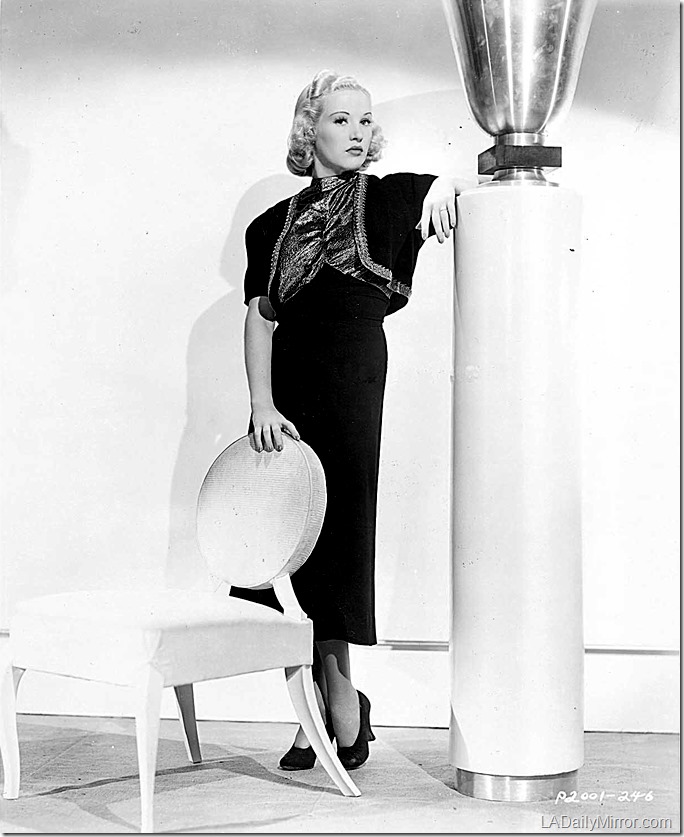
Betty Grable in an undated publicity shot.
Betty Grable’s one of those people—a long list—I’d love to write a book about, but can’t. Her daughters were really nice, but said “we just don’t want to go through all that again,” having dealt with some pretty sleazy writers. I totally understand and told them I wouldn’t bother them again, but of course any book I’d do without them would be half-assed, and I like my books to be fully assed.
But I do adore Betty. She was one of the top song-and-dance gals of her generation; she could sing like Dinah Shore, dance like Ginger Rogers, and she was considerably cuter than a bug’s ear. She was no great shakes as a dramatic actress, but she knew it and put a halt to it after two serious films (the main thing I love about I Wake Up Screaming is the ads, which read “I Wake Up Screaming with Betty Grable!”).
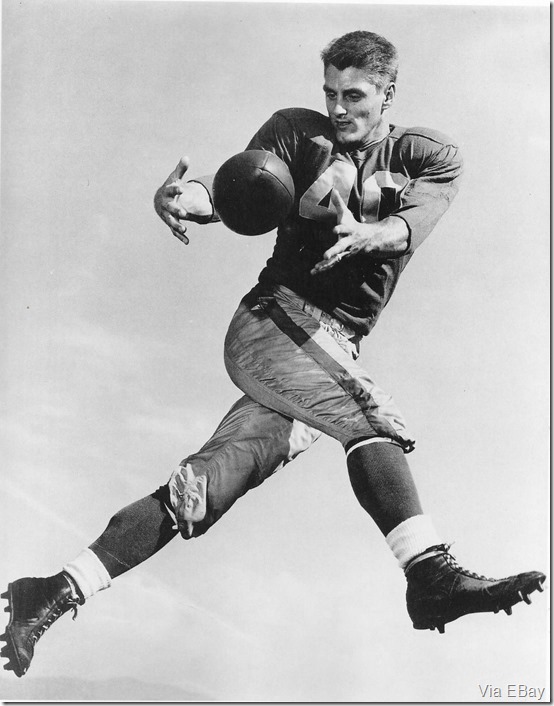
An image of Elroy “Crazylegs” Hirsch, scanned from a negative listed on EBay at $24.99.
Los Angeles is currently experiencing the second coming of its professional football team, the Los Angeles Rams, who first arrived in town in 1946 and also played at Memorial Coliseum. The team achieved some special firsts: such as being the first to be televised as well as the first to play themselves onscreen in the 1953 film “Crazylegs,” based on the life of its talented receiver/running back, Elroy “Crazylegs” Hirsch.
From 1949-1957, Elroy “Crazylegs” Hirsch excelled as one of the team’s top offensive players, earning All-Pro status in the National Football League for his top receiving/running skills. A potent ground gaining weapon, Hirsch’s odd twisted running style gained him his nickname. Hirsch’s remarkable background led writer/director Hall Bartlett to create a film about him, one that featured the team as well as its historic playing field, the Coliseum, a longtime film location.
“Hollywood Celebrates the Holidays” by Karie Bible and Mary Mallory is available at Amazon and at local bookstores.
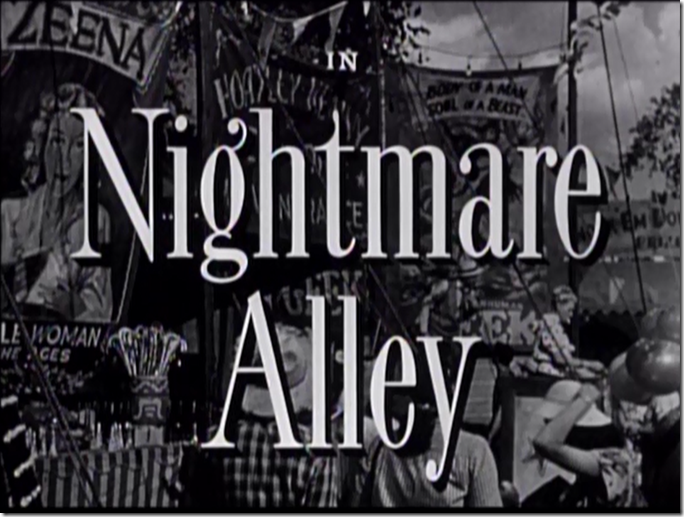
This week’s mystery movie has been the 1947 Twentieth Century-Fox film “Nightmare Alley,” with Tyrone Power, Joan Blondell, Coleen Gray, Helen Walker, Taylor Holmes, Mike Mazurki and Ian Keith. It was written Jules Furthman from the novel by William Lindsay Gresham, with music by Cyril Mockridge, photography by Lee Garmes, art direction by Lyle Wheeler and J. Russell Spencer, wardrobe direction by Charles LeMaire and costumes by Bonnie Cashin. It was produced by George Jessel and directed by Edmund Goulding.
It is available on DVD from Amazon.

Halloween is quickly approaching, which means the internet is brimming with photos of young women practicing their “Chelsea Smile” makeup and otherwise showing off their talent in dressing up like a brutally murdered woman. Regardless of what you may think, this does no honor to Elizabeth Short.

Rethink your choices. Really.

Cary Grant and Jayne Mansfield in a still from “Kiss Them for Me,” listed on EBay at $8.99.
If Jayne Mansfield had died in 1957 instead of 1967, she’d be remembered as one of the most talented and promising actresses of her generation. In 1956 and ’57, she gave two sharp, smart comic performances (The Girl Can’t Help It and Will Success Spoil Rock Hunter?) and a quiet, touching dramatic performance in The Wayward Bus. Then it all went straight to hell, starting with the unwatchable Dumpster fire of Kiss Them for Me. Fox is really foxy about not letting its movies get onto YouTube, so I will have to present you with the official trailer for Rock Hunter:
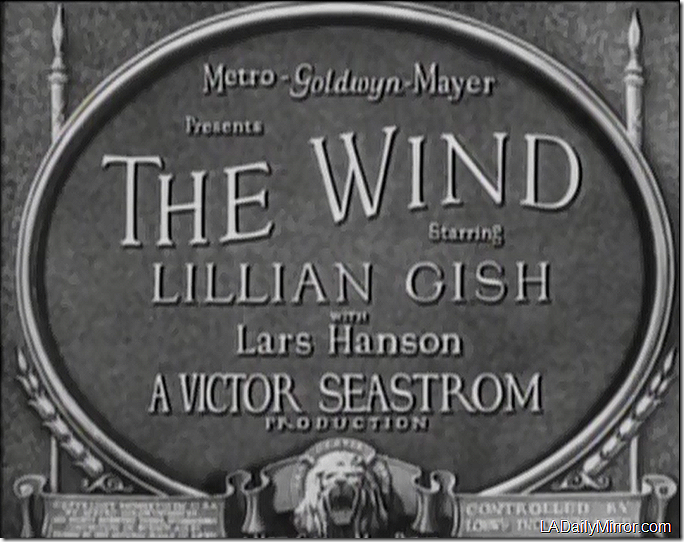
This week’s mystery movie has been the 1928 MGM film “The Wind,” starring Lillian Gish, Lars Hanson, Montagu Love, Dorothy Cumming, Edward Earle, William Orlamond, Carmencita Johnson, Laon Ramon and Billy Kent Schaefer, with a screenplay by Frances Marion adapted from the novel by Dorothy Scarborough. It was directed by Victor Seastrom.
It is available on DVD from Amazon Spain.
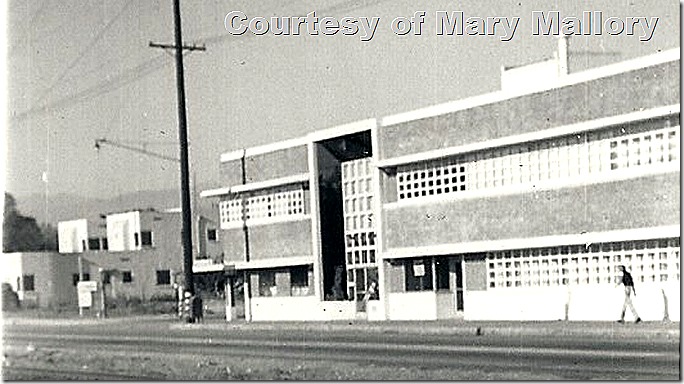
4418 Vineland Ave. in an undated photo, courtesy of Mary Mallory.
Two years can bring changes in life, whether to a person or building, and not always for the better. I wrote about the history of 4418 Vineland Ave. in May 2014, pointing out that the building had opened as a medical office complex in 1947 and had remained as such through 2014.
Photographs demonstrated how it still remained a building of integrity, looking much the same as it had more than 60 years ago. What appeared to be original brick facade had been plastered over and decorative detailing over the windows had been removed, though the original windows appeared to remain.
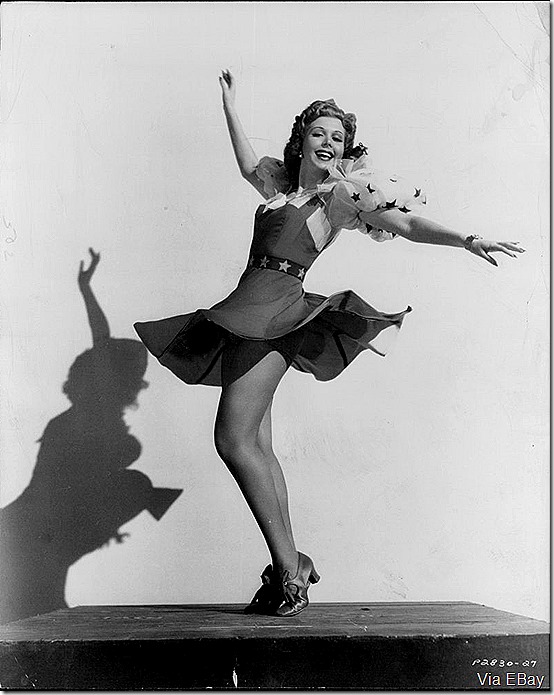
A publicity photo of Ann Miller, listed on EBay for $28.88.
My friend Donna hates Ann Miller—hates her—so I apologize to Donna in advance for this piece. But I love Annie. She was bright and glittery and silly and unlike the accomplished and talented dancers Cyd Charisse and Eleanor Powell, Ann seemed to be having fun when she tapped—Cyd and Eleanor seemed more like straight-A students dutifully showing off for final exams.
I interviewed Ann Miller once, and she was just as daffy and off-the-wall as in her films, but she was sharp as a tack, too, when it came to analyzing her career and her sometimes rocky life.
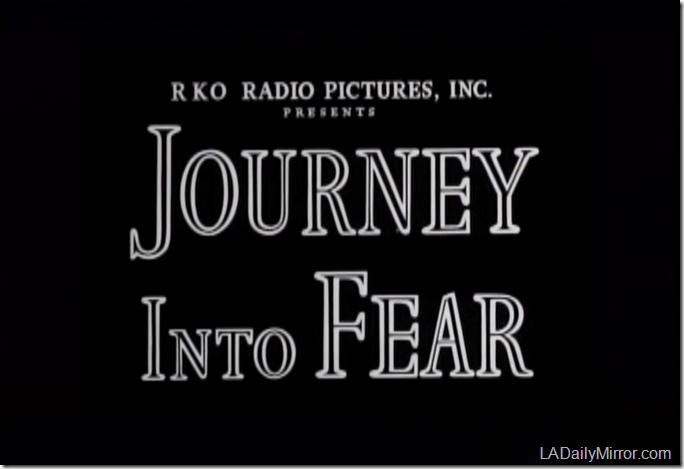
This week’s mystery movie has been the curious 1943 RKO film “Journey Into Fear,” with a screenplay by Joseph Cotten from the novel by Eric Ambler. The movie starred Joseph Cotten, Dolores Del Rio and Ruth Warrick, with Agnes Moorhead, Jack Durant, Everett Sloane, Eustace Wyatt, Frank Readick, Edgar Barrier, Jack Moss, Stefan Schnabel, Hans Conried, Robert Meltzer, Richard Bennett and Orson Welles. The music was by Roy Webb, photography by Karl Struss and art direction by Albert S. D’Agostino and Mark-Lee Kirk. The movie was directed by Norman Foster.
The movie is available from Amazon UK in an all-region DVD. It is also available from Amazon in a Region 2 DVD.
It is also on Archive.org.
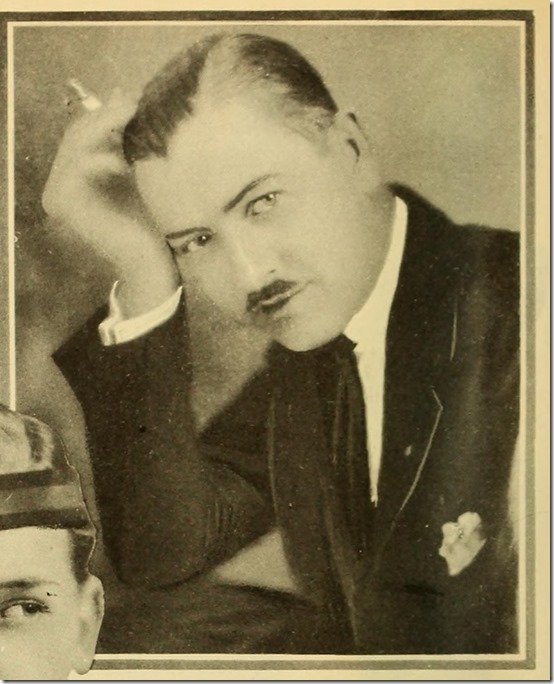
Max Munn Autrey, from Pictures and Picturegoer, August 1925
“In Hollywood, photographers spring into fame overnight. They are, for a time, a fad—and only become recognized as established worth when they prove that their ideas are not limited. All an ambitious camera artist needs to start him off on the road to fame and fortune is to display two or three portraits of big stars and if he has obtained something of beauty in photographing them, he is made. The fact, alone that a star admired his work enough to pose for him, is recommendation, and soon the other stars follow. When the picture trade is established, the photographer expands his business proportionately, and sets his prices. The more famous photographers have been known to charge as much as $350 for 12 prints of a single portrait.”
— Walter Irwin Moses, Pictures and Picturegoer, August 1925
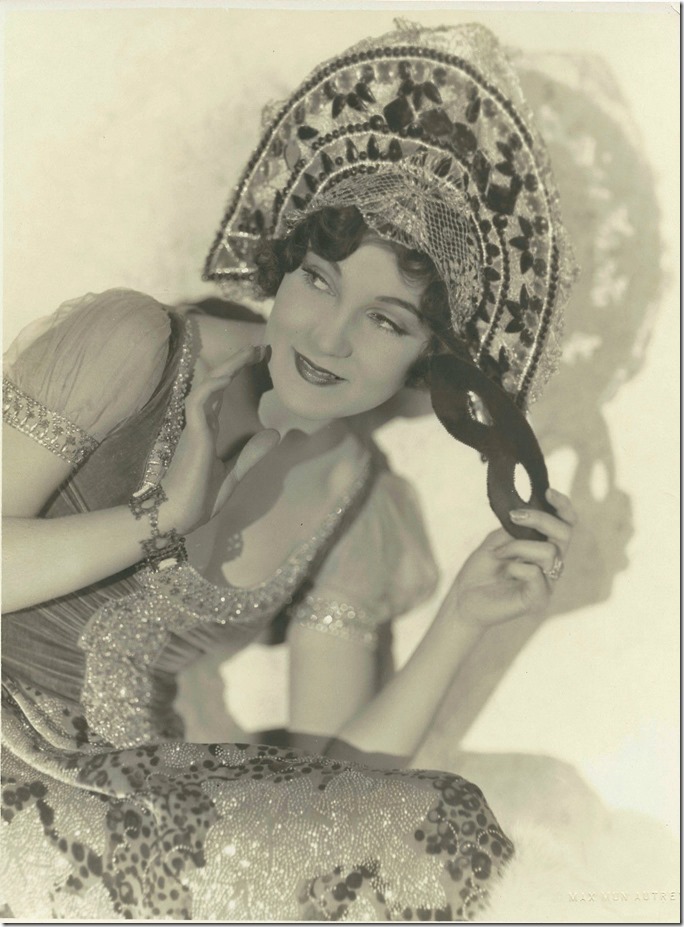
Max Munn Autrey’s portrait of Jane Winton, for sale on EBay listed at $199.95.
Note: This is an encore post from 2014.
Texan Max Munn Autrey sauntered into the world of Hollywood still photography in the 1920s, a journeymen cameraman looking to settle down. He found his niche in portraiture, helping devise mystique and sensuousness in star portraits.
Born June 24, 1891, in Hamilton, Texas, Autrey moved around the state taking photographs as an adult. He was employed by P.T. Collier & Son in Dallas, per his World War I registration papers. In 1918, he married his wife, Bonnie, in her hometown of Tyler. They lived in Burleson in 1920, but soon decided to move to California.
Mary Mallory’s “Hollywoodland: Tales Lost and Found” is available for the Kindle.
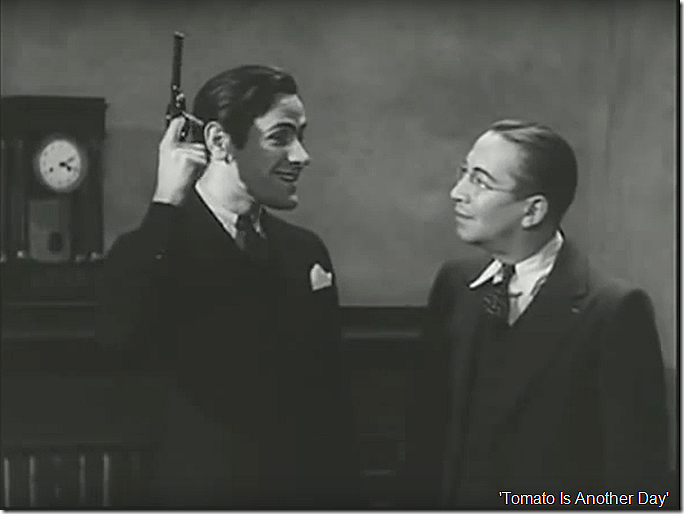
“Cigarette Life!” A deathless line from “Tomato Is Another Day.”
I offer for your bewilderment Tomato Is Another Day (1930), seven of the weirdest minutes ever committed to film. It was never widely shown (for obvious reasons) and was only rediscovered in the wonderful age of cable, DVDs and YouTube. And no one knows what the hell to make of it.
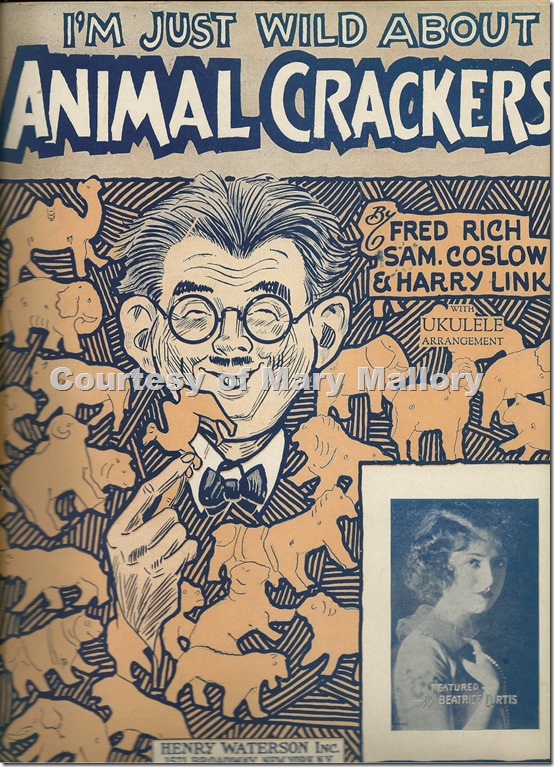
The sheet music for “I’m Just Wild About Animal Crackers,” courtesy of Mary Mallory.
Popular culture, be it music, the written word, or mass entertainment, so often unintentionally defines a time and place in history, revealing so much about a society’s values, beliefs, and actions. Just seeing or hearing something produced for wide enjoyment can conjure up a vision of the world in which it was created, something often never consciously intended by its makers.
Such was the case in the 1920s, a decade of jazz-mad, devil-may-care flappers and sheiks enjoying life to the fullest after the devastation and despair caused by the Great War and its aftermath. Leaving behind a more stolid and serious world view, carefree young people threw themselves wholeheartedly into life, enjoying everything from feverish dancing to petting parties, booze-filled festivities to flagpole sitting. Fads like playing miniature golf, bridge, mah jongg, etc. boomed.
“Hollywood Celebrates the Holidays” by Karie Bible and Mary Mallory is available at Amazon and at local bookstores.
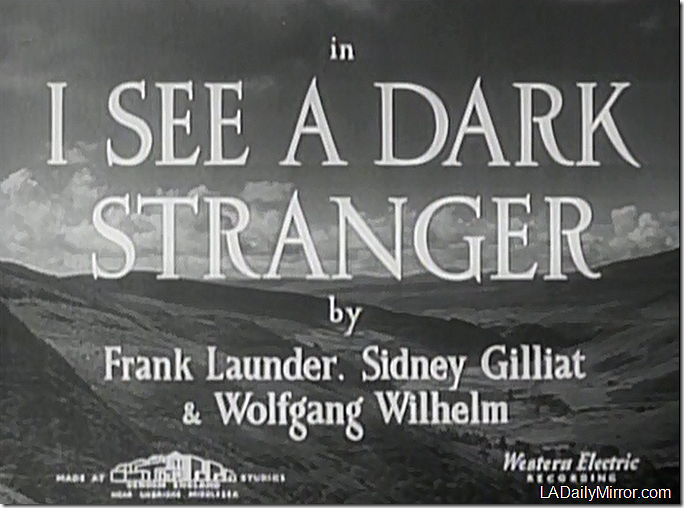
This week’s mystery movie has been the 1946 film “I See a Dark Stranger,” with Deborah Kerr, Trevor Howard, Raymond Huntley, Michael Howard, Norman Shelley, Brenda Bruce, Brefni O’Rorke, James Harcourt, Liam Redmond and W. O’Gorman, by Frank Launder, Sidney Gilliat and Wolfgang Wilhelm. The film was written and produced by Frank Launder and Sidney Gilliat. Production design by David Rawnsley, photographed by Wilkie Cooper, art direction by Norman Arnold and edited by Thelma Myers. Music by William Alwyn, performed by the London Symphony Orchestra conducted by Muir Mathieson. Directed by Frank Launder.
Bosley Crowther, reviewing the film for the New York Times (April 4, 1947) said:
That talent for richly combining melodrama and comedy, which writers Frank Launder and Sidney Gilliat so delightfully displayed in their scripts for Hitchcock’s “The Lady Vanishes” and Carol Reed’s “Night Train,” has been deftly applied by those gentlemen to the writing, production and direction of their own film, a British honey entitled “The Adventuress,” which opened at the Victoria yesterday. Since that is a recommendation quite sufficient for lots of folks, we wouldn’t blame you for dropping this paper right now and rushing down to get a seat.”
Grace Kingsley, reviewing the film for the Los Angeles Times (Dec. 26, 1947) said:
Important chiefly because of the outstanding talents and beauty of Heroine Deborah Kerr, J. Arthur Rank’s English production, “The Adventuress,” which opened yesterday at the Esquire Theater, is nevertheless sufficiently exciting to hold any spectator. Perhaps, ironically, the film’s chief fault is to be found in too many close-ups of the star, which at times seem to halt the story action.
“I See a Dark Stranger” is available on DVD from Amazon for $13.90.
Continue reading
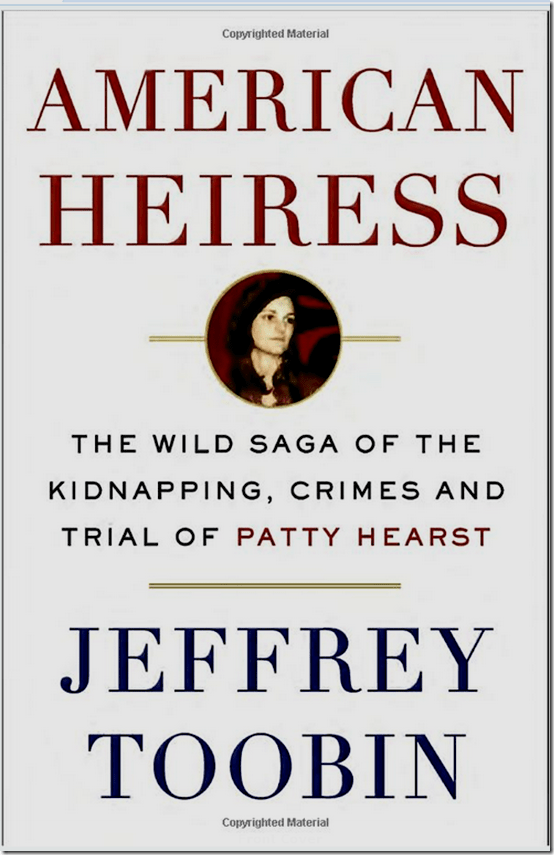
“American Heiress” via Amazon.com.
Rush out and get Jeffrey Toobin’s new book about the Patty Hearst kidnapping, American Heiress. It’s really one of the best-written, best-researched books I’ve read lately, and is actually laugh-out-loud funny at points. I am quite old enough to remember how obsessed we all were by the case—it was like John Waters directed It Happened One Night (a madcap heiress kidnapped by The Filthiest People Alive).

This week’s mystery movie has been the 1958 film “Equinox Flower.” Original story by Ton Santomi, screenplay by Yasujiro Ozu and Kogo Noda, produced by Shuzuo Yamauchi, cinematography by Yuharu Atsuta, music by Kojun Saito. Directed by Ozu.
Vincent Canby of the New York Times said (May 27, 1977):
“Equinox Flower”—a particularly inscrutable title even for this great Japanese director—is one of Ozu’s least dark comedies, which is not to say that it’s carefree, but, rather, that it’s gentle and amused in the way that it acknowledges time’s passage, the changing of values and the adjustments that must be made between generations.
The movie is available on DVD through Amazon.com.
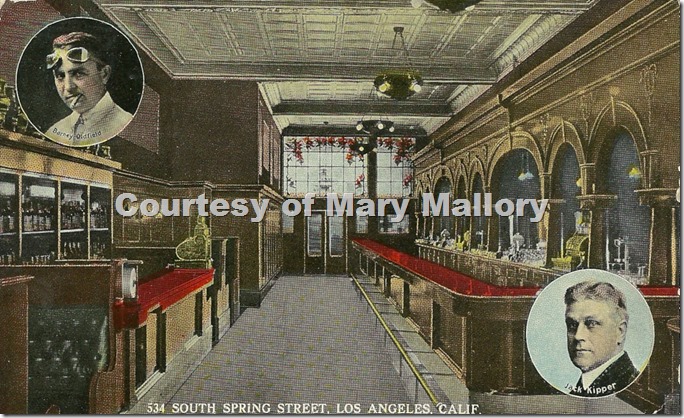
A postcard showing the interior of Barney Oldfield’s saloon on South Spring Street, courtesy of Mary Mallory.
‘Mile a minute” Barney Oldfield, the first automobile racer to achieve that feat while racing, was quick when it came to promotions bearing his name as well. Like many famous celebrities, actors, and sports stars before and after him, he quickly realized he could turn his fame into cash. Oldfield promoted various products throughout his life like Firestone Tires and the Fisher Auto Co., but for a brief time, operated a saloon under his name in downtown Los Angeles.
Born Berna Eli Oldfield in 1878, daredevil Barney Oldfield first found his outlet for speed racing bicycles. His car racing career began in 1902 when fledgling automobile designer Henry Ford hired him to race his model 999 car. With little to no experience, Oldfield fearlessly took the lead and won the race against more experienced competitors.
“Hollywood Celebrates the Holidays” by Karie Bible and Mary Mallory is available at Amazon and at local bookstores.
 ladailymirror.com