Sigh.

Note: This is an encore post from 2005 and originally appeared on the 1947project.
Hard at work as a mechanical engineer during the day, the former naval aviation researcher still finds time to do a little writing. At the moment he’s on his first novel, which is a book for children. It’s an amazing story about three young friends who have a rocket-building club.
Invited to address local librarians at a 1948 luncheon, the author says: “If we have a military base on the moon there will be no war. This would change the strategic situation so completely as to immediately postpone the cause of war.”
His first novel is published by Scribner’s under the name “Rocket Ship Galileo.” The author lives at 333 S. Clark Drive, Los Angeles, Calif.
His name is Robert A. Heinlein.
Note: This is an encore post from 2006.
July 5, 1907
Los Angeles
See here, you pesky temperance workers, beer is “liquid bread.” It’s good for you.

July 4, 1944: Uncle Sam in a cartoon by Edmund Waller “Ted” Gale for the Los Angeles Examiner and republished in the Milwaukee Sentinel.
Note: This is an encore post from 2014.
Here’s a look at how Los Angeles has celebrated Independence Day over the years.

Note: This is an encore post that originally appeared on the 1947project, but in June rather than July. Oops.

Note: This is an encore post from 2014.
July 4, 1944
”The Make-Believe Sheriff” is the title of today’s episode of “The Green Hornet.” Otrrlibrary.org via Archive.org
”Lum and Abner” are building a health resort on grandpappy’s farm. Otrrlibrary.org via Archive.org.
Get ready to smile with “Vic and Sade,” brought to you by Ivory flakes. Otrrlibrary.org via Archive.org.

Note: This is a post from 2015.
Years ago, in researching Camp Cooke, I bought the diary of a soldier named Harry A. Rankin, who was stationed there in 1942 and early 1943 (and no, he doesn’t mention Elizabeth Short). Here’s his list of what he did on a pass to Los Angeles on July 3-5, 1942.
Among the places he visited were Clifton’s Cafeteria of the Tropics, 618 S. Olive.; Pershing Square, where a B-25 was on display; the Biltmore; Beverly Hills Hotel; the Hollywood Canteen; Grauman’s Chinese Theatre; the Pantages Theatre; Earl Carroll’s; and Temple Baptist Church at 5th and Olive – also known as Philharmonic Auditorium. He also mentions the Platinium dance hall, which is a new one on me.

Note: This is an encore post from 2006.
July 4, 1907
Los Angeles
And how does Los Angeles celebrate Independence Day? With cricket matches and bagpipe contests.

The complete July 4, 1863, issue of the Los Angeles Star is available from USC, which scanned a copy at the Huntington.
Note: This is an encore post from 2013.
July 4, 1863: Los Angeles plans to celebrate the Fourth of July with a 34-gun salute and a fireworks display in the evening. A ball was planned at the Willow Grove House in the afternoon and another ball in town in the evening.
The Star, a staunch supporter of the Confederacy, said: “This Declaration is being now reenacted. The same soil which sent forth its heroes to do battle for these fundamental truths is again called upon to endure a baptism of blood in their vindication.”
The Star also reports on a measure in Sacramento “requiring foreigners to show their papers before voting.”

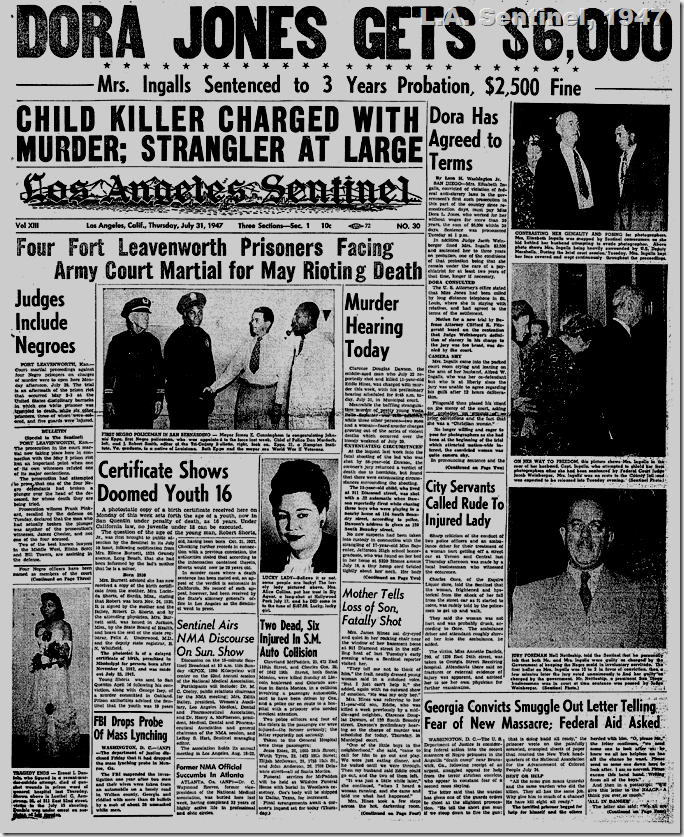
Sugar Chile Robinson performs at the Lincoln. I should do an entire post on him, but so many stories and only one Larry Harnisch.

July 3, 1947: One of the regular complaints in my Twitter feed is about the lack of people of color among movie critics. So here we are. A review of “Crossfire” in the Los Angeles Sentinel by Wendell Green. He says: “They should have stood in bed.”
Also: Duke Ellington says jazz musicians need thorough technical training.

Note: This is an encore post from 2005 and originally appeared on the 1947project.
This is where the 1947 Project intersects with other 1947 Project. Mysterious flying discs were reported June 28 over New Mexico, prompting sarcastic letters to The Times: (“They went by a cow out in the field right behind our house and the suction sucked the cow inside out so now all we have to do to milk bossy is lean her over sidewise and let the milk run out.”)
The next day, other observers reported that the saucers over Beverly Hills were searchlights reflected off clouds (presumably from another movie premiere or the opening of coin laundry).

Note: This is an encore post from 2006.
July 3, 1907
Los Angeles
Robert T. Hall, head of the Los Angeles Anti-Fakers League (or Anti-Fakers Society), says shots were fired at him as he returned from an outing to a friend’s summer camp, and he blames local spiritualists and mediums.
He has been leading a crusade against fortune tellers, seers and other practitioners of the mystic arts and in heading for the end of the streetcar line in Edendale, he passed Semi-Tropic Park, a gathering place for spiritualists just outside the city limits, where such practices are regulated by law.

This week’s mystery movie has been the 1955 Warner Bros. film “Illegal,” and yes, it is the studio’s second remake of “The Mouthpiece.”
With Edward G. Robinson, Nina Foch, Hugh Marlowe, Jayne Mansfield, Albert Dekker, Howard St. John, Ellen Corby, Edward Platt, Jan Merlin, Robert Ellenstein, Jay Adler, Henry Kulky, James McCallion, Addison Richards, Lawrence Dobkin, DeForest Kelly, Clark Howat and Stuart Nedd. This version of the screenplay was by W.R. Burnett and James R. Webb from a story by Frank J. Collins. Photography was by J. Peverell Marley, art direction by Stanley Fleischer, set decoration by William Wallace, wardrobe by Moss Mabry, orchestrations by Murray Cutter, makeup by Gordon Bau, music by Max Steiner. Produced by Frank P. Rosenberg, directed by Lewis Allen.
“Illegal” is available on DVD from Warner Archive, paired with “The Big Steal.”

Construction of the Statue of Liberty, artwork by John Durkin, Harper’s Weekly, Jan. 19, 1884.
Written in 1883 to help raise money for building the pedestal on which the Statue of Liberty would stand, Emma Lazarus’ 14-line poem “The New Colossus” would take on a life of its own: becoming enshrined on the statue as a memorial to the poet and as a statement of welcome to those seeking refuge in our country. As we approach Independence Day, the meaning behind its words rings even clearer today.
Born July 22, 1849, in New York City as the fourth of seven children to wealthy merchant Moses Lazarus, Emma received a strong private education, learning to speak at least four languages and becoming an excellent writer, especially in poetry. Ralph Waldo Emerson mentored her. She translated works of literature as well as setting down her own odes, many based on romantic literature and others on troubling historic events regarding her fellow Jews, receiving much praise upon their publication. She also worked to alleviate the suffering of women and the poor.
Mary Mallory’s “Living With Grace” is now on sale.

Note: This is an encore post from 2005 and originally appeared on the 1947project.
This is, of course, a murder frequently tossed into the Black Dahlia file by crime books such as “The Cases That Haunt Us” and “Black Dahlia Avenger.” But no one (except a reference I recall from “True Confessions” and can’t locate at the moment) mentions that Tate was African American. Nor does anyone ever add that a suspect was arrested in the case.
Well, we know where this story is going.
Note: This is an encore post from 2005 and originally appeared on the 1947project.
I had never heard of this particular cinematic triumph, but it was apparently a fixture of sexploitation in middle America of the 1940s and 50s. I’m deeply indebted to an essay by that luminary of le bad filme, Joe Bob Briggs. (http://www.reason.com/0311/fe.jb.kroger.shtml)
“Mom and Dad” was produced by Kroger Babb, written by Mildred Horn and directed by the incredibly long-lived and prolific William “Billy the Kid vs. Dracula” Beaudine, one of seven films he directed in 1945.
Starring nobody you’ve ever heard of unless you’re a total film geek (look for Perry White from the “Superman” TV show in a teeny role, for example) “Mom and Dad” was a movie that served as bookends for a live presentation by an actor who delivered a lecture as “Dr. Elliot Forbes.”

Note: This is an encore post from 2006.
July 1, 1907
Los Angeles
If you ever wondered if the Locomobile or Pope-Hartford got great gas mileage, the answer is no, as shown in the results of the 185-mile Lakeside Endurance Race. In cost and fuel efficiency, the 1907 automobiles were about the equivalent of a 2006 Ford Explorer (MSRP $31,650) or a Range Rover Sport (MSRP $56,085-$69,025).
The car with best gas mileage in the economy competition was the Pope-Hartford, 8½ gallons (21.76 mpg), in the class of touring cars costing $1,501-$3,000 ($30,805.88-$61,570.71 USD 2005).
Continue reading

Note: This is an encore post from 2005 and originally appeared on the 1947project.
Thus began a career that endured past his retirement in 1965—making way for Martin Bernheimer—until shortly before his death in 1990 at the age of 91. Goldberg was The Times’ first full-time classical music critic.

Alan Ladd and Veronica Lake in “The Blue Dahlia.”

Here are the opening paragraphs of the piece I’ve been working on for the last few months as I waited for the clamor to die down about Piu Eatwell’s “Black Dahlia, Red Rose.” It’s a deep dive into the making of “The Blue Dahlia” and John Houseman’s tall tale about Raymond Chandler going on an eight-day drunk to finish the picture.
At this point, I’m not sure what I’ll do with the piece. It’s quite long and although I could post it on the blog, I’m casting around for a venue with more exposure.