

Note: This is an encore post from 2006.
Nov. 6, 1907
Los Angeles
Here’s a real mystery, although a minor one, and like all real mysteries, it is incomplete and may have no solution.
Exhibit 1: This postcard up for auction on Ebay.
Note: This is an encore post from 2006.
Nov. 6, 1907
Los Angeles
Here’s a real mystery, although a minor one, and like all real mysteries, it is incomplete and may have no solution.
Exhibit 1: This postcard up for auction on Ebay.
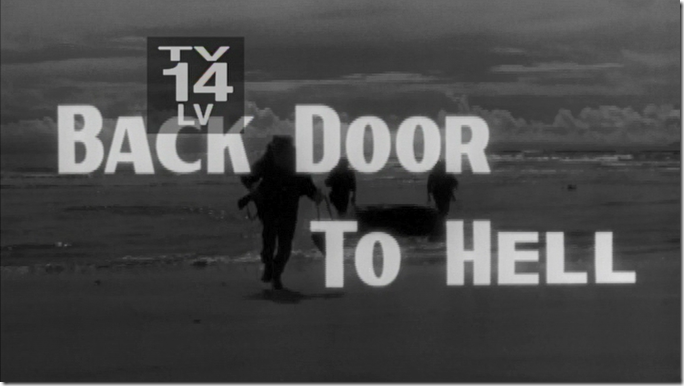
This week’s mystery movie has been the 1964 Twentieth Century-Fox picture “Back Door to Hell” with Jimmie Rodgers, Jack Nicholson, John Hackett, Annabelle Huggins, Conrad Maga, Johnny Monteiro, Joe Sison, Henry Duval, Ben Perez and Vic Uematsu. Photography by Mars Rasca, makeup by Nita Sol Cruz, camera operation by Ricardo Remias. Music by Mike Velarde. A Lippert Inc. Production, filmed in association with Medallion Films Inc. Screenplay by Richard A. Guttman and John Hackett from a story by Richard A. Guttman. Produced by Fred Roos. Directed by Monte Hellman.
“Back Door to Hell” is available on DVD from Amazon.
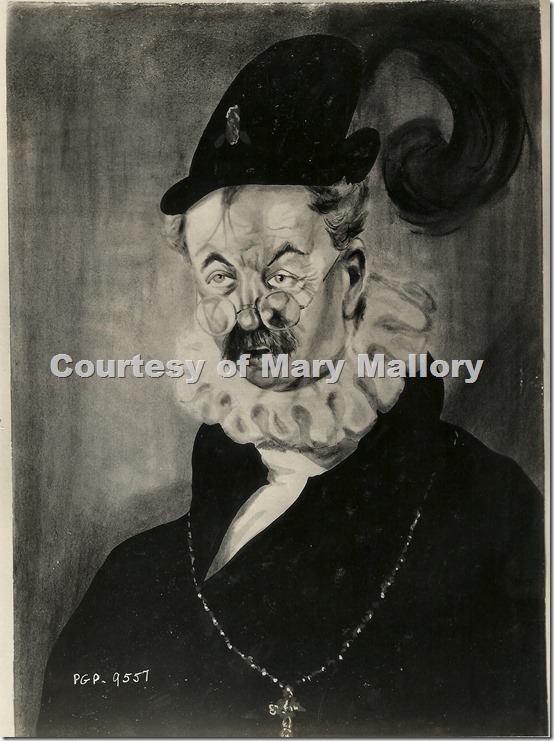
Chester Conklin by John Decker, courtesy of Mary Mallory.
Note: This is an encore post from 2013.
“To sing, to laugh, to dream, to walk in my own way and be alone…”
A recording of John Decker’s voice recited this phrase and the other words of Edmund Rostand’s “No Thank You” speech from “Cyrano de Bergerac” at his own Memorial Service on June 10, 1947. The phrase succinctly described how the 52-year-old Decker conducted his life, madly dining at the banquet of life like a male Auntie Mame. His wild life and exact talent as a caricaturist overshadowed his fine skill as an artist.
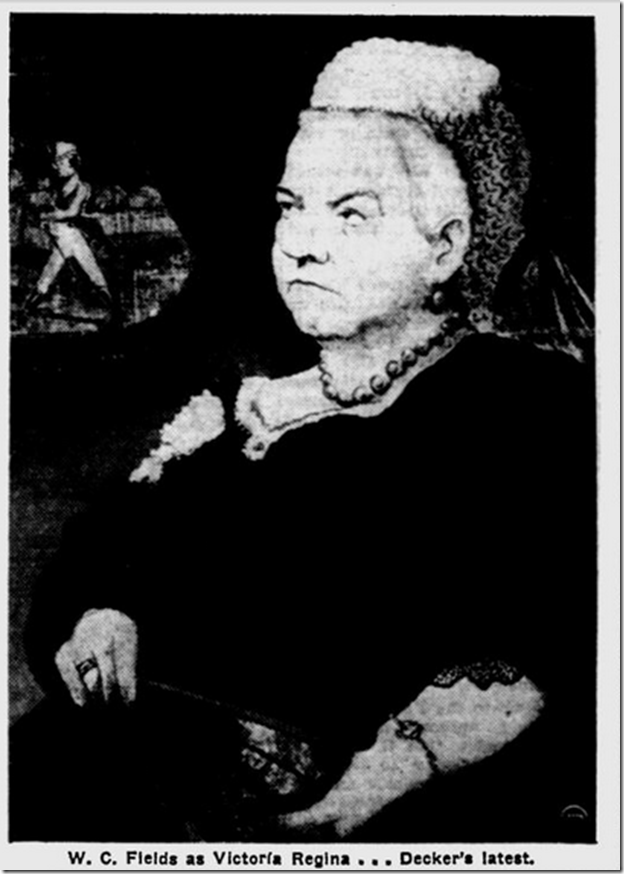
One of Hollywood’s Three Musketeers, along with actor John Barrymore and writer Gene Fowler, Decker had a colorful life that outshone even the most outlandish film. His surrealist eye captured Hollywood irony. As his stepdaughter Mary Lou Warren noted decades later, “He worked very hard at being a painter, but he worked very hard at being a character too.”
Born Leopold Wolfgang von der Decken in 1895 Berlin, the son of a Prussian count and British opera singer, Decker grew up in Brixton, England, after his parents fled censure of their scandalous relationship. His parents divorced and abandoned him as well as each other, leaving the artistic 13-year-old to fend for himself.
A 1923 article in Daily Variety noted that he studied acting for a short time, performing impersonations of author Charles Dickens in London, which earned poor response. Decker turned to scenery painting for theatrical productions while studying painting and also apprenticing with an art forger.
ALSO BY MARY MALLORY
Magic Castle
Mack Sennett
Brand Library
Auction of Souls
Note: This is an encore post from 2005 and originally appeared on the 1947project.
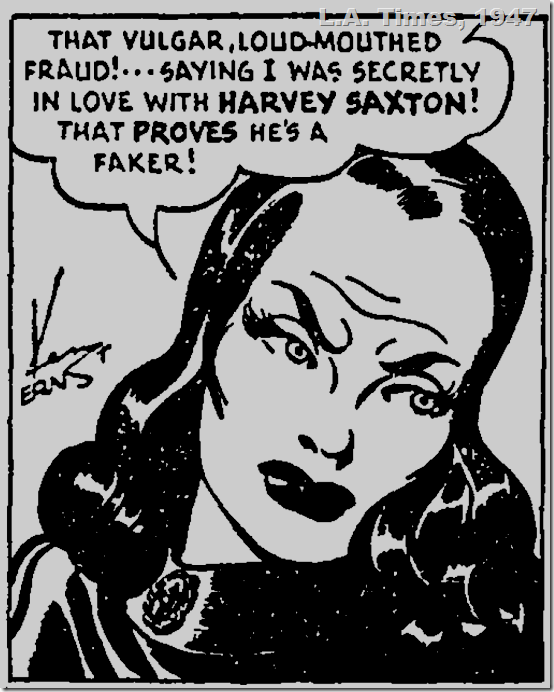
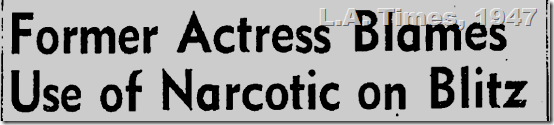
Nov. 5, 1947: She called it “The Amazing Career of a Girl Drug Addict” and she wasn’t exaggerating—and yet she was.
Arrested in October for driving erratically on Wilshire Boulevard, a woman calling herself Margaret Burton told police she was a former actress and had become addicted to sedatives during the London Blitz, when a physician gave her tranquilizers to calm her nerves.

Note: This is an encore post from 2006.
Nov. 5, 1907
Los Angeles
John Richie led the bass section of the choir at St. Machar’s Cathedral in Aberdeen, Scotland, while Testristina Adams was a contralto. They sang in the choir for about 10 years, and fell in love.
Two years ago, in hopes of more opportunity, John left Scotland and came to Los Angeles, but not before asking Testristina, a pretty brunette, according to The Times, to marry him. “If I had not said that I would follow him he would never have come,” she said.

Note: This is an encore post from 2005 and originally appeared on the 1947project.
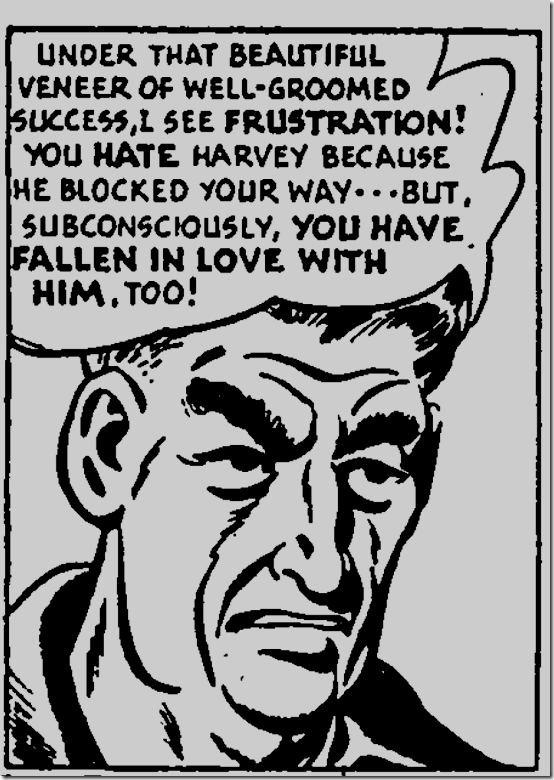
Nov. 4, 1947: Although it isn’t mentioned, this sounds like a riff on “Sadie Hawkins Day,” founded by “Li’l Abner” cartoonist Al Capp, who has been featuring the holiday for the last month.

Note: This is an encore post from 2006.
Nov. 4, 1907
Los Angeles
About a year ago, Eugene Rowe’s little runabout was smashed by a trolley. After some repairs, it won a trophy, but a month later, it was wrecked in the Pasadena hill climb. And then it overturned in a ditch.
Undeterred, and practicing the route of a Thanksgiving run, Rowe and his friend Charles Fuller Gates set off for Box Springs in Riverside County, where the runabout overturned on a curve. Gates was pinned under the car, crushing his left leg. Rowe was thrown clear and although he was badly battered managed to free Gates from the wreck.

.

Note: This is an encore post from 2006.
November 3, 1907
Los Angeles
Mrs. E.N. Eskey is building this 10-room house in Pico Heights, on Van Ness just south of Pico.
According to The Times, the two-story house (with basement) has a first floor divided into a reception hall with an oak staircase leading upstairs. The living room features built-in bookcases and a massive brick mantel. The dining room has a built-in buffet and china closet, with a pantry and kitchen.

Update: This is a post from 2006. The location was identified by Crime Buddy Nathan Marsak as Olive Street, with Philharmonic Auditorium and Pershing Square in the background.
Here’s a frame grab from the opening shots of “Double Indemnity.” According to the script, the car driven by Walter Neff speeds through an intersection, narrowly avoiding a delivery truck bearing the sign: “READ THE LOS ANGELES TIMES.”
But tinkering with the photo (the original is very dark, after all we are talking about film noir) shows that the truck apparently reads “Los Angeles Examiner.” Although it’s difficult to be positive, the elaborate “E” on the second line almost surely gives it away as the Examiner. It certainly isn’t the Los Angeles Times. Either way, it’s definitely a newspaper truck as bundles of papers tumble from the back when the driver slams on the brakes.

Note: This is an encore post from 2005 and originally appeared on the 1947project.
All right, kids, let’s do some math. 1947 take away 1940 leaves 7. That’s how many years Tom Mix has been dead.
Now some science… Does anybody have something at home that glows? Your dad’s wristwatch? The dial on your mother’s radio? How about the instruments in your car?
Who can tell me what makes those things glow? Right. It’s called radium. And why does it glow? Correct. It’s radioactive.
 Note: This is an encore post from 2006.
Nov. 2, 1907
Los Angeles
As part of a new city beautification campaign, Boyle Heights residents have suggested turning the Los Angeles River into a garden spot.
The plan calls for “a long, winding strand of posies and greenery—a narrow, picturesque parking, which will be viewed by practically every passenger who arrives or leaves Los Angeles on any of the transcontinental railroads,” The Times said.
Sorry, no.
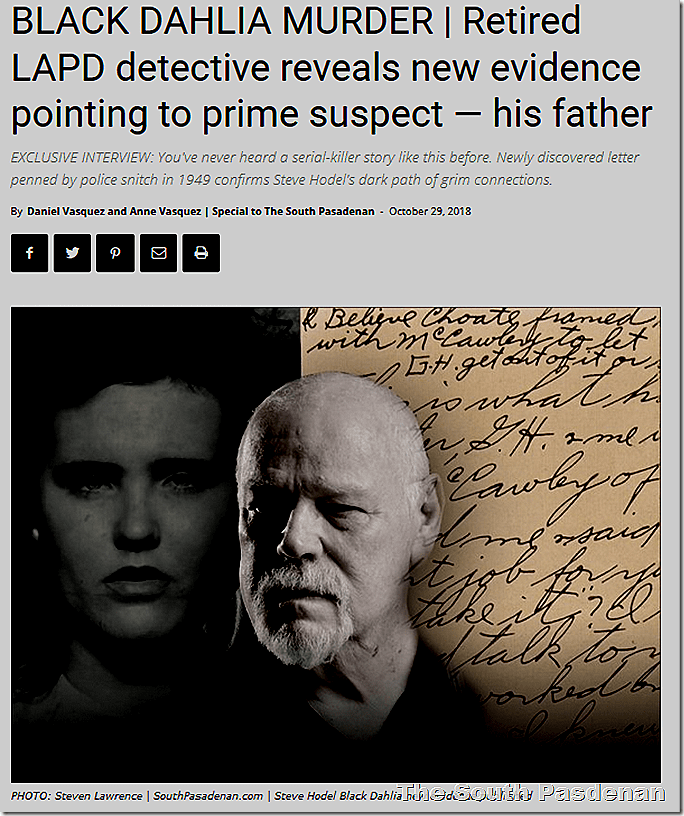
If you are familiar with Steve Hodel’s elevator pitch (“retired LAPD homicide cop discovers evil genius dad was maniacal serial killer”) you can skip all of this in the South Pasadenan. It’s more of the same old exaggerated claims, distorted details and suppressed facts that don’t fit with the predetermined narrative. And lots of rambling about surrealism.
But for those who are new to the ever-expanding Dr. George Hodel “evil genius” franchise, you might want to read on. I’m not going to rehash all of the George Hodel material I have done over the years (there is a lot of it) but here are some selected links.
Executive summary: Dr. George Hodel was never “the prime suspect” in the Black Dahlia case. That dubious title would be reserved for Robert M. “Red” Manley, Joseph Dumais and Leslie Dillon. Dr. Hodel was investigated for a while, his house was bugged for about a month and a half and that’s it.
See:
Black Dahlia: George Hodel — Soil Samples at the Sowden House: FAIL
Black Dahlia: The Non-Smoking Gun – George Hodel Files (37 parts)
Black Dahlia: Can You Identify the Black Dahlia? (Updated)
Note: This is an encore post from 2005 and originally appeared on the 1947project.
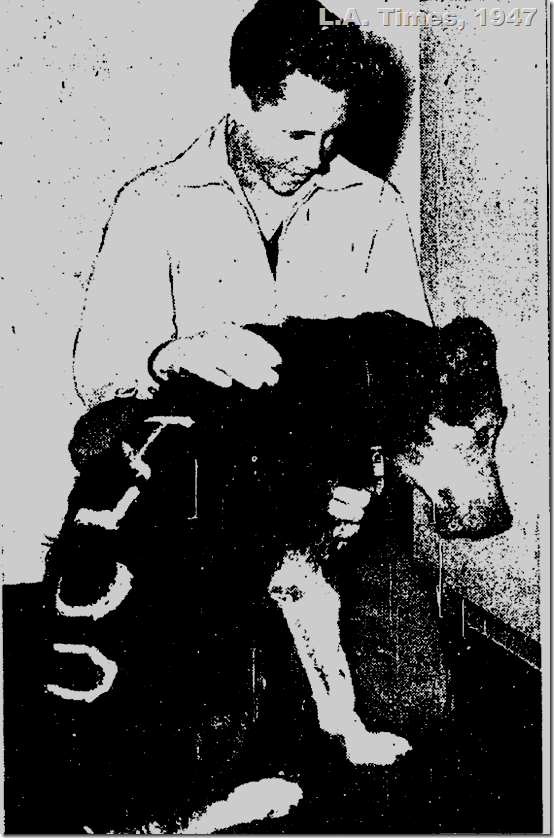
The assault on USC’s campus canine prompted angry letters to The Times and a pointed barb on the sports pages. “Whoever did that had a warped mind,” columnist Braven Dyer said.
Of course, the Trojans were up to the challenge and shortly before the schools’ annual grudge match, painted the Westwood campus with slogans like “George Tirebiter’s Revenge.” The scoreboard was vandalized to read: “USC 1,000, UCLA 0.” The actual score was much closer. USC, which at that point was unbeaten, defeated UCLA 6-0 and went to the Rose Bowl, although it subsequently lost its homecoming game to Notre Dame 38-7.
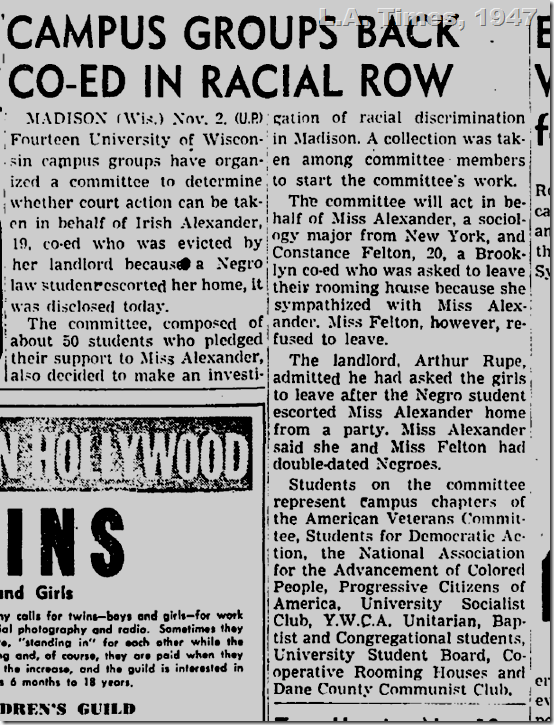
Oct. 30, 1947: Annie Rhone, a 60-year-old great-grandmother, was chosen as the Sentinel’s “Sepia Cinderella” in a contest judged by Eddie “Rochester” Anderson and held at West Coast premiere of the film. “Sepia Cinderella” was directed by Arthur H. Leonard and starred Sheila Guyse, Billy Daniels and Tondaleyo, and many musical acts..
“The Lord was with me,” Rhone said as she looked at the prizes she won, including a fur coat and a wristwatch. A niece and nephew convinced her to enter the contest against more than 50 women. “The Lord kept hunching me, so I came,” she said.

Note: This is an encore post from 2006.
Oct. 31, 1907
Los Angeles
John J. Mooney, 23, a Southern Pacific machinist who recently arrived from Butte, Mont., was aboard the West 2nd Street car on his way to be initiated in the Modern Woodmen of America when the brakes failed, sending the car into the southbound Spring Street trolley, killing him and injuring seven other passengers.
The intersection is known as a danger point because of the steep hill on 2nd Street, according to The Times, which noted that another fatal accident occurred there Dec. 24, 1905. Officials say the 2nd Street car stopped at Broadway, then proceeded toward Spring when the brakes failed. The motorman of the Spring Street car accelerated to avoid the oncoming trolley but couldn’t get out of the way.

Oct. 30, 1947: Leading the juke box hits this week: Louis Jordan’s “Early in the Morning,” T-Bone Walker’s “I Know Your Wig Is Gone” and “Look Out” by Louis Jordan.
Note: This is an encore post from 2005 and originally appeared on the 1947project.
Less than three years ago the average American solider in combat was under oath to kill Japanese—but yesterday it was learned that a former combat soldier, Herbert D. Long, 32, of 540 N. Orange Drive, had virtually “adopted” one.
Cables from Tokyo quoting the Japanese newspaper Yomiuri described how the former Army man had carried out the request of a Japanese who died at Attu Island—by assuming responsibility for the future welfare of the soldier’s young daughter in Japan.
Continue reading

Note: This is an encore post from 2006.
Oct. 30, 1907
Los Angeles
The young men of Los Angeles High School have issued a direct challenge to the Board of Education, defying its authority by enlisting fraternity members despite a ban issued last year.
The chief offenders are the Pi Phis, who just added seven members, The Times says. “Another ‘brat frat,’ as they have been dubbed, recently held high jinks at Levy’s restaurant and made a burning declaration of independence in which the city superintendent of schools and all persons concerned in opposing them were relegated to a place where a fire company would not be a circumstance,” The Times said.
 ladailymirror.com