
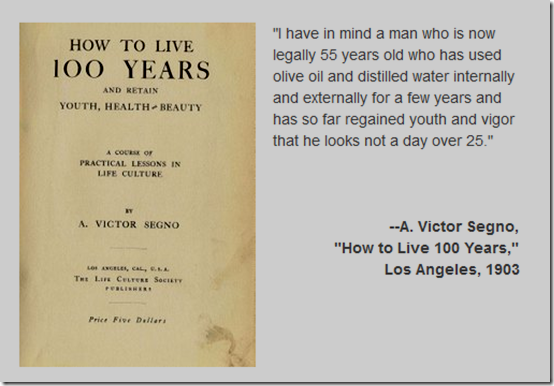
More wisdom from A. Victor Segno, my favorite L.A. charlatan. Via Archive.org..
More wisdom from A. Victor Segno, my favorite L.A. charlatan. Via Archive.org..
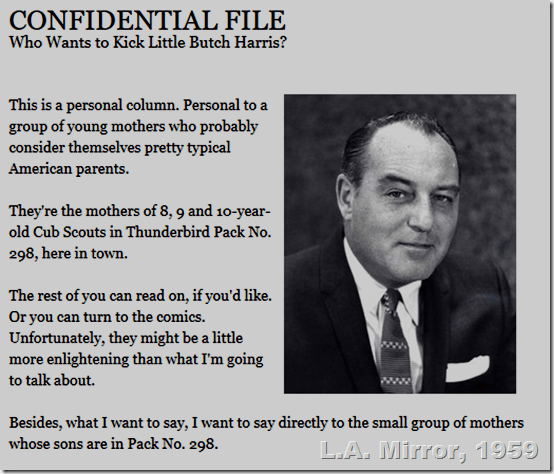
Dec. 10, 1958: Here’s Paul Coates’ earlier column about Butch Harris, the young African American boy who was denied admission to the Cub Scouts..
The column originally appeared in the L.A. Mirror in 1958 and was republished on latimes.com in 2009. It is available via Archive.org.

Jan. 17, 1959: Matt Weinstock invented the “Only in L.A.” column while he was at the L.A. Mirror. In this edition, Weinstock is cataloging some L.A.-bashing:
It is a city without the power to assert its own identity; a city with nothing unexpendable in it, nothing which, vanished, would cause a civilized man at the other end of the world to weep . . . I have the impression of a Technicolor slum . . . a dance macabre of uproarious stucco fonts . . . a honky-tonk of exclamations . . . It is nobody’s city; it is only a place with more ‘housing units,’ it seems, than there are hills in the world . . . I felt, in Los Angeles, that I did not need to notice anything. Could anything really remarkable happen where ‘everything is okay?’
Weinstock’s column originally appeared in the L.A. Mirror in 1959 and was republished on latimes.com in 2009. It is available via Archive.org..

 Jan. 17, 1959: It was Saturday in 1959, so Paul Coates ends his week with a letters column. Pretty standard for those guys who wrote six columns a week. (In case you don’t know, afternoon papers did not publish on Sundays).
And “Jamie Curtis,” age 8 weeks, makes his (yes, HIS) camera debut. Oops.
Also: blacklisted screenwriter Dalton Trumbo is revealed as Robert Rich, credited with “The Brave One.”
Coates’ column originally appeared in the L.A. Mirror in 1959 and was republished on latimes.com in 2009. It is available via Archive.org.
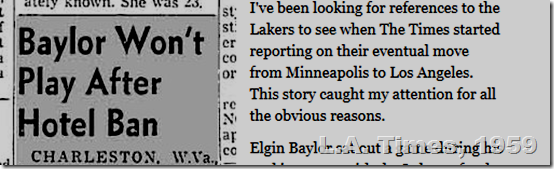
Jan. 17, 1959: Keith Thursby has the story of the Minneapolis Lakers moving out of a hotel in Charleston, W.Va., after operators refused to give a room to rookie Elgin Baylor and two other black players. Baylor boycotted the game, which the Lakers lost 95-91 to Cincinnati..
The story originally appeared on latimes.com in 2009 and is available via Archive.org.
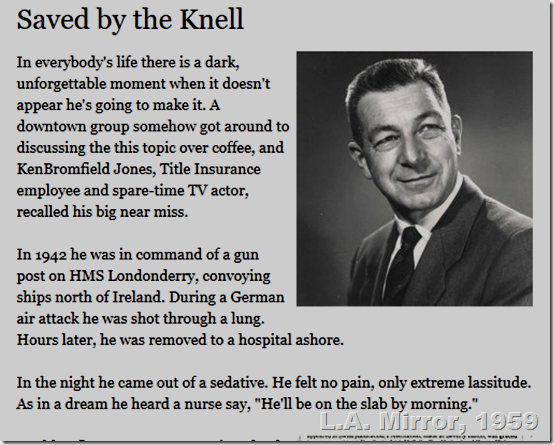
Jan. 16, 1959: Puns, poems, jokes, little stories. Ending the day with a smile courtesy of Matt Weinstock.
This column originally appeared in the L.A. Mirror in 1959 and was republished on latimes.com in 2009. Via Archive.org.
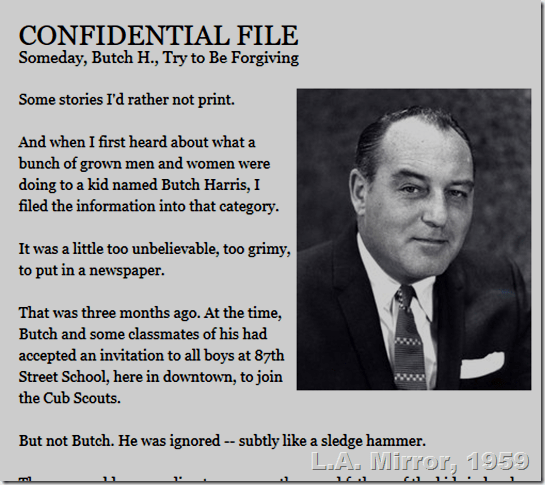
Jan. 16, 1959: The Cub Scouts don’t want to admit 9-year-old Butch because he’s black. This is one of my favorite Paul Coates columns and well worth the read.
The column originally appeared in the L.A. Mirror in 1959 and was republished on latimes.com in 2009. It’s available via Archive.org.
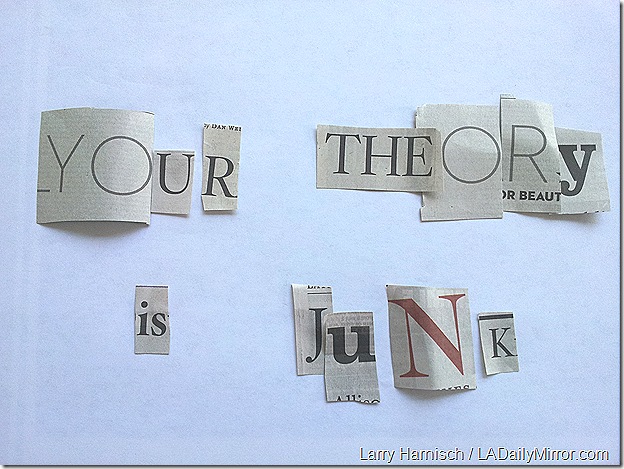
Black Dahlia breakthrough!
Note: This is an encore post from 2013.
Let us suppose that there was a mathematician. A retired mathematician who once taught at a major university, who published and received tenure, and retired as a well-regarded member of the faculty.
Let us further suppose that in retirement, this mathematician wrote a book and on the day of publication called a news conference to announce his stunning discovery:
1 + 1 = 3.
The way the retired mathematician derived this amazing breakthrough was not through the typical methods that have been used for millennia. Instead, the mathematician had spent hours and hours gazing at photographs and paintings of the number “1” and the number “3.”
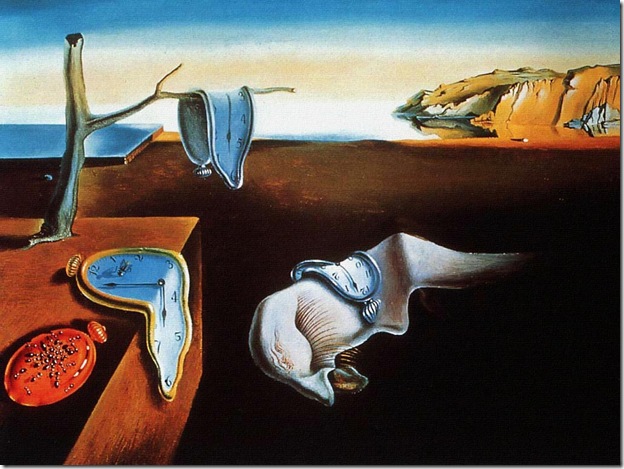
Until finally, seizing upon Salvador Dali’s surrealist painting “Persistence of Memory,” the mathematician found the proof he was seeking.
1 + 1 = 3. Don’t you see it?
To skeptics who insisted that he was wrong and that any child with a calculator could prove that 1 + 1 = 2, the mathematician would say that there was a vast, shadowy conspiracy among the calculator and adding machine cartels of the world, who were ruthlessly suppressing the facts. Indeed, much of the book was devoted to the massive “coverup” mounted by Texas Instruments, Casio, Hewlett-Packard and other office machine manufacturers to prevent anyone from learning the truth.
Once he embarked on his theory, the mathematician would go on to make other, similar discoveries: 2 + 2 = 5, therefore 2 x 2 = 5, thus rendering any number times itself an odd number. He capped his theory with the long-sought and elusive square root of –1, widely assumed to be an “imaginary” number, (or “Error” to the calculator and adding machine cartels determined to ruthlessly suppress the truth), which was 42.

Proof of the coverup by the calculator and adding machine cartels!
In the ensuing years, the mathematician built up elaborate theories about other mathematical concepts that were wrong, including the secret messages contained in five-place log tables, publishing more books, maintaining a website and delivering occasional public appearances about his increasingly complex theory, all of it based on 1 + 1 = 3 and the shadowy conspiracy of the calculator and adding machine cartels determined to suppress the truth.
The mathematician gained a number of followers, who likewise insisted that “I think he’s proved it!” and “Yes, 1 + 1 = 3.” The supermarket media adored the mathematician, writing headlines such as: “Math Prof Claims 1 + 1 = 3!” It was never necessary to interview anyone else about the validity of the theory. “Math Prof Claims 1 + 1 = 3” was sufficient. The mathematician sold books (some of them self-published), gave lectures and all was well.
But not really, because 1 + 1 = 2 and any elementary school pupil who turned in 1 + 1 = 3 was marked wrong.
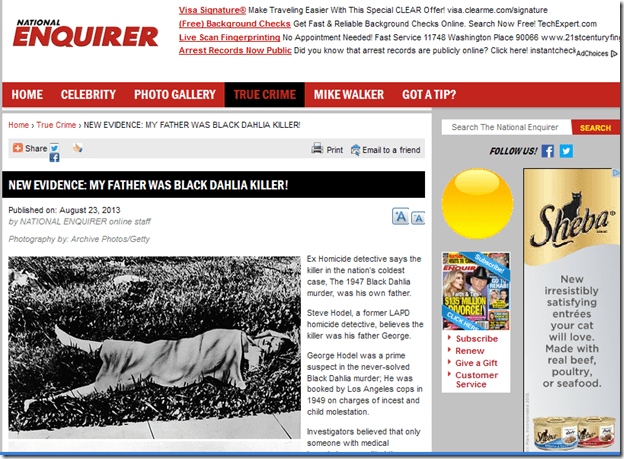
Black Dahlia breakthrough! Former homicide cop says dad was Black Dahlia killer!
Which brings us to the George “Evil Genius” Hodel Franchise.
Recently, author Steve Hodel has received publicity about “new evidence” in the Black Dahlia case.
Ignoring the problems of the “old evidence,” which is the foundation of everything that follows, including the “new evidence.”
And that is this: The photographs found in the belongings of Dr. George Hodel after his death – claimed in the “Black Dahlia Avenger” series to show Elizabeth Short – are not Elizabeth Short.
One might question the validity of the original assumption – that both photographs were of the same woman, and that woman was Elizabeth Short – when one of the women came forward and identified herself as Marya Marco.
The remaining and unidentified (at least for now) photo is likewise not Elizabeth Short. This is according to the family of Elizabeth Short, whom I consider definitive.
And if the spurious photo is removed, the entire George “Evil Genius” Hodel scenario collapses like a house of cards in a strong wind. Because without this spurious photo, there is nothing to show that Dr. George Hodel and Elizabeth Short ever met.
I have heard one of Steve Hodel’s presentations, and when confronted with this statement, he talked his way around it by saying that the photos merely served to get him interested in the case and that it was irrelevant whether they were Elizabeth Short. But at that time he said he believed they were her.
The truth is that there is nothing to show that George Hodel and Elizabeth Short ever met.
In other words: George Hodel + Elizabeth Short = 0

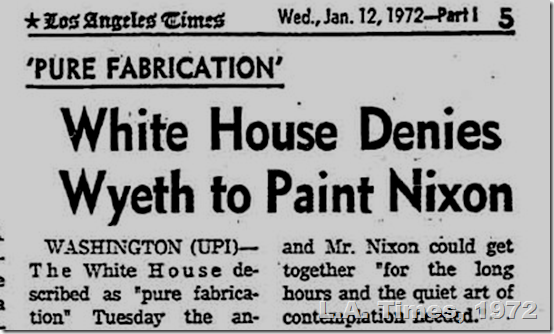
January 1972: A fun little contretemps about whether Andrew Wyeth would paint a portrait of then-President Nixon.
The original post appeared on latimes.com in 2009 and is available via Archive.org.
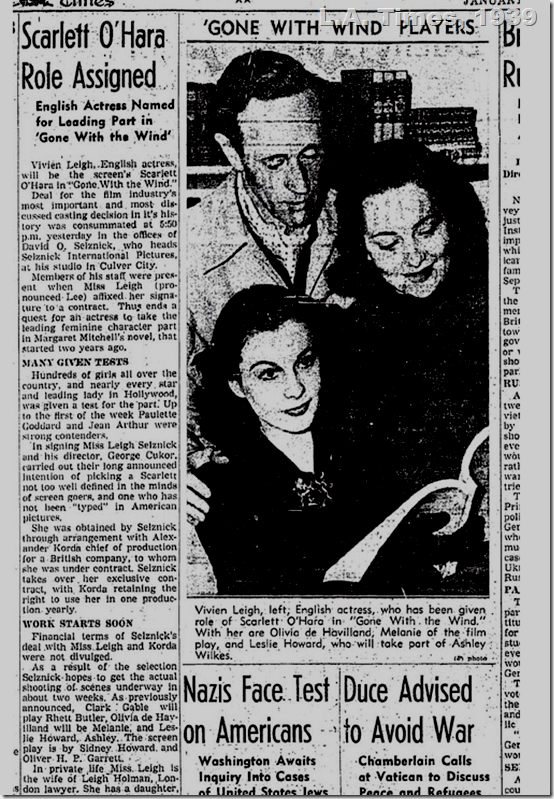
January 1939: Vivien Leigh is cast as Scarlett O’Hara. Hedda Hopper does not approve. Boy does she not approve. Frankly, was there anybody who was ever worse at casting than Hedda Hopper? She would shamelessly use her column to campaign for someone to get a part – even when they were completely wrong.
This post originally appeared on latimes.com and is available via Archive.org..
Today is Jan. 15, the anniversary of Elizabeth Short’s death. As is the custom, the Daily Mirror will be dark.
Trim your roses in her memory.
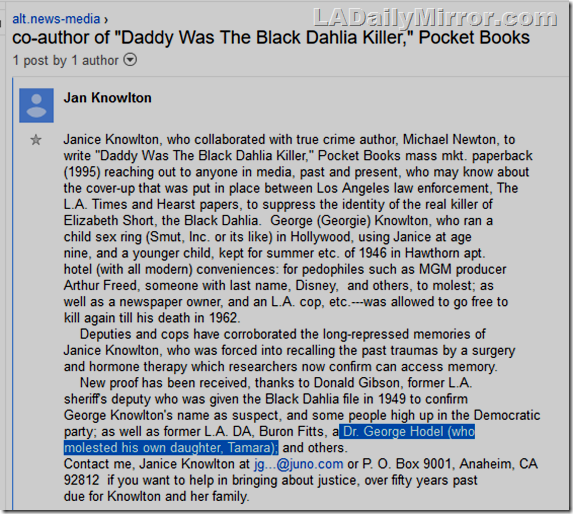
Aug. 8, 1998: A post on the old usenet alt.news-media by Janice Knowton was the first to publicly link Dr. George Hodel and the Black Dahlia case.
At this point, George Hodel was alive but would die in a bit less than a year. He was never publicly identified as a suspect – and certainly not a “prime suspect” before then, despite claims by the “Black Dahlia Avenger” franchise.
Knowlton killed herself in 2004, a year after “Black Dahlia Avenger” was published.

Jan 14, 1959: Matt Weinstock has an eccentric visitor with a theory about the electron. Funny things that kids say, a poem and some bullet items. Weinstock ends the day with a light touch.
The column originally appeared in the L.A. Mirror in 1959 and was republished on latimes.com in 2009. It’s available via Archive.org
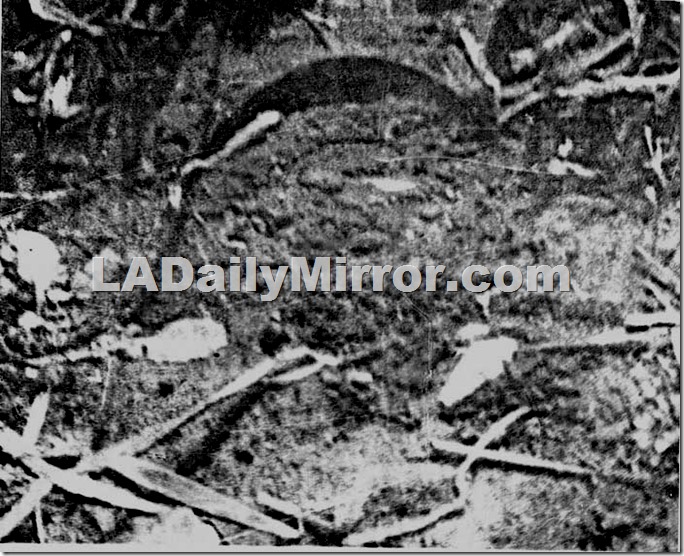
Jeanne French was found beaten and stomped to death Feb. 10 1947, almost a month after Elizabeth Short was killed. French died from a broken rib that punctured her heart. Heel prints were found on her chest and near her body, according to Los Angeles County district attorney’s files. The prints were identified as a man’s shoe, size 6 or 7, someone with unusually small feet. Dr. George Hodel had, according his family, much larger feet.
Many armchair sleuths and authors of crummy books on the Black Dahlia case (notably “Severed” and “Black Dahlia Avenger”) claim that the Black Dahlia and Jeanne French killings were related. The concise answer is no. The full analysis is much longer and reaches the same conclusion.
The takeaway is that George Hodel could not have killed Jeanne French because his feet were the wrong size. And he had no connection to Elizabeth Short and was not the Black Dahlia killer.
Period.
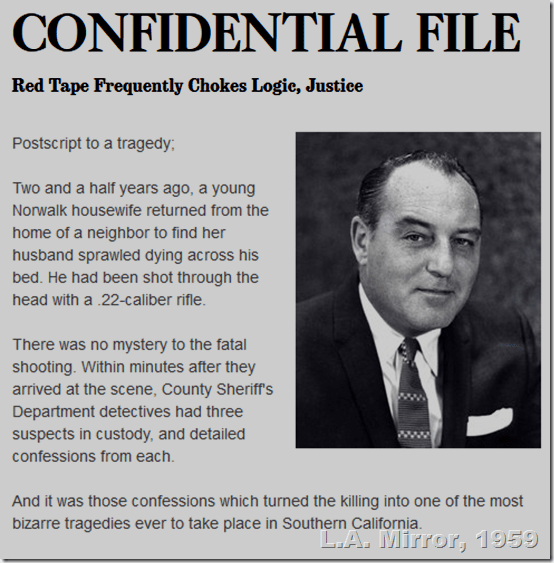
Jan. 14, 1959: Paul Coates has the amazing story of three boys, ages 7, 9 and 10, who shot their father to death as he slept. Coates says that the mother (and the boys planned to kill her as well – they thought they had been unjustly punished) had regained custody of the children and was struggling to get her slain husband’s Social Security payments. The boys were denied their Social Security benefits.
Coates says: Because the children were never charged with a crime, they can’t be cleared. That apparently, is the logic of the Social Security office.
The column originally appeared in the L.A. Mirror in 1959 and was republished on latimes.com in 2009. It is available via Archive.org.
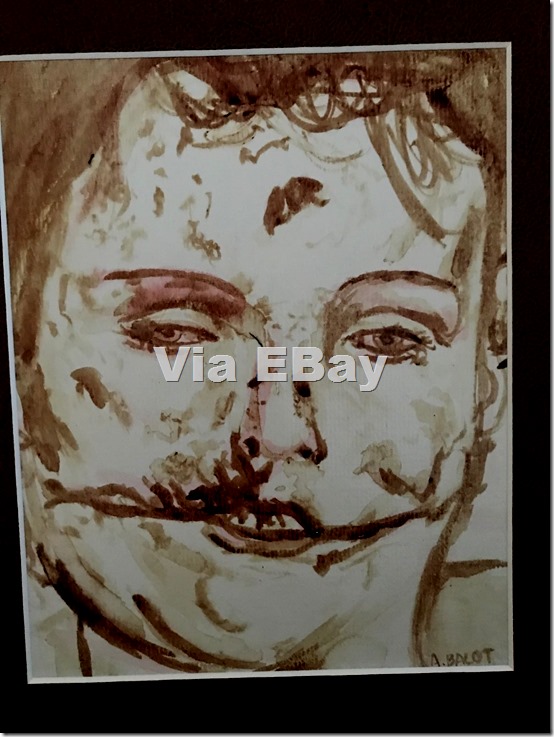
I occasionally scan the Web to see what’s out on the distant fringes of the Black Dahlia case. And wow. This is fringe.
Here we have a portrait of Elizabeth Short – post-mutilation – painted in the artist’s blood. Listed on EBay for $250. People never cease to amaze me in the ways they will try to cash in the Black Dahlia.
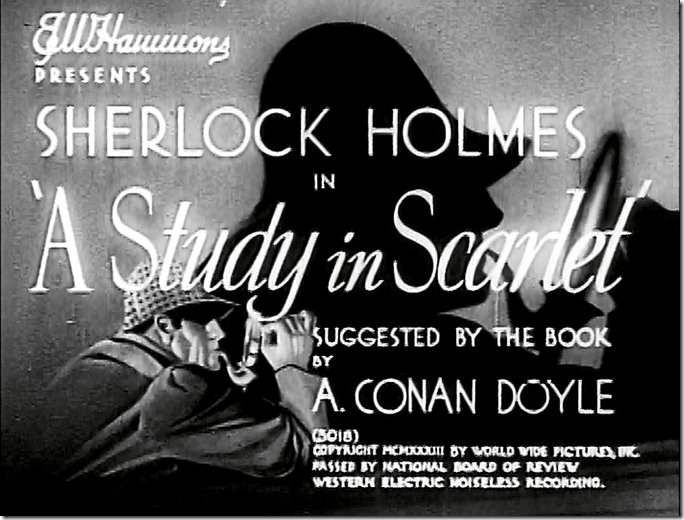
This week’s mystery movie was the 1933 film “A Study in Scarlet,” with Reginald Owen, Anna May Wong, June Clyde, Allan Dinehart, John Warburton, Alan Mowbray, Warburton Gamble, J.M. Kerrigan, Doris Lloyd, Billy Bevan, Leila Bennett, Wyndham Standing and Halliwell Hobbes.
Screenplay by Robert Florey, continuity and dialogue by Reginald Owen, photography by Arthur Edeson, editing by Rose Loewinger, settings by Ralph DeLacy, sound by Hans Weeren, directed by Edwin L. Marin. A KBS production produced at the California Tiffany Studios, distributed by Fox.
“A Study in Scarlet” is available on DVD from TCM.
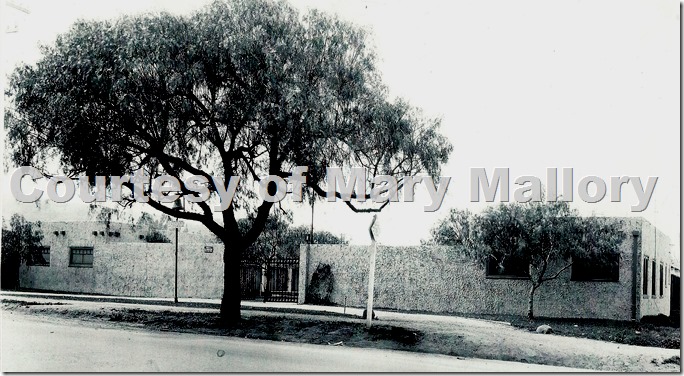
A photo of the original museum at Campo de Cahuenga, courtesy of Mary Mallory.
Note: This is an encore from 2012.
Driving south down Lankershim Boulevard from Toluca Lake into Universal City, it’s hard to miss the skyscrapers, soundstages, and flashing billboard of Universal Studios on the south side of the street. On the north side of the street in Studio City, surrounded by the MTA Universal City subway station parking lot and hard to see, sits a small Spanish building called the Campo de Cahuenga. At this location on Jan. 13, 1847, Col. John C. Fremont signed a treaty with Andreas Pico, ceding California to the United States. Here, California’s Spanish past merged with America’s western expansion to help eventually create our bustling state.
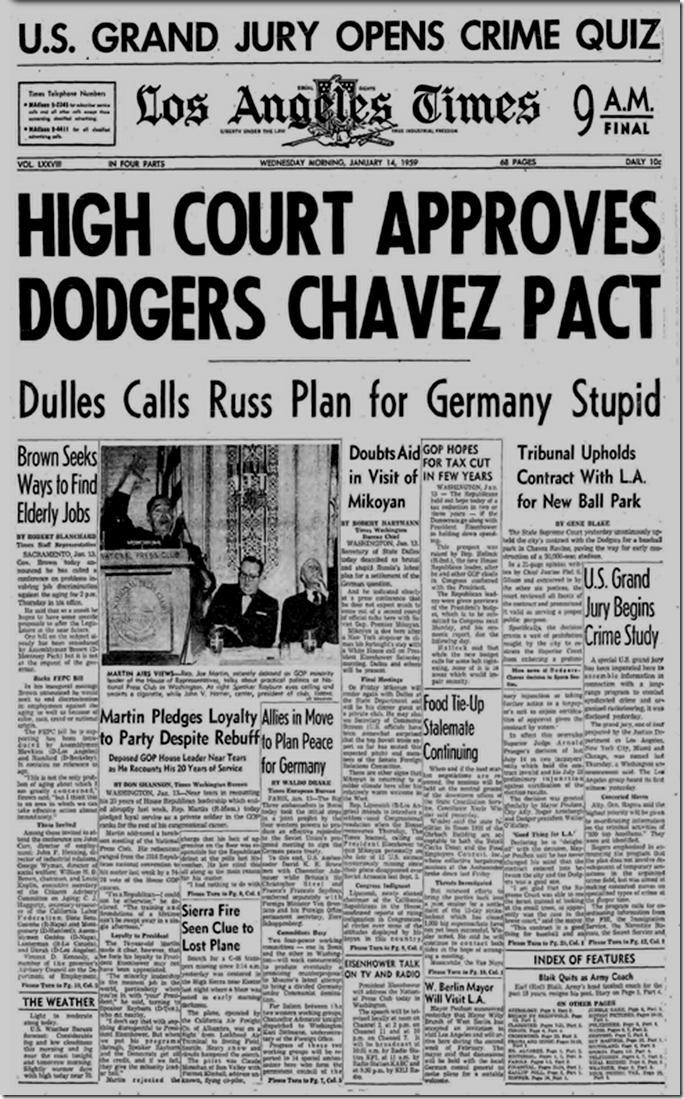
Keith Thursby writes: The state Supreme Court ruled unanimously in favor of the Dodgers and City Hall, moving plans for a baseball stadium in Chavez Ravine one huge step closer to reality. The Times’ coverage was breathless, no surprise since the paper was an open champion of the deal with the Dodgers..
“Progress must not be stopped in Los Angeles,” Mayor Norris Poulson said in Gene Blake’s lead story.
This post originally appeared on latimes.com in 2009 and is available via Archive.org.
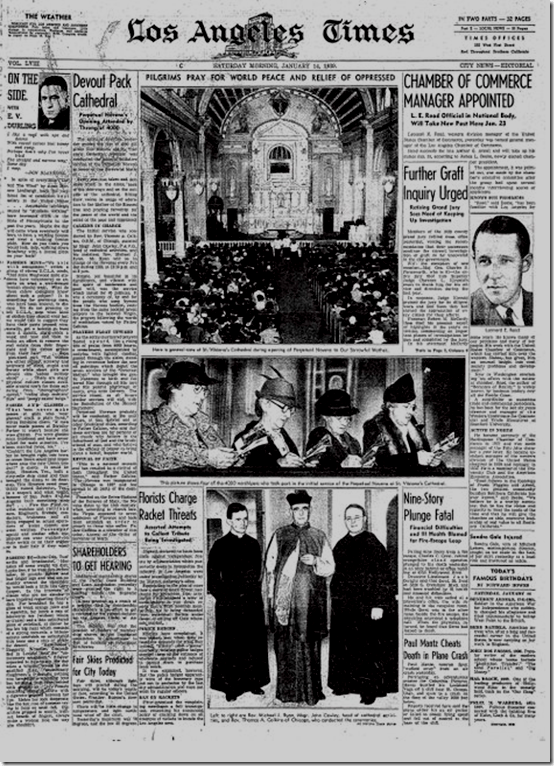
Jan. 13, 1939: About 4,000 worshipers attend a Perpetual Novena for Our Sorrowful Mother at St. Vibiana’s Cathedral. People knelt in the aisles, in the doorways and outside praying for peace and for relief of the poor, The Times says..
Also: RKO plans more lavish films with Carole Lombard and Claudette Colbert, Anne Morrow Lindbergh’s “Listen! The Wind” leads the bestseller list and good seating is available for the Pro Bowl at Wrigley Field.
The post originally appeared on latimes.com in 2009 and is available via Archive.org.
 ladailymirror.com