Reading the palms

1957_0421_vivian


April 21, 1957

Los Angeles

I think about his hands. I don’t know, but I would imagine that at the age of 78,
they were old and worn from a lifetime of custodial work for Los Angeles County.
Gnarled, maybe, with age spots.  I like to think you can tell more about
some people by their hands than by their face. This is mostly guesswork, but I
wonder what story his hands would tell.

Were his nails all ragged or did
he keep them neat and smooth? Were his fingers short and stubby or long and
thin? Did he have a wedding ring or was he one of those men who didn’t wear one
for fear it would get caught in the machinery he used?

Ad_rubinstein

We just don’t know.

He would have been born about 1879, and I picture him in school holding a pencil
and figuring sums. We know he could read and write because of his last note.

It’s fairly certain his hands gripped the reins of a horse and buggy; maybe he
held the steering wheel of an automobile, or maybe he took the streetcar. I
think of him as a young man in his 20s, filling out a job application. At that
time, many county jobs were gotten through political patronage, but that’s just
a guess.

At
some point in the next 28 years, he met a woman named Adelaide Houston, who was
15 years younger.  I have no how they met, but I picture him holding her
hand and putting a wedding ring on her finger.

Then I picture his hands holding his son, Roger, who was born about 1928.

Maybe he pitched a ball to his son and hugged him when he graduated from high
school.

All along, those hands picking up a mop bucket and pushing a broom for the
county. Washing windows and scraping gum off the floor. Shaking hands when he
retired.

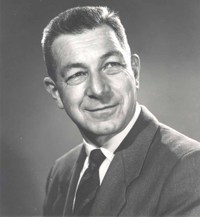
Ad_tony_martin

And then opening the door to the doctor’s office for him and Adelaide.
Comforting her when the doctor told them she had cancer, just like him.

Those worn hands, opening his wallet to get for medicine at the drugstore, and
paying the rent for the apartment at
834
N. Huntley Drive
in West Hollywood.

The
hands, which figured sums in school so long ago, writing a three-page letter to
Roger, sealing it in an envelope and leaving it on the coffee table.

Then dialing the telephone to the hotel in Hollywood where Roger worked the
graveyard shift while going to law school at USC. There was a letter on the
coffee table, be sure to mail it, he said.

Finally, the old, worn hands picking the gun as he walked into the bedroom where
Adelaide was sleeping.

When Roger came home that morning, he found his parents’ bodies on the bedroom
floor.

The note said: "If we continue spending our money to keep ourselves alive, there
won’t be anything left for you to go to law school."

Note:
The
State Bar of California
does not list an attorney named Roger M. Vivian.

Email
me

Posted in Suicide, West Hollywood | Comments Off on Reading the palms

Cross purposes

City_hall_cross1930

April
21, 1957
Los Angeles


Although
Easter has passed in 2007, it has just arrived in 1957. One way Los Angeles
marked Easter weekend was by arranging the lights in City Hall so that they
formed a cross. I’ll apologize in advance for the poor quality of the pictures,
but take a look, because we are not likely to see this again.

The first example is from 1930, two years after City Hall opened. The practice
continued at Easter and Christmas for more than 40 years. (Below, Easter 1957 and Christmas 1962).

In 1959, Mrs. Gordon L. Mann (remember, this is the era when married women had
no first names) wrote a letter to The Times, invoking the Founding Fathers and a
Christian nation in protesting plans to keep City Hall’s windows dark
because of construction work. Her argument prompted a rebuttal from John R. Goy
on religious freedom.

City_hall_cross1957
Then,
in digging through the clips, I encountered the incomparable Jack Smith.

In 1971, he wrote about the annual press release announcing that the Board of Public
Works would present the cross in lights on three sides of City Hall. And yes,
I’m quoting an official City of Los Angeles press release:

"In a world of war and unease, among  people who pray and plead for
peace,  there will shine again this Eastertime the lighted Cross atop the
three sides of City Hall as a herald of the day when died a man who was born to
bring peace to the world….

"He died on a wooden cross he had carried himself up the hill of the
skull–called Golgotha–and none was to help him save Simon as he stumbled and
fell under his heavy burden. And they crucified him, the soldiers of Rome….

"Therefore, to illumine the story of his death and the lasting lessons learned
from his life, the Board of Public Works, on a directive from Mayor Sam Yorty,
today ordered the lighting of huge crosses on the high faces of City Hall
…  to mark the advent of Easter and to bring a brightness into the hearts
of men troubled by the times….

"And as he was outstretched and pinioned to the cross to form a living crucifix,
so will the outflung arms of the lighted cross high above the city’s strife
serve as a sign of the universal appeal of the words he spoke in forgiveness of
his enemies and of the love he bespoke for all mankind….

"And the lights burning bright on City Hall will grow dim and flicker and die as
Easter morn again comes gently to the city with the message his believers form
gratefully with their lips and repeat in their hearts as has been their wont for
2,000 years: He is risen."

Now
that’s quite an official press release and it’s probably not something we would
expect to see today.

But of course being Jack Smith, he’s got a twist. And I’ll get to that in a
minute.

City_hall_cross1962In 1976, Judge Norman R. Dowds barred the display in a preliminary injunction
sought by S. Dorothy Metzger Fox, who said the cost of the lights was an illegal
use of tax money. In 1977, the state Court of Appeal overturned the ban. The
state Supreme Court took up the case, and in 1978 upheld the ban.

Chief Justice Rose Elizabeth Bird wrote in a separate, concurring opinion:
"It does not take foresight to see that this situation is fraught with dangers
of political divisiveness."

In the dissenting opinion, Justices Frank K. Richardson and William P. Clark
said: "The 30-year practice has passed unchallenged either by the general public
or by any individuals or groups, religious or otherwise….

"The record before us totally fails to demonstrate that the display either
encouraged or inhibited any particular religion in Los Angeles or anywhere
else."

The
decision generated its own dispute and figured in a 1979  investigation as
to whether the high court delayed several controversial decisions until after
the Nov. 7, 1978, elections.

A report by the state Commission on Judicial Performance found that another of
the controversial decisions–overturning the "use a gun, go to prison"
law–could have been returned five months before the elections if Bird had not
decided to write a separate concurring opinion. The sensational investigation
ended in November 1979, when the commission found no wrongdoing by the state
Supreme Court.

And as for the author of the annual Easter press release, David Soibelman, who
emigrated from Russia, spent his retirement writing for The Times, the Santa
Monica Outlook and the Buffalo, N.Y., Jewish Review until his death in 1998 at
the age of 94.

Email
me

Posted in #courts, City Hall | 1 Comment

Like gonesville

Ad_brubeck

"These Foolish Things," 1959

"Brandenburg Gate," 1959

"Take the ‘A’ Train," 1959

"St. Louis Blues," 1961

"Take Five," 1961

Note the personnel change, Gene Wright replacing Norman Bates on bass

Art Pepper Movie, Part 1

Art Pepper Movie, Part 2

Email me

Posted in #Jazz, #video, Nightclubs, Television | Comments Off on Like gonesville

Ex nihilo nihil fit

April 20, 1957
Los Angeles

By Matt Weinstock

ONLY IN L.A.–A woman about to board a Metro 91 bus at Hollywood Blvd. and Vine asked, “Do you go on La Brea?” (Some turn on Fairfax). The driver said no.

She asked: “You don’t go on La Brea?”

He said: “No, lady, I don’t.”

She got on, started to put her fare in the box when the driver said firmly:   “Lady, I said I didn’t go on La Brea!”

She deposited her fare and said pleasantly: “Oh, that’s all right–I didn’t   want to go there.”

Which is one reason bus drivers acquire that harried look.

Posted in 1957, Columnists, Matt Weinstock | Comments Off on Ex nihilo nihil fit

Note to Frank Stella

1957_0420_coloring

Email me

Posted in art and artists | Comments Off on Note to Frank Stella

I love to tell the story

1957_0420_fuller
 

April 19, 1957
Los Angeles

Fuller_revival_1937 It seems incredible, but The Times never ran an obituary on Charles E. Fuller, who helped found Fuller Theological Seminary and was one of the pioneers of radio evangelism.

Broadcasting live from the Long Beach Municipal Auditorium, and later in recordings made at a Hollywood studio, Fuller was on the radio for 43 years, until his death in 1968, preaching "salvation, personal conversion and the life hereafter," The Times said.

He was born in downtown Los Angeles, and his father, Henry, ran a furniture store.  The Fullers moved to Redlands,  where the family planted the first Valencia orange in 1886, The Times said. He graduated from Pomona College in 1910 and turned to religion in the 1920s after working as a manager at a citrus firm.

Fuller began his broadcasts in 1925 when he was at the Calvary Church in Placentia, with coast-to-coast transmission beginning in 1949.

Fuller_revival_1963_2 The broadcasts featured Rudy Atwood, sometimes called the dean of gospel pianists, and the choir, male quartets and male and female soloists, with listeners' letters read by Fuller's wife, Grace.

"Its appeal is the universal appeal of the Scriptures," Fuller said of the broadcasts. "I preach a simple yet eternal message of the Gospel."

Fuller said he and Harold John Ockenga got the idea of founding a theological seminary after his encounters with other ministers across the United States.

"In traveling about the country, I met evangelists who themselves believed firmly in the Gospel and who were dedicated to their preaching of it. But they did not have the full understanding of theology and were frequently no match in theological debate. And, too, they could not meet with business and professional leaders on an equal footing."

1957_fuller_house


Fuller, who lived at 1180 Oxford Road, San Marino, above, went to his heavenly home on March 19, 1968. The Old-Fashioned Revival Hour ended in October 1969 after 44 years.

"May we stand, please, and sing 'Heavenly Sunshine.' My what a privilege it is to send out this heartwarming, cheering chorus across the nation on 'Heavenly Sunshine.' As you do, sing through the first time, turn around and shake hands with as many people as possible. Glad to see so many here today at the Long Beach Municipal Auditorium. And now all together on 'Heavenly Sunshine.' "

Email me


Posted in 1957, broadcasting, Long Beach, Religion | Comments Off on I love to tell the story

Dear Mr. O’Malley

April 19, 1957
Los Angeles


1957_0419_dodgers01Dear Walter,

We all know that the lease on Ebbets Field expires in 1959. How would you like a nice 78-acre parcel in Flushing Meadows, 12 miles from Midtown Manhattan, for the Dodgers?

Forget this Chavez Ravine nonsense, just a stone's throw from downtown Los Angeles. So what if California has freeways. Wouldn't you rather pay a 25-cent toll for using the bridge or the tunnel? And wouldn't you prefer a 5% amusement tax here in New York rather than nothing out there on the West Coast?

Look, we'll build you a nice, Space Age ballpark. With a dome. A really nice one.

Just keep an open mind, OK?

Sincerely,

Robert Moses,
New York City Park Commissioner

ps. What's this I hear about some outfits called the California Baseball Club and the Dodgers Rookie Baseball Club incorporating in Los Angeles?

Posted in 1957, Dodgers, Downtown, Sports | Comments Off on Dear Mr. O’Malley

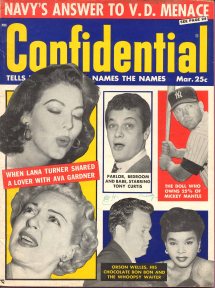
Confidential tells the facts and names the names

April 19, 1957
Los Angeles


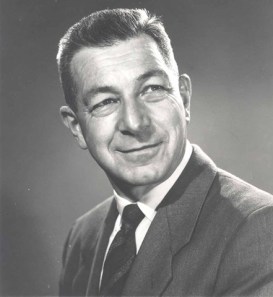
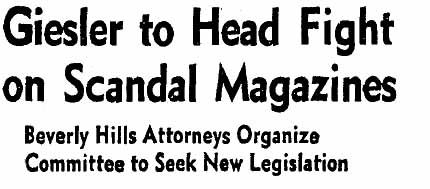
Jerry Giesler, one of the most prominent attorneys in Los Angeles, was chosen to lead the war against Confidential magazine during a meeting of the Beverly Hills Bar Assn. at the Beverly Wilshire Hotel.

Giesler, who handled the cases of countless celebrities, including Errol Flynn and Lili St. Cyr, bitterly attacked the studios for not protecting their stars but “running to cover” when any of them were accused of wrongdoing.

“They talk a lot, but they do nothing,” Giesler said. “I know. So each individual will have to stand alone. No matter who, no matter how right he or she may be.

“When it’s over, they may get a pat on the back. They are congratulated, and taken back into the fold. But while they’re on the battlefield, they never hear a word.” Continue reading →

Posted in #courts, Hollywood | Comments Off on Confidential tells the facts and names the names

This is your life

1957_0419_strickland

April
19, 1957

Los Angeles

1957_0419_strickland_hed_2Your name is Jay. You are 55. You grew up in the San Fernando
Valley–15224 Willard Way in Van Nuys, to be specific.

You were adopted at birth by a couple named Strickland: Jane and her husband,
Edward, a fourth-grade teacher at the Isabelle Buckley School, 4477 Woodman
Ave., in Van Nuys. There were other children in the home: Danny, who would be 61
now; Cynthia, 58; and Celeste, 52.

As far as your foster parents were concerned, you were an exceptionally bright
youngster. "I defy anyone to find a smarter little boy than this one," your
father, Edward, said. "He’s really adopting us," your mother said.

There’s one other thing we know: You were a little harder to place than other
foster children because one of your biological parents was white and the other
was Chinese.

The rest is guesswork, because I can’t seem to find any trace of you. So I’m
left to wonder what it was like for you growing up in the 1950s. Was it the
standard baby boomer childhood with a coonskin cap, a hula hoop and trips to
Disneyland?  How was high school? Did you get drafted and go to Vietnam or
have a student deferment? And how about a family?

Maybe someone reading knows the rest of the story. I’d like to know what became
of that bright 5-year-old named Jay.

Email
me
 

Posted in Adoptions, San Fernando Valley | Comments Off on This is your life

You have got to be kidding me


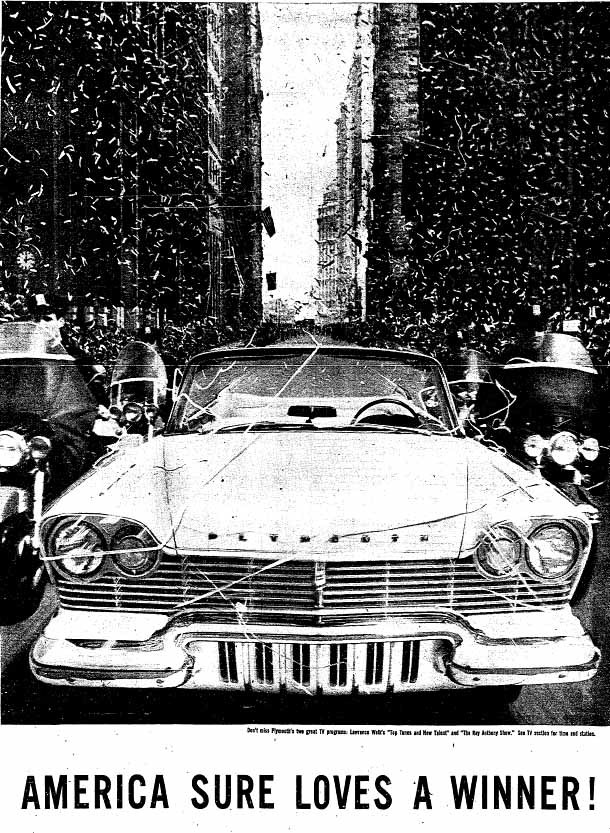
Tulsa buries a 1957 Plymouth in a time capsule.

Email me

Posted in #video, 1957, Television | 2 Comments

Con game

April 18, 1957
Los Angeles

By Matt Weinstock

 Dist. Atty. William O. Weissich of Marin County has announced that he plans to ask all persons with access to San Quentin’s death row to take lie-detector tests to find out how Caryl Chessman smuggled out a book manuscript, his fourth.

Six persons already have taken the test, but one of the four prison chaplains has refused, saying, “If the word of a man of God is not enough, he might as well take off his clerical gowns and bury them.”

A man now working in L.A. who served some time in San Q. is irked by the D.A.’s announcement. It is not only a grandstand play, he says, but silly and stupid.

And he told me how a man in condemned row when he was up there got out mail at will, without help from the prison staff. He is certain Chessman, who expertly writes Gregg shorthand, uses the same method.

Men on the row can buy tobacco, candy and cookies from the commissary out of their allowance of about $15 a month ($107.48 USD 2006).

The man in question wrote his letters on the inside of candy bar wrappers. These were swept out each morning with the other trash–cigarette wrappers, newspapers, magazines. A guard escorted it downstairs, where a trash cart worker picked it up and it was hauled to the incinerator and ostensibly burned.

But one of the cons, perhaps the one at the incinerator, would pick out the candy bar wrappers and give them to another con, perhaps a typist clerk. From this point it was no trick at all to smuggle a letter out of prison. Remember, several hundred men work outside the prison–at the hog ranch, doing road work, cleanup jobs. The trick was getting the letter out of condemned row.

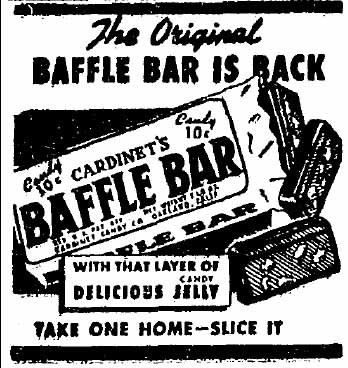
To make it easy for his cooperative pals, the man in question always used the same candy bar wrapper–ironically, a Baffle bar.

Posted in 1957, Caryl Chessman, Columnists, Matt Weinstock | Comments Off on Con game

“My Father, My Son”


April 18, 1957
Los Angeles


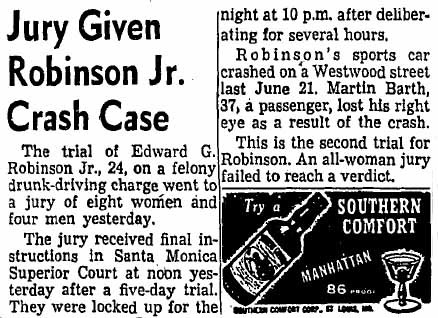
Someone at The Times had a sense of humor to place a story about a drunk driving case next to an ad for Southern Comfort. There really wasn’t much news to it, just the son of a Hollywood star, in trouble for being drunk once more.

The arc of his life is not a pretty one. The Times’ earliest stories are about birthday parties with other children of other celebrities. Then the stories turn dark: Injuring himself slightly when he was 16 and out in his expensive convertible, hitting two cars at Willoughby and Hudson avenues in Hollywood.

At 19, he eloped to Tijuana with the first of his three wives. His furious father threw him out of the house at 910 N. Rexford Drive and cut off his $70 weekly ($524.97 USD 2006) allowance. He and his wife split up and reconciled several times until she finally divorced him three years later.

He was arrested for drunk driving, being drunk and disorderly, and charged with holding up cabdrivers, although the jury deadlocked  in that case.

Here and there, he turned up in a few movies and TV shows: “Screaming Eagles” and “Tank Battalion”; “Laramie,” “Wagon Train” and “Gunsmoke.”

And he appears as Johnny Paradise with George Raft in “Some Like it Hot” in scenes set at a resort that was actually the Del Coronado.

By the time he was 38, he was so ill that his lawyer warned the judge he might not survive a 90-day jail sentence for drunk driving.

And in February 1974, at the age of 40, Edward G. Robinson Jr. was dead.

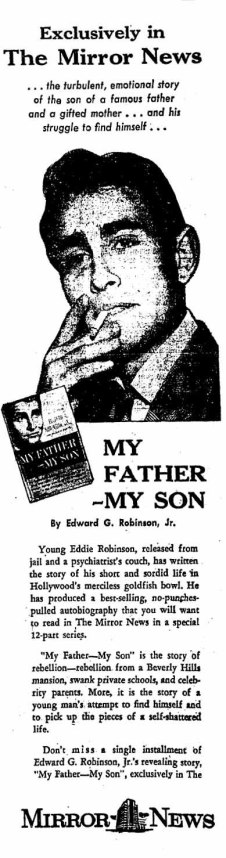
Somewhere in the midst of all his arrests, Robinson found time to write a book, “My Father/My Son,” which was serialized in the Mirror, despite terrible reviews.

In a biting commentary, Robert R. Kirsch wrote: “If Edward G. Robinson Jr. ever reads this book with the eyes of an adult it should seem apparent to him  that at least some of his difficulties stemmed from his unwillingness or incapacity to make his own way. Though he deeply resents it, he has done very little to prepare himself for what he says are his ambitions and ideals.

“He might try changing his name and making his own way as a start.”

Email me


Posted in 1957, Hollywood | Comments Off on “My Father, My Son”

Voices


Cliff Dektar was a copy boy for The Times in 1943. He worked for the Mirror from 1950 to 1956, when he left for ABC-TV.

On Jan. 2, 1951, Photographer Bud Gray and I were working the overnight Mirror radio car 91… after 2:30 a.m. the streets really are quiet until around 5 a.m. We had stopped at Hollywood Receiving Hospital and were headed north on Wilcox…I was driving.

The police radio came alive…69 meet 66 at Hollywood and Vine. Well, 69 was a sergeant and 66 was a district radio car and this was a most unusual call at 4:30 a.m. … so I decided to drive by since it was only a few blocks away.

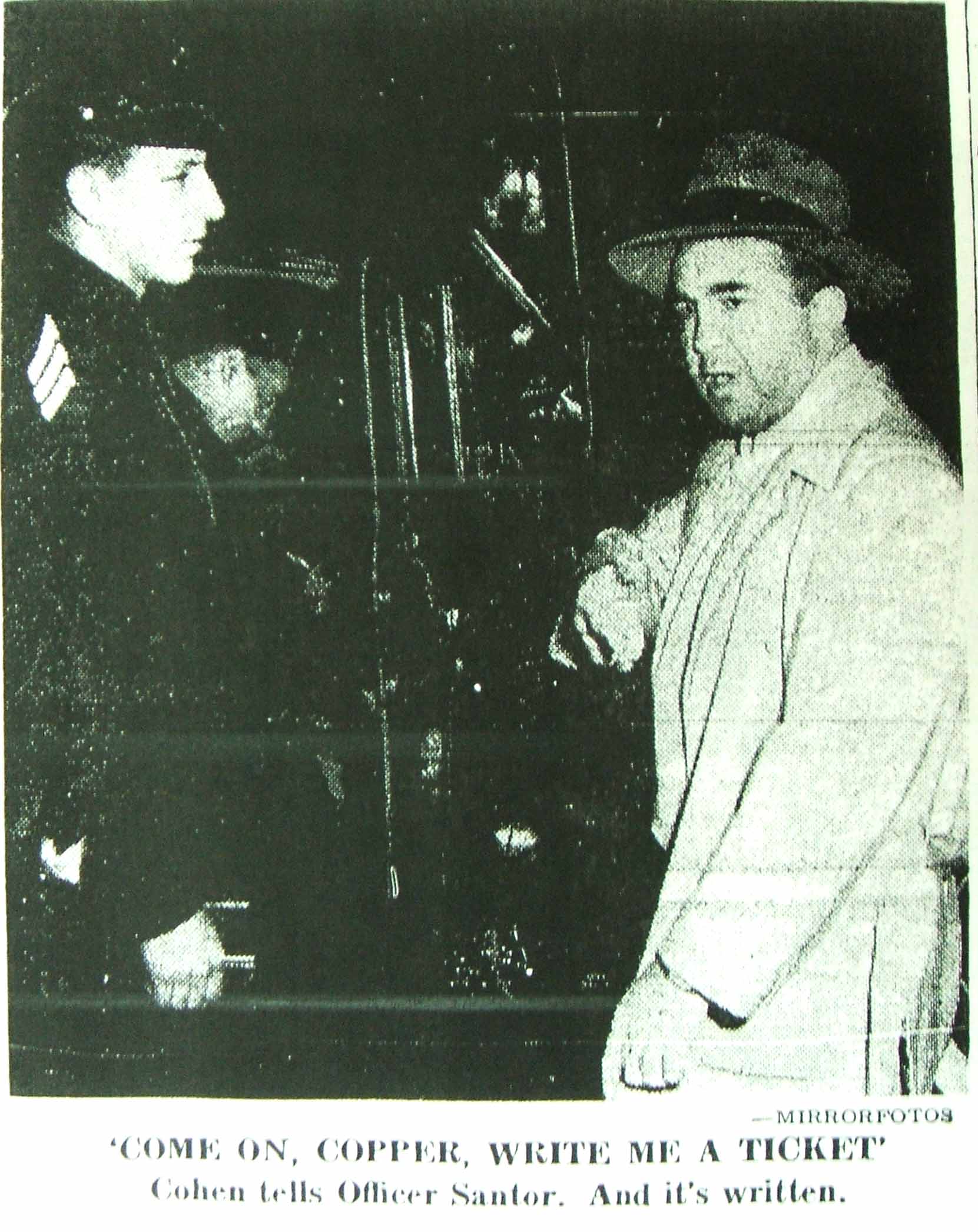
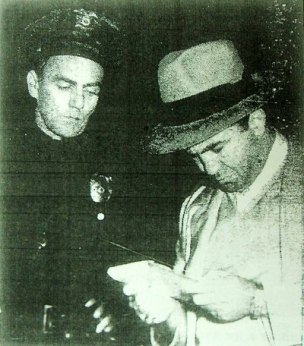
Amazing… standing on the corner by the  Broadway Hollywood was Mickey Cohen… wearing his hat as usual… and waving his hands with an LAPD Officer Tommy Hutton.  He was agitated.

I nudged Bud, made a U-turn on Vine and parked across the street in front of the Owl drugstore.

I turned off the ignition and strolled across Vine and listened… no note taking.

“If you’ll take off your badge and come into the alley and fight me fair and square, I’ll give you my wife and my car,” growled Mickey.

(The blue Cadillac and his wife were parked a few feet away).

Officer Hutton had written Mickey a traffic citation for not proceeding on a green light–he had stopped to purchase a newspaper.

Mickey refused to sign the ticket.

The sergeant arrived and explained to Mickey that by signing, he did not admit guilt, only to appear.

“If  you don’t sign, Mickey, we will take you to jail,” the sergeant explained.

Finally, Mickey signed, walked and entered his car, and drove south on Vine.

Meanwhile Bud Gray had set his Speed Graphic so he could shoot from the hip without focusing.

Bud shot four photos… all were excellent.

We jumped back into the radio car, called the office and sped to 2nd and Spring with the photos.

By the time  reporters in the police press room heard about  the incident, everyone  was gone, Mickey, the police and the few spectators.

We had a real beat… four good photos and details… all Page 1.

I thought of how wild Aggie Underwood, city editor of the Herald-Express, would be, as the Mirror guys had beat her team, again.

Email me


Posted in Hollywood Division, Mickey Cohen | Comments Off on Voices

A lack of curiosity

April 16, 1957
Los Angeles


Everyone seems to be wondering what became of Evelyn–everyone except her husband, Leonard. The way he tells it, on May 8, 1955, they took a car for a test drive along Mulholland, came back to their home at 217 N. Bentley Ave. in Bel-Air and she asked him to go to the store and get some tooth powder.

When he got back, she was gone. He found her car a few days later and decided he might as well sell it. He also figured that since Evelyn, at least in his version, used to disappear frequently on drinking binges, there was no point in filing a missing persons report.

Her friends and her brother, E. Raymond Throsby, began asking questions about where Evelyn might be, but never got any answers. Finally, they went to the district attorney’s office with a complaint.

The questions became more awkward, and eventually the police were asking what had become of Leonard, who was released from custody even though he was under indictment for murder. His car, a 1948 maroon coupe, was found May 5, 1956, at 2214 Washington Ave., with a bullet hole in the windshield in front of the driver’s seat and another in the interior.

At first, it seemed that Leonard had met an unfortunate fate. Police were unconvinced, however, since it was clear that the bullets had been fired from inside the car, and the search for L. Ewing Scott was on.

Scott remained a fugitive until April 15, 1957, when he was arrested in Windsor, Canada, while returning from Detroit with a new car. He had been passing himself off as Lewis E. Stewart and a customs agent noted that he had the same initials as the fugitive. Under Canadian law, an individual doesn’t have to give fingerprints unless he is charged with a crime, so Scott refused and his identification was delayed briefly.

He hadn’t been idle while he was on the run. As Leonard Spencer, he had been courting a teacher in Barrie, north of Toronto, police said. He had also been living in Ontario, Montreal and Oakville, sometimes using the name R.E. Scott.

To be continued…

Posted in Homicide | Comments Off on A lack of curiosity

Like gonesville

Billie Holiday, 1957, “Fine and Mellow”

Email me

Posted in #Jazz, #video | Comments Off on Like gonesville

The case of the new courthouse


April 15, 1957
Los Angeles

The Times features the new courthouse rising at 1st Street and Hill in the Civic Center.  After cataloging  the materials (Italian  marble,  red granite from Texas  and ceramic veneer from Springfield, Calif.)  The  Times’ Ray Herbert notes the architects, who include Paul Revere Williams, J.E. Stanton and Adrian Wilson, and says the building is designed to last 250 years.


Did The Times note that Williams was first African American west of the Mississippi to be a certified architect? No. Did The Times note that Williams was the first black member of the American Institute of Architects? No.

Let’s move on.

The Times says that the Los Angeles County Board of Supervisors approved a proposal for a new courthouse the day after the Long Beach earthquake in 1933.  Bureaucracy being what it is, in addition to a lack of money, disagreement over the location and World War II, the groundbreaking was delayed until March 26, 1954.

One of the most interesting aspects of the new courthouse is the massive civic works project to lower Bunker Hill. The Times says that 520,000 cubic yards of dirt was removed in excavating the site of the courthouse. But it also says the Grand Avenue entrance will “abut on 15 feet of solid earth under Grand Avenue until the street is lowered.”

I have heard all sorts of figures thrown about for how much Bunker Hill was lowered–anything from 30 feet to 90 feet. This is the first reliable figure I’ve come across.


The courthouse formally opened Oct. 31, 1958.

Of course, I always think of the building as an establishing shot for “Perry Mason.” But that’s just me. (And no, there aren’t any windows like the one used in this opening sequence for the TV show).

Posted in Downtown | Comments Off on The case of the new courthouse

Forest Lawn


Easter Sunday seemed like a good time to drive over to Forest Lawn and visit a few graves. I bought some flowers and went off to find Norma McCauley and Caren Lynn "Sande" Crabbe.

The woman at the front gate was extremely professional and helpful, and she gave me precise directions. Norma is in the Columbarium of Sunlight and Sande is in the Sanctuary of Celestial Peace. I was surprised at how many people were simply spending time at the hillside graves, with folding chairs and flowers. A couple of young men were partway up a hillside with a Marine flag.

The Columbarium of Sunlight is quite pretty and I had it entirely to myself. While I was in the area I found the graves of Earl Carroll and Beryl Wallace, who died in a plane crash, Mary Pickford and Atwater Kent, which reminded me of "Millionaires’ Row" up at Mountain View Cemetery in Oakland.

The Sanctuary of Celestial Peace was a bit different. I went in the wrong door and in wandering around, stumbled across the crypt of Art Tatum.

In fact, it was quite a day for musicians, as I also found Alfred Newman and Max Steiner, who had been sent a large floral wreath. There were roses on the crypt of William "Hopalong Cassady" Boyd.

"Sande" Crabbe is partway up the wall and while I was getting water for the flower I ran into a couple of women. It turns out  Paramahansa Yogananda of the Self-Realization Fellowship is in the same building and they were meditating in front of what appeared to be his crypt. I didn’t want to interrupt them to find out.


One of the crypts was elaborately decorated for an Easter egg hunt. I have seen all sorts of grave decorations in searching for Los Angeles history, but this was a first and very nicely done.
Email me

Posted in Cemeteries, Forest Lawn | 1 Comment

Voices

          In 1957, saxophonist Dave Pell was the leader of the Dave Pell Octet, the house band at the Crescendo on the Sunset Strip. He recently reminisced about performing there with comedian Lenny Bruce. Pell performs once a week with Johnny Vana’s Big Band Alumni at Los Hatos in the San Fernando Valley. Lenny Bruce died Aug. 3, 1966, at 8825 Hollywood Blvd. at the age of 40.
  

Well I was lucky, very lucky. I was there for five years and Lenny was there for almost the same amount of time. It was one of greatest moments of my life. He was quite a man. Incredibly funny, loving, kind, sweet… all the things that nobody ever knew about him. Nobody took the time to know about him. He was really a lovely guy, a lovely man, a funny man. We had a guy named Jack Sheldon in the band. Sheldon was the phenom of our time. A very funny cat. He and Lenny were dear friends. They used to do crazy things together.


We were a Be-Bop band that played for everybody.

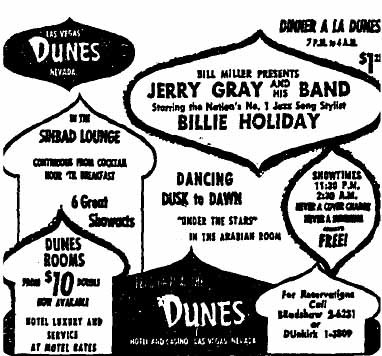
Gene Norman (the nightclub owner) … says: “You have a home here… Stay as long as you wish.” It was the time where Mickey Cohen used to hang out at the club. He used to have his boys there. They were dear men. As big as gangsters as there ever were. He loved Lenny. He was their favorite of all.

We played for all the acts. Johnny Mathis and we played for the Mills Brothers and, you know, people of that nature. People played the club with us…. Lenny was in and out of jail every other day. He was there.

Then the narcotics people were hanging out. They were dear friends. They were after the guys selling to the band and Mickey was there every night. With Lenny there; he was changing the show every night and the band was absolutely loving it. Most comedians worked to the bands because they gotta hear the same material night after night. If they could make the band laugh then they knew they were funny… Lenny played to us. He and Jack Sheldon would do dialog together.

Lenny would say: “Did you see Mickey’s here tonight?” We’d be on the floor. A very hip band: Marty Paich on piano, Mel Lewis on drums, Buddy Clark on bass. It was the best band in town by far. We’d play the dumb Mills Brothers. We’re playing “You Want a Paper Doll.” Playing almost back to Dixieland and playing it straight. And Bobby Darin. Just an incredible thing.

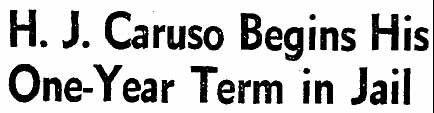
The funniest thing. Lenny Bruce and Jack Sheldon decided to go on the amateur hour…. Do an Al Jolson song. Something was all set up and they’d play it and wear black makeup. They did the show… it was a car dealer that had the show … I wish I could remember. On Sunday morning… Jack and Lenny were going to be on and we were all set up to watch it. (This was apparently Compton car dealer H.J. Caruso, who was indicted on charges of forgery and grand theft in June 1957).

 They got on. They didn’t do the show they auditioned with. It got a little dirty and funnier and funnier and Lenny is yelling “Caruso is a thief!” “He doesn’t give good deals on cars!” They couldn’t get him off soon enough. They said, “This isn’t the way they auditioned.” They finally figured out it was Lenny Bruce.
I never got over that one. Funniest thing that ever happened with the band.
Every night, Lenny was a magnificent mind. If he took off, we had Mort Sahl. He would do a half-hour on Lenny Bruce. And they put him in jail and he’d try to behave. He got put in jail 50 times because they were trying to clean up the nightclub circuit.

Just the greatest time of our lives.

Lili St. Cyr, a  beautiful lady. Harry Betts was a trombone player with Kenton. He said, “Well you know she has this one little piece that needs a violin.” So we made him bring a violin. He played a solo behind her (Pell hums something from Tchaikovsky’s “The Nutcracker”). Lenny would come up just to see the guys laughing… He didn’t play the violin well. She was dancing with all these lights. She was never naked, she wore a skin thing. We weren’t going to see nothing. Lenny Bruce made so much of it. God he was funny.

Between sets, they turned over people so fast, we’d go downstairs and play poker for an hour.


Johnny Mathis was doing seven or eight shows a night. People were around the block. Gene Norman had signed Johnny Mathis 10 months before he had a hit. He comes up with all his hits in one short time…. He was working for $350 a week… around the block crowds are waiting to get in. We would do a fast 20-minute or 30-minute show and the next one would start. They’d empty the house and do another one.

And of course Lenny … He’d say: “I can’t be very funny tonight I’m down to 10 minutes.”  So hip and so sharp… and I look back. Damn that was fun. Lenny was a marvelous cat and got in trouble and couldn’t handle it and died very young. His wife a very nice gal and a homemaker and tried to make him straight.

Jack Sheldon and Lenny Bruce. Jack almost started his career with Merv Griffin… doing comedy. All the timing he got from Lenny….

Five years. We had a ball… a lot was happening then.
When Lenny Bruce was downstairs, Mort Sahl was upstairs. When Lenny had to go to jail we got Mort Sahl… He’d read tabloids, and then do a show.

It was sensational. Edie Gorme, all the good singers. Everybody who was hot at the time was there with us. Marty Paich, in 1957 he couldn’t have been over 21 years old. Marty turned out to be one of the most successful jazz and big band arrangers of that time. We had him and Shorty Rogers and we never had the same band two nights in a row. The deal was you could take off any time as long as I approved the sub. We had record dates so there was a different band every night….

Bobby Darin says, “The band is sensational. It’s the best band I ever had.” He comes in the next night, it’s totally different. “The band is sensational.” Half the band was back the third night… He says “Dave I can’t handle it.  I can’t kid with the band, it’s never the same guys twice.” They’re playing for scale, so I say, “They can take off anything they want as long as they are the top guys.” The best band I’ve ever had….

Those things were so much fun… That whole club situation….

The club was on Sunset in the Playboy Building…. and then we were right at the middle of the strip. Across the street was Ciro’s, right across the street. Little nightclub on the West Coast. Ben Polack (?) had a Dixieland club that ran strippers. He had a good Dixieland band. Great players. We’d play the opener or closer. “Mountain Greenery.”

He booked smart in those days, three or four shows a night….
 

I
t was a great home for me. I was working at a record company during the day. It would be the Dave Pell band and I’d be at a record date. Gene Norman and I went to high school together (so that wasn’t a problem).

It was a record company. I’d record in the afternoon and rush over to play the first gig at the club. I’d be tired but had a such a good time… such an incredible time. Not a dumb gig at a nightclub, it was the hit nightclub and Lenny being there with us killed us.

It was the funniest thing going day by day. Mickey Cohen…. Lenny would come and play to them. Call them the stars of the government…. highest government officials in town and Mickey Cohen… everything was so cool.

I used to be in  the record business. Sold them in the supermarkets for 99 cents. I’d record “Dave Pell Plays Benny Goodman,” “Dave Pell Plays whatever.” I must have made 50 albums, “The Best Songs of Italy.” I’d go to England for a couple weeks and record 20 albums. Put them in Kresge, Woolworth, the same albums but change the songs on each one…. It was the beginning of the compilation disc.

I’d have 75 string players over in England. The albums were gorgeous… The label was TOPS records… I put out 20 other labels for everybody else. Everybody had their labels. You’d go into Sears and there’d be a rack near the door. I sold millions. People never had to go to the record store.

I’d work at night.. Edie Gorme would come to sit in. People didn’t realize it was her. Didn’t recognize her… They’d wonder who is singing with the band?


It’s marvelous, at 10:30 every Tuesday morning… at Los Hatos at Balboa and Nordhoff… They can’t get in the joint. Oversold every Tuesday morning. We play till 12:30. The band is excellent… Johnny Vana’s Big Band Alumni… Everybody played with the big bands, Stan Kenton, Buddy Rich…. producing a new album we did live a couple of weeks ago…

Lots of bands out there… They say we’re the Glenn Miller Band, or the Harry James band. All picked up for the night. They sound fair. This band plays all the bands… We have a great band… One of the guys got sick, so they asked “Pell, would you like to play?” Love to. I don’t have to set up, don’t have to bring mikes. Just sit in the band. I love it.

The other day they gave me a red tie that I can keep so when I play around town I don’t have to borrow a tie… It’s a good band.

A guy came in and recorded it… We only get a one-hour set and then a 20-minute set. He figured he could do an album in two days… The album was almost really done the first morning it was so good. It was fun and we go out and do the shows and the band is very happy. We call it a rehearsal, so the guys can keep their chops up.

Lots of clubs tried to do that but they don’t seem to get the crowds that this thing does. People still really want to dance, do the jitterbug. It’s not rock ‘n’ roll.

Sound clips courtesy of Davepell.com

Email me.

https://ssl.google-analytics.com/urchin.js    _uacct=”UA-18065-1″; _uanchor=1; urchinTracker(); if (typeof(setPostToken) != “undefined”) { setPostToken(‘J7Yb6xEBAAA.kuAnviL6EEcCqPetJxhIoz0GE4tc5seI6T4hOe2ubVA.-wXbyJhuyf1R-OLPfm6rvA’); }

html hit counter

Posted in #Jazz, Mickey Cohen, Nightclubs, Sunset Strip | 5 Comments

The Wife-Saving House

April 13, 1957
Los Angeles

By Larry Harnisch

Step back with me for a moment to that 1950s home the McCauleys built, one of those futuristic places that practically took care of itself and just needed a little soap and water. You know, tall ceilings, lots of glass, a big brick fireplace in the living room and radiant heating in the slate floor.  The walls and ceilings are birch that never has  to be painted. When it was written up in The Times, they called it “The Wife-Saving House.”

Don’t rush over to 1100 Somera Road to look for it. The home is gone now; torn down by 1967 and maybe it’s just as well.


It’s the middle of the night and quiet now. July 5, 1955.  Come on in. They never lock the doors around here. Everybody–well almost everybody–is asleep. The three boys are in their bedroom, where the bedspreads, with pictures of the circus, match the drapes. There’s a maid, too, somewhere around here, and the family dog, Cinders.

Nice, modern home, isn’t it? Just the kind you’d expect for a wealthy Los Angeles contractor to build for his daughter. Let’s push open the door to the bedroom. Look at those big windows. Quite a view. Be careful of all the blood.

There she is. Don’t touch anything. Just look. They’ll find her soon enough. That’s her quilted silk robe across the foot of the bed.  She never made it.

Oh, that’s the dog howling. Here comes the maid to let it out. She’s going to go back to bed as if nothing is wrong.

The woman lying there is named Norma and she was 33. She’s still wearing the red cocktail dress from the Fourth of July barbecue at her parents’ house. That thing knotted around her neck is a white lace stole beaded with pearls. She was stabbed 11 times, but the one in the left chest, just below the collarbone, is the one that killed her. It went all the way into her lung. Most of the rest are from trying to protect herself.

That’s how she landed, face-down on the chaise longue with her knees on the floor.

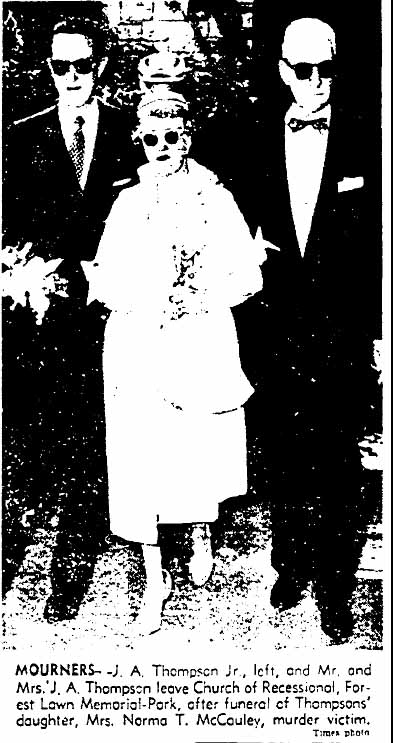
Norma’s father is J.A. Thompson and he’s a big builder here in Los Angeles. She went to USC and was an Alpha Gamma. Married? Not any more. Her husband was named Frank McCauley, a former Army Air Forces major and a flying ace with the 56th Fighter Group. They got married in 1945; a big society affair. They started having children: Craig, who’s 7; Kirk, who’s 5; and Kevin. He’s 2 years old. She was raising her boys and was in a couple of women’s clubs that did charity work.

I guess she had her hands full with a house and a husband and the kids. Norma got the idea of hiring a UCLA student to help around the home. His name was John Russell Crooker, a very bright law student.  He worked on the school paper at Pepperdine and won a journalism award. He’s not a kid, though. John is 34 and separated from his wife. Has a couple of children. His wife said he practiced his cross-examination technique on her until she was afraid to say anything to him.

There’s a stack of his love letters over there. Leave them alone; the police will find them in a couple of hours. When the detectives go to pick him up at his apartment, they’ll find another stack of letters that she wrote to him.

One of hers says: “Hello, Sweetheart, I love to think of the times we held hands, listened to KFAC dinner music  and looked at candlelight. Love me as I love you, darling and it will work. N”

Down the road at his murder trial, a cocktail waitress is going to testify that Norma and John were quite the romantic couple in the fall of 1953 and early 1954. Another thing that will come out in court is that she got a divorce in March 1955 after a year of bitter legal disputes. I’ll let you do the math.

The detectives are going to question John for 14 hours straight until he writes a confession in longhand on a yellow legal pad.  He’s got some legal training so he won’t tell them anything to start, but eventually John is going to crack.

He’ll say that he drove up to the house yesterday afternoon and saw Norma and her brother, J.A. Thompson Jr., leave for a Fourth of July party at her parents’ house, 773 Stradella Road, in Bel-Air. Since her parents were out of town, Norma was hostess for the party. While everybody was gone, John drove down to UCLA and parked his car, then hired a cab to take him back.

Remember how they never lock the doors around here? He hid in the closet of the boys’ bedroom and waited. About 9 p.m., she came back and put the children to bed, then returned to the party with a family friend who brought her home around midnight and left right away.

A little while ago, John slipped out of the closet and went into Norma’s bedroom. John said they talked.

Things between Norma and John had deteriorated since their romantic days. She told friends she was afraid of him and had been giving him money; a little bit here and there and $300 more recently.

They talked for an hour, then Norma fell asleep.

John will write in his confession: “When I tried to wake her up to continue our talks I could not arouse her and I became incensed. I started to shake her and choke her with both hands. She started to scream. I put my left hand over her mouth to muffle the scream and reached in my right-hand coat pocket for a knife. I had found this earlier in the room. I stabbed her several times with the knife as she tried to fight me off. She bit my left hand and scratched my chin.

“I then knotted the stole and twisted it with both hands until I was sure she was dead.”

John didn’t leave right away after he killed Norma. He sat here for an hour, thinking about the future.

Finally, covered with blood, he walked back to his car at UCLA. He drove home, and he’s probably burning his clothes in the incinerator right now.

At his trial, he’s going to say that the detectives hit him in the stomach. He’s going to say that he was trying to protect Norma from blackmailers because he knew she’d gotten an abortion a month ago and that her ex-husband would use it against her to try to get custody of the children.

Her parents are going to say that John was only blackmailing her. After Norma let him go, they hired him as a houseboy. They say they were merely trying to help him out.

  The judge is going to sentence John to the gas chamber. They were about to execute him on April 12, 1957, then granted him a delay. In fact, he will  never be executed. Gov. Pat Brown is going to commute his sentence to life without the possibility of parole. John will eventually be freed and Brown is going to call him a reformed man.

Well, it’s morning already. Norma’s son Kirk is going to wander in here in a moment to check on his mother. He’s going to tell the maid, “Mommy’s not feeling very well.” The maid will call Norma’s sister-in-law and she’ll call Norma’s brother. And he will call the police.

They’re going to fix her up for her funeral at Church of the Recessional at Forest Lawn Memorial-Park. Open casket. Norma will be in a white dress with a blue net stole and she will be holding a bouquet of orchids. The Rev. Haven N. Davis of Westwood Presbyterian Church will say:  “To know her was to love her. She was always considerate and thoughtful of others.”

Ready? Let’s go, then, and  watch the tragedy unfold. Maybe we should stop by Westwood Presbyterian on the way back.
Email me

Posted in Homicide | Comments Off on The Wife-Saving House

Strictly: Human Interest

April 8, 1957
Los Angeles
 

Latin Holiday
by Pepe Arciga

1957_arciga_3Here's how the anguished voice of a stricken lady, Norberta Venegas, pleaded for what should not be perhaps a lost cause. This she said to me in hesitant Spanish:

"Senor Arciga… I do not know how to begin. My name is Norberta Venegas and I live alone here at 2827 Rokeby St. in Los Angeles.

"One week ago my daughter, Maria, she is 21 years old, and I had a disagreement. Not very serious, Senor Arciga, and now she has gone. I don't know where.

"The other day I believe I had an attack of the heart. Now I am in bed and cannot move. My husband, Vicente Herrera, is far away. I think in Mendota.

"Perhaps you can say something in your radio program or in your column so that my Maria returns. I will forgive her, of course. Now please tell me how much I owe you for this service."

And there you are. Words of a mother who prays so that family spats shouldn't be home-breakers. As this goes to press, wandering Maria (last named Rivera) was being sought all over.

WANTED: A MARIACHI BAND

Now the voice of Senora Julia Ramirez, daughter of a prominent mortician in East Los Angeles. Dona Julia, always cocking a sharp eye when someone's welfare is at stake, delivers her message to Arciga:

"My good friend, Senora Muriel Scott, who lives in Rivera and is very active with the American Legion Post there, wants to do her bit, on April 16, at the Long Beach Veterans Hospital.

"She wishes, Pepe, to take over there a band of mariachis and serenade those unfortunate GIs. Do you think, Pepe, there's a mariachi band that would want to go see them and play for a while? Mrs.  Scott can be reached evenings at OX 9-2075."

That, Senora Ramirez, is a most noble idea. As to the availability of mariachi bands, it's been said that outside of Mexico City and Guadalajara, this li'l old pueblo of ours is the world's third-ranking mecca for mariachi balladeers.

The question, now, who'll volunteer? Please raise your right hand.

Note: The Daily Mirror is pleased to introduce another generation of readers to Joseph "Pepe" Arciga, a writer for the Mirror and The Times, and a personality on Spanish-language KALI-AM. Writing in a chatty, familiar style, completely different from Paul Coates or Matt Weinstock, Arciga vividly captures a portion of L.A. that was mostly ignored by the mainstream press.

ps: Maria, go home!

Update: Mrs. John Jamar, 621 Venice Way, Inglewood, like una buena Samaritana, puts in her dos centavos' worth en la siguiente forma:

"That story of yours about the stricken lady Norberta Venegas and the squabble she had with her daughter…. I know what this is like…. I sincerely hope she is reunited with her daughter."

Por fortuna, Senora Jamar, all is now well. Not only have they reunited, but last reports indicate that both mother and daughter plan a free-for-all taco shindig for the buenos vecinos of the neighborhood.
Signed, Pepe.

https://ssl.google-analytics.com/urchin.js
// <![CDATA[
_uacct="UA-18065-1";
_uanchor=1;
urchinTracker();
if (typeof(setPostToken) != "undefined") {
setPostToken('8MsDDxIBAAA.kuAnviL6EEcCqPetJxhIoz0GE4tc5seI6T4hOe2ubVA.dd9EjrOuQC2z4gQFkpxT8A');
}
// ]]>

Posted in 1957, Columnists, Pepe Arciga | Comments Off on Strictly: Human Interest