Silver Spoon

April 12, 1957
Los Angeles


By Larry Harnisch

Those who say you can never be too rich or too thin never heard of Caren Lynn Crabbe, the daughter of "Flash Gordon" star Buster Crabbe, a young woman of wealth and privilege who weighed 60 pounds when she died at the age of 20.

Crabbe, who was nicknamed "Sande," died at the home of her grandparents, Mr. and Mrs. Thomas Held, 840 Napoli Drive, Pacific Palisades.

A 1954 graduate of the Marlborough School for Girls, Sande had been attending USC and was a member of Kappa Alpha Theta, the Ticktockers of the Los Angeles Charity League and Silver Spoons of California Babies and Children’s Hospital. She dropped out of college in March, because "she just couldn’t make it," her father said.

Anorexia nervosa was apparently a mysterious affliction in 1957. The Times reported that she died of "malnutrition brought on by an emotional disturbance." The family said Sande had been losing weight for about a year. Still, her death was unexpected, her doctor said.

"It was a complete surprise," said Dr. Carl D. Strouse. "That is why I didn’t sign the death certificate."

After an elaborate funeral at Little Church of the Flowers, Sande was buried at Forest Lawn wearing a peach pink nylon gown, The Times said.

"The coppertone metal casket bearing the girl’s body was blanketed by a profusion of floral sprays and wreaths–more than 75, mortuary attendants said," according to The Times.  "Following the playing of the ‘Ave Maria,’ the casket was taken to Forest Lawn for emtombment. Members of the family entered the mausoleum but they remained only a few minutes."

Sande was survived by her parents; sister Susan Allen Crabbe, brother Cullen Held Crabbe, who was appearing in the TV show "Captain Gallant of the Foreign Legion"; grandparents Mr. and Mrs. Thomas Held, and grandmother Agnes Akins.

Email me

Posted in anorexia, Forest Lawn | Comments Off on Silver Spoon

Look to the Skies!

April 11, 1957
Temple City

By Larry Harnisch

Early that morning, about 4:40 a.m., a sonic boom that was perhaps from some secret aircraft shook the San Gabriel Valley awake, setting off burglar alarms and breaking a window at 275 N. Hill Ave. in Pasadena. It was, the Mirror noted, "the first sonic blast reported in the metropolitan area at night."

It was another day of anxiety for Los Angeles residents worried about a Soviet attack. Hadn't they been just been warned that 90% of the people in the metropolitan area would not survive a nuclear blast?

As he left for school that morning, 10-year-old Patrick Murphy noticed a crater 2 feet deep in the backyard of his home at 8831 Greenwood in Temple City, but he didn't say anything to his parents, Oscar, a venetian blind salesman, and Virginia, until that evening when he got home.

At 2 a.m., Capt. Robert Jackson of 551st Ordnance Detachment arrived with three enlisted men and two sheriff's deputies. Jackson's verdict: Possibly a small missile or a meteorite.

Jackson dismissed the notion that the crater was the work of neighborhood children. "If a child had dug it, we'd know it by now," Jackson said. "There would have been knee marks around the crater."

So the men began to dig–carefully, since what was down there could be an unexploded bomb.

More military officers arrived, including two men from Air Force intelligence who said very little, according to The Times, except: "There's definitely a hole in the ground."

The excavation turned up a chunk of concrete marked with yellow paint that was unrelated to anything military, experts at Fort MacArthur said. The men found a rusty baby buggy, a long piece of garden hose and a tin can. After digging in loose, sandy soil for several days, the soldiers excavated a hole 15 feet deep and 10 feet in diameter. Using sensors and a mine detector, they determined that there was nothing of interest to a depth of 10 feet beyond the bottom of the hole.

Although they abandoned the search, Lt. T.D. Smith and Jackson insisted: "Whatever it was, it came from the sky." Smith later said the crater "was probably made by a small meteor which disintegrated after it burrowed into the sandy soil."

Note: Some news accounts give the location as 8831 Greenwood while others report 8331 Greenwood, an address that does not exist.

Email me

Posted in 1957, Temple City, UFOs | Comments Off on Look to the Skies!

The Education of Mrs. Snethen

April 10, 1957

Los Angeles

By Larry Harnisch

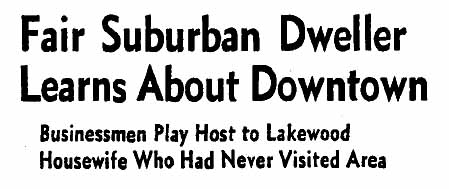
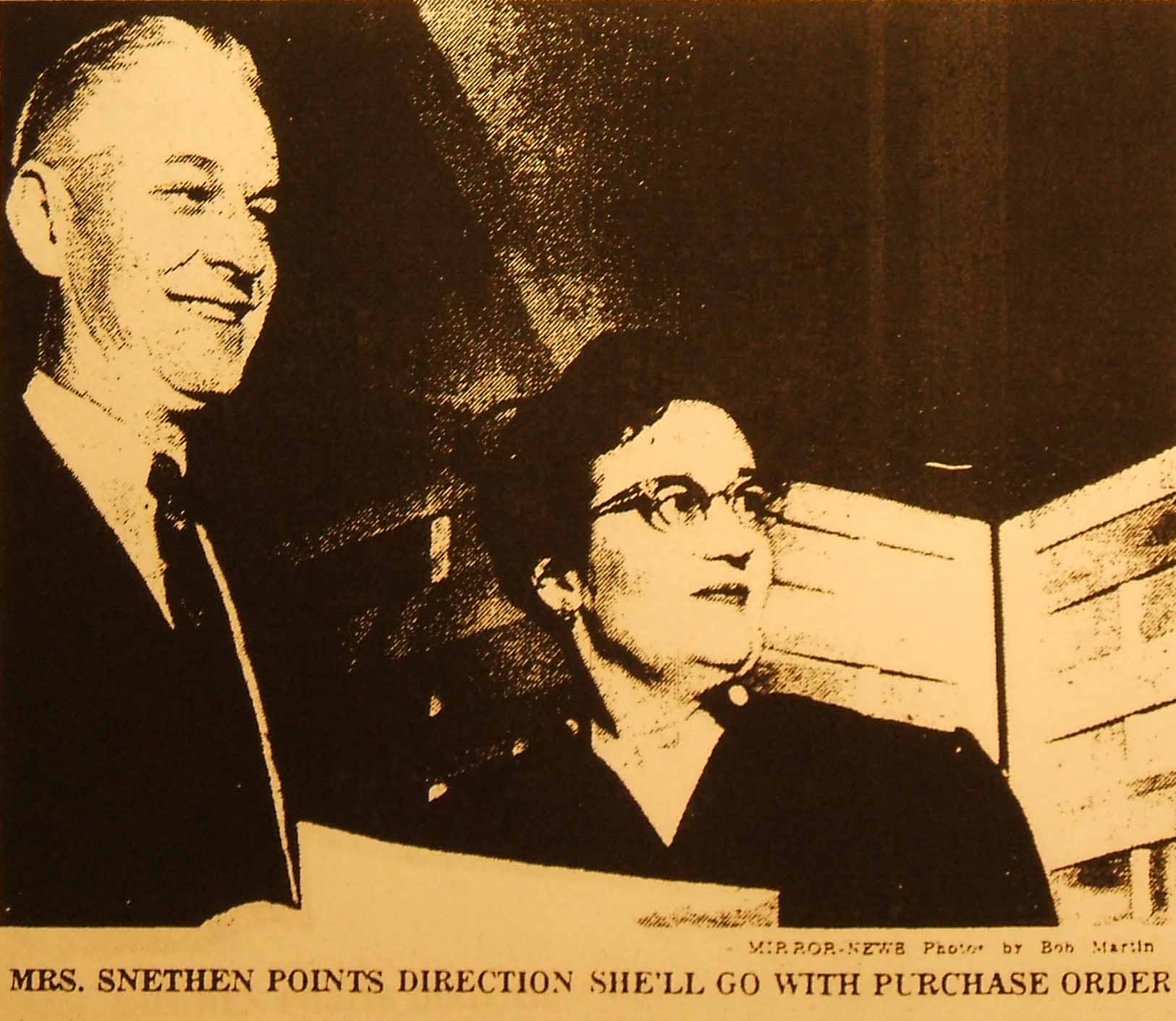
Mrs. Andrew Snethen, 39,  of Lakewood (remember this is the era when married women had no first names), a recent arrival from Omaha, Neb., had never been to downtown Los Angeles, had no intention of ever visiting downtown Los Angeles and said exactly that–to Newsweek magazine for a feature story on suburbia.

The next thing she knew, Snethen, a comptometer operator for a Long Beach dairy, was being whisked downtown via limousine along with a companion, Mrs. Dalbert Clodfelder, as guests of the Downtown Businessmen’s Assn.

"Why, I never realized it was so easy to get downtown on the freeway," Snethen said. "I was impressed, too, by the selection available in the downtown stores."

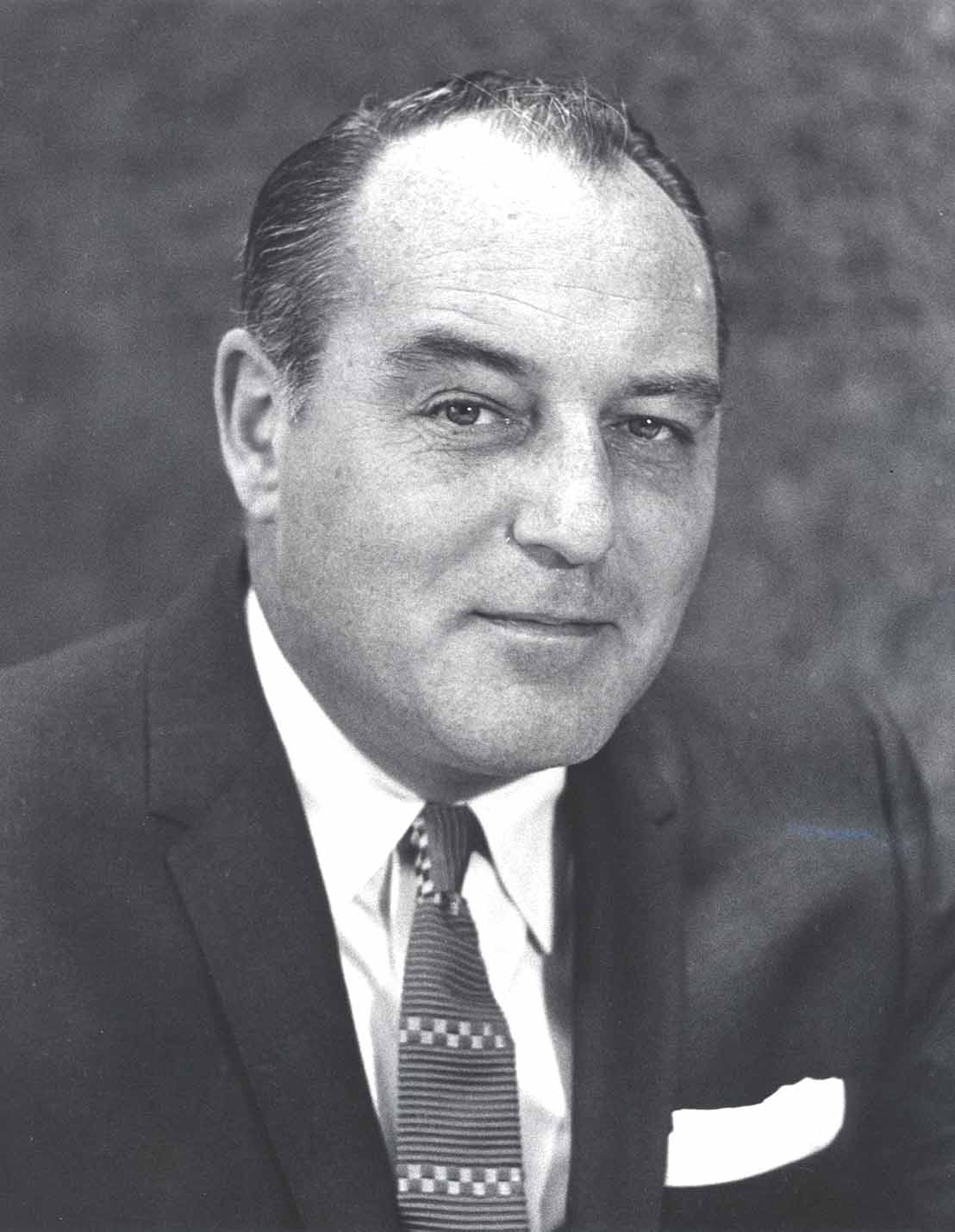
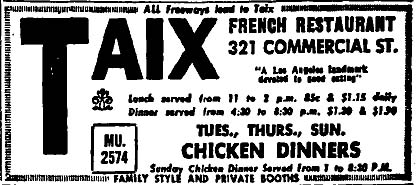
Accompanied by Burton C. Rawlins, above, head of the businessmen’s group, Snethen was taken to lunch and  escorted to the roof of the Union Bank  Building at 8th Street and Hill for an 11th-floor view of the city–recall that in 1957, no building could be taller than City Hall.

Not bad, Snethen said, noting that Omaha and Los Angeles were much the same, although Los Angeles was much bigger. She also pointed out that Omaha’s Medical Arts Building was 17 stories high. And because Omaha had converted to buses, Snethen asked: "Do they have streetcars here?"

Snethen, the mother of five children and the wife of a bakery route driver living at of 4016 Camerino St., was given a $50 ($358.26 USD 2006) gift certificate. Since it was only valid at a downtown store,  the  businessmen’s association ensured a second trip.
Burton C. Rawlins died March 24, 1974, at the age of 67. There is no further information on Mrs. Andrew Snethen.

Email me

Posted in Downtown | Comments Off on The Education of Mrs. Snethen

Smog Is a Four-Letter Word

Paul V. Coates
Confidential File


April 10, 1957

And it is a comparatively new word in the American vocabulary.

The 1953 Webster in my office defines smog as "a fog made heavier and darker by the smoke of a city."

But already it's an outdated definition.

Because every day we're learning more about it–it's moving that fast.

It has reached a point today where "smog" jokes here have lost their funny flavor.

And technically worded newspaper articles–with a hundred accused causes and a thousand questionable cures–have become painfully required reading to the man on the street.

He's read quotes, optimistic and pessimistic, from doctors, manufacturers, incinerator salesmen and weather experts.

And he, if he's anything like me, must get a little confused by all the double talk and plain nonsense being circulated.

I did, however, read a couple stories in the past week which sounded authentic.

One quoted Dr. Francis M. Pottenger Jr., chairman of the county medical association's smog committee.

The other quoted Dr. Leroy E. Burney, our nation's surgeon general.


BREATH OF DEATH

If these two men know what they're talking about–and I assume they do–their remarks add up to a singularly terrifying story.

Dr. Pottenger revealed the results of a county medical association survey stating that more than 90% of 1,181 surveyed doctors have detected symptoms of a smog complex in their patients here.

He said 40.7% of the doctors stated that they had recommended to certain patients that they leave the so-called smog belt.

These statistics are unpleasant but the doctor's next comment was thoroughly frightening.

He said that physicians closely associated with neoplastic (cancer) diseases were overwhelmingly of the opinion that air pollution contributes to malignancies.

In the simplest, most awful terms, that means smog causes cancer.

This is the belief of pathologists (83%) X-ray men (81%) and physicians specializing in cancer treatment (80%).

An appalling conclusion such as that would immediately make you think that we're running out of time.

That we have to mobilize the forces of scientific research to end the menace in our atmosphere. That we have to do it quick. And that we have to do it at any cost.

But yesterday, Dr. Burney's statement was released to the press.

If the people of Los Angeles think they can get rid of smog, he implied, they're just kidding themselves.

He added that in his opinion there was no immediate hope of even partial relief.

And when you tally those two stories up, they equal this:

"If you want to live a few years longer, get out of town."

The surgeon general's direct quote, from a letter to congressman Joe Holt, was:

"To be realistic, the people of Los Angeles should be candidly informed that there is no practical way to eliminate smog. There is little probability of alleviation in the immediate future."

WHY GIVE UP?

These are cold-blooded words.

The only hope we have is in continued research until we find the antidote for this posion.

But the good doctor seems to suggest that we give up trying to hard and reconcile ourselves to existing in a filthy haze.

I think it's a lousy suggestion.

If we take it, if we give up the battle against smog, then the findings of the county medical association's committee are too awesome to contemplate.

Note: Dr. Francis M. Pottenger, an Ohio physician, moved to Monrovia after his wife developed tuberculosis and he dedicated his life to finding a cure after she died in 1898.  He  founded the Pottenger Sanatorium and was president of the American College of Physicians. He died in 1961 at the age of 91.

His son, Dr. Francis M. Pottenger Jr., who also worked at the sanatorium, died in 1967 at the age of 65. Shortly before his death, he wrote a letter to The Times advocating electric autos.

Email me

Posted in 1957, Columnists, Environment, Paul Coates | Comments Off on Smog Is a Four-Letter Word

15 Minutes

April 9, 1957
Los Angeles


By Larry Harnisch

He was 4. His mother dressed him in a coat and tie, and took him to the airport. Out to the airplane. There were lots of people there. Men with cameras. A lady with black hair, all dressed up, came down the steps from the plane. They took her picture. She went back up and did it again. They took more pictures.

Someone handed him flowers and told him to give them to the lady with black hair.

He went up to her and gave her the flowers. She smiled and messed his hair. She rubbed his cheek and touched him under the chin.

Now what? Someone signaled to him to kiss the lady. So he did. The photographers took his picture. Then the young man wiped his mouth with the back of his hand as he walked back to his mother. He didn't see it, and he certainly didn't understand it, but the lady gave him a "wait till he grows up look," The Times said. Then she began talking to reporters in less than perfect English.

And so  went the encounter between  4-year-old John Minervini, on behalf of the  Italian Women's Club, and 22-year-old Sophia Loren, who had come to Hollywood to film "Desire Under the Elms." (Her first American movie, "Pride and the Passion," had been shot in Spain, and the next, "Boy on a Dolphin," was filmed in Greece.)

She was happy to slink and pose for photographers, and engage reporters in a fractured conversation. In the Viking Room of SAS, Loren "held court in a deep chair that pivots. She crossed her legs and  pivoted  languorously," The Times said.


She dispelled many of the statements in her official biography.

"No, she does not eat spaghetti every day. No, she does not owe her voluptuous figure to the chocolate bars GIs gave her when she was a skinny kid of 8."

What did she plan to do when she wasn't working?

"When do I not work?" she asked.

One of the reporters asked if she had read "Desire Under the Elms,"  Eugene O'Neill's play, adapted for the film by Irwin Shaw.

"She said yes," The Times reported.

A year later Loren told writer Joe Hyams (who noted her measurements as 37 1/2-22-36) that she wished she could "get rid" of her body. "It is a distraction to photographers," she said. "I would like all pictures taken of me in the future to be of my head only."

And what of John Minervini? Let's see if I can find him. Stay tuned.

Update: John Minervini e-mails he remembers meeting Loren (not bad for the age of 4) and adds that they also made Life magazine. Thanks, John!

Email me

Posted in 1957 | Comments Off on 15 Minutes

Silver Starlight of G. Louis Gabaldon

April 8, 1957

Paul V. Coates

Confidential File


I found another hero today, a local boy who made good in battle.

What he did on the island of Saipan perhaps equals in achievement and guts any story of any man in any war.

His name is Guy Louis Gabaldon. He’s an American of Mexican descent. He grew up on the Eastside, one of a family of seven children. But at 11, he decided that he wasn’t getting enough attention at home.

So he quietly checked out.

He moved in with a Japanese American couple, parents of a friend of his. They gave him the attention he wanted and kept him attending school.

The next few years were fairly pleasant ones for Guy. He even learned to speak Japanese.

But when he was 16, the United States went to war with Japan. And Guy’s "foster parents" were taken away from him to an internment camp.


He was on the streets again and not having much fun, so finally he joined the Marines. He was 17 and just tall enough to meet the Corps’ height requirement.

At 18, he went ashore on the third wave of 2nd Marine Regiment troops to invade Saipan.

He had a Browning automatic rifle in his hands and military records show he used it to kill 33 Japanese soldiers the first day.

But after the landing, because he could speak Japanese, he was pulled back to work with regimental intelligence.

Guy found it awfully dull. And the next morning he sneaked off into the jungle by himself. He came back with five prisoners.

His achievement made him a minor hero and his superiors ignored the fact that he’d disobeyed orders by leaving and then thrown his rifle and helmet away to replace them with a lighter carbine and a more comfortable Seabee cap.

Japanese soldiers didn’t surrender easy and Guy was pretty proud. So he slipped off the following morning and returned with 10 more.

His knowledge of East Los Angeles Japanese was paying off. "Usually," he said, "I’d flush ’em out. But sometimes I’d just walk through the jungles and call out and promise ’em things."

From that day, Guy became a one-man Marine Corps and a legend. His daily collections of prisoners ran as high as 30 and his buddies would make bets every morning on how many he’d bring back.

"I kept going out and hoping I’d get killed and get a medal," he said. "so they could send it home to show people I did something good."

After a month of lone forays, he hit a bigger jackpot.

He sneaked up on six Japanese soldiers in an open field and got the drop on them. While their hands were over their heads, he talked to them. He told them they were going to be treated well and given water and food and medical care.

"I’m keeping three of you here," he said. "The other three can leave and bring some friends back."

But if they didn’t come back, he warned, he’d blast the hell out of the three left behind.

They came back with half a dozen more prisoners, but Guy wasn’t satisfied. Again, he sent half of the group out. They came back with more and still more were sent out.

In seven hours, Pfc. Gabaldon was surrounded by 800 prisoners.

Two patrolling Marines spotted the operation through field glasses and went to the scene. Guy dispatched them for more aid and trucks and his day’s work was done.

A couple weeks later, Guy was shot in the arm and hand on a similar mission and his fighting career ended.

As recognition, he received the Silver Star.
"For the capture of over 1,000 enemy."

This is where the story should end, but of course it doesn’t.

Guy returned to the States, went AWOL, was forgiven because of his record and then discharged.

Since then, he married, settled down a bit, had three children.

He jumped from job to job–fisherman, truck driver, TV repairman, farmer. He never owned much, never did much, he admits.

And debts started piling up.

A couple weeks ago, on his 31st birthday, Guy Gabaldon started proceedings to declare himself bankrupt.

Note: The Daily Mirror is pleased to introduce a new generation of readers to Paul Coates, a regular in the Mirror, The Times and on TV, who died in 1968 at the age of 47. Look for more Coates columns in the future. 

Posted in Columnists, Paul Coates | Comments Off on Silver Starlight of G. Louis Gabaldon

Officer-Involved Shooting


April 8, 1957

Los Angeles

 By Larry Harnisch

Off-duty Police Officer Dallas W. Walters, 32, was leaving a Wilmington liquor store at 2 a.m. after visiting the clerk when two young gunmen stepped from the shadows at 1109 W. B St. and ordered: "Back into the store. Both of you."

"Oh no, we won’t," Walters replied, and as clerk Albert Estrada, 19, of 1522 Island St., dropped to the pavement, the officer drew his pistol and fired.


In a moment, Walters, of 3250 N. Woodruff Ave., in Lakewood had been shot in both legs and one arm, Lucious Claude Williams, 21, of 150 E. 108th St. was dead and Charles Hawkins, 18, of 4511 Staunton Ave. had been shot in the chest.

The apparent getaway driver, Sonjalee (or Sonjale) Whitmore, 21, of 1192 E. 43rd St., picked up Williams’ gun, carried Hawkins to a car and sped to Harbor General Hospital, where he left his wounded companion, The Times said. Whitmore fled from the hospital but ran the car into a ditch at 66th Street and Arlington Avenue.  He  went to Hawkins’ home and told the family that Hawkins was in Harbor General. The family and Whitmore returned to the hospital and while the family was looking for Hawkins, Whitmore hid in the trunk.

Police eventually found Whitmore and took him and Hawkins to the prison ward of General Hospital. In the meantime, doctors at Good Samaritan Hospital grafted an artery into Walters’ leg in an attempt to save it. Investigations were planned to determine whether Walters killed Williams or if he had been killed by gunfire from his companions, police said.

My big question was whether Williams, Hawkins and Whitmore were black. In the 1940s, the newspapers referred to African Americans as "John Jones, Negro," so there was never any doubt. But by 1957, this practice seems to have disappeared.

Figuring that other newspapers might shed some light on the question, I looked up the killing in the morning Los Angeles Examiner and the afternoon Herald-Express.

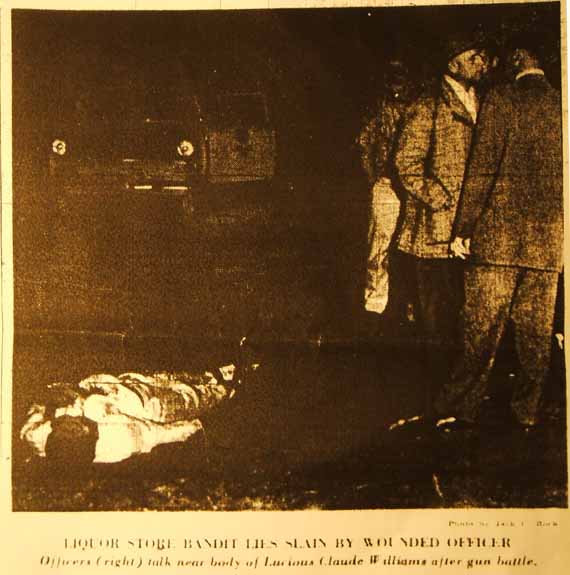
The Examiner had a few more details (Walters had diabetes and was the father of four children: Sharon, Larry, Pamela and Peggy), plus a photo of  officers standing next to Williams’ body sprawled on the pavement and Bill Brunk’s picture of Walters and his wife, Eulyne, at the hospital. Det. Lt. Ralph Weyant told the Examiner that the three men were suspected of other holdups in the Harbor area.

Then, out of curiosity, I pulled the Los Angeles Sentinel, the weekly serving the African American community. Although the Sentinel didn’t identify the men as being black, the treatment of the story is a fair indicator that they were. The Sentinel noted that Williams was "still clutching a .25-caliber revolver [probably a semiautomatic-lrh] in his right hand."

Interestingly enough, the Sentinel led its front page with a story about the fatal stabbing of Ola Williams, whose body was found in the offices of Jimmie’s Transfer and Storage, 1720 W. Jefferson.  And no, The Times didn’t even cover it.

Police Chief William Parker presented Walters with the Military Order of the Purple Heart in 1959 for his actions during the botched robbery. Records show he retired from the LAPD on Jan. 3, 1965 and died March 21, 1983. There was no further word in The Times on the fate of Hawkins or Whitmore.

Rest in peace, Lucious Claude Williams, above left, who was born March 11, 1936, in Louisiana, and died in the streets of Wilmington, April 7, 1957, with a gun in his hand. He had just turned 21.

Email me

Posted in Harbor Division, Robberies | Comments Off on Officer-Involved Shooting

Deal Me a Card, HAL

April 7, 1957
Los Angeles

By Larry Harnisch

In a gathering for newsmen, Caltech staged a demonstration of its "electronic brains." Charles Ray showed off the Royal Precision Electronic Computer LGP-30, a 740-pound "desk computer" with 113 vacuum tubes and 1,350 diodes.

Reporters also saw the enormous direct electric analogy computer, which was being used to simulate a DC-8 jetliner.  

But the star of the show, as displayed by Joel Franklin, was a ElectroData Datatron 205, which, like the LGP-30, had been programmed to play games, in this case, blackjack.

After running through the calculations for a nuclear reactor, Datatron asked: "How many suckers–I mean players?" "The machine dealt four hands by marking the names of the cards down on its typewriter," The Times said. To help the humans determine whether they should ask for another card to fill out their 21, Datatron politely–and without being asked–told them their chances of drawing a card and not going over 21."

Like the serious student who becomes a handsome movie star by removing his horn-rim glasses, the Datatron computers found real fame not by their work in the Boston Navy Yard or a drab insurance office in Minnesota, but on TV and in films.

The Bat Computer? A Datatron. "Lost in Space?" A Datatron. "Angry Red Planet?" "Fantastic Voyage?" "The Computer Wore Tennis Shoes?" All the Datatron. And don't even ask about "Dr. Goldfoot and the Bikini Machine."

Vincent Price, as Dr. Goldfoot, with tape drives from the Datatron, later renamed the Burroughs 205.

One of the Datatron's latest screen appearances? Some of the tape drives turned up in "Austin Powers: The Spy Who Shagged Me."

Read about Caltech's Computer Center here.
Here's the manual, in case you have a B205 in the garage.
And here's the handbook.
Thanks to Burroughs 205 website for some of this information.
ps. I dropped a note to Joel Franklin at Caltech to see if he'd like to share some recollections of the Datatron. I'll let you know what he has to say.
Email me

Posted in 1957 | Comments Off on Deal Me a Card, HAL

Silk-Stocking Slayer


April 6, 1957
Los Angeles

By Larry Harnisch

Ruth Newgarden Goldsmith, 52, a New York fashion designer, had been dead about 12 hours when she was found after 3:30 p.m. by two maids in a $25-a week room at the Hollywood Algiers Hotel, 445 N. Rossmore Ave. on the edge of the Wilshire Country Club.

Goldsmith, a widow who gave her address as 15 Christopher St., New York, N.Y., had checked into the Algiers a month earlier. According to police, she made frequent business trips to Los Angeles, selling belts out of her hotel room. Her hands were tied with a silk stocking and she apparently suffocated on a washcloth forced into her mouth and held in place with another silk stocking.

The Hotel Algiers, formerly the Casablanca and the Country Club Hotel


There were traces of cold cream on her face, leading authorities to believe she was getting ready for bed when she was killed. Her light green negligee was "disarranged," but there were no outward signs of a "criminal attack," The Times’ delicate term for a brutal crime. The only sign of a struggle was shoe prints on the rumpled bed, Detective James Close said.

Investigators found that her wallet was empty and although acquaintances at the hotel said she had expensive-looking jewelry, nothing was found in a search of her room. Her bank books showed that she sometimes withdrew as much as $2,000 ($14,330.57 USD 2006). Police said she had frequent business callers and kept a display of belts in her room.

Marine Pvt. Brad Arnold and his father, Charles, who had a room a few doors down, said Goldsmith was a quiet woman of excellent character.  In an interview, Charles Arnold said Goldsmith was trusting and "took everyone at face value. If someone came to her door she would have let them in." He added, "She had no enemies and lived very quietly. She usually went to the movies by herself."

Her only apparent survivor was a son named Walter, described as a Korean war veteran who was studying law at New York University.


The Internet can tell us a few more things about Goldsmith. She was born Dec. 28, 1904, her father’s last name was Newgarden and her mother’s maiden name was Schwartzenberg. The New York Times appears to list an engagement announcement of Walter George Goldsmith and Ruth Newgarden, daughter of Dr. and Mrs. Albert Newgarden, 151 W. 86th St., on Oct. 4 and Oct. 11, 1925. The New York Times also shows a company called Coordinated Accessories of 15 Christopher dealing in belts and accessories declaring bankruptcy in May 1957 under the name Benjamin Weintraub.

A little more digging shows that Albert Newgarden had a brother George J. Newgarden, whose obituary appeared in the New York Times on June 5, 1931. According to World War I draft records, a man named Walter George Goldsmith lived in Essex, N.J., but it’s unclear if was her husband.

All right, armchair sleuths, there’s a real unsolved case from the archives with everything available from the initial reports in The Times and the Mirror.

Maybe it’s just me, but something doesn’t add up here. We have a quiet, well-behaved woman of excellent character who goes to movies by herself and yet has an extraordinary number of business clients who visit her hotel room ostensibly to buy her custom-designed belts. I would suspect something else, but according to the bankruptcy filing, there was a belt company at the address she gave.

One curious note: In 1950, a judge ruling in a case brought over alterations done without the proper permits said the Algiers looked like "a glorified quickie motel."

Email me

Posted in Uncategorized | Comments Off on Silk-Stocking Slayer

April 5, 1957: Twice Burned in Club Mecca Firebombing

April 5, 1957: Club Mecca bombing
April 5, 1957
Los Angeles

By Larry Harnisch

They were a six-pack of juiceheads, daddy-o. Human-torched by lowlifes that wildfired the imagination of young, L.A. bike-roaming James Ellroy, demon dogging the pulp novel city in type-O scarlet and memory napalm.

Six juiceheads: That’s how they’re cast in our film noir tale about one of the biggest Los Angeles crimes of the 1950s. But it’s not that easy. History never is.

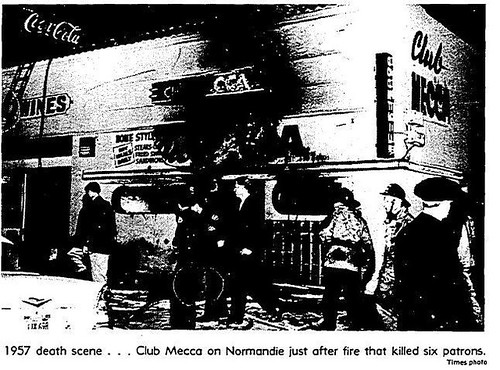
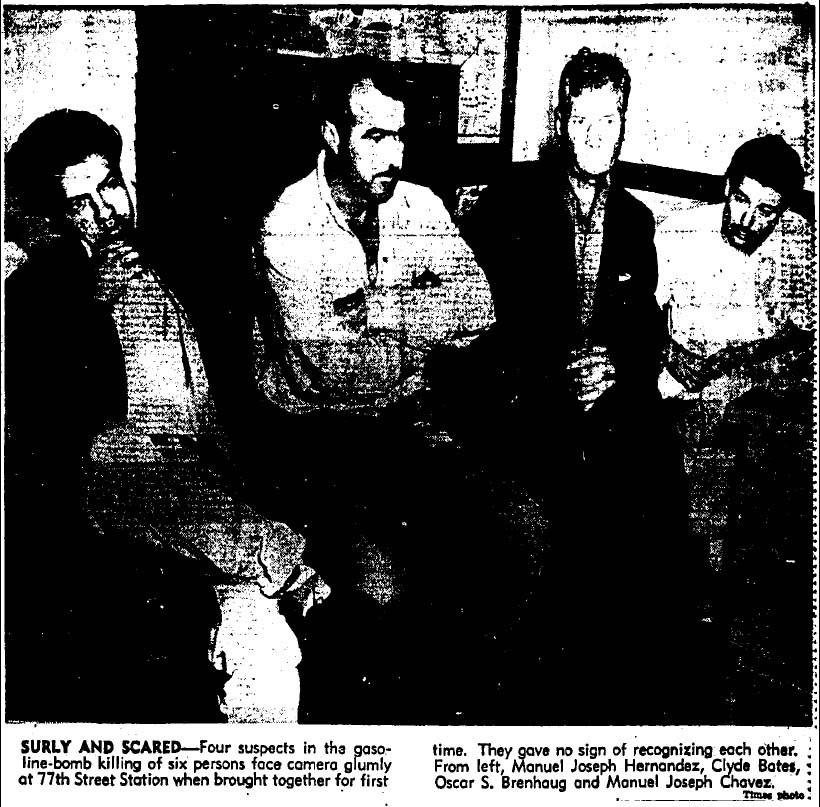
At 20 minutes to midnight, four men who had been thrown out of the Club Mecca, 5841 S. Normandie Ave., came back with an old five-gallon paint can full of gasoline. One of them, an ex-convict, threw the gas into the bar like a cleaning lady pouring out her mop bucket; another, a delivery driver for a bindery,  lit a matchbook and tossed it onto the gas-soaked carpet. The small neighborhood bar, 25 feet square packed with 21 people, exploded in flames.

Firefighters found one victim still sitting on a bar stool, so badly burned it was days before he was positively identified. Four other men and one woman died, and the rest survived, one of them with severe burns.  At the time, police called it the biggest mass murder in Los Angeles history.


Detectives found one of the killers, Clyde Bates, 36, and his companion, Oscar Brenhaug, 44, sleeping off a drunk in a blue Plymouth sedan parked in the driveway of Bates’ home at 1623 S. Menlo Ave. Investigators eventually arrested the other two men, Manuel Joseph Hernandez, 18, and Manuel Joseph Chavez, 25.

Of course, they all had alibis. Chavez said he went home from the bar and didn’t know anything about the fire until he read about it in the papers. Bates and Brenhaug said they were at another cocktail lounge until it closed at 2 a.m. Hernandez said he couldn’t get served because he was underage. Otherwise, he couldn’t remember what happened.

Joyce Chapdelaine, 22, a Mecca waitress, said she danced with Bates briefly while Hermina Morales, 28, danced with one of the other killers. The men became abusive and after a brawl with two bar employees and a customer, three of the suspects were thrown out. In the brand of logic known only to drunks, they returned to the bar to insist that a fourth companion also be thrown out and bartender Larry Fenton complied.

The men went to a Union Oil station at 5720 S. Vermont Ave., filled an old, dirty bucket with gas, then returned to the club. Bates pitched $1.43 worth of high-octane revenge into the bar and Chavez lit the matchbook.

“I was sitting on the third stool near the door,” Joseph James Marriott said, “when I felt something hit my pant leg and run down into my shoes. I thought it was a friend playing a joke—squirting me with a hose.

“My leg and shoe were saturated. I turned and saw the guy striking the match. It was a book of paper matches and he struck the match two or three times. That’s all I remember—I had troubles of my own after that.”

So who were Ellroy’s juiceheads?

  •   Gilbert J. Gonzalez, 20, an apprentice cook at the Scandia restaurant in North Hollywood. “He didn’t go in for heavy drinking,” his sister Helen Brahim said. “He just liked to drop in and chew the fat with a few of his friends.”
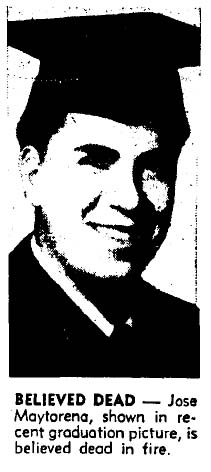
  • Jose Maytorena, 20, a San Pedro market checker whose burned body was found sitting on a bar stool. His father, Angel Luis Vallejo, warned the suspects at the 77th Division station: “All I can say is you guys better not get out on bail.”
  • Jacqueline Agnes MacInnes, 21, who had just arrived with Barbara Spinelli, a secretary at a nearby plating company. MacInnes had been babysitting for Morales, her roommate, who went home before the fire started. Spinelli, a divorcee with two young children, had been dating Fenton, the bartender, and was returning his car. MacInnes, who was waiting for her fiancee, Chuck Westbury,  to get off work at another bar, died en route to the hospital; Spinelli survived but was burned on her hands, face and legs.
  • Anthony M. “Tony” Smaldino, 27, an assistant pressman, Korean War veteran and former Golden Gloves contender.
  •    Phillip E. Crawshaw, 28, described by friends as “a very quiet, a very likable boy.”
  • Harry Leslie Robinson, 64, who liked to putter in the yard. Robinson and his ex-wife had been divorced for many years and each lived with one of their children. One of them would spend a month with their daughter in Pico Rivera while the other stayed with their son Alfred at 3704 Hillcrest Drive. “He avoided fights,” his daughter said. “He was a quiet man who liked to sit around and talk in the bar. It was nice and friendly for him.”

  Crawshaw’s services were held in Seattle and Robinson was buried at Inglewood Park Cemetery. Gonzalez and Maytorena received Requiem Masses at St. Vincent’s Catholic Church and were to be buried next to one another at Calvary Cemetery. MacInnes’ Requiem was held at Nativity Catholic Church and she was buried at Holy Cross Cemetery, The Mirror said. After rites at St. Brigid’s Catholic Church, about 300 people attended Smaldino’s burial at Calvary Cemetery, with several of them surging forward to restrain his mother as she threw herself on his casket.


Now for the lowlifes.

Claiming that he was too drunk to have helped plan the bombing,    Brenhaug turned state’s evidence and the case against him was dismissed for lack of evidence. Hernandez was sentenced to life in prison and vanished from the pages of The Times a few years later.

Bates and Chavez were sentenced to die in the gas chamber at San Quentin, and in 1960, they got into a Death Row brawl with Red Light Bandit Caryl Chessman and convicted killer James Merkouris over watching the Rose Bowl on TV. But in 1966, Gov. Pat Brown commuted their sentences, giving Chavez life in prison and Bates life without the possibility of parole.

In 1972, the state Supreme Court scrapped the death penalty, further reducing Bates’ sentence to life in prison. A final Times story says Bates was scheduled to be paroled in March 1977. Chavez had already been freed and was working in Sacramento as a counselor for ex-offenders.

A year after the fire, Spinelli and Fenton were married. In 1959, she and the survivors of several victims won a lawsuit against Union Oil and the men who sold the gasoline to the killers, but it was overturned on appeal. Times reporter Gene Blake, writing a postscript in 1976, noted that he was unable to locate Barbara Fenton, but quoted her reaction to Brown’s clemency ruling: “I really feel that they should have been given the death penalty.”

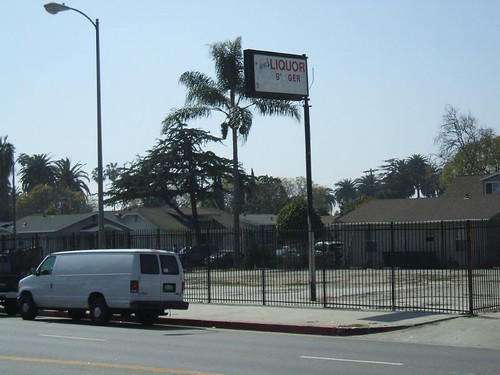
Blake also noted that the Club Mecca had been torn down to make a parking lot for a liquor store–a liquor store that was a mile north of Florence and Normandie, the flashpoint of the 1992 Los Angeles riots, when most of South-Central was in flames.
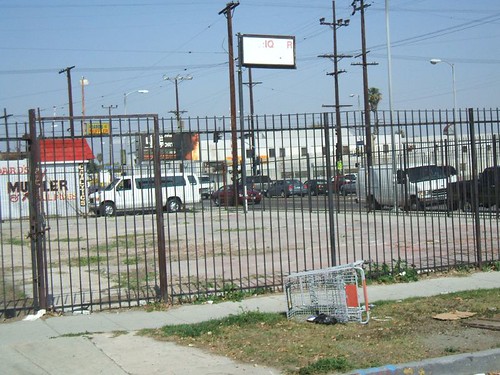
Today, 5841 S. Normandie Ave. is nothing but a pockmarked concrete slab surrounded by a strong metal fence. The only thing left is a sign. Most of its letters are missing, but it looks as if it once said: “Lee’s Liquor. Hamburgers.”


There is no happy ending in this story, no stern-voiced narrator intoning the prison terms of the guilty as there was in “Dragnet.” Six people died and the killers got out of prison. Memories fade, but as Barbara Fenton said: “I still have a few scars and I’m a little self-conscious about them. The scars will remain the rest of my life.”


Woof, daddy-o.
Email me

Posted in #courts, 1957, Homicide, LAPD | Tagged , | 18 Comments

Sorry It Had to Happen This Way

April 4, 1957
Los Angeles

By Larry Harnisch

Sometime in the night, Robert Tunis Palmer, a 27-year-old meatpacker from Marysville, Ohio, sat on the steps of the church at 14th and Union, finished his can of beer, put the muzzle of a .45 revolver to his forehead and pulled the trigger.

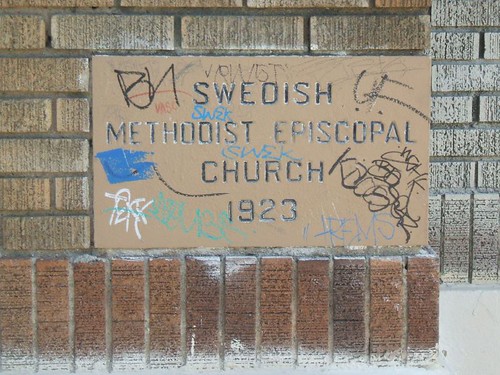
A neighbor who was walking his dog found Palmer at dawn, sprawled next to the Swedish Methodist Episcopal Church, 1575 W. 14th St. There was a note beside the beer can: “I’m sorry it had to happen this way.”

At 5:30 that Thursday morning, Clara Barnes, the landlady at Palmer’s apartment house next to the church, discovered a note pinned to the telephone in the hallway: “Please contact Mary at once. I’m sorry it had to happen this way.”

There was another note to Barnes in Palmer’s room. Please send his service discharge papers and birth certificate to his mother back in Ohio. Have his TV set repossessed and give his alarm clock and “other possessions” to Mary. Since he went to the trouble to mention what he wanted done with his TV and alarm clock and said nothing about a car, I assume he didn’t have one.

A .45 is not a delicate weapon, nor does it make a modest sound, but if anybody heard the gunshot, nobody called the police. I wonder if Mary was supposed to get his gun too. I wonder if anyone claimed the body or if he just lay there, waiting.

Most of all I wonder whom he was addressing when he said he was sorry. And what was the “it” that had to happen? His suicide? All the loose ends that had to be tied up now that he was gone?

On a bright, sunny Saturday 50 years later, I drove down to the little corner of Los Angeles to see where Robert Tunis Palmer, 27-year-old meatpacker from Ohio, sprayed his brains all over the concrete.

14th Street and Union is a block south of Pico, the heart of Mara Salvatrucha country in one of the poorest areas in Los Angeles. On my way, I got lost in one of the neighborhoods that’s closed off to the outside world—or at least the MS-13s.

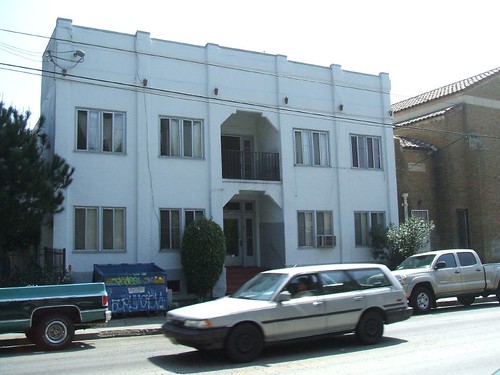
Palmer’s apartment house, 1352 S. Union, is still in business, an off-white two-story building that looks like it’s from the 1920s. Back in the 1940s it was the Del Rio Hotel, DRexel-0342.

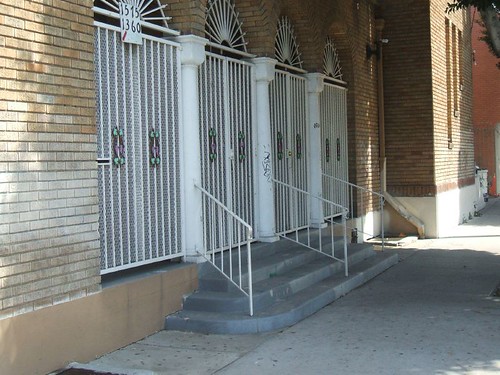
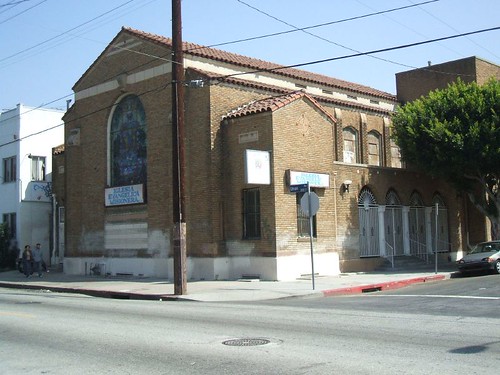
What was once the Swedish Methodist Episcopal Church, built in 1923, has become the Iglesia Evangelica Missionera. While I was taking pictures of the steps where Palmer killed himself, I met the minister, Pastor Rodolfo, who was picking up trash along 14th Street.

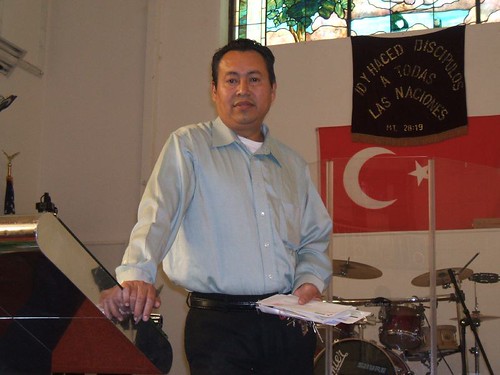
Pastor Rodolfo is gentle man, with liquid eyes, a quiet voice and a soft handshake. Could I see inside the church? Of course. The congregation bought the building from the Methodists a few years ago, he says.

He explains the red flag on the altar, with the star and crescent, by saying that the church sponsors a family of Salvadoran missionaries who are serving in Turkey. Because Turkey wants to join the European Union, they are open to Christianity, he says.

When I comment on the beauty of the stained-glass window facing Union, Pastor Rodolfo voices an almost physical pain. He wants to get the window repaired because unbelievers in the neighborhood have thrown rocks through it. He had a phone number for someone who could fix the window but lost it.

I reassure him that my church just had its windows repaired and I’ll find out the number so he can the work done. Please do, he says. When I finally get the information I struggle with calling him. I attend a wealthy church in Pasadena with an annual budget of nearly $5 million. I suspect it might cost more to fix the window than it does to send Iglesia Evangelista’s family of missionaries to Turkey.

Someone long ago and far wiser than I said suicide is permanent answer to a temporary problem. If Robert Tunis Palmer hadn’t pulled that trigger, he would be 77 now, maybe playing golf or heading to Laughlin in his RV. What was he looking for at the church that night? Sanctuary? Salvation? A place to pray? Or just a good spot to drink a beer and kill himself? And for the moment, I too am sorry it had to happen this way.

ps. I finally called the church with the phone number of Judson Studios, which specializes in repairing stained-glass windows. Pastor Rodolfo was busy so I left the information with someone. Then I wrote out a check, in memory of Robert Tunis Palmer, to Iglesia Evangelica Missionera, 1575 W. 14th St., Los Angeles, 90015. It seemed like the least I could do.

E-mail me 
Posted in 1957, Pico-Union, Suicide | 3 Comments

Ovation for Ollie

April 3, 1957


If you haven’t taken a look at the Civic Center scenery lately—and many longtime residents boast they haven’t been downtown for years—a surprise awaits you.

Except for the public buildings and a few others, it’s hardly there anymore.   

Where remembered buildings used to be, there are now great leveled places. Soon new structures will rise out of the debris. Already the handsome new County Courts Building has taken its place in the revised landscape at the northwest corner of 1st and Hill.

All this brings us around to a letter George Smedley Smith, who has operated a modern apartment house at 2nd and Grand for 18 years, has written to Councilman Ed Roybal.

Smith, who by the way composes brilliant plays which get published, wrote: “During those long years of observation we have become aesthetically appreciative of the wayward and mystic passes, the eye rollings, knee bends, lamp-post leanings, the vague and occasional (sometimes stratospheric) swishes made by the street cleaners in the manipulations of the tool of their profession.”

He continued, “At the moment we are being kicked out of this location by the county, which has purchased this building. Before putting out the cat and the fire for the last time, we would like to record our appreciation of the contemporary street cleaner at the crown and apex of this old quarter. He has done more to keep the streets of this acropolis tidy in the last year or so than all the efforts of his predecessors lumped together.” 


Smith concluded, “Perhaps you would pause in your heavy schedule to point this letter to the proper authority in favor of a conscientious public servant, the contemporary street cleaner of Bunker Hill—Mr. Ottie Phine.” 


Let’s go all the way and declare Ottie Street Cleaner of the Week.

Note: The Daily Mirror is pleased to introduce a new generation of readers to Matt Weinstock (1903-1970), the author of "My L.A." and "Muscatel at Noon,"      and a columnist for the Los Angeles Daily News, the Mirror and The Times.


Posted in 1957, Columnists, Matt Weinstock | Comments Off on Ovation for Ollie

Postcards From the Past

The Hotel Green, Pasadena
Posted in Black Dahlia, Books and Authors, LAPD, Pasadena, Streetcars | Comments Off on Postcards From the Past

The Bridge

March 15, 2007
South Pasadena

Here’s the Gold Line, its passengers mercifully unaware that they are zipping along to Pasadena in the “Gorge of Eternal Peril” beneath “The Bridge of Death.”

Here’s a close-up of a patch made to fix one of the 1907 cracks in the bridge. And yes, the darn thing is still standing. Hm. Maybe I should call it “The Bridge of Hope” instead.

Lmharnisch.com
Lmharnisch.blogspot.com

E-mail: lmharnisch (AT) gmail.com

Posted in 1907, Black Dahlia, Books and Authors, LAPD, Pasadena, Streetcars | Tagged | Comments Off on The Bridge

In Which a Ghostly Visitor Returns

March 15, 2007
Los Angeles

“Well, dear boy, I suppose you thought you were through.”

“Yes, I did.”

“And?”

“Good grief! Do you see this bridge over the Gold Line? It looks like it’s held up with hairpins and spit!”

“Saliva, dear boy. And what is the Gold Line?”

“Well, it’s sort of a streetcar, except it doesn’t run on the street.”

She leaned back in her ghostly chair. “And what did you think of our little year?”

“I was quite wrong, wasn’t I?”

She merely nodded.

“You could have at least told me.”

“Dear boy, you needed to find out for yourself.”

“OK, so there were movie theaters in Los Angeles.”

“Yes.”

“And there were comics in the paper.”

“Little Nemo is one of my favorites.”

“I couldn’t believe all the domestic violence. Awful stuff.”

“It was terrible,” she said.

“And getting a divorce was so difficult.”

“That was horrible,” she said.

“And the rotten doctors, the fakes and charlatans, dirty restaurants, the drinking and alcoholism. The exploding gasoline stoves.”

“Well,” she said chidingly, “you didn’t write very much about people who were nice. You newspaper folks never do.”

“Most of all, we haven’t changed very much, have we? I mean, look at our problems with transportation… with sanitation… with growth… with housing… immigration… ethnic discrimination… education… polluting the ocean. A century later, the Police Department is still pleading for more officers. It’s the same story, with different details, that we had in 1947.”

“And why do you think that is?”

“Ma’am, that’s a short question with a long answer. You could tell me, couldn’t you?”

“I could.”

“But you’re not going to, because I have to figure it out for myself, is that it?”

She nodded.

“I’ll miss all of you so much.”

“You know where to find us,” she said.

“Was it a kinder, simpler time?” I asked.

“Maybe in some ways, but mostly no.” And then she paused for a moment. “Go take a picture of your bridge. It hasn’t fallen down yet, has it?”

“Nope, it’s still there. Or at least some bridge is still there.”

I didn’t know what else to say: “Thanks for everything.”

“You are most welcome. And thank you.”

And then she was gone.

Lmharnisch.com
Lmharnisch.blogspot.com

E-mail: lmharnisch (AT) gmail.com

Posted in 1907, 1947, Black Dahlia, Books and Authors, Comics, Education, Immigration, LAPD, Streetcars, Theaters, Transportation | Tagged | Comments Off on In Which a Ghostly Visitor Returns

The Celebrity Inteview


March 14, 1907
Los Angeles

Harry C. Carr, future author of “Los Angeles: City of Dreams,” visits Fely Dereyne, who is starring in the San Carlo Opera Company’s touring production of “Carmen.”

Accompanied by Times artist Harold R. Coffman, who sketched the singer, Carr conducted a backstage interview with Dereyne with the help of two opera company members who served as translators. As an interview, it is disjointed, poorly organized and frustratingly incomplete; the early work of a green but talented writer who is somewhat smitten with his subject. And yet it is fresh and immediate.

“Dereyne dutifully remarked that she didn’t study Carmen” as a character, Carr says.

“Just natural,” she said in French. “I am just like that myself.”

“Gee,” said the artist, uneasily, “have you really got a temper like that?”

“Sometimes,” she said, with dancing eyes.

“Well, then, I hope you like this picture.”

“Oh,” she said airily. “Sometimes I am ver—how do you call it? Ver’ nice.”

“Like the little girl that had the little curl?”

Dereyne looked troubled. “I don’ know zee ladee; who is she, please?”

“This was a great moment in Dereyne’s career,” Carr wrote. “She was about to learn the tragedy of the little girl who had a little curl. It took two newspapermen, an opera manager and a second tenor to do it.”

Dereyne, an incredibly obscure figure today, was described in The Times as “one of the best Carmens who has ever been seen upon the local stage, for with her vigor and vivacity she never loses sight of the vocal demands of the role. At all times she sings. Her stage work and byplay are constantly assertive.”

She made her Metropolitan Opera debut in November 1907 as Musetta in a performance of “La Boheme” with Geraldine Farrar and Enrico Caruso. Her last Met performance was in 1908 as Nedda in “Pagliacci.” After that she seems to have vanished from the stage.

And there you have it; a moment backstage in a theater (Philharmonic Auditorium) that is gone with people who are, except for Carr, entirely forgotten. That’s what I love about research.

Lmharnisch.com
Lmharnisch.blogspot.com

E-mail: lmharnisch (AT) gmail.com

Posted in 1907, 1908, Black Dahlia, Books and Authors, Columnists, LAPD, Streetcars, Theaters | Tagged , | Comments Off on The Celebrity Inteview

Farewell, Faithful Companion


Feb. 12, 1907
Whittier

Don had rushed up San Juan Hill with the Rough Riders, fearless in the face of enemy fire. But he could not survive a speeding driver on the otherwise placid streets of Whittier.

A present from Teddy Roosevelt to Hamilton Fish, Don was the mascot of Company B of the Rough Riders. Don was given to Col. William Wallace. When Wallace died in Whittier, Don was given to Wallace’s physician, Dr. Hadley.

“Since that time the big dog had had the freedom of the Quaker town and had never walked through the streets without receiving much attention from small boys and girls to those of larger growth,” The Times says.

Death came from “a big touring car containing four persons, going around a corner at so high a speed that the old dog, which was walking quietly along, could not get out of its way.”

Lmharnisch.com
Lmharnisch.blogspot.com

E-mail: lmharnisch (AT) gmail.com

Posted in 1907, Black Dahlia, Books and Authors, LAPD, Streetcars | Tagged | Comments Off on Farewell, Faithful Companion

Los Angeles Has No History

Feb. 24, 1907
Los Angeles

Google Earth, 2007

lmharnisch.com
lmharnisch.blogspot.com
E-mail: lmharnisch (AT) gmail.com

Posted in 1907, Black Dahlia, Books and Authors, LAPD, Streetcars | Tagged | Comments Off on Los Angeles Has No History

A Tumultuous Season


March 10, 1907
Los Angeles

Someone who opened the Los Angeles Times on this Sunday might be forgiven for wondering what had become of the world, for Page 1 was full of news about the demise of two religious leaders.

The first was the death of John Alexander Dowie, the founder of Zion, Ill., who considered himself the reincarnation of the biblical prophet Elijah. The second was the decline of Mary Baker Eddy, founder of Christian Science.

The Times published some of Eddy’s letters to her son, saying: “These Eddy letters, now carefully guarded in a safe deposit vault at Washington, are confidently expected to invalidate every transaction made by Mrs. Eddy in the last 15 years.”

They are too long to post, but here’s a sample:

“My Dear Son: The enemy to Christian Science is led by the wickedest powers of hypnotism and is trying to do me all the harm possible by acting on the minds of people to make them lie about me and my family.”

Dowie’s history is far more complex and even the highlights of his career defy an easy summary. He arrived in San Francisco in 1888 and moved to Chicago two years later. By 1899 he was mobbed by thugs while staging nightly crusades in Chicago after establishing a divine healing mission and opening a bank and newspaper.

In 1900, he bought the property for what is now Zion and began calling himself “Elijah the Restorer.”

Five years later, he was paralyzed in Zion upon returning from a trip to begin a colony in Mexico. In 1906, he appointed a general overseer, Wilbur Glenb Voliva, who took over the movement and repudiated him.

Dowie’s last words were: “The millennium has come. I will return in a thousand years.”

Lmharnisch.com
Lmharnisch.blogspot.com

E-mail: lmharnisch (AT) gmail.com

Posted in 1907, Black Dahlia, Books and Authors, LAPD, Religion, Streetcars | Tagged | Comments Off on A Tumultuous Season

Random Shots From Our 12-Bore

March 9, 1907
Los Angeles

The Insanity Begins

Led by I. Newerf and J.B. Dudley, the automobile owners of Los Angeles are fighting a new city ordinance that bans parking within 40 of downtown intersections. Newerf, the West Coast representative of Goodyear Tire Co., and Dudley, a car salesman, received citations for violating the law and have pleaded not guilty.

In April 1909, Dudley pleaded not guilty to involuntary manslaughter after hitting street inspector Woodman J. Thomas on Broadway near 5th Street. He was sentenced to five years’ probation in March 1910.

Disgraced Woman

Hazel La Doux, a.k.a. Hazel Rogers, hid her face with a veil as she was tried on charges of forgery.

“Her downfall is said to be due to a man named William Rogers, an alleged Ascot tout who deserted her,” The Times says. “It is charged that Miss La Doux forged the name of Mrs. John Brink on a check for $120 and cashed it.”

La Doux told police that she and Rogers used a scheme in which she took a job with a reputable employer and passed clients’ information to lover. La Doux said she worked at a department store in Oakland and a dentist’s office in Los Angeles, turning over names to Rogers, who forged the checks.

“She had been an honest woman, she said, until Rogers’ oily tongue and smooth ways captivated her and she became his mistress and then a thief,” The Times says.

He Paid $40

Restaurant owner Frank Flood stood over his wife, Annie, as she lay on the floor of their quarters at a Spring Street rooming house and said it would be worth the $25 fine just so he could beat her up.

In testifying against him, “She recited a story of shocking cruelty, saying that she had been mistreated, scorned and finally beaten by the man who promised to love, cherish and protect her,” The Times says.

Flood did not dispute any of the charges, refused to cross-examine her (a husband’s right in those days) and pleaded guilty to battery. “He admitted that he struck her and confessed to having assaulted her with his fist as she lay on the floor,” The Times says.

He paid $40 ($837.08 USD 2005).

Flood skipped town in September 1907. “He made the acquaintance of a fast sot and spent plenty of money, too much, in fact, for a man of his means. Late suppers at swell cafes cost Flood much cash. Then he became possessed of a desire to take long journeys in touring cars. He paid his bills with other people’s money, the new restaurant manager says, by levying on the cash drawer of the restaurant, which is owned by a company,” The Times says.

Lmharnisch.com
Lmharnisch.blogspot.com

E-mail: lmharnisch (AT) gmail.com

Posted in 1907, 1909, 1910, Black Dahlia, Books and Authors, Downtown, LAPD, Streetcars | Tagged | Comments Off on Random Shots From Our 12-Bore