
Rigoletto Village

April 29, 1957
Los Angeles

One of my favorite adventures while working on the 1947project was revisiting old neighborhoods that I found in The Times real estate sections from 1907, a feature I called “Architectural Ramblings.” Exploring the city, I discovered street after street of 100-year-old homes in the Adams district, Monrovia, Sierra Madre (which is celebrating its centennial this year) and Angeleno Heights.

But since I grew up up in a 1956 split-level tract home, the ubiquitous and banal 1950s developments held no allure for me. Then I ran across ads for Rigoletto Village, which offered the prospect of comic relief from true crime. Did the “Gilda model” have a pool? Did the “Duke model” have an attached garage? (A close second was Rebecca Park at San Fernando Mission Boulevard and Haskell Avenue. Did the “Manderley model” have a boathouse? I suspect not). Continue reading →

Posted in 1957, San Fernando Valley | Tagged , , , , , , | Comments Off on Rigoletto Village

Reprieve


1957_0428_train_2

April
28, 1957


Los Angeles

A boy (and how anyone knows it was a boy is never explained) came across a
stalled car on the Southern Pacific right of way
near Valley
Boulevard and Boca Avenue in Alhambra
.  He  ran along the tracks
to
Farnsworth
Avenue
and flagged down the oncoming Sunset Limited, The Times says. 

The boy’s actions saved the life of the driver, William Frasie McKeehan, 21, who
was booked at the City Jail for being drunk.


1957_ad_sunset_ltd

Rather like the Lone Ranger, the boy left before giving police his name. As for
McKeehan, he died Aug. 20, 1989, at the age of 53, 22 more years than he would
have had if  he hadn’t been  spared that night.  Let’s hope he
made use of them.

Email
me

Posted in Transportation | Tagged , , , | Comments Off on Reprieve

A shot in the dark

1957_0429_hed

1957_513_elm

April
28, 1957

Los Angeles

Let’s park here and sit in the car for a minute. It’s late, sometime between 11
p.m. on Jan. 3 and dawn on Jan. 4, 1957. The lights are on as if
someone’s home. Hear the music? That’s the record player. Let me warn you before
we go in that none of this will make any sense at all. Just a dumb little
murder.

1957_0429_smasonMany streets in Alhambra are named for trees, like Poplar, Birch
and this one: South Elm. There’s a pair of these little, boxy duplexes, both 3
years old, that look like they were built at the same time by the same
developer. In the picture above, 513 S. Elm St. is the front unit of the first duplex, and 517 S. Elm St. is the front unit of the second duplex. The matching
duplex on the end, 521 S. Elm St., was built in 1958. The Times says she was murdered around the back in
515
.

OK, come on in. Keep your hands in your pockets and don’t move anything. Someone
has already rummaged around.

That’s her sitting in the hallway, leaning against the wall next to the telephone. Notice that it’s off the hook. Her name is Susan Miller Mason. She’s
28 and worked in Alhambra as a receptionist in the office of Dr. H.
Lee Berry, a physician and surgeon. Her husband is named Raymond and he’s a
lineman. He’s 30. I don’t think they have any kids.

She’s got a couple old injection marks on her butt and one that’s fresh, which
is from the shot that killed her. The medical examiner will call it acute morphine
poisoning and says that based on the location, it’s almost impossible that she gave
herself the injection. She had asthma and the combination of morphine and asthma might have been what killed her.

About 6 p.m. on Jan. 3, she went to a doctor’s office out in the Valley for a shot
of cold vaccine in her left arm. When she got home, she and her husband had an
argument and she threw a flowerpot and her beaded key case.  He left about 9:30  p.m., hit a few bars, spent the night in his car and went
to work the next morning.

Berry, who lives at 1208 S. Garfield Ave.,  will testify that she called him about 1 a.m. and said she felt itchy all over. According to Berry, she said “Just a minute,” then her
voice trailed off and all he could hear was the music from the record player. He
figured she was drunk again.

According to The Times, he says that because her phone was off the hook, he
couldn’t break the connection, so he had to go across the street to a hospital
and call one of her neighbors to check on her. The Mirror says that Berry got a busy signal because her phone was off the hook so he went across the street to use a phone.

Either way, Mrs. Lena Talercio, 519 S. Elm, will say that Berry called at 1:15 a.m. and asked her go over to Mason’s home. Talercio will say the lights were
on and music was playing but Mason wouldn’t come to the door.

1957_0429_hlberry
In a few hours, according to The Times, Berry is going to call the Alhambra Police Department to check on Mason because she hasn’t shown up for work, and Detectives
Edmund Chappell and Carl Hoffman will come out to investigate. The Mirror, meanwhile, says Mason hadn’t shown up at work for two weeks.

I warned you it was complicated.

The medical examiner will say Mason died about 11 p.m.–flat on her back.  That
means someone came along and propped her against the wall. Notice there’s no
sign of the flowerpot or the key case. They’re missing. And there’s no
hypodermic needle anywhere. If she gave herself the shot, there should be a syringe someplace.

About 1:50 a.m. this morning, Jack Case, 517 S. Elm, will hear a man say: “Susie! Susie! Let me in!” And a woman is going to say: “Be quiet or you’ll wake the neighbors.”  The record player is going to keep going until about 4:30 a.m., when someone will turn it down, according to Case.

At the inquest, Berry will say he had been treating her for about six or eight
weeks and had given her several shots in the buttocks, but hadn’t kept any
records.  He will say that he bought 10 syringes of morphine from two
Arizona men two years ago and turned over six of them to his attorney. He says he used two on an injured
horse. He will claim that he asked Mason to clean out his medical bag a couple
weeks ago and that when she was done, the two remaining morphine syringes were
missing.

According to the April 28, 1957, edition of The Times, Mason was a hypochondriac and often hired a cabdriver to take her
to doctors’ offices all over Los Angeles, including the Valley, Pasadena, West
Los  Angeles and Beverly Hills.

Berry’s housekeeper, Elsie Otto, an immigrant from Brazil, is also going to
testify. Otto will say that at the time of the murder, Berry’s wife was out of
town with one of their four children. She’ll say that Berry went to his office
for 10 minutes between 6:30 p.m. and 7 p.m., got a phone call from Mrs. Berry
about 10:30 p.m. and went to bed about 11 p.m.

Mason’s husband is going to testify that after police left, he found the missing
flowerpot behind the garage and his wife’s key case in a kitchen drawer,
although the detectives are certain neither of those items was there when they
searched the house. The police will give him a polygraph test and he’ll come back
clean.

Notice that Berry’s housekeeper hasn’t said anything about a 1 a.m. phone call
from Mason. Notice that we don’t find out why Berry had Talercio’s phone number. Maybe none of it came up at the inquest. Maybe The Times
didn’t think any of it was important. Notice that Berry had a neighbor check on Mason and that he called the police, who found the body. He could have gone over to the house either time. It’s only three miles away. Notice that Berry’s housekeeper is a Brazilian immigrant.   Just speculating, mind you, but if she weren’t here legally she might be reluctant to rat out her boss.

Berry will also refuse to sign the death certificate, although we don’t know why. 

All we we know for sure is that somebody moved her after she died. And we know none of the stories add up.

According to the Medical Board of California, Herbert Lee Berry graduated from the University of Maryland Medical School in 1943. He died in 1997.

We better get going. The police will be here soon.

Email
me

Posted in Homicide | Tagged , , , , , , | 3 Comments

Head hunters

1957_0427_floristas06

April 27, 1957
Los Angeles

 
I have somehow managed to miss out on coverage of the "Headdress Ball" staged every year by
Las Floristas in which women wear the equivalent of Rose Parade floats on their heads in a fundraiser for children’s charities.

Here’s how they looked in 1957 in the newly renovated Cocoanut Grove at the Ambassador Hotel.

1957_0427_floristas01

1957_0427_floristas05_2

Above, Times society columnist Christy Fox, left, has a demure tiara while serving as TV announcer while Mrs. John M. Foley Jr. (recall that in the 1950s, married women had no first names), center, wears  "Love Is Crown Jewel" and Mrs. James Powell displays "The Imperial Jewel."


1957_0427_floristas04

And yes, they’re still being given.
Here’s
the link to coverage of this year’s event
.

Email me

Posted in Nightclubs | Comments Off on Head hunters

Locos

1957_0427a

April 27, 1957
Los Angeles

1957_0427c_2 Although the term "drive-by shooting" didn’t appear in The Times until two
decades later, what happened near
107th
Street and Juniper
has all the tragic characteristics that are so familiar
today.

The victim was Fred Gallegos, 16, 10221 S. Broadway, whom The Times called a member of the "Quarters
Gang" or "Little Quarters Gang," although Gallegos told police he was not a gang member.

The driver was Gilbert Rivera, 17, 8129 Santa Fe. Ave., a member of the
"Florence Gang." His passengers were Richard Juliana, 16, 8021 Croesus Ave., and
Henry Rodriguez, 18, 8127 Lou Dillon St. Police recovered two .22-caliber rifles
at Rodriguez’s house and two zip guns and some Molotov cocktails at Juliana’s
house.

According to police, Rivera’s car circled the block before shots were fired into
a crowd gathered at a traffic accident. Gallegos was hit in the abdomen and was
taken to the Georgia Street Receiving Hospital, then transferred to what is now
Los Angeles County-USC Medical Center.

Achiello Ernest Lopez, 18, 127 E. 85th St., chased Rivera’s car and got the
license plate number, even though three shots were fired at him, police said.

Soon after, teenagers in a car fired shots at another auto as they went
west on 66th Street between Avalon Boulevard and San Pedro Street., The Times said. (A neat trick since 66th doesn’t connect to San Pedro).  One
bullet hit the auto of Henry R. Elias, 19, 8125 Marbrisa Ave., who told police he
was not a gang member.

Police arrested Valentino Renteria, 3280 Compton Ave.,  Henry A.
Mangaser,  17,  8620 1/2  Makee Ave.,  and Joe Louis
Martinez,  17,  1408  E. 59th.  and  found a shotgun
and a .22-caliber rifle in the car.

Unfortunately, The Times never followed up on this story. But the violence
continued. On Sept. 1, 1957, members of the "Little Quarters" standing outside
10216 Lou Dillon St. fired at a passing car in the mistaken belief that it was
carrying rival gang members. They killed Emily Guzman, 18, 3238 E. 120th St.,
another Quarters member.

1957_0427d

Again, The Times didn’t follow up on the story.

The next year, Florence Gang member Richard Vasquez, 17, 243 E. 119th St., was
shot to death as he sat at the bus stop at 119th and San Pedro streets after he
threw a bottle at a car driven by George Guerena, 244 W. 61st., a Quarters
member.

And again, The Times didn’t follow up on the story.

On May 12, 1959, two members of the Peewees set of the Florence Gang were shot
by Quarters members near 8315 Maie Ave. The Times identified the victims as
Victor Maza, 16, 347 E. 84th St., who was hit in the chest while walking along
the streetcar tracks, and  Raymond Velasquez,  16,  2040  E.
76th St.
,  who was  struck in the arm.

And no, The Times didn’t follow up on the story.

First use of "vato loco" in The Times:
1974.

First use of the gang term "home boy" in The Times: 1975.

First use of "drive-by shooting" in The Times: 1977.

Email
me

Posted in Uncategorized | Comments Off on Locos

He was no Cupid

1957_0426_hed

April 26, 1957
Los Angeles
 

Albert Duarte, 20, was tired of hearing the noise made by the wrecking crews day after day as they demolished a building at 1st and Hope streets.

So he got a 5-foot bow and shot an arrow at them.

Charles Ousley, 25, of 11610 S. San Pedro told police he was standing in the bed of a dump truck when the arrow whistled past him.

1957_0426_3

The foreman of the crew, John Trott, 30, of 1215 S. Server Ave., in Montebello, looked up at the apartment building and saw a figure in the window at 700 W. 1st St. "This work is dangerous enough without somebody shooting arrows at my men," he said.

Duarte had fled by the time police arrived. But they confiscated his bow and arrows, The Times said.

Email me

Posted in 1957, Downtown | Comments Off on He was no Cupid

Not on Netflix

Ad_war_drums


    Note: Plot summaries are based on a variety of sources since it’s difficult to find
viewing copies of these cinematic gems from 1957.

  • "China Gate." Bad things happen in Viet-Nam when an American soldier (Gene "The Girls of Pleasure Island" Barry) is repelled by the appearance of the son born to him and his Eurasian wife (Angie "Tension at Table Rock" Dickinson–no kidding) only to be reunited with her as she guides his group of French  Legionnaires on a mission to  destroy a Red Chinese ammunition dump.  Look for Nat "King" Cole and Lee Van Cleef.  Oh, and she gets blown up. Oops. A Sam Fuller film.
  • "Dragstrip Girl." Bad things happen when a wealthy young man and a poor but honest youth compete for the attentions of a local beauty. Look for Frank "Twilight of the Ice Nymphs" Gorshin.
  • "Guns of Fort Petticoat." Bad things happen when a Texan in the Union
    Army (Audie "No Name on the Bullet" Murphy)  goes AWOL and discovers a
    group of women back home who are left defenseless against Indian attacks. Look for  Hope
    "Thieves’ Highway" Emerson.
  • "The Man Who Turned to Stone." Bad things happen as mad scientists electrocute young women to stay alive hundreds of years. Look for Victor "Cat-Women of the Moon" Jory.
  • "Pharaoh’s Curse." Bad things happen with archeologists and mummies. Look for Diane "Courage of Black Beauty" Brewster and Ziva "Macumba Love" Rodann.
  • "Rock All Night." Bad things happen when criminals take over a teenage hangout called Cloud Nine. Dick "Shorty" Miller comes to the rescue. Look for Mel "Chopping Mall" Welles, the Blockbusters and the Platters. Directed by Roger Corman.
  • "Spring Reunion." Bad things happen at Carson High School’s 15th reunion when hometown girl made good (Betty "Here Come the Waves" Hutton) reconnects with her old beau (Dana "Hot Rods to Hell" Andrews). Look for Irene "Beverly Hillbillies" Ryan and Jean "Panic in Year Zero" Hagen.
  • "The Strange One." Bad things happen when young scoundrel Jocko De Paris (Ben "Maneater" Gazzara) schemes his way through a Southern military college. Look for George "Groundstar Conspiracy" Peppard and Peter Mark "Girls on the Loose" Richman.
  • "Tears for Simon." Bad things happen when the child of American parents is kidnapped during a visit to London. Made as "Lost" in the UK. Look for David "Black Shield of Falworth" Farrar. (This is the movie in which Tony Curtis says: "Yonder lies the castle of my father." More or less.)
  • "War Drums." Bad things happen when a Latina (Joan "Earth vs. the Flying Saucers" Taylor) is kidnapped by an Apache warrior (Lex "Die Schlangengrube und das Pendel" Barker). 
  • "Zombies of Mora Tau." Bad things happen as the living dead go  underwater  to protect sunken  treasure from adventurers.  Look for Gregg "The Creature Walks Among Us" Palmer.
Posted in 1957, Film | Comments Off on Not on Netflix

Like gonesville

1957_ad_ella_fitzgerald

Ella Fitzgerald, "April in Paris"

Email me

Posted in #Jazz, #video, Television | Comments Off on Like gonesville

If you build it, they will drive

As envisioned, 1957

1957_0425_freeway_map


As built, below, looking north from Slauson

1957_0425_freeway

As used, below, looking north from Slauson, April 22, 2007

2007_harbor_fwy_slauson

The Harbor Freeway, below, looking south from 42nd Street, 1957. Note there are no center guardrails.

1957_harbor_42nd

The Harbor Freeway, below, looking south from 42nd Street, April 22, 2007


2007_harbor_fwy_42nd

Email me


Posted in Freeways, Transportation | Comments Off on If you build it, they will drive

Love me, love my shotgun

1957_0425_howard_hed

April
25, 1957

Los Angeles

1957_0425_howard
Charles S.
Howard and his estranged wife, Rowena, have declared a truce in their war over
two shotguns as they divide their property in a separate maintenance agreement.

Howard had already agreed to give his wife a $150,000 home at
133
S. Mapleton Drive
in the Holmby Hills ($1,074,792.57 USD 2006) and payments
of $1,900 a month. However, he complained that she kept a portrait of his father, a wealthy Buick
dealer and racehorse owner; a bronze statuette of the family’s prized horse
Seabiscuit; a cashmere topcoat; a red bathrobe; and a 12-gauge Belgian shotgun.

His
wife countered by saying that he had failed to turn over her .410 shotgun, which
he had given her as a present years ago.

Judge Joseph W. Vickers called a recess in proceedings so the couple and their
lawyers could talk. At the end, the Howards agreed to return each other’s
shotguns.

Charles S. Howard Jr. married his third wife, Louise, in Reno, Nev., May 27,
1958. He died in June 1966 at the age of 63.


1957_seabiscuit

Seabiscuit died May 18, 1947, at the age of 14.

Email
me

Posted in Uncategorized | 1 Comment

Voices

Note: Ulrich K. Quast, an auto salesman who took L. Ewing Scott and his wife, Evelyn, for a test drive along Mulholland in 1955, was probably the last person who saw her alive aside from her killer. As far as he was concerned, it was an ordinary sales call.

Page 1, "Give us your full name
"

1957_scott_quast01

Page 2 "May 12, 1955"

1957_scott_quast02

Page 3, "What time did you arrive there?"

1957_scott_quast03_2

Page 4, "We went for a ride."

1957_scott_quast04

Page 5, "First, I drove the car."

1957_scott_quast05

Page 6, "They were both around."

1957_scott_quast06

Page 7, "The phone was disconnected."

1957_scott_quast07

Page 8, "He was very considerate as far as his wife was concerned."

1957_scott_quast08

Page 9, "No disagreement whatsoever."

1957_scott_quast09

Page 10, "He only referred to her as being ill."

1957_scott_quast10

I’d like to extend a special thanks to Sandi Gibbons of the Los Angeles County district attorney’s office for granting me access to the Scott material.

Email me

Posted in #courts, Homicide | Comments Off on Voices

Inca-redible

April 24, 1957
Los Angeles

Note: Bylined stories were rare in the 1940s and 1950s. Here’s the handiwork of Jack Smith, doing rewrite on a celebrity brawl involving Yma Sumac and Fred Otash, former police officer, private detective and one of James Ellroy’s inspirations.
By Jack Smith

Singer Yma Sumac’s home yesterday was the scene of the champion brawl in fighting Hollywood’s history–featuring the Peruvian beauty herself, her estranged husband, two hot-blooded Inca dancers, three private detectives, a male Peruvian harpist and a collie dog named Prince.

The head-thumping, hair-pulling Donnybrook took place in the entry hall of the Cheviot Hills home as the tension in the Sumac household finally snapped into a shrieking extravaganza with sound effects in two languages, not to mention the barking of the dog.

The spark that touched off the swirling free-for-all was the strained relationship between the exotic songbird from the Andes and her high-strung Peruvian husband, Moises Vivanco, 38, whom she sued for divorce only a week ago.

The luxurious house shook from the piercing screams from Miss Sumac’s celebrated five-octave voice as clothes ripped, flesh and bone struck flesh, blood flowed and at least one 220-pound private detective hit the deck under a tangle of assorted Peruvians.

Flashbulbs and television lights bathed the colossal action in an eerie glare and photographers and reporters scrambled to the walls for points of vantage as the struggle unfolded before them like the climax of a high-budget Western.
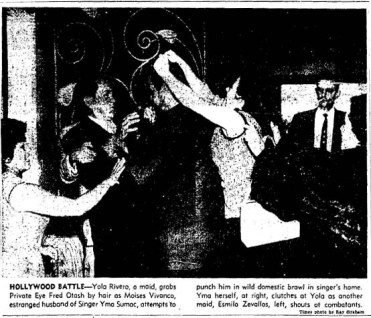
Miss Sumac herself was credited with one of the most telling strokes of the con [text missing here–lrh]

after Miss Sumac and [private detective Fred] Otash, accompanied by one
of Otash’s operators, Norman Placey, 37, drove up to her home at 3065
McConnell Drive in Otash’s blue Cadillac.

Miss Sumac was wearing a  long fur coat and her almond-shaped eyes with
their arched eyebrows were hidden behind the dark glasses.

She
went there with Otash, explaining that she wanted to pick up some of her her personal things and also to look for her 1957 Cadillac Fleetwood, which she said Vivanco had hidden from her.

Vivanco opened the door and beckoned to eight newsmen waiting outside.

“Please come in,” he invited. “I want you to see this.”

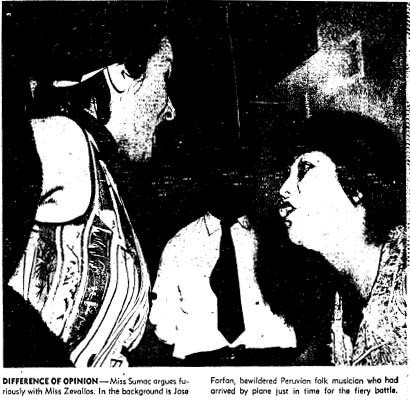
Miss Sumac swept regally through the large living room and into the den. There she found Farfan playing the alpa, an ancient Incan harp that stands on three legs.

Miss [Esmila] Zevallos was singing.

Farfan had arrived from Peru only yesterday morning, just in time for the festivities. He speaks no English, which turned out to be of little disadvantage in the events to follow.

Miss Sumac began questioning Zevallos about the night before–a preliminary skirmish in which, Vivanco charged, he was strong-armed and threatened with a gun by two of Otash’s detectives.

Miss Sumac asked Miss Zevallos if she had seen the gun. Otash has said his men carried none. Miss Zevallos said she saw it.

Miss Sumac, said witnesses, slapped her.
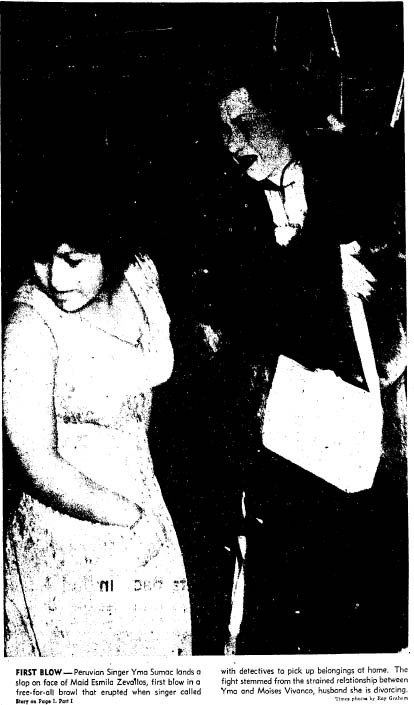
Miss Zevallos called Miss Sumac a “bad woman” and the battle was engaged.

“I have work for you like a servant,” cried Miss Zevallos. “Me and your
cousin, Yola. You’re going to throw me and your cousin out. I work for
you. I washed your…your… your many things. You are bad woman!”

Otash glided in from the living room, sensing trouble, to help keep the peace.

Farfan leaped up from his harp and helped Otash–for the time being.

The action subsided temporarily.

Peace was restored. Miss Sumac and Vivanco stood at the front door to pose for pictures.

“She knows how to pose,” he said gallantly. “She has many years of practicing.”

“Yes,” said Miss Sumac, smiling. “He taught me.”

Those were the last pleasant words spoken.

Vivanco spotted Otash and brought up the incident of the night before and the gun.

Otash said his man didn’t have a gun.

“If you say he didn’t have a gun,” cried Vivanco, his temper rising,”you are a big, fat liar!”

He exploded into Spanish and struggled back into English.

“You get out of this house!” he roared.

At this critical point,Vivanco noticed Private Detective Placey, who was standing mildly against the wall.

“There is the man,” he accused, “who had the gun!”

Vivanco lunged for Placey.

Another private detective, Bill Lowe, who had been staked out across the street, looking for the missing car, slipped up behind the irate Peruvian and grabbed his arms.

Otash moved in to separate the men.

Miss Rivero grabbed Otash from behind–by the hair–and yanked downward.
Otash backed against the wall, squirming to get free from the determined Inca woman.

Miss Sumac grabbed at Vivanco. Miss Zevallos danced onto the scene and grabbed Miss Sumac.

Miss Sumac’s dark glasses flew to the floor. Somebody tramped on them.

Prince, the collie, loped into the ring, threading among the struggling legs, tossing his head and barking joyously.

Miss Sumac flipped a smart backhand across Miss Zevallos’ mouth.

Farfan slithered in from the den, still speaking no English. He flung
his medium-sized figure at the bull-like Otash, trying to shove him
through the door.

Vivanco fell into a wrought iron planter.

Then, suddenly, the storm subsided.

Hair was patted and stroked back into place by the panting gladiators.
Yanked clothing was rearranged. Otash hunted on the floor for a missing
coat button. Miss Rivero dabbed at blood from a gash on the back of her
neck and assorted scratches on her arms.

But tempers still were on edge.

Miss Sumac slipped her mink coat down over her left shoulder and displayed a bruise the size of a dollar.

“How did I get this mark,” she demanded of Miss Rivero.

Haltingly, Miss Rivero recounted an incident of Thursday night, the import of which was that Vivanco had inflicted the bruise.

Vivanco smiled scornfully.

“This is your lover’s marking,” he said.
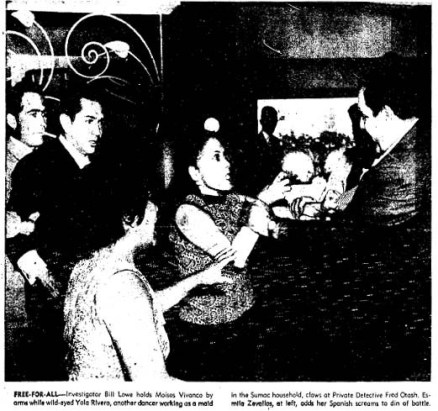
About this time, a district attorney’s car hove up on the curved driveway and three investigators spilled out.

In a few moments Sgt. V.A. Peterson and Det. Merle Pagh, who had investigated the incident of the night before, joined the show.

They had hardly taken charge before a patrol car raced up–somewhat
belatedly–in response to an alarm that a brawl was going on.

In the resulting powwow today’s meeting in Santa Monica was scheduled.

Otash later gave a stirring version of his own involvement, with comic overtones.

“This Vivanco grabbed my arm and his buddy grabbed  my coat. Vivanco
took a couple of shots at me with his fists. I was afraid to hit him
back. I was afraid he’d go into another world.

“Then one of the maids jumped in and started pulling my hair. The other maid came up behind me and grabbed me by the coat.

“One minute I’m up–the next I’m down.

“They were pulling me and pushing me. I was spread-eagled. I couldn’t
hit anybody. The whole pack of them wouldn’t weigh in at more than 225
pounds.

“Miss Sumac let one of the maids have it in the mouth–backhand. I told
her to be quiet and take it easy. Boy, it was a ball there for a while!”

The
Monday night affair that roughened tempers for the main event of
yesterday began when Miss Sumac called at the house to pick up some
things. She was accompanied by two Otash operators, Placey and Henry P.
Cohen. Also with her was her son by Vivanco, Charles, 8.

Vivanco said he tried to talk to the boy and the two detectives
manhandled him and threatened to shoot him, one of them drawing an
automatic. He later signed a complaint against the two men charging
assault with intent to commit great bodily harm.
Otash scoffed at the charge, insisting “none of my men have a gun
permit and none of them even own a gun.” Police who were called to the
house Monday night said they searched the two private detectives and
their car and found no weapon.

Miss Sumac left her son without bothering to pick up any of her
belongings but the detectives did accomplish something. They served
Vivanco a Santa Monica Superior Court order to show cause why Miss
Sumac should not retain custody of the boy, and a second paper
advancing the hearing into the matter next Friday.

Troubles between Miss
Sumac and Vivanco, who has been her musical director for years, began
when he lost a paternity suit filed by her former secretary, Maureen
Shea, 24.

Miss Shea charged that Vivanco was the father of twin girls born to her
in 1954 as the result of a backstage romance carried on while Miss
Sumac and her troupe were on tour. Her claim was upheld here in
Superior Court last January after a three-week trial.

Otash said yesterday that he will demand his detectives and Vivanco take lie detector tests
to determine the truth of their stories on Monday’s incident.

“I told Vivanco he’s going to get in trouble for making false crime reports,” the detective said.

Before the situation boiled over into violence yesterday, Vivanco talked reminiscently of his long career with Miss Sumac, which he described as a Pygmalion and Galatea relationship.

“Yma was nothing–musically and artistically,” he told reporters. “I made her. Like you make an image from clay–a puppet.”

Miss Sumac was born 35 years ago in the Andean village of Ichocan. She was given her professional name by Vivanco. It is the name of a legendary daughter of an Inca ruler. Miss Sumac’s voice, which is said to range over five octaves, has electrified audiences the world over.

Posted in Hollywood, Jack Smith | Comments Off on Inca-redible

Like gonesville

Ethel Merman and Perry Como

Email me


Posted in #video, Music, Television | Comments Off on Like gonesville

The bad dream

1957_0423_2

April
23, 1957

Los Angeles

1957_0423c_2
"It’s
like a bad dream," he said. "You keep thinking you’ll awaken and find it’s a bad
dream."

Edward Simon Wein, given five death sentences under California’s "Little
Lindbergh Law" for a series of kidnappings and rapes, said: "I was convicted
before I ever came to trial. The papers said all kinds of bad things about me.
They called me all kinds of bad names, including ‘beast.’ There was so much
prejudice I was convicted."

The 32-year-old painting contractor was identified by seven women, but he said
they were all wrong. "They were mistaken–honestly, the first time," he said.
"But then they couldn’t change their minds."

"A half-hour after I was arrested, a Hollywood detective said they were going to
make a [Caryl] Chessman out of me. The prosecutor in my case is the one who
prosecuted Chessman. I had the same charges pressed against me as Chessman and
the verdict was the same."

Of California’s death penalty, Wein said: "I don’t think it’s human. It’s
something more or less out of the Middle Ages."


A
ccording to police, Wein, who lived at
418
S. Hamel Road
, answered classified ads placed by women. He told them he
would have to check with his wife about whatever was being sold, then pretended
to have lost the stem from his watch. He gained control over his victims when
they stooped down to look for the missing watch stem and threatened to kill them
if they made any noise.

The attacks occurred over 18 months in Alhambra, Hollywood, South-Central,
Burbank and elsewhere in the San Fernando Valley. He was arrested by a private
officer at a Long Beach cocktail party after one of the victims said she
recognized Wein when he stepped on her foot. She said: "I’d never forget what he
looked like."

Wein was prosecuted by Deputy Dist. Atty. J. Miller Leavy, a formidable lawyer
who handled the Chessman,  Barbara Graham and L. Ewing Scott cases. When
Wein said he’d never in his life answered a classified ad, Leavy produced
Shirley Tierstein, who identified a check Wein wrote to her for an electric
stove. Tierstein said Wein came into her home at
753
S. Mariposa
in Burbank, but fled  when her son  Kenneth, who
was  sick and home from school, called out to her.

The prosecution also introduced partial
fingerprints matching Wein’s taken from a glass that he allegedly used to drink
water at one victim’s home.


W
ein was sentenced to death. His Dec. 5, 1958, execution was upheld by the state
Supreme Court and the U.S. Supreme Court rejected his appeal. However, the state
high court granted a delay pending a second appeal to the U.S. Supreme Court.

The mother of one of his victims, who was 14 at the time she was raped, wrote to
The Times in 1959: "What is wrong with the course of justice? … To think of the
possibility of such a man getting back on the streets again, free to come into
homes again to rape, rob or kill!!"

The U.S. Supreme Court denied his second appeal,  which claimed inadequate
counsel. But in June 1959, Gov. Pat Brown agreed to grant Wein a clemency
hearing. Brown reduced Wein’s sentence to life in prison "without the
possibility of parole" because the kidnapping was technical–he only moved the
victims within their homes.

"I feel that only where there is kidnapping in the true sense of the word, with
bodily harm, should the death penalty be involved," Brown said.

In 1966, Brown further reduced Wein’s sentence, making him eligible for parole
and on Sept. 16, 1974, after 17 years on death row, Edward Simon Wein was a free
man.

1957_0423b


T
hen on Aug. 8, 1975, the strangled body of Dorothy George, 52, was
found in the bathtub of her home at
5935
Abernathy Drive
in Westchester after she placed an ad for a recliner on a
supermarket bulletin board. On Sept. 5, a woman living in Palms who had posted items for sale on
a supermarket bulletin board was raped by a man who claimed he had lost the stem
of his watch. He began filling her bathtub with water but fled when a neighbor
slammed a door.

Over lunch a few days later, Venice Division detectives were discussing the
cases with retired investigator Robert S. Wright, who recalled the series of
"watch stem" rapes from 1956. After learning that Wein had been paroled, they
arrested him and charged him with murder.

Several of his earlier victims testified during his 1976 murder trial. A
63-year-old woman said that on Dec. 15, 1955, Wein came to her Crenshaw district
home to look at a fur stole and dining room set that she was selling. He choked
her "so long and so hard it ruptured the blood vessels in my eyes," she said.

A 54-year-old woman testified that on March 12, 1956, Wein locked her 5-year-old
son in a closet at her Encino home before raping her after she advertised a
mattress and box springs for sale.


T
he testimony of a woman who was a 19-year-old concert pianist when she was
raped May 11, 1956, was read into the record because "her physical and mental
condition is still so fragile that she cannot testify in person," The Times
said.

In June 1976, Edward Simon Wein, the "watch stem rapist," was convicted of rape
and murder and sentenced to prison.

As he said in 1957: "It’s like a bad dream. You keep thinking you’ll awaken and
find it’s a bad dream."

Email
me

Posted in #courts, Caryl Chessman, Homicide, Long Beach, San Fernando Valley, Venice Division | 3 Comments

Senoras y senores: ze mail

April 22, 1957
Los Angeles


Latin Holiday
by Pepe Arciga

1957_arciga_2


Lew Irwin, news director, KPOL
, generously switches on his mike, bows and says:

"Listeners telephoned to call my attention to your article concerning my
unfortunate identification of the race of two of the Club Mecca firebombing
suspects as ‘Mexican American.’ I can only blame thoughtlessness and
carelessness on my part…. I offer my profoundest apologies to the Mexican
American audience of KPOL."

Off the record, senor Irwin, we who handle news sometimes slip inadvertently,
no? Mexican Americans, I’m sure, will accept your noble apology most graciously.
Now back to KPOL’s excellent Cloud Nine. Signed Pepe.

Justin McCarthy, 816 W. Olympic, L.A. Newspaper Guild, takes off his printer’s
devil apron and makes up a front page that reads like this:

"Being an old copy desk man and a Catholic I noticed one of your recent columns
which mentions the Virgin of Guadalupe as being a ‘Catholic’ deity…. I’ll bet
it spoiled the archbishop’s dinner."

Well, Don Justino, it’s hard to say if dinner was spoiled at all. His eminence
the archbishop has already forgotten,  mebbe, Pepe’s slip. Signed, Pepe.

Jack Natteford, dahlia specialist, 12935 Saticoy, North Hollywood, waters his
rosebushes, turns around and bouquets Pepe
asi.

"Que tal? I consider you an ambassador
between two different cultures striving for same freedoms… (Mexico’s) idea of
religious sanctuary, carried into the political field, has drawn many of our
leading Reds to Mexican residence around Cuernavaca…. They wound up unable to
win power in the local parent-teacher association. Ha!"

Fascinating as the place is, my fran Jack, Cuernavaca is also home for the
gosh-darndest assortment of human birds you ever saw around its lovely plazas.
Including Red birds. Signed, Pepe.

Note: I can’t find Arciga’s original article referring to the Club Mecca firebombing so I’m not sure what he’s talking about. Two of the suspects were named  Manuel Joseph Hernandez, 18, and Manuel Joseph Chavez, 25. Further research is clearly required.

Posted in Uncategorized | Comments Off on Senoras y senores: ze mail

Missing

Paul V. Coates
Confidential File

Paul_coatesApril 22, 1957 

SUBJECT’S NAME: Stella Catherine Meyer.


SUBJECT’S DESCRIPTION:
Age, 36. Height, 5ft., 1 in. Weight, 140 lbs. Black hair.
hazel eyes. Stocky build.

The county sheriff’s office reports that Mrs. Meyer left her home at 12118
Highdale St.
, Norwalk, on an errand on May 6, 1956, shortly after noon. She has
not been seen since.

  I visited Roy Meyer this week. He is the subject’s husband. They had been
married for 13 years.

He told me about a little incident which happened not too long before his wife
disappeared.

"We–she and I–left the kids with some relatives to spend a few quiet days
vacationing by ourselves. As we drove out of Los Angeles, she kept asking me if
I thought the kids would be all right without her.

1957_0422_ad"I said sure, but before 24 hours had passed she talked me into turning around
and going back for the kids. That’s how strongly she loved them."

Mr. Meyer admits that a bit of friction had built up between himself and his
wife before she disappeared. But she couldn’t, he says, stand the pain of not
seeing her children.

"She needed them," he says. "Just like they need her."

All five of them.

There are John, 19, Frankie, 17, and Suzanne, 15–all Stella Meyer’s children by
her first marriage.

And there are Bobby, 13, and Jacqueline, the "baby" at 10.

It has been 50 weeks since she’s seen them.

"It was a Sunday," Mr. Meyer recalls, "and I was painting the bedroom."

"Stella called her brother and asked him if he had a paint roller. he did, so she
said she’d go over and pick it up and come back and help me.

"She said, ‘You should be through with the high parts by then, and I can do the
low parts without getting in your way.’

"She took Jackie with her–just like always.

"But after a couple hours she hadn’t returned, so I called her brother. He lives
about a mile and a half away.

  WHAT HE SAID

"And you know what he said?"

"He said she only stayed a few minutes. And she left Jackie to play with her
cousins, saying she’d pick her up later–when she brought the paint roller
back."

That was the last time anyone saw Stella Meyer.

But someone heard from her the next day.

It was a friend who lived across the street.

Stella, the friend said, sounded like she’d been crying. "I’m afraid," she spoke
over the phone. But she didn’t say afraid of what.

Never in 13 years of married life had Stella Meyer left home before. Her husband
is a mild-mannered man and it’s unlikely that she was afraid of him.

The next day police found Mrs. Meyer’s car. It was parked on Rosecrans Boulevard
near the Santa Ana Freeway. The key was in the ignition and the paint roller was
on the back seat.

Sheriff’s deputies talked to neighbors.

They learned that Mrs. Meyer had been quite nervous for a few months.

"She never seemed to be listening when you talked to her," one neighbor said.

Another woman, one of her closest friends, said: "If she was nervous and tired,
she might have run off–but she’d never stay away for as long as she has if she
was all right."

In the year she’s been away, Mr. Meyer has done his best to devote the proper
time to his family.

"I guess that I personally have made the adjustment," he says, "but with the
kids, it’s something else.

"It’s rough on any youngster to know he doesn’t have a mother.

"But I’d say it’s rougher when a kid thinks he’s got a mother but doesn’t know
where.

"Of even if she’s dead or alive."

Posted in Columnists, Paul Coates | 1 Comment

A flurry of interest

Eastla_snow_3

UNEXPECTED THRILL–Romping in the snow was a surprising Easter treat for youngsters in the 4500 block of Yellowstone Street yesterday when a white blanket fell–not in the foothills–but just 1 1/2 miles from General Hospital. Enjoying a rare toboggan ride is Karen Louise Block, 6, with others waiting their turn.

Email me

Posted in #East L.A. | Comments Off on A flurry of interest

“Not Too Good”

1957_0422a

April
22, 1957

Las Vegas

Ntg
Nils
  T. Granlund, 1950s TV personality and master of ceremonies at Hollywood’s
Florentine Gardens through most of the 1940s, was killed in a car accident on
  the Las Vegas Strip, ending a flamboyant career described in the 1957 book
  "Blondes, Brunettes and Bullets."

The man nicknamed "Granny" and
"N.T.G." was taking a cab from the Riviera Hotel and died after the taxi was
  hit by a driver who refused a blood-alcohol test, The Times said. Granlund was 57.

His casket was covered with flowers and a ribbon that said "To Granny From the Girls," a tribute to a man responsible for the careers of Jean Wallace, Lili St. Cyr and especially Yvonne De Carlo, who claimed his body and arranged
the funeral at Forest Lawn Memorial-Park in the Hollywood Hills


Here’s an interview I did years ago with the late studio publicist Bob Rains
  about N.T.G.

In 1946, International Pictures, that I had started with, released a movie called “Tomorrow Is Forever,” which starred Orson Welles, George Brent, Claudette
  Colbert, Natalie Wood, and a young kid called Richard
  Long
.
 

NTG in those days had a radio show on the Mutual Network, KHJ, and somebody called the studio and said they’d love to do an interview with him because he had a great story about the way he was
  discovered.

1957_granlund_book

He lived in the Valley and was  a student at Hollywood High School, and he was hitchhiking from the Valley to
  Hollywood High.

And one day he was picked up by a man by the name of Jack
  Merton, who was a casting director for International Pictures. And they got to
  talking. He says, “What are you doing?” and he says “I want to be an actor.” He
  says “Great, call me some day, we may have something for you.”

Richard never called. About
  three or four months later, it was pouring rain, Merton picks up the same kid,
  it’s Richard Long. He says, “Call me!” He called him and that’s how Dick Long
  got started with International Pictures when I was there. This was in 1946.


Anyway, the picture’s coming out and NTG heard about it. He called the studio, and wanted to interview Dick on his radio show on KHJ. I think it was the whole  network then.
 

We said fine. I was then
  involved in that. And he said well I’d like to meet him beforehand. In those days, 1946, it was live. I said fine, so we set up a meeting at NTG’s house on
  Fountain Avenue [Note: It was really Franklin–lrh]. It was east of Vine Street, a great big place. And we were
  supposed to be there at a certain
  time.
 

We got there a few minutes early and rang the door bell, and a very  voluptuous, beautiful young
  lady opened the door. We introduced ourselves and she said “NTG isn’t here
  right now; come in and
  wait.”
 

So
  we went in. And I don’t remember—we didn’t drink; we had some soft drinks or
  something—and we waited for about half an hour.

1957_0422b

During this time, one after
  another after another of the most beautiful young ladies walked through the
  room we were waiting in. All introduced themselves, all said they were his
  secretary.
 

Finally NTG comes and we do a
  nice interview, preliminary and all that. Somehow he says, “Do you want to see
  the house?
”
 

I said yes, so we have a tour
  of the house. And we walk in one room, there is this immense bed. I don’t
  recall the size, maybe 10 by 20, it was the biggest bed I’ve ever seen, twice
  the size of a king size.
 

And I said to him, “How come
  you got this big bed?”


He said, “Well we all live
  here.”


I said,
  “who?”


He said, “My secretaries; we
  all live here.”


I says, “Well do you all sleep
  together?”

And
  he says yes!


And we went on a few days
  later on KHJ, which used to be on Melrose, and Dick did the
  interview.


It was an amazing… man with a
  great appetite. But imagine … four, five, six of them of the most beautiful
  broads you’ve ever seen … sleeping in the one bed. And every time they came
  through the room, … I’m so and so, glad you’re here. Period. It was quite the
  experience
.
 
Note: Muzzy
  Marcellino,  former bandleader at the Florentine Gardens, used to joke
  that N.T.G.  stood for "Not Too Good."


Email
  me

Posted in Hollywood, Nightclubs | 1 Comment

The honorary mayor of Sherman Oaks

1957_ad_liberace

Liberace on Edward R. Murrow’s "Person to Person"


Email me

Posted in #video, Music, San Fernando Valley, Television | Comments Off on The honorary mayor of Sherman Oaks

Reading the palms

1957_0421_vivian


April 21, 1957

Los Angeles

I think about his hands. I don’t know, but I would imagine that at the age of 78,
they were old and worn from a lifetime of custodial work for Los Angeles County.
Gnarled, maybe, with age spots.  I like to think you can tell more about
some people by their hands than by their face. This is mostly guesswork, but I
wonder what story his hands would tell.

Were his nails all ragged or did
he keep them neat and smooth? Were his fingers short and stubby or long and
thin? Did he have a wedding ring or was he one of those men who didn’t wear one
for fear it would get caught in the machinery he used?

Ad_rubinstein

We just don’t know.

He would have been born about 1879, and I picture him in school holding a pencil
and figuring sums. We know he could read and write because of his last note.

It’s fairly certain his hands gripped the reins of a horse and buggy; maybe he
held the steering wheel of an automobile, or maybe he took the streetcar. I
think of him as a young man in his 20s, filling out a job application. At that
time, many county jobs were gotten through political patronage, but that’s just
a guess.

At
some point in the next 28 years, he met a woman named Adelaide Houston, who was
15 years younger.  I have no how they met, but I picture him holding her
hand and putting a wedding ring on her finger.

Then I picture his hands holding his son, Roger, who was born about 1928.

Maybe he pitched a ball to his son and hugged him when he graduated from high
school.

All along, those hands picking up a mop bucket and pushing a broom for the
county. Washing windows and scraping gum off the floor. Shaking hands when he
retired.

Ad_tony_martin

And then opening the door to the doctor’s office for him and Adelaide.
Comforting her when the doctor told them she had cancer, just like him.

Those worn hands, opening his wallet to get for medicine at the drugstore, and
paying the rent for the apartment at
834
N. Huntley Drive
in West Hollywood.

The
hands, which figured sums in school so long ago, writing a three-page letter to
Roger, sealing it in an envelope and leaving it on the coffee table.

Then dialing the telephone to the hotel in Hollywood where Roger worked the
graveyard shift while going to law school at USC. There was a letter on the
coffee table, be sure to mail it, he said.

Finally, the old, worn hands picking the gun as he walked into the bedroom where
Adelaide was sleeping.

When Roger came home that morning, he found his parents’ bodies on the bedroom
floor.

The note said: "If we continue spending our money to keep ourselves alive, there
won’t be anything left for you to go to law school."

Note:
The
State Bar of California
does not list an attorney named Roger M. Vivian.

Email
me

Posted in Suicide, West Hollywood | Comments Off on Reading the palms