
Oct. 25, 1953
Los Angeles

Oct. 25, 1953
Los Angeles
Calypso attire for summer


June 7, 1957
Los Angeles
Max Cossak, an abstract artist, hates the modern art on display at the
Los Angeles County Museum. He hates the artworks so much that he is
picketing a juried show because he believes "the abstract
paintings chosen to be shown are trash and giving abstract art a black
eye," the Mirror says.
Assistant Chief Museum Curator James Elliott defended the panel that
chose the paintings by saying: "The jury was asked to select solely on
the basis of quality without regard to stylistic tendencies and as
representative as possible of the best work recently produced. In this
regard, I believe they have done a very good job."
Cossak, of 1321 N. Harvard Blvd., disagreed vehemently, calling the
jury "partisan, blind and stupid." He noted that he submitted six
paintings for exhibition using his own name and three pseudonyms and
none of them were picked.
He also wrote a letter to The Times stating his complaints about the show:
"There are 166 pictures in all, 98 of them abstract. Out of the 98, 52 were so bad that I wonder if the jury was blind.
"Six paintings actually had the paint run on the canvas. Some were
painted with a house brush. Others were infantile, sloppy and
tasteless. It is a disgrace to hang such work in our top museum which
is supposed to show the best work of L.A. artists.
"It seems to me that the pictures were picked more for the name of the
painter than purely on their own merits. Proof of that is the test I
made. I submitted six paintings under three false names and not even
one was accepted. Among them was one that won a prize at a former
exhibit. So I have lost faith in the methods and fairness of the jury.
"Next year I suggest that the names of the artists be taped over so
that the jury will be forced to choose each work on its own merits. The
silence of our art critics in Los Angeles amazes me; don’t they have
enough courage to criticize bad art?"
The Samuel Goldwin Award was given to Edgar Ewing for "Rose Parade Saddle" while the Junior Art Council Award was given to Oliver Andrews for an 80-inch steel piece titled "Figure."
Cossak died Feb. 21, 1974. He was 64.
Note the Michio Takayama artwork in the background of the top picture.
Richard Schave, one of my friends from the 1947project, writes that Councilman Herb Wesson has become involved in the situation regarding the John Fante building at 826 S. Berendo, and is seeking a historical marker for the structure. Stay tuned….
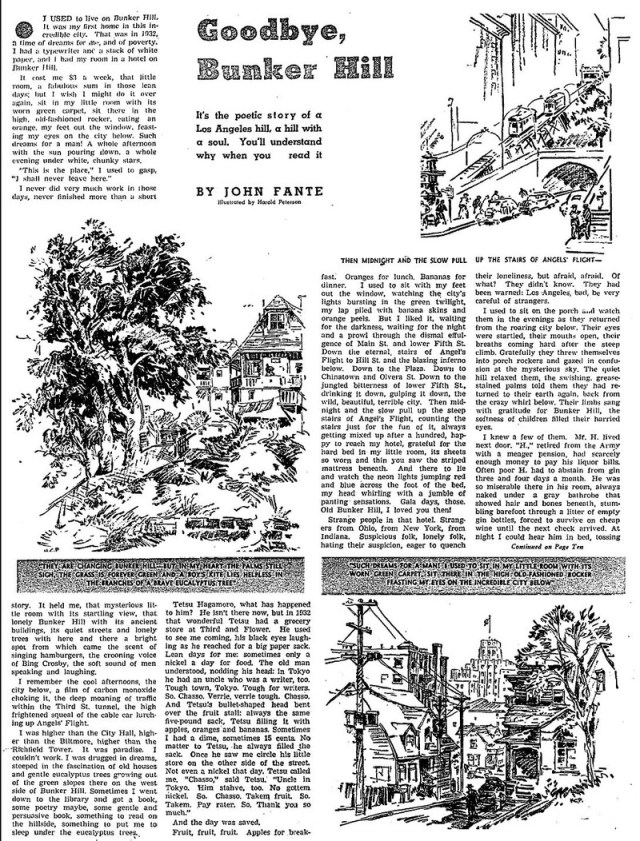
And as a treat, here’s a John Fante story that appeared in The Times in 1940. Enjoy!
Page 1

June 6, 1957
Los Angeles
Just in time for Father’s Day, 16-year-old Barbara Davis Chilton was
reunited with her dad, whom she had never seen, thanks to a Paul Coates
column.
Lester Eugene Davis came to the door of 11812 Phillips Ave., Lywood, "Right away I was crying on his shoulder," Barbara said.
"I remember her saying, ‘This is my daddy. I just know it is.’ And then
she fell into my arms," Lester said. "I guess we were both crying."
Lester said that he and Barbara’s mother separated shortly before his
daughter was born. "I did get to see her at the hospital in Inglewood
when she was a few days old, but on later attempts I was told that I
wasn’t wanted. And, eventually, I lost complete track of her."
Barbara was bounced from one relative to another and finally placed
with foster parents. Whenever she asked about her father, she was told
that he had moved out of state. Barbara finally ran away from a foster home in Lancaster to marry a mechanic named Jack Chilton, 21.
The break came when Lester’s mother read Coates’ column and contacted
her son, who lived in Yucaipa. At the same time, Barbara’s
sister-in-law Cloa Chilton also contacted Lester’s mother.
Upon being introduced to his new son-in-law, Lester said: "A wonderful boy and a real fine addition to our family."
According to California death records, Lester E. Davis died Feb. 5,
1977, at the age of 65. As for the newlyweds? There’s no further
information. We can only hope for the best. Barbara would be 66 now and
her husband would be 71.
 June 6, 1957
Los Angeles
Former vice squad Detective Sgt. Philip Barnes was convicted of
molesting a 13-year-old girl, according to The
Times.
Barnes, of 3811 W. Avenue 41, presented an unusual challenge to
prosecutors. Because he waived his preliminary hearing in Municipal
Court and said he planned to plead guilty, there was no transcript of
the girl’s testimony. When Barnes changed his mind and pleaded not
guilty, the girl had vanished and there was not enough evidence to go
to court.
Deputy Dist. Atty. Joseph T. Powers located the girl after a nationwide
search and personally brought her back to Los Angeles from the East
Coast, but she refused to testify until a recording of Barnes’
confession was played in court.
Barnes was convicted, but The Times failed to report the sentence imposed by Judge LeRoy Dawson.
Bonus fact: Dawson, who lost his left foot after being wounded in World
War I, collapsed and died in 1964 after 33 years in the Municipal and
Superior Courts.

June 5, 1957
Municipal collection of combustible rubbish began Monday in a vast area
including Hollywood and, human nature being what it is, the results
were slightly startling.
Householders seized upon the opportunity to get rid of all sorts of
rusty and dusty stuff stored for years in garages, including broken
birdcages, wicker baby buggies, old tires, beat-up suitcases, ruptured
easy chairs and worn-out girdles.
Their attitude was plain. They’re paying for the service and they intend to make the most of it.
The Fire Department naturally is delighted by this wholesale unloading. Much of the junk is a potential fire hazard.
The rubbish collectors, nursing aching backs, figure it’s all part of the job.
Their bosses would say only that the collections were "unprecedentedly heavy."
In the event anyone is interested, the stuff is burned in two city
incinerators–one on Lacy Street and Avenue 21, the other on Gaffey
Street in San Pedro–and also dumped in Toyon Canyon in Griffith Park.
Toyon Canyon is a cavity of 5,000,000 cubic yards, will take
approximately five years to fill and never seemed so appropriately
named as now.
Note: In April 1957, the city of Los Angeles began collecting
combustible rubbish as it moved toward a ban on incinerators, which
were outlawed as of July 1, 1957 for businesses, motels and apartment
houses, and Oct. 1, 1957, for homes. The Toyon Canyon Landfill closed in 1985.

June 5, 1957
Beverly Hills
"OK, 261 S. Maple, Beverly Hills. This is the place.
"Hi, Mr. and Mrs. Bloom?"
"That’s us."
"We’re from The Times. You the folks with the dog that watches TV?"
"Yes. Do you want to see him?"
"Actually, we’d like to see him and take his picture."
"Come on in."
"Thank you. Is he watching TV now?"
"Right now he’s in the backyard."
"OK, where’s the TV set?"
"In here…. Have a seat."
"Why don’t you tell us what happened?"
"Well, there isn’t much to tell. On Monday night, we were watching
television and there was a show about a hypnotist. And the dog was
sitting in his chair, right there, and he suddenly sat up and got very,
very stiff."
"So Mrs. Bloom, what did you do?"
"I waved my hand in front of his eyes and he didn’t react. So I told my husband, ‘I think he’s dead. Call the police.’ "
"Call an ambulance," said Mr. Bloom.
"So you called the Beverly Hills police?"
"They said to call the Humane Society."
"And what happened next?"
"They said to throw some water on him. I got a towel and wet it down and put it on him, you know, but it didn’t do any good."
"I see. What happened next?"
"Our son, Phil, came home and the dog finally moved."
"And then what?"
"And then nothing. Just back to normal."
"I see. I wonder if we could get a picture of the dog watching television."
"Why certainly."
"What does he like to watch? ‘Lassie?’ ‘Rin-Tin-Tin?’ "
"No… I don’t think so."
"Hm. This was Monday night?"
"Yes."
"How about if we go through the listings to see if I can jog your memory?"
"Leave It to Beaver?"
"No, it was later than that."
"I Love Lucy?"
"No."
" ‘December Bride?’ ‘Voice of Firestone?’ "
"I’m sorry, I wish I could be more help."
"Channel 2 news with Clete Roberts?"
"Sorry."
"Here it is: Channel 7. ‘Mask of Dijon.’ Erich von Stroheim. Refusing to work, a magician uses hypnotism for evil purposes."
"That must be it."
"May we get a picture of the dog watching television?"
"Of course."
"OK, Mrs. Bloom, how about if you stand there and look at the dog?"
"Surely."
"Thanks."
Ps. Somehow the Times reporter forgot to ask the dog’s name. I’d like to think he was named Ch. Tampa Chatsworth Devonshire III. But they called him Spot.

June 5, 1957
Tokyo
Until the moment he pulled the trigger on that day in January, Spc. 3rd
Class William S. Girard of Ottowa, Ill., was a just bored 21-year-old
soldier with an IQ of 90 guarding a machine gun on a firing range.
Until the moment Girard pulled the trigger, Naka Sakai of Somagahara,
Japan, was just a 46-year-old wife and mother of six children from an
impoverished village scavenging shell casings from the range.
Maybe
as a warning, maybe out of boredom, Girard had his companion, Spc. 3rd
Class Victor N. Nickel, throw some empty cartridges out on the firing
range. As Sakai and the other scavengers scrambled to pick up the
precious brass, Girard fired a warning shot: a spent casing from a
grenade launcher mounted on a borrowed M-1 rifle. But the casing struck
Sakai, killing her and touching off an international furor.

Beyond
those few facts, the case is cloudy. According to the scavengers, some
soldiers treated them well and saved empty brass for them while others
threw spent cartridges in the bushes "as if they were feeding
chickens," one said. Still others played a game of luring the
scavengers and then shooting over their heads to frighten them away,
according to a story by writer John Hersey.
To the U.S.
military, Girard was acting while on duty and thus under American
jurisdiction while Japanese officials insisted that Girard shot Sakai
during a rest period, making him subject to local laws. After
deliberations, U.S. military authorities decided to surrender Girard to
Japan for a civilian trial, provoking furious protests from U.S.
veterans groups like the American Legion.
According to Hersey,
Girard was "a short, slight, sandy-haired man with a faded scar on his
forehead, a prominent nose and wide-flying ears, a thin-lipped mouth
and weak chin. He leaves his mouth open much of the time in court.
Before the killing, Girard was a kind of bumpkin clown. He drank quite
a bit and ran up petty debts in the Japanese shops near his camp."
Girard’s
Japanese wife was a hindrance and help. Haru "Candy" Sueyama was born
in Formosa and came to Japan as a teenager, where she worked various
jobs before meeting Girard as a bar hostess. "Her kind is deeply
scorned by the Japanese," Hersey said, describing her as small,
freckled and brighter than her husband. Still, she paid the traditional
visit of condolence and apology to the Sakai family on behalf of her
husband.
The trial revealed the unbridgeable gulf between
Japanese and American customs. "Girard will never look apologetic
enough to the Japanese," Hersey wrote. Americans, even sensitive
Americans–and Girard cannot be charged with overdeveloped
sensitivity–simply do not have it in their tradition to fall to their
knees and bow to the floor in abject humility, either literally or
figuratively."
Even an attempt to present money in a condolence gift misfired and seemed to be nothing more than "a materialistic American
attempt to buy off justice," Hersey wrote.
Girard, who was reduced in rank to private, was ultimately found guilty and given a three-year suspended
sentence, a lighter punishment than he might have received in a
court-martial, U.S. legislators noted. On his way home to Ottowa in
December, Girard was booed by other soldiers. At her first American
Christmas, Candy Girard told a reporter: "I’m just happy. I’m just
happy."
Akikichi Sakai and his six children received $1,748.32 ($12,527. 21 USD
2006) in consolation money for the death of his wife. He said: "I do
not thank you for it."

June 4, 1953
Harold Leader is not a man of few words.
Or minced words.
He is one of a group of persons who are planning, shortly, to start a house of ex-cons in Los Angeles.
And he has every belief that the house will be a credit to our
community and may someday be the ignitive spark for a new national
approach to the problem of criminal rehabilitation.
The idea for a house of ex-cons does not belong to Mr. Leader. It is,
rather, the outgrowth of a study of rehabilitation problems by the
American Friends Service Committee.
The study was stimulated by one shocking fact:
That 85% of the nation’s prison inmates are repeaters.
I talked with Leader about the proposed house this week but before we
really got into the plan, he made a few other beliefs of his quite
clear.
"Today’s penal systems," he told me, "are illogical and expensive.

"A man goes to prison because he is incapable of dealing with situations. And his prison experiences make him even less capable.
"When a man commits a crime, it usually shows that he doesn’t have the necessary personal qualities to cope with society."
The personal qualities which Leader enumerated were:
1–Pride in himself
2–Acceptance by others.
3–A feeling that his contributions are worthwhile.
And this, according to Leader, is what our penal system does to a human being:
"First, we convict him. Saying, in effect, ‘You are no good.’
"Second, we remove him physically. Reject him.
"Third, we refuse to permit him to work competitively while in prison.
"And finally, the man is kicked out of a secure prison society and
tossed back into the same society which he couldn’t cope with in the
first place."
Leader, a retired industrialist, told me that he has no pretensions that a "halfway house" for ex-convicts would solve all this.
"The plan of the Friends Society is merely to demonstrate that an
ex-convict, given proper environment and monitorship, can readjust."
"How many ex-convicts would you take in?" I asked.
"Probably 10. With living quarters, that is. And each would stay for
periods from 60 to 90 days. The first couple months are when most men,
if they are going to repeat, do repeat."
"Why?"
"Because they walk out of prison into a very hostile atmosphere. They
are ex-cons. They are rejected for credit, rejected for employment and
rejected for social acceptance. Many of them, because of their original
problems, exaggerate the hostility."
"How," I asked, "would a home such as you propose help them?"
"Primarily, by providing the environment in which human beings can
grow. The club will merely be a vehicle through which they can exercise
their positive ideas.
"It will, of course, provide a haven and place of relaxation where they can drop their defenses against society.
"It will be for them to use as they wish. Any organized efforts toward
employment or public relations programs or the like must be started by
the ex-convicts themselves."
I asked Leader if the club would be restricted to residents.
He said it would be open to all ex-convicts.
"Aren’t many ex-convicts forbidden by parole regulations to associate with other ex-convicts?"
"The Friends Society has been working on the project for more than two
years. The program was planned with encouragement and aid from top
penal officials.
"They see the need and are 100% willing to go along with us. We’ve also cleared with local police."
"How about your prospective neighbors?" I asked.
"When we select a site we’ll discuss the entire project with them."
"Won’t the fact that 85% of our prison inmates are repeaters scare them?"
"It should," said Leader. "It should scare them into realizing that everyone wants to help the ex-convict go straight.
"Except," he added bitterly, "when they’re asked to help."
Note: Harold Leader died Feb. 16, 1980.


June 10, 1957
Los Angeles
The street is quiet and the house is unremarkable. A neighbor’s small collection
of emergency vehicles might be the only unintentional clue that
something terrible ever happened on Gullo Avenue.
The death toll would have been higher, authorities said, if pilot Harry
Smith of Chico hadn’t cut the ignition on the Piper Tri-Pacer moments
before it went down over Pacoima, hitting the edge of a home where the
Worth family was having a birthday party.
In addition to Smith, who owned a construction company, the crash
killed Terrence Lockhart, Robert Peterson and Owen Wallis. "Firemen had
to literally tear apart the crumpled fuselage to reach the bodies of
the victims," The Times said.

Photographs by Larry Harnisch Los Angeles Times
9410 Gullo Ave., Pacoima, Calif.
Ed Rauch, a neighbor, said: "The plane was about 2,000 feet up when I
heard the engine cough and I looked up. It went into a roll and one
wing collapsed backward. Then it nosed over into a dive and the pilot
gunned the motor, then cut it. The plane dived straight down. It was
silent and kind of eerie. The pilot had no chance to guide it away from
buildings."
Fortunately, the plane only clipped the edge of the home. Five feet
closer and it could have wiped out an entire family: Barry Worth and
his wife, Mary; their children Katherine, Danny and Harold; Worth’s
sister-in-law, Erica, and his mother-in-law, Katie Bauchwitz, and
father-in-law, H.E. Bauchwitz.

The fatal crash renewed calls for new flight restrictions for the San
Fernando Valley, where a transport plane and a jet fighter collided
over Pacoima on Jan. 31, 1957, killing three Pacoima Junior High School
students and five airmen and injuring 70 others.
Other Valley plane crashes:

Richard Schave, one of my friends from the 1947project, writes that the duplex at 826 S. Berendo, were John Fante wrote "Ask the Dust," is slated for demolition.
And here’s a slide show on the Fante building.
I passed this car — covered with computer keys — on the Golden State Freeway on my way to the site of a Pacoima plane crash.

Photograph by Larry Harnisch Los Angeles Times

June 4, 1957
Los Angeles
Meet the city's Japanese American gangs: The Black Juans, the Dominators, the Koshakus, the Ministers, the Algonquins and the Little Gents.
Unfortunately, The Times wrote very little about them. One exception was a 1970 story about the Yellow Brotherhood, a self-help group founded to help get gang members off drugs and back in school.
One unidentified founder, a former gang member, said: "The kids aren't happy. The parents are working so hard to give the kids the things they didn't have but they are thinking in terms of material things. Not love."
Tadashi Nakamura's 2004 film on the Yellow Brotherhood won an award for best documentary short at the San Diego Asia Film Festival.
Dear friends at Model Minority: I'm pleased you're linking to this post, but I would prefer to know what's being said.
Sincerely, Larry Harnisch
 June 3, 1957
SUBJECT’S NAME: Lester Eugene Davis.
SUBJECT’S DESCRIPTION: Age 42. Height, 6 feet. Weight, average. Light brown hair. Brown eyes.
Any
person with information as to subject’s whereabouts is requested to
contact his daughter, Barbara Davis Chilton, 11812 Philips St.,
Lynwood.
Barbara Davis Chilton is 16 years old. She’s slim and blond and soft of speech.
She’s a pretty girl and looks her age, but her demeanor tips off an early maturity of her mind.
When I talked to her the other day, I sensed that the maturity wasn’t easy in coming. And that it had only recently arrived.
Before
meeting Barbara, I had received a letter from her sister-in-law giving
me a little background on the girl and her missing father.
"Barbara,"
the letter said, "has never seen her father and I feel that if she
could find him she would have the happiness she honestly deserves."
The letter stated that Barbara came from a broken home and that her
father had made attempts to see his daughter when she was young.
But had never succeeded.

"The girl’s life hasn’t been an enviable one," the sister-in-law wrote.
"She has lived in foster homes, with relatives and friends and has a
long record for running away."
The letter also mentioned that last December Barbara ran away from a foster home again–to marry 21-year-old Jack Chilton.
"Her marriage has been approved by the court now," it said, "and has every possibility of being a very happy one."
The letter left a few questions unanswered.
And I asked them of Barbara.
"First of all," I said, "tell me all you know about your father."
She told me that her parents split up shortly before she was born.
"He stayed in the Inglewood area for a while but eventually, I’ve been told, went to Indianapolis. He was a race car mechanic."
She added that his mother, Linda Davis, used to live in San Bernardino.
"But I don’t know if she still does."
I asked Barbara where she received her information.
"From neighbors, and some from my mother’s parents."
"Did your mother ever talk about him?"
"No. She didn’t want me to see him."
"Do you think she knows where he is?"
"No, not any more."
"Barbara, your sister-in-law wrote me that you’ve never seen him. Is that right?"
"That’s…," she started. "I don’t know. Once, when I was living with
my mother on Inglewood Avenue a man came to the house who might have
been him. I was 10 at the time."
"What happened?"
"I was in the bedroom when the doorbell ran. I went to answer it but my
mother told me to go back into the bedroom and close the door.
"My mother and the man talked in the living room and I heard her ask him:
" ‘How did you find us?’ "
"I opened the door a little bit and peeked at him."
"What did he look like? I asked.
"He looked…" she began. Then she broke into a smile. "At least I think he looked quite a bit like me.
"I asked my mother and she said it was just a friend."
"Does your mother know that you’re looking for your father now?" I asked.
Maybe Barbara didn’t hear the question.
"You know," she said, "if I could find him I think he’d like Jack, my husband.
"You see, Jack is a mechanic too."

June 3, 1957
An alumnus of a large social fraternity has received a letter from
national headquarters in Indianapolis alerting him to a "major crisis
in California."
Under this particular fraternity’s laws, Negroes and Orientals are not eligible for membership.
The crisis centers about Assembly Bill 758, now under consideration by the Committee on Education.
It proposes that effective July 1, 1959, "No state-owned college or
university nor student council or student assembly thereof, shall
recognize for official campus activities any student organization,
fraternity, sorority or other private student organization which
restricts its membership on the basis of either, race, color, religion
or national origin."
If this legislation passes, the Greek-letter fraternity warns, it will
affect chapters at Berkeley, UCLA, San Jose, Fresno and Davis.
"Opposition to AB 758," the letter continues, "carries with it no
implication of racial bigotry or disagreement with the persisting ideal
of the ultimate brotherhood of men. Those opposed feel that progress
toward that ideal will be limited rather than encouraged by the
legislation proposed."
The alumnus is urged, if he agrees with this philosophy, to make his
view known to his friends, his representative in the Legislature and to
Assemblyman Vernon Kilpatrick of Lynwood, sponsor of the bill. The
letter concludes:
"There is no time to be lost, and the issue is vital–not only to our
fraternity, but to freedom-loving Americans everywhere. We are counting
on you."
The alumnus, who among other things learned tolerance while a university student, is resigning from the fraternity.

June 3, 1957
Los Angeles
Los Angeles celebrates the 75th birthday of one of its most famous
emigre composers with a concert at UCLA and a party in Beverly Hills.
Calling him "the dean of the world’s music composers" (recall, for
starters, that Dmitri Shostakovich and Aaron Copland are still alive), The Times announces a concert honoring the man who wrote "The Rite of Spring," "The Firebird" and "Petrushka," although none of those works are performed in his honor.

Instead, the Los Angeles Music Festival, headed by film composer Franz Waxman, featured "The Symphony of Psalms,"
conducted by the composer. The concert at UCLA’s Royce Hall also
included the U.S. premiere of "Canticum Sacrum" and the world premiere
of "Agon," conducted by Stravinsky’s Boswell, Robert Craft, as well as Stravinsky’s arrangement of Bach’s "Von Himmel Hoch" and "Symphonies for Wind Instruments."
Stravinsky received a scroll from the City Council and a telegram from President Eisenhower. Aldous Huxley read a tribute praising "the perpetual dawns in Stravinsky’s work," The Times said.
One of the large mysteries about Stravinsky’s years in Los Angeles is
where he lived. A little detective work shows that he had a home at 1260 N. Wetherly Drive
in West Hollywood. When I drove over to find it one weekend last year,
I ended up talking to a man who had grown up across the street in a
house he eventually inherited from his parents. He recalled that as a
youngster he met Stravinsky and shared some pleasant little stories. To
me that is one of the ultimate L.A. moments.
Photograph by Larry Harnisch Los Angeles Times


Photographs by Larry Harnisch Los Angeles Times
The "Wrong Door Raid" apartments at Waring Avenue and Kilkea Drive, May 27, 2007

June 2, 1957
Los Angeles
Let’s suppose you are an American baseball legend being divorced by
your beautiful Hollywood actress wife. Let’s further suppose that you
see her car parked outside a small apartment house near Melrose and Crescent Heights
late one night in 1954.
Naturally, you decide to break down the door and catch her in the act
with another man, even though you have a less than 50-50 chance of
breaking into the right apartment.
Of course, you call some private detectives. And being an American
baseball legend, an Italian American baseball legend, your chums
include a well-known Italian American singer.
Out comes the ax and down goes the door at 8122 Waring Ave.
Uh-oh.
Instead of catching Marilyn Monroe, Joe DiMaggio and various companions (including Frank Sinatra) terrified Florence Kotz Ross.
Who was asleep.
By herself.
"Mrs. Ross was fast asleep about 11 p.m. when five or six
men suddenly battered down the back door to her apartment, tearing it
from its hinges and leaving glass strewn on the floor," The Times said.
"Immediately … a bright flash of light was shone in her eyes and she
was confronted with a number of men, some of whom seemed to be carrying
an instrument which at first sight she believed to be an ax."

The men fled and Ross reported the incident to police as a burglary.
Then Confidential magazine published a story about the raid in its
February 1957 issue, touching off the Legislature’s investigation of
scandal magazines and private detectives. Ross learned the identities
of the raiders when one of the private detectives, Philip Irwin, told
the story to the investigative committee and the grand jury.
Sinatra received similar treatment when he was served with a subpoena
in Palm Springs at 4 a.m. on Feb. 16, 1957, and he filed a complaint
with the LAPD about the incident. Although his testimony was
contradicted by others, Sinatra was adamant that he remained in a
Cadillac parked outside the complex during the raid.
Private detective Barney Ruditsky, Irwin’s boss, testified before the
grand jury that Sinatra and DiMaggio remained outside while he and
Irwin broke down the door. During the investigation, Irwin testified
that he had been beaten up by six men after he told an official of the
State’s Bureau of Private Investigators and Adjusters his version of
the raid. He also testified that he hadn’t sold the details to Confidential
magazine.
In September 1958, the "wrong door" lawsuit against DiMaggio, Sinatra,
Irwin, Ruditsky, Patsy D’Amore and John Seminola was settled for $7,500
($53,739.63 USD 2006).
And where was Monroe during all of this? Next door, visiting girlfriend Sheila Stewart Renour at 8120 Waring.

June 1, 1957
Los Angeles
In Washington, Arthur Miller
is found guilty of contempt of Congress for refusing to reveal who else
attended a Communist meeting in 1947. In an appearance before the House
Un-American Activities Committee, Miller, the playwright and husband of Marilyn Monroe,
admitted being at the meeting but said his conscience prevented him
from saying who else was there. Federal Judge Charles E. McLaughlin
allowed Miller to remain free on bail pending his sentence.
In Blacksburg, Va., a riot by 300 Virginia Tech
students is halted when the student band plays "Dixie." The students
were protesting the city’s plans to annex part of the campus.
In Los Angeles, Nobel Prize-winner Linus Pauling
continues to speak out against testing nuclear weapons. He says that
even minute quantities of radiation released by the blasts raise the
risk of genetic damage, bone cancer and leukemia.
Also in Los Angeles, U.N. Ambassador Henry Cabot Lodge
vows to continue blocking China’s admission to the United Nations.
"We’ve blocked Red China’s entry into the U.N. 34 times since I’ve been
at the U.N.," he tells The Times. "That’s one of my assignments."
Noting that there are more U.N. members now, Lodge says: "The job gets
harder all the time. But we get it done."
Lodge also said that making peace in the world would aid the U.S.
economy and help cut taxes. "The only way to get real economy, to hope
for a real tax reduction, is to reduce the tensions that breed war
and eventually reduce our expenses for military items. Sixty percent
of our expenses are for support of the military," Lodge said.
And at the Ambassador Hotel, thousands of bridge players are gathering for the 23rd annual Bridge Week, sponsored by the American Contract Bridge League.
Below, Longwood Estates, Long Beach and Arestia boulevards. This cleanly designed piece stands out from most of the real estate display ads in The Times. There’s no architect’s drawings or floor plans, just crisp type and a photograph of a happy couple with lots of white space. A forward-looking piece of work.


June 1, 1957
A rewrite man assigned to vacation relief on the police beat was shown around the new police building the other day.
As he entered a padded cell he was told to feel how soft the walls were.
When he turned around he was alone.
"Hey, where’d everybody go?" he yelled.
His pals left him there for an hour.


