
June 15, 1957

June 15, 1957

June 15, 1957
It can now be revealed that a dark plot against the Stanfords by the
Uclans–an offshoot of the feuding between the two universities as a
result of PCC [Pacific Coast Conference] penalties–has been
inadvertently thwarted.
Not long ago, Bob Kennedy, a Stanford alumnus in the floor covering
business in Westwood, was commissioned to supply carpeting for the
Stanford office at 621 S. Hope St., where the university’s president, trustees and fundraisers meet.
A number of samples were shown, but for price and quality a beautiful job which could be dyed any color was outstanding.
However, the conservative Indians [Note: Stanford’s former mascot, abandoned in the 1970s–lrh] decided it was too lush and selected a slightly cheaper pattern, thereby innocently averting future embarrassment.
It seems that Kennedy’s business partners are UCLA grads and they’d
planned to treat the white rug in the dyeing process so that in about
six months the letters UCLA would appear right in the middle.
ONLY IN PURE L.A. — A cabby told it to reporter Frank Laro:
Two men got into his cab and asked if he could take them to a place
where there were some women. (By the way, this is a frequent request
and one fraught with peril).
The cabby cagily drove them to Hollywood Cemetery, handed them the fat taxi tab and said:
"There they are, boys, dig ’em up."
He’d recognized them as vice squad officers.

June 15, 1957
Los Angeles
Chief William H. Parker welcomed 12 new policewomen in commencement
exercises at the Police Academy. The Times reports that most of the new
officers will be assigned to the juvenile detail or work as jail
matrons.
The women will carry .38-caliber snub-nosed revolvers.
Starting pay for policewomen is $440 to $516 ($3,152,72-$3,697.29 USD
2006) a month, The Times says, adding that the department is seeking
more officers.


June 15, 1957
Los Angeles
Deputies arrested 13 people after finding them hiding in tunnels dug beneath at house at 12117 Jersey Ave., Norwalk, apparently intended as a bomb shelter.
Investigators found 22 marijuana cigarettes in the house and 22 more on
the suspects, police said, adding that the home was used for dealing
drugs.
The house had been rented two weeks earlier by Gary Smith, 18, Jerrold
R. Rose, 18, and their wives, and Conrad E. Castro, 21, the newspapers
said.
Six months later, one of the suspects, Joseph L. Pickle, 19, was in the
news in a bizarre incident in Tijuana. On Christmas Day, the body of
Gilbert Byron Sharp, 21, was found on the Tecate Highway near the local
jail. Pickle said Sharp was electrocuted after climbing a utility pole
in a plan to cut electricity to the jail and free a drug suspect.
According to The Times, Sharp and another man were arrested on drug
charges in Tijuana in September. Sharp was freed but his companion was
still in custody.


June 14, 1957
Los Angeles
Sometimes predictions for the future are simply painful to read. The
people living in 1957 were prolific in sketching out hopeful plans. Some of them
were foolish (I think we can safely eliminate the atomic-powered
monorails) but others sound terribly familiar: Like one-way streets and
restricted bus lanes on the freeways.
All I can say is this: We have been ignoring our transportation problems for a century. (Above, a downtown traffic jam in 1907).
Proposals from 1957:
Page 1
Page 2

What should we call our new team? Hey I know!


June 14, 1957
Los Angeles
As Marjorie Hipperson was laid to rest, raw terror swept over
Los Angeles and reports of attacks rained down on the police. Women
fought off intruders and in senseless, unreasoning fright, men fired shots at
the shadows at their doorsteps, killing a neighbor’s dog and wounding
an unfortunate stranger.
A police artist drew a sketch based on a
victim’s description of the attacker and the newspapers ran advice to
women on being safe. Suspects were photographed in handcuffs, cleared
and released.
Esther Esparza, 30, 1633 Lucille Ave.,
frightened off an intruder who pushed her to the floor after she came
inside from burning papers in the backyard. In a few minutes, the phone
calls began: "I’m going to come back and this time I’ll kill you," a
man said. She described him as 30 years old, 5-feet-10, 190 pounds,
with blond hair, blue eyes and a pimply face.
Gail Donavin, 21, who shared an upstairs apartment at 3966 Clinton St.,
said she slept with a sorority paddle because she was so frightened,
but when she found a man sitting on her bed at 4 a.m. she was afraid to
use it. "Don’t move or say anything or I’ll kill you!" he said,
according to The Times. "I was afraid I would really be in trouble if I
hit him and didn’t knock him out," she said of the paddle.

Margie M. Purdue, 32, 327 New Hampshire Ave.,
also reported awakening to find a man sitting on the edge of her bed
and told police that he fled when she screamed. Officers J.L. Conrad
and R.D. Brodbeck arrested Harold E. Bond, 23, at New Hampshire and Oakwood and although Purdue was unable to identify him, she said his clothing matched the intruder’s.
Bonnie Rambo, 28, 529 N. Berendo,
said a man burst in by breaking the chain on her door and began forcing her to the
floor, but he fled when she struggled toward the telephone.
Wanda
Wilson, 20, of Wilmington reported fighting off a man who was only
wearing a T-shirt by choking him with his rosary beads.
Edith Clouse, 26, 2516 Kent St.,
said she was coming home at 4 a.m. from her job at an aircraft plant
when a man ran from the shadows and grabbed her by the shoulders.
Margaret Cruikshank, 41, 3510 1/2 Bellevue Ave.,
reported that after she returned from a date with Jim Rhode, 27, she
heard a noise in the living room and found a blond, pimply faced young
man crawling through a window. Rhode tried to capture the intruder, but
he escaped, The Times said.
The arrests followed quickly.
Mario J. Sanchez, 1244 S. Lake St., was arrested on charges of making lewd phone calls after his victim, Judy Jackson 25, 639 N. Parkman Ave., made a date with him.
 Tommy
Tommy
Sciandra, 34, a man with a criminal record in New York, Chicago and Los
Angeles, was arrested in a Sunset Boulevard cafe after employees told
police that he was talking about the recent attacks. Blaming most of
the troubles in his life on women, he said: "They’ll lie about you
every time."
Darrell W. Morgan, 19, was arrested then released after proving that he
was at a Navy recruiting station when Esparza was attacked. Esparza
identified him in a lineup, then fainted. When she recovered, she said
she was mistaken.
John James Johnson, 22, 1926 Vista Del Mar, was arrested on charges of peeping in the window of Ann Collins, 1931 N. Argyle Ave.
At 12931 Calvert St.,
Van Nuys, Eli Sterling heard a suspicious noise and went to
investigate. Seeing something in the shadows, he fired his .38
revolver, killing his neighbor’s wire-haired terrier with one shot.
Michael L. Bergen, 40, was shot in the arm while checking on the home he had bought at 17018 Los Alimos St., Granada
Hills. According to police, Robert Hobday, 65, had been leasing the
home and had been unable to move out. When Bergen knocked, Hobday fired
four shots through the door with a .38.
Former USC football player Donald F. Bahrman, 26, was shot to death by William Pottorff, 1217 W. 187th St.,
an off-duty traffic officer. Pottorff’s wife, Yvonne, came home from
her job at a Gardena club and told her husband she’d been followed. In
a few minutes, they heard someone cutting the screen on a bedroom
window.
The man fled when Pottorff went outside to investigate. Pottorff
shouted and fired two warning shots into the air, then aimed for the
intruder. He found Bahrman , a former all-city football star, dying
behind a nearby house.
To be continued….


June 14, 1957
Los Angeles
Charles Hilbert Dodd was eager to kill someone. If he couldn’t find his
estranged wife, Dolores, then he’d shoot whomever he could get.
Armed with a 16-gauge shotgun, Dodd, 47, of 6415 Balcom Ave., Reseda, showed up at the home of a casual acquaintance, Charles A. Barlow, 35, 13005 Chandler Blvd. "You’ve got to make a telephone call … got to help me find my wife," Dodd said.
When Barlow told Dodd that he couldn’t come in the house until he put
down his shotgun, Dodd fired, hitting Barlow in the hand, then
barged into the living room and fired twice more, shooting Barlow in
both legs.
Dodd waved the shotgun and told Barlow and his wife, Joyce, 23, "drive
me somewhere and be quick about it." Dodd pushed the couple outside,
but let Joyce go back into the house to get the car keys. As Dodd
forced Barlow to walk to the corner where Dodd’s car was parked, Joyce
called the police. [Note: I know none of this makes sense, but the man was out of his mind–lrh]
In the meantime, Barlow got a cane out of Dodd’s car and began hitting
him with it. Joyce Barlow returned and began wrestling with Dodd over
the shotgun, but he pushed her away and shot her husband in the
abdomen.
Then he shot himself in the head.
Joyce, a recent immigrant from England, told police that although they
didn’t know the Dodds well, Dolores Dodd had briefly been to their home
shortly before Dodd arrived. Police said Charles Dodd had been charged
with domestic abuse and on June 4 was sentenced to a year’s probation.
What became of Joyce Barlow and Dolores Dodd? No further information is available.
June 13, 1957

They said it:
City Councilman Edward R. Roybal: Chavez Ravine is "the worst possible
place for a major league park." Roybal said he favored Wrigley Field or
a location in East L.A., predicting that putting a baseball stadium in
Chavez Ravine would lead to terrible traffic.

June 13, 1957
Los Angeles
There was a time when IBM’s standard office equipment included signs that said "THINK." Although William B. Thompson was an economist with Prudential Insurance, rather than IBM, he was certainly thinking about the future. He couldn’t have been more wrong, but at least he was thinking.
Thompson predicted that by 1990, California would be desalinating sea water using electricity generated by atomic power ("as plentiful as the water," the Mirror said).
In fact, the reclaimed water would be so plentiful that the "Colorado River Aqueduct may eventually have the function of delivering converted sea water inland, rather than carrying water to the coast," Thompson said.
The initial price, 12 cents per 1,000 gallons, would be too costly for farmers, but affordable for cities, Thompson said.
And with the assuredness of true visionary, Thompson said: "At the very least, we can expect the freeing of water from the Owens and Colorado rivers for agricultural purposes."

June 12, 1957
"Marijuana," you don’t say out loud.
You whisper it.
Because, in the last few years, it has become a hysterical word.
And the hysteria has reached a point, today, whereby guilt can be decided by association.
But the danger of any tight control is that it can envelop innocent people.
People like Al Hoffman, a licensed radio engineer whose story was brought to my attention yesterday.
On April 24 of this year, Hoffman’s car was taken by an actress friend.
And while he was sleeping, she was arrested with a friend of hers on
charges of violating the State Health and Safety Code.
They were several miles from Al’s house when picked up, but they were
in Al’s car. Police say that the actress’ friend was smoking marijuana.
Both the actress and her friend were booked.
It happened at 5 a.m., and by 6 detectives were at Al’s home.
They woke him up, he says, and searched his place. Then they took him to the station for questioning.
Here’s what has happened to Al Hoffman since then:

His car, a 1953 Lincoln, has been confiscated by the state of California. There’s a good chance that he won’t get it back.
He is no longer a Miami, Fla., special deputy constable. His
credentials were revoked, Al says, when police here contacted the Miami
constabulary and explained that he was "mixed up in a narcotics mess."
His automobile insurance was revoked. "I notified my insurance company
about what had happened and they immediately canceled my policy."
Al’s story sounded slightly incredible to me.
But I checked it out with the attorney general’s office and it adds up.
Section 11610 of the State Health and Safety Code states that if an
occupant of a vehicle, or the vehicle itself, possesses narcotics, the
vehicle will be seized and turned over to the Bureau of Narcotics
Enforcement.
It will be kept by the bureau until forfeiture is declared or release ordered.
That the owner permitted his car to be borrowed in complete innocence makes no difference.
The state can legally steal his car.
Hoffman’s car was taken seven weeks ago. He has been trying, vainly, to get it back ever since.
Yesterday, I discussed the case with an agent of the attorney general’s office forfeiture section.
He said that a forfeiture complaint was being issued against Hoffman’s
car and that such complaints usually took between eight and 12 weeks.
"I think Hoffman’s forfeiture is being issued today," he said. "But
understand, it’s not against Hoffman. It’s against the car."
After the complaint has been issued, Hoffman has 20 days to interpose an answer. To say why his car shouldn’t be seized.
If he doesn’t, he loses his car. If he does, the case must be tried within 30 days.
But even then he stands a good chance of losing his vehicle to the state. He wouldn’t be the first person to do so.
He could appeal, of course. But by carrying his case up to the Supreme
Court, he’d soon find that legal expenses were running twice the value
of the car itself.
There’s a good possibility, I’ve been told, that such forfeiture is unconstitutional.
But so far, no public-spirited citizen has been willing to invest a
couple grand to find out if he could win back a thousand-dollar car.
Economically, it’s unsound.
The forfeiture law was effected because narcotics traffickers were moving around with frightening ease.
But it’s webbing innocent bystanders, and even car dealers–conditional sellers.
I asked a narcotic agent yesterday what effect it was having on the movement of the pushers themselves.
He shrugged. "Now they drive $50 clunks. Cars they can afford to lose."
June 12, 1957
Los Angeles


Downtown Los Angeles: Huge, efficient and beautiful with 52-story skyscrapers and subways, the hub of a developed area stretching from the Mexican border to Pismo Beach.
Part 1

Part 2

June 12, 1957
Los Angeles
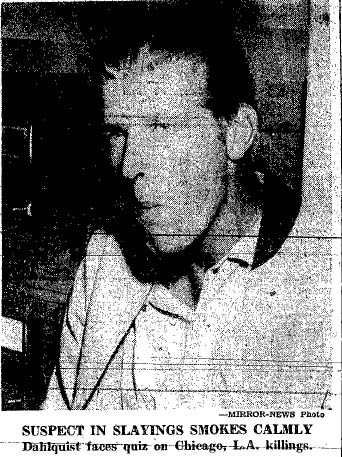 An illegal U-turn at Sunset Boulevard and Virgil Avenue at 1 a.m. led to the arrest of Charles Lawrence Dahlquist, a 6-foot-5, 211-pound fugitive from Chicago wanted for questioning in the sex slayings of three boys in 1955.
In searching the car, Officers Mel Tousseau and A.J. Sauro found a stolen license plate. Under questioning, Dahlquist, who had been working as a golf caddy, admitted stealing the car in Hollywood four months earlier.
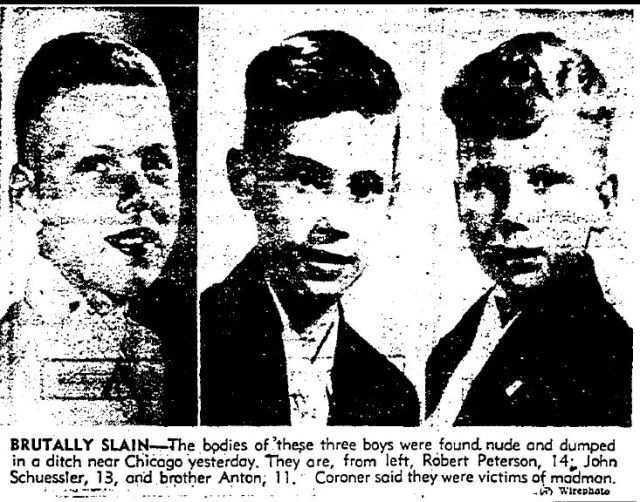
Dahlquist, of 1735 W. 6th St., fled Chicago while free on $4,000 bail in a case involving the molestation of a 15-year-old boy. While a fugitive, he was indicted in that molestation case and became a suspect in the sex slayings of John Schuessler, 13, his brother Anton Jr., 11, and their friend Robert Peterson, 14. Anton
Schessler Sr. died of a heart attack less than a month after the killing.
According to Chicago investigators, police chemists identified material under the slain boys’ fingernails as peat moss and fertilizer as is used on golf courses. The Cook County Sheriff’s Department said that the boys’ bodies “were thrown like bags of potatoes” into a ditch, which “would suggest that at least
two persons or one very powerful person did it,” according to the Mirror.
The Times never followed up on the Dahlquist story. However, in 1995 a former stable hand named Kenneth Hansen was convicted in the killings. Hansen was retried and convicted again in
2002. His case is under appeal.
Retired Chicago Detective James A. Jack wrote a book about the case titled: “Three Boys Missing.” Elmer H. Johnson and Carol Holmes Johnson have also written a book on the case: “Shattered Sense of Innocence.” Gene O’Shea, meanwhile, has written “Unbridled Rage” on the case.
Important warning: I have not read any of these books and list them merely for informational purposes. Given my experiences on the Black Dahlia case, I am highly suspicious of anything purporting to be a “true” crime book. Such works are often highly fictionalized, full of mistakes and usually not worth the paper they are printed on.

In February 1957, after adding 300,000 square feet, the General Motors' Van Nuys plant (note: it's really in Panorama City) began making station wagons and convertibles. A spokesman says the plant is producing 150 cars a day in five different models and shipping them to dealers in eight Western state.
A Bel Air Nomad for sale on EBay provides a nice example of how to decode the 1957 Chevrolet VIN tag, which was welded to the driver's door pillar post. (You always wanted to do this, right?)
In this case, the car's VIN is VC57J211710.
So we have: VC, which means the car was originally a 2400 model with a V-8 engine.
57 is the year the car was made.
J indicates where the car was assembled, in this case, Janesville, Wis.
211710 is the car's serial number.
Chevrolets made in Los Angeles were indicated by an L. In other words, if the car had been made in Los Angeles it the tag would read: VC57L
Thanks to Danchuck Manufacturing for the information.

Figueroa Street, Highland Park

Photograph by Larry Harnisch Los Angeles Times

June 11, 1957
Our national concern for the plight of soldier William Girard has, from the start, struck me as oddly misplaced.
As
well as I can understand it, we’re upset because the United States has
failed to stand behind the young soldier. And has, instead, given a
foreign country permission to decide his fate.
Suddenly, it’s a matter of monumental importance.
And absurdity.
Because if soldier Girard’s personal well-being were the issue, common sense would tell us to stop worrying right now.
And be thankful that Japan, rather than the United States Army, is going to handle the case.
Now
that the soldier’s killing of a Japanese housewife has achieved global
notoriety, whoever gets the case will be forced into a backbreaking
lean toward justice.
If Japan tries him, that country will be in
the delicate position of having to prove to us, and the world, that its
justice is pure and impartial.
It’s an interesting fact that
since the U.S.-Japan treaty permitting the latter country to try our
soldiers went into effect, American servicemen have committed more than
14,000 infractions of Japanese law.
And that all but about 400 of them were turned over to the U.S. military for trial.
Of
even greater interest, however, is the fact that there are, at present,
some 40 U.S. servicemen in Japanese prisons, convicted by Japanese
courts.
They are there for crimes as serious as murder and rape.
But the most severe sentence yet passed on any of them was eight years’ imprisonment.
It’s fairly obvious that Japan has made a conscious effort to prove to us that its justice is tempered with mercy.
 But what would happen if Girard were suddenly thrown back to us–and his fate became our responsibility.
The whole big mocking world would be watching us.
Especially Asia.
And it would be our obligation to prove that we play no favorites, either.
The tendency, I fear, would be to throw the book at Girard.
And he would end up as a martyred pawn for our desperate effort for friendly foreign relations.
It’s
my personal feeling that American soldiers, when told to serve on
foreign soil, should be disciplined by our own government.
But we made a treaty with Japan, granting that country certain judicial rights.
And
a review of American history shows that when we sign a piece of paper,
we do so with the intention of living up to our signature.
Japan’s national bitterness in the Girard case, coupled with the recent trouble in Formosa, is worth a pause for thought.
Can we, who try so hard to be liked, be botching matters up so badly in Asia?
I asked the question of Dr. Bob Pierce, president of World Vision Inc., this week.
Pierce,
a frequent Far East visitor and the man directly responsible for the
establishment of a permanent aid program for 8,600 Korean orphans,
denied that we were.
"It might be more accurate," he said, "to call us victims of the rise of nationalism now sweeping Asiatic countries.
"In Japan, for example, the people can once again see possibilities for national achievement."
"Are we," I asked, "standing in their way?"
Pierce nodded uncertainly. "In a way. They still remember us as conquerors, and as such, we’re a hindrance.
"They want to be leaders in their part of the world, but they figure the first necessary step is to impress us.
"Exaggerated incidents like the Girard case are expressions of the cumulative frustrations of the people"
I asked Pierce for his opinion on the treaty which will let Japan try Girard.
"Missionaries," he answered, "must be prepared to accept the consequences of foreign laws.
"But with soldiers, it’s not the same. They’re not necessarily there because they asked to be."


June 11, 1957
Los Angeles
We’re parked outside a two-story apartment house at 3737 Los Feliz Blvd.
It’s late, after 1 a.m. I’ll warn you before we go in: I hate this
case. I can’t say I like any of them, but this one I hate. It’s pitiful
and tragic and I wouldn’t blame you if you wanted to go for a cup of
coffee instead.
You sure? OK, come on then. That’s her sedan parked at the curb.
This whole area is a hot spot for peeping Toms: It’s all apartment
houses with bedrooms at the back facing dark alleys. About half a dozen
women live here and they all say they have seen men at their windows
and that someone has been rattling their doorknobs in the middle of the
night. The landlady filed a report not long ago that somebody was
stealing underwear off the clothesline and about a year ago, a woman in
Apartment 6, next to the murder scene, said some prowler slid a note
under her door:
"If you are lonely and want some company, why don’t we get
acquainted. I am not trying to scare you. I think you and I could have
a good time together.
"I’m young and so are you, so let’s not waste our time. A friend, I hope."
Another neighbor says a man broke in and choked her last September, but that he ran away when she started screaming.
I figure the guy may have been watching our victim and knew she was
living alone. Until a few days ago, she had a roommate–another
nurse–but the woman moved out because the victim was getting married
to a doctor. She had just come home from a wedding shower when she was
killed.
I told you it was nasty.
Notice the front door is locked and chained. She was careful. Not quite
careful enough, maybe, but pretty careful. The roommate, Margot
Wright, says that about six months ago, a young man barged into the
apartment while she was lying on the bed. Wright told police that she
grabbed her purse off the nightstand and the man laughed and ran.
Our victim is named Marjorie Lucille Hipperson, 24, and she’s a nurse
at Hollywood Presbyterian Hospital. A few hours ago, the staff gave a
wedding shower for her and her fiance, Dr. Walter Deike, who’s an
intern so he spends a couple nights a week at the hospital. In fact, he
got called away from the party, so Marjorie wrote him a note before she
left:
"Dear Walter: I hope you don’t have too tough a night. Get a lot of sleep.
I love you.
Marjorie."
Let’s go around the back. Here’s where he got in: She left the kitchen
window unlocked. Police will find the screen over in the garage of a
neighbor who lives at 3745 Los Feliz. Let’s go in. Don’t touch anything. They’re going to find prints all over the place. Notice the apartment hasn’t been trashed as it would be if there was a burglary.
She was a tidy one. Here’s the sweater she wore to the party, washed
and stretched out to dry on the drainboard. The rest of that outfit is
hanging in the closet. OK, here’s the living room. You can see she’s
laid out her clothes for the wedding trip to Chicago and is getting
ready to move. The rent runs out in a couple of days and the telephone
has already been disconnected.
You sure you don’t want to turn around? OK, let’s go in the bedroom.
Well, that’s her, poor thing. You can see her arms and legs are
bruised from fighting with him. Her hands might have been bound at some
point, but they’re not tied now. White nightgown bunched up around her
neck, left arm doubled up behind her back and her right arm stretched
out. She’s been strangled with a nylon and gagged with a blue washcloth
held in place with another nylon, just like the Ruth Goldsmith case, remember? Yeah, she was raped. He apparently didn’t steal anything. There’s loose money on the bureau and in the drawers.
Nope, nobody heard a sound.
We better get going. In a little while, Dr. Deike is going to start wondering why she hasn’t shown up for work. Remember, the phone is disconnected. He’s going to come over. He’ll see her car at the curb and know she’s home. When she doesn’t answer the door, he’ll come around back and crawl in the kitchen window.
And then he’ll find her here.
Walter will remarry–eventually. A woman named Joan. But five years later, he’ll be gone too. He’s going to go out swimming in Mendocino Bay and drown.
I told you, I hate this case.

Let’s drop by Mountain View Cemetery in Altadena on our way back and pay our respects.
To be continued….


