Bar brawl


1957_0710_sica_hed

1957_0710_sica_times
July 10-11, 1957
Los Angeles

There isn’t much in doubt about what happened that night in North
Hollywood; the only mystery comes much later. That night, Frank “Puggy”
Sica, 40, and Salvatore Di Giovanni, 39, were having a few drinks with
Ronnie Kopp at the Club Shobah, 4923 Lankershim Blvd.

As it turned out, Kopp was a waitress at the club and neglecting the rest of her customers while chatting with Sica, a man with no convictions and many arrests, and Di Giovanni, who had been convicted of burglary.

Unable to get Kopp’s attention, Ann T. Burgess, 23, approached Sica’s table and requested some service.

According to police, Di Giovanni punched Burgess twice and knocked her out. Then
he told Kopp: “If you be a witness to this thing remember you have two kids and I’ll take care of them.” Authorities said Kopp resisted Di Giovanni’s attempt to drag her out of the Club Shobah, so he knocked her down and he and Sica kicked her.

Police had been to the bar earlier that night but were told there was no trouble.  Before they
arrived a second time, Mike Sboto, the bartender, pulled a gun from under the counter and fired several shots because the men were kicking Kopp. Di Giovanni punched Sboto and Sica threw a drink at him, police said.

1957_0710_sicaa
In response, Sboto punched Di Giovanni and Sica. “I hit them with everything I could lay my hands on,” he said. Di Giovanni had two black eyes, and “one detective had to chase the terrified Sica two blocks before he caught up with him,” the Mirror said.

The Times, meanwhile, said that when police arrived, Di Giovanni had Sboto under a shuffleboard table and was punching him in the face.

Burgess signed a complaint against Di Giovanni. And then, of course, all the witnesses got amnesia. The bar was mysteriously burglarized and trashed. Without
witnesses’ statements, the district attorney’s office was forced to file misdemeanor charges accusing Sica and Di Giovanni of battery, disturbing the peace and being drunk.  They pleaded guilty and  were fined $100 each.

Two years later, Sica began trying to get a piano bar at his restaurant, Sir Sico’s, 8351 San Fernando Road, in Sun Valley, but he always ran into trouble because of his record and because his brothers, Joseph and Fred, were involved in organized crime.

Not until 1967, after numerous hearings and appeals, did a judge order the Police Commission to approve a piano bar at Sica’s restaurant.

The real mystery is what became of Frank Sica,  who vanished from the pages of The Times about 1970. California death records list three men named Frank Sica. Frank A. Sica, born in 1909, died  in 1976 in Los Angeles County. Frank Ralph Sica, born in New Jersey in  1917, died  in Los Angeles County on April 4, 1987. (This is presumably the Sica in question). Frank Rocco Sica, born in 1926, died Sept. 19, 1999, in El Dorado County.

The site of Sir Sico’s is apparently occupied by La Herradura Restaurant, according to Google. The site of the Club Shobah is occupied by the Lodge, which appears in “Reservoir Dogs,” (thank you, Google). 

No further trace can be found of Mike Sboto or Ronnie Kopp.

Update, Dec. 18, 2008: Michele Kamleiter writes:

I can across this article accidently while looking for an obituary on my neighbor.  I believe (based on the picture) that my neighbor was the Mike Sboto, bartender, of your article.

Mike was a retired stage hand who had worked on a number of productions including the original Grease movie.  For at least the last 15 years, he had lived in Las Vegas.

He was a true gentleman and a kind soul who passed suddenly on December 2, 2008.  He will be deeply missed.

Email me

Posted in #courts, LAPD, San Fernando Valley | Tagged , , , , , | Comments Off on Bar brawl

Paul V. Coates–Confidential File

July 10, 1957Paul_coates

Since my boyhood days in the wheat fields of Manhattan I have steadfastly held Hollywood in veneration.

I feigned interest in Lou Gehrig and Carl Hubbell and Hank Greenberg
and the rest of their sweaty ilk to remain in good standing with the
stickball crowd.

But I found my real idols at the local cinema…

…Tom Mix, Oliver Hardy, Rudy Vallee.

To me it was obvious that they–and they alone–were the genuine, true
(and odorless) models of American manhood, to be enthroned and emulated.

Surreptitiously, I would slip down to the corner magazine stand to filch the latest copy of Movieland Heroes.

And even more surreptitiously, I would jam it between the jibbering,
statistic-laden pages of the St. Louis Sporting News, baseball’s answer
to the Wall Street Journal.

I did this as a condescending gesture to my playmates, who naively
thought that all the world’s a diamond and all the men and women merely
players.

But I knew different.

1957_island
I knew that girls didn’t play baseball.

And that the world was a stage, not a diamond.

I knew because my filched fan magazines carefully illustrated that
Hollywood, not Yankee Stadium, was the birthplace of such fine American
traits as bravery, integrity and go-get-em.

But then, shortly following my adolescence, there came a mass confusion to my life.

Suddenly, people–more specifically authors–began saying nasty things about the film capital of the nation.

They wrote books like "The Last Tycoon" and "What Makes Sammy Run."

But I wasn’t shaken from my faith. I still worshiped my heroes.

(I did, however, occasionally mumble to myself).

Patiently, I waited for them to spit their final, un-American venom. But they never did quite finish.

In fact, new spitters arrived on the scene.

En masse, they moved to Hollywood to sit in soft chairs and peck at typewriters and cash $1,000 studio checks every week.

Supposedly, they were writing new Great American Movies.

But actually, they were pecking out subversive, anti-Hollywood prose to
be published in book form after the termination of their studio
contracts.

And then a few years later, sold back to the movies.

Their disloyalty annoyed me but I figured that if they were making a
buck (if that’s what they wanted) by biting the golden hand that fed
them, they had some excuse.

Besides, Hollywood had little difficulty surviving the insult.

But today, there’s a more dangerous game being played around the film capital.

It’s called Star Bite Hollywood.

And its rules, briefly, are (1) amass $1,000,000 or so by emoting for
the simply pleased public (us) and then (2) when you’ve been built up
to the point of financial security, look back on your career and hiss:

"They’ve ruined me."

Don’t be too specific as to who or what ruined you.

Just say that your talents were ill-used and prostituted. Or, with a
vague swish of the hand, "They’re all a bunch of damn idiots."

According to my latest copy of Daily Variety (Hollywood’s answer to the
St. Louis Sporting News), a calypso singer by the name of Harry
Belafonte is the latest to jump on the bandwagon.

His direct accusation:

"I was catapulted out of drama school into a series of compromises like (my first three) pictures."

Variety quotes Mr. Belafonte as denouncing his latest film effort,
"Island in the Sun" as "a terrible picture based on a terrible
best-selling book."

"I hate Hollywood and the cliches of American culture," he was quoted.

I have long considered Belafonte a very talented young man. And it came
as a shock to learn that, by his own admission, his commercial success
was nothing but a sinister plot of the movie barons.

Put me in the same embarrassing position and I think that I might be magnanimous enough to let bygones by bygones.

Maybe, some day, he will too.

Even though Hollywood has robbed him of his priceless poverty.

[Note: I have neglected to get into the complicated controversy surrounding the
1957 film "Island in the Sun"; so many stories, so little time to blog.
The picture’s interracial aspects, though muted, touched off quite an
outcry and Joan Fontaine got a fair amount of hate mail. I’ll have to
rummage through my notes and see if I can find some of the stories.
They are amazing.]

Posted in Columnists, Film, Hollywood, Paul Coates | Tagged , , , , , | 1 Comment

A few golden hours


July 10, 1957
Los Angeles

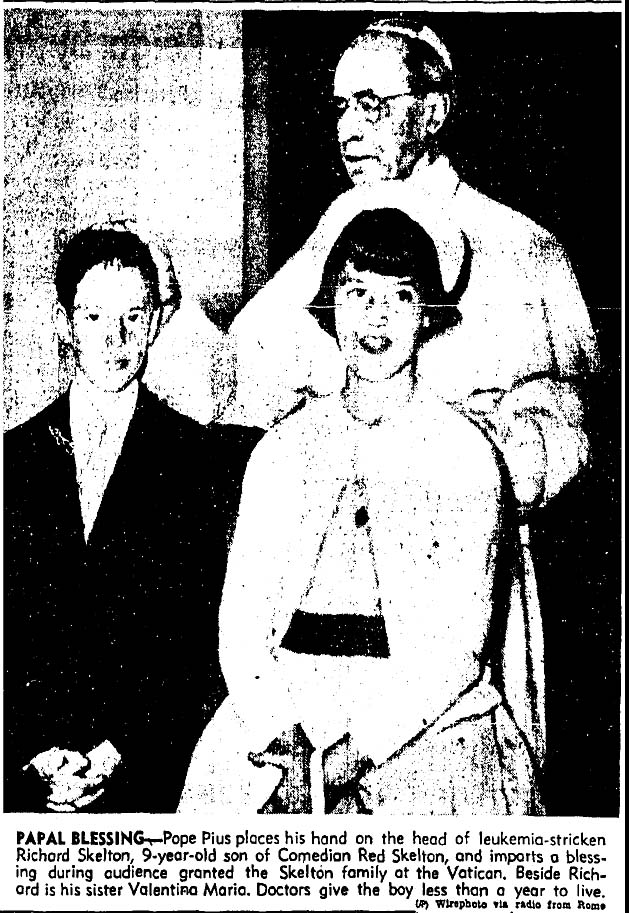
Let’s suppose you are a famous comedian with a hit TV show. Fame and wealth are yours–more than you could have ever imagined. You are recognized wherever you go.

Now let’s suppose that the doctors at UCLA say your 9-year-old son, Richard, has less than a year to live because of incurable leukemia. Maybe only five months. All that wealth and fame can’t bring him even one more day.

You don’t know how to explain such things to a 9-year-old, so you haven’t told him. Right now, the leukemia is in remission. He has no idea he has such a brief time to live.

But when he sees “The Last Days of Pompeii” on TV and thinks it looks interesting, that’s all you need to book a trip for you, your wife, your son and your 10-year-old daughter to Pompeii. There’s no way to pack a lifetime’s worth of experiences into a year, but you can try, so you add stops in Copenhagen, Switzerland, Rome, Barcelona,  Paris, London and Dublin, Ireland. Continue reading →

Posted in Film, Forest Lawn, Hollywood, Mickey Cohen, Television | Tagged , , , , , , , | 2 Comments

Driving Survey–Route 6

Here’s my jaunt down Route 6: Arcadia to the Auto Club on South
Figueroa. Note that I had to alter the route since Figueroa is a
one-way street north of Olympic. Also note that I made the trip on a
Sunday afternoon rather than rush hour. Still, I beat the 1957 drive
time of 47 minutes by 5 minutes. (Also note that I followed the posted
speed limits at all times). I have to say, it’s a nice, easy route
until Chinatown, which is not my favorite place to drive.  And I would
never go through downtown L.A. on Broadway during rush hour.

01_huntington_baldwin

Photographs by Larry Harnisch Los Angeles Times
Huntington Drive and Baldwin Avenue, Arcadia, 4:30 p.m. (Yes, I know I’m heading the wrong way).

02_huntginton_goldenwest

Huntington and Golden West Avenue, 4:30 p.m. Notice the wide center median in Arcadia. San Marino. This used to be the right of way for streetcar tracks.

03_huntington_rosemead

Huntington and Rosemead Boulevard, 4:31 p.m.

04_huntington_sangabe

Huntington and San Gabriel Boulevard, 4:33 p.m.

05_huntington_sanmarino

Huntington and San Marino Avenue, 4:36 p.m.

Huntington and Oak Knoll Avenue, 4:39 p.m.

Huntington and Los Robles Avenue, 4:40 p.m.

Huntington and Marengo Avenue, 4:41 p.m.

Huntington and Fair Oaks Avenue, 4:42 p.m.

Huntington and Fremont Avenue, 4:43 p.m.

Huntington and Pueblo Avenue, 4:47 p.m.

Huntington and Monterey Road, 4:47 p.m. (I made such good time that I didn’t even get a chance to take  pictures).

06_huntington_mission

Huntington and Mission Road, 4:50 p.m.

07_huntington_broadway

Huntington and North Broadway, 4:51 p.m.

08_broadway_johnston

Broadway and Johnston Street, 4:53 p.m.

09_broadway_ave22

Broadway and Avenue 22, 4:54 p.m.

10_broadway_i5

Broadway and Interstate 5, 4:55 p.m. (Shout out to Kim and Richard at 1947project HQ!) 

11_broadway_spring

Broadway and North Spring Street, 4:55 p.m.

12_broadway_solano

Broadway and Solano Avenue, 4:56 p.m. (Shout out to the cornfield!)

13_broadway_bernard

Broadway and Bernard Street, 4:57 p.m.

14_broadway_ord

Broadway and Ord Street, 4:59 p.m. (Shout out to Philippe!)

15_broadway_arcadia

Broadway and Arcadia Street, 4:59 p.m. (Shout out to the Hall of Justice! You knew there was once a huge tunnel here, right?)

16_broadway_1st

Broadway and 1st Street, 5 p.m. (Shout out to The Times Building!)

17_broadway_2nd

Broadway and 2nd Street, 5:01 p.m.

18_broadway_3rd

Broadway and 3rd Street, 5:01 p.m. (Shout out to the Bradbury Building, the Million Dollar Theater and Grand Central Market!)

19_broadway_6th

Broadway and 6th Street, 5:03 p.m. In the heart of downtown’s theater district.

20_broadway_8th

Broadway and 8th Street, 5:04 p.m. (Shout out to the Tower and Orpheum theaters!)

21_broadway_olympic

Broadway and Olympic Boulevard, 5:05 p.m. (10th Street was renamed Olympic for the 1932 Los Angeles Games. You knew that, right?)

Olympic and Hill Street, 5:05 p.m.

22_olympic_olive
Olympic and Olive Street, 5:06 p.m.

23_olympic_grand

Olympic and Grand Avenue, 5:06 p.m.

24_olympic_figueroa

Olympic and Figueroa Street, 5:07 p.m. (Hey, there’s a bus–shout out to mass transit!)

25_figueroa_pico

Figueroa and Pico Boulevard, 5:09 p.m.

26_figueroa_venice

Figueroa and Venice Boulevard, 5:09 p.m. (Shout out to the Santa Monica Freeway and Patriotic Hall!)

27_figueroa_washington

Figueroa and Washington Boulevard, 5:11 p.m.

28_figueroa_adams

Figueroa and Adams Boulevard, 5:12 p.m. (Hey, there’s another bus. Shout out to mass transit!) 

Total miles: 15.4; time: 42 minutes.

Email me

Posted in Transportation | Tagged , , , , , , , , , | 1 Comment

Hipperson suspect


1957_0709_hipperson_hed

1957_0709_boyerJuly 9, 1957
Los Angeles

Detectives investigating the killing of nurse Marjorie Hipperson
are questioning a con artist with ulcers who was an orderly
at Hollywood Presbyterian Hospital, where Hipperson and her fiance,
Dr. Walter Deike, worked.

Monte Melvin Krier, 29, who is being held on forgery charges in the
prison ward of General Hospital, says he knew Hipperson and saw her on
the day she was killed. He says he left Hollywood Presbyterian shortly
after the  slaying out of fear of the police.  "I quit my job because I
knew they were going to find out about my record," said Krier, who had
served a total of 11 years in prison for forgery and burglary.

"Miss Hiperson was a very friendly girl," Krier said. "We had lunch
several times and we talked quite a bit while we were working. The last
time I saw her was the day she was murdered."

Krier reluctantly admitted that he knew where Hipperson lived because
both of them had gotten a ride home from work with a fellow employee.

After he was arrested on the forgery charges ("I have a champagne
appetite with a beer pocketbook," he said) detectives began questioning
him in the Hipperson case. "They fingerprinted me twice," Krier said.
"They thought my palm print matched ones found in the apartment but now
I think they have cleared me."

(Krier’s con worked this way: He would check into a hospital for
ulcers, then write hot checks for jewelry and clothing  to merchants
who assumed he was trustworthy because he was in a hospital. When he
got enough merchandise, he skipped out of the hospital).

Detectives are also investigating an attack on Carol Boyer, 24, 2113 N. Rodney Drive
in Los Feliz, who fought off a man who attacked her with a pipe about
4:30 a.m. while she slept. Neighbors say the attacker had canvassed the
apartment building two weeks earlier by posing as a census taker
seeking information on single people.

Police also arrested  Conrado Hernandez, 44, 9339 S. Western Ave., after firing a warning shot as he was allegedly breaking into a home at 416 N. Orange Grove Ave. 

Monte Krier died Jan. 4, 1998, in Los Angeles. He was 69, according to California death records.

Email me

Posted in Hollywood, Hollywood Division, Homicide | Tagged , , , , , | Comments Off on Hipperson suspect

Matt Weinstock

Matt_weinstockd_2
July 8, 1957

Readers may have noticed that, except when vital to the story, this paper no longer uses the names of victims of rapists.

The policy was prompted by the editors’ opinion that printing these
names only added to the grief of the women innocently involved. And,
except in unusual cases, names of juveniles who get into trouble have
always been deleted.

There’s evidence that the distress that comes later can be almost as bad as the terror and indignity of the incident itself.

Not long ago a woman of 21 was sitting in a parked car with a young
man. They were suddenly set upon by five youths who viciously beat the
young man and forced the young woman to submit. The names of the couple
were used at the time.

Four of the five assailants were later arrested and will receive the punishment they deserve.

But life has become miserable for the girl, the innocent victim in the
case. She is the object of vile gossip and sidelong glances, even by
friends–a shameful thing.

Posted in Columnists, Matt Weinstock | Tagged , , , | Comments Off on Matt Weinstock

Literary diversions

Detective Sgt. Joe Wambaugh gets in trouble for writing a book. Nov. 18, 1970.

Part 1

1970_1118_wambaugha

Part 2

1970_1118_wambaughb_2

Part 3

1970_1118_wambaughc

Posted in books, Downtown, LAPD | Tagged , , , | Comments Off on Literary diversions

Ronnie Quillan update

Here’s the August 1955 article from Whisper magazine referred to in my earlier post on Ronnie Quillan (thank you, EBay). Quillan actually provided the information for this story, so we have to assume it was at least somewhat accurate. In reading this sleazy, vicious account, it’s no wonder the scandal magazines got shut down.

I am not familiar with the name Patricia Hirsch, who is mentioned as a prostitute.  However, a woman by that name pleaded guilty to vice charges in 1954 after being arrested in Malibu, according to The Times. And I cannot locate anything on Frank Harwyn Vanderveld  II.

The saddest thing, of course, is Quillan’s disintegration. A tragic Hollywood tale.


1955_whisper_cover


Page 1

1955_whisper01

Page 2

1955_whisper02

Page 3

1955_whisper03

Page 4

1955_whisper04

Page 5

1955_whisper05

Posted in #courts | Tagged , , , , | Comments Off on Ronnie Quillan update

Paul V. Coates–Confidential File

Paul_coates_3
July 6, 1957

Teenagers’ magazines are a comparatively new fad. But in spite of their
recent arrival, they have already grabbed a strong position of
influence. And respect. Yesterday, I printed some letters written to
Lilly Cooper, Dig magazine’s problem editor.

They were written by teenagers. But they couldn’t be printed in the
periodical, even though it is published specifically for that age group.

The letters were too "hot." Too many parents would complain.

Yet, Miss Cooper asks hesitantly whether the type of adult who objects
to such letters might often be the type responsible for them.

"So many kids have turned to us–complete strangers–for answers to their most serious problems," Miss Cooper tells me.

"Why us? Why not their parents or someone else in their communities?"

The answer might be found in some of the letters.

Here’s one from a 16-year-old schoolgirl:

"My rep has been marred by an 18-year-old boy whom I met in the next town.

"I dated him quite a while.

"One night he started something which I told him would have to stop even though I loved him. And he agreed.

"But it happened again and I couldn’t stop him.

1957_0706_ad
"Well, now I’m going to have a baby and he just won’t marry me.

"He got some other guys to say that they had done it, too, so he wouldn’t be responsible.

"Could you help me. Please!"

Try this one, from Judy:

"Just finished reading your article about teenage spankings.

"I envy the kids who just get spankings or simple punishment. Have them
try getting pushed up against the wall, choking around the neck and
punched in the face, stomach and chest with a fist.

"Or for simple punishment, a beating with a thick belt.

"That’s what happens to me, a 16-year-old girl, by my father. Maybe I
deserve it. I don’t know and care less. I’ve had it for so long I just
don’t feel anything any more."

In the two weeks’ collection of problem letters which Miss Cooper showed me, the majority were from pregnant girls.

One, however, was from a young boy suffering perverted sexual urges. He
couldn’t face his father or his priest, he admitted, "because they
think too much of me."

A 15-year-old wrote that she accidentally discovered pornographic pictures and literature in her parents’ bedroom.

"I felt like screaming when I read it because my father’s name was
actually used in the literature. I just stood and cried and shook all
over."

The most pathetic letter, however, came from Jane:

"I have never turned to anyone before and still don’t know who to go to for help.

"I’m only 16 1/2 and a junior in high school, but since I was 12 I’ve been falling downward.

"When I started going out with boys I looked for any kind of affection. You see, no one ever told me to be careful.

"I saw no harm in what I was doing. I knew nothing about life or sex.
My name became bad, of course, and my girlfriends and schoolmates
avoided me. I couldn’t understand why!

"Now 15, I started going with servicemen, older boys, fellows out of town. I began to drink. Almost every weekend I was drunk.

"Then I began going with a ‘cat’ from the big city. I was accepted into a large gang AFTER I proved I could smoke dope.

"Thank God I’ve avoided ‘H’ and mainlining.

"I really live two lives–my home and school life and my outside life.
I’ve hurt so many boys, good clean-cut guys that happen to fall in love
with me. I would take money from them, make them take me here and there
and then bow out.

"Yes, I guess I’m just no good.

"My mother tries hard to make things nice for me by buying me records,
clothes, etc. You just can’t buy love and affection, though.

"My dad is a drinker and goes a bit crazy sometimes. He’s put us both in the hospital from time to time.

"I’m trying my best to be as polite as possible and write as best I can
and use the best English. I could lengthen this by all the laws I’ve
broken but I only want to give you enough of a picture of me to help me
out.

"Lilly, I think I’m very sick emotionally.

"If you can’t help me, please, please tell me who could."

The letters I used were just average. There were dozens more like them.

Apparently the kids who wrote them knew no adult–parents, friend, neighbor–in whom they felt they could confide with trust.

The reflection is on us–and the image isn’t pretty.

[Note: These teenagers are in their 60s now. I wonder what their lives were like and whether they overcame the pain of their early years. I certainly hope so. –lrh.]

Posted in #gays and lesbians, Columnists, Paul Coates | Tagged , , , , , , | 1 Comment

Ouch!


1957_0706_gordo

July 6, 1957

Los Angeles

Oh this is a painful moment on the Mirror’s comics page. I was always a big fan of Gus Arriola and "Gordo,"
which I read for many years. The strips are beautifully drawn and the Aztec motifs are wonderful. But I certainly don’t recall the dialect. Ouch!

Arriola was a former MGM
animator and here’s what he had to say about the strip:

The early Gordos were very stereotypical, yes, and the dialogue was very broken English. A couple of editors started complaining that it was hard to read, and salesmen said it was difficult
  to sell.
So little by little I began clearing up the dialogue and cleaning up the characters myself in order to appeal to a wider audience.

And then I saw this: Ack!!!!


1957_0706_lil_pedro

"Gordo" is a model of sensitivity compared to "Lil’ Pedro." I can’t find any information about the
artist or the strip. I can only imagine the reaction of my old pal Rudy
Wagner, who became furious whenever he discussed the lawn statues of a
Mexican sleeping against a cactus.

Email me

Posted in Uncategorized | Tagged , , , , , , | Comments Off on Ouch!

The searchers

Jack_webb_30
The stats for my blog allow me to see the search terms people use to
reach the Daily Mirror. I never realized there were so many people
interested in Mickey Cohen. There are quite a few false hits and some
interesting queries.

To the person researching Jack Webb’s "-30-":
Despite what you may have read or heard, the movie was not filmed in
the Examiner Building (this was lore for many years at The Times among
former Her-Exers). Webb built an exact duplicate on a sound stage. He
did this for "Dragnet" too.

To the person researching Gamblers Anonymous: I hope you found what you needed.

And to whoever is researching "little girl lost intestines in swimming pool"–I am at a loss for words.

At right, the VHS box for "-30-" Kids! Don’t Play Here!

Email me   

Posted in Weblogs | Tagged , , , | 1 Comment

Gail Russell–in memoriam

Photographs by the Los Angeles Times
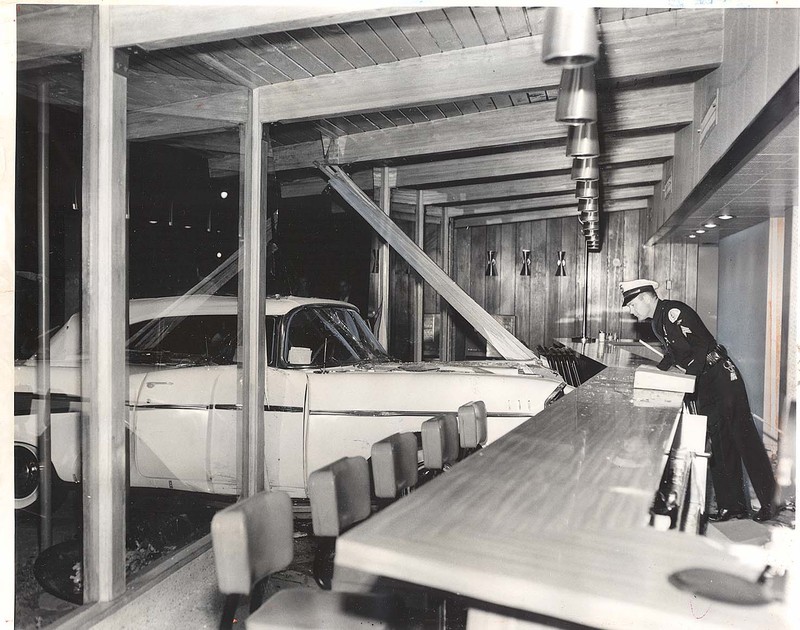
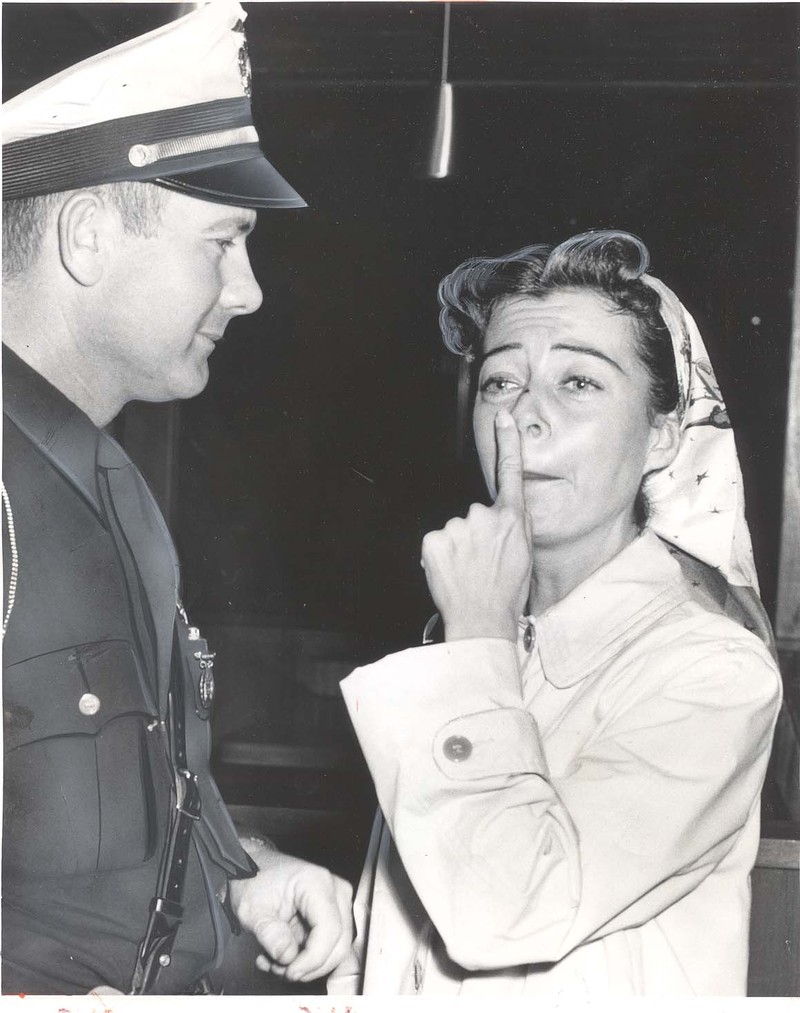
Sgt. C.H. Specht examines damage to Jan’s Restaurant, 8424 Beverly Blvd., caused by Gail Russell’s convertible.  Below right, Russell fails a test for intoxication administered by Specht.

July 6, 1957
Los Angeles

You poor thing. Look at you lying there, probably for a couple days now, sealed off from the world in a little home on the Westside. No husband, no children and no career. Just an empty vodka bottle on the floor and you sprawled next to it in a blouse and the pants from your pajamas. Dead at 35. Your mother wanted you to have the career she never had. I’m sure she didn’t realize you weren’t cut out to be a movie star; so tightly wound and such a painfully shy, insecure bundle of nerves.

Let’s go back 20 years to 1941, when you were studying to be an artist and someone started calling you “the Hedy Lamarr of Santa Monica High.” How you hated that nickname and kept
apologizing for it, so embarrassed that when you finally ran into Lamarr volunteering one night at the Hollywood Canteen you looked the other way. Continue reading →

Posted in #courts, Cemeteries, Film, Hollywood, LAPD | Tagged , , , , , , | 21 Comments

Paul V. Coates–Confidential File

Paul_coates_2
July 5, 1957

Lilly Cooper is an average, mature woman.

But she has one quality which separates her from the rest of us older, wiser inhabitants of the world.

She is neither amused nor annoyed by teenage melodramatics.

Instead, she has a true sympatico for them. Because Lilly Cooper probably knows more about our kids than we ourselves do.

One of her jobs is that of "problem" columnist for the teenager magazine Dig.

The magazine has a readership of close to a million and every month
Miss Cooper prints answers to subscribers’ letters dealing with
personal difficulties.

The printed problems involve dating, troubles at home or in school, employment and similar subjects.

But they’re not the ones which bother Miss Cooper.

The ones which disturb her are those she can’t print–without the risk
of stimulating the wrath of hundreds of adults. (And, from letters
received by the magazine, it’s obvious that many parents browse through
it too.)

Her mailbox is full every day.

There is correspondence from girls, 12 and 13 years old, who are
pregnant. From married girls who want to know where babies come from.
From others who want explanations of the invisible, often arbitrary
barriers of religion or race.

1957_0705_bullocks_2
"Yet," Miss Cooper told me, "they write to me–a complete stranger–with the most intimate details."

Miss Cooper asked me to run a few of the letters she couldn’t print.
"To let adults know that teenager melodramatics have a base.

"And to let them decide the cause for themselves."

I will, today and tomorrow.

The letters are quite basic. I’m sorry if they offend you–Unless, of
course, they offend you into positive, constructive thought.

From Judy:

"I’m 15 and I’m going to have a baby in two months.

"My boyfriend and I were engaged, and one night we just went too far. We were going to be married and he got drafted.

"I just wrote him about the baby last month.

"What can I do, he’s overseas and can’t come back to marry me for four
more months. By then the baby will be born and without a father.

"Oh, I’m so worried, please, I love him so much, and he wants the baby as much as I do."

From Louise:

"I am a sophomore at high school and a girl of 16.

"I come from an average family with wonderful parents. I am dating a
boy 20 years old. But because he’s a Mexican I have to lie to Mother
and Dad to be with him.

"I hate to do things behind their backs. What would you suggest?

"Do you think it’s proper for a white girl to date a Mexican?

"Three other girlfriends of mine are in the same boots. And we could use all the information possible."

From Harriet:

"I am 19 years old and have been married six weeks. Now I am pregnant.

"I was wondering if you would tell me how a baby is born and how they start us nursing.

"My mother would never tell me and my doctor just died.

"So you see it is important for me to know this."

From Jane:

"I do have a problem.

"Kenny and I are very much in love. I am just turned 17 and he is 18.
My family don’t like him and have forbidden me to see him because he
has been in jail and had a lot of trouble.

"He is trying to stay out of trouble and has for over a year and a half.

"But a month ago I found out I’m pregnant and Tony’s [cq–lrh] the father.

"He told me to tell my parents but someone said they could charge him with rape.

"He has a job and is setting aside for the baby and our future. He can’t afford any more trouble.

"Please tell us what to do for the future of ourselves and our baby.

"They won’t give consent to our marriage. So we can’t get married till we’re of age."

It’s melodrama, possibly, but it’s more gnawing than annoying.

Certainly, it’s not amusing.

Posted in Columnists, Paul Coates | Tagged , , , | Comments Off on Paul V. Coates–Confidential File

Driving survey–Route 5

I wouldn’t ask anyone to do something I wouldn’t try myself, so here’s
Route 5 of the Auto Club’s commuting survey from 1957. It’s not an
entirely fair test since I made the trip on a Saturday morning, but it
was an interesting experience all the same.

Wash_lincoln01

Photographs by Larry Harnisch The Los Angeles Times
Washington and Lincoln boulevards, Venice. 10:51 a.m.

Washington and Centinela Avenue, 10:53 a.m.

Wash_grand_view

Washington and Grand View Boulevard, 10:53 a.m.

Wash_sepulveda

Washington and Sepulveda Boulevard, 10:56 a.m.

Wash_minaret

Random shot–King Fahd Mosque

Wash_elenda

Washington and Elenda Street, 10:58 a.m.

Wash_overland

Washington and Overland Avenue, 10:59 a.m.

Washington and Ince Boulevard, 11:02 a.m.

Washington and National Boulevard, 11:03 a.m.

Wash_lacienega

Washington and La Cienega Boulevard, 11:05 a.m.

Wash_adams

Washington and Adams Boulevard, 11:05 a.m.

Adams and Redondo Boulevard, 11:07 a.m.

Adams and 8th Avenue, 11:10 a.m.

Adams_arlington

Adams and Arlington Avenue, 11:12 a.m.

Adams_western

Adams and Western Avenue, 11:13 a.m.

Adams_normandie

Adams and Normandie Avenue, 11:15 a.m.

Adams and Hoover Street, 11:17 a.m.

Adams_fig_auto_club

Auto Club of Southern California, Adams and Figueroa, 11:19 a.m.

Adams_randomshot

Random shot

I wish I’d gotten a shot of the Helms Bakery,
but it went by too fast.

Total time, 1957: 30 minutes (rush hour)
Total time, 2007: 28 minutes (weekend)

Email me

Posted in Downtown, Transportation | Tagged , , , , | Comments Off on Driving survey–Route 5

Valley blaze

The west San Fernando Valley’s tinderbox goes up in flames–again.

Page 1

1957_0705_mirror01

Page 2

1957_0705_mirror02

Posted in San Fernando Valley | Tagged , , , | 1 Comment

Woman strangled

1957_0703_delao

1957_0703_delao_pix
July 5, 1957
Los Angeles

What we have is a dead woman and a man who says he strangled
her–except he doesn't remember it.  Or he did remember it and then he
forgot.

No, it doesn't make any sense.

Her name was Ruth Lucero de la O. She was 35 and lived with her three children at 12812 Waltham Ave.,
Baldwin Park. The husband, Albert, 42, a foundry worker, moved out a
year ago because "she had too many men friends." He lives at 1020 W.
91st St.

This is what supposedly happened early Wednesday, July 3, 1957.

Ruth is sitting in the living room reading a magazine. Her 15-year-old
son Jerry comes home about 11 p.m., July 2, 1957, talks to his mother
and goes to bed. His younger sister, Amelia, 13, is spending the night
with a friend. The youngest girl, Marguerite, 5, is asleep in her
bedroom.

Sometime after 2 a.m., the Sheriff's Department gets a call from Jerry,
who is hysterical. "There's something wrong," he says. "It looks like
Mom is all mangled." Later, Jerry says the sound of a door closing woke
him up, and he thought his mother had gone out so he got up to turn off
the radio. 

"I looked out the window and I saw a car. I think it was a 1950 Chevy.
The lights were out and a few minutes later it drove away," he says.

1957_0703_delao_suspect
Jerry goes into the living room and finds his mother strangled. The
Times says she was on the floor near the kitchen and was wearing a
light skirt, white blouse and moccasins. The Mirror says she was fully
dressed, bent backward over an overstuffed chair. The volume on the
radio was turned up high.

"Her hands were behind her and she was all bent over," Jerry says.

According to the medical examiner, Dr. Frederick Newbarr, she may have
been struck on the head and then strangled by someone who approached
her from behind.

"Marks on the woman's neck indicated that the assailant's thumbs had
been placed on the back of her neck and the fingers at the front," the
Mirror says. There are scratches on her neck and detectives speculate
that the killer might have been a woman, The Times says.

On July 18, 1957, a mural painter named Wilber A. White, 12721 Salisbury
St., Baldwin Park,  told investigators that he killed Ruth. White says
he had been loaning Ruth money since she was separated from her husband
and went to her home to discuss finances. White says she "infuriated
him by talking about his wife," so he "grabbed her by the throat and
then threw her aside," The Times says.

Of course, the medical examiner says she was attacked from behind and
struck on the head before being strangled, so White's story doesn't make much sense.

The next day, sheriff's detectives took White and his wife, Allie, to the
home. White says: "I can't believe it. I know I've done something
terrible but I just can't believe it's possible." Then he told
detectives he couldn't remember the killing. "I can't think," he said.
"I just can't think."

After that, the entire case vanishes from the paper.

What else can we find out? Ruth was born June 15, 1922, in New Mexico.
Her mother's maiden name was Enriquez and her maiden name was Lucero.
No recorded Social Security number. [Update: The Albert de la O, born in 1910 is completely unrelated to this incident]. A man named Albert de la O, born
Jan. 6, 1910, in Mexico, died in Los Angeles on Aug. 8, 1979, so I
assume that's the husband.

A man named Wilbur A. White, born May 24, 1917, so he was the same age as the suspect, died in Monterey County in 1964.

Here's a map.
Note that the crime scene is only a little more than three miles from
where the body of Geneva Ellroy was found less than a year later.
Probably a coincidence.

Email me

Posted in Homicide | Tagged , , , , | 2 Comments

Safe driving

Happy Fourth of July from the staff of the Daily Mirror!

Posted in Transportation, travel | Tagged , , , | 1 Comment

August 18, 1944: Times reporter killed covering war

Through most of World War II, Tom Treanor provided Times readers with firsthand accounts of the battle against the Axis as his travels took him to such places as China, South America and Europe.

This is the last story he wrote before being killed Aug. 18, 1944, when a tank made a turn and struck his jeep on a dusty road outside a French village that had just been liberated from the Nazis. He lived long enough to learn that the doctor attending his wounds was from Los Angeles: Capt. William Werner, 1402 Crenshaw Blvd. Treanor told Werner that
he was sorry he wouldn’t be able to cover the liberation of Paris. Continue reading →

Posted in @news | Tagged , , , , | 3 Comments

Matt Weinstock

Matt_weinstockd
July 3, 1957

 We have on our hands today a taxpayer in that happy frame of mind known as irate.

He is enraged because he finds himself helpless at fighting City Hall.

Half a dozen years ago he bought a home in the Hollywood Hills. It
wasn’t new, but he and his wife envisioned that it could be made into
their dream home.

They put every cent they could spare into modernizing it and worked
like slaves repainting, landscaping and putting in brick walks. They
even went to night school to learn of cabinetwork. It was a labor of
love.

About a year ago, a bulldozer appeared nearby and carved out a ledge on
the hillside and soon there was erected a house sometimes referred to
as "chicken coop modern." It was promptly sold.

A few months later, the same builder put up another and sold it and now a third is under construction.

1957_0628_ad_stack
The indignant homeowner and his neighbors complained about these cheap,
unorthodox homes. They were particularly irked because the builder
seemed able to get away with certain techniques in construction that
they had not.

They learned that the only restriction on building in the section was
that homes must cost not less than $5,000. The ordinance so stating
went into effect in 1923. The law is ridiculously outdated, of course.
You can hardly build a garage today for $5,000.

Here’s the angry homeowner’s plaint:

"A man who buys a home to live in is at the mercy of these fast-buck
guys who grab up vacant land and build these chicken-coop homes on
speculation. It’s beside the point that such houses cause the
neighborhood to decline and run down property values. What is needed
down at City Hall is a new conception of home ownership. It’s about
time they rewrote the property and building laws to protect the
homeowner. But he’s only the poor chump who gets nicked for every tax
raise. Nothing is ever done for him. He’s stuck."

Is that an echo I hear?

THE BEAUTY contest
season is upon us. Everywhere you turn, it seems, smiling girls in
unswimmable swimsuits are parading. Don’t get me wrong, I’m not
knocking it.

Once such event was held in a mountain resort a few days ago and as a
bevy–I think the word is bevy–swished past the judges a boy of 5 was
overheard by Lee Austin inquiring in an awed voice:

"Mommy, are you going to do this too?"

THE FLOWERS will
continue to bloom in the spring, the birds will continue to be on the
wing, but things will not be the same up on Mulholland Drive, for lo
these many years a hallowed rendezvous for neckers.

About a week ago, advises Carol Sugar in horror, they put a traffic signal at Mulholland and Beverly Glen Boulevard.
Imagine young couples trying to whisper sweet nothings in the moonlight
as a traffic light winks green, yellow and red at them. It could give
them a complex as if Big Brother were watching.

TRAFFIC casualties are hardly news any more, they’re taking for granted–except by the victims and their loved ones.

William DeLair took his wife to an Eastern Star meeting a few nights ago at Masonic Hall on Daly Street.
He was waiting outside for the meeting to end so he could take her home
when he was struck by an auto and killed. In this case the tragedy was
deeper than most. Mrs. DeLair is blind.

MISCELLANY—
Big uproar among the ladies who save Green Stamps. They’re discovering
inflation has hit the premiums and for their precious books of stamps
they get, say a two-quart stew pan instead of a three-quart one. . .
Statistic for tomorrow: In 1903, according to the Safety Council, 466
persons were killed by fireworks, 400 in auto crashes. Last year one
person died of fireworks injuries, approximately 40,000 in auto
crashes. . . When the boss returned from his vacation the other day in
a midtown office the help was all wearing black mourning bands on their
sleeves as a gag. He didn’t think it was funny.
Posted in Columnists, Matt Weinstock | Tagged , , , , , | Comments Off on Matt Weinstock

The Daily Mirror commuting challenge


1957_0703_map

July 3, 1957
Los Angeles

We complain about traffic all the time. But how much worse is driving in L.A. than it was in 1957?

We can find out.

Best of all, you can help!

You might be surprised by some of the results. I was.

In July 1957, the Auto Club of Southern California announced the results of a survey that examined commuting times over 17 routes in Los Angeles comparing freeways and surface streets. The Auto Club praised the freeways for faster trips and noted that it took less time to get to work in the morning than to get home in the evening. All distances were measured from the Auto Club headquarters at 2601 S. Figueroa.

Freeway_crash

(Travel time was unchanged between 1936 and 1957 even though the number of cars had tripled, according to the Auto Club. And commuting was about to get better because of the new freeways, club officials said). 

Here's how you can help: Pick one of the routes, send me your time and I'll post it. Note: All drives in the 1957 survey were conducted during weekdays from 7 a.m. to 9 a.m. and 4 p.m. to 6 p.m.

In the meantime, I'll be sampling a few of the routes myself. Check back and see how I'm doing. Here's one surprise: So far, driving at off-hours last weekend, I beat the commuting times from 1957 by a few minutes.

Let me say that again: So far, driving at off-hours in 2007 has been FASTER than the commuting times from 1957.

Above right, a freeway wreck and gawkers' block courtesy of the Los Angeles Police Department. Note that in 1957, the LAPD had jurisdiction over the local freeways rather than the Highway Patrol.

OK, let me know. I'm eager to hear your experiences!

Email me

Posted in 1957, Downtown, Freeways, San Fernando Valley, Transportation | Tagged , , , , | 4 Comments