

If you can’t guess the unfortunate mystery guest from this, I’ll just have to tell you….
(C’mon, folks, this is a famous Los Angeles incident of the 1950s! You Ellroy freaks should know this.)

If you can’t guess the unfortunate mystery guest from this, I’ll just have to tell you….
(C’mon, folks, this is a famous Los Angeles incident of the 1950s! You Ellroy freaks should know this.)
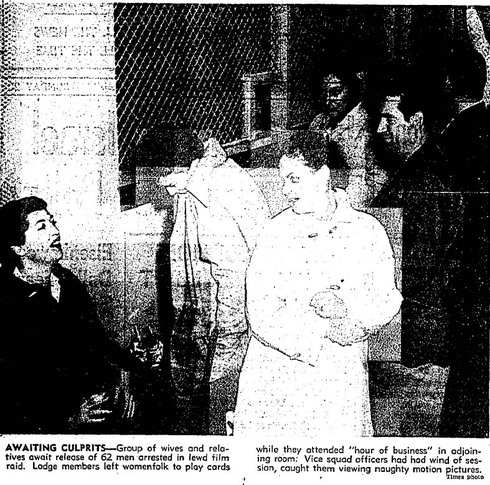
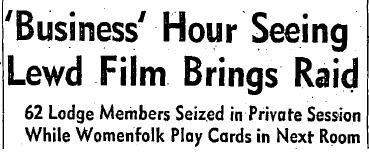
Feb. 10, 1957
Los Angeles
I stumbled across this story while researching yesterday’s post on South-Central vice raids and it was too wonderful to ignore. It sounds almost like one of the “Honeymooners” episodes involving Ralph Cramden, Ed Norton and the International Order of Friendly Sons of the Raccoons.
Apparently some lodge member had a perfect plan: “Our wives are always complaining about us going out to lodge meetings at night, so we invite them, OK? After some refreshments, our wives go play bridge while we have a business meeting! ” So 62 of them rented the Hollywood Eagles Hall, 1203 N. Vermont Ave., for an evening.
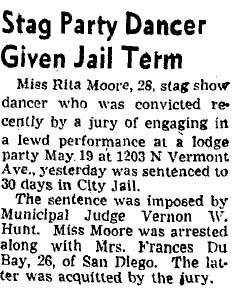 But instead of holding a business meeting once the wives left,
the members of the unidentified lodge rolled out a projector and began watching stag films.
(At right, the result of a 1951 raid on the Eagles hall.)
And although the wives weren’t aware of the scheme, the police knew all about it.
Police Lt. W.C. Nemetz and the Central and Hollywood vice squads stationed themselves around the hall, “peered through bamboo blinds when the movies began and then crashed the ‘business meeting,’ ” The Times said.
” ‘Follow us down to the Police Building. Your husbands will need help to bail out,’ vice squad officers informed the women as they roared off into the night with their convoy of lodge members,” The Times said.
The men were charged with suspicion of viewing lewd films and bail was set at $500 ($3,582.64 USD 2006).
The Times apparently didn’t follow up on the case. The domestic turmoil is best left to our imaginations.

Lots of guesses so far: Telly Savalas (2 votes!), Mickey Cohen, Sammy
Cahn, Billy Wilder, Mel Blanc, Neil Simon, Jack Dragna, E.H. Land,
Harry "Big Greenie" Greenberg, Johnny Roselli, Frank DeSimone, Bugsy Siegel, Matt Weinstock and Dustin Hoffman.
But none of them are right.
Maybe you have become fond of our mystery guest or wondered what he was like. Unfortunately, the end of his life was not pretty.

OK, you’ll have to work for this one.
June 17, 1905. The last time advertising appeared on the front page of the Los Angeles Times.

Until today.
Louis L’Amour, Oct. 23, 1960.
No, I don’t consider Louis L’Amour a great writer. I don’t even consider him a good writer. But I’m dedicated to presenting a variety of voices and not necessarily those I agree with. And he has some interesting things to say about the West.
P.S.: Note the similarity between Wyatt Earp and James Ellroy.


Sept. 8-12, 1957
Los Angeles
 Let's suppose you are the mayor of the nation's third-largest city. Let's further suppose that your wife has received several letters complaining about rampant crime in a heavily minority neighborhood. You might turn the complaints over to the Police Department.
Then again, you might not.
Because if you're Mayor Norris Poulson, you won't bother with the LAPD. You'll hire a couple of private investigators to look into the situation on South Central Avenue, which, according to Albertha J. Callahan, is "full of bookies by day and at night it's full of women on the street."
Nor did Police Commission President Michael Kohn contact anyone at the LAPD about the allegations. Instead, Kohn disguised himself in work clothes and drove down to Central Avenue in an old car.
"The situation was appalling," Kohn told the Mirror. "At Vernon Avenue and Avalon Boulevard I found groups of four or five girls on each corner waving at cars."
"Groups of four or five women cruised in cars and waved at men. Others stood on corners and when traffic stops for a red light, they 'come out to your car and knock on the windows,' " Kohn said, according to The Times.
By now, you're probably wondering why Poulson didn't contact Chief William H. Parker and say something like, "Oh, by the way, Bill, old chum, how exactly are things down in the 'hood?"
 The answer: Poulson figured the police either couldn't do the job or were on the take. He had complained to the department before, he said, "but we were always told there was nothing to it. They would tell us the persons making the complaints were troublemakers or that their reports were exaggerated. The police were paying no attention to these complaints."
He told the Mirror: "We have been making inquiries through usual channels about vice conditions and getting the usual replies that everything was hunky-dory. I took it upon myself to look into the situation."
Poulson said his inquiry showed that: "Flagrant vice conditions exist in this area. Prostitution, gambling, bookmaking and illicit traffic in narcotics are allowed to flourish without apparent restraint. A condition of this sort indicates either that vice is operating with protection or reflects inadequate law enforcement in the area."
If you know anything at all about Parker (or even if you don't), you can imagine his reaction to being ambushed at a hearing, especially because Poulson didn't make his charges in person, but had Kohn read a letter while he was out of town.
Parker heatedly denied charges that the department was corrupt. Instead, he blamed a lack of officers, the higher cost of patrolling Newton Division (now known as "Shootin' Newton"), an increase in criminals who had been chased out of skid row by urban renewal, lax courts that freed suspects on low bail and recent judicial decisions that hampered the police by granting rights to suspects.
"You can't put people in jail without evidence any more," Parker said. "We're going to have evidence to justify arrests and I'm not going to violate anyone's civil rights and I don't want it done by anyone in the department."

"We know who a lot of these people are, but we can't arrest them just for walking down the street," said acting Newton Division commander Lt. Walter Baker. "Not until they commit some overt act can we nab them. What's more, we think we've been doing a pretty good job as it is."
The criminals were clever, Parker said: "We have a wolf pack situation where a number of prostitutes work together. If one doesn't recognize one of our vice officers, one of the others will."
And there were more of them: Arrests for prostitution in Newton Division were up 24% from 1956 and gambling arrests increased 34.7%. Why? The demolition of skid row, police said. In the previous two years, nearly 500 buildings were destroyed, The Times said.
Police also complained that the jails had revolving doors when it came to vice arrests. Police Commission member Emmett McGaughey cited the case of a prostitute who had been arrested six times in a year, but only fined $200 ($1,433.06 USD 2006).
In response, Parker assigned Deputy Chief Richard Simon to examine the problem, along with Police Inspector James Lawrence (an obsolete rank that was between captain and deputy chief).
The LAPD sent more motorcycle officers and police cars to the area and assigned photographers to document the situation, the papers said.

And what about the residents? The Times didn't look into the local reaction to the vice crackdown, but the Mirror did, interviewing several African American leaders.
Dr. J.A. Somerville, a dentist and former Police Commission member, complained: "An investigation of any neighborhood, regardless of its racial complexion, will disclose prostitution in some form. The trade carries no racial label. To point out the Vernon and Central Avenue districts as a vice area because colored people live there, without naming other sections where similar conditions exist, seems biased to me and designed to discredit Negroes."
The Rev. B.O. Byrd of New Hope Baptist Church, Central Avenue and 52nd Street, said: "There is vice in almost every section of our city. In some areas, however, they are financially able to cover it up better."
What did the California Eagle and the Los Angeles Sentinel say about the LAPD's vice crackdown? Looks like a trip to the microfilm is in order.
Stay tuned….
Here’s the home at 457 S. Serrano Ave., where mystery writer Craig Rice died.

Photograph by Larry Harnisch Los Angeles Times
I missed this op/ed piece when it came out July 19, 1957. It was certainly a different era for the police.

Here’s the fourth picture of our mystery guest from The Times photo archives. The second photo of him is here. The third one is here.
(Hint:
He’s not Arnold Stang. He’s also not Telly Savalas (2 votes!), Mickey Cohen, Sammy
Cahn, Billy Wilder, Mel Blanc, Neil Simon, Jack Dragna, E.H. Land, Harry "Big Greenie" Greenberg, Johnny Roselli or Frank DeSimone).
And, in case you’re wondering, he’s not Phil Silvers or the Dalai Lama.
It must be the glasses. You can see in this picture he was a dapper dresser. What do you think about our mystery gentleman? Does he seem like a pleasant fellow? Intellectual? Would you want to have a cup of coffee with him? Think he has a family? What sorts of stories do you tell yourself about him? Clearly, if The Times took this many pictures of him he must be someone. Is he a blacklisted playwright? Some sharp producer? Does he own a restaurant on Hollywood Boulevard or an appliance store in the Valley?
And not Matt Weinstock, who looks like this:


Sept. 7, 1957
The week’s cordon bleu for eccentric behavior goes to a sharply dressed
young man who came into a hill Street bat cave around midnight and
ordered a beer.
Before sipping any, he unlatched a luggage case, extracted a trumpet,
poured about half the beer into it and sloshed it around. Some spilled
on his clothes, the floor and the bar.
Lou, the bartender, frowned but said nothing. Almost anything goes in this place.
But then the fellow belted out a few notes on the horn, causing other
customers to shudder, and Lou said, "no, no, no, no," pointing out the
place had no floor show or dance license.
The fellow desisted only to the point of pouring about an inch of brew
instead of half into the trumpet from his second, third and fourth
glasses of beer before testing it for sound.

By this time there was only the hint of noise. The sound was more like a faulty bilge pump.
Enchanted by this charade, Mike Molony asked why he was pouring good beer in the trumpet.
The young man fixed him with a glassy stare and, instead of answering
the question, said stiffly, "In France, they do it with champagne."
Then he lifted the trumpet into position and with a dramatic flourish
blasted a moist fanfare, packed up and departed into the night.
PERHAPS it’s
the Van Gogh influence. Anyway, artist Claire Vadnay recently got the
urge to paint some sunflowers. She called several flower shops and
nurseries but they didn’t have them.
One nurseryman said the only thing to do was plant some seeds and grow
her own. He pointed out they grow very fast. This she did and painted
her picture, rather elated about this new communion with nature.
If anyone else gets the impulse, there’s a large patch of them on
Sepulveda Boulevard a short distance north of Ventura Boulevard.
A HUSKY young
man wearing a Nazi officer’s uniform with swastikas and decorations
came into a highway restaurant in Malibu the other morning accompanied
by four other youths who kept up a noisy, laughing repartee with him
about the costume.
People in the restaurant looked at him but no one inquired if he had a part in a movie or was wearing the uniform as a gag.
A woman of French origin who saw the Nazis at their worst got up quietly and left, unable to finish her breakfast coffee
"I know," she says, "it was 12 years ago and we should forget, but I can’t."
VACATION NOTES Jack
Jarvis, Seattle columnist, drove his MG to Victoria, B.C., where it
attracted considerable attention. An Englishwoman asked, "Is that one
of those funny little foreign cars?" "Yes, ma’am," said Jack, "made in
England." "Oh," she said….
I didn’t see it while I was up north last week but Bill Vernon of the
Stenotype Co. here photographed a highway sign between Quincy and
Portola stating, "Deer, Keep Off Highway Motorists Are Passing." Yep,
the deer up there apparently can read.
MISCELLANY — Harper’s
magazine has come up with the word "unnice." Some people just can’t
bring themselves to say "lousy"…When Bill Hazen passed the place the
first letter of a neon sign on Olympic Boulevard west of Figueroa was
blacked out and stated "HOTOGRAPHY." A salute, no doubt, to the
Inconsequential trial… Mike Kaplan of Variety, who will conduct a
UCLA extension course this month in Contemporary Reviewing in the
Theater Arts, and Hal Levy, who will give his course in Popular Lyric
Writing for the sixth year there, got together the other day for a
chat. Conclusion, mutually arrived at: Maybe they should put their two
courses together and teach people how to become Al Jarvis…
The Let’s Have Better Mottoes Association selection for September is
"Think Big"–printed on a card in type so small a magnifying glass is
required to read it… Leon Lukaszewski has a suggestion for the
gray-haired gent who is driven to a 7th Street office building daily in
a chauffeured convertible and has to push the front seat down to
squeeze out the door: Come down the ladder one more run and ride in
front with the chauffeur.
Here’s a third picture of our mystery guest from The Times photo archives. Another photo of him is here.
(Hint:
He’s not Arnold Stang. He’s also not Telly Savalas, Mickey Cohen, Sammy
Cahn, Billy Wilder, Mel Blanc, Neil Simon or Jack Dragna).
He almost looks like Igor Stravinsky in this picture. But he’s not.
Someone asks: "Is he one of the Marx Brothers?" He’s not. But if he were, his name would be "Ammo." Hint. Hint.
He’s also not E.H. Land (of Polaroid fame) or Harry "Big Greenie" Greenberg. Or Johnny Roselli. Or Frank DeSimone.
And, in case you’re wondering, he’s not Phil Silvers or the Dalai Lama.


Sept. 4-6, 1957
Los Angeles
If it’s true that a woman without a man is like a fish without a
bicycle, then author Kate Constance wants every salmon to have a
Schwinn. She’s written a book on the subject, "How to Get and Keep a Husband," which is being serialized in the Mirror.
In the last three parts of her series, Kate Constance tells the
aspiring fish how to get ready for the big date, what to do when you’re
out with an eligible bicycle and getting him to pop the question!
If you want to land a bicycle, dear fish, you must get into training.
You can take 10 years off your age if you get plenty of sleep and rest,
exercise and eat properly:

"Usually a woman’s diet shows in her face. Unless you are planning your
meals under a doctor’s direction, you can be sure of a beauty diet if
you eat plenty of fruit, vegetables (all colors), fish, fowl, beef,
butter, eggs, whole grain breads and cereals and drink at least 1 1/2
pints of milk daily," Constance says.
Next, make a list of your best characteristics and worst flaws. Be
brutal, dear fish. Now accentuate your positives and remember that your
wardrobe can make all the difference because it combines smartness and
illusion!
First of all, dress appropriately and for goodness’ sake dress your
age. "Nothing is so pitiful as the mature woman who seeks to turn back
the calendar by taking the role of the schoolgirl!" Constance says.
"Suppose you are tall, slender, red-haired and past 40, possessing a
pensive smile and a quiet manner. Vivid blues, full skirts and
dramatically squared-out necklines should be good features for you."
On the other hand:
"If you have lovely gray hair and your figure is on the stoutish side,
with average height, you can be exquisite in all black touched with
white (not lace!!) to emphasize your hair."
Above all, Constance says, be neat and clean, don’t wear too much makeup, choose the right perfume and wear tasteful jewelry. And do your hair!
Now that you’re ready for your big date, here’s some things to remember, Constance says:
A man is a hunter and wants to do his own seeking for a mate. He prefers not to be pursued.
He has a deep-seated ego for reproduction, which is his vulnerableness to marriage.
His natural sexual urge may trip him into untoward advances. You must know how to deal with his "proposition."
He likes to enjoy the benefits of marriage but is not eager for its responsibilities.
He does not crave marriage when his sexual appetite is satisfied.
He envisions his perfect woman as half mate, half mother, full of love and virtue.
He despises the woman who steps down from her higher standards, even for him.
Don’t make the mistake of calling the bicycle, dear fish. Let him call
you. Don’t phone him unless it’s necessary and above all, do NOT call
him at work unless it is an emergency. When you’re on the phone with
your bike, don’t say too much. Use your conversations to "stimulate
curiosity and an aura of excitement," Constance says.
In dressing for your date, it’s all right to show your shoulders and
arms, but watch the neckline, dear fish! "Give him a chance to look at
you and take in your total charm."
When he picks you up, invite him in for a few moments to see the fish
tank. "This closeup view of your home environment will give him a
better understanding of the kind of woman you are," Constance says.
Don’t let anyone else answer the door. And for
heaven’s sake, don’t let your family interrogate him while you’re still
getting ready as they are likely to ask all sorts of prying questions.
Keep calm, dear fish. "Maintain an air of composure, even if you are
excited," Constance says. "If you are inclined to have romantic
jitters, try holding a small, rough object such as a tiny comb clutched
in the palm of your hand so tightly that it hurts."
When you’re at dinner, don’t order the most expensive thing on the menu–nor the cheapest. And do NOT flirt with other bikes!
Go for a walk with the bicycle and take his arm, but don’t talk too
much. Do NOT dawdle in front of store displays as you may "bore him
with a touch of commercialism."
Don’t be possessive around his mother and most important, don’t do
anything to make the bicycle think that you are "hopelessly tied at
home," Constance says.

Now let’s suppose, dear fish, that you have been dating for several
months, keeping in mind your neckline, long walks and the firm rule
that the route to the altar does NOT go through the bedroom (remember,
the sexually satisfied bicycle has no interest in marriage!) But for
some reason, your eligible bicycle is noncommittal.
First, indulge in quiet moments where the conversation grinds to an
uncomfortable halt. When the bicycle asks what’s wrong, be evasive and
hesitant, maybe for an evening, a week or even longer.
Finally, tell your eligible bicycle that you are trying to make a
decision–but do NOT tell him what it’s about. Be wistfully distracted
but still cheerful. Got that?
Usually, this will make a bicycle ask what’s wrong. If he doesn’t, take
the next step and break a few dates. Tell him you’re busy but mention
ever so gently that you are afraid your friendship doesn’t mean
anything to him. Don’t make a scene.
If he brings up his usual list of reasons for not getting married,
listen in silence. "The less you say the more foolish he will seem to
himself, for silence has a way of magnifying the important issues and
minimizing the small ones," Constance says. Don’t seem peeved or hurt!
If he still hasn’t proposed, start making other plans, even if it’s
with your fishfriends. Give a few parties and don’t invite him.
Unless he is an incredibly dim and obtuse bicycle, "when he discovers
that you are leaving him out of your life, most likely he will ask
questions," Constance says.
Here’s where you’ve got him, dear fish. Tell him you’re disappointed
that he hasn’t proposed. You don’t want to see other bicycles, but you
don’t think he is too poor, too busy, too old, too young or too
anything–whatever his feeble excuse is–to get married.
"Tell him that you like him above all men and that he has your first
interest. You would prefer him above all others," Constance says. "But
you want to be fair to him and to yourself, and also practical. Tell
him that you want to know where the friendship is leading."
If he doesn’t pop the question immediately–or very soon–dump him at
any old bike shop, because this is the fish version of a marriage
proposal.
"He is not for you," Constance says. "You should drop the whole so-called romance and work toward new opportunities!"
[Note: I have been unable to find any biographical information about
Kate Constance. "How to Get and Keep a Husband" was published in 1957
by Dorrance and Co., a vanity press. The book has never been reissued,
but is sometimes available from antiquarian book dealers
and on Ebay. HTGAKAH apparently had the subtitle "A Christian Business
Woman’s Answer to One of the Most Perplexing Problems of Our Time,"
that the Mirror did not use.]
[And in case there is any doubt, let me add: As with the horoscopes, this is for entertainment purposes only.–lrh]
Sept. 4, 1957
Los Angeles
This is almost beyond belief. "I spit fire with every word and could smack my wife’s head off with my fist–but, hey, I take a bath every day. What’s her problem?"

Sept. 6, 1957

Last week while driving between Cortez and Durango, Colo., Paul Weeks turned on the radio to relieve the monotony.
After a while it came through his consciousness that the station, KWIK
in Farmington, N.M., was playing the same song over and over.
The announcer would say that the next number would be Nat Cole or Paul
Weston or the Hi-Lows or Joel Gray, and there would be an occasional
news flash, but the guy kept playing the same tune. Paul has since
identified it as "White Silver Sands" by the Lennon sisters.
This went on for more than an hour, and Paul became increasingly
intrigued, particularly when sounds of someone pounding on a door and a
phone ringing came through the interminable refrain, "When the deep
blue pearly waters wash upon white silver sands."
As he arrived in Durango, the tune was still being beaten to death.
Fascinated, Paul sat in his car for half an hour awaiting the
denouement.
Finally, it came. A different voice broke through and said sharply:

"We wish to apologize for the program you have been hearing for the
last two hours and to announce that Johnny Andrews is no longer
connected with this station."
That’s all Paul knows about it.
Well, maybe so. Me, I’m suspicious, especially of mysteries. I can’t
help thinking Johnny was deliberately creating consternation among his
listeners.
MONTHS AGO, presumably, someone strolling along the north side of 2nd
Street, just west of Main street, eating his lunch decided he didn’t
want the tomato he’d brought along and flung it into the rubble of the
building which had just been removed from the site.
The desolate, gaping excavation is still there. The level part of it is used by the State Highway boys to park their cars.
But lately, a luxuriant tomato plant, unwatered and untended but loaded
with fine green tomatoes, has sprung up out of the brick and debris.
Once they get ripe they won’t be there long. Things get a little hungry around 2nd and Main.
WHILE selecting a prepared, wrapped sandwich at a Spring Street lunch
counter, Hank Frank came upon one labeled "Mah" and, being a curious
fellow, asked what a Mah sandwich was.
"Meat and pickle," the girl replied. Then she explained, "The meat is
pork shoulder and they can’t call it ham so they call it mah–ham
spelled backward."
Makes sense to me. However, I’ve been feeling a little irrelevant all week.
THE PROLONGED hot spell isn’t doing people any good. A large lady in
the Valley Ranch Market sighed, "I wish we would have an earthquake."
Manager Paul Anter asked why. "Because," she replied, "it would take my
mind off this terrible heat."
AROUND TOWN–As Spud Corliss signaled a left turn on Cahuenga Boulevard
and Selma, the strap broke on his wristwatch and it fell into the
street. Several cars passed over it by the time he stopped and
retrieved it but it was undamaged and still running. Spud says he knew
it would be safe–he won it in a national safety contest.
Notice on the Crescent Heights Methodist Church: "People who live right never get left."
Remembered from somewhere: Nowadays a baseball player not only has to
know how to hit, run, field and throw but he better know how to shave.
Definition for today: An old-timer is a person who remembers when Chavez Ravine was intended as a municipal housing project.
Sept. 6, 1957

Sometimes it’s a good idea to holler
Because if you don’t, people don’t hear. Or, at least, they don’t pay attention.
I’ve done a little hollering over the past couple of months–about a situation which I considered a pretty bad one.
It concerned conditions at County General Hospital.
Too many employees there felt that their services to patients should be regarded as favors, rather than duties.
And, as a result, too many patients were receiving indifferent, insufficient care.
Today, I hope, I’m through hollering.
Because, from reports I’ve received during the past week, lots of
things have been happening. Things which point toward much-improved
conditions at the institution.
There have been people fired.
There have been some changes made to facilitate handling of patients
and to alleviate personnel shortages in certain sections of the
hospital.
 And, just last week, the county Board of Supervisors decided that it
should make a check into the situation. The body appointed a special
committee to conduct an investigation.
Before I start pecking away at County General’s treatment last July,
stories illustrating its faults had been popping up in papers for years.
So I claim no credit for having unearthed anything new.
A few days ago, I discussed the hospital’s shortcomings with four of its top officials.
All of them have ideas which could turn General into one of the better hospitals in this area, in spite of its size.
At the meeting, Director Robert J. Thomas told me:
"The hospital has definitely fallen behind.
"In employee development, in modern procedures, in our physical plant, we are not up to date."
He added, however, that things are starting to happen. There are
probably close to a hundred projects and reforms now either started or
in the mill.
A sampling of them:
The present, poorly planned admitting room will receive a $62,000
($444,247.59 USD 2006) face-lifting designed to speed up patient
processing.
Stricter, more organized employee-control methods are being put into practice.
"Before," Thomas said, "we graded a new employee only once–at the end of his six-month probationary period.
"Now, we’ll do it monthly."
To improve patient morale, visitors will be allowed to come to the
hospital every day between 7 and 8 p.m. Previously, visits were
permitted on Wednesday and Sunday afternoons only.
To cut hours of waiting for outpatients, the hospital is setting up a
staggered schedule of appointments in many of its clinics.
Its elevator system is to be overhauled. New X-ray film processing
equipment is being installed to cut the present delay of 45 minutes
down to six or seven. A system to expedite filing and movement of
patients’ charts will be in effect in two or three weeks.

The plant’s physical problems can’t be solved at once, of course. The
new osteopathic unit isn’t due for completion until the end of the year.
But one problem which is being tackled right now, Thomas said, is the shortage of registered nurses.
A few months ago, there were 214 vacancies.
A recent nationwide "enlistment" campaign by the hospital cut the figure by 80.
"We’re going to make General a better place to work for people who want
some satisfaction out of their jobs," Thomas told me. "And as for the
dead weight–the Civil Service Commission has yet to turn us down on a
request for dismissal of an employee."
The human element in any business is a major one.
If General Hospital can whip some enthusiasm into its personnel, the problem should be well on its way to [being] solved.
In case you have never seen one, this car was called a Studebaker. This model was the Silver Hawk.
Studebaker’s West Coast assembly plant was at 4530 Loma Vista Ave. in Vernon. The factory resumed postwar auto manufacturing Oct. 18, 1946. The plant closed indefinitely June 8, 1956. It was producing 64 cars a day.
The site was later occupied by St. Regis Paper.
Here’s what I heard from Ben Eckart, one of the collectors who has posted a photo of an En-Ar-Co bucket on his website:

Sept. 6, 1957
Los Angeles

Kindly, mild-mannered and quiet, The Traveler, 51, was the last person
anyone would suspect of a crime. He seemed more like a Sunday school
teacher, which he had been, or perhaps an itinerant newsman. In fact,
he had worked at newspapers throughout the West, including jobs as a
reporter, rewrite man and copy editor in Oklahoma City and Salt Lake
City.
But beneath that disarming facade, The Traveler was a bitter,
vindictive man. Wrongly accused of writing a bad check in 1942, "he
determined to revenge himself by becoming a forger," The Times said.
For the next 15 years, The Traveler crisscrossed the nation, writing
half a million dollars in bad checks in nearly every state before being
arrested in Middleburg Heights, Ohio.
"Why, he didn’t look like he had that much intelligence," Fay Branch
told detectives. "I thought he was a real nice guy but a complete
failure in life."
Being nondescript worked to The Traveler’s advantage and he used a
simple but effective method: He always stayed 20 miles from where he
committed his crimes and earned a victim’s trust by paying cash for a
few minor items before making a larger purchase with a bad check for
$65 to $85 ($465.74-$609.05 USD 2006).
A success at crime, The Traveler was hopeless in the business world. At
times, he tried to go straight and ran a hamburger stand and prospected
for uranium, but when those efforts failed, he returned to easy money.
"I was well aware of what I was doing, but it was a conflict between my
conscience and expediency," he said.
"I wasn’t particularly smart. It was just that merchants are so
careless. Los Angeles and the San Fernando Valley are among the
toughest places in the country to cash phony checks. Cooperation
between police and merchants is very close," he said.
The Traveler perhaps got careless in Oregon, where Lane County
sheriff’s investigators noticed him staying in a motel about the time a
number of bad checks were reported. Oregon investigators sent his
license plate number to the LAPD for further inquiry.
Although The Traveler wasn’t home, information led Sgt. D.R. Sheldon of
the Valley Division to The Traveler’s storage sheds in Sylmar. In a
cache that eventually measured 6 feet high, 6 feet wide and 100 feet
long, police found photo equipment, canned good, appliances, record
albums, electric guitars and scores of road maps, The Times said, along
with a copy of "How to Use Your Imagination to Make Money." The LAPD
also found information indicating that The Traveler was in Ohio.
The Traveler was convicted in Los Angeles and sentenced to one to 14 years in prison.
Although he used 350 aliases, police said, his real name was Charles
Robert Speedie.
We don’t know what happened after that. The Social Security Death Index
shows that Speedie died June 4, 1988, in Jessup, Ga. But I wonder: Did
he retire or was he at the federal prison there?
See if you can identify this gentleman from The Times photo archives.
(Hint: He’s not Arnold Stang. He’s also not Telly Savalas, Mickey Cohen, Sammy Cahn, Billy Wilder, Mel Blanc, Neil Simon or Jack Dragna).


