
Dec. 13, 1913
Los Angeles

Photograph by the Los Angeles Times

Nov. 29-30, 1957
Los Angeles

We’re in one of those hilly neighborhoods east of Glendale
Boulevard, a couple blocks north of Echo Park. They’re putting in
Dodger Stadium just over the hill. Everybody else is having
Thanksgiving dinner and she gets dumped.
Let’s get out and take a look. Watch where you walk and don’t touch anything.
This is her. On her back, with her shoes under her arm. Here’s the tire
prints. Somebody pulled up, lifted her out of the car and dragged her
next to a hedge near 1812 Ewing St.* She was flashy, all dressed up in
red. Red pedal pushers and a red bolero top. Maybe nobody ever told her
not to to wear white shoes after Labor Day.
Looks like she’s asleep, doesn’t she? Fresh needle mark in her left
arm; old ones too. And a tattoo on her right wrist: "ARANA."**
This is the second one this month. There was that woman dumped in an
alley at 3531 3/4 9th Ave. on Nov. 16. Mickey Arr, 36-year-old
secretary. She was dressed up too. Dress, sweater and coat.
Let’s get a closer look. How about that? Her pupils are dilated; wide-open and not pinpoints.
Here’s her purse, right next to her. Everything’s here.
Black leather wallet full of baby pictures. Christine and Frederick.
Here’s her hype kit; eyedropper, spoon and syringe.
All right, lady, let’s see who you are. Carol Ann Berutko, 22. One
address says 3836 Lugo, Lynwood, another says 8138 Cypress Ave.*** Works
as a waitress. She’s got a prior from 1955; 90 days for narcotics.
We might as well get going. Nothing else to see here. Poor kid, 22
years old. You wonder what’s going to become of her two children, that
boy and girl, with their mom dead and their dad in jail. You can only
hope for the best.
* The Times said she was "on a dirt slope about 120 feet north of the corner where Ewing dead-ends into Vestal Street."
**Spanish for "spider."
*** The Times and the Mirror reported that her mother lived at 8836 Lugo
Place, which doesn’t exist. This is possibly a typographical error for 3836 Lugo. 8138 Cypress St.
is in Covina; 8138 Cypress Ave. is in South Gate.


Dec. 1, 1957
Los Angeles

George and Bill had known each other for five years and were best
friends. They worked together in an East Los Angeles metal shop and
lived next to one another in Rosemead.
Bill, 30, and his wife had the house
at 4837 N. Halkett Ave., and George, 24, had the house at 4843 N. Halkett, which
he shared with his wife, Lou Ray, 22, and their 4-year-old son, Johnny.
Then Bill and Lou Ray fell in love. It apparently was no secret. The
two couples used to double date and on a Friday night, the four of them
met at George and Lou Ray’s home to talk over the affair.
George asked
that Bill and Lou Ray go off and make a final decision about what they
were going to do. After they left, Bill’s wife went home.
George wrote a note:
"It all depends on what Lou Ray tells me. Bill and Lou Ray think they
are in love. They went out tonight to talk things over and make sure.
If Lou Ray decides she really loves Bill, I’m going through with it.
She and Johnny are all I’ve got. I love Lou Ray so very much.
"I cannot live without her. Johnny boy is my truly heartbreaking reason why I should not do this, but I cannot help it."
About 11:45 p.m., Bill and Lou Ray returned and told George they were
in love. However, they had not reached any decision over what to do
about it. Bill went home.
Half an hour later, Lou Ray found George on the front lawn, shot in the
head with a .22. She ran to Bill’s house and someone called an
ambulance.
George Louis Sposito, 24, was pronounced dead on arrival at General
Hospital. The Times never followed up on this story, so we don’t know
what became of Lou Ray or William D. "Bill" McHenry.

Photograph by the Los Angeles Times
Aviation cadets at the preflight training center near Santa Ana decorate a Christmas tree in a photograph published Dec. 24, 1942. From left, Peter Kaldare, David T. Gunn, Edward Kahill and Loren Gale. I wonder if they survived the war.
Dec. 2, 1957
Los Angeles
I am always perplexed when I come across one of these 1957 stories in The Times in which a working woman preaches against the evils of working women. It is almost beyond belief that nobody ever questioned this absurd contradiction. But if anyone did, I haven’t found any evidence yet.
In August, there were several stories about working women and the horrors of day care. Here’s an advice column, and I (almost) can’t believe the ridiculous response. The idea of telling a wife that she should pretend to be ill so her husband won’t nag her about working sounds like a plot for Lucy and Desi.
I’m running the column exactly as it appeared, just so people can read it for themselves.


I looked through hundreds of Joe Louis’ pictures today before I finally found two from the Main Street Gym. Of course, since these are from 1939, this is the old Main Street Gym.

Photograph by Maurice Terrell / Los Angeles Times
Here’s Louis on March 28, 1939, with a local fighter named Ernest
"Dynamite" Jackson, a Pacific Coast heavyweight champion who later
became the first African American to get a referee’s license.

Photograph by the Los Angeles Times
This is Louis sparring with Paul Williams at the Main Street Gym in a photo published April 16, 1939, shortly before Louis’ bout with Jack Roper on April 17, 1939, at Wrigley Field. Roper lasted 2 minutes, 20 seconds with Louis.
The statements in this ad may all sound remarkably familiar. In case you young people are wondering what’s going on in this picture: Once upon a time there were service station attendants who pumped the gas (fill ‘er up!) and handed you a charge slip. They even cleaned your windows and checked your oil. I know this is almost impossible to believe, but it is true. Really.


Nov. 28, 1957
Los Angeles
Sometimes you have to wonder where newspapers get their facts–at least I do.

Here’s another take on the story of Zenobia Maddox.
A few things haven’t changed. James Bedford Burton is just as dead as
before, shot five times and beaten with three different lamps during a
home invasion robbery. But many other details are different.
The Mirror interviewed Zenobia–here’s the picture of her, with her
daughter Toni, and three very smashed lamps.
She said Burton and his partner bound
them with adhesive tape (The Times says they were tied up but alludes
cryptically to "binding tape"). Burton sent his partner outside to
wait for Zenobia’s husband, saying: "If he gives you any trouble, kill
him."
But here, the stories diverge. The Times said that Burton put his gun
down so he could light a cigarette. The Mirror says that Burton put the
gun on a bed and began going through dresser drawers. While he was
trying to adjust a watch on his wrist, Zenobia got free and grabbed the
gun, the Mirror said. (Adjusting "a" watch? Was he stealing it? The
Mirror doesn’t say).
"That won’t do you any good. It’s not loaded," Burton told Zenobia.
"I don’t know anything about guns and am scared to death of them," she
said. "But I didn’t believe him. I pointed the gun at the wall behind
him and pulled the trigger. When it fired I pulled the trigger again
and again, only I aimed right at him."
Zenobia continued: "I didn’t think he was dead, so I broke three lamps
over his head. They were brand new ceramic lamps. They even had the
price tags still on them."
She heard a car outside grinding its gears, the Mirror said. "I
guess the other man thought discretion was the better part of valor. I
locked the door to keep him out but he didn’t try to get in," she said.
If she hadn’t died in 2002, I would send Zenobia Maddox some money for a couple of new lamps. She’s awesome.
Erich Wolfgang Korngold, 1897-1957
The suite from "Robin Hood" is playing at the Daily Mirror HQ as I post The Times obituary on Korngold, one of the great film composers of his generation. And he lived in the Valley!

My goodness. Well, this is too good not to share.

A few months before Korngold’s death, Times Hollywood writer Philip K. Scheuer responded to recent articles in Variety and the New York Times puzzling over the popularity of soundtrack albums (please trust me, this actually happened). According an article by Fred Hift in Variety, film producers and distributors were stunned that the soundtrack album for "Around the World in 80 Days" had sold nearly 1 million copies. (And yes, as soundtrack collectors know, that thing is in every Salvation Army record bin in America).
But why on earth are soundtrack albums popular, Hift asks. "Music in these pictures was penned to help to create and underscore a mood set by the film. Heard by itself, some of that music doesn’t sound like much. Some trade people speculate that the glamour illustration and screen names appearing on the album fronts do the trick. Others point out that in today’s crazy inflation, Americans are buy-happy."
Scheuer ticks off a list of current, popular soundtrack albums:
"The Man With the Golden Arm," "Saint Joan," "A Face in the Crowd," "The Pride and the Passion," "Picnic," "The Ten Commandments," "The Rainmaker," "The Sweet Smell of Success," "War and Peace," "Baby Doll," "An Affair to Remember," Band of Angels," "Trapeze," "Men in War" and the Benny Goodman, Glenn Miller and Eddy Duchin stories.

All of which were dismissed by legendary New York Times music critic Harold C. Schonberg.
"Take away the film and let the music stand on its own. Then what? The chances overwhelmingly are that the product suddenly becomes synthetic, a collection of musical banalities and inanities. What may work in a film does not necessarily work elsewhere," he wrote.
For example, Schonberg wrote, " ‘Saint Joan’ has a medieval setting. Thus (Mischa) Spoliansky has inserted into his score many sections of a quasi-modal character, even resorting to a basse dance at one point. The scoring, however, pays the usual debt to Rachmaninoff. One organ interlude could be by Franck. A big Hollywood musical sunburst ends the score.
" ‘The Pride and the Passion’ has a Spanish locale and (George) Antheil throws in the works–Albeniz-sounding Iberianisms, flamenco, nightclub-like heel and toe suggestions, and sections that nod fraternally to Ravel’s ‘Bolero.’ What a hodgepodge!"
Scheuer concludes that although some composers (like Korngold) write good music, they are the exceptions that prove the rule. "These scores just do not stand up as hi-fi listening."
A trip to the archives clears up the mystery about what became of the Hippodrome. As I suspected, the back of the theater was demolished, but the facade was saved.
Photograph by the Los Angeles Times
Notice that the Main Street Gym doesn’t seem to have set up business yet (the sign over the door reads "Here Television," although a 1984 article says that the gym moved to 318 1/2 S. Main in 1951 after its old building across the street burned down). There’s a cafe at 318 S. Main, which was replaced with Mexico Luggage and a barbershop by 1984.
Notice that the building was also called the Adolphus Theatre. This is another mystery. According to The Times, the Adolphus opened on Main Street "across from the Belasco" (335 S. Main St). on Nov. 27, 1911. It vanished from the clips after July 14, 1912. The Hippodrome opened Aug. 31, 1913. A one-year gap would allow for construction of another theater (the Hippodrome seated 3,000 while the Adolphus seated 1,450), but I can’t find anything in the clips. Stay tuned…

Photograph by Jack Carrick / Los Angeles Times
And here’s the demolition of the Hippodrome’s proscenium, Oct. 26, 1952.
Brian Hanrahan, one of my friends at the website, asks if there are any historic pictures of the Coliseum at the Daily Mirror HQ.
The answer is "of course." In fact, here’s a photo showing Los Angeles police officers at the Coliseum.

Photograph by the Los Angeles Times
Here are Mayor Porter (in the white suit) and Police Chief Steckel inspecting LAPD officers on May 23, 1933.

Photograph by the Los Angeles Times
Los Angeles County Supervisor Beaty and Sheriff’s Capt. Cannon inspect new Harley-Davidson motorcycles (with an amazing innovation: front-wheel brakes) at the Coliseum, Jan. 12, 1928.

And here are some images of the Coliseum from the Olympics. No, not the 1984 Olympics, the 1932 Olympics! These photos are from a large series of pictures published in Germany in the 1930s.

And another view

And here’s a mystery photo. Who is this distinguished-looking gent in the VIP box?
I dug out the old photos of the Main Street Gym and fired up the scanner at the Daily Mirror HQ.
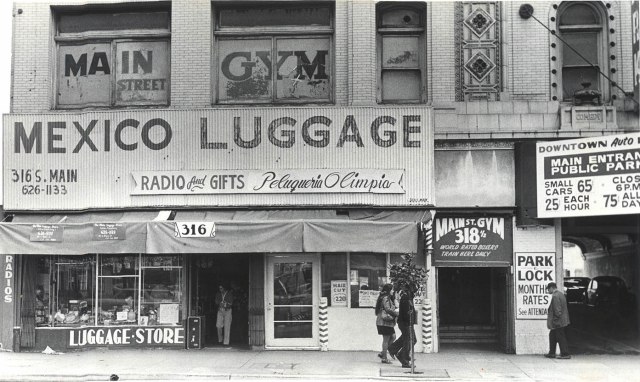
Photograph by Marilynn K. Yee / Los Angeles Times
Then I took a closer look at this picture from 1976. Continue reading

Adjusted for inflation, this baseball went for $7,165.28 in 2006 dollars.

I can hear every memorabilia collector in America screaming.
Here’s how news editors (now they’re called "page designers") used to crop feature pictures down to a one-column mug.
The original portrait. Here’s hoping the poor AP photographer never saw how it got butchered.

First, rotate the picture so the person’s head is "straight."

Now cut it down to one column and paint out the background.

Voila! A Nancy Valentine mug shot. Newspaper design as it was practiced in 1950. (And no, The Times doesn’t do this anymore. Thank heavens).

Nov. 28, 1957
Los Angeles
The last bad decision in James B. Burton’s 42 years of bad decisions was to light a cigarette.
Because to light the cigarette, he had to put down his gun.
Of course he had been drinking, which is not necessarily a bad
decision, but it is a poor choice if you’ve taken a woman and her
teenage daughter hostage and are threatening to kill them as you wait
for the husband to get home so you can rob him.

Maybe Burton didn’t think he needed to worry because Zenobia Maddox,
32, and her daughter Tony, 15, were tied up. And because his partner
was outside the home at 4715 S. Gramercy Place waiting to ambush Thomas Maddox, a real estate agent.
James Bedford Burton was an old, seasoned criminal who had served time
in Kentucky, Nevada, Utah and California and had a record going back to
1935. He and his partner forced their way into the Maddox home by
trying to collect on what they said was a bad check.
The men tied up the two women and while his partner waited outside,
Burton ransacked the home, threatening to kill the family if they
didn’t find any money. As he rummaged through the house, he drank from
a liquor bottle and continued threatening the Maddoxes.
In the meantime, Zenobia managed to work free of her restraints and
when Burton put down the gun to light a cigarette, she grabbed the
pistol.
Burton told her that the gun wasn’t loaded, but she proved him wrong–five times.
Then she got a lamp and beat him with it.
Then she got another lamp and beat him with it.
Then she got a third lamp and beat him with it.
After being shot five times and beaten with three different lamps,
James Bedford Burton was not feeling too well. In fact, he was pretty
much dead. And his partner was long gone, having run off when he heard
the gunshots.
Zenobia A. Maddox died May 6, 2002, according to the Social Security Death Index. Nice work, ma’am.


