|
I did promise that I wouldn’t go off the deep end on vintage fashions, but here’s a real period piece: A young woman’s hat from the Collegienne department at Bullock’s Pasadena. Bidding starts at $9.98. |
|
I did promise that I wouldn’t go off the deep end on vintage fashions, but here’s a real period piece: A young woman’s hat from the Collegienne department at Bullock’s Pasadena. Bidding starts at $9.98. |
 Photograph by Barbara Davidson / Los Angeles Times A LOOK BACK: The sun sets on Colonel Allensworth State Historic |
| By Peter H. King October 27, 2008 Reporting from Allensworth, Calif. — From outside her house in this beaten-down little town in the southern San Joaquin Valley, Nettie Morrison, Allensworth’s unofficial mayor, can look up the road a few hundred yards and see where it all so grandly began — the birthplace of one of the more audacious California dreams. A century ago, it was on this flat, barren piece of California that Col. Allen Allensworth, a former slave and retired Army chaplain, came to launch a utopia: a colony of, by and for black Americans. |
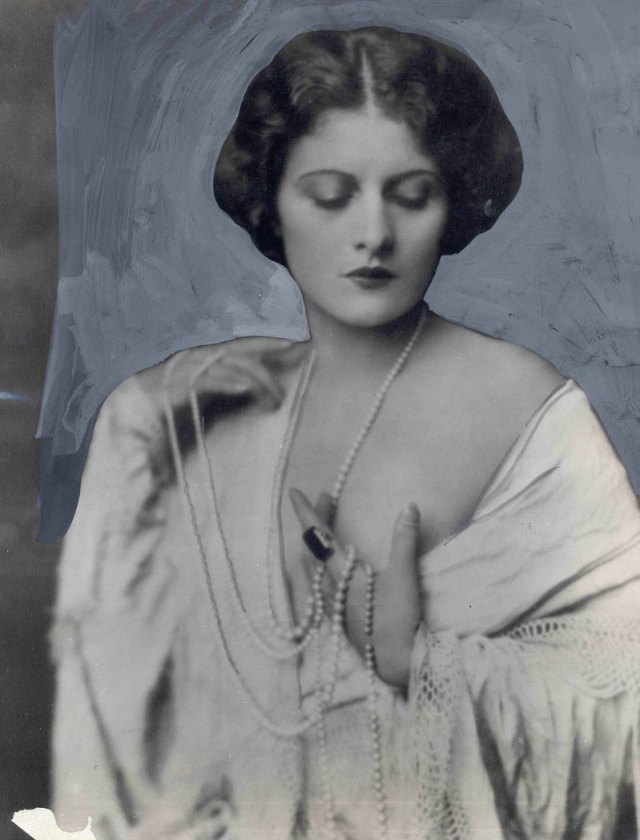
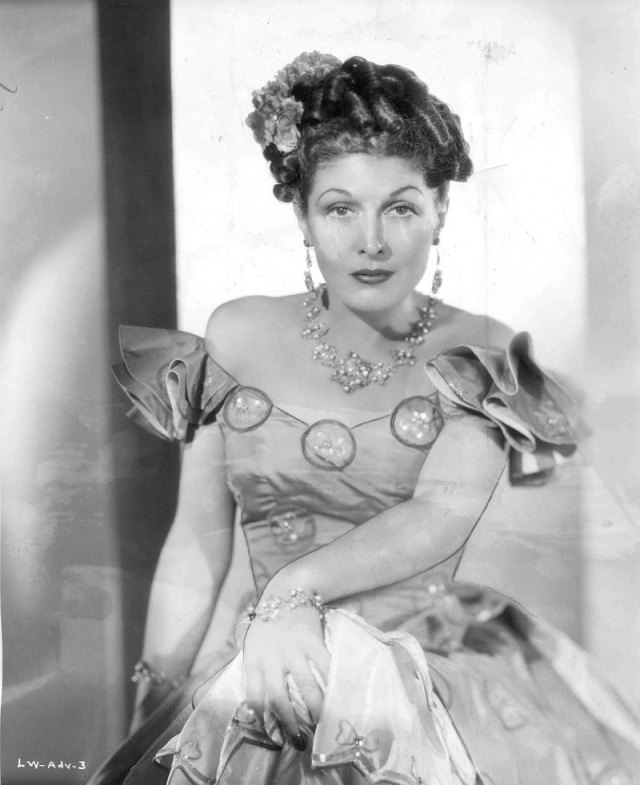
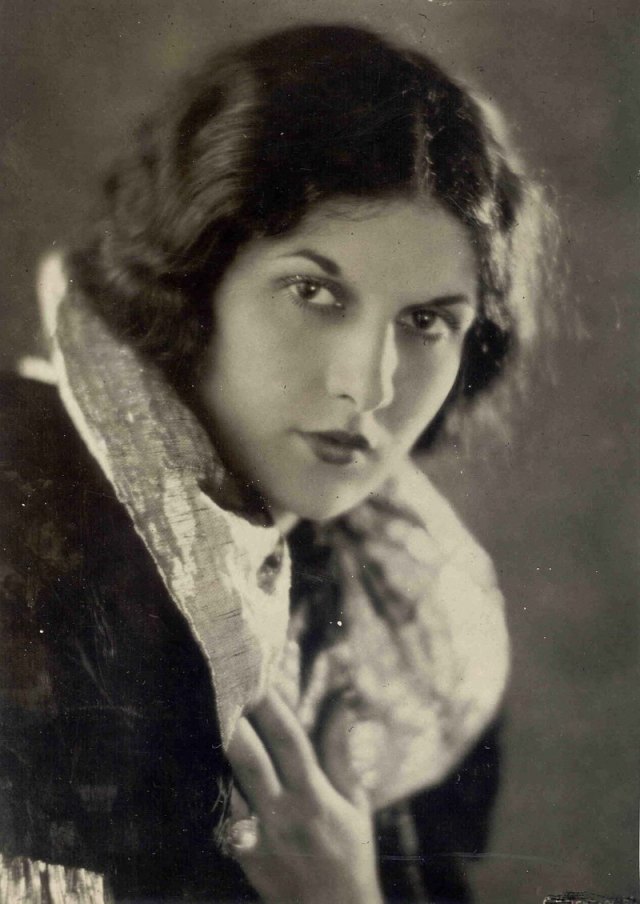 Los Angeles Times file photoThis week’s mystery guest has 125 credits on imdb. Los Angeles Times file photoThis week’s mystery guest has 125 credits on imdb.
Update: Steven Bibb and Gregory Moore have correctly identified our mystery star. I’m going to defer revealing her name to give other readers a chance. Congrats, Steven and Gregory! |
||||||||
|
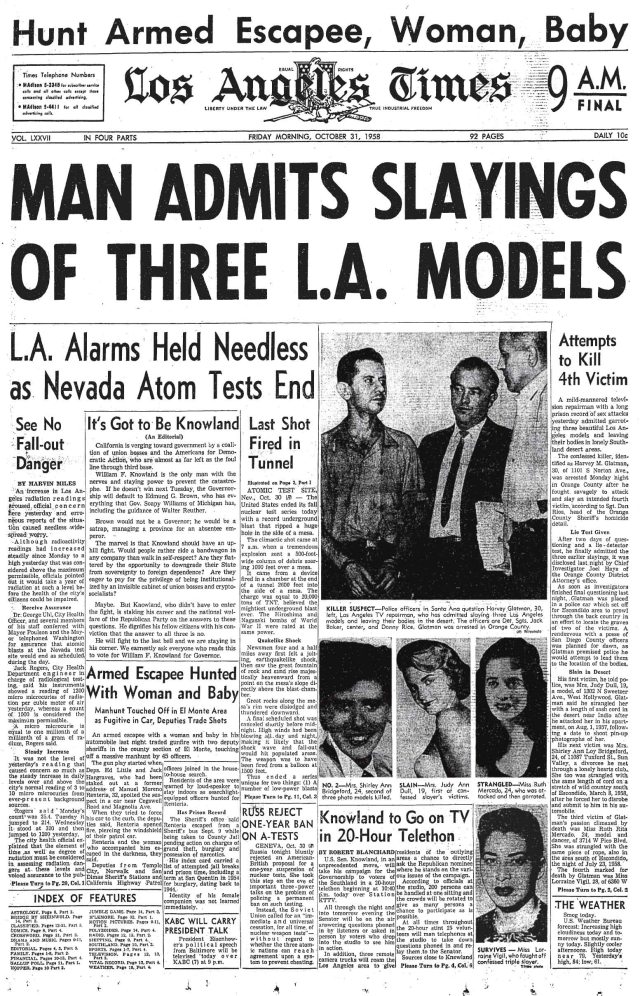
Harvey Murray Glatman is arrested and freely admits killing three women. He was executed in the gas chamber Sept. 18, 1959. It took him eight minutes to die. Continue reading
 Los Angeles Times file photoThe Northcott ranch. Notice the stop sign used as a precursor to crime scene tape. |
||
|
||
 Los Angeles Times file photoSanford Clark showing Deputies Sepulveda, Mendoza and Ybarra the direction taken from Mint Canyon cabin by Gordon Northcott when the latter told Clark, according to his story, that he was going to visit a mine where Northcott says he aided a miner slay his partner. |
||
 Los Angeles Times file photoGordon Stewart Northcott points with a pencil to a chicken house at his ranch where the state contends one of his alleged boy victims was slain. Undersheriff Rayburn, left, and Deputy Brown, right, keep him closely guarded as the trial jury inspects the ranch. |
||
 Los Angeles Times file photoSheriff Clem Sweeters, left, and Deputy Bob Bailey, foreground, watch a trusty dig for bodies on the Northcott ranch. |
||
 Los Angeles Times file photoInvestigators dig in the desert in a search for Northcott’s victims. |
||
 Los Angeles Times file photoDeputy J.R. Quinn and Sheriff Clem Sweeters with items recovered at the ranch. |
 Photograph by Jay Jones The Lizzie Borden Bed and Breakfast, Fall River, Mass. |
| By Jay Jones Reporting from Fall River, Mass. Karen Zorn and her boyfriend fled their cozy bed-and-breakfast earlier this year. It wasn’t that the place was dirty or the neighbors noisy. Zorn says they grabbed their bags and left for a nearby motel after discovering that, apparently, some of the other guests were ghosts. The couple had just finished checking in to the B&B in Fall River, Mass., when things started to go awry. "We went up to the room and it was freezing cold. It was the coldest room in the house by far. And that kind of spooked us out," she recalls. |

|
 By Keith Thursby Times staff writer The American Basketball Assn., which gave the world three-pointers, Bill Sharman had been a standout player with USC and the Boston "I made the move because I love Los Angeles," Sharman told The The Stars played in the Sports Arena but never drew much attention.
Hafner’s story advancing the Stars’ first home game included Sharman spent three seasons in the ABA, winning a title with the Here’s some ABA video found on YouTube that includes old game clips and interviews. See what L.A. for the most part missed. |
|
|
||||
|
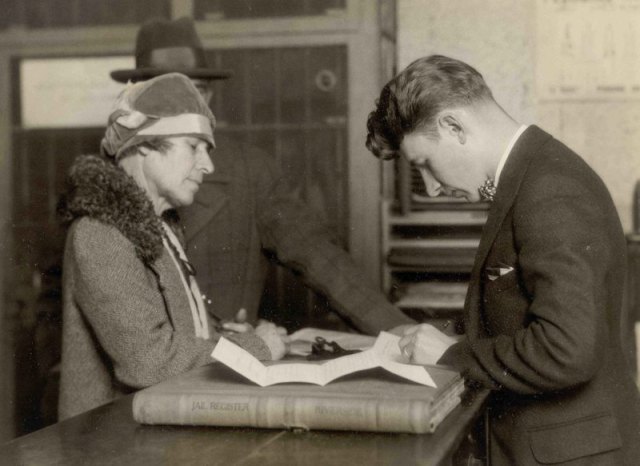 Los Angeles Times file photoLouisa Northcott, the mother of Gordon Northcott, isn’t portrayed in “Changeling,” but played a key role in the actual case. Above, she’s booked in jail. |
||
|
||
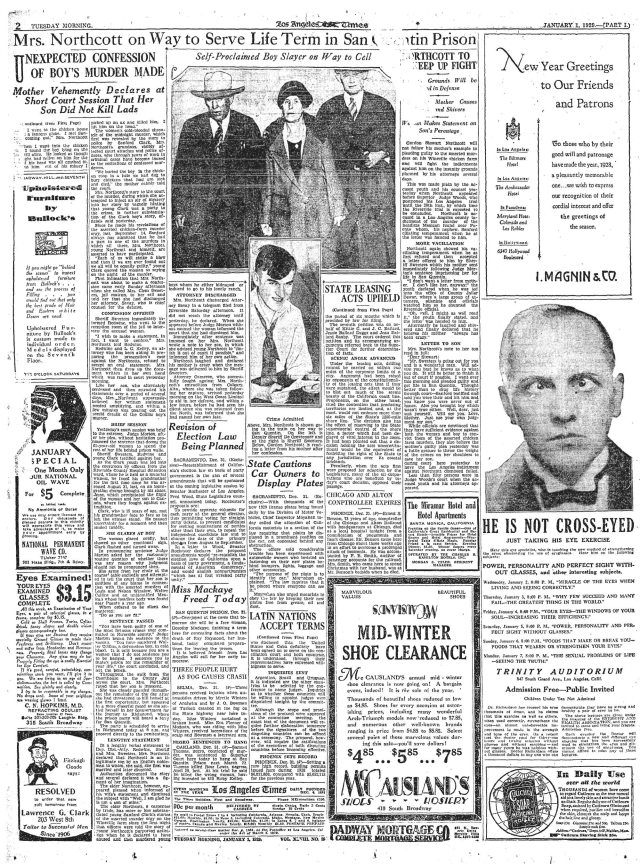
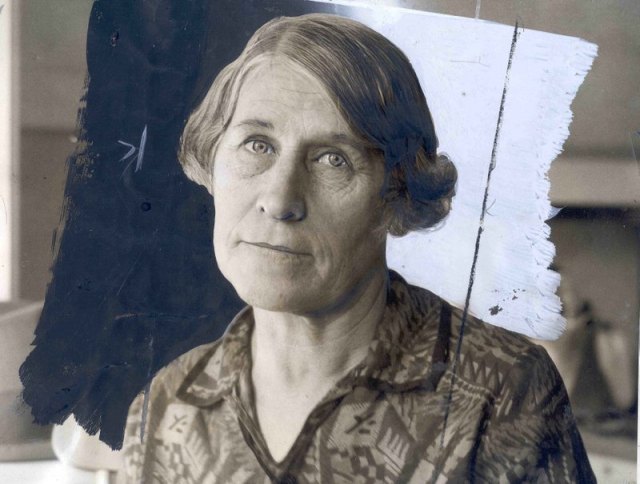 Los Angeles Times file photoLouisa Northcott, December 1928. She was paroled in 1940. |
 Photograph by Scott Mayoral The Fawcett residence, built for Randall and Harriet Fawcett. |
| Frank Lloyd Wright’s 1959-1961 Fawcett residence in Los Banos, Calif., has been offered for $2.7 million. A memoir about the home is here. The realty agents’ website is here. |

|
||||
|
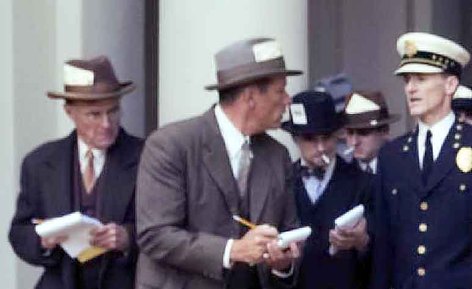 Photograph by Tony Rivetti Jr. / Universal PicturesAbove, Colm Feore as Police Chief James Davis, “Changeling,” set in 1928. |
||||||
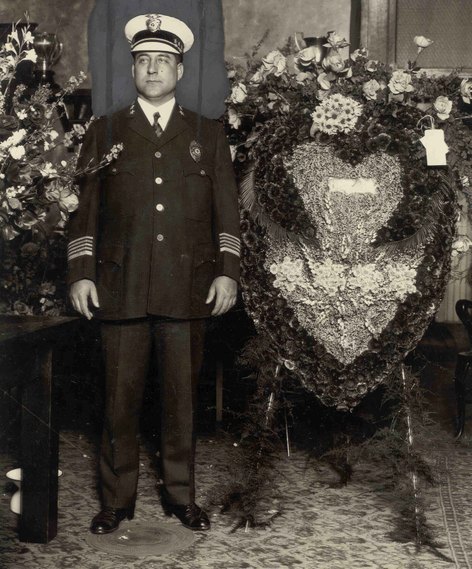 Los Angeles Times file photoAbove, Police Chief James Davis, 1926. |
||||||
|
 |
| I promised I wouldn’t go off the deep end on vintage fashions, but I did post something about menswear and don’t want to be biased. Here’s an Irene Lentz number from the 1950s priced at $349. |

|
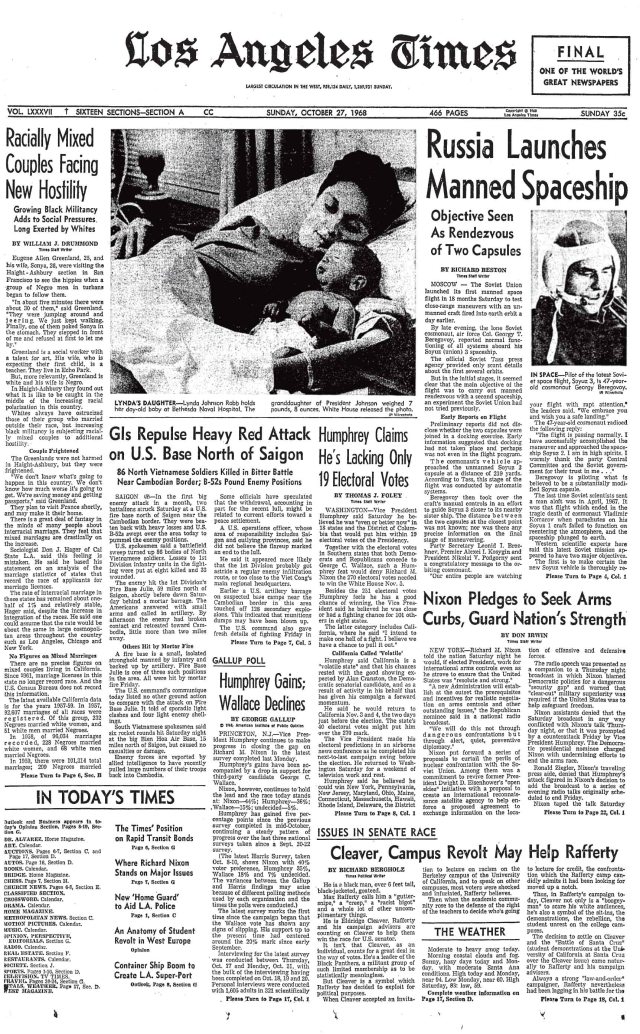
 I wondered if somewhere during my tour of the Rams’ 1958 and ’68 I wondered if somewhere during my tour of the Rams’ 1958 and ’68seasons I’d find the same name pop up in a story, 10 years later. What were the odds, given that length of time and two very different eras in the NFL? Well, we have a winner: Earl Morrall. In 1958, he had a small part Player of the game: Morrall was playing for a sore-armed legend, Quote of the game: “There were no tricks or any magic,” Colts Coach –Keith Thursby |
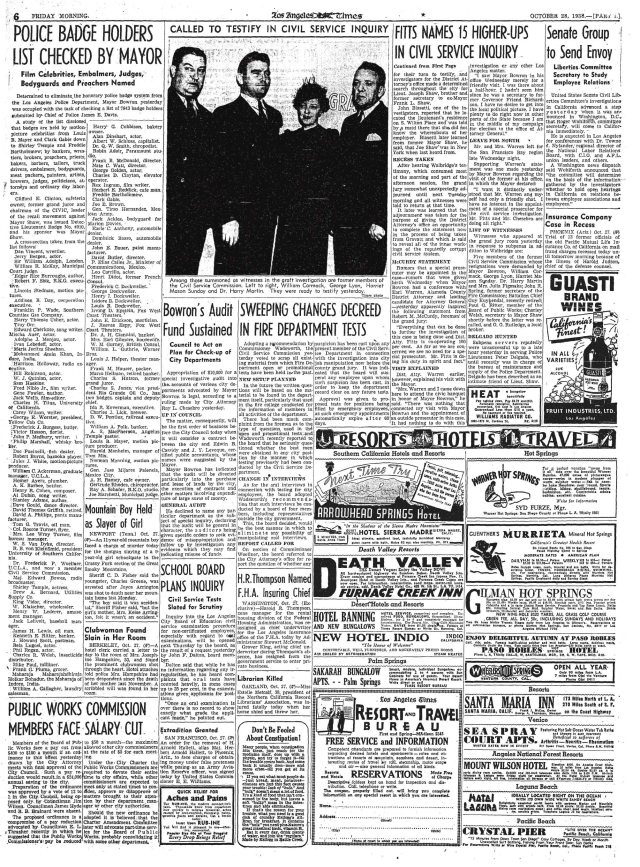
 Above, Police Chief James Davis turns over a list of more than 7,800 people who have received honorary badges from the Los Angeles Police Department. Recipients include Shirley Temple, Clark Gable, Louis B. Mayer, Joe E. Brown, King Vidor, Bela Lugosi and Leo Carrillo.
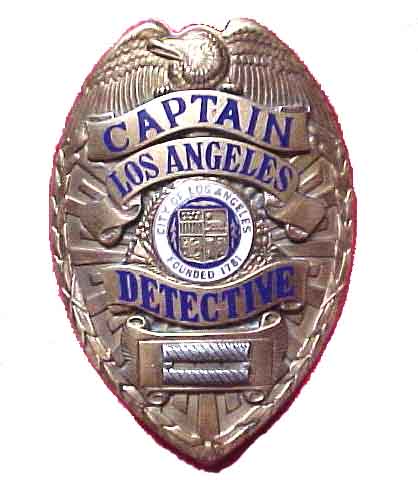
So many old-style badges like one the at left and the one in the Daily Mirror sidebar were handed out that the department replaced them with the current design and these are tightly restricted.
The old badges (usually with the rank of captain or chief) can sell for a fair amount of money, even though thousands of them were given away.
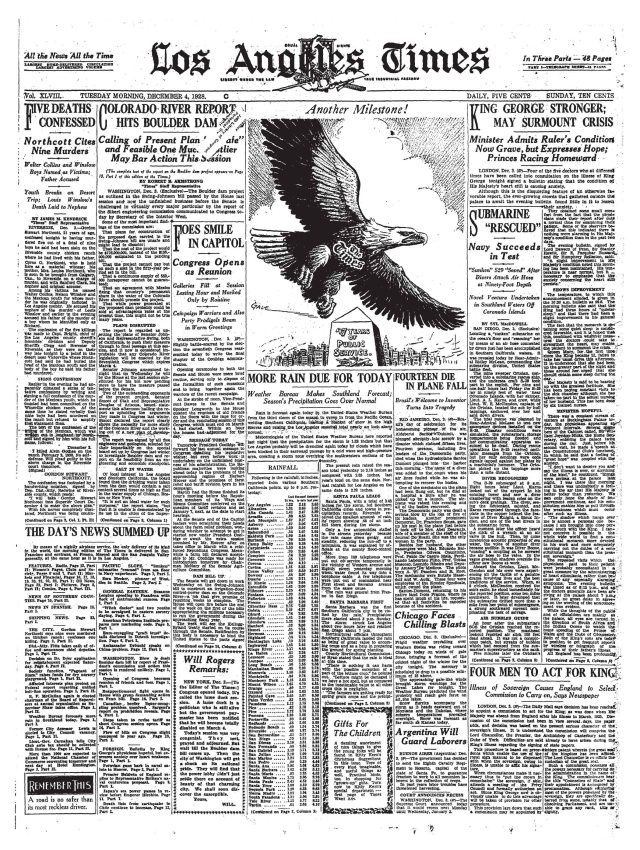
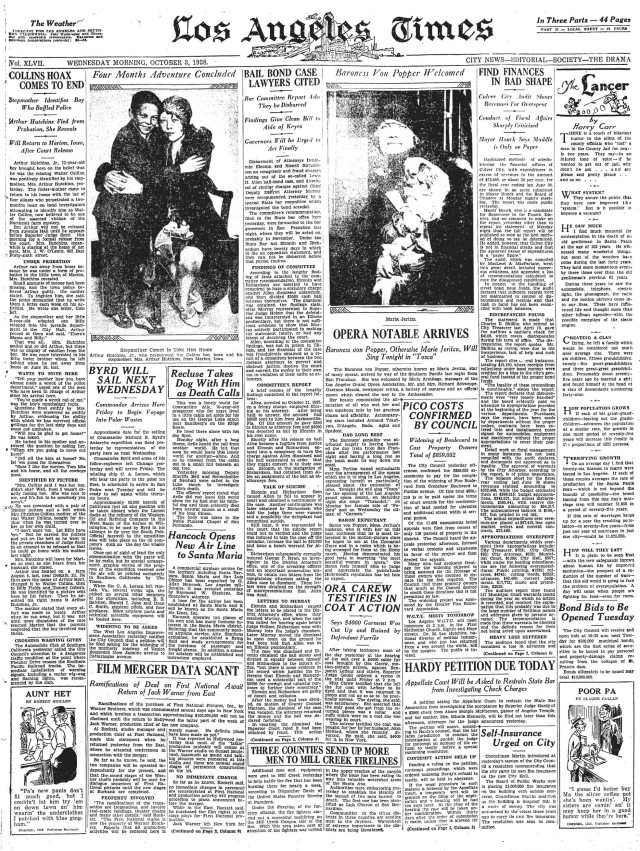
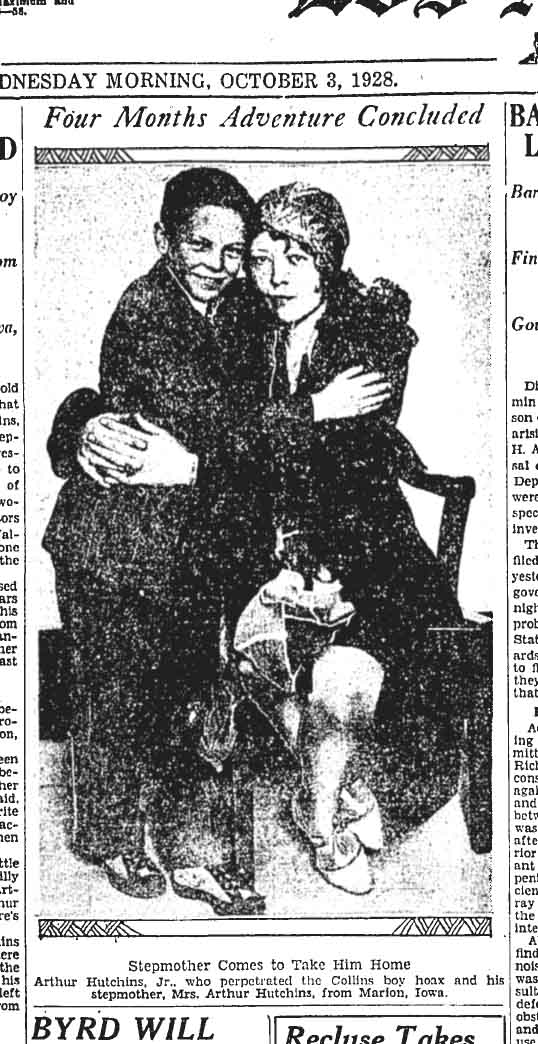 The “Enigma Boy” who fooled police into believing that he was Walter Collins is identified as Arthur Hutchins Jr. of Iowa. Read Part I of The Times reports on the story that formed the basis of “Changeling.” The “Enigma Boy” who fooled police into believing that he was Walter Collins is identified as Arthur Hutchins Jr. of Iowa. Read Part I of The Times reports on the story that formed the basis of “Changeling.” |
||||
|
 Photograph by Scott Mayoral The 1946 Kaufmann house in Palm Springs. |
| October 26, 2008 By Diane Wedner Richard Neutra, a pillar of 20th century Modernism, is known for his sleek, glass-sheathed designs that take advantage, to beautiful effect, of the surrounding natural landscape. The Kaufmann house in Palm Springs, commissioned by Pittsburgh department store magnate Edgar J. Kaufmann, was built in 1946 and is considered one of the Viennese-born architect’s greatest works. Its sleek form, sliding panels and glass-and-stone aesthetic helped shape the postwar Modernism movement. |
On the Case With the Navajo Tribal PoliceA THIEF OF TIME by Tony Hillerman
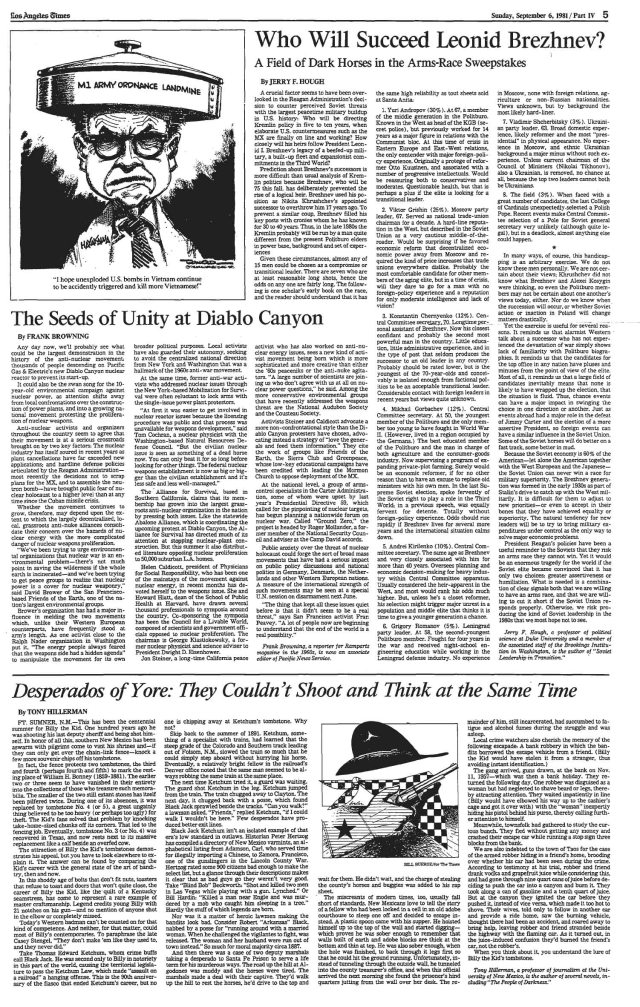
3 July 1988 By Charles Champlin Tony Hillerman’s mysteries featuring Lt. Joe Leaphorn and Officer Jim Chee of the Navajo Tribal Police are unique in American crime fiction. They combine a deep and sympathetic knowledge of ancient Navajo beliefs, a poet’s power to evoke the peculiar austere beauty of the Navajo country and a wire service reporter’s sad awareness of the greeds, hates and schemings of the modern world. In Hillerman’s beautifully constructed plots, the ancient beliefs sometimes seem to have a bearing on present dastardly events, and they certainly color the thought processes of his policemen. But in the end, the crimes are very much from time present, as real and ugly as corpses and never falling back on the mystical to explain the inexplicable. “A Thief of Time” is Hillerman’s ninth novel and the eighth of his Navajo mysteries. (His second novel, “The Fly on the Wall” in 1971, was a first-rate thriller about political corruption, drawing upon his days as a wire service bureau chief in two state capitals.) A feisty young woman, an anthropologist digging near the ruined cliff-dwellings up Chinle Wash off the San Juan River, disappears. Joe Leaphorn, although still demoralized by the death of his young wife, takes up the search. It leads him into the world of the pot-stealers, the thieves of time who ransack burial sites and other traces of the Indian past for relics to sell to collectors. Leaphorn flies to New York to seek a clue from one such collector. The trail leads him as well to a previous case and a bitter old man whose son Leaphorn identified as a multiple killer. The young man, a paranoid schizophrenic, is presumed drowned, but was he? Crime series have a way of running down, the fleshings-out ever less able to conceal the bare bones formula. But Hillerman, it is admittedly a cliche to say, gets better all the while. “A Thief of Time” builds to a socko finish, with bow and arrow and helicopter metaphorically colliding among the tortured cliffs. Compassion was central to Hillerman’s point of view from his first novel, the first of the Navajo mysteries, “The Blessing Way,” in 1970. But the feelings seem to run even deeper now: Leaphorn dealing with his private sorrow but dealing as well with a father’s grief over a son lost to madness if not to death. Hillerman was born and reared in Oklahoma and attended an Indian school for the first eight grades. As he has said, Native American beliefs run deep into his own life, and he has studied them ever since. After a series of newspaper and wire-service jobs in Oklahoma and Texas, he joined the Sante Fe New Mexican and was finally its executive editor when, in 1963, he went back to school, as journalism professor, assistant to the president and student, at the University of New Mexico in Albuquerque. His Joe Leaphorn is an individual with claims to being an archetype-an American Indian trying to straddle the old ways and the new, caught in a kind of limbo between mystical tradition and later rationality, between symbolic feathers and walkie-talkies. The two worlds are joined, as Hillerman demonstrates in the books, by an enduring family feeling that transcends all else, including material possessions. By now, Hillerman’s sensitive handling of Indian ways and the Indian past, his summoning of the sights and sounds of the land and his understanding of the often uneasy and abrasive meeting of cultures have won him a place in American letters and not simply among crime writers. But in less solemn terms, as a storytelling inventor of plots and generator of high suspense, he has no exact equal among the writers about crime either. Like Elmore Leonard and other writers who worked for years to a small but steadily growing coterie of admirers before breaking out into wider attention, Hillerman now seems poised for the big acclaim. “A Thief of Time” begins with a 50,000 cloth print order-not Leonard country yet but impressive-heavy advertising and a 10-city tour for the author. It’s time. |
||
|
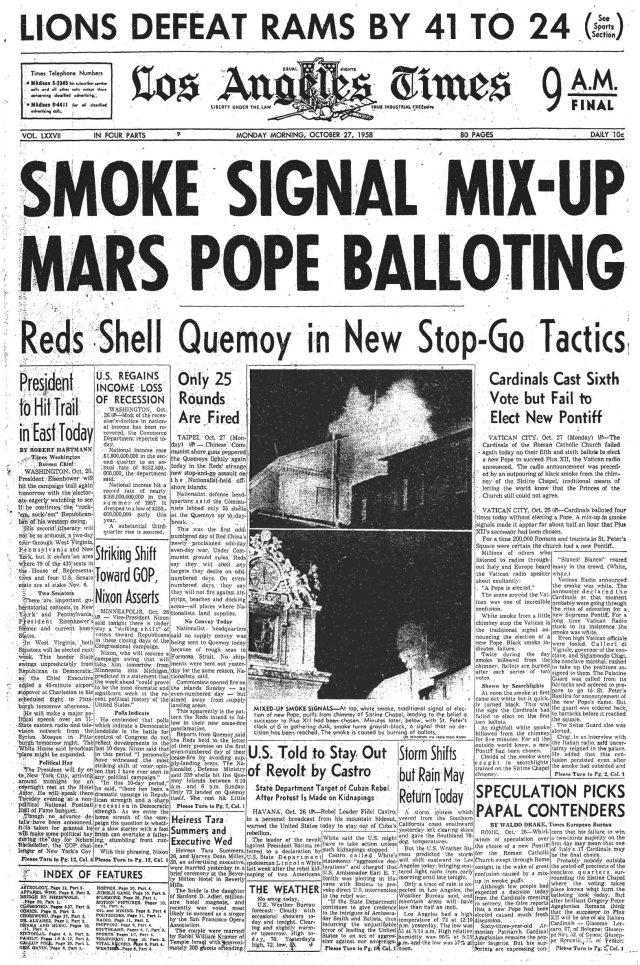 |
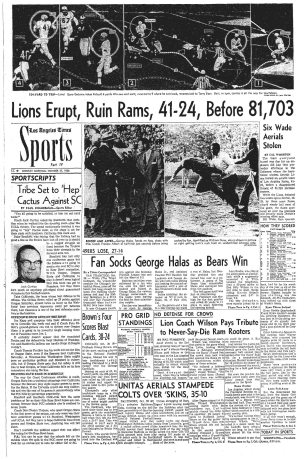 The Rams lost their rematch with the Detroit Lions, 41-24, who finally looked like a team that won the NFL title in 1957. The Rams lost their rematch with the Detroit Lions, 41-24, who finally looked like a team that won the NFL title in 1957.
Players of the game: The Lions’ defenders, or as The Times’ Paragraph of the game: “The crowd did an unusual thing when the Rams were unable to work up a head of offensive steam. They started booing.” Really, booing the home team was unusual in 1958 Los Angeles? –Keith Thursby |
 |
||||
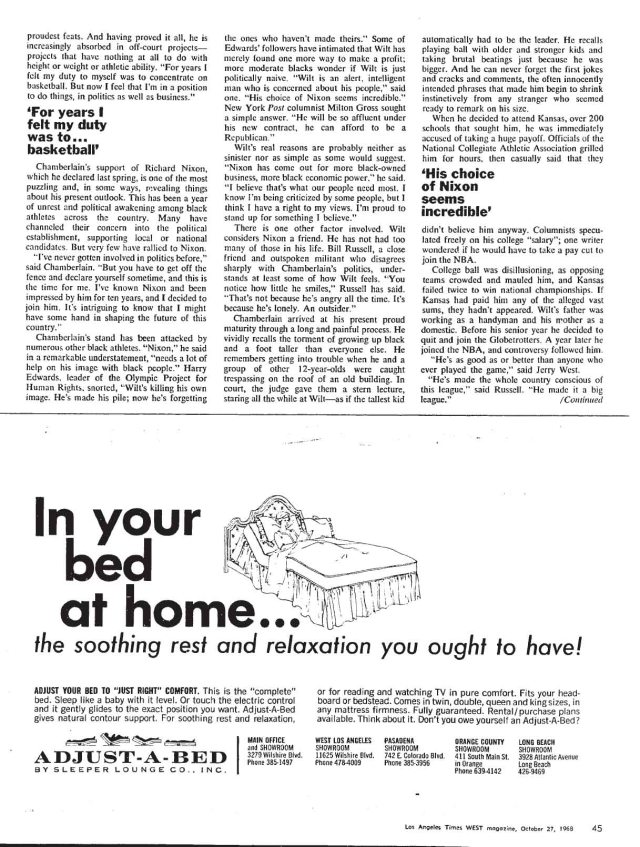
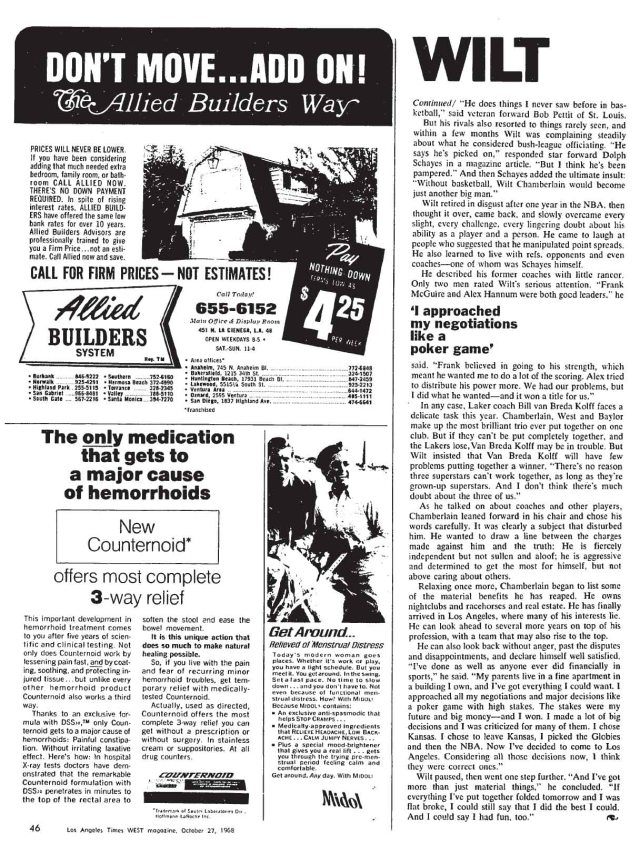
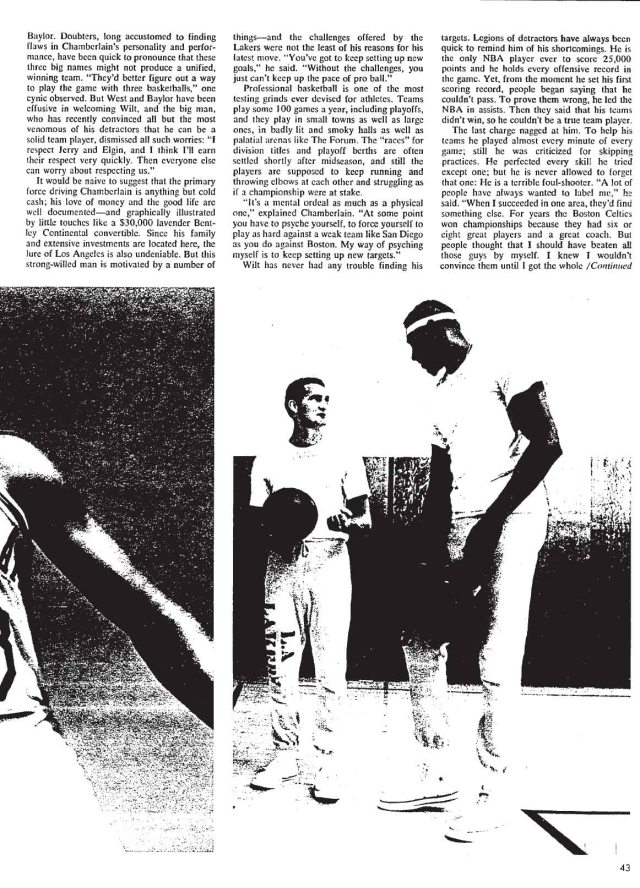
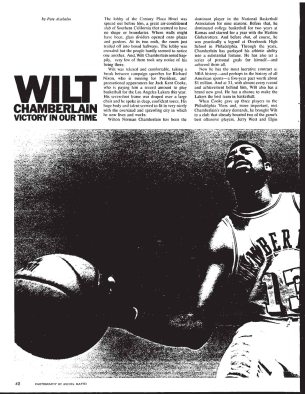 By Keith Thursby By Keith ThursbyTimes staff writer Wilt Chamberlain tried to explain his political leanings during a turbulent year in American history, particularly his support of Richard Nixon for president. “I’ve never gotten involved in politics before. But you have to get off the fence and declare yourself sometime and this is the time for me,” Chamberlain told sportswriter Pete Axthelm in a long profile published in The Times. “I’ve known Nixon and been impressed by him for 10 years and I decided to join him. It’s intriguing to know that I might have some hand in shaping the future of this country.” Axthelm quoted New York Post columnist Milton Gross, who had a different rationale for Chamberlain’s endorsement: “He will be so affluent under his new contract [with the Lakers] he can afford to be a Republican.” Axthelm had another, simpler theory–Wilt considered Nixon a friend. “You notice how little [Chamberlain] smiles,” said Boston Celtics star Bill Russell, a close friend despite their political differences. “That’s not because he’s angry all the time. It’s because he’s lonely. An outsider.” |
||||
|
 Los Angeles Times file photo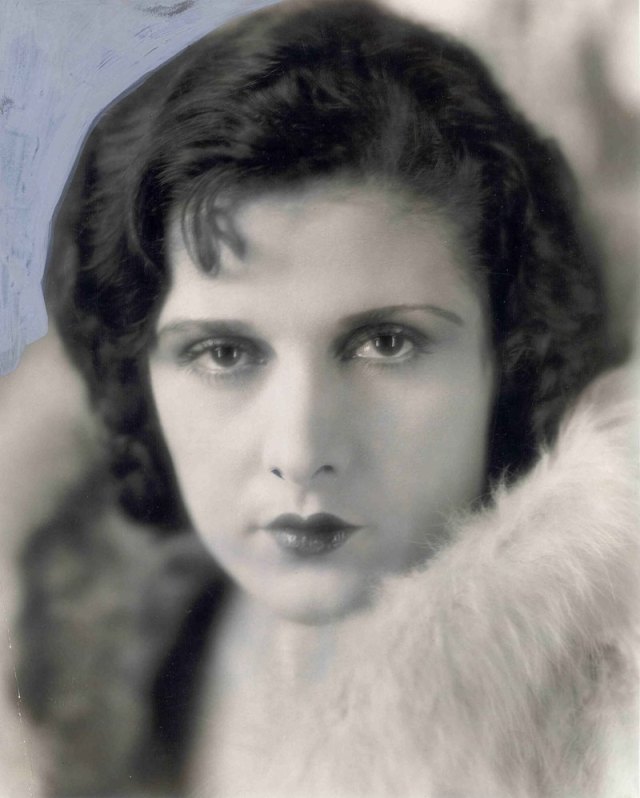



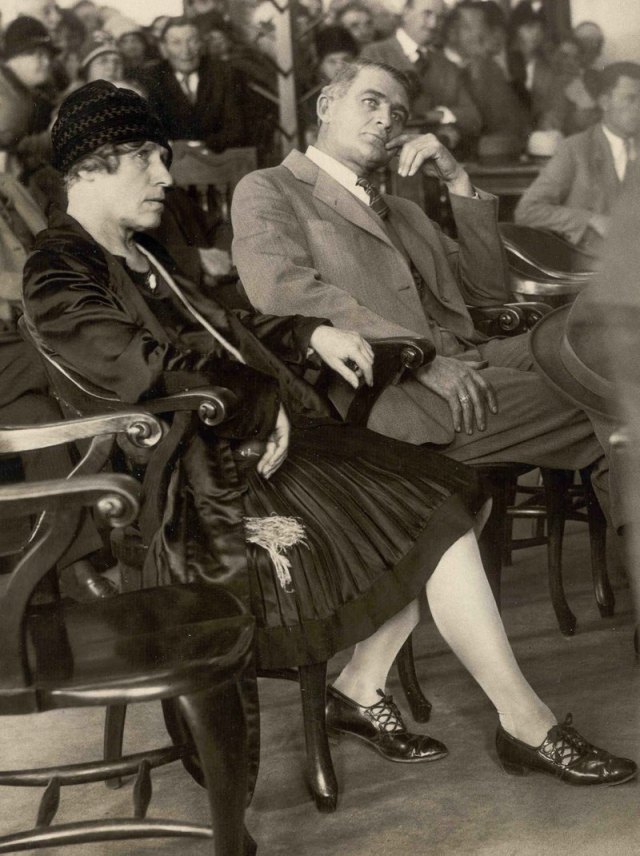 Los Angeles Times file photoLouisa Northcott with one of her attorneys (she was represented by Norbert Savay, A.H. De Tremaudan and J. McKinley Cameron).
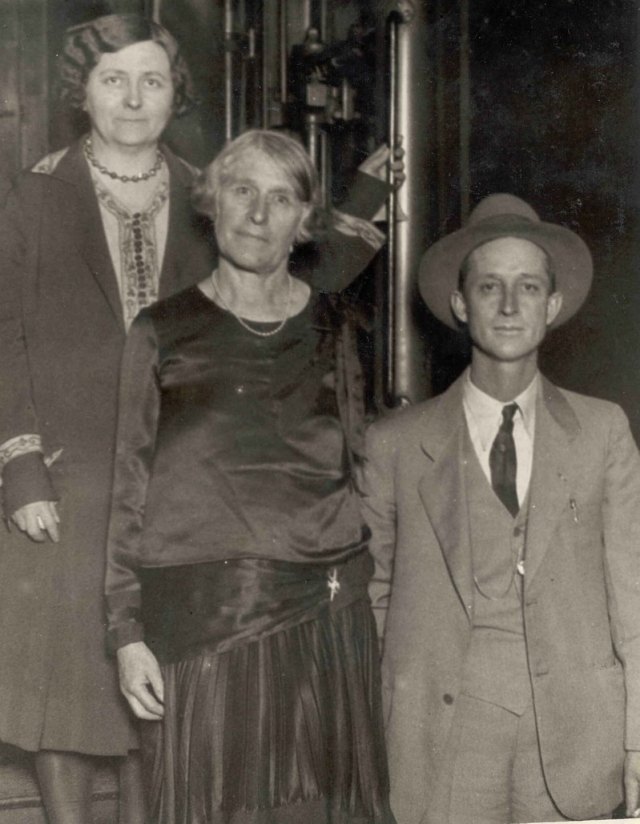 Los Angeles Times file photoDeputy P.H. Peterson and his wife escort


 Northcott signs confession.
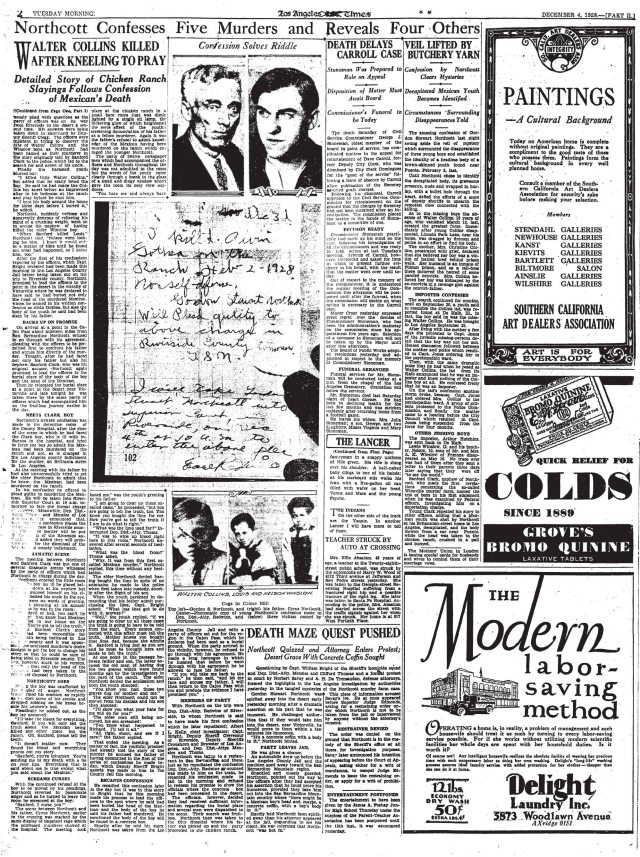 “I kept his body around the house for three days before I buried it.”
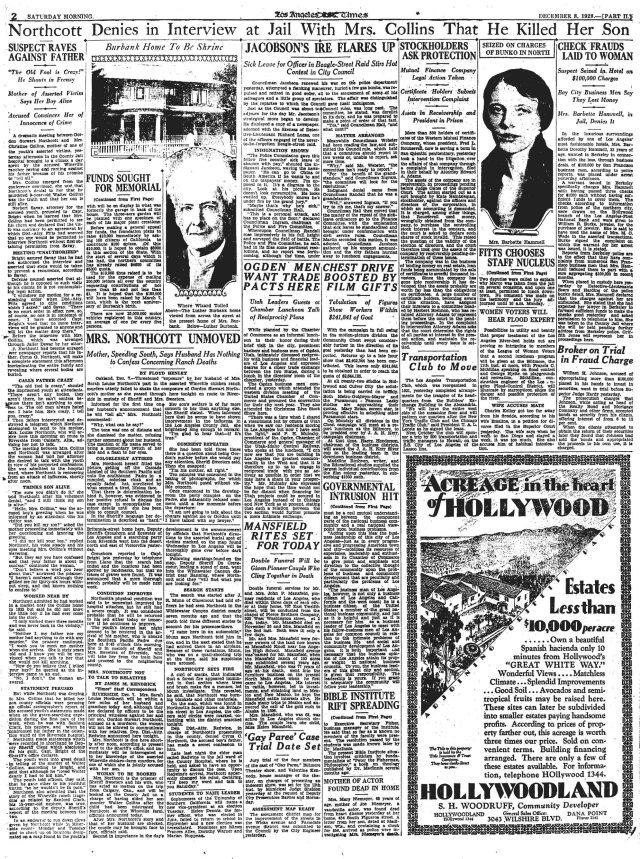 “The old fool is crazy! There aren’t



 Tony Hillerman on the
 Tony Hillerman on desperadoes
 $30,000 Bentley convertible
 He speaks five languages