Changeling stories — Part I


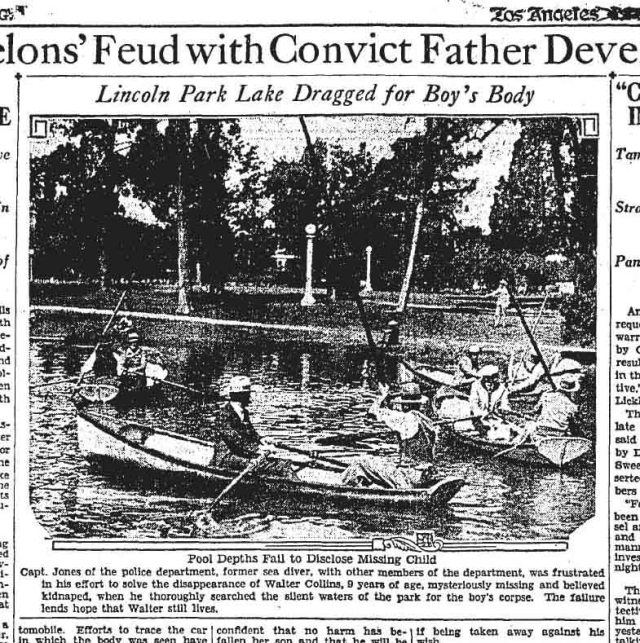
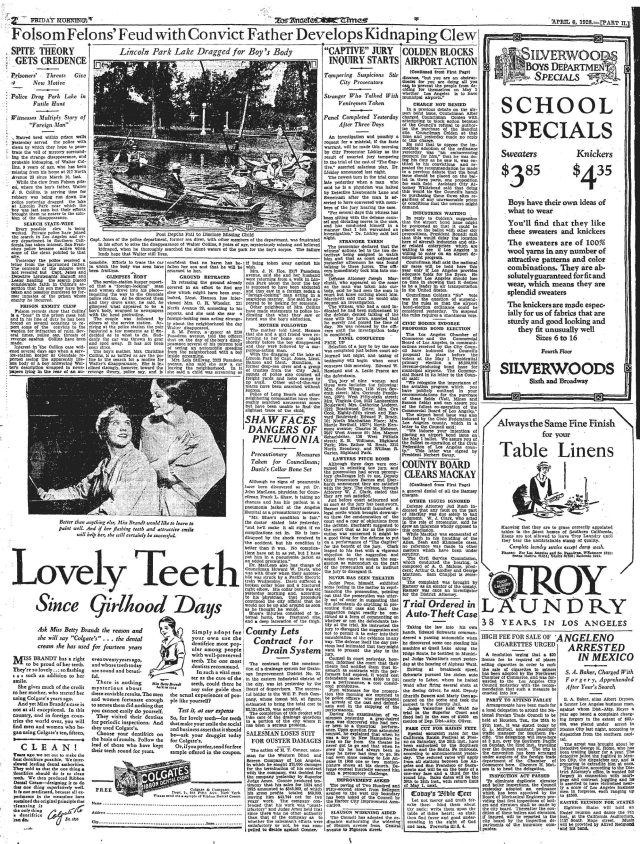
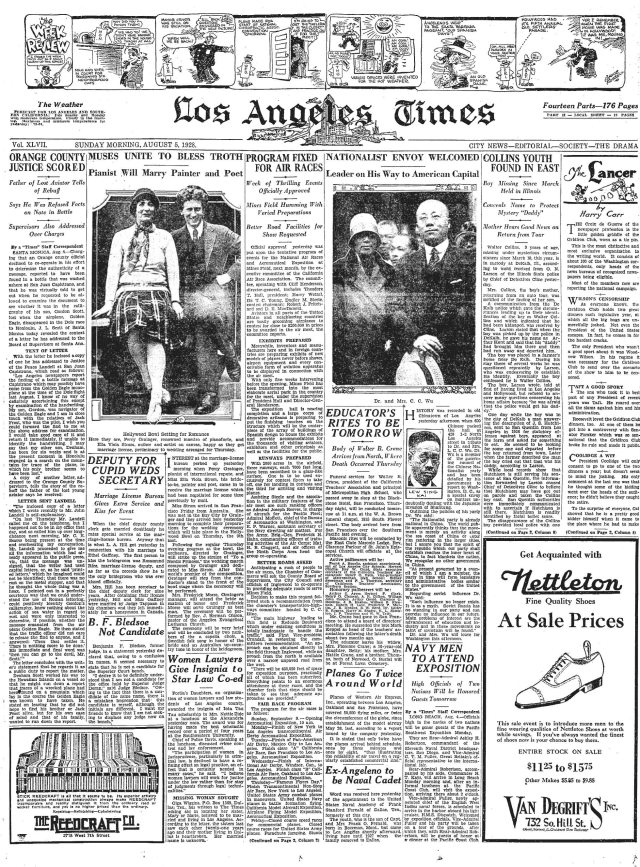
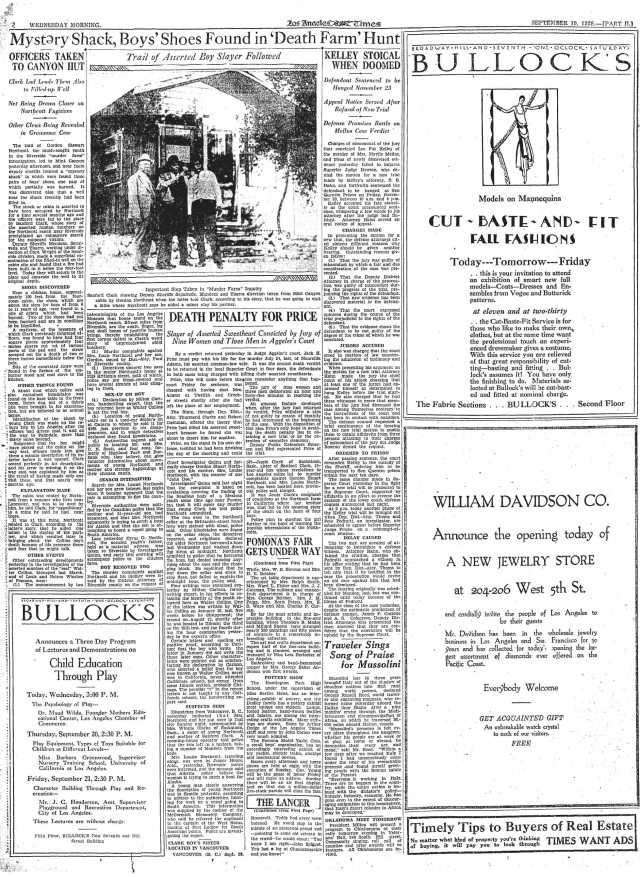
Police Capt. Jones and LAPD officers search the lake in Lincoln Park for the body of Walter Collins, Los Angeles Times, April 6, 1928.
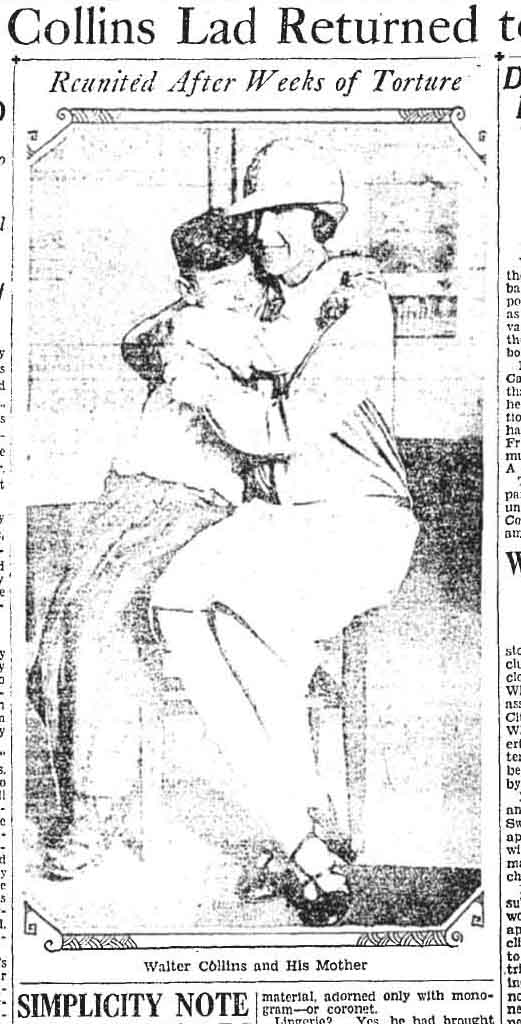
The boy claiming to be Walter Collins poses with Christine Collins, Aug. 18, 1928 Several regular readers have asked to see the original stories that formed the basis of the current movie “Changeling,” written by J. Michael Straczynski and directed by Clint Eastwood. The movie’s website is here>>>
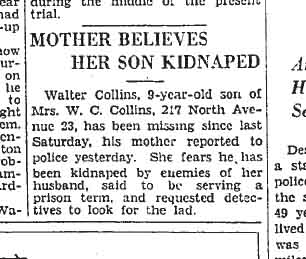
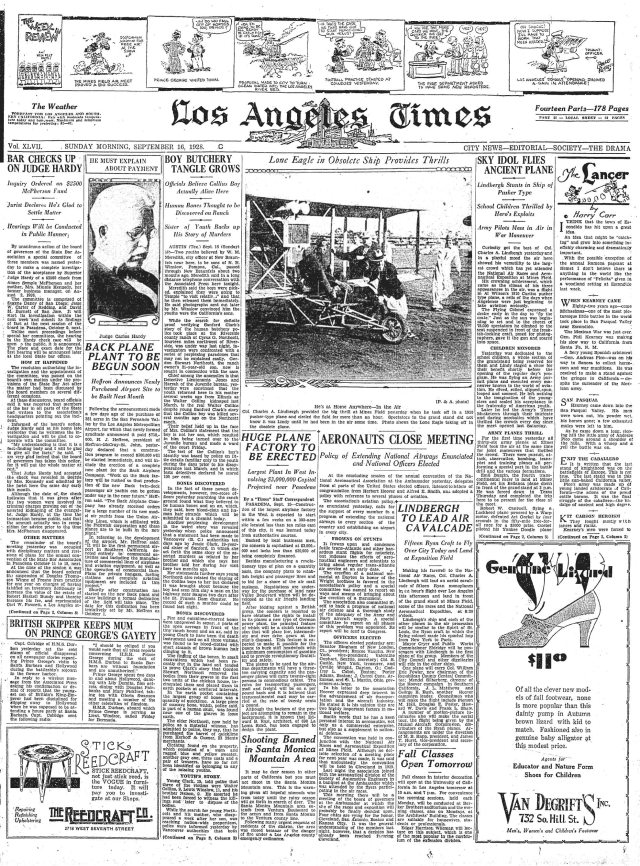
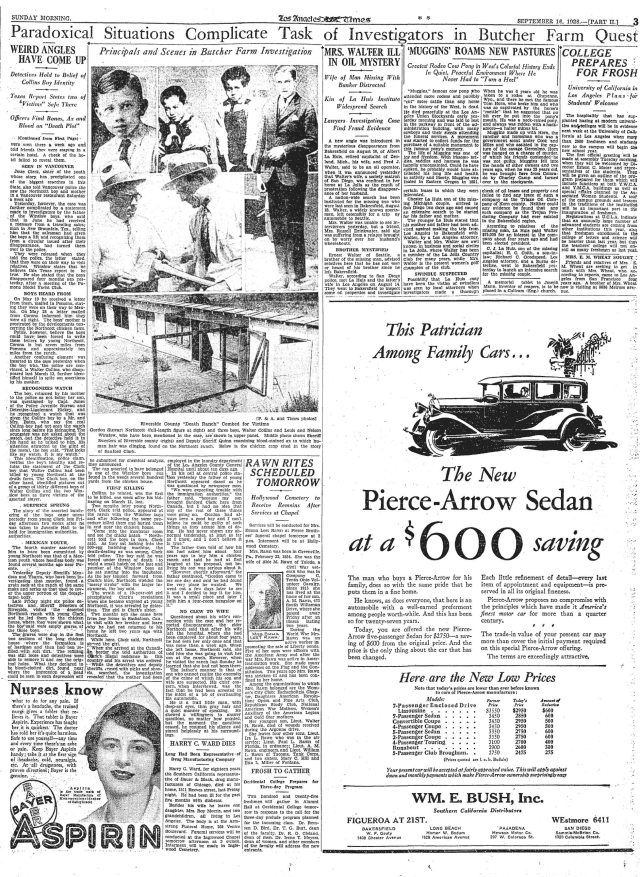
Alas, The Times published far more stories than I can ever upload to the Daily Mirror. Over the next few days, I’ll try to post a few of them just to give a sample of the coverage–and of course the competition also filed stories that would only be available on microfilm at the Los Angeles Public Library.

The Times stories are available from The Times archive or via ProQuest from the Los Angeles Public Library (you will need a library card to sign in).


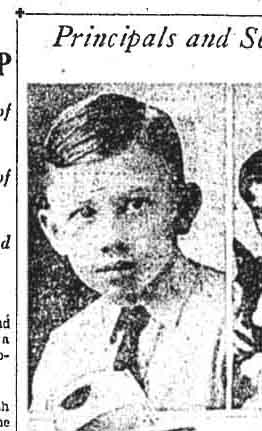
Photo of the real Walter Collins
A Glendale service station attendant says he saw the missing boy in the back of a car.
Police suspect kidnapping is retaliation against boy’s father, a Folsom inmate. Missing boy found in DeKalb, Ill., refuses to identify “daddy.”
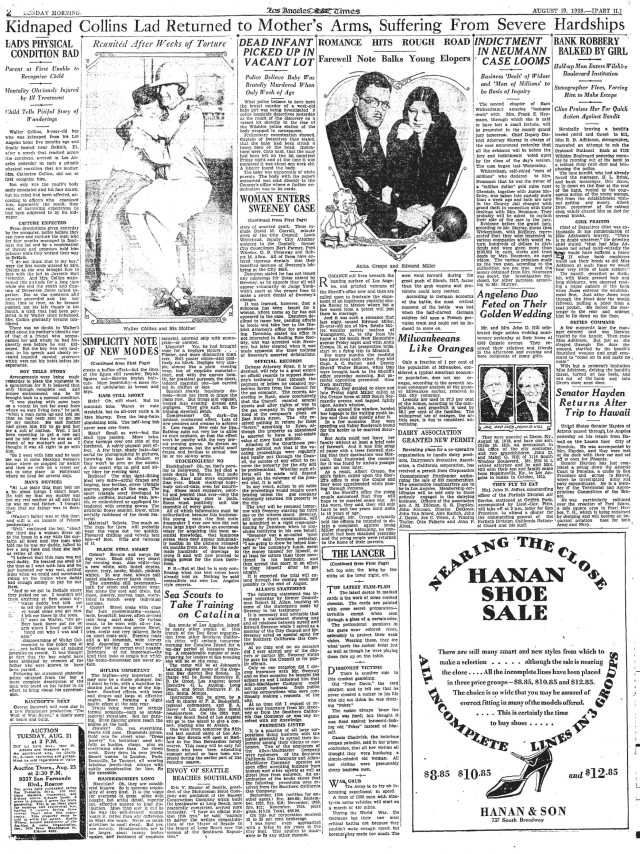
“I do not think that is my boy,” Christine Collins says. Police insist boy is Walter Collins despite statements that he was killed.
Mother returns boy, saying he’s not her son. Handwriting expert says boy is not Walter Collins.
Posted in #courts, @news, Changeling, Film, Front Pages, Hollywood, Homicide, LAPD, Parks and Recreation | 42 Comments

‘The speculative bubble always comes to an end’–John Kenneth Galbraith


John_galbraith

Photograph by the Associated Press

John Kenneth Galbraith, 1908 – 2006, in a 1998 photo. 

Dec. 12, 1999

John Kenneth Galbraith

‘The speculative bubble always comes to an end–and never in a pleasant or peaceful way.’

By Elizabeth Mehren
New England bureau chief for The Times

CAMBRIDGE, MASS. — The economy is thriving, boasts the president. Never been healthier, agrees Alan Greenspan. Buy, buy, buy, urges Wall Street.

But in a grand, wood-paneled salon a mere percentage point from Harvard Yard, the guru of modern economics is a bit more temperate. The next time someone in authority announces that America has entered a new era of prosperity, cautions John Kenneth Galbraith, run for cover. If, he adds, the word "unprecedented" happens to be part of the conversation, take especially deep cover.

At 91, Galbraith thinks, speaks and writes in rich, eloquent paragraphs. His 31 books are marked by the same balance of self-effacement and self-congratulation that characterizes his conversation. "Galbraithspeak" is what William F. Buckley Jr., a skiing buddy of Galbraith’s in Gstaad, Switzerland, calls this distinctive lingua franca. Galbraithspeak permeates speeches and correspondence that the economist has authored for presidents from Franklin D. Roosevelt to Lyndon B. Johnson. Among the many titles he claims credit for on the bookshelf in his living room, Galbraith likes to joke that his personal favorite is "The Speeches of Adlai E. Stevenson."

A farm boy from western Ontario, Galbraith went to work for Roosevelt in 1936 and demonstrated that at least one economist was not as dismal as the science he practices. Partly because of his uncanny ability to translate Keynesian theory into terminology that even politicians could understand and partly because of his habit of slipping his arch wit into those translations, Galbraith won the ears of a succession of postwar Democrats. For Republicans, meanwhile, he was a perpetual thorn in the side: a Harvard professor with a huge audience, a sense of humor and an intolerance for any capitalism that forsakes humanism.

Presidential candidates from Stevenson to Eugene J. McCarthy chose Galbraith as their key advisor on the economy. He served President John F. Kennedy as ambassador to India and remained close to the Kennedy family after the president’s death in 1963. While not in President Bill Clinton’s inner circle, Galbraith is on friendly terms with Clinton and has visited Arkansas as his guest.

Without his two hearing aids, Galbraith is "quite deaf," and age has caused his 6-foot, 7-inch frame to stoop a bit–perhaps to a mere 6 foot 6. Yet, Galbraith and his wife of 62 years, Kitty, travel relentlessly, often to the countries whose welfare he worries about most. Recently, he found himself an honored guest at the 50th-anniversary celebration of Newfoundland. Days later, he was lecturing at the University of Texas at Austin, where his youngest son, James Kenneth, 48, is a professor of economics. Another son, Peter Woodard Galbraith, 49, was Clinton’s ambassador to Croatia and now teaches at the Naval War College, while John Alan Galbraith, 58, is a lawyer in Washington.

The eve of the millennium seemed an appropriate moment to check in with America’s economic eminence grise.

*

Question: In sounding a skeptical note about the current economic climate, you’re at odds with some leaders, as well as some leading thinkers. Have you appointed yourself chief curmudgeon, or do you think others are turning blind eyes to the dangers of runaway success?

Answer: I see people generally happier with economic life than in many years. And there’s a reason for that. There’s no question that the economy, at the moment, is doing well by the people at large. On the other hand–and, I remind you, Harry Truman once said he wanted a one-armed economist who didn’t always say "on the other hand"–we have, as we all know, a sort of securities-market speculation: a lot of innocent participation in the stock market. We have far more mutual funds and other stock-market apparatus than we have intelligence to manage it. Out of this, everyone should be aware of the oldest rule in economics, for which I take credit, which is that when someone says we have entered a new era of permanent prosperity, you should take cover. That has been said many, many times in the last 300 years.

Q: One result of all these people playing around with the market is we have a new class of enormous wealth. How does this affect our economy?

A: We should always remind ourselves that capitalism, now politely called the market system, has always, basically, been unstable. My old, much-admired colleague, Joseph Schumpeter [the Austrian economist], argued that it was necessary to clean out, periodically, incompetent and reckless bankers, incompetent and reckless corporate executives, incompetent and reckless government officials and other misdirected people involved in the economy. He gave it a name: creative destruction. I hasten to add, Schumpeter was a stalwart conservative. To the rest of us: If we have a setback–which, historically speaking, is possible–it would have an adverse effect on consumer spending, an adverse effect on investment and thus an adverse effect on the economy as a whole. On the other hand, we have a much more secure economy than we had, for example, after the 1929 crash.

Q: How are things different now?

A: There was no banking insurance, so the crash led directly to a banking crisis. There was no Social Security. And there was no real commitment to helping people in distress–though it must be said that that commitment is still weak.

Q: Granted that economics is known as the dismal science, we hear terms like "crash," "correction" and now "creative destruction." What’s the difference?

A: It’s a matter of which term is selected by the particular speaker to either minimize or exaggerate the situation.

Q: Can you offer guidance as to which words minimize and which exaggerate?

A: If you are very optimistic about the future, you say it will only be a correction. There are other terms that are considerably rougher. I see them as quite possible in terms of historical precedent. But I don’t make predictions. I long ago discovered that my wrong predictions are wonderfully remembered, and my right ones are quickly forgotten. So I rely on the history of capitalism.

Q: Which tells us?

A: Any person given to excessive optimism should step back to 1637, the wonderful year when all the sober and somber people of Holland believed you could get rich on tulip bulbs. Call it tulip-mania. The whole country was committed to that speculation. Holland and its 17th-century residents did not get rich on tulips or anything else. Or, at the beginning of the next century, when all of Paris was excited endlessly, wonderfully, by the prospect of gold in Louisiana, something that has not yet been found–except in Louisiana politics.

Q: With so much new wealth are we living in a new gilded age? Does the economy as a whole benefit when there are so many with such enormous wealth?

A: The enormous inequality in wealth and income, and the way it has been increasing, is the other important factor that distinguishes our economy. This kind of extreme is against both the economic and political stability of the economy. It means that large sums of money can move rapidly in one direction or another and be deflationary. And a socially stable society has not an equal, but a reasonably fair distribution of wealth and income. I say that because I am, socially, a conservative. I don’t want to see the political effects of this kind of unequally distributed income. On the other hand, I willingly retreat to realism and say that equality in income distribution is neither likely nor possible.

Q: Back to the new wealth. This class accounts for a very tiny segment of the population, less than 1%. But the total amount controlled by this small group is between 40% and 50
% of the wealth in this country. What do you make of this?

A: That’s a good question, for which there is a very good answer: It has always been true. In the early part of this century, there was enormous excitement about the wealth being created by the railroads. In 1929, it was technology, something called the Radio Corporation of America–in short, technology. And now we have the world of the computer. This is perfectly normal. Speculative excitement always centers on something that seems to be wonderful and new. That adds to the speculative excitement, the belief that you can get wonderfully rich on the basis of your own exceptional intelligence.

Q: Some get wonderfully rich on the basis of stock-option offerings. How much influence do corporate captains have?

A: We have a large community which enjoys senior positions in the great corporations of this country. They set their own salaries–and stock-option deals–subject to the approval of the boards of directors that they have appointed. Not surprisingly, the directors go along. Very high incomes are returned to those who are in command; the great economic rewards go to people who have a big stake in the corporation–but particularly those who have a stake in combination with position. So the modern corporation involves a very large number of people who have a large command in their own income. That’s the nature of modern corporate society.

Q: That’s great for the folks in command, as you put it. What about the rest of us? Where’s the balance?

A: There is no balance. We have made ourselves into the most unequal society in terms of income in the world, and certainly the most in the recent past.

Q: Will the vast caste of people who are not so rich simply be left behind?

A: We must not doubt the importance of the great Republican innovation of President [William H.] Taft, which was the progressive income tax, and we must distribute the cost of government in accordance with wealth. But going beyond that, I have long been persuaded that a rich country such as the United States must give everybody the assurance of a basic income. This can be afforded and would be a major source of social tranquillity. It will be said that this will cause some people to avoid work, but we must always keep in mind that leisure is a peculiar thing. Leisure is very good for the rich, quite good for Harvard professors–and very bad for the poor. The wealthier you are, the more you are thought to be entitled to leisure. For anyone on welfare, leisure is a bad thing. I am prepared to take a tolerant attitude on this matter.

Q: What kind of a basic income would you advocate?

A: I would want a decent income for an urban family, adjusted to living costs, but I would not venture to come up with a particular figure. Let us always keep in mind that nothing so denies liberty as a total absence of money.

Q: In the past, compassion was often a characteristic of the very rich. Now, it seems that personal advancement tends to leave little room for social conscience. Is noblesse oblige a thing of the past?

A: There has always been some socially beneficial action by the rich. Possibly that is as strong now as it ever was. Rockefeller and Carnegie immortalized themselves by their foundations and their charity activity. But there were a lot who didn’t. And I would say that is the same situation today.

Q: Do you see a government commitment to helping people in distress?

A: That commitment is very weak. Too weak.

Q: How much of this should we blame on Ronald Reagan, whose presidency marked an era of avarice?

A: What’s generally not recognized is that Ronald Reagan was the first true Keynesian president. He came into office with a recession, even a mild depression, and sustained a high level of well-being by borrowing and by encouraging public expenditure. The only difficulty was that the expenditure was overwhelmingly on armaments, most of which we didn’t need–and Ronald Reagan was ignorant of any personal knowledge of Keynes. Still, I don’t blame the disproportionate affluence on Reagan. There are deeper factors in the system which reward the corporate great, including, needless to say, those who are on the frontiers of new development.

Q: While this narrow segment of the population has gotten even richer, what has happened to the face of poverty?

A: If you look back at the social problems of the last century, the dominant one is the number of people in the rich countries–particularly in the United States, particularly in the great cities–who are desperately poor. It used to be that we thought of poverty as a rural phenomenon, something we saw only in Appalachia, or in the deep South, something we could dismiss as a result. But now we see aching poverty in every one of our great cities. The second part of this problem is, internationally, the number of countries where millions of people are still living at the very margin of life. Locally, in the United States, we must be suspicious of an economic theory that was invented on behalf of the rich. And I remain fully persuaded that in a rich country, like the United States, we can also provide for the poor.

Q: For all our free-spirited marketing, it seems that, in the past, Americans have been ambivalent about capitalism.

A: That’s true. But we no longer talk about capitalism within a negative connotation–Marx, J.P. Morgan, Rockefeller or the robber barons. We talk about the market economy, which is bland.

Q: To go back to this boom, this euphoric moment of economic prosperity, real or imagined. Will it inevitably come thudding down around us?

A: We are now experiencing a classic manifestation of the speculative bubble. The only thing I can say is the speculative bubble always comes to an end–and never in a pleasant or peaceful way. *


Posted in @news, books, Current Affairs, Politics | Comments Off on ‘The speculative bubble always comes to an end’–John Kenneth Galbraith

How to live 100 years — A. Victor Segno

Segno_100_crop
"Hair that is naturally oily should be washed every two weeks but hair
that is dry and brittle should not be washed so often, a daily massage
being much better for it."

–A. Victor Segno,
"How to Live 100 Years,"
Los Angeles, 1903


Posted in books, health | 1 Comment

Check out the Gangster Squad series


http://video.latimes.com/global/video/flash/widgets/WNVideoCanvas.swf

By Paul Lieberman, Los Angeles Times Staff Writer

Sgt. Willie Burns had a Tommy gun on the bench in front of him when his 18 handpicked candidates arrived at the 77th Street station on the edge of Watts. It was a cool evening in November 1946, and the men came in topcoats and hats. Burns wore his low, almost over his eyes, like the bad guys.

Years later, he told a grand jury: "My primary duties were to keep down these gangster killings and try to keep some of these rough guys under control." But he hadn’t given his fellow LAPD cops any hint of why they’d been summoned that night. Now he laid it out.

Read more >>>


Posted in City Hall, LAPD, Mickey Cohen | Comments Off on Check out the Gangster Squad series

Pasternak wins Nobel, October 25, 1958


1958_october_25_pasternak_2
 

Boris Pasternak wins the Nobel for "Dr. Zhivago" and rejects the award under withering criticism from the Soviet government.

1958_october_25_cover

In Rome, 52 cardinals gather to select the next pope … Arthur Godfrey’s helicopter "crash-lands" when it was a foot off the ground … 83 men remain trapped in a Canadian coal mine … and an RAF Vulcan bomber explodes over Detroit.

A man is in critical condition after trying to shoot a police officer during a supermarket holdup in San Pedro. Officers responding to a silent alarm at 1355 Avalon Blvd. found two gunman holding three employees. Officer M.E. Smith shot one robber in the chest after the gunman tried to fire his .45 and Officer Les Brewer wrestled a .38 away from the other robber.   

1958_october_25_theater

"Blood of the Vampire"
1958_october_25_sports

UCLA vs. the Stanford Indians
Posted in books, Film, Front Pages, Hollywood, LAPD, Nightclubs, Sports, Stage | Comments Off on Pasternak wins Nobel, October 25, 1958

Found on EBay — vintage fashions

Oviatt_shoes_ebay

What could be more stylish?
I don’t plan to go off the deep end on vintage clothing but these are certainly of a period. Men’s size 8 1/2 C from Oviatt’s. They’re on EBay for $325 (or $22 in 1940s dollars).
Oviatt_jacket_lbj

Sold to LBJ in 1955.
For a slightly more updated ensemble, also from Oviatt’s, consider this jacket sold to Sen. Lyndon Baines Johnson in 1955. Bidding starts at $350. What size? The vendor doesn’t say. I mean you wouldn’t wear it, would you?

Closing price: $900.


Posted in Fashion | 1 Comment

Movie mystery photo


2008_1020_mystery_pix

Our mystery guest has 66 credits on imdb and is an Oscar winner.  Update:
This is Gregg Toland with his first wife, Helene Barclay. They later divorced and he married Virginia Thorpe in 1945.

2008_1021_mystery_pix

Los Angeles Times file photo
Here’s another picture of our mystery fellow.
2008_1022_mystery_pix

Los Angeles Times file photo
Update: Toland poses with Loyola High School junior Bob Mathewson during Boys Week activities at the Goldwyn studios, 1948.

Congratulations to Calum McFarlane, Sam O’Neal and Alexa Foreman for identifying him. I’ll wait until Friday just to give other folks a chance.

"The Best Years of Our Lives"

And here’s some of his work. Many people have recognized him now. Congrats!

UCLA Special Collections has Toland’s annotated script from "Best Years," but it’s difficult to locate in the library’s incredibly clunky online catalog.

"Citizen Kane"

Yes, as everyone finally guessed, this is Gregg Toland, who died of a heart ailment at his home, 1257 Sunset Plaza Drive, in 1948 after returning from scouting locations in Sonora, Calif. He was 44.   

Note that in "Best Years" and "Citizen Kane," the music (Hugo Friedhofer/ Bernard Herrmann) and the photography tell the story, with minimal dialogue.

Posted in Film, Hollywood, Mystery Photo | 44 Comments

Coming attractions — Archives Bazaar

Chinese_vaquero

Photograph courtesy of the Autry National Center
Just a reminder that the third annual Archives Bazaar is Saturday at USC Davidson Conference Center, 3415 S. Figueroa (at Jefferson Boulevard). Free. Parking at USC Parking Structure D is $8. Visitors can get free or discounted admissions to museums in Exposition Park.

More information >>>

And a brochure is here >>>


Posted in art and artists, books, Coming Attractions, Education | Comments Off on Coming attractions — Archives Bazaar

When the past makes news

Lapd_crime_scene_photo1
Photograph by the Los Angeles Police Department, Dec. 4, 1950

D.R. No. 324-936. The photographer didn’t initial his work.

Photos give a glimpse into LAPD history

An archive of images spanning from the Prohibition era to Woodstock — which was once slated for destruction — exhibits the evolution of the city and policing.

By Andrew Blankstein
Times Staff Writer

Crime_scene_1955
Photograph by the Los Angeles Police Department

Investigators stand with a body in the Los Angeles River, Feb. 17, 1955. Note the D.R. number (547-627) and the initials of the photographer, R.Rittenhouse.

A man lies on the tiled floor illuminated by the afternoon sun as blood streams from a head wound, out an open door and onto the sidewalk.

The grisly incident, immortalized by one of the Los Angeles Police Department’s crime scene photographers, was shot inside a dark hallway in July 1932, after a deadly shooting at a Vermont Avenue jewelry store.

Another vintage black-and-white image, circa 1955, shows several detectives in fedoras and overcoats standing over a dead body in the rain-swollen Los Angeles River.

Still another offers a tight shot of a sofa and blood-stained newspaper, leaving the clear impression that an unseen victim met an untimely end.

The prints are part of an immense photographic archive discovered earlier this decade that was tucked away in a corner of the LAPD’s downtown evidence storage facility.

Once slated for destruction, the collection of nearly a million pieces — the majority of them film negatives — span from the Prohibition era to Woodstock, a period of prolific growth in Los Angeles.

Read more >>>


Changeling_clip
A Los Angeles Times clipping on the Gordon Northcott case.

‘Changeling’ revisits a crime that riveted L.A.

The Walter Collins case would end up becoming the O.J. Simpson drama of its day.

By Rachel Abramowitz
Times Staff Writer

One of the most notorious crimes of Jazz Age Los Angeles began quietly enough with a lost boy.

But the Walter Collins case would end up becoming the O.J. Simpson drama of its day, a horrifying crime that inspired a media frenzy and captivated the Southland. What started as the real-life tale of a missing child would eventually take on a much larger significance in the then-burgeoning city. Though the details may have faded into the miasma of time, its commentary on corruption and abuse of authority, on female empowerment and on the ultimate price of justice, continues to echo throughout the canyons of L.A.’s collective memory.

Read more >>>


Siqueiros mural restoration targets 2010 completion

Mural_2
Photograph by Annie Wells / Los Angeles Times

By Augustin Gurza
Times Staff Writer

Every time I revisit the saga of the Siqueiros mural at Olvera Street, I always discover something new. This time, while reporting an update for my Culture Mix column on plans to once again exhibit the long-lost mural, I discovered that the famed Mexican artist had actually started work on a replacement for “America Tropical,” which had been whitewashed soon after completion in 1932.

Hollywood director Jesus Trevino had visited David Alfaro Siqueiros in Mexico for a documentary he did in 1971, inspired by the desire to restore the mural to public view.  The director remembers Siqueiros Mural_2 saying: “Before you start spending all this time refurbishing, why don’t you just let me do a new one?” So the artist started “America Tropical 2,” working in his Cuernavaca studio where the mural panels could be ingeniously raised and lowered through the floor so he didn’t have to climb on scaffolding the old-fashioned way.

Read more >>>


Modernist architecture: feeling the pinch too?

Homes by Lautner, Neutra aren’t fetching the prices they once brought.

Lautner Tim Street-Porter
Lautner’s 1949 Schaffer house.

By David Hay
Special to The Times

Classic houses by Modernist architects — once relatively immune to swings in the real estate market — are no longer able to fetch the premiums they once commanded, if recent prices are any indication.

John Lautner’s 1949 Schaffer residence in Glendale, originally listed at $1,958,000 in the spring and then reduced to $1,775,000, has been reduced again, to $1,573,000.

The architect’s 1947 Gantvoort house in La Cañada Flintridge, which sold for $2 million in 2004 and again in 2007, recently dropped its price to $1.65 million. It has been on the market since February.

Read more >>>

Posted in Architecture, Film, Hollywood, LAPD | 1 Comment

Found on EBay — Black Dahlia doll

Dahlia_doll_crop

Here’s a disgusting little item on EBay: a more or less anatomically correct Black Dahlia doll–and yes I have cropped the photo. In theory, such objects violate EBay’s policies, but the company rarely takes action on my complaints about Black Dahlia snow globes, photo books, sculpture, paintings, etc.


Posted in LAPD | 3 Comments

October 22, 1958: Mob suspected in bookie’s killing

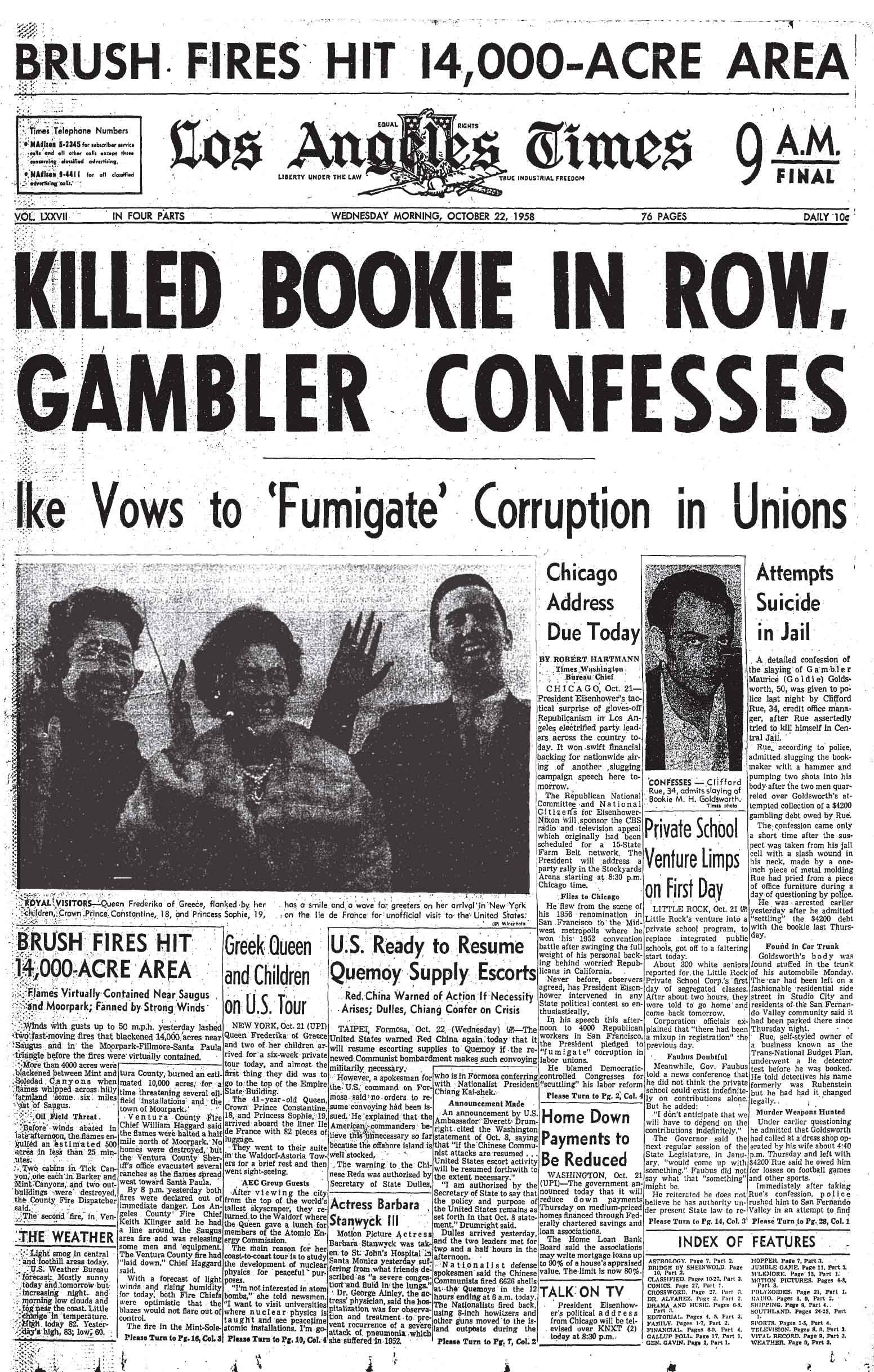
October 22, 1958: Killed Bookie in Row, Gambler Confesses

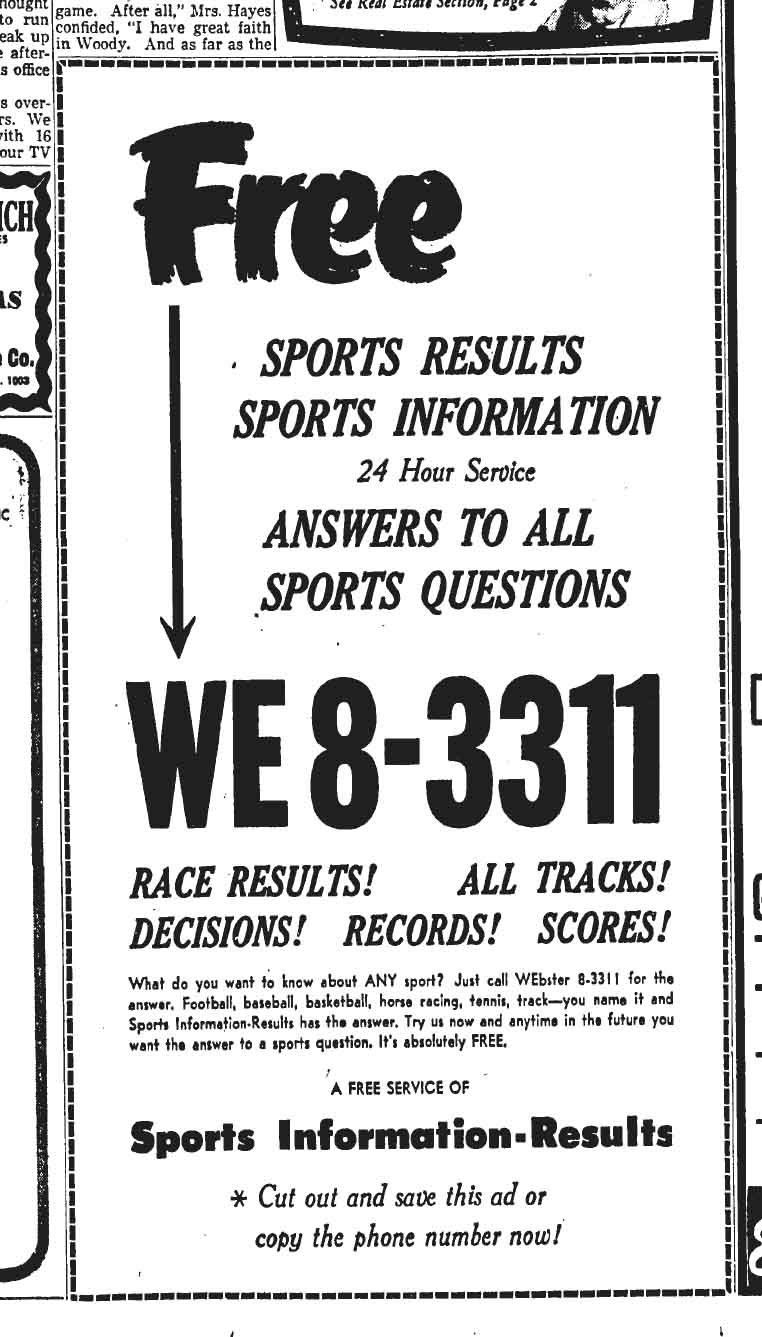
December 26, 1954: Sports InfoClifford Rue was a man who was ahead of his time and behind on the payments to his bookie.

A former Marine who changed his name from Rubenstein for business purposes, Rue had been working at his father’s liquor store when he
persuaded some friends to join him in an unusual venture.

Rue was one of those men who couldn’t get enough sports statistics. If he were alive today, he would probably be in a dozen fantasy leagues and spend all his time on a computer.

But in the 1950s, access to sports information was far more restricted. Rue badgered sportswriters and newspaper editors for updates until he wore out their patience. So in 1955 he persuaded some friends to come up with enough money to begin a free sports information service. Continue reading →

Posted in #courts, Front Pages, Homicide, LAPD, San Fernando Valley | 1 Comment

How to Live 100 Years — A. Victor Segno


Victor_segnoc1_2

Professor A. Victor Segno sends out a "success wave" (artist’s conception).

Take a cool sponge bath every morning immediately following the regular
physical and breathing exercises. A warm bath should also be taken once
or twice a week in the evening, just before retiring. Give your entire
body a sunbath frequently."

–"How to Live 100 Years," A. Victor Segno, Los Angeles, 1903


Posted in books, health | Comments Off on How to Live 100 Years — A. Victor Segno

Mr. Blackwell picks the worst-dressed women of 1967


1968_0105_blackwell

1968_0105_blackwell_ro

 
Worst-dressed women of 1967 are:
Barbra Streisand
Julie Christie
Elizabeth Taylor
Julie Andrews
Carol Channing
Raquel Welch
Ann-Margret
Jane Fonda
Vanessa Redgrave
Zsa Zsa Gabor

On the other hand, he likes:
Audrey Hepburn
Katharine Hepburn
Merle Oberon
Marlene Dietrich
Sylva Koscina (now there’s a name I haven’t seen in years).

Blackwell calls Fonda "Stretch pants on angel food cake." What does that mean?

Posted in Fashion, Front Pages | Comments Off on Mr. Blackwell picks the worst-dressed women of 1967

Jack Smith, October 21, 1958


1958_october_21_jack_smith

Posted in Columnists, Jack Smith | Comments Off on Jack Smith, October 21, 1958

Landmarks — The Oviatt Building


"The Oviatt Building"


http://mediaservices.myspace.com/services/media/embed.aspx/m=44714763,t=1,mt=video,searchID=,primarycolor=,secondarycolor=

Oviatt_19281


I was lucky enough to see the first showing on Saturday of "The Oviatt Building," Marc Chevalier and Seth Shulman’s tribute to the 1920s landmark on South Olive Street.

"Oviatt" is first and last a labor of love. As Chevalier told the
audience at the Egyptian Theatre, the movie was done on a shoestring
with gracious assistance by people who in some way were involved with
the building’s history. The score of vintage tunes (and there’s lots of
music in the picture) is by Mora’s Modern Rhythmists, with additional music by Shulman. 

As with many premieres, the obvious question is when it will be shown
again. "Oviatt" is a fine addition to the body of quirky, heartfelt Los
Angeles documentaries that includes "Shotgun Freeway" and "L.A. Plays
Itself
."In the meantime,  DVDs are available.

Posted in Uncategorized | Comments Off on Landmarks — The Oviatt Building

Mystery song

Edison_logo

OK, I found this recording while looking for something else and it’s too weird and wonderful (and weird) not to share.

Listen to the mystery recording>>>


Posted in broadcasting, Music | 5 Comments

L.A. firefighter buys job for $600, October 21, 1938


1938_october_21_fire

A 2,000-acre brush fire burns from Stone Canyon Dam to Beverly Glen and north to Mulholland Drive.

1938_october_21_cover
A political bombshell explodes in the Los Angeles City Fire Department: The sale of jobs for $600 ($8,745.89 USD 2007). Fire Chief Ralph J. Scott tells investigators that Fire Commission Secretary John R. Spring and Joe Shaw, brother of ex-Mayor Frank Shaw, conspired to sell civic positions.

"Many of these men wept as they told their stories," one fire official said. "Originally they were just citizens out of a job. They wanted a job on the Fire Department and were told point-blank that the only way they could get it was to pay for it and after investigating they were brought to that inescapable conclusion." 

1938_october_21_runover
Ex-Mayor Shaw denies misconduct.
 
1938_october_21_sports
Boxer dies in ring.
Posted in #courts, @news, City Hall, Front Pages, LAPD, Sports | Comments Off on L.A. firefighter buys job for $600, October 21, 1938

Marilyn Monroe may be pregnant; spying on Rams, October 20, 1958

1958_october_20_hopper

Above, trouble with Marilyn Monroe on the set of "Some Like It Hot," which has been in production at the Del Coronado in San Diego.


1958_october_20_sports By Keith Thursby
Times staff writer

The Rams were clobbered by the Chicago Bears, 31-10, and suggested that the Bears might not have been playing fair.

Rams assistant Bill Swiacki was quoted in The Times claiming that someone from the Bears listened in on phone calls from the press box to the Rams’ bench. He said he couldn’t reach another Rams official on one call but "I heard foreign voices on the line. And they weren’t Ram voices."

According to the story, the Bears installed the phones used by the offensive coaches. The Rams provided their own communications for the defense.

Pete Rozelle, Rams general manager and future NFL commissioner, had an interesting quote in The Times’ story: "If the wires were tapped, I feel that they were without the knowledge of [Coach] George Halas." Sounds like he was already running for the NFL job.

Halas was quoted in the same story suggesting that a Rams assistant coach was telling players to put out of the Bears "out of commission."

Just in case you weren’t sure where The Times stood on the matter, here’s a paragraph deep in the story: "It’s the feeling in certain quarters that Halas purposely brought up the … incident as a smoke screen following the excessive number of penalties levied against the Rams." 

The Rams and Bears will meet again on November at the Coliseum.

Posted in Film, Front Pages, Hollywood, Sports | Comments Off on Marilyn Monroe may be pregnant; spying on Rams, October 20, 1958

Morse code vs. text messaging

Which is faster, Morse code or text messaging? Jay Leno has the answer. (Score one for the brass pounders!)

This is what 40 words per minute sounds like.


Posted in broadcasting, Science, Television | Comments Off on Morse code vs. text messaging

Movie star kisses 1-millionth visitor to park, October 20, 1958


1958_october_20_park

Pacific Ocean Park, 1958 – 1975

1975_february_18_ocean_park


Posted in #games, Film, Front Pages, Hollywood, LAPD, Parks and Recreation | Comments Off on Movie star kisses 1-millionth visitor to park, October 20, 1958