Movie comedian Stan Laurel accused of planning to bury wife in backyard


1938_1229_laurel

Stan Laurel and wife No. 4 Illiana (or, according to a revised count, wife No. 3)

1938_0426_laurel
They drank, they fought and they got arrested. Such was the whirlwind
year of marriage for Stan Laurel and Tovera Ivanova Shuvalova, a
Russian singer who performed under the stage name Illiana (or sometimes Illeana).

When
they met, Illiana, born Sept. 24, 1912, was 25 and the film comedian
was 43 and freshly divorced. In fact, he was so recently divorced from
Virginia Ruth Laurel (wife No. 2) that on Jan. 1, 1938, she stopped by
the hotel where the newlyweds were staying to "consult with her
ex-husband," according to The Times. Understand that this wasn’t in Los
Angeles but at the Del Ming Hotel in Yuma, Ariz.

Judging by news
accounts,  it wasn’t a friendly call: "While others may have viewed the
situation with a smile, says Laurel, it did not seem funny to him when
Mrs. Laurel disturbed his honeymoon at Yuma, Ariz., with his recent
bride … with loud knocks at his hotel door and threats to have him
arrested as a bigamist."

Everything was untangled, the divorce
was upheld and in February, just to make sure, Stan and Illiana
returned to Yuma to be married a second time. 

1939_0413_laurel
What followed
was about a month of bliss, then in April there was a lawsuit by Lois
N. Laurel (wife No. 1, 1926-1933). [Note that Lois is sometimes listed
as wife No. 2, but in 1937, Mae Laurel, Stan’s longtime vaudeville
partner, entered into an
agreement in which she promised to drop all contentions that they
had a common law marriage from 1919 to 1925].

Lois wanted $1,355
($19,751.14 USD 2007) a month support for their 10-year-old daughter,
including $100 a month each for a chauffeur, governess and cook, $35 a
month to entertain friends and $10 a month to visit beauty shops. 

Despite
two ceremonies, Illiana wanted a traditional wedding, so in April 1938,
the Laurels took out a marriage license and got married again in a
Russian Orthodox ceremony.

And then the storybook marriage became more of a Grimm’s fairy tale.

lliana was sentenced to jail for hitting two parked cars in Beverly Hills while she was driving without a license.

Then
it was Stan’s turn in court for a drunk driving charge, which he blamed
on being upset over Illiana rather than being intoxicated.

Before
he was arrested, Stan said, he and Illiana had a fight in which she
tried to hit him with the handset of a telephone, threatened him with a
skillet full of potatoes and threw sand in his eyes. In the struggle,
he put his arm through a window, Stan said.

"She has a terrific temper," he told the court.

By
the end of 1938, Illiana sued for divorce, saying that Stan drank too
much, "repulsed her efforts to show him affection, behaved rudely
toward their friends and on several occasions remained away from home
for several days at a time without explanation," The Times said.

The
couple reconciled and Illiana began 1939 with a day in jail for the
reckless driving charge, soon followed by an arrest for being drunk and
disorderly in a nightclub "while loudly discussing the Russian
situation with herself."   

By March 1939, Illiana renewed her
divorce case. She charged that Stan’s account of their fighting was
invented to avoid a drunk driving conviction that would cost him his
movie contract. In fact, she said, on the night in question he planned
to bury her alive in the backyard of their San Fernando Valley home.
She said she was rescued by friends and that Stan was coming after her
when he was arrested for driving on the wrong side of the road.

Their
divorce was granted in May 1939 and they finalized an agreement in 1940
in which Illiana agreed to never publish anything about their
relationship and that he had sole rights to dramatize "their stormy
married life," The Times said.

Postscript: In 1942, Illiana was rescued after a fire broke out at the Radio Center
Hotel in New York’s Times Square. She had fled to the roof and was
about to jump when firefighters saved her, The Times said. No further
trace can be found of her.

In 1941, Stan remarried wife No. 2, Virginia Ruth, who filed for
divorce in January 1946. On May 6, 1946, he married Ida Ketiva (Kitaeva) Raphael,
widow of an internationally known concertina virtuoso named "Raphael
Raphael Raphael."


Posted in #courts, Film, Hollywood, San Fernando Valley | Comments Off on Movie comedian Stan Laurel accused of planning to bury wife in backyard

Voices — Donald E. Westlake, 1933 – 2008


Book Review

Playing Politics With a Master of Dialogue
VICTORIES By George V. Higgins Henry Holt & Co.: $19.95; 298 pp.)

December 2, 1990

1972_0507_westlake
By Donald E. Westlake

Westlake is a novelist and screenwriter. His most recent book is "Drowned Hopes" (Mysterious Press), and his latest screenplay adaptation is "The Grifters," due out next month.

Probably the worst thing that ever happened to George V. Higgins was success. When "The Friends Of Eddie Coyle" was published in 1972, it was that rarest of things under the sun, something new, and readers gobbled it up like the fresh taste it was.

Unfortunately, however, Higgins wound up praised and remembered for the wrong accomplishment. What people saw was an ex-prosecutor who had listened to and was reporting on criminal speech in an excitingly different and realistic way. This elliptical rump-sprung dialogue, overheard by the reader but not directed at him, full of half-revealed mysteries and unexpected depths of duplicity, seemed like the real thing at last, and catapulted Higgins to fame.

If that were the whole story, if Higgins were merely another guy with a stylistic stunt, like Jeffrey Farnol or Damon Runyon, there would soon have been little reason left to read him. Once you know the stunt, once you can hear the music in your head even before you open the book, why open the book? And other guys–Elmore Leonard, most noticeably–were using similarly bumpy dialogue rhythms for reasons of their own.

But that wasn’t the whole story. Higgins was never trying to be merely a hard-boiled crime novelist, one step to the right of the private-eye people; what he was trying to do was write novels. And what linked the characters of his various books was not the world of the criminal but a love of talk.

Higgins’ characters wallow in narration and description and mere jazzing around. Stuck together in a car on a long drive across New England, they tell one another stories, recounting in detail the dialogue from those previous adventures. Faced with a decision, they talk it out together, reminding one another of possibly useful parallel situations from the past, worrying the issue with a flood of words.

Since it wasn’t really crime stories Higgins was trying to write, his interest from the beginning was never in the caper itself. His interest was a novelistic one: What do his characters want? What are they willing to do to one another to get what they want? How do they manipulate, struggle, excuse? Why do they want what they want, and what happens inside them when they either do or do not get it?

As Higgins, in later novels, moved away from the world of Eddie Coyle, following his true interests into the lives of other characters in other settings, critics and readers alike were annoyed and disappointed. Where were the wonderful romantic losers? Where were the great bouquets of overheard dialogue in grimy smoky bars, the cheap betrayals glancingly alluded to, the flop sweat sheening on those sallow, doomed faces? From his sudden initial burst of success, Higgins soon ebbed into a middle range of unexcited acceptance, publishing roughly one book a year, all of them rewarding but none frantically anticipated.

It may be time to reassess Higgins, and "Victories", his 22nd book in 22 years, just may be the proper vehicle for it. Beginning with the title. Anyone with even the slightest acquaintanceship with the Higgins world will know that within it there are no total victories, that it would be impossible for Higgins to refer to victory without an ironic edge. And his whole career has been an ironic victory, has it not?

Henry Briggs, the reluctant hero of "Victories," is a retired ballplayer, a onetime relief pitcher, a star but never a superstar, now sharing a small-town New Hampshire home with a shrewish wife. He’s semi-estranged from his grown son and daughter, and through a local politico has taken a job as game warden, which he treats seriously and fairly. Now is 1967, with anti-Vietnam feeling just beginning to show its political muscle, and the local Democratic pols persuade Henry to run for Congress against the entrenched Republican officeholder. Henry doesn’t know it, but the pols fully expect him to lose. He’s merely the sacrificial lamb, put out there to protect the regulars from the growing power of anti-war radicals within the Democratic party.

There have been any number of political novels written in this politics-besotted nation, but rarely if ever one with the particular angle of view of "Victories." On a narrow canvas–the struggle over one minor House seat in New Hampshire–and using a limited palette of dialogue and reflection and simple action–no big-league chicanery, no smoking guns of any kind–Higgins lays out as clearly as anyone ever has just how this hopeful hopeless buoyant ridiculous self-governing scheme of ours operates. It probably would be a good idea for the Russians en masse to read this book, to learn before it’s too late just what sort of new game they’ve decided to learn to play.

If Higgins has a major flaw, and he does, it is in his portrayal of women. Apparently he has never been in the presence of an actual woman; how else explain the clumsy failures of this normally brilliant observer? Women are more than a mystery to him, they are blank spaces with names.

One of the most telling ironies of "Victories" is surely an unconscious one: The female character who grates the least is mute. This from a master of dialogue. And the most awful character is a New York woman, a political fund raiser, who marches on for one scene of dreadful monologue–thudding bricks of prose, no cross-pollination of chat from the other characters at all–and then marches away again, dragging a whole lot of the novel’s credibility with her.

In order to keep his hero from seeming too good to be true, Higgins assures us he’s a womanizer, but not once do we see what that means. Not once does Henry interact with a woman as though he has any interest in her at all. Far from being the womanizer Higgins claims, his Henry is clearly sexless, a nice guy who’s polite to the ladies, operates on equal terms with men, and tries to behave decently.

For a writer whose goals are high and honorable, it must be a tragedy to be so totally unable to cope with half the human race. It has to harm every serious attempt he ever makes, and suggests he’s best off after all in those smoky male-only bars.

Which is a pity; what he sees, he sees with wonderful clarity. For a nitty-gritty study of politics at ground level, you will not find a better novel anywhere than "Victories." 

Posted in books, Film, Front Pages, Hollywood, Obituaries | Comments Off on Voices — Donald E. Westlake, 1933 – 2008

January 1, 1959: Matt Weinstock

Unsung Heroines

Matt WeinstockToday the focus is on that thriving city north of South Pasadena.  The bands will play, the crowds will roar, the traffic will snarl.

But in all the gigantic gymkhana there will be no mention of those unsung heroines, the nameless little old ladies of Pasadena who have also done so much to bring fame to their city.  So let us pay tribute.

Historically they don’t rate much, but sociologically they have had a great impact on civilization.

THEIR ORIGIN is blurred, but legend has it that around 1934 an ad appeared somewhere stating, “For Sale–1924 Marmon. Like new, Used only to drive to church on Sunday by retired old lady in Pasadena.” Continue reading →

Posted in 1959, Columnists, Downtown, LAPD, Matt Weinstock | Comments Off on January 1, 1959: Matt Weinstock

January 1, 1959: Paul Coates — Confidential File

Confidential File

Looking Back at ’58; Looking Ahead to ’59

Paul Coates, in coat and tieIn this business, all years go by fast. But ’58, somehow, seemed to be out to break records.

It just doesn’t seem like a year ago this week that I sat down with Tim Moore, TV’s fabulous Kingfish, after his famous shotgun feud with his in-laws.

He told me then: “A man who’s got three score and 10 years behind him ought to retire, and that’s what I’m going to do.

“I’m going to go home to Rock Island,” the veteran showman said. “I’m going to sit down on the porch. And I’m going to loaf.

“And,” he added, “I’m going to do it slowly.”

But Kingfish never quite made it home.  He died in General Hospital just before Christmas. Continue reading →

Posted in #courts, 1958, 1959, Columnists, Paul Coates | Comments Off on January 1, 1959: Paul Coates — Confidential File

Day in the Life of a Rose Queen, 1959


1959_0101_rose_queen

Meet Pamela Prather of San Marino, the 1959 Rose Queen. She mows the lawn, bakes a cherry pie and is president of the Pamphile Sorority at PCC. She hopes to be a psychiatric social worker.
Posted in Front Pages | Comments Off on Day in the Life of a Rose Queen, 1959

Rose Parade Photos

Jan. 2, 1960, Rose Parade 

Quaker Oats’ entry wins the Grand Prize with a float showing Sinbad the Sailor. Chevrolet makes its debut in the parade and wins the President’s Trophy with a float depicting a soapbox derby.

Jan. 2, 1960, Rose Parade 

“The city of Los Angeles depicts its future growth as a city of skyscrapers with this float, which was awarded the Queen's Trophy.”
Jan. 2, 1959: Glendale’s float, “Adventures in Fantasy,” wins the Sweepstakes Prize in the Rose Parade. 

Posted in broadcasting, Television | Comments Off on Rose Parade Photos

Pasadena crowds cheer Rose Parade, 1909

1909_0102_cover
 

1909_0102_quote04_2
 

1909_0102_rose_parade01
 
1909_0102_coronado

1909_0102_rose_parade02
1909_0102_rose_parade03

1909_0102_pig

1909_0102_kill
Posted in Fashion, Front Pages, Homicide, LAPD | 1 Comment

Happy New Year, 1959!

The rest of the world may peer into a darkened crystal ball, but at the Daily Mirror, we know what the future has to bring.

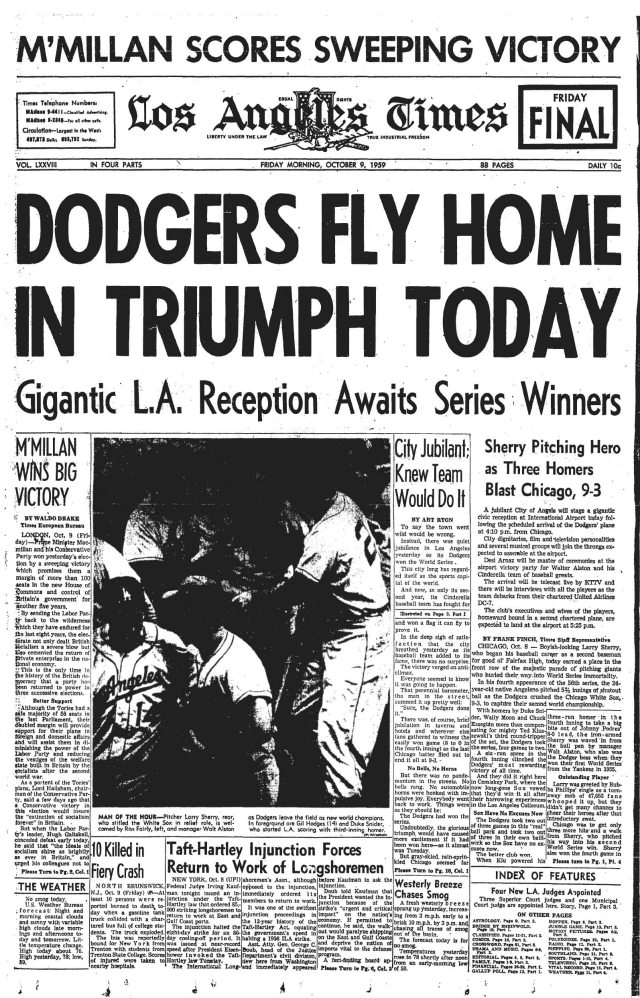
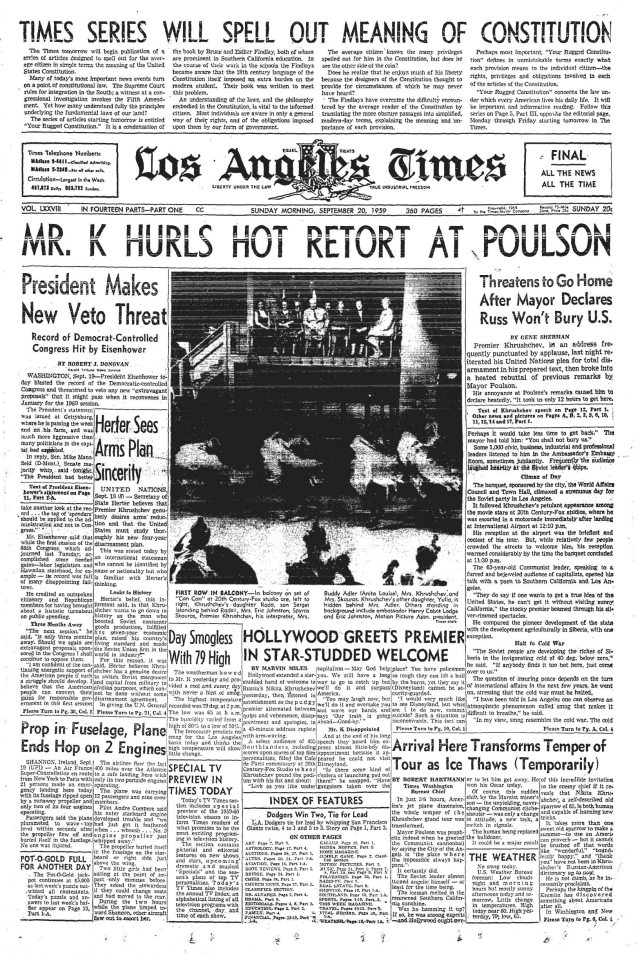
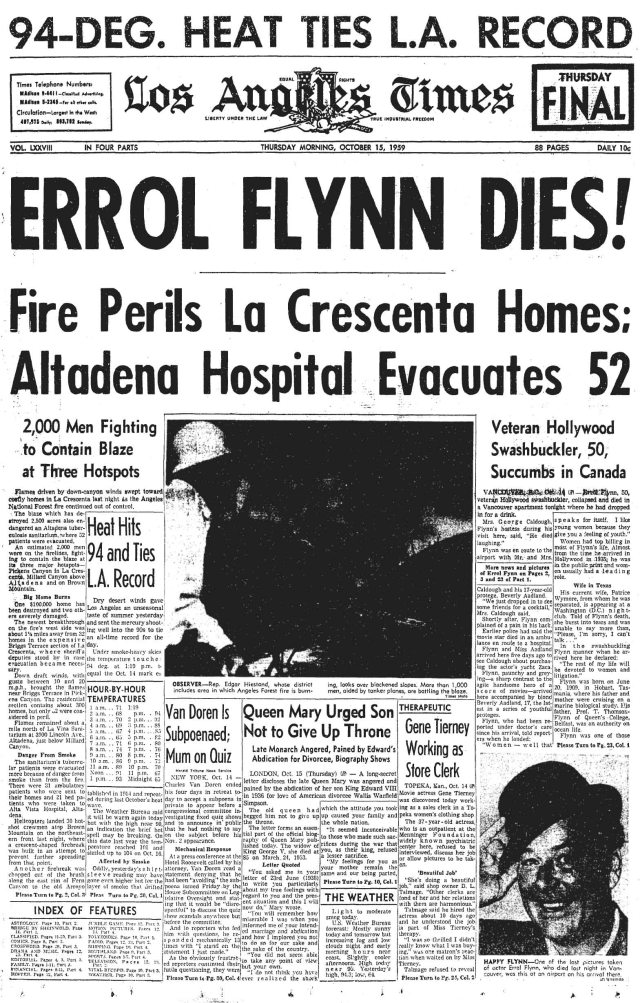
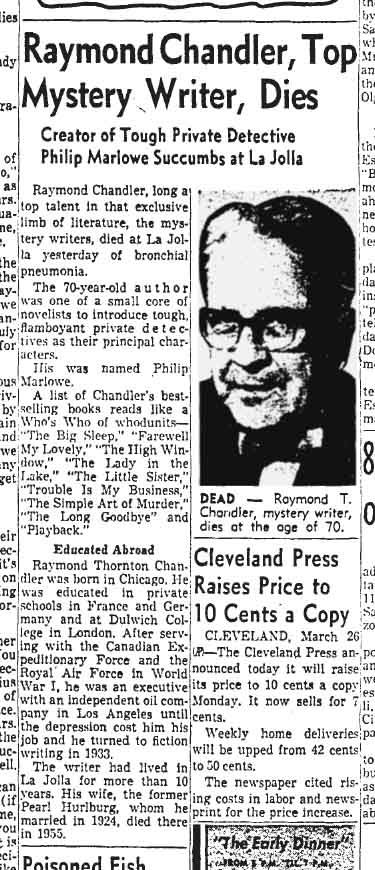
In 1959, Los Angeles won the series and we lost Errol Flynn and Raymond Chandler. Nikita Khrushchev paid us a call. Schoolchildren designed 50-star flags to welcome Hawaii and Alaska into the U.S. And a municipal judge named David Williams wonders why the LAPD mostly arrests African Americans for gambling; 5,210 blacks compared with 482 whites for 1958.

It’s going to be quite a year–stay tuned!

Flynn discusses his 1959 trip to Cuba.


Raymond Chandler’s obit
runs on Page 4 of The Times.
Baby Boomers rotted their minds with “Clutch Cargo.”
While their parents listened to Miles Davis–or Arthur Godfrey.
And Jack Kerouac turned up on Steve Allen’s TV show.
Posted in #courts, #Jazz, Blues, books, broadcasting, Coming Attractions, Current Affairs, Dodgers, Downtown, Film, Front Pages, Hollywood, LAPD, Television | 1 Comment

Voices — Christine Collins, November 12, 1930

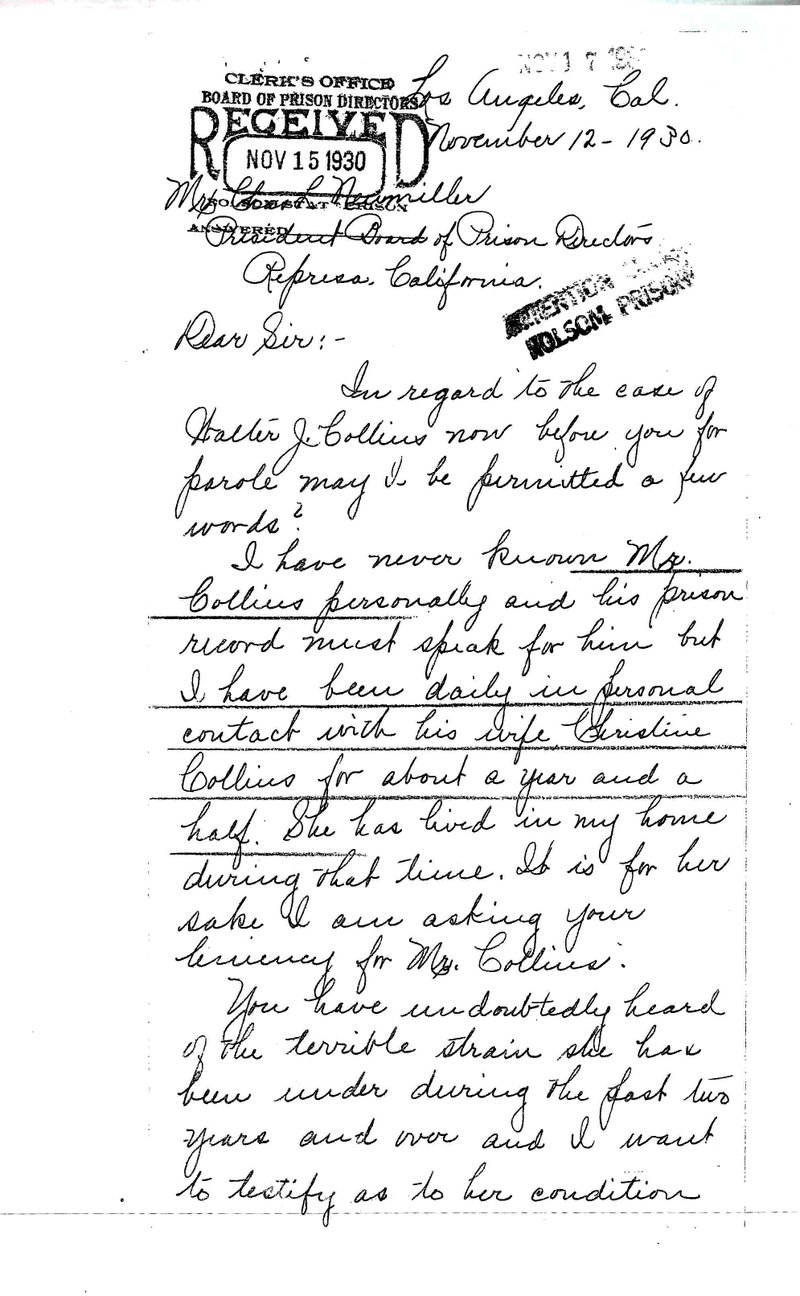
November 12, 1930: Borton Letter, Page 1From the California State Archives.


The Christine Collins letters

The woman whose tragedy inspired the Clint Eastwood movie “Changeling” tells her story in her own words.

Los Angeles, Cal.
November 12, 1930
Mr. Chas. L. Neumiller
President Board of Prison Directors
Reprisa, California

Dear Sir:

In regard to the case of Walter J. Collins now before you for parole may I be permitted a few words?

I have never known Mr. Collins personally and his prison record must speak for him, but I have been daily in personal contact with his wife, Christine Collins, for about a year and a half. She has lived in my home during that time. It is for her sake I am asking your leniency for Mr. Collins. Continue reading →

Posted in #courts, Changeling, Film, Hollywood, Homicide, LAPD | Comments Off on Voices — Christine Collins, November 12, 1930

Robbery suspect kills LAPD officer, 1958


Nash_headstone_lo_rez

Photograph by Larry Harnisch / Los Angeles Times

The grave of Sgt. Gene T. Nash, Rose Hills Memorial Park.

Note: This updates a post from November.

Budlong_apts_lo_rez
Photograph by Larry Harnisch / Los Angeles Times
On the night of Oct. 20, 1958, four police
officers went to 2723 S. Budlong Ave. in search
of suspects in a series of 60 holdups 

Police Sgt. Gene T. Nash died in 1958 after a shootout with robbery
suspects at an apartment house on Budlong just south of Adams. The
killer was convicted and sentenced to prison, and in a televised
ceremony, Police Chief William H. Parker presented his widow, Cynthia,
with her husband’s Medal of Valor.

But that’s only the beginning
of a complex story that was mostly ignored by the newspapers — even
though it went to the U.S. Supreme Court — and exists in conflicting
accounts on dim microfilm in the basement of the Hall of Records and in
material at the California State Archives.


Gene_nash_02LAPD photograph
Police Sgt. Gene T. Nash

About 8:30 p.m. on
Oct. 20, 1958, Nash, 32, and Sgt. Walter F. Bitterolf of the Robbery
Division, accompanied by Sgt. Sheril O. “Sam” Eastenson and Officer
Charles E. Leonard, went to the two-story apartment house at 2723 S.
Budlong Ave., slightly northwest of USC.

The officers had a
warrant for suspected robber Bennie Will Meyes, 33, a parole violator
and longtime criminal with an eighth-grade education who had a job
cleaning out garbage trucks, and they were looking for William Douglas,
Meyes’ alleged partner in about 60 holdups. Meyes and Douglas had “a
penchant for striking at card and dice games, but they do not ignore
business establishments, markets, theaters and even street jobs,”
according to a probation report. Several victims had been shot or
pistol-whipped, according to prison records.

Eastenson and
Leonard waited outside in case the men tried to escape while Nash and
Bitterolf went in with their guns drawn. Bitterolf knocked at Apartment
No. 2 and a man named Virgil Lee, 24, answered the door. Both
investigators showed their badges. Bitterolf said they were police
officers and asked for “Bill.”

Lee said there was no one there
named “Bill,” so Bitterolf pushed his way into the apartment,
explaining that they wanted to look around.

The officers found
another man and two women watching TV in the living room. One woman
said: “There is absolutely no one in this apartment except my baby,
lying on Pappy’s bed there in the front bedroom.”

Bitterolf
turned off the TV to question the four people and after about five
minutes, Nash left to explore the rest of the apartment. There was a
hallway with doors that led to the back bedroom used by Douglas, the
front bedroom where the young boy was sleeping, and the central
bathroom that connected both bedrooms.

According to Meyes’
account, when the police arrived, he and Douglas had been talking in
the bathroom. Meyes had violated his parole by leaving Indio, Calif.,
without permission and Douglas gave him a gun to pawn so he could
afford a lawyer to straighten things out. Meyes had taken the loaded
.38 revolver from under Douglas’ mattress and stuck it in his waistband
beneath his shirt. 

“While we were talking, the apartment
suddenly went quiet,” Meyes said in court documents. “There was no
sound coming from the living room or the television set. Then in that
areaway of the hall we could not see, footsteps, along with this
strange silence, started back where we were…. Douglas and I bolted
through a darkened bedroom. Douglas got on the floor on his stomach
alongside the bed with his head facing the window and I stood alongside
a chest near the door.”

Nash, his gun drawn, tried the door to
the front bedroom, but it was locked. He went through the bathroom and
into the front bedroom.

Bitterolf heard eight to 10 shots and
ran down the hallway. He found his partner lying on the bedroom floor,
still holding his gun. Nash had taken several bullets in the abdomen,
including one that went through his spleen and virtually cut one of his
kidneys in two.

“How is it, Gene?” Bitterolf asked.

“Real bad,” Nash answered. “There were two of them. The one that shot me went out the window, the other one is in the closet.”

Having
heard the gunshots as he waited outside, Eastenson ran into the
apartment and kicked down the bedroom door. Bitterolf told him to go
back outside and radio for an ambulance.

Gene_nash_shotBitterolf found
Douglas in the closet, so badly wounded that Bitterolf thought he was
dead. According to court documents, the sleeping boy wasn’t injured,
although Bitterolf thought he had been killed because of the blood on
the bed.

Bitterolf went back to the living room, searched the
men for weapons and made them sit on the floor, then returned to
encourage Nash.

“Take it easy, the ambulance is on the way, you will be all right,” Bitterolf said.

“Don’t kid me,” Nash replied. “I know I am done for. I know I am going to die.”

As
a Herald-Express photographer took pictures, doctors at Central
Receiving Hospital worked to save Nash. His wife, Cynthia, rushed to
the hospital, but arrived minutes after he died, The Times said.

Back
on Budlong, Eastenson saw the blood that Meyes left when he jumped out
the window. The officer followed the trail over a fence and across
adjoining property, finally finding Meyes on the floor of a car, shot
in the thigh and right hand.

On the ambulance ride to the hospital, Meyes was questioned by Sgt. Leonard Rafferty.

And at this crucial point of the story, it becomes impossible to reconcile the conflicting court documents.

In
one version, Meyes implicated Douglas, apparently assuming that Nash
had killed him. In another account, Meyes said he didn’t know Nash was
a police officer and that Nash fired first.

One account says
Douglas was badly wounded and lost a large amount of blood. He was
purportedly given powerful painkillers and Rafferty allegedly kept
tapping him on the forehead so he wouldn’t fall asleep as he gave his
statement to a police stenographer.

Another account implies
Douglas was fully conscious and says he and Meyes, both in wheelchairs,
were brought together and that Douglas implicated Meyes.

“You
are going to fry, Bennie,” Douglas supposedly said, “and you are not
going to take me with you. Tell them the truth; tell them you pulled
the trigger.”

The case was presented to the Los Angeles County Grand Jury and Meyes and Douglas were indicted on charges of murder.
1958_1128_nash

Hundreds
of officers attended Nash’s funeral and he was buried at Rose Hills
Memorial Park. In addition to his wife, Nash was survived by a
2-year-old daughter. On Nov. 27, 1958, his widow was presented with his
Medal of Valor.

Then the news reports stopped. The Times never wrote a word about any of the trials in the killing.

And
now the story becomes even more complex. According to court documents,
the first prosecution of Meyes and Douglas ended in a mistrial in March
1959.

On June 23, 1959, Meyes was convicted of second-degree
murder and found to be a habitual criminal, receiving a life sentence.
(In one of the typical conflicting accounts in the case, the Superior
Court file says Douglas was found not guilty and the U.S. Supreme
Court’s 1963 ruling says he was convicted and sentenced to five years
to life).

According to the federal high court’s ruling, Meyes
and Douglas were given a public defender. But at the opening of the
Superior Court trial, the lawyer asked for a continuance, saying that
he hadn’t time to prepare the case. It was complicated, he had too many
other cases, and Meyes and Douglas wanted separate attorneys, he said.

Meyes
and Douglas fired their attorney because he was unprepared, asked for a
continuance and filed a request for separate defense lawyers.

Those motions were denied and the men were convicted.

They
first appealed to the California courts, and because they had no money,
asked for a court-appointed lawyer. The state Court of Appeal upheld
their convictions without appointing an attorney for them, saying that
“no good whatever could be served by appointment of counsel.”

The California Supreme Court denied their petitions for a review without giving them a hearing.

On
March 18, 1963, the U.S. Supreme Court ordered a state appellate court
hearing for the men, who were represented by future “palimony” lawyer
Marvin M. Mitchelson and Burton Marks. Two other lawyers on the men’s
legal team, Fred Okrand and A.L. Wirin, often worked with the ACLU,
although it’s not clear if this was an ACLU case.

Justice
William O. Douglas wrote for the majority: “Where the merits of the one
and only appeal an indigent has as of right are decided without benefit
of counsel in a state criminal case, there has been a discrimination
between the rich and the poor which violates the 14th Amendment.”

On June 20, 1964, The Times reported that Meyes and Douglas had been granted new trials.

The
Times never followed up on whether the men were retried, although
prison records show that Douglas and Meyes were discharged in August
1964.

For reasons that are unclear, Meyes returned to prison
in 1965 and in 1967 was trying to get his conviction overturned by
charging that he and Douglas were given “truth serum” before making
their statements to police.

Meyes was permanently discharged
on July 1, 1978, by the California Department of Corrections, which has
no further record of him. If he is alive today he would be 83.

Bennie_meyes_02
One
of the lingering mysteries of the case is why none of the major Los
Angeles papers covered the trials. The shooting and Medal of Valor
ceremony were widely reported and The Times and other papers published
photos of Nash, but curiously, none of them used pictures of Meyes or
Douglas.

In fact, only the California Eagle, a weekly serving
the African American community, published Meyes’ photo, showing that he
was black (as was Douglas, according to prison records). And in the
days of segregated news, the major Los Angeles papers simply didn’t
cover such stories — even if they involved the death of a police
officer.

Postscript: Eastenson died in 1994, Bitterolf in 2001 and Leonard in 2005.


Continue reading →

Posted in #courts, Homicide, LAPD | 1 Comment

Found on EBay — Bullock’s Wilshire

Ebay_collegienne
Ebay_collegienne_label_01

Here’s an interesting number (check out the zebra stripes!) from the Collegienne department of Bullock’s Wilshire. Listed on EBay starting at $275.


Posted in Fashion | Comments Off on Found on EBay — Bullock’s Wilshire

Voices — Christine Collins, November 10, 1930

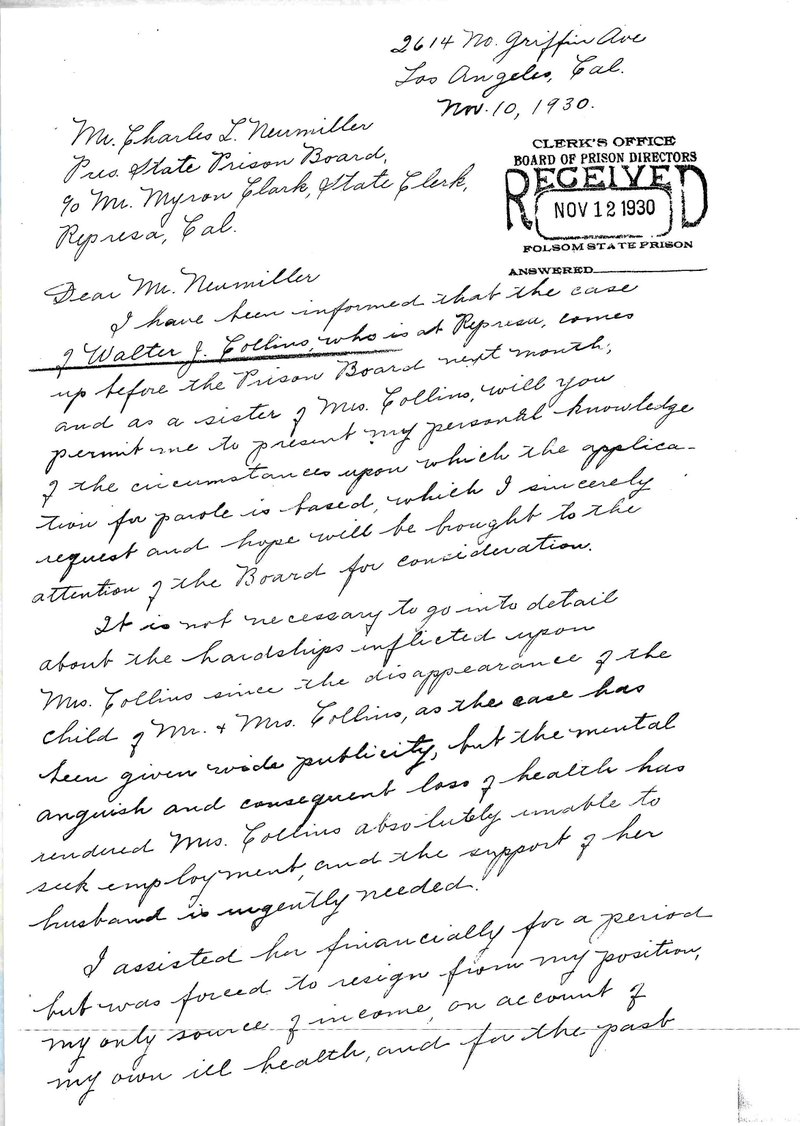
November 10, 1930: Christine Collins's sister writes to the prison board regarding Walter Collins, Page 1From the California State Archives


The Christine Collins letters

The woman whose tragedy inspired the Clint Eastwood movie “Changeling” tells her story in her own words.

2614 N. Griffin Ave.
Los Angeles, Cal.
November 10, 1930

Mr. Charles L. Neumiller
Pres. State Prison Board
% Mr. Myron Clark, State Clerk
Reprisa, Cal.

Dear Mr. Neumiller,

I have been informed that the case of Walter J. Collins, who is at Reprisa, comes up before the Prison Board next month and as a sister of Mrs. Collins will you permit me to present my personal knowledge of the circumstances upon which the application for parole is based, which I sincerely request and hope will be brought to the attention of the board for consideration. Continue reading →

Posted in #courts, Changeling, Film, Hollywood, Homicide, LAPD | Comments Off on Voices — Christine Collins, November 10, 1930

December 29, 1938: Bookie shot to death in Hollywood

December 29, 1938: People stand around the car where suspected bookmaker Weldon Irvin was found shot to death
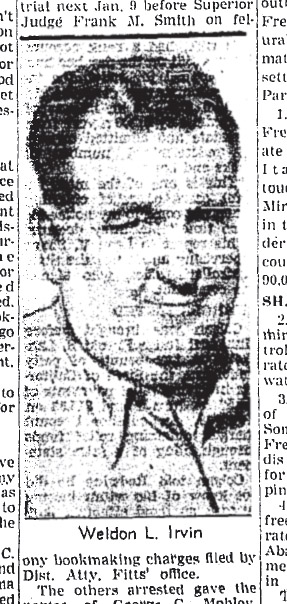
December 29, 1938: Slain bookmaker Weldon IrvinBy the end of 1938, Weldon sensed that he was a marked man and that death was not far off. He could have stayed out of Los Angeles and maybe he would have lived–at least for a while. But he evidently decided to face whoever it was that killed him in what The Times called the “perfect murder case” — a case that was never solved.

Earlier that year, Weldon divided his extensive Los Angeles gambling operations with his four partners and used his share of the money to invest in Inland Empire real estate and buy the Morongo Valley Lodge near Palm Springs.

The IRS soon brought a tax lien on his earnings for 1936 and by that summer, he resumed bookmaking operations. On Aug. 10, 1938, he and three other men were arrested at 7404 Santa Monica Blvd. Under
extensive questioning by the district attorney’s office, Weldon freely discussed illicit gambling in Southern California, The Times said. Continue reading →

Posted in #courts, @news, City Hall, Film, Hollywood, Homicide, LAPD | 2 Comments

Voices — Freddie Hubbard, 1938 – 2008

1968_0811_hubbard Freddie Hubbard tells Leonard Feather: "I’ve worked very hard to get as far as I have. I think the turning point came when I toured in Art Blakey’s Jazz Messengers in the early ’60s. Art spotlighted all his soloists, gave us a chance to talk on the mike, and let us compose for the band. I learned there and then that I wanted to be a leader."
1971_0801_hubbard_01 1971_0801_hubbard_02
Posted in #Jazz, Music, Obituaries | 7 Comments

Found on EBay — Culver City Speedway

1925_1130_sports Ebay_speedway_program

A program has been listed on EBay for the 1925 auto races, when driver Frank Elliott set a world record of 127.87 mph.

Posted in Front Pages, Transportation | Comments Off on Found on EBay — Culver City Speedway

Voices — Christine Collins, November 10, 1930


The Christine Collins letters

The woman whose tragedy inspired the Clint Eastwood movie “Changeling” tells her story in her own words.

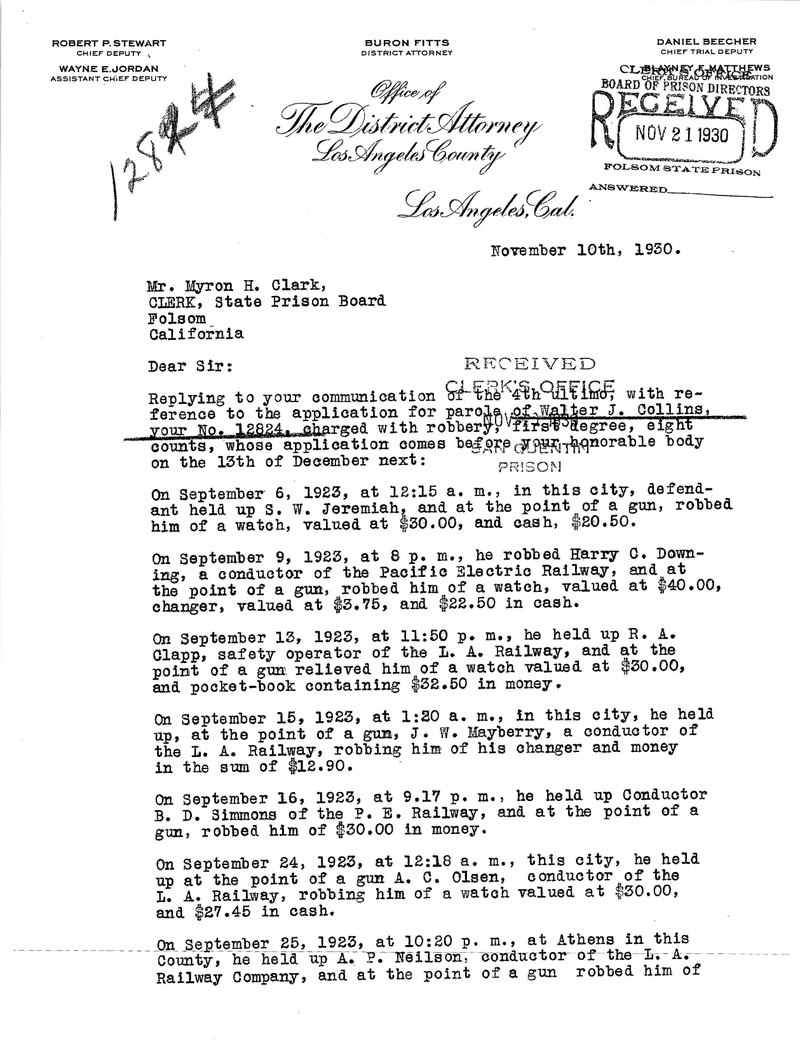
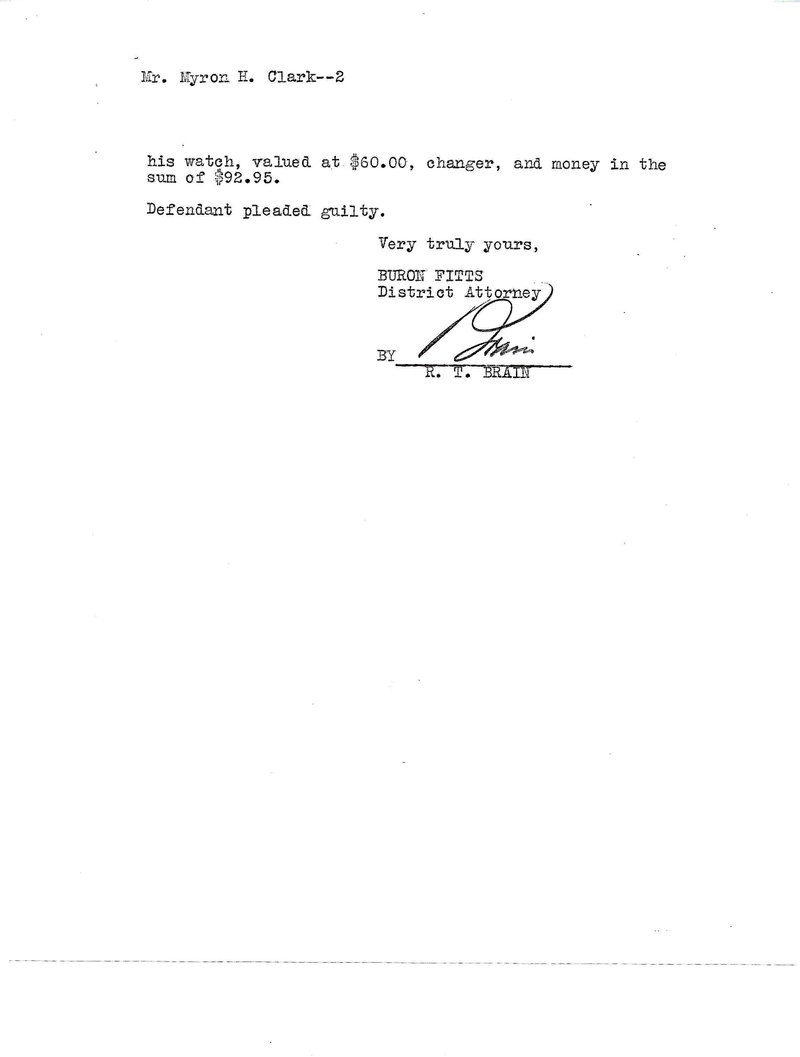
November 10, 1930: Walter Collins letter listing offenses, Page 1 November 10, 1930: Walter Collins letter listing offenses, Page 2
Posted in #courts, Changeling, Film, Hollywood, LAPD | Comments Off on Voices — Christine Collins, November 10, 1930

Fierce fighting in Cuba, near riot as Colts win over Giants, December 29, 1958

1958_1229_cover

Creswell, Ore., farmer Harry Holt helps bring 107 Eurasian children from South Korean for adoption in the United States.


1958_1229_sports

Part 2
Part 3
Part 4
Part 5
Part 6 (missing)
Part 7
Part 8

The Colts defeated the New York Giants to win the NFL championship in what some people called the greatest game of all time. But the top story in The Times’ sports section that morning was about crowds at Los Angeles sports events.

I’m sure it was a big deal at the time, how successful 1958 had been for all sports in L.A. Successful as in how many people showed up.

Sports editor Paul Zimmerman broke down the top sports and crowds. Horse racing was the top-drawing sport, with 4,608,919 people attending events over 263 days.

Baseball was second in town, thanks to the new kids from Brooklyn. According to Zimmerman, the Dodgers drew 1,845,556 to the Coliseum. About 816,000 more fans attended games for free or with discount tickets.

The numbers also show how sports in L.A. have changed. Football ranked third, thanks in large part to the Rams, followed by motor racing and boxing.

As for the NFL game, The Times covered it all including what read like a riot in Baltimore: "An unruly mob of victory-frenzied fans made a shambles of a welcome home celebration for the Baltimore Colts tonight and caused a near panic on a jammed runway of Friendship International Airport."

–Keith Thursby

Posted in @news, Dodgers, Downtown, Front Pages, Politics, Sports | Comments Off on Fierce fighting in Cuba, near riot as Colts win over Giants, December 29, 1958

Found on EBay — Williams and Walker

Williams_walker_ebay_02

Sheet music of "I May Be Crazy but I Ain’t No Fool," by Alex Rogers, sung by Bert Williams. Listed on EBay starting at $25.
Posted in Music, Stage | Comments Off on Found on EBay — Williams and Walker

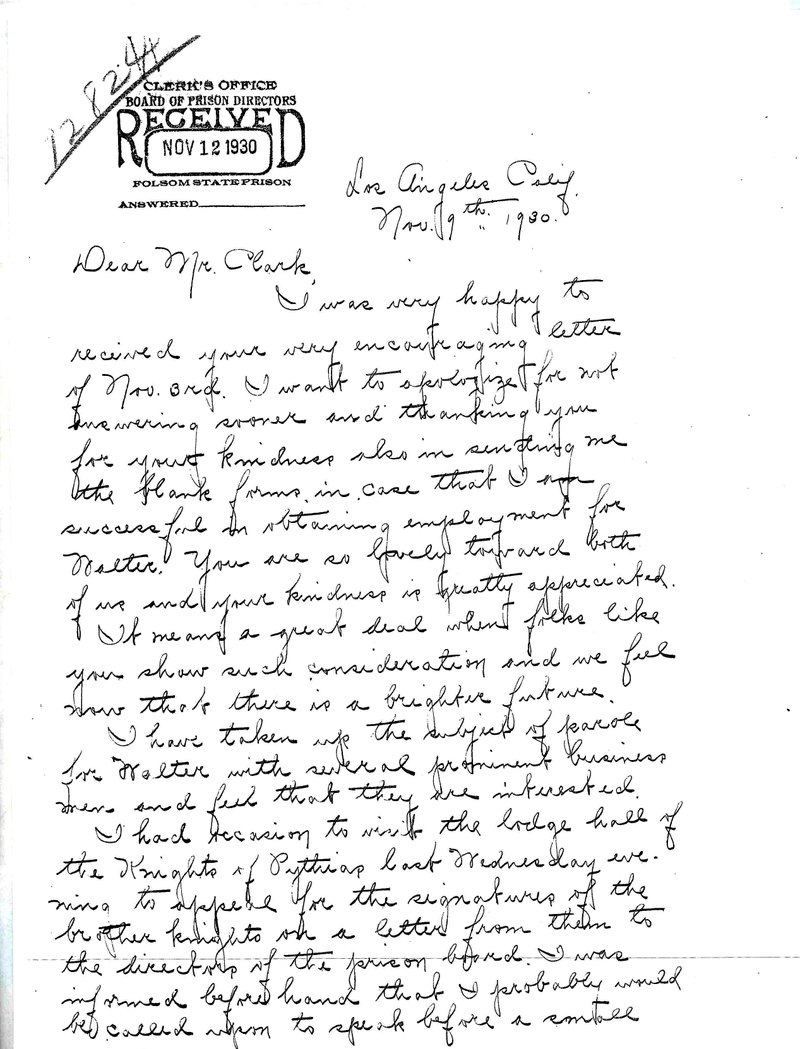
Voices — Christine Collins, November 9, 1930

November 9, 1930: Christine Collins letter, Page 1From the California State Archives.


The Christine Collins letters

The woman whose tragedy inspired the Clint Eastwood movie “Changeling” tells her story in her own words.

Los Angeles Calif.
November 9, 1930

Dear Mr. Clark,

I was very happy to received your very encouraging letter of Nov. 3rd.
I want to apologize for not answering sooner and thanking you for your
kindness also in sending me the blank forms in case that I am
successful in obtaining employment for Walter. You are so lovely toward
both of us and your kindness is greatly appreciated. Continue reading →

Posted in #courts, Changeling, Film, Hollywood, LAPD | Comments Off on Voices — Christine Collins, November 9, 1930

December 28, 1958: Movie stars to watch in the new year, tribute to Archie Moore

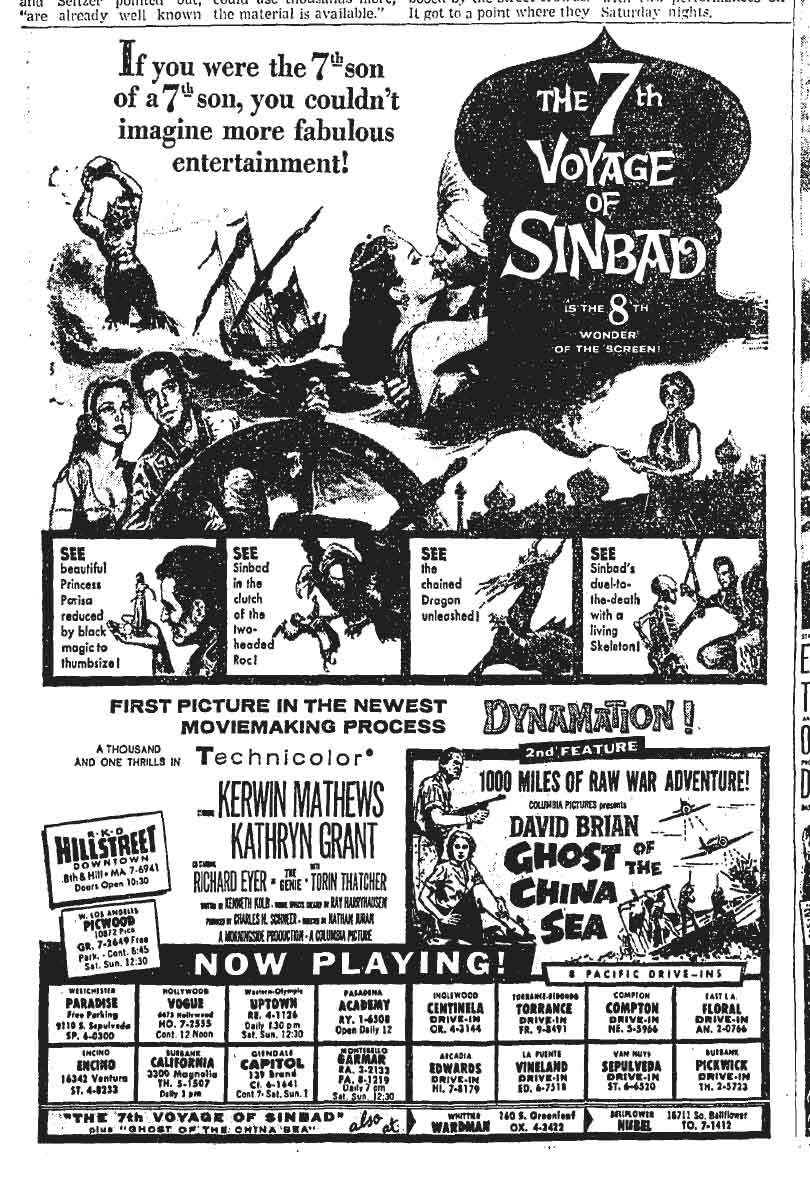
December 28, 1958: Seventh Voyage of Sinbad ad

Hedda Hopper’s predictions for the next crop of movie stars somehow bypasses the cast of “7th Voyage of Sinbad.” (Listen to the orchestration in Bernard Herrmann’s score for the sword fight with the skeleton: tuba, xylophone and something rattley, like castanets).  Sounds a bit like “On Dangerous Ground,” doesn’t it?

Continue reading →

Posted in Film, Front Pages, Hollywood, Music | Comments Off on December 28, 1958: Movie stars to watch in the new year, tribute to Archie Moore