December 21, 1930: Voices — Christine Collins

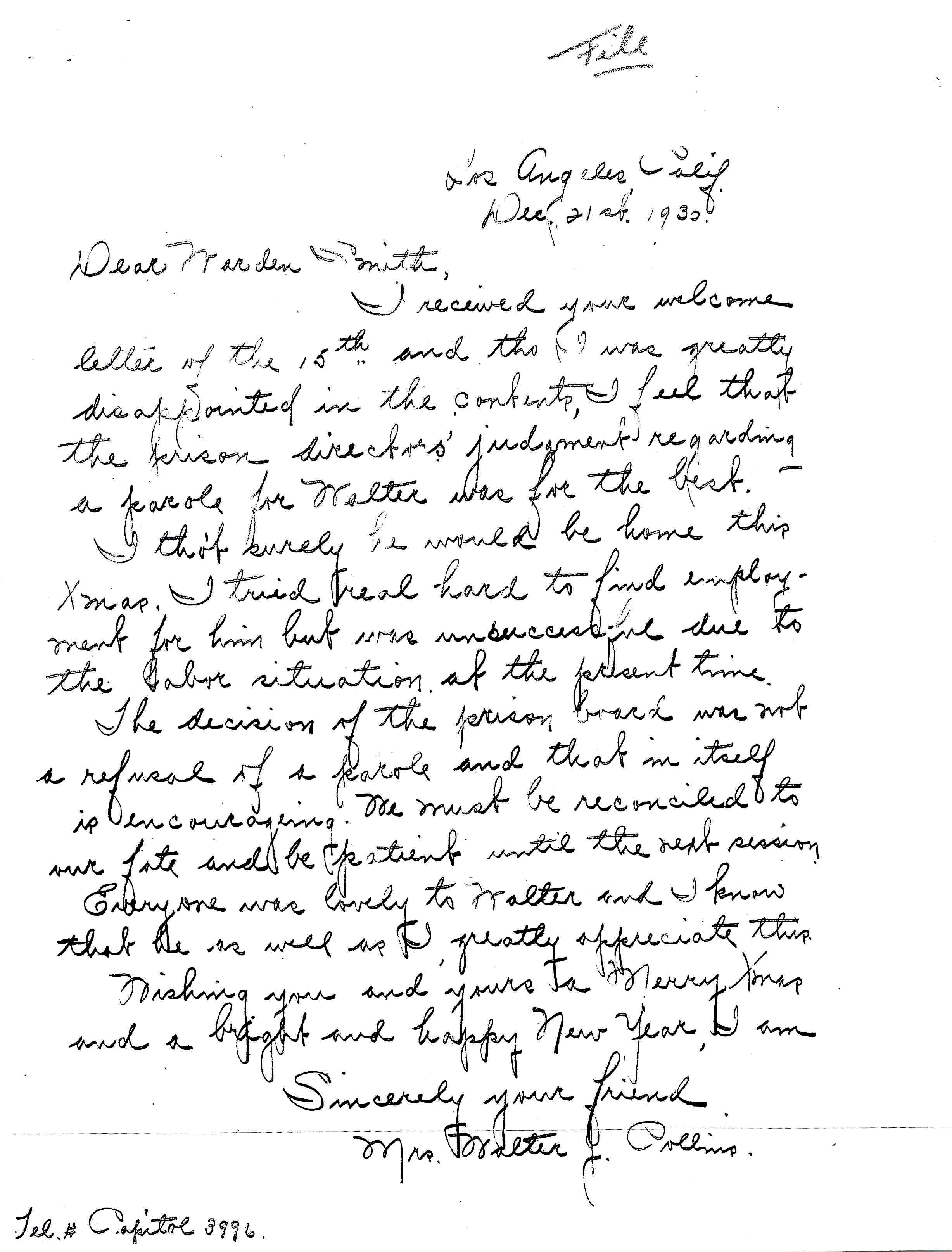
December 21, 1930: Christine Collins writes to the warden regarding the denial of parole for Walter Collins

Posted in #courts, Changeling, Film, Hollywood, LAPD | Comments Off on December 21, 1930: Voices — Christine Collins

Errol Flynn wounded in Cuba; Gehrig’s widow praises Ted Williams, January 6, 1959


1959_0106_cover

California gets its second Democratic governor since 1900, Pat Brown. Errol Flynn
is wounded in Cuba. He says he was hit by a bullet or a piece of masonry that ricocheted but Cuban officials are a bit skeptical.

[Look what’s on the sports page: A Glen Binford byline! Binford predates me at The Times, but as a line editor in the 1970s, back in the days of Bob "The Basher" Harlow, he figured prominently in something known within the paper as the Metro Desk Diaries. –lrh].


1959_0106_sports
Ted Williams received high praise from the widow of baseball’s tragic star, Lou Gehrig.

Eleanor Gehrig talked with The Times’ Jeane Hoffman while in Los
Angeles as part of her work with the Muscular Dystrophy Assn. She
recalled asking Williams for permission to use his name in their
campaign.

"He wired back both his permission and a large financial donation.
People can say what they want about his personality, I have found him a
great gentleman and I consider him one of baseball’s two or three
all-time greats," she said. "He is poetry in motion."

It had been only 20 years since Gehrig’s illness forced him to retire in 1939. He died in 1941.

–Keith Thursby

Posted in Film, Front Pages, Hollywood, Politics, Sports | 1 Comment

Matt Weinstock — January 5, 1959


Men of Good Will

Matt_weinstockd
As the chill of dusk settled over 2nd and Spring streets Newsboy Bill Franklin noticed his helper, Juan Jiminez, 10, was shivering. Juan sells papers for him after school.

"You’ll freeze in that T-shirt," Bill said. "Why didn’t you bring a sweater or jacket?"

Juan said he didn’t have one.

As
if a good fairy had been listening, one of Bill’s customers, a real
estate appraiser in the Wilcox Building named Sparks, a few minutes
later handed him a $5 bill as a belated Christmas gift.  "Sorry I
didn’t get it to you sooner," he apologized.

BILL WENT to
the Bargain Store at 210 S. Hill St., a little place, and asked for a
jacket that would fit a 10-year-old boy — cheap. The owner, who
handles mostly used adult stuff, managed to find one. When Bill
explained the circumstances he refused to take any money.

1959_0105_wife
As Bill passed the Civic Cleaning shop at 318 W. 2nd
St., Milt, the owner said, "Let me have it; and I’ll make it look like
new." He cleaned and blocked it and put it on a hanger. No charge.

Things get a little sordid sometimes around 2nd and Spring but Bill and Juan think people are pretty wonderful.

* *

A COPY OF Think,
the IBM magazine, has come my way and I’ve been reading it with
interest. So far I have detected no noticeable result. To put it
another way, it is too soon to decide whether it’s true that you can
lead a man to a magazine but you cannot make him think. But watch out!
I’ve got a year’s subscription.

* *

HANDYMAN
Nothing can fill the bill
For a typical Jill
When her car’s out of whack
Like a typical jack

— Joseph P. Krengel

1959_0105_flag_3

"One
of my big resolves for the new year," a man named Everett writes, "is
to make better use of my time and get some reading done. This means
throwing off the hypnotic spell of the cyclops in the living room, no
easy task. Nevertheless, I can report progress. The first night I was
able by sheer grim will power to deny myself the late late show, which,
by pure chance, I’d already seen.

"My hopes are high."

Strictly from Pixieville, that Everett.

* *

IT ISN’T
generally known that Joe Hernandez, who has called every race at Santa
Anita — more than 8,700 — since the track opened in 1934, also owns
some horses.

They race in his name and their silks are scarlet
and silver, his old junior high school’s colors. One is named Lock Out,
another Lahore, which Joe pronounces La-hor-ray.

Joe never falters at a pronunciation. However, there’s a horse named Damat on the grounds and the betting is that when it runs Joe will accent the second syllable.

* *

A BEVERLY GLEN
resident asks a typographical posy in behalf of himself and his
evacuated neighbors for the unknown firemen who saved their homes. "It
was like a dream to come back the next morning and find it still
there," he said. He was particularly touched to discover that a fireman
had helped himself to a can of beer, nothing else, from his
refrigerator — and left a quarter.

Posted in Columnists, Downtown, Matt Weinstock | 2 Comments

Paul Coates — Confidential File, January 5, 1959

CONFIDENTIAL FILE

Cheer Up; Desmond Is Home, Vaguely

Desmond Slattery has returned.

Paul_coatesHe’s back. Here in Hollywood.

And I’ll bet you didn’t even know he was gone.

Well, he was. Obviously. And the reason I happened to know he’s back is because he hustled straight for my office.

Right off, he told me, "I’ve got another exclusive for you, Coates."

It has been Desmond’s custom for the past half-dozen years to bring me one story a year. He’s trustworthy. He never leaks them out to Hedda Hopper or Louella.

And he’s consistent, too. In the past, his stories have always pertained to the activities of the same Desmond Slattery.

One year, it was his scheme to promote a safe and sane Fourth of July celebration by importing 10,000 fireflies from Texas to replace firecrackers.

1959_0105_radio_free_europeAnother year, it was about his organizing a "Cricket on Every Hearth" campaign after he had cornered the cricket market.

Always, Desmond made pretty exciting copy.

Except last year, when he tipped me off about his impending safari to Central America on what he described as "monkey business."

He promised me that he was going to round up dozens of midget Central American Monkeys, bring them to my office on his return and — in front of my very eyes — stuff them all into a big barrel.

"We’ll prove," he promised, "once and for all, just how much fun are a barrelful of monkeys."

Desmond did make the trip, but he came back without even one monkey.

Thus, my cautious greeting to the man when he showed up in my office again a few days ago.

"Slattery," I said coldly, "if this year’s story concerns you, leave."

Slattery shook his head slowly.

"This story," he answers, "concerns anteaters.

"And," he added, "ants."

Opening his briefcase, he extracted a pair of warn copies of True and Life magazines and spread them out before me. He showed me articles in each that warned of the fire-ant menace in the South.

"These little insects have already done 20 billion dollars in damage to agriculture," he said. "They’re natives of South America but somehow found their way to Alabama. Now they’ve spread through the South and are taking dead aim on the wheat fields of Kansas.

1959_0105_smog "Last year Congress allocated $2.5 million to invent an insecticide that’ll wipe those devils out," Slattery went on. "But there’s a patriotic private enterprise organization which plans to do the same thing — destroy the ants — at a fraction of the cost."

"What organization, Slattery?"

"This organization," he explained, "will go to South America next April and stage ‘The First Annual Pan-American Anteater Round-Up.’ It will return with anteaters who specialize in eating fire ants, and then rent the animals out to distressed farmers."

Slattery Reveals Identity

"This organization, Slattery?" I questioned, "Are you a member?"

"The man who heads this humanitarian group could well go down as one of modern America’s great heroes," he replied.

"Desmond," I pressed, "is that man you?"

Slattery leaned across my typewriter. "I’ll level with you, Coates," he whispered. "The whole dedicated, loyal outfit is me.

"But please — it’s the least I can do for this," he added softly. "So keep my name out of it."

And believe me, if I could figure out how to, I would.

Posted in @news, broadcasting, Columnists, Environment, Paul Coates | 1 Comment

Voices — Christine Collins, November 1, 1930

1930_1101_christine_collins01_01
Los Angeles, Calif.
November 1, 1930

Dear Mr. Neumiller

1930_1101_christine_collins02_01 I am taking the liberty of writing you a personal letter which I sincerely hope you will give consideration.

I am again pleading for a parole for my husband, Walter J. Collins, imprisoned at Reprisa, Calif. I understand that he is eligible for parole very soon and I hope you and the other members of the prison board will grant him a release.

Mr. Collins is a good man as you know by his good record and behavior while imprisoned. I am not at all well and as yet not able to take a position. If Mr. Collins were paroled he would certainly take care of me.

We are trying to get a position for him so as he may have employment in the event you see fit to grant him a parole.

I wanted to see you personally while staying in San Francisco after my visit to San Quentin where I went to question Gordon Northcott regarding my little son. I was a guest at Warden Holohan’s home for three days. He is a lovely man and both he and his lovely daughter, Josephine, treated me wonderfully. I never shall forget their hospitality.

While there, the warden informed me that you were ill with a heavy cold and I was very sorry to hear it. I felt that I didn’t want to intrude at this time so consequently returned to Los Angeles without seeing you. I trust that you’re over that cold and well on the road to recovery.

I attended an entertainment given by the Knights of Pythias last Wednesday evening in honor of their annual role call. I met some very nice people, who, of course, were brother knights and when I informed them that my father had been a K.P. for 35 years they became interested. I learned thru the committee chairman that Warden Holohan also was a member of the Knights of Pythias. My father went thru every branch of his (my father) lodge and was a grand chancellor in his last days.

If Mr. Collins is permitted I want him to join that order and make something out of himself.

I felt that I wanted to write to you Mr. Neumiller so please do not regard this an imposition.

Hoping this finds you well and in the best of health, I am,

Very sincerely,

Mrs. Walter J. Collins
2614 N. Griffin Ave.,
Los Angeles, Calif.

Posted in #courts, Changeling, Film, Hollywood, LAPD | Comments Off on Voices — Christine Collins, November 1, 1930

Parolee sought in killing of studio executive, January 1959

1959_0101_savoy_2

1959_0121_lichtenwalter George Albert Scott and Curtis C. Lichtenwalter were leaving the In Between Cafe, 5414 Melrose, with $400 and a sawed-off shotgun about midnight Dec. 30, 1958, when they encountered Kenneth S. Savoy, 35, on his way into the bar.

"Just a minute, mister," Scott said. "Give me your wallet."

Savoy, an executive at Samuel Goldwyn Studios, said: "I’m single and have no responsibilities — no one will miss me. If you want my wallet, you will have to shoot me first."

In reply, Scott pulled the trigger.

Scott and his partner ran for the car, where Jessie Mae Noah, 27, of Long Beach was waiting. "I just went along for kicks," she told homicide detectives.

Lichtenwalter took the wheel as Scott jumped into the car, saying: "Take off. I had to use this. I shot a man in the stomach." The three of them went bar-hopping in Long Beach before splitting up.

It was supposed to have been easy money, Lichtenwalter said. Lichtenwalter, who had no police record, told investigators he had come to Los Angeles from Chicago in 1958 and met Scott, a 36-year-old parolee, through a co-worker. When Lichtenwalter got laid off, Scott suggested they pull some robberies.

"I don’t know why I did such a crazy thing but after I once started, the die was cast," Lichtenwalter, 41, said. 

The partners robbed six Los Angeles bars between Dec. 16 and Dec. 30, 1958, according to court records. After the killing, Lichtenwalter told Scott he was through, so Scott went by himself to rob two more bars on Jan. 7, 1959, before leaving town.

Scott was identified through a police sketch. After his photo was published in newspapers, Noah surrendered to Long Beach police and investigators arrested Lichtenwalter at a Compton hotel.

1959_0126_scott State police, sheriff’s deputies and FBI agents cornered Scott at a tourist court in Texarkana, Ark., where he had registered with Barbara White, a former women’s wrestling champion. Authorities cleared the rest of the guests, then called Scott’s room and ordered him to surrender.

When he hung up on police, officers fired 12 tear-gas shells into the cabin, along with 10 rounds of buckshot and "numerous bursts of machine gun fire," The Times said. Although neither Scott nor White was injured, "gunfire literally blew apart the front of the cabin," The Times said.

Scott and Lichtenwalter were tried on six counts of robbery and one count of first-degree murder. Lichtenwalter was found not guilty of murder but convicted on the robbery charges and sentenced to prison.

Scott was convicted of first-degree murder and sentenced to the gas chamber. During a sanity hearing after his sentencing, Scott slashed his throat with a double-edged razor he had hidden in his mouth. It took 16 stitches to close the wounds.

In the summer of 1960, he staged a hunger strike because his wife hadn’t written to him, and his attorney filed an appeal with the California Supreme Court because Scott’s mother had been hospitalized for drug addiction and emaciation.

The state high court rejected Scott’s plea, and he was executed in the California gas chamber on Sept. 7, 1960. No further record can be found of Curtis C. Lichtenwalter.  Update: Regular Daily Mirror reader Dick Morris tells me that a man named Curtis C. Lichtenwalter died July 13, 1993, in Dade County, Fla., at the age of 74. 

Posted in #courts, Film, Hollywood, Homicide, LAPD, Robberies | 2 Comments

Our new favorite thing

Double_indemnity_script
Black_dahlia_script Here’s one of our new favorite things: The Daily Script. Above, a page from "Double Indemnity" and — for contrast — the opening of Josh Friedman’s "The Black Dahlia."

Note that "Double Indemnity" has been retyped and put into modern script format, although the wording appears to be unchanged. The actual script is formatted this way:

PHYLLIS: I love you, Walter.

NEFF: I love you, baby.

Posted in books, Film, Hollywood, Homicide, LAPD | 1 Comment

Voices — Christine Collins, November 24, 1930


1930_1124_christine_collins01_01

Los Angeles, Calif.
Nov. 24th, 1930

Dear Mr. Smith,

1930_1124_christine_collins02_01
I
wanted to write to you sooner and thank you for your kindness toward
both Walter and myself but I have been very busy so please excuse the
delay this time. I have not been very well lately, which I guess is
another excuse for not writing. I am in bed several days at a time due
to my wrecked nerves.

I wanted to see you when I visited the
prison recently but I realized you were very busy at the time so did
not want to disturb you. Beside, I was very tired and nervous from my
trip to San Quentin, where I interviewed that awful person who was
hanged while I was there.

The warden there was lovely to me
too and extended such wonderful hospitality while a guest at his home.
I have met two lovely wardens and was wondering if they all were as
kind.

I had occasion to be at the Knights of Pythias hall after
a lodge meeting one evening in regard to the members considering their
signatures to a parole for Walter. I was informed beforehand that I
probably would be asked to speak in his behalf [illegible] members of
the lodge but when I arrived it seemed all the knights were present.

I
asked the chancellor commander to speak for me which he very kindly
did. He stated that as an appeal from a daughter of a knight (now
deceased) I asked that they consider a parole for my husband so as he
(Mr. Collins) may support and take care of me. I just couldn’t talk, it
seems, before a large body of strange me; some were acquaintances.

As
I was leaving I turned around and said, "I want to thank you all for
your kind attention." They all applauded. I am still wondering if it
were for the "speech" I made or for the recovery of my tongue.

Mr. Borton
told me that you wrote him a very nice letter which he will present at
the next lodge meeting. I want to thank you for this and also for your
answer to the K.P. members’ letter which Walter said you answered.

I
have tried real hard to secure employment for Walter but due to the
distressed conditions of the employment situation it seems impossible.
I am worrying what to do next.

Mr. Smith, if possible, in the
event Walter is given a parole I wish this would not be made public as
I believe Walter would stand a better chance for a new start. As a
favor will you please have his parole kept from the press?

Thanking you for your consideration and time and kindness toward us, I remain,

Sincerely your friend,

Mrs. Walter J. Collins
2416 N. Griffin Ave.


Posted in #courts, Changeling, Film, Hollywood, LAPD | Comments Off on Voices — Christine Collins, November 24, 1930

Grocery store of tomorrow, January 4, 1959

1959_0104_grocermat
Hey, look! It's the 7-Eleven from "The Jetsons!" Actually, it's not. Instead,
The Times published an artist's concept of grocery shopping in the years ahead. The "futurism" of the past always fascinates me. Notice that cars will still have tail fins.   
1959_0104_ads
In the 1950s, Westerns such as "Gunsmoke," above, filled the airwaves and men like Bob Bowman, below, brought quick-draw contests to real life.

1959_0104_bowman


You won't see stories about African Americans in The Times or the other mainstream newspapers of the 1950s, but you can find them and other minorities in the classified ads.

1959_0104_sfv
A typical San Fernando Valley page: One feature with lots of art, surrounded by government stories.
1959_0104_sports
Football coach Earl "Curly" Lambeau says the split-T offense is dead. He also thinks college ball should put the goal posts back on the goal line!   
Posted in 1959, @news, broadcasting, Film, Food and Drink, Front Pages, Hollywood, Politics, San Fernando Valley, Sports, Television | 1 Comment

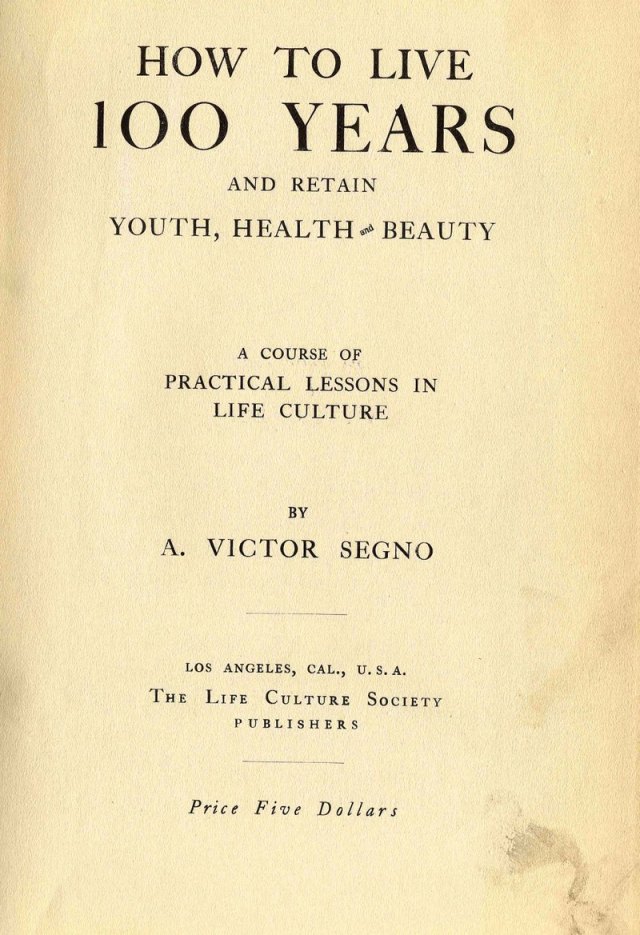
A. Victor Segno — “How to Live 100 Years”

“This lesson is written especially for people who have passed the age of 35 and have begun to show signs of approaching age; people who have begun to lose strength and vigor and those who feel that they have lost their grasp on youth.”

–A. Victor Segno,
“How to Live 100 Years,”
Los Angeles, 1903
Posted in books, health | Comments Off on A. Victor Segno — “How to Live 100 Years”

‘Pretty Woman’ car for sale

Pretty_lotus


  The 1989 Lotus Esprit driven by Richard Gere in "Pretty Woman" is being offered in Hemmings Motor News for $54,998.

Posted in Film, Freeways, Hollywood, Transportation | 1 Comment

November 22, 1930: Voices — Christine Collins

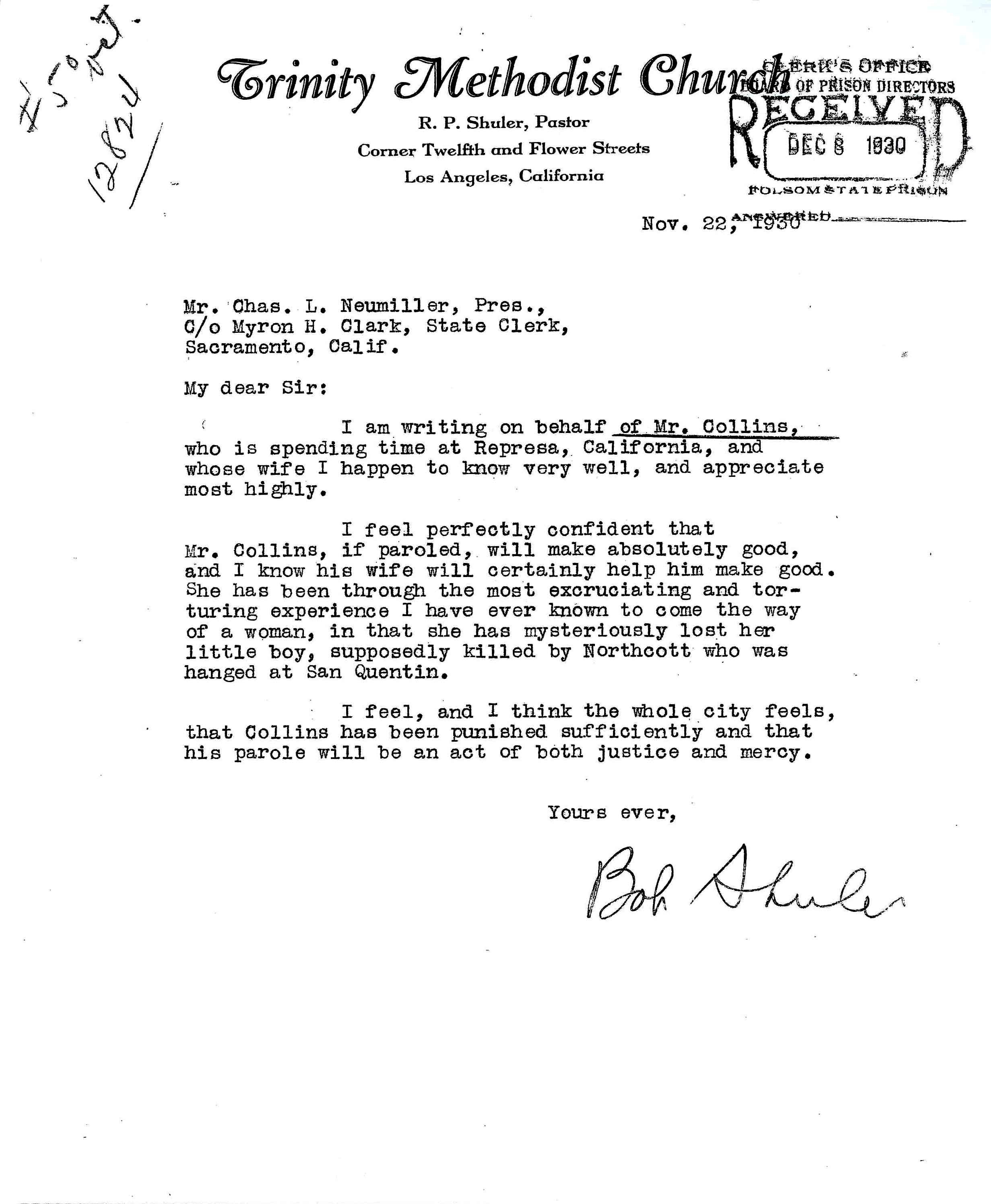
November 22, 1930: The Rev. R.P. "Fighting Bob" Shuler urges parole for Walter Collins.
The Rev. R.P. “Fighting Bob” Shuler urges the parole of Walter J. Collins.

Posted in #courts, Changeling, Film, Hollywood, LAPD | Comments Off on November 22, 1930: Voices — Christine Collins

Fierce fighting in Cuba, Los Angeles Open begins, January 3, 1959

1959_0103_cover
 
The Soviets are winning the space race and communism establishes a foothold at America’s doorstep. These were worrisome times for the nation.

1959_0103_metro

Cheryl Crane visits Lana Turner.

1959_0103_comics

"Li’l Abner," "Rick O’Shay"
and "Moon Mullins."

1959_0103_mra

Moral Re-Armament and the Young Americans for Freedom were two
major institutions for conservative Baby Boomers. (In college, many YAFers discovered they liked to smoke dope and became Libertarians).

1959_0103_sports
Johnny Bulla of Phoenix leads
the L.A. Open.

Now playing: "Some Came Running."


America in the days before the Gun Control Act of 1968—although you can still go into Big 5 and buy antique military rifles. ($9.98 in 1959 is $70.26 USD 2007 vs. $89 today for a M91/30 Russian Mosin Nagant in 7.62 millimeter).

1959_0103_rifles_2

Posted in @news, art and artists, broadcasting, Current Affairs, Fashion, Film, Front Pages, Hollywood, LAPD, Sports, Television | Comments Off on Fierce fighting in Cuba, Los Angeles Open begins, January 3, 1959

Broadcaster looks at the future of TV sports

1949_0103_harmon_pix

1949_0103_harmon01 The story posed a simple question: Would television hurt or help sports attendance?


‘Television is only a very good substitute for the actual game. The camera cannot cover all of the interesting factors. And to the real sports addict, yelling "Kill the umpire!" at the television tube is small satisfaction for his feelings.’


The Times published a piece by former college football star Tom Harmon, who in 1949 was the sports director of KFI-TV (an early version of Channel 9 in Los Angeles).

He believed television would introduce people to new sports and draw them to the games.

1949_0103_harmon02"Television is only a very good substitute for the actual game," Harmon wrote. "The camera cannot cover all of the interesting factors. And to the real sports addict, yelling ‘Kill the umpire!’ at the television tube is small satisfaction for his feelings."

Harmon also discussed how television would change the announcer’s role: "The announcer must have the memory of an elephant and know what he’s talking about. … The announcer cannot make a mistake."

Wonder what Harmon would think if he spent a day in 2009 watching sports from local to cable.

–Keith Thursby

Posted in broadcasting, Downtown, Sports | Comments Off on Broadcaster looks at the future of TV sports

Found on EBay — Bullock’s Wilshire

Bullocks_tank
Bullocks_tank_tag
At left, a Dinky Toys set with the original box from Bullock’s Wilshire has been listed on EBay. Bids start at $115.


Posted in #games | Comments Off on Found on EBay — Bullock’s Wilshire

Paul Coates — Confidential File, January 2, 1959


Puts Ego Factor Into Poll 

Paul Coates Tries Out New Survey-Taking Theory

Paul_coates_3
Now don’t misunderstand me. 
 
I’m not looking to start anything with Mr. Gallup. There’s enough petty
bickering going on around here without us getting into a hassle.
 
Besides, he’s bigger than I am. He could take one poll and consign me
to oblivion or some other faraway place where columnists go when their
readership ratings die.
 
But a kind of gnawing remnant of
integrity forces me to state publicly that ever since the Literary
Digest goofed I haven’t put much faith in surveys.
 
The Ego Factor

Their flaw, I think, is that they fail to take into consideration the ego factor in all of us. 
 
If you go to a man’s door with a clipboard in hand and ask: "Do you
feel we should support Quemoy?" he’s not likely to admit that he
doesn’t even know who Quemoy is.
 
At least. I’m not likely.
And, except for a few spectacular neuroses having to do with things
like early rejection feelings, toilet training and bottle feeding, I
consider myself an average citizen.
 
And to us average
citizens, ignorance is not bliss, it’s embarrassing. We don’t want any
pollsters in Brooks Bros. suits putting us down as dopes. Ask us
something about anything and we’ll give you a carefully considered
answer, even though we don’t fully understand your question.
 
1959_0102_king_ro
I’m firmly convinced for example, that when Mr. Gallup’s doorknockers
go around asking: "Do you think the President should attend a summit
conference?" a majority of the people who give a "No" response are
opposed on ground that the high altitude might be bad for Ike’s health.

 
To test this theory, I formed a small survey company of my
own. A couple of days ago my secretary and I polled 150 people in the
county of Los Angeles.
 
Their names were selected from the
phone book. The calls were made over a period of two days between the
hours of 11 a.m. and 4:30 p.m., giving us a good sampling of housewife
reaction.

  Want to Repeal

After identifying ourselves as the "Los Angeles Survey
Institute" and inquiring if the voice at the other end was a registered
voter, we pose the question:
 
"Do you think the Mann Act
deters or helps the cause of organized labor — and if you feel it
deters, would you vote for its repeal?"
 
The results are in. And they’re astonishing. 
 
It will shake the very foundations of the PTA to learn that 38% of
American housewives want to repeal the Mann Act which, since 1910, has
made it socially unacceptable and highly illegal to take a woman across
state lines for immoral purposes.

A percentage breakdown is as follows: 
 
38% — For repeal of the Mann Act. 
10% — Opposed to repeal. 
28% — Don’t know anything about it. 
6% — Don’t know enough about it. 
12% — Either know the Mann Act or suspect it has something to do with white slavery.
4% — Can’t be bothered 
2% — Never discuss politics. 

One lady said we got her out of the bathtub. We didn’t bother to make her a statistic. 

Some of Replies

1959_0102_freeway
The reasons given by those in favor or against repeal indicate
the public temper of our times. Or something equally fraught with
meaning. Here, for the benefit of any sociologists among you, are a few
of the ladies’ replies:

– "We need the Mann Act. Labor would just go wild without it." 

– "It should definitely be repealed. My husband’s in the union and I’m for anything that helps the working man."

– "Repeal the Mann Act? Dearie, don’t you know what the Mann Act is?"

– "I haven’t been feeling too good lately, so I haven’t kept up with what’s in the papers."

– "Yes, it should be repealed. We’re strictly against that act in our family."

– "I don’t know what it is. Is it a socialist thing? Then we should get rid of it."

– "No. It certainly should not be repealed. Hoffa gets away with too much as it is."

– "I have no opinion. I don’t care what they do about the Mann Act. They’re all a bunch, of grafters, anyway."
 
In all fairness, I should point out that since my survey company was a
fly-by-night organization we were not as thorough as we could have
been. We didn’t sample representative racial groups, economic levels or
educational backgrounds.
 
The only other question we asked
was each participant’s age, which came to an average of 25 years. But,
since we were surveying women, I don’t believe that either.

Posted in Columnists, Freeways, Paul Coates, Transportation | 1 Comment

Matt Weinstock — January 2, 1959


Reader’s Choice

Matt_weinstockd_2
A man in the VA hospital in West L.A. writes, "Lying here, a person has time to think of many things, especially things he has missed. I am writing to ask what you think is the most interesting book to read, one that would benefit the person reading it."

Anyone in his right mind would walk away from that one. No one book, except possibly the Bible, has everything. 

But, I feel a little lightheaded with the new year and all, I gave it the old college try. 

Presuming the man in the hospital seeks wisdom, universality or serenity, dramatically presented, I phoned some writers and library people.

Shuddering slightly at such an impossible request, they nevertheless came through with the following: "The Education of Henry Adams," Boswell’s "Johnson," Will Durant’s "Story of Philosophy," Mark Twain’s "Huck Finn," "Tom Sawyer" or "Life on the Mississippi," the complete works of Shakespeare, the one-volume Columbia Encyclopedia, Fielding’s "Tom Jones" and Benjamin P. Thomas’ "Abraham Lincoln."

1959_0102_kingMe? Barlett’s Quotations.

THE SEASON’S nod for nonchalance goes to a man who came into George Caterer’s restaurant on west 8th Street, ordered coffee and opened his newspaper to the want-ad section. After a moment he exclaimed, "Now here’s just the job for me!" He asked George to dial the number, then invited the man who had placed the ad to come over and interview him while he had his coffee.

ET TU?

Resolutions hard and fast-
Ten to one they will
not last.
Is it that I lack acumen,
Or mainly that I’m
only human?
        -PAT SHROYER

SHORTLY BEFORE Christmas a year ago a friendly stranger came into a big downtown office and offered 50% off on handsome new kitchenware. He took a number of orders, the merchandise was delivered and everybody was pleased.

A couple of weeks ago he showed up again at the same office, this time with two cases of a well-known brand of Scotch whisky.  He offered them for $20 each and they were snapped (schnapped?) up immediately, amid moans from others who would have liked to have been in on the bargain.  "Oh, I can get more," he said. 

He took orders for many more cases, collecting around $1,000, and said the stuff would be delivered between Christmas and New Year’s. Neither he nor the Scotch has been seen since. 

The moral is clear. Never trust a con man with your money.

A MAN planning a trip to Europe next summer with his wife phoned the steamship line with which they have reservations and asked the size of their stateroom.

The man at the steamship line, an old, conservative firm, didn’t know but volunteered savagely, "It won’t be so small that you’ll feel like sardines and it won’t be large enough for you to dance." Thereby confirming the couple’s fears that the day of good manners is passing.

But they’re going anyway. They don’t particularly enjoy sardines or dancing.

A TIRED LOOKING woman with three small children found their path on South Barrington Avenue blocked by a ladder against a building.

"Don’t walk under!" the boy, about 6, said sharply, "It’s bad luck!"

The woman, glancing despondently at the kids, "It’s too late to worry about that."

AT RANDOM — Now let’s get it straight. The voice of the Old Pro in the animated Falstaff TV commercials is that of Eddie Mayehoff. The voice of Mr. Magoo, the W.C. Fields caricature, was that of Jim Backus. And Burgermeister’s Bashful Guy is Eugene Bollay, who used to be a TV weather man . . . Yes, it has come to this. Changing Times magazine advertises an upcoming article titled, "How to Spend an Evening Without TV" . . . Add unsung claims to fame: Tom Dixon of KFAC is one of the few nonresidents who can find his way out of the Parklabrea maze of the streets . . . The silly season is still with us. An unsigned note bears the postscript, "Please do not use my name (which I shall not give you)."

Posted in Columnists, Matt Weinstock | Comments Off on Matt Weinstock — January 2, 1959

Voices — Christine Collins, November 14, 1930

November 14, 1930: Borton letter

Posted in #courts, Changeling, Film, Hollywood, LAPD | Comments Off on Voices — Christine Collins, November 14, 1930

Body of writer’s daughter found off Mulholland; bidding war for Alcindor, January 2, 1969


1969_0102_cover_2


1969_0105_habe
Elizabeth Marina Habe was home on Christmas vacation from the University of Hawaii and staying with her mother, actress Eloise Hardt, at 8962 Cynthia Ave., in West Hollywood. Her parents were divorced and her father, author Hans Habe, lived in Switzerland.

Elizabeth had been on a double date with John Hornburg, 22, a longtime family friend, and left the Hornburg home, 13326 Sunset Blvd., about 3:15 a.m. Dec. 30, in her sports car.

About 3:30 a.m., her mother was awakened by a car with a noisy muffler. She looked out the window, saw a man run toward a black car and yell "Go!"

They found Elizabeth’s car in the driveway with the handbrake set so firmly that police doubted she had the strength to do it.

A couple walking on a fire road off Mulholland Drive discovered Elizabeth’s purse about 2 p.m. on New Year’s Day. Investigators found her in heavy brush 30 feet down a slope in the 8800 block of Mulholland near Bowmont. She was wearing brown capris, a white turtleneck and a brown coat. Elizabeth had been stabbed repeatedly in the chest, but not raped, police said. Her killing was never solved. She was 17.


1969_0102_sportsThe bidding war for Lew Alcindor has begun.

"If Lew Alcindor comes to the American Basketball Assn. it will
guarantee the success of the league," said Rick Barry, who jumped from
the NBA to play and part-own the Oakland Oaks. "But if he goes to the
NBA it will make it a long, tough haul."

Alcindor figured to be the top pick in the NBA draft, but the ABA
was going to change its rules to try and get him to sign. The Times ran
a AP story on Jan. 28 that said the ABA would
let Alcindor pick his own team.

Commissioner George Mikan said most of the teams were in favor of
letting the UCLA star choose where to play and most teams favored
pooling resources so the league could afford his salary. The story
suggested that New York might be his first choice because he grew up in
New York City. But the Nets were playing in "a drafty arena in Commack,
Long Island, about 40 miles from Manhattan." They hoped to move into a
new arena being built in Long Island.

So what might have happened if Alcindor (Kareem Abdul-Jabbar) had
picked the Nets? Might he have teamed with Julius Erving, the league’s
biggest star who was traded to the Nets in 1973. Interesting to imagine
how good that team might have been. Maybe good enough to help the ABA
survive.

–Keith Thursby

Posted in books, Film, Front Pages, Hollywood, Homicide, Sports | Comments Off on Body of writer’s daughter found off Mulholland; bidding war for Alcindor, January 2, 1969

Movie star mystery photo

2008_1229_mystery_photo
Los Angeles Times file photo

Here’s our last mystery star of 2008!

2008_1230_mystery_photo
Los Angeles Times file photo
Lots of guesses, but
none of them were correct. Our mystery guest has more than 30 credits
on imdb and  figured in the investigation of a famous murder case.

Update:
Please congratulate William (westpv) for correctly identifying our
mystery woman as Jewel Carmen. Very impressive! I’ll keep posting photos to see who
else recognizes her.

Update: Sam (sammathtchr) also recognized her. Congratulations!

2008_1231_mystery_photo

Los Angeles Times file photo
Here’s another photo of our mystery woman, now with a mystery co-star!

Update: This is Kenneth Harlan in a scene from "Nobody."

2009_0101_mystery_photo

Photograph by the Los Angeles Times

And here’s our mystery gal a few years later. I think her sunglasses are great.
2009_0102_mystery_photo

Photograph by the Los Angeles Times

1935_1218_todd

And here she is in 1939. Our mystery woman is Jewel Carmen. She figured in the Thelma Todd case because she  was married to Roland West and owned the buildings where Todd operated her restaurant, including the garage where Todd’s body was found. Carmen told investigators that Todd had heart disease and believed she only had a few years to live.

Posted in Film, Hollywood, Mystery Photo | 20 Comments