Voices — Christine Collins, May 16, 1929


The Christine Collins letters

The woman whose tragedy inspired the Clint Eastwood movie "Changeling" tells her story in her own words.

1929_0516_christine_collins_01

Posted in #courts, Changeling, Film, Hollywood, LAPD | Comments Off on Voices — Christine Collins, May 16, 1929

Christmas 1968


1968_1225_cover
The Pueblo crew arrives in San Diego.
Note the bylines: Chuck Hillinger and Bob Rawitch!

1968_1225_torgerson_graf
My good friend Eric Malnic, retired reporter who’s now recovering from surgery, often talks about the other distinguished rewrite folks at The Times and their techniques. One of the people he respects the most is the late Dial Torgerson, who was killed covering the war in Nicaragua.

Eric often talks about using a "Dial Torgerson graph" that appears high in a long roundup (usually a fire story or a weather story) as a capsule of what’s ahead. At left, here’s a perfect example from Torgerson’s 1968 Christmas story. –lrh


1968_1225_sports
The Times’ Bob Oates thought he found the perfect man to become the next commissioner of baseball: Vin Scully.

Oates, a longtime football writer, seemed a surprising choice to
write what basically was an opinion piece. The story should have been
labeled as a commentary, but the reader was left a bit confused. Why
was this a story? Maybe he had some inside info? Despite all that, it’s
hard to argue with the endorsement. Scully certainly would have been a
wonderful spokesman for the game.

"He would bring to the commissioner’s office a first-class mind as
well as the self-confidence to act when necessary and the self-control
to abstain from action in other circumstances," Oates wrote.

–Keith Thursby


Posted in @news, Charles Hillinger, Dodgers, Front Pages | 1 Comment

Christmas 1938


1938_1225_christmas_2
The Times’ front page features a poem by James "Sunrise Jim" Warnack, the paper’s religion writer for many years.

1948_0506_warnack

1938_1226_bethlehem

Posted in Front Pages, Religion | 1 Comment

Christmas 1908


1908_1225_christmas
Crowds of shoppers watch a downtown building go up in flames and bandits rob a holiday party. Volunteers give presents to the needy children of Los Angeles and there’s dinners for the hungry and homeless. Mayor Harper is hurt in a car accident at Union and 24th Street. Merry Christmas, 1908.

Posted in @news, Front Pages | Comments Off on Christmas 1908

Holiday greetings


City_hall__cross

Los Angeles Times file photo

Merry Christmas from the Daily Mirror!


Posted in Architecture, City Hall, Downtown | Comments Off on Holiday greetings

Voices — Christine Collins, May 3, 1929


1929_0503_christine_collins_01_01

From the California State Archives

The Christine Collins letters

The woman whose tragedy inspired the Clint Eastwood movie "Changeling" tells her story in her own words.


San Gabriel, Calif.
May 3, 1929

Mr. A Eichoff
San Francisco, Calif.

Dear Sir:

1929_0503_christine_collins02_01
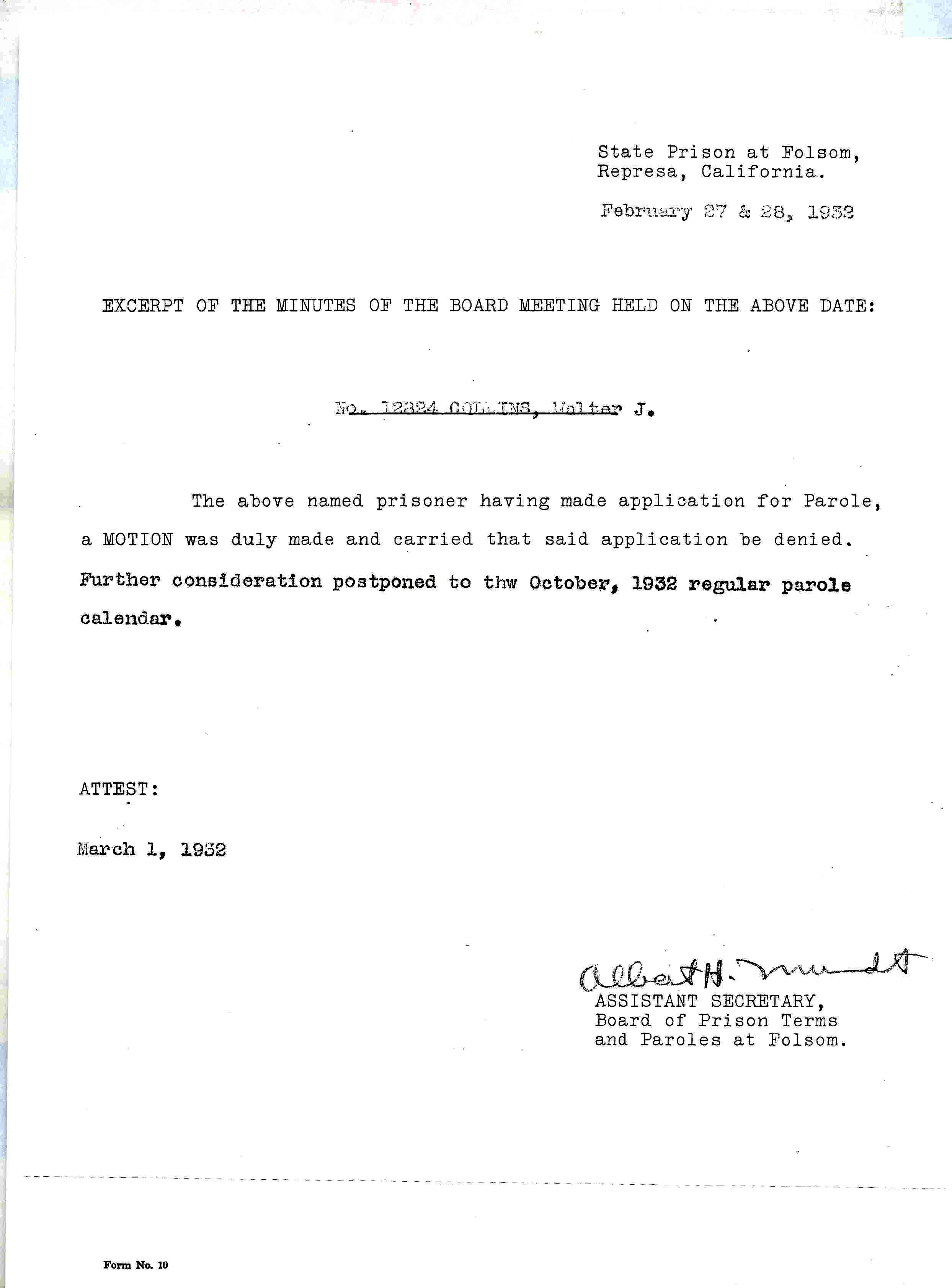
I am writing to you in regard to my husband, Walter J. Collins # 12824 imprisoned at Reprisa,
Calif. I would like to make you a personal call and explain matters
definitely but I am unable to on account of financial circumstances as
well as ill health.

Mr. Collins was convicted of robbery on
circumstantial evidence in 1923. I was forced to work to support our
boy and myself in spite of my very nervous condition. On March 10,
1928, our poor boy disappeared and has not [illegible] Stewart Northcott on his Wineville ranch.

I
am sick and grief-stricken over our son’s disappearance. In August 1928
a boy was found in the east who posed as our boy and because I would
not accept him as our son I was treated most inhumanly, called a lair,
damn fool, crook and almost everything by the police here and finally
throw into the psychopathic ward of the General Hospital among the
maniacs for five days and nights.

The stigma of being in the
insane ward caused me to lose my position that I had held for over five
years, consequently I am without means of support.

Mr. Collins (#12824) is to appear for hearing before the board of directors soon and I wish Mr. Eichoff
that you will give this your kind consideration. The poor man is not
deserving of the terrible sentence meted out to him when he was
sentenced. The judge was told to give Mr. Collins the limit because he
would not plead guilty to one count of robbery and so Mr. Collins was
charged with several which was not fair. And to make matters worse the
counts were made to run consecutively instead of concurrently.

1929_0503_christine_collins03_01
Mr.
Collins has taken up a course in civil engineering during his
incarceration and I am sure he will be qualified to fill a very good
position if released, which I hope that he will be thru your kind consideration.

I am under a doctor’s care and have been for some time due to a terrible nervous strain.

Hoping
you will decide favorably for a release for Mr. Collins so as he may
come home to take care of me. I ask this in the name of humanity and
sincerely hope you will grant me this request.

Thanking you for your time, which I know is valuable and hoping for a favorable reply, I am

Very sincerely.

Mrs. Walter J. Collins
811 E. Park St.
San Gabriel, Calif.


Posted in #courts, Changeling, Film, Hollywood, Homicide, LAPD | 2 Comments

A very Daily Mirror Christmas


1964_1218_santa_martians1

http://video.google.com/googleplayer.swf?docid=-2260027996690730318&hl=en&fs=true Here at the Daily Mirror HQ, we’re watching "Santa Conquers the Martians."  And with a title like that, you don’t have to wonder what it’s about.


Posted in broadcasting, Film, Hollywood, Rock 'n' Roll, Science, Television | 2 Comments

Movie star mystery photo

2008_1222_mystery_pix

Los Angeles Times file photo

Our mystery fellow on the right has more than 200 credits in imdb. His lovely and vivacious companion has more than 50. Note: Comments on the Daily Mirror are monitored and must be approved. Be patient if your guess isn’t posted immediately.
Update: So far, everybody has guessed correctly. This is a first!

2008_1223_myster_photo
Los Angeles Times file photo
The correct guesses are pouring in.
Dewey Webb was the first to identify our mystery guest and Barbara Klein was the first to identify his lovely and vivacious companion.

2008_1224_mystery_photo

Los Angeles Times file photo
Fair enough, everybody has guessed that our mystery fellow is Robert Loggia. So, our question becomes: "What is Robert Loggia doing in this picture?"

Posted in Film, Hollywood, Mystery Photo | 22 Comments

Radio station cancels ads as Christmas present to listeners, Dodgers and Phillies swap players, December 24, 1958


1958_1224_tv
As a Christmas gift to its viewers, radio station KPOL is going without ads for 48 hours … and watch for Santa Claus played by Peter Lorre (with Milton Berle) and Buster Keaton ("The Donna Reed Show")! The plot of The Silent Night" episode of "Pursuit" with Lew Ayres and Patrician Neal sounds intriguing. 
 

1958_1224_sports
The Dodgers traded a future Hall of Fame manager for a guy named Rip.

Sparky Anderson, then a longtime minor league infielder better known
as George, was sent to the Phillies for three players. The key for the
Dodgers was Rip Repulski, described in The Times story as "one of the
more dangerous right-handed hitters in the National League." He had 20
home runs with Philadelphia in 1957 and 13 in 1958, including four
pinch-hit homers. The Dodgers also got two minor league pitchers.

Repulski, whose real first name was Eldon, played only 53 games for
the Dodgers and hit two home runs. Anderson hit .218 for the Phillies.
He won World Series titles managing the Reds and Tigers.

–Keith Thursby


Posted in broadcasting, Dodgers, Front Pages, Religion, Television | Comments Off on Radio station cancels ads as Christmas present to listeners, Dodgers and Phillies swap players, December 24, 1958

December 23, 1968: N. Korea frees crew of U.S. spy ship Pueblo

December 23, 1968: Los Angeles Times cover with headline on the Pueblo incident

Pueblo’s Bittersweet Tribute

For Pete Bucher, captain of the spy ship, the years haven’t erased the pain of his captivity–or his homecoming. Even medals and a ceremony did not come without a fight.

Saturday May 5, 1990

By RICHARD E. MEYER
TIMES STAFF WRITER

They beat Pete Bucher with gun butts. They kicked him with their boots. They threw him into walls.

“Sonabitchi criminal!” they yelled. “Goddamned liar! Spydog!”

They forced him to his knees. One put a pistol to his ear and cocked it. “Two minutes to sign, sonabitchi!” Quietly, he said: “I love you, Rose.” He said it again. “I love you, Rose . . . ” The pistol clicked.

A ploy, Pete Bucher realized, and he regained some composure. So they beat, kicked and hit him again with their gun butts, in his stomach, head, neck, groin and kidneys. He retched, urinated blood. Continue reading

Posted in @news, Current Affairs, Front Pages, Politics | 1 Comment

Retro holiday gift — 1951 Thomas Bros. Guide

1951_thomas_guide_ebay
The old Thomas Bros. maps (yes, the Daily Mirror HQ has a motley collection) are handy for anyone interested in Los Angeles history. This one is listed on EBay.
Posted in art and artists, books, Freeways | Comments Off on Retro holiday gift — 1951 Thomas Bros. Guide

Kidnapping victim meets reporters, December 23, 1968


1968_1223_mackle
   

November 19, 1985

Kidnapper Who Used ‘Grave’ Accepted at Medical School

‘There are some people who have faith in me.’

Associated Press

ATLANTA — The man convicted of abducting Barbara Jane Mackle and placing her in a "living grave" for 3 1/2 days in 1968 has been accepted at a medical school in Mexico, parole officials say.

Gary Steven Krist, 40, was paroled from a Georgia prison in 1979 after serving 10 years and banished to Alaska. He wrote to the state parole board that he has been accepted at the Autonomous University of Guadalajara in Mexico.

"He said: ‘I did it. I finally did it. There are still some people who have faith in me,’ " said parole board member Tommy Morris.

Mackle, daughter of a wealthy Miami developer, was kept in a ventilated underground box in Gwinnett County for 3 1/2 days. She was rescued based on directions Krist left in exchange for a $500,000 ransom. Krist was later arrested as he tried to flee from Florida to Texas.


Posted in @news, Front Pages | Comments Off on Kidnapping victim meets reporters, December 23, 1968

Voices — Christine Collins, March 7, 1929

1929_0309_brain_01_01
1929_0309_brain_02_01


Posted in #courts, Changeling | Comments Off on Voices — Christine Collins, March 7, 1929

Geronimo Pratt case 40 years later


Geronimo_pratt_2000_ftt
Los Angeles Times file photo

Elmer Gerard  "Geronimo" Pratt in 2000, after his release from prison.


'Lie down and pray'

Gunshots on a Santa Monica tennis court reverberated across legal landscape.

Note: Edward J. Boyer, now retired, covered the Elmer Gerard "Geronimo" Pratt case for The Times.

By Edward J. Boyer

1968_1219_cover1On a clear, chilly December evening 40 years ago, Kenneth Olsen, head of the English department at Belmont High School, and his wife, Caroline, drove to Santa Monica's Lincoln Park tennis courts to meet another couple for a friendly doubles match.

The courts on Wilshire Boulevard at 7th Street were dark when the Olsens arrived about 8 p.m. Caroline went to the light meter to deposit a quarter. When she had trouble getting the meter to work, Kenneth went to help.

Just as the lights came on, the Olsens noticed two men walking toward them. As the pair drew closer, Kenneth Olsen realized both men were carrying pistols.

The men ordered the Olsens to put their hands up.

"We want your bread, man," Kenneth Olsen remembered one saying. "Give us your money. Where is it?"

He directed the robbers to his tennis bag and his wife's purse. They ordered the couple to the ground and started to leave.

Suddenly, they turned and opened fire.

Kenneth Olsen survived the fusillade; his wife did not. And those shots fired on Dec. 18, 1968, reverberated across Los Angeles' legal landscape for nearly three decades.

Just over three years later, former Black Panther Party leader Elmer Gerard "Geronimo" Pratt was sent to prison for the robbery and murder. Pratt had maintained at his trial that he was in Oakland, 341 miles away, attending Black Panther Party meetings when Caroline Olsen was killed.

Even by the standards of those turbulent times, it was a crime remarkable for its chillingly random and wanton character.

Describing the shooting at Pratt's trial, Kenneth Olsen said: "It came as a complete surprise to me that they actually fired. I didn't think they would."

He was hit five times–in the forehead and right hand, little finger, forearm and hip. Caroline Olsen was struck in the back and hip.

Olsen, then 31, checked on his wife as blood poured out of the wound in his forehead.

"Are you OK? Can you move?" he asked his wife.

She could not. And there was no one else around.

"I realized I had to get help for her and that I wouldn't last too long the way blood was flowing," Olsen testified.

He stumbled across Wilshire, barely avoiding an oncoming car, and made his way into the Broken Drum restaurant, where a waitress called for help.

Caroline Olsen, 27, a teacher at Stoner Avenue Elementary School, died later from her wounds.
The thugs who murdered her netted about $18.

Santa Monica police made little headway in their investigation of the coldblooded assault on the Olsens. But events within the Black Panther Party and efforts by a secret FBI counterintelligence program called COINTELPRO intersected in 1969 to change that. Pratt was convicted in what his defenders still call one of the most overtly political trials in Los Angeles' history.

A month after Caroline Olsen's murder, Panthers in Los Angeles themselves were left reeling by violence. Their charismatic leader, Alprentice "Bunchy" Carter, and his close aide, John Huggins, were killed Jan. 17, 1969 in a shootout on the UCLA campus.

Carter's death left a void, and Julius C. "Julio" Butler, a 35-year-old former Los Angeles County sheriff's deputy turned Panther, saw himself as Carter's logical successor. But party leaders in Oakland tapped Pratt, 20, a decorated Vietnam veteran, who had been a Panther for only about four months.

A bitter rivalry developed between Pratt and Butler. Pratt and other Panthers accused Butler of being a police informant, while Butler accused them of threatening his life.

By May 1969, Butler had begun talking to the FBI. On Aug. 5, he was expelled from the party, according to former Panthers and FBI documents obtained after Pratt’s conviction. He says he quit.

Five days later, he gave a letter to Los Angeles Police Sgt. DuWayne Rice, naming Pratt as Caroline Olsen's killer.

Butler had written on the outside of the sealed envelope that it should only be opened in the event of his death. He called it his "insurance letter," and prosecutors at Pratt's trial argued that Butler never intended for it to be made public, likening the envelope's contents to a deathbed declaration.

Information disclosed after Pratt's conviction, however, revealed that Butler's insurance letter was anything but a secret. FBI agents approached Rice on the street immediately after Butler gave him the sealed envelope. They demanded that the sergeant turn it over and referred to it as "evidence."

Rice refused, but later recalled that he wondered how the agents knew the envelope contained a letter since it was sealed, and how could they have known it was evidence.
More than a year later, in October 1970, Butler gave Rice permission to give the letter to his LAPD superiors. Butler explained to Rice that the FBI was "jamming" him and that he had told agents about the letter.

Butler's letter said Pratt had told him of a "mission" he was about to undertake on the night the Olsens were shot. The next day, Butler said, he pointed to a front-page story in The Times about the robbery and shooting. Pratt, Butler said, indicated that was the mission he had spoken of. Pratt’s defenders have always dismissed as ludicrous Butler’s contention that Pratt, who was extremely suspicious of Butler, would have confessed to him.

Butler's letter became the tool prosecutors needed in December 1970 to convince a grand jury to indict Pratt for Caroline Olsen's murder. The LAPD's Criminal Conspiracy Section had taken over the investigation from Santa Monica police. Pratt, who was being held on other charges, would be tried in June 1972.

Butler's letter also implicated a "Tyrone," and police arrested William Tyrone Hutchinson in 1970. In a sworn statement given in 1991 to investigators working on Pratt's behalf, Hutchinson said he told police in 1970 that two men, Larry Hatter and Herbert Swilley, had bragged at a Panther office about being present at the tennis court when the Olsens were attacked.

Hutchinson said he had known Swilley and Hatter since childhood and knew them to be Butler's friends. Officers told him not to discuss what he heard Swilley and Hatter say, if he knew what was good for him, Hutchinson said.

Explaining why he had not come forward with the information earlier, Hutchinson said he took the officers' comments "to be a threat on my life, and I still do."

Pratt's defenders maintain that LAPD investigators did not pursue evidence pointing to other suspects because their primary objective was to "neutralize" Pratt and cripple the Panthers.
Friends of Swilley and Hatter have described both as heroin addicts who committed robberies to pay for drugs. Swilley was also known as a particularly violent killer. He was shot to death in 1972 during an argument.

Hatter was found dead in 1978 on the Pacific Tennis Court grounds in Santa Monica. He apparently fell while attempting to enter or leave a building during a burglary, impaling his skull on a fence.

The key evidence against Pratt consisted of Butler's testimony that he had obliquely confessed the crime, Kenneth O
lsen's eyewitness testimony, ballistics tests from a .45-caliber pistol and the car allegedly used in the robbery/murder.

Although Butler denied on the witness stand that he had ever been a police informant, FBI files released after Pratt's conviction showed that Butler had been providing information on the Panthers to the bureau for three years before the trial.

Kenneth Olsen identified Pratt as one of the men who committed the murder. He told the Pratt jury that "one of the most distinguishing things about Mr. Pratt is his intensive eyes," calling them "very piercing and very penetrating."

Neither the jury nor Pratt's lawyers knew at the time that Olsen earlier had identified another suspect as his wife's killer. The public defender who had represented that suspect recalled after Pratt's conviction that Olsen had said after that earlier identification: "The voice did it."
In fact, the first man Olsen identified as the assailant had been in jail the night the couple was attacked.

Had the jury known about Olsen's earlier identification, "I think that alone would have changed our mind," said Jeanne Hamilton, a juror at Pratt’s 1972 trial.

LAPD criminalist DeWayne Wolfer testified at Pratt's trial  that firing pin marks on shell casings found on the tennis court matched those on shells fired from a .45-caliber pistol seized from a Panther house. In an earlier trial, a California appellate court ruled that Wolfer had "negligently presented false demonstrative evidence in support of his ballistics testimony." Another forensic scientist has characterized Wolfer's testimony as lacking "credibility in the minds of most forensic scientists."

The only other person to tie Pratt to the .45 was Butler.

The presence of Pratt's car at the murder scene is a point even some of his defenders acknowledge. A witness saw the gunmen flee in a red and white Pontiac GTO convertible with out-of-state plates–a description matching Pratt's 1967 car.

Several witnesses, however, testified that Pratt's car was used not only by other Panthers, but by any number of people associated with the party–including Butler on several occasions. Pratt, his defenders said, had no idea who used his car on the day of the murder because he was in Oakland, where he had gone earlier in the week.

Pratt always has insisted that he was in Oakland attending Black Panther Party meetings when the Olsens were attacked. Years later, retired FBI agent M. Wesley Swearingen said the bureau knew Pratt was in the Bay Area then because the Panthers were under surveillance and phones at their party headquarters were tapped.

Pratt's defense presented several witnesses who placed him in Oakland during the party meetings. But they could not–3 1/2 years later–specifically place Pratt in the Bay Area on Dec. 18, the day of the crime.

What turned out to be one of the most damaging pieces of evidence against Pratt was introduced by the defense. Olsen had described his assailants as clean shaven, but several other witnesses–including Butler–said they always had seen Pratt with facial hair.
Pratt's lawyers introduced a Polaroid photograph, supposedly taken around Christmas 1968, showing Pratt with a goatee, which they argued he could not have grown in the week after the murder.

"We took the word of Pratt's brother, Chuck Pratt, about this picture," Johnnie L. Cochran Jr., one of Pratt's attorneys at his original trial, said. "We didn't consider it really important. We thought it was clear to everybody that Pratt had a goatee, that he was not clean shaven as Mr. Olsen said."

But that photo was more important than Pratt's defense team could have imagined. Prosecutors called a Polaroid representative who testified that the picture could not have been taken in December 1968, because the film used in the photo was not manufactured until May 1969.
That testimony was devastating. One juror said it made him begin to question other parts of the defense case. Another said jurors argued during deliberations that if Pratt had lied about the photo, he could have lied about other events.

The jury deliberated for 10 days before it returned its guilty verdict.

Pratt, who now uses the name Geronimo ji Jaga, served two years in Los Angeles County Jail and 25 years in prison–the first eight in solitary confinement–before Orange County Superior Court Judge Everett W. Dickey overturned his conviction in 1997 and released him on bail.

The case was moved to Orange County after the entire Los Angeles Superior Court bench was recused because one of its members, Judge Richard P. Kalustian, who as a deputy district attorney prosecuted Pratt, was to be called as a witness.

Dickey, by all accounts a conservative, law enforcement-oriented judge, publicly branded Butler, the prosecution's key witness, a liar and ruled that Los Angeles County prosecutors had suppressed evidence favorable to Pratt's defense.

"The importance of Butler to the prosecution cannot be denied," Dickey later wrote in his decision. He noted that Pratt was never a suspect until police learned the content of Butler's letter, and that Kalustian "emphasized Butler's importance in argument both to the trial judge and to the jury."

At Pratt's trial in 1972, Kalustian had summed up just how important a witness Butler was: "Julio Butler has testified in this court under oath and to the jury to a confession that Mr. Pratt made to him that admits all of the elements of the offense. If the jury believes Julio Butler, Mr. Pratt is guilty. The case is over if they believe that."

Butler had denied under oath that he had ever been an informant for law enforcement, saying "the connotation (of) informant means a snitch, and I have never been in the world a snitch."
But in the hearing before Dickey, prosecutors revealed that Butler’s name had turned up in a confidential informant file kept by the Los Angeles County district attorney's office.

San Francisco attorney Stuart Hanlon, one of Pratt's lawyers, called the informant card on Butler a "smoking gun," saying the district attorney's office knew during Pratt's trial that Butler was an informant.

"The fact is that he was an actual informant, and no one said anything about it in court," Hanlon said. "The informant status of a main prosecution witness is always reversible error."

Three jurors, including Hamilton, told Jim McCloskey, whose Centurion Ministries independently investigated Pratt’s case, they would never have convicted Pratt had they known Butler—who went on to become a lawyer and chairman of the board at Los Angeles' First African Methodist Episcopal Church–was an informant.

In overturning Pratt's conviction, Dickey ruled that despite Butler's denials, he had been an FBI informant for at least three years before the trial. Dickey also ruled that Butler had been an informant for the LAPD and for the very agency that prosecuted Pratt–the Los Angeles County district attorney's office.

A detective in the district attorney’s office gave Butler $200 to buy a gun several months before Pratt's trial, Dickey noted, even though Butler was a convicted felon who could not legally possess a firearm.

Several law enforcement officers knew Butler carried the gun, even though doing so was a felony punishable by up to 15 years in prison, Dickey said.

Pratt's defense lawyers, Dickey said, were not given information needed to show Butler's motive for naming Pratt as Caroline Olsen's killer. Had Pratt's lawyers known of Butler's activities, they could have devastated his credibility o
n cross-examination, the judge said.

After Pratt’s release, then-Los Angeles Dist. Atty. Gil Garcetti appealed Dickey’s decision. But one veteran prosecutor said parts of Garcetti's appeal were difficult for experienced trial attorneys to fathom.

"There appears to be a whole bunch of stuff out there that was not turned over to the defense that should have been–like guys buying a guy a gun," he said. "Had this been turned over, would it have affected the outcome? That question doesn't pass the straight-face test."


  Gil_garcetti_pratt_lat
Photograph by Gina Ferazzi / Los Angeles Times

DROPPING CASE: Dist. Atty. Gil Garcetti said that he will accept an appellate court decision upholding the reversal of the murder conviction of ex-Black Panther Elmer Gerard "Geronimo" Pratt.


Garcetti lost his appeal and Pratt settled a false imprisonment and civil rights lawsuit against the city of Los Angeles and the FBI for $4.5 million. Pratt now splits his time between Morgan City, La., his home town, and east Africa. He has used part of his settlement to support projects for young people in Morgan City and a community founded by former Panthers in Tanzania.


Posted in #courts, books, Front Pages, Homicide, LAPD | 11 Comments

A. Victor Segno — “How to Live 100 Years”

“Make it a rule never to wear a hat indoors, either in the home, office, store or workshop. If you now suffer from baldness give your head a chance to get the benefit of the air, sunshine and rain. In this way, many people have grown luxuriant heads of hair. Nature is always ready to supply us with renewed youth, when we are ready to place ourselves in harmonious relationship with her laws.”

–A. Victor Segno,
“How to Live 100 Years,”
Los Angeles, 1903
Posted in books, health | Comments Off on A. Victor Segno — “How to Live 100 Years”

Retro holiday gift — Duesenberg transmission

Duesenberg_transmission Here’s something you don’t see every day — unless you’re EBay vendor med3021. Imagine your loved one’s reaction to find this under the tree (assuming you have a fairly large tree): "Why … it’s a Duesenberg transmission housing. Just what I’ve always wanted!" And in case your loved one has a machine shop in the basement, you can buy a pallet of unmachined castings for Duesenberg transmissions while you’re at it.

or a Duesenberg radiator shell?

Posted in Transportation | 1 Comment

Body found in shallow grave; Rams take off-season jobs, December 22, 1958


1958_1222_cover

I thought I had encountered just about every kind of bizarre Southern California crime imaginable, but the Elizabeth Ann Duncan case is staggering–lrh.

1958_1222_runover

Mother leaves three children
outside orphanage. 
1958_1222_runover02

Teenage robbers shoot barber

1958_1222_sports
The Rams’ season was over, so it was time to go back to work.

Back when athletes needed second jobs when not playing, The Times’
Cal Whorton compiled a Rams’ employment list. Jon Arnett and Dick
Daugherty were headed to local financial firms. Don Burroughs and Duane
Putnam would sell beer. Bill Wade went to a television station in
Nashville. Even then, the quarterbacks got the TV jobs.

Ron Waller would spend time at his bowling alley in Studio City and
his new liquor store. Several others were going back to school and a
couple had military service.

But here’s my favorite from Whorton’s story: "Surprisingly only one
Ram, Frank Fuller, has indicated he’ll try his hand in the insurance
business. Fuller also can be expected to pick up a few stray bucks on
the wrestling circuit.’

A wrestling insurance salesman? I’m sold.

–Keith Thursby

Posted in #courts, @news, Front Pages, Homicide, Sports | Comments Off on Body found in shallow grave; Rams take off-season jobs, December 22, 1958

December 22, 1938: Jealous husband kills wife with ax

March 7, 1939: Emma Spinelli takes the stand to testify against her father in the ax murder of her mother.
Testimony in the murder trial was so graphic that spectators became ill
and fled the courtroom, The Times said. Continue reading

Posted in #courts, 1938, Front Pages, Homicide, LAPD | 1 Comment

Voices — Christine Collins, February 21, 1928

February 21, 1928: George B. Anderson writes a letter to Christine Collins regarding a letter to her husband, Walter, regarding his hopes for parole. Above, George B. Anderson’s letter to Christine Collins and below,
his letter to Walter Collins.
Continue reading

Posted in #courts, Changeling, Film, Hollywood, LAPD | Comments Off on Voices — Christine Collins, February 21, 1928

Hanukkah 1980: Man recovers 400-year-old menorah from dump

Mike Goldberg and his wife, Ellen, with their recovered menorah.

The Goldberg family of Cheviot Hills usually kept their 400-year-old menorah in a bank vault, but Ellen Goldberg decided to show the family heirloom to a religion class she taught at Wilshire Boulevard Temple.

She brought it home and left it in a paper bag–which was thrown out by the cleaning lady.What follows is a story by former Times reporter J. Michael Kennedy about one man’s struggle with sanitation officials to retrieve the silver candelabra from the Sepulveda landfill. Continue reading

Posted in Front Pages, Religion | Comments Off on Hanukkah 1980: Man recovers 400-year-old menorah from dump