Hallucinations of a Cocaine Fiend

Aug. 27, 1889, School

Aug. 27, 1889: Hanna Los Angeles College, at Hope and 8th streets, is opening for the fall term.

Aug. 27, 1889, Cocaine

An unidentified visitor at the New Natick House on Los Angeles Street tries to throw a woman out of his room — but was she ever really there at all?

Posted in health | Comments Off on Hallucinations of a Cocaine Fiend

Voices — Dominick Dunne, 1925 – 2009

Dominick Dunne
Genaro Molina / Los Angeles Times / August 7, 2001

Dominick Dunne gestures during an introduction before reading to a
small group of people from his book "Justice: Crimes, Trials and
Punishments" at a Beverly Hills hotel.

Dominick Dunne's Dangerous Game


Is He Part of the In-Crowd or Simply Its Chronicler? He's Both, Friends Say, and That Can Get a Bit Dicey

June 1, 1988

By MARY ROURKE, Times Staff Writer

Dominick Dunne's eight-day visit started with dinner at the Regency Club. His pal Paige Rense, who edits Architectural Digest, invited him and a few others–all as rich or as famous as the people Dunne writes about.

Another night it was Mortons, watering hole for the stars. By the time he got to the big one, the cocktail party at Chasens to celebrate his new novel, "People Like Us," Dunne had worked his way through Los Angeles' upper crust.

That night at Chasens,
the guest list glittered with names like Jackie Collins, Candy and
Aaron Spelling, Billy Wilder and Michelle Phillips, who spent the night
air-kissing one another, as Dunne would say. Later he made a curious
disclaimer about the whole thing: "All my life I've thought of myself
as an outsider."

Watching him you wouldn't know it. As the room
filled with more and more dazzling faces, Dunne's own face lit up. His
otherwise dark, absorbing eyes began to twinkle. His skin glistened
with the heat of excitement. He was hugging and squeezing and having a
good time. Or he was putting on quite an act.

He's not exactly a
social lightweight. Raised among the country-club set in West Hartford,
Conn., and graduated from Williams College, he made his mark as a
Hollywood producer before he ever produced a novel.

'I Have Access'

Yet
he regularly denies any personal attachment to the social scene he
lives in and writes about with such devastating detail for Vanity Fair
magazine. He's profiled everyone from Elizabeth Taylor and Diane Keaton
to Clausvon Bulow and Imelda Marcos. "I have access to them," he
explained kindly, as if he was instructing the ignorant. "I'd be remiss
if I wrote about life on the farm, which I know nothing about."

As
often as Dunne insists it's all been strictly for business, he'll drop
a comment like this: "Malcolm Forbes is flying some people to Normandy
to go hot-air ballooning.There'll be 25 people for six days." Yes, Dunne is going. No, he won't be on assignment.

It's
a dangerous game, walking both sides of the street. And it nearly cost
him plenty when word of his new novel got out. The spicy roman a clef
is an insider's look at New York's new money crowd. The trouble began
last winter, before the book was even in print, when Women's Wear
Daily, a fashion publication, got hold of an early draft and issued a
guess-who's-who list.

Is Dunne's Elias Renthal, the grasping financier who lands in jail, really Saul Seinberg, the Wall Street investor? Is Ezzie Fenwick, the bitchy social escort, in real life Jerry Zipkin, Mrs. Reagan's lunch-bunch chum? And what about the slippery shoe designer in the book? Could he be Oscar de la Renta, the New York fashion designer?

No,
Dunne said. It was the swift, firm denial of someone determined to stop
a dangerous rumor. He calls the characters in his novel composites and
types. But he also said the who's-who list put a damper on his fun.
"People went crazy. One woman called and wept and said, 'How could you
do this to me?' I can't pretend it didn't cause me grief, or that I
didn't feel the ice-cold freeze of ice-cold freezes."

Since
then, the book has made the best-seller list and been slated for a TV
miniseries, just like Dunne's first best seller, "The Two Mrs.Grenvilles." And nouvelle
society has welcomed him back. He doesn't kid himself about why. "If
the book had been a failure, I would have been finished for life."

Glen Bernbaum owns Mortimer's restaurant in Manhattan (Clarence's in Dunne's book), where nouvelle society–and Dunne–make dates for lunch and dinner. Bernbaum overhears a lot.

The
people who see themselves in the book complain because they're in it,
the people who don't complain because they're not, he said.

For
now at least, Dunne is free to carry on his love-hate affair with the
in-crowd. And that must be a relief. A a recent Polo Lounge lunch,
Dunne described the things in all of life he finds fascinating: the
ulterior motives of the social set, wealth and how people handle it,
nuances, details, VonBulow and Imelda Marcos.

"Nick's (Dominick) always liked rich people, he always wanted to go to their parties," said Thomas McDermott, a Hollywood producer who remembers back 25 years when Dunne worked in Hollywood and threw some big, glitzy parties of his own.

"They
were a who's who of the movie and social world," recalled Lee Minnelli.
"If you weren't invited you had to pretend you were out of town." She
went with her late husband,Vincente, who at the time was making movies like "Gigi" and "The Reluctant Debutante" between social engagements.

But
Dunne's memories are different. "I failed for 10 years," he said. Even
his successful producer's credits, including "Panic in Needle Park,"
"The Boys in the Band" and "The Users," don't seem to have brought any
real satisfaction. "I never felt comfortable in Hollywood," he said.

A
lot went wrong for him in those years. He developed a serious drinking
problem. His marriage broke up, and he cut ties with his famous author
brother, John Gregory Dunne.

Now he's a recovering alcoholic,
he's close to his ex-wife, Ellen Griffin, and to his children. Griffin,
his actor son, lives near him in New York. Son Alex lives in Los
Angeles near his mother and goes to school.

Dunne has also made
a sort of peace with his brother. "I had a nice letter from my brother
about my new book," he said, allowing, however, that "He hadn't read
it, he'd seen it." It was on display in a New York store window.

"One
moves into the other's territory and whatever front you keep up there
has to be a resentment. My brother and sister-in-law (JoanDidion) were famous, established writers when I decided I wanted to write."

Instead
of writing about his own experience with sibling rivalry, Dunne covered
the subject for Vanity Fair by way of the Hollywood sisters, Jackie and
Joan Collins. "I understood totally that Jackie resented Joan and Joan
had the guilty sense of being an interloper," he now says.

The
Collins report was flip and funny and scathing at times. As usual,
Dunne let his subjects show and tell it all. It's a way he has of
crucifying people without ever condemning them. He's so adept at it
they hardly seem to know what happened. The other night at Dunne's book
party, Jackie Collins said, "I'd be the easiest person in the world to
do a hatchet job on, but Nick didn't."

A man who's lived a
roller-coaster life and looks out at the world with please-be-gentle
eyes, Dunne nevertheless looks back most critically. "I have felt very
strongly about people getting away with things," he said. Maybe that
explains it. Or maybe this does: "Privilege abused is a theme that
interests me tremendously."

The Worst Injustice

Certainly
the worst example of injustice from Dunne's point of view relates to
his daughter Dominique, the young actress killed in Los Angeles six
years ago. That gruesome experience is the subplot of "People Like Us."

The
real-life convicted killer, John Sweeney, is out of jail on parole now,
released on good behavior after serving three years of a 6-year
sentence.

Dunne admits to feelings of rage. He has already
written a nonfiction account of the trial, including his opinion that
the judge in the case favored the defense and that relevant evidence
was not allowed to be presented in court.

"The article he wrote twisted the facts," defense attorney Michael Adelson countered. Concerning withheld evidence, Adelson said, "What is allowed in evidence is not understood by Mr. Dunne."

Adelson
has read Dunne's novel and may have wondered whether he inspired Marv
Pink, the defense attorney in the story. He describes Pink as a
somewhat sleazy character and admits, "Mr. Dunne doesn't like me a
great deal."

Helped Resolve Feelings

Dunne said
that writing about the murder and trial helped him resolve his
feelings, but when Dunne talks about it a muscle spasm makes his jaw
jut forward uncontrollably. "I'm going to let it go now," he said. But
most of his friends don't expect him to. "He'll write about it again
because he's in pain, every day," explainedRense, a longtime friend. But then, she said, "He can be more fun than anybody."

Part
of his fun appears to be shining that laugh-house light of his on the
people he writes about. It doesn't make for the most flattering
pictures. But his subjects seem to become his friends afterward, if
they weren't his friends already.

"It's understanding the edge,"
he explained about this remarkable state of affairs. "You have to
understand the parameters." And there is something else to understand
if you want to be invited back. "You don't have to go in for the kill.
You can still make your point."

Posted in #courts, books, Obituaries | 3 Comments

Sen. Edward M. Kennedy’s Eulogy for Robert F. Kennedy

June 9, 1968, RFK Eulogy

"Love is not an easy feeling to put into words. Nor is loyalty, or trust, or joy. But he was all of these. He loved life completely and lived it intensely."

June 9, 1968: The Times' obituary of Sen. Edward M. Kennedy (D-Mass.) describes him delivering the eulogy for his brother Robert. Above is the full text.
Posted in Obituaries, Politics, RFK | Comments Off on Sen. Edward M. Kennedy’s Eulogy for Robert F. Kennedy

Matt Weinstock, Aug. 26, 1959

Aug. 17, 1959, Weinstock Is on Vacation

Matt Weinstock is on vacation.
Posted in Columnists, Matt Weinstock | Comments Off on Matt Weinstock, Aug. 26, 1959

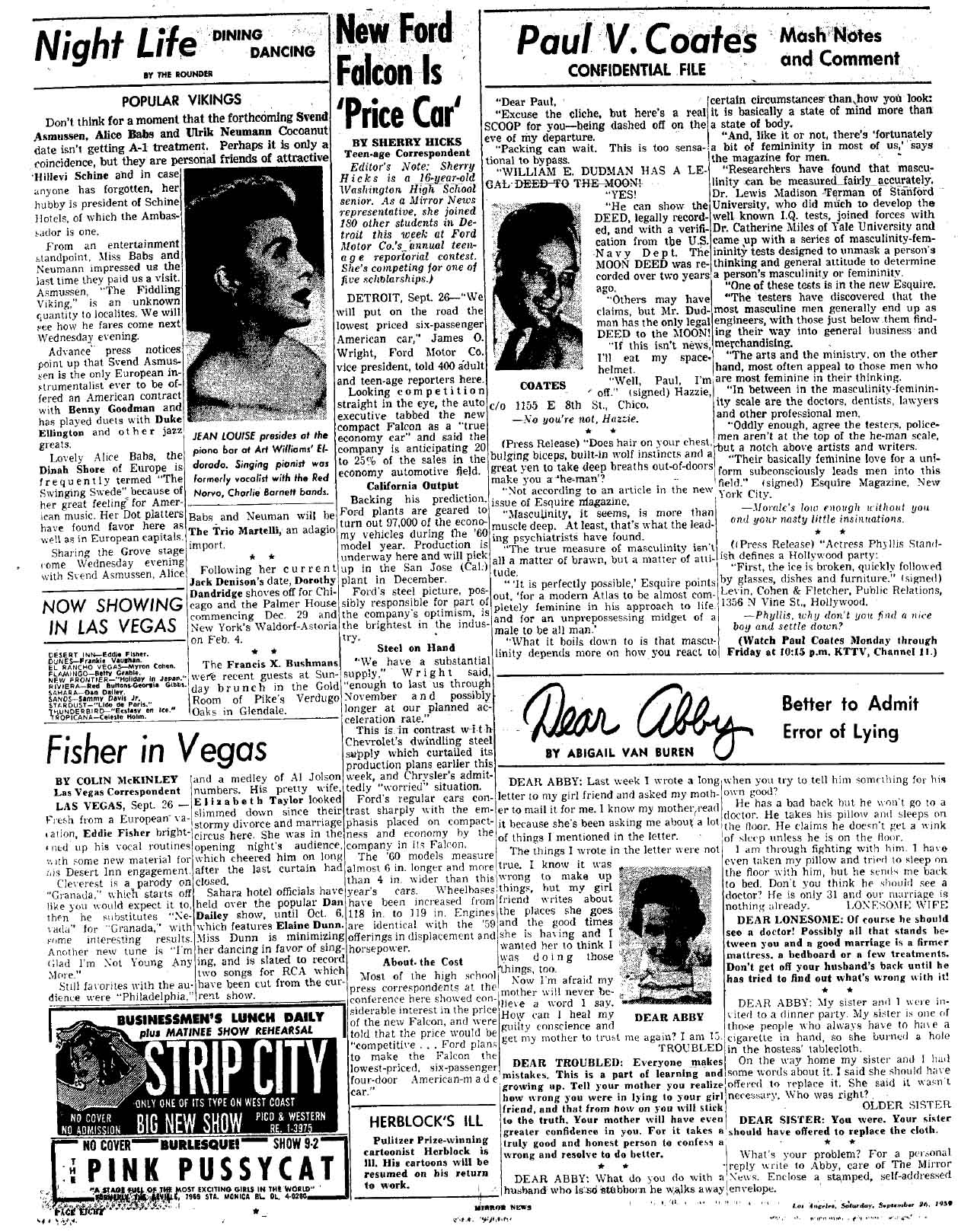
August 26, 1959: Paul V. Coates — Confidential File

August 26, 1959: August 26, 1959: The Miss Universe Contest is becoming increasingly scandalous and tawdry, Paul Coates says. Dear Abby has advice for a woman who sees nothing wrong with having an affair "as long as nobody is hurt."

Posted in Columnists, Paul Coates | Comments Off on August 26, 1959: Paul V. Coates — Confidential File

A Kinder, Simpler Time Dept.: Your Comics


    Aug. 26, 1974, Comics

Aug.
26,
1974: Here's a real slice of the 1970s — "Tank McNamara" and a redesigned "Lolly." "Lolly" was an old 1950s strip that had undergone several incarnations at this point and although the fashions have been updated, it's obviously already out of ideas with an old "Uncle Tom" gag. "Tank McNamara" had more staying power and many papers eventually moved it to the sports pages.

Posted in art and artists, Comics | Comments Off on A Kinder, Simpler Time Dept.: Your Comics

Saving the Watts Towers

Sam Rodia, Los Angeles Times
Photograph by the Los Angeles Times
Simon Rodia (or Rodilla as The Times referred to him in early stories) with his creation in 1952.


By Devon McReynolds

On a recent smoldering Tuesday afternoon, I visited the Watts Towers
for the first time in the three years I’ve lived in Los Angeles. The
heat was impossible and the area beneath the towers and structures was
closed (it will reopen in September).

Even so, in the 15 minutes I
stayed there, three groups of art-seekers came to visit, and all were
in just as much awe as I was. Once you get close to the towers, you can
see the incredible creativity with which Simon Rodia meticulously
pieced together scrap metal, broken dishes, seashells, pieces of glass
bottles, tiles and bed springs into a stunning modern art experience in
the middle of a Los Angeles neighborhood.

Fifty
years ago this summer, public debate arose over whether the folk art
sculptures were structurally sound. H.L. Manley, head of the
conservation bureau of the Department of Building and Safety, said:
"Inspections show these structures are dangerous and should be torn
down. They were built without a permit, without inspection and without
approval of the design."

On May 25, 1959, the Building and Safety
Commission declared the towers unsafe and planned to demolish them if
they failed to pass a 10,000-pound "stress test" to see if they would
topple to the ground.

The enraged art community, locally and
nationally, including New York's Museum of Modern Art and the
Guggenheim Museum, fought back by supporting preservation. In May, the
International Assn. of Art Critics sent a letter of protest to Mayor
Norris Poulson. James Johnson Sweeney, the director of the Guggenheim,
praised the towers as "an expression of enjoyment and creative work
very rare in this country, where we are accustomed to think of the more
practical issues."

Rodia, 81, refused to take part in the
controversy. He had moved to Northern California five years earlier
after leaving a grant deed to the property with a neighbor. The deed
changed hands again before being bought by William Cartwright and
Nicholas King, whose attempts at preservation drew officials' scrutiny.

May 26, 1959, Watts Towers The
Times and Mirror-News also took a stand for saving the towers. "The
Washington Monument, the Statue of Liberty, even the Leaning Tower of
Pisa have never been condemned as attractive nuisances from which
neighborhood kids could fall and break their necks," the Mirror's Jeff
Davis wrote on July 31, 1959, before the crucial test. He concluded:
"Presumably, if the towers are still standing, the populace will then
cheer loudly and the villains from the Department of Building and
Safety will slink away and art will be triumphant."

Mirror columnist and television host Paul Coates wrote extensively about the towers and in 1954 he came close to getting a televised interview with Rodia.
An assistant brought Rodia to KTTV 10 or 15 minutes before airtime, but
as soon as he was introduced to Coates at the studio gates, Rodia fled
down Sunset Boulevard — with Coates and his assistant trying in vain
to chase him down.

On Oct. 10, 1959, the Watts Towers passed the
test, withstanding a side pull of 10,000 pounds, and they have become
an internationally known landmark.

There's no danger of the
Watts Towers falling victim to skeptics any longer, but during the
anniversary of the debate, visit for yourself. Just make sure to resist
any childhood temptation to swing from its sculpted metal rods — even
though they withstood 10,000 pounds of pressure, these aren't your
playground's monkey bars.

Note: UCLA student Devon McReynolds recently completed her
summer internship with the Daily Mirror and is now in Paris.

Posted in art and artists, City Hall | 2 Comments

Hair Trigger


Aug. 26, 1899, Borden  

Aug. 26, 1899: For healthy babies, give them Gail Borden's Eagle Brand condensed milk.

Aug. 26, 1899, Peeping Tom  

A following story clears up some of the confusion. Louis Mayer was a barber and Mary E. Smith was a hairdresser who had an adjoining shop. She accused Mayer of peeping in her window to learn her trade secrets. She was fined $3 for disturbing the peace.

Posted in #courts, Countdown to Watts, Fashion | 1 Comment

Followed by ‘Woman in Black’

Aug. 26, 1889, Shoes

Aug. 26, 1889: Gibson & Lemon, 54 N. Spring St., has Johnston & Murphy shoes.

Aug. 26, 1889, Woman in Black

The Times interviews an unidentified woman who complains of being followed by a unseen "woman in black," who steals things. No one believes her. Not her husband, not the police, nobody.

Posted in health, LAPD, Transportation | Comments Off on Followed by ‘Woman in Black’

Voices — Sen. Edward M. Kennedy, 1932 – 2009

Those Who See Only Dwarfs Today

Are the Sort Who Belittled Giants Past

December 3, 1987

By EDWARD M. KENNEDY, Edward M. Kennedy is the senior senator
from Massachusetts. This commentary is adapted from a speech that he
gave recently at the John F. Kennedy School of Government at Harvard.

My
experience in national campaigns, winning and losing, from 1960 to
1980, has left me with a sense of a widening gap between the real
issues and the reporting–a feeling that the voters are not seeing
candidates whole or clearly, but through a journalistic lens
increasingly honed to the prism of People magazine.

Nothing more
clearly manifests the distorted political bent of the coverage than the
obsession with polls. Everybody takes them, everybody trumpets them and
everybody treats them as the near-equivalent of an election. Candidates
move up and down, gain or lose attention and money, are perceived to be
stalled or surging–and nobody bothers to ask how accurate such
pre-caucus and pre-primary surveys are likely to be, or have been in
the past.

They did not predict the rise of Jimmy Carter in
1976–or the decline of Walter Mondale in 1984. In 1979 the November
polls said that there was no way I could lose Iowa–and in 1980 the
March polls said that there was no way I could win New York.

The
polls did not pick up the McGovern movement early in 1972 or the
McCarthy breakthrough of 1968. Yet now polls have become the
quintessential pseudo-events of the pre-primary campaign. They may tell
us something, but they don't tell us everything. Perhaps we cling to
them because they offer us numbers–and the numbers confer a certain
appearance of reality. It is the statistical analogue of false
consciousness; it is false objectivity. Or perhaps the seductive pull
of the numbers reflects a resistance to the harder work of dealing with
issues on their own terms.

Instead, serious candidates can be all but read out of the race before a single election is run.

And
as each candidate's season passes, much of the press, in
self-fulfilling disappointment, renews the suggestion that they are all
dwarfs anyway. If there is a pack journalism this year, that is its
common chord.

The complaint that there were giants in other
days, running in other campaigns–a complaint amplified by the
question: "Where are they now?"–represents an even deeper disregard
for history than the obsession with pre-primary polls.

Often the giants, too, were at first dismissed as dwarfs in their own time.

Lincoln
was derided as a party hack, with no executive experience. Wendell
Phillips assailed him as "a huckster"–and William Lloyd Garrison
called him a "coward" who would block emancipation.

Franklin
Roosevelt was dismissed by Walter Lippmann as an "amiable man" of no
consequence. The New Republic weighed in that he was "not a man of
great intellectual force or supreme moral stamina"–which sounds like
some of what the New Republic writes about candidates today.

Listen
to some of the other things that were said of F.D.R.–and you will hear
the cliches of 1987. Here are sentences from the Nation magazine:

"His
candidacy arouses no real enthusiasm . . . . (There is) no evidence
whatever that people are turning to Roosevelt . . . . There is small
hope for better things in his candidacy."

Come forward a
generation, to 1960, and Lippmann does it again. He urges that John
Kennedy step aside so that Adlai Stevenson can be drafted. And later in
the year Arthur Schlesinger has to write a book to refute another
journalist's view, widely repeated, that there is no difference between
Kennedy and Richard Nixon.

Obviously, in 1987, there are many
who have forgotten history, for they surely are repeating it. But now
the message of mediocrity is applied to a field of candidates, is woven
like a thread through most of the coverage and magnified by the
increasingly powerful technology of the information age.

People and politicians, candidates and non-candidates alike, are left asking: Is this any way to pick a President?

No
system is perfect–and who would want to return to the time when a
controlled convention could deny the clear preference of the people?

I
think that the press can do a better job of reflecting on its own
role–and recognizing that the choice ultimately belongs to voters, not
reporters.

But here are some things that we can do:

–Candidates
should be able to discuss campaign coverage without fear of being
assailed as "whiners" or "complainers" or agents of repression. I see
no prospect for a resurgence of Agnew-ism, which in any case consumed
its own perpetrator.

–At the same time, the press can resist
the standard of the lowest common denominator, the rationalization that
all news is fit to print that has appeared anywhere else, in any barely
respectable newspaper. Handicapping the race is irresistible, but it
should not be the ceaselessly beating heart of campaign journalism.

–Finally,
we can approach presidential elections with at least a minimal sense of
consequence and history. Why not give stories historical context?
Theodore White told us what went on inside a campaign, but he also
related it to what had gone on in other generations and other
campaigns. And those who borrow his approach should not leave half of
it behind.

Posted in Obituaries, Politics | Comments Off on Voices — Sen. Edward M. Kennedy, 1932 – 2009

Found on EBay — Batchelder Pot

Batchelde Pot EBay

We usually associate the Batchelder name with tile, although the Los Angeles company also produced ceramic items such as bookends. Here's a Batchelder pot that has been listed on EBay. Bidding starts at $200.
Posted in Architecture, art and artists | Comments Off on Found on EBay — Batchelder Pot

Matt Weinstock, Aug. 25, 1959

Aug. 17, 1959, Weinstock Is on Vacation

Matt Weinstock is on vacation.
Posted in Columnists, Matt Weinstock | Comments Off on Matt Weinstock, Aug. 25, 1959

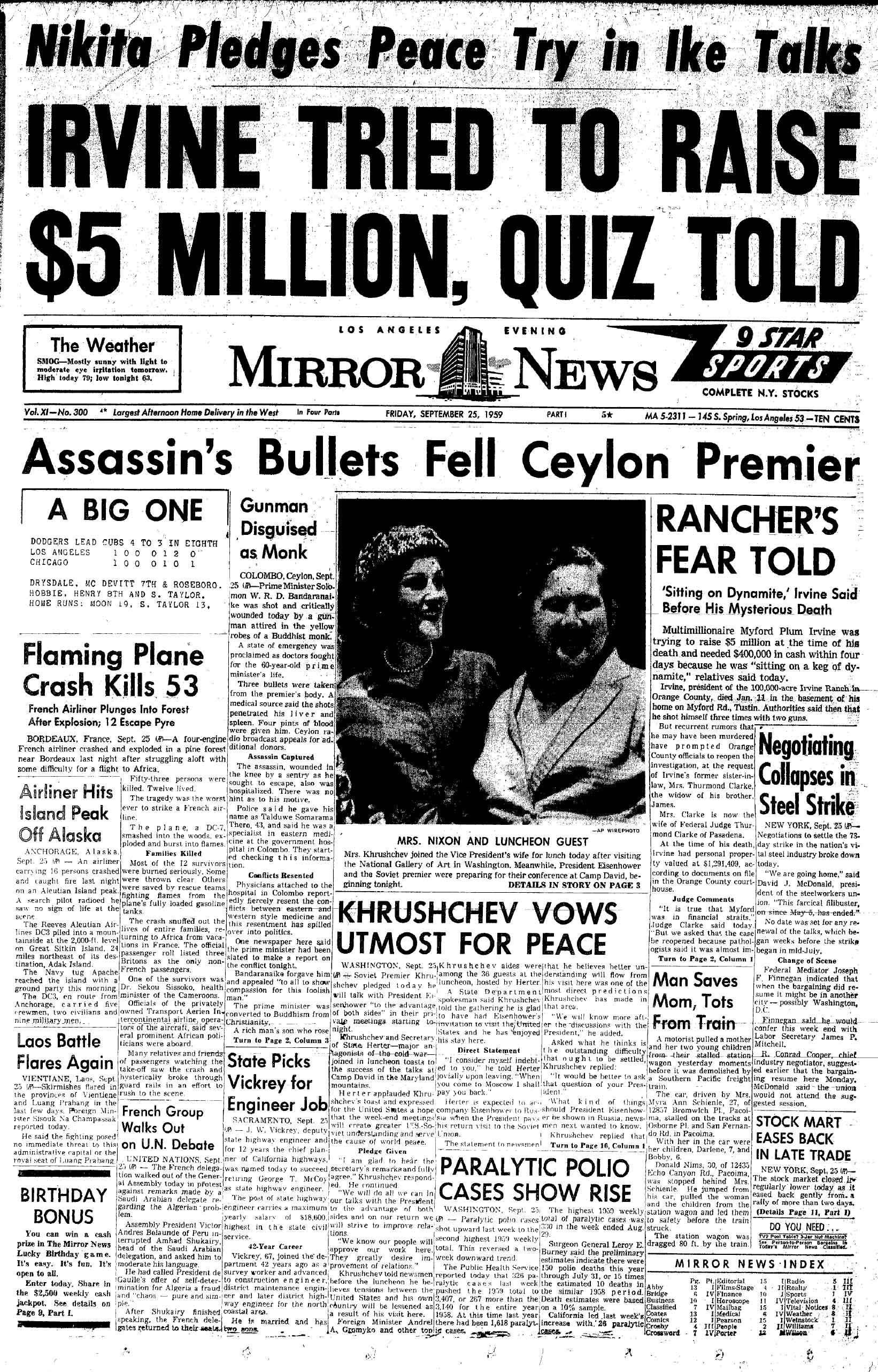
August 25, 1959: Paul V. Coates — Confidential File

August 25, 1959: Paul Coates and Dear Abby

Posted in Columnists, Paul Coates | Comments Off on August 25, 1959: Paul V. Coates — Confidential File

A Kinder, Simpler Time Dept.: Your Comics


   Aug. 25, 1973, Doonesbury

Aug. 25, 1973: The Times continues to alter its comics lineup, eliminating "Dark Shadows" and adding Jack Moore's "Kelly." Notice the much more sophisticated draftsmanship in "Doonesbury," compared with the panels two years earlier.

Posted in art and artists, Comics | Comments Off on A Kinder, Simpler Time Dept.: Your Comics

Coming Attractions — Mexican Science Fiction Films

Ana Bertha Lepe Regular Daily Mirror reader Mary Mallory notes that former Mystery Movie Star Ana Bertha Lepe, left, will be featured in "La Nave de los Monstruos" ("The Monsters' Ship") at 7:30 p.m. on Friday at the Hammer Museum.

The plot summary: "The last man on Venus has died. Beta and Gamma, two Venusian women,
have been sent on an intergalactic mission to collect bizarre male
specimens from throughout space. And a monstrous collection they are
too, all scales and fangs and exposed brains."

Co-hit: "Santo vs. the Martian Invasion." Admission is free.

Read more>>>

Posted in Film, Hollywood Division, Mystery Photo, UFOs | 1 Comment

USC Coed Killed; O’Malley Confident on Chavez Ravine

Aug. 25, 1959, Cover

The imam of Yemen beheads several "Christian agitators" and has others mutilated in a crackdown on liberal reforms … USC student Linda Edna Martin, 21, is found naked and bleeding to death outside her boyfriend's apartment.

Aug. 25, 1959, Parker T-ball Jotter

The Parker T-Ball Jotter is the ballpoint pen of choice at the Daily Mirror HQ. Perfect for doing New York Times crosswords.

Aug. 25, 1959, New York Philharmonic  

Aug. 25, 1959, Coed

In January 1962, John P. Schoeneweg will confess to killing Martin when she stepped out of the shower and surprised him after he broke into her boyfriend's apartment and was taking money from her purse. Schoeneweg also confessed to killing Emeline Ferber and Dors (no, not Doris) M. Wilson.

Schoeneweg was convicted of killing Ferber and Wilson, but found not guilty in Martin's death because his confession didn't match the facts. State death records show that a man named John P. Schoeneweg died in 1972 at the age of 39.

Aug. 25, 1959, Coed

Aug. 25, 1959, Princess Phone

A Princess phone, a major innovation at the time.
Aug. 25, 1959, Immigration

Aug. 25, 1959, Chubby

Is this girl supposed to be "chubby"? A point of departure for a long conversation.

Aug 25, 1959, Immigration

At left and above, an installment of Charles Hillinger's series on illegal immigration.

"There is no opportunity for someone like me in Tijuana. I sell candy and gum at a stand. Make $5 ($36.54 USD 2008) a week if I'm lucky. It's enough to get by on. But what kind of a future is there?"

Aug. 25, 1959, Blue Angel

We're still in the 1950s for a few more months. But notice that in theme and in spare, simplified design, this ad for "The Blue Angel" could have been done in the mid-1960s.

Aug. 25, 1959, Mickey Cohen

Aug. 25, 1959, Valentino

Above, 50 people attend the 33rd memorial for film star Rudolph Valentine. There was no sign of the "lady in black."

At left, lawyer Melvin Belli introduces Mickey Cohen as guest speaker "Professor O'Brien," at a bar convention. 

Aug. 25, 1959, Comic

"You Neanderthal Brute!"

Aug. 25, 1959, Walter O'Malley

No doubt about it, Walter O'Malley was an optimist.

His deal with the city to build his Dodgers a ballpark in Chavez Ravine was still held up in the courts, and city leaders were starting to worry about spending money for road construction just in case there wasn't going to be a ballpark at the end of the road.

O'Malley was still making plans and staying hopeful. He told The Times' Jeane Hoffman the plan was to start digging by Sept. 15 and have the stadium finished by July.

"We would first have to level the stadium site and hills, then get ready to pour the concrete," he said. "The city in turn will close off several roads. It means we're jumping the gun, but we feel it's a good risk."

— Keith Thursby

Posted in #courts, Charles Hillinger, Comics, Dodgers, Fashion, Film, Front Pages, Hollywood, Homicide, LAPD, Sports | 1 Comment

Man Sleeps Off Drunk on Top of Brooklyn Bridge

Aug. 25, 1899, Dr. Wong  

Aug. 25, 1899: Dr. Wong offers free consultations, 713 S. Main.

Aug. 25, 1899, Drunk New Yorker


Mr. Wagner sleeps off a drunk on top of the Brooklyn Bridge and is rescued by "Jim the Climber." No, he doesn't remember how he got there … Officer George H. Walker resigns from the Redlands Police Department after killing Clinton P. Hawley.

Posted in #courts, Food and Drink | Comments Off on Man Sleeps Off Drunk on Top of Brooklyn Bridge

Profiles in Domestic Violence

Aug. 25, 1889, E. Adam

Aug. 25, 1889: Prince Albert suits for $14 ($331.36 USD, 2008).

Aug. 25, 1889, Abused Wife

The late 19th and early 20th century newspapers are full of harrowing stories about domestic violence, usually alcoholic men beating their wives and children. The women in these reports typically say that they endure countless beatings because they are unable to support themselves and their children, and because the husbands, once sober and/or in jail or in court, promise to reform.

In fact, the husbands almost never reform and the drinking and beatings escalate until the women end up in the hospital and the husbands are prosecuted, even though the wives refuse to press charges.

I've come across an interesting variant of these stories in the papers of the 1950s. As the abused children grow older, one of them — usually a son in his mid-teens — confronts the drunk, abusive father as he's beating the mother and kills him. I haven't read enough of the earlier papers to know if this occurs regularly, but these stories are a fixture of the mid- to late 1950s.

Posted in #courts, 1889, LAPD | Comments Off on Profiles in Domestic Violence

Matt Weinstock, Aug. 24, 1959

Aug. 17, 1959, Weinstock Is on Vacation

Matt Weinstock is on vacation.
Posted in Columnists, Matt Weinstock | Comments Off on Matt Weinstock, Aug. 24, 1959

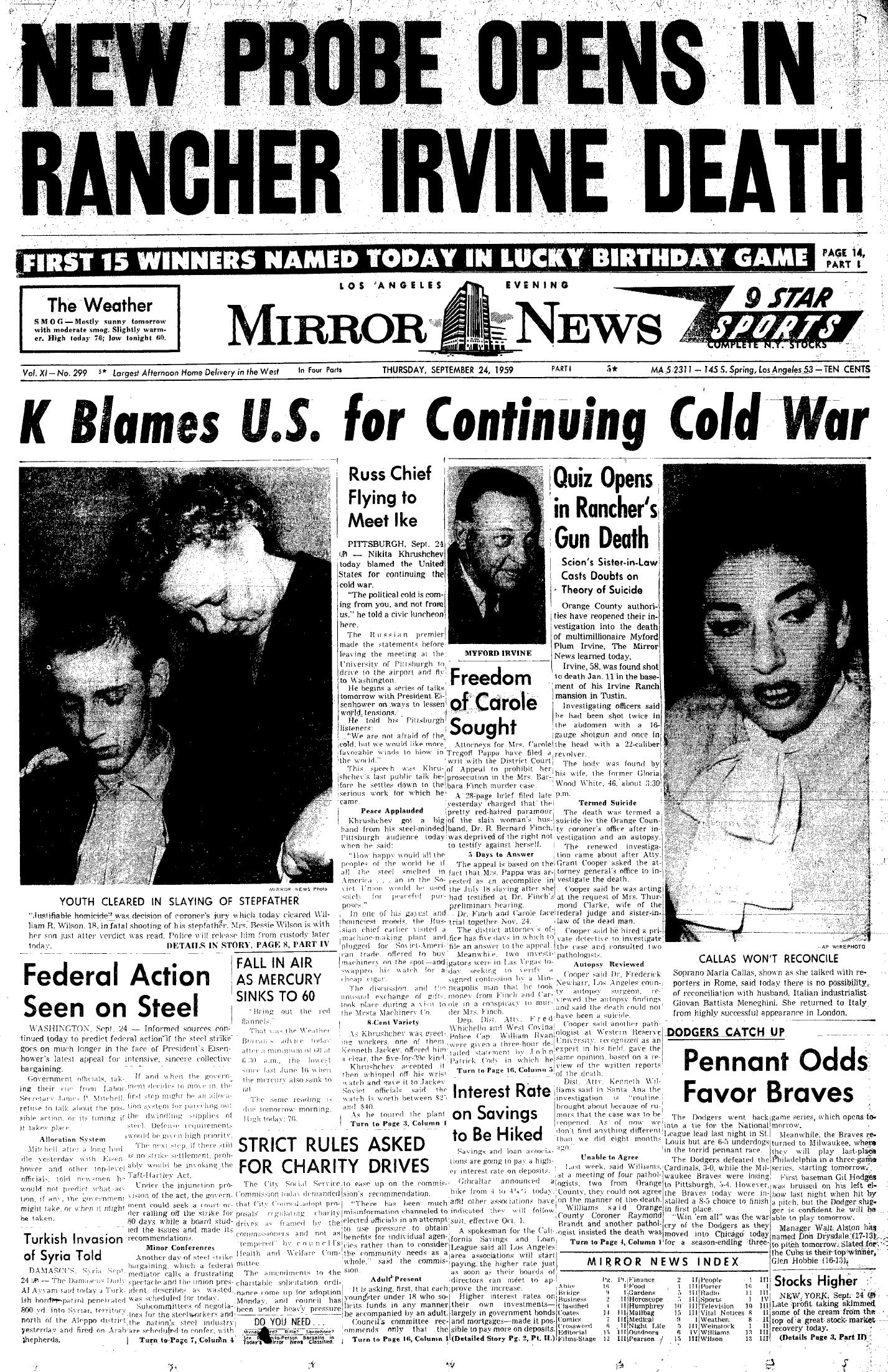
August 24, 1959: Paul V. Coates — Confidential File

August 24, 1959; Mirror CoverGreat Impostor Fools Our City Too

Paul Coates, in coat and tieFerdinand Waldo Demara Jr., age 37, is, by profession, an impostor.

Without benefit of a high school diploma, he has masqueraded as a college dean of philosophy, a surgeon in the Royal Canadian Navy (where he performed major operations), a Trappist monk, a cancer researcher, assistant warden of a large Texas prison and half a dozen other professions of equal status.

With each new job he assumed a new identity and a new personality. And, from his superiors as well as subordinates, new respect.

With rare exceptions, he conned them all. Continue reading

Posted in Columnists, Paul Coates, Religion | Comments Off on August 24, 1959: Paul V. Coates — Confidential File