

Here’s today’s mystery chap, courtesy of Steven Bibb!
 Nov. 22, 1941: Here is Times reporter Tom Cameron’s description of the execution of Juanita “the Duchess” Spinelli:
Eight cyanide “eggs” under the chair dropped into a bucket of sulfuric acid and distilled water.
Nothing happened. The Duchess, her back still to her audience, was moving her lips in silent supplication.
The beads of perspiration began to stand out on reporters’ brows. Then the Duchess coughed. Through the heavy glass and steel it sounded like that of an asthmatic sufferer. The Duchess’ head dropped forward in a nod.
Then it jerked back, back until her long graying hair streamed down over the chair.
The Duchess coughed again; then blew out her breath with a sound like that a horse sometimes makes with his lips.
“Lemme outta here!” an elderly man whispered, “reminds me of my kid — he’s got asthma.” He forced his way through the spectators and went outside.
“That’s an old retired guard,” someone whispered. “He was saying a while ago the gallows was more decent than this.”
The Duchess was coughing more frequently now. Again, she blew invisible fumes from her lungs. Her head swung back over the chair, her eyes staring straight up at the low ceiling.
A large vein on the right side of her neck was still throbbing. Her mouth looked sunken, for they had taken away her false teeth. A gray, unhealthy pallor was spreading over her face. She was still alive, yet she had been in that little room, with every cranny of its 355.44 cubic feet of air space packed with the deadly gas, for what seemed a long time.
But it had been only five minutes — if my watch hadn’t stopped. A glance showed it hadn’t.
Another five minutes — the longest 300 seconds I’ve ever watched go into eternity — ticked off. The vein in the Duchess’ neck had long ceased pulsing.
Thirty seconds more. Then:
“That’s all, boys; the times were 10:14 1/2 and 10:25.” (Ten and one-half minutes from the time the cyanide was dropped until the stethoscope had indicated beyond doubt the Duchess’ heart — the heart that the law said was too evil to live, yet only Tuesday had thrilled over the sight of a baby — had stopped.)

In keeping with the theme of the 1941 execution of Juanita “the Duchess” Spinelli, here’s a souvenir brick from San Quentin that has been listed on EBay. Bidding starts at $49.95.


Nov. 21, 1941: Juanita “The Duchess” Spinelli arrives at San Quentin to be executed in the gas chamber – the first woman legally executed in California’s history.
“No one who is a Christian will kill!” the 52-year-old mother of three cried in a voice as gray as her face, as lifeless as her gaunt, bony frame. “My blood will burn holes into their bodies,” she cried. “Before six months have passed they will be punished.”
Because the killing occurred in Sacramento, The Times only ran occasional wire stories about the case, which is frustrating for the researcher. The execution was covered by Times reporter Tom Cameron, who died in 1982 after retiring from The Times in 1966 as real estate editor.
Jimmie Fidler says: Papa Walter Huston and son, John, are collaborating on a script based on the life of President Ulysses S. Grant, in which Walter will star under John’s direction.

Photo: A model of a 1959 Cadillac hearse, listed on EBay for $599.99.
Queen of the Dead—dateline November 21, 2011
• “The Baroness Huntingtower died on the 8 th inst.,” said Lady Prudence Fairfax. “Not Katherine Grant of Rothiemurchus, the 12th Countess of Dysart!” exclaimed Lady Marjorie. “Such a shock, though she was 93.” Yes, there is one less Countess in the world, and there are few things I would not give to be called The Baroness Huntingtower (though that is my nickname down at the Blue Bar on 44th Street). Lady Katherine Greaves was a Scottish (not “Scotch,” if you please) peeress who didn’t even get to become a Countess till her childless sister, Lady Rosamund Agnes, popped her clogs in 2003. “No mourning, no flowers please,” says her London Times death notice. I shall withhold the flowers (though I have a huge floral blanket reading POLA) but I damn well shall mourn.

This photo of the “Greatest Generation” at play at the Florentine Gardens, c. 1944, has been listed on EBay. Bidding starts at $15.99.

Here’s another mystery chap, courtesy of Steven Bibb.
[Update: This is Robert Beatty. Please congratulate Don Danard and Rotter for identifying him. Here’s his obituary in the Los Angeles Times | New York Times ]

Nov. 20, 1941: California prepares to execute Juanita “The Duchess” Spinelli at San Quentin. Spinelli, her boyfriend Mike Simeone, Gordon Hawkins and Albert Ives were convicted of drugging and drowning Robert Sherrard to keep him from informing on them about another killing.
Spinelli was the first woman to be legally executed in California. She was followed by Louise Peete (1946), Barbara Graham (1955) and Elizabeth “Ma” Duncan (1962). A Mexican woman usually identified as Juanita was lynched in Downieville, Calif., in 1851 for killing a man named Jack Cannon, who is variously described as Scottish or Australian.
Jimmie Fidler says: Lucille Ball left by plane yesterday to join hubby Desi Arnaz in New York, then to Cuba for Christmas.
Also on the jump: The proper headwear for working on an old car – especially if your name is Goober.

A reprint of a c. 1907 photo of a tattooed woman from the Plaza Gallery in Los Angeles has been listed on EBay. The photo is listed as Buy It Now for $8.99.
On the jump, the tattooing craze, from 1910.

This post has be edited. See note at bottom for explanation.
Nov. 19, 1941: Angelka Rose Gogich was 18 when she died at Glendale Emergency Hospital after undergoing an abortion. She had be working as a model, hat check girl and dancer under the name Rose Ann Rae. Her boyfriend was Alfred Mathis, a 33-year-old sports promoter. The abortion was allegedly performed by a chiropractor named James F. Petrie, who fled to Mexico, claiming that his estranged wife was ill, The Times said.
On Oct. 24, 1941, Mathis brought Gogich to see Dr. Patrick S. O’Reilly of Glendale Emergency, with the story that her name was Mrs. Ann Gray and her husband was a soldier at Ft. Ord, The Times said. An examination revealed that she was pregnant and she remained at the hospital until Oct. 31, O’Reilly said. Gogich’s mother accused O’Reilly of referring the victim to Petrie, but O’Reilly denied the allegations, the Los Angeles Examiner reported.
Petrie allegedly performed an abortion, but there were complications, and on Nov. 3, Gogich returned to O’Reilly’s hospital, where she died Nov. 15. By law, O’Reilly should have reported to incident to officials, but he told the coroner’s inquest that he thought a death certificate was all that was needed. The cause of death was listed as “peritonitis due to septic abortion and pernicious anemia.”
Gogich was survived by her mother, Rose, and a sister, Nellie.
In 1942, Petrie returned from Mexico and on March 30, he surrendered to LAPD Homicide Detective Harry Fremont. While free on bail, he was accused to trying to get a witness to change her testimony. The outcome of the case cannot be found in The Times.
If the names in this case sound familiar, there’s a reason. Harry Fremont was one of the investigators in the Black Dahlia case and was later charged in the Bloody Christmas beatings. Dr. Patrick S. O’Reilly (sometimes spelled O’Reilley or O’Riley) was a notorious character who was accused to trying to rape his receptionist and was investigated in the Black Dahlia case as a member of a “clique of sex degenerates.” No link was ever found between him and Elizabeth Short.
A few historical notes on abortions: Like most papers of this era, The Times rarely used the word “abortion,” and preferred “illegal operation.” Other euphemisms were “criminally attacked” for rape and “mistreated” molestation. It is extremely rare to find a licensed medical doctor performing abortions in this era. They were usually done by chiropractors, osteopaths, physical therapists, nurses, possibly a medical student and sometimes people with no medical training whatsoever.
Tom Treanor writes about the recent visit of the United Daughters of the Confederacy.
Jimmie Fidler says:That femme columnist who likes to correct other reporters (but makes so many mistakes herself that others have long since lost sport in correcting her) achieved a new high in misreporting.
Note: I have edited this post to add attribution from The Times and the Examiner, and to qualify the allegations against Petrie, because I was unable to determine the resolution of the case.

A lot of 10 commemorative covers from the 1940s mailed to Bullock’s Wilshire has been listed on EBay. I’m not sure whether Bullock’s had a coin and stamp department or if this is from some other activity. Bidding starts at 99 cents.

Here’s today’s mystery photo, courtesy of Steven Bibb!
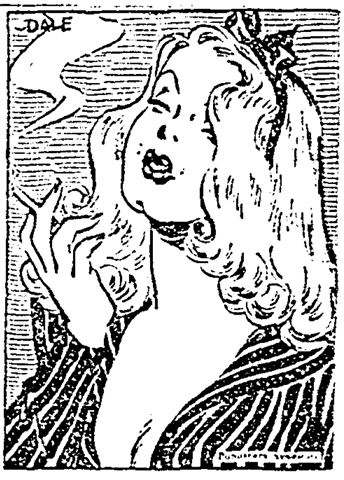
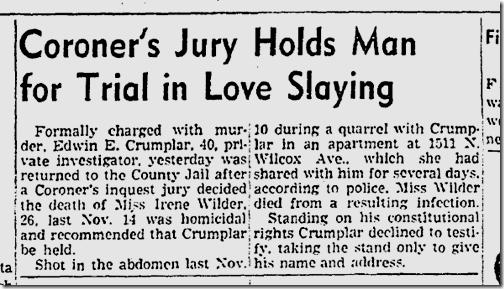
Nov. 18, 1941: Jimmie Fidler says that new Alan (Paramount white hope) Ladd and Sally Wadsworth romance won’t please his studio, which is readying a “wolf” buildup.


217 W. 6th St. via Google Street View.
A wooden box from the Chocolate Shop has been listed on EBay. The shops were located at 211 W. 5th St., 217 W. 6th St., 731 S. Broadway and 20 E. Colorado Blvd. in Pasadena. In 1923, two of the stores were taken over by Brown’s Chocolates. The shop at 217 W. 6th, which is decorated with Batchelder tiles in a Dutch theme, was later remodeled into Finney’s Cafeteria. Bidding on the box starts at $24.95.

Manson family member Charles “Tex” Watson was denied parole. L.A. Times | AP via Washington Post
Stephan Benzkofer of the Chicago Tribune takes a look at Police Officer Francis O’Neill in Part 2 of his Legendary Lawmen series.
Edith Brady-Lunny of Lee News Service profiles Myra Westray, 93, who was honored recently for replacing her husband, Kenneth, as sheriff of DeWitt County, Ill., while he was serving in World War II.
The L.A. Daily Mirror and L.A. Crime Beat curated from only the finest Twitter feeds by the discerning bots at paper.li


Nov. 17, 1941: Reporter Mary Shaw Leader is honored posthumously for her work in covering Abraham Lincoln’s Gettysburg Address. Leader, a reporter for the Hanover Spectator, walked 15 miles to Gettysburg, Pa., to cover the Lincoln’s talk.
“She carried his full three-minute text in the weekly Hanover newspaper while most journalists gave their space to principal speaker Edward Everett’s flowery oration of nearly two hours or merely announced that Lincoln also spoke.”
Times reporter Cecile Hallingby writes a first-person account of a weekend at Camp San Luis Obispo as one of 80 “U.S.O. Dates for Defense.”
“The big dance at the camp Saturday night, at which the ratio of solders to girls was about 10 to 1, was definitely voted the outstanding event of the weekend.”
Jimmie Fidler says: RKO’s “Mexican Spitfire at Sea” at a glance — Marion Martin: “This is my third ‘comeback.’ I’ve gone up and down in this business so often I’m developing a bounce.”

This image, dated May 17, 1945, from the Florentine Gardens has been listed on EBay. The war in Europe had just ended on May 8 and perhaps these folks are doing a little celebrating – and wondering what peacetime would be like. A snapshot of the “Greatest Generation” at play. Bidding starts at $9.95.


One thing that drives me crazy about the current crop of period films is that men usually don’t know how to wear hats.
“The Black Dahlia” (with costume design by Jenny Beavan) is a particularly excruciating lesson in unfortunate hat wear. I mean look at these guys! Stick a hat — any hat — on your head and voila! The 1940s.
There is an art to pairing the right hat to the right actor – and there’s an entire language of hats in the way they were worn in films in the 1940s.

A 1923-24 guide to Metro pictures, published for theater managers, has been listed on EBay. Full-color printing was quite expensive in this era, and it’s always interesting to see how much mileage a commercial artist could get from two colors. In this case, the artist did a remarkable job with black and red. The red adds a bold touch and the custom lettering of “Mae Murray” is very classy. Bidding starts at $59.99.

There are so many things that Brian De Palma got wrong in “The Black Dahlia” that a list of mistakes would fill a long book. I had forgotten that the movie starts out with what is purportedly the Zoot Suit Riots.

LAPD officers ignore cars that have been overturned and set on fire. There is nothing to indicate this actually occurred. Zero.

