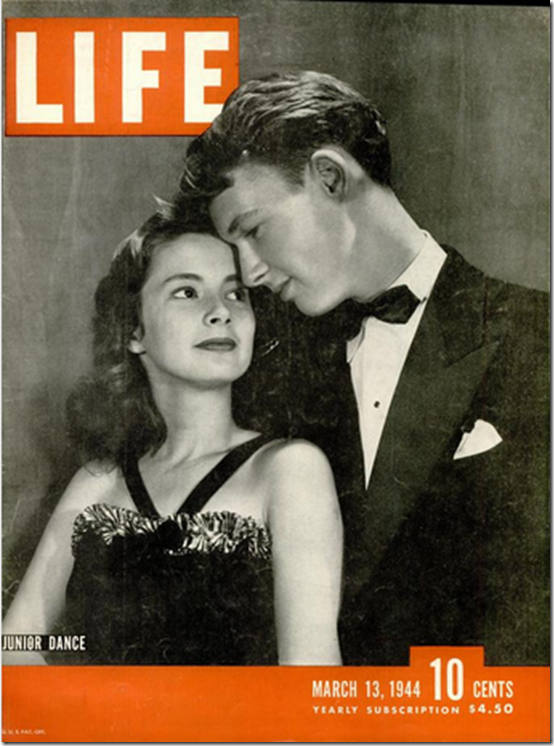
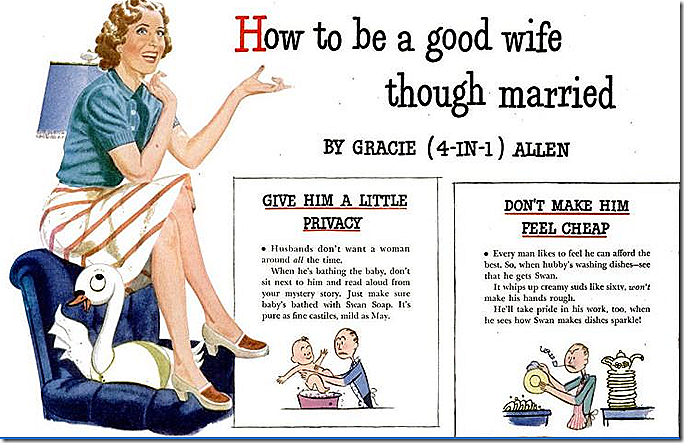
Jan. 3, 1944: Google has thoughtfully scanned Life magazine for 1944. Here’s the first issue of the year.

Jan. 3, 1944: Google has thoughtfully scanned Life magazine for 1944. Here’s the first issue of the year.

Aug. 26, 1946: Harvey Glatman is arraigned on robbery charges in Albany, N.Y.
When he was still a teenager, Harvey Glatman was already displaying the behavior that led to the deaths of three Southern California women in the 1950s and his execution in the gas chamber.
Glatman was born in New York, but moved with his parents, Abe and Ophelia, to Denver, where he apparently lived until his middle teens.

Joining us in our question, blogger Militant Angeleno also asks “What happened to the Lindbergh Beacon on City Hall?”
The Militant says: “Leaving the Lindbergh Beacon off during the holiday season makes Huell Howser’s angel cry.”

And for Tuesday, a mystery woman, courtesy of writer Christopher McPherson.

Jan. 2, 1944: “Texaco Star Theater” with Fred Allen, Portland Hoffa and violinist Albert Spalding. Courtesy of archive.org.

Aug. 27, 1946: Harvey Glatman in the Yonkers, N.Y., Herald Statesman.
Whenever I am contacted by TV producers about appearing on a crime show, I always caution them that I’m a specialist not a generalist. I don’t do Sal Mineo, Marilyn Monroe, the Manson family or O.J. Simpson, etc., etc. Just the Black Dahlia.
But as I was reminded by a television production company from Australia, I had written several entries on Harvey Glatman when the blog was at latimes.com. They asked if I would please consider discussing him.
So I reluctantly agreed.
To be honest, I don’t like talking about Harvey Murray Glatman, at right, about 1946, who was born Dec. 10, 1927, in New York and executed in the California gas chamber Sept. 18, 1959. The women he killed were nothing but objects to him and they endured horrible ordeals before being strangled. Oh yes and he took pictures of them, in case you didn’t know.
The deaths of his Los Angeles victims Judith Ann Dull, Shirley Ann Bridgeford and Ruth Rita Mercado were already covered when the blog was at latimes.com, so I won’t repeat that information here.
But I think it’s wrong to waste research, so over the next few days we will look at Glatman’s earlier crimes, the ones that occurred in New York in the 1940s.
To be continued.

And here’s our first mystery photo of the new year, courtesy of writer Christopher McPherson.

January 1944 Weird Tales, for sale on EBay at $49.99.
I had so much fun adding radio broadcasts for Christmas 1943 that I thought I would add radio shows throughout the year, on the days that they aired in 1944 – our base year for 2014.
That’s been interesting (there are lots of old-time radio shows out there). Some of the shows are timeless, but I discovered that our friend Fred Allen was making lots of lots topical references in his programs, including one to an article in Life magazine about comedians. Fortunately, Google has scanned all of Life for 1944, so those got added to the mix.
Then I remembered another website that has scanned lots of old magazines, like the American Mercury, Saturday Review of Literature and Weird Tales.
So now we have the 1944 magazine rack. Hope you enjoy the reading! Courtesy of Unz.org

Jan. 1, 1944: And so we start with our experiment of going through 1944 on the radio, beginning with “Challenge of the Yukon,” a 15-minute program later named “Sgt. Preston of the Yukon.” Courtesy of archive.org.

Feb. 17, 1936: I think this may be my favorite entry so far. Times artist Charles Owens and columnist Timothy Turner visit a Japanese flower shop on San Pedro Street north of 1st Street, which was converted by Toyo Y. Maeda from a garage and parking lot.
Enter a hidden garden of a size and beauty that makes us say “Oh!” It is a completely Japanese garden with miniature landscaping in large plats or little flower boxes one can pick up; with miniature bridges over imaginary streams, a Shinto shrine in the corner — an apparently accidental yet carefully studied arrangement of flora in profusion…
Traffic cannot be seen or heard, for the walls keep the sound out. You can stand there right in the heart of old Los Angeles, with streetcars and motor trucks jammed on all sides, and hear birds sing and look up at the blue square of sky and write a poem or chew gum meditatively — commune with nature according to your desires.
An anonymous drawing of Cafe de Leche found in Cafe de Leche.
I am at Cafe de Leche in Highland Park this morning and a little while ago I heard the woman at the next table tell her companion that “All in the Family” starred Ed Asner. So I had to do an emergency Baby Boomer cultural intervention. She was very nice and explained that she’s a history teacher and was trying to think of sitcoms that her students could watch to compare modern situation comedies with those of earlier eras.

And for the last mystery photo of 2013, we have this New Year’s Eve mystery woman.

Yes, it’s Gloria Swanson. And why would there be a photo of Gloria Swanson on New Year’s Eve? To reference this scene, set on a very different New Year’s Eve. (Back of the Head Guy = William Beedle Jr.)

Happy New Year’s Eve 1943 from the pen of Ernie Bushmiller!

Dec. 31, 1943: The Times lists the top stories of 1943. For Los Angeles, that included Zoot Suit Riots (June 7), the 48-hour work week (July 21) and Frank Sinatra at the Hollywood Bowl (Aug. 11).
Film columnist Philip K. Scheuer goes through his calendar, listing what he considered the hits and duds for every month of the year. The titles will challenge all but the hardest-core TCM fans. For every “Casablanca” or “Ox Bow Incident” there’s half a dozen “Chetniks” (later titled “The Fighting Guerrillas”) or “Lucky Jordan.”

Here’s Monday’s mystery chap, courtesy of writer Christopher McPherson.

The Studio City Theatre, courtesy of Mary Mallory.
Celebrities and movies have existed as an integral part of Studio City’s economic life from its very beginning. Established as a motion picture district in 1928, Studio City would see entertainment-related businesses spring up over the years, as well as retail and restaurant establishments run by motion picture and television stars. What had originally been ranch and farmland would eventually become an entertainment hub for the city of Los Angeles.
Mary Mallory’s “Hollywoodland: Tales Lost and Found” is available for the Kindle.


Dec. 27, 1943: The British sink the Nazi battleship Scharnhorst off the coast of Norway. With the loss of the Scharnhorst, and the sinking of the Bismarck in 1941, the Nazis were left with the Tirpitz, the sister ship of the Bismarck, and the Gneisenau, the Scharnhorst’s sister ship. The Gneisenau was badly damaged in a 1942 bombing raid while in dry dock and scuttled in 1945. The Tirpitz was hit by “midget submarines” and after continuing attempts was destroyed in 1944.
Tom Treanor, who will be killed in a jeep accident during the liberation of France, writes of spending Christmas Eve with a P-40 squadron in Italy. The fliers have made themselves comfortable after previous hardships. “No use making war tougher than it already is,” Treanor says.
Continue reading

Just in time for New Year’s, we’ll take a look at a “lost drink,” making a brief inquiry into San Francisco’s Pisco Punch, made famous by Bank Exchange saloon owner Duncan Nicol (often spelled Nichol or Nicoll), who died in 1926 without revealing the recipe.

1980 was a bloody year in Los Angeles, with more than 1,000 killings for the first time in its history.
For the LAPD, homicides increased 30% from 1979 to 1,038 in 1980. The Sheriff’s Department also a reported a 7.9% increase to 424 homicides, according to a 1981 story in The Times, although the Sheriff’s Department now reports the 1980 homicide figure as 372.
In November 1980, Sheriff Peter Pitchess said the homicide rate for all of Los Angeles County was 1,557 for 1979, and noted grimly: “This year we are past the 1,500 mark already, the way we are going we’re going to be around 2,500. Pretty close. Some place above 2,000.”
But Los Angeles was not alone. Even its sedate neighbor, Orange County, experienced a 19.1% increase, from 93 to 122, according to The Times.

![]()
The Slaughter at Bob’s Big Boy occurred on the violent weekend of Dec. 12-14, 1980. But the 32 homicides failed to set a record. The LAPD had recorded 34 homicides on three previous weekends in 1980 (Aug. 1-3, Aug. 29-31 and Oct. 10-12) and from Dec. 28-30, 1979, recorded 36 homicides.
Amid the rising fear of deadly violence, Los Angeles was wondering why.
“Some attribute the rising homicide rate to what they believe are lenient judges, lenient legislators and a public acceptance of ‘doing your own thing.’ Others attribute it to poverty, child abuse, insanity and drugs,” The Times said in a January 1981 analysis.
It’s beyond the scope of the L.A. Daily Mirror to examine even a fraction of the more than 1,038 killings that occurred in the city of Los Angeles in 1980. It’s impossible to even examine in any depth all 32 homicides that occurred on the violent weekend of Dec. 12-14, 1980.
So we will look at one case: The Slaughter at Bob’s Big Boy.
To be continued.
![]() Suspect 1, DR-80-585-895 |
![]() Suspect 2, DR-80-585-895 |


Dec. 14, 1980: The takeover robbery of Bob’s Big Boy at 1845 S. La Cienega Blvd. was part of a rising tide of violence in the 1980s. As The Times noted, “the latest multiple murders occurred about eight blocks from the spot where four people were shot to death last Aug. 24.”
In an Opinion piece, then-Dist. Atty. John Van de Kamp said: “With the latest wave of slaughter has come a general recognition that the world around us is intolerably violent and that if we want to survive we’d better do something about it.
“This recognition is late. It has come only after years of spiraling homicide rates, only after the fear of homicide has gripped the upper and middle classes — those people who control our society.
“It has come only after killings in such affluent places as Venice, West Los Angeles, Santa Monica, Hancock Park and on La Cienega Boulevard at Bob’s Big Boy restaurant have brought home the undeniable fact that today no one is immune to violence.”
To be continued.