May 8, 1944
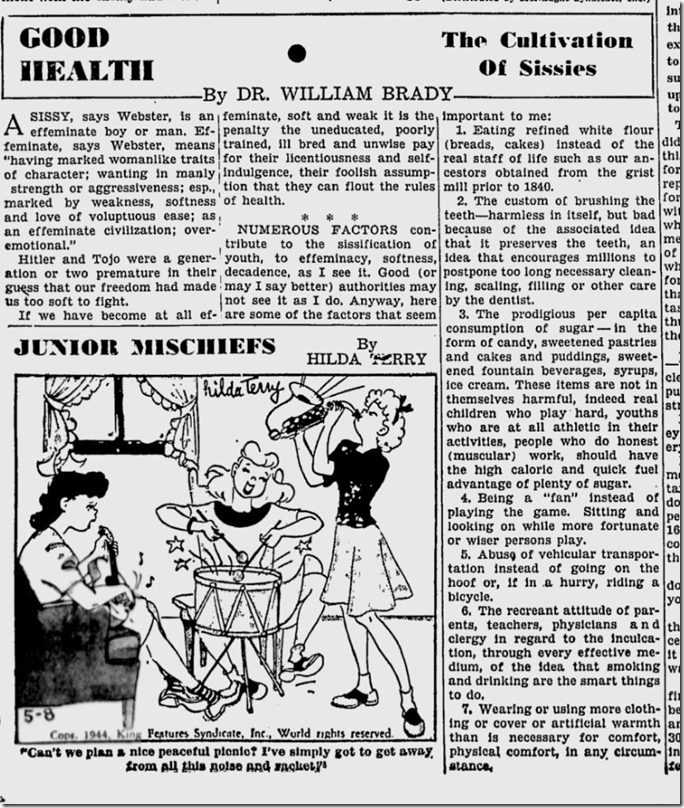
Many factors contribute to the “sissification” of youth: White flour, not getting your teeth cleaned, sugar, being a sports fan instead of a player, riding in a vehicle, smoking and drinking, and wearing too much clothing.
May 8, 1944
Many factors contribute to the “sissification” of youth: White flour, not getting your teeth cleaned, sugar, being a sports fan instead of a player, riding in a vehicle, smoking and drinking, and wearing too much clothing.


May 8, 1944
HOLLYWOOD, May 7 — Susan Hayward’s radiant happiness at playing the lead in “Dark Waters” was short lived, for Susie is out and Merle Oberon is in. This is the way it happened. Before Susan was so much as mentioned, Ben Bogeaus, the producer, was doing his best to get Merle. The deal was nearly closed, with Mike Levee negotiating the contract. But it wasn’t until Saturday that Merle found she could accept the offer.

This is the last in our series of posts on the 1928 Lon Chaney film “While the City Sleeps.” We have previously looked at the history of the film, the plot (convoluted), the reviews (mixed) the condition of this print (damaged and missing about 20 minutes), and the use of Los Angeles’ then-new City Hall.
Today, we’re going to pull back the curtain on a bit of movie trickery used in the film.
Warning: Spoilers ahead.
In the three previous posts on the 1928 Lon Chaney film “While the City Sleeps,” we took a brief look at the production history and the plot, the critical reaction (mostly mixed) and the curious condition of the print, which is missing fairly substantial portions of the film and has nitrate damage.
In this post, we will examine the film’s use of Los Angeles City Hall, which was dedicated April 26, 1928, a little more than a month before shooting began on “While the City Sleeps.” I hesitate to say that this is the first use of City Hall in a motion picture (one never knows what crazy movie people were doing in the crazy ‘20s), but it must be one of the earliest.
This is going to be a breakdown of the film sequence. Then we’ll go back and look for locations.
Warning: Spoilers ahead.
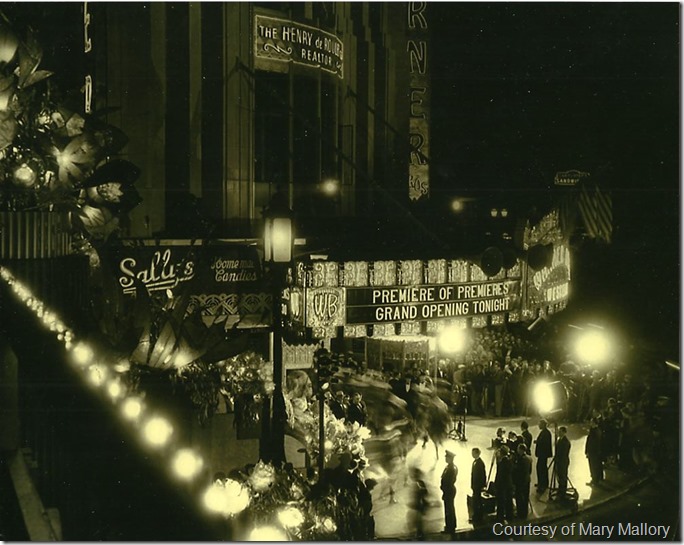
The grand opening of what was then the Warner Western Theater, courtesy of Mary Mallory.
The history of one street corner can often show the growing pains of a burgeoning city. What started out as a rural location can often times become a gorgeous office tower drawing all eyes to its sleek structure. Such is the case with the magnificent Wiltern Theatre, still proudly standing at the southeast corner of Wilshire Boulevard and Western Avenue, an emblem of a city dreaming of a spectacular future.
Since the 1880s, the 80 acres southeast of Wilshire Boulevard at Western Avenue had been the Germain Pellissier family ranch, green pasture housing merino sheep. As early as 1913, they smartly recognized the economic potential of the area and subdivided their 80 acres southeast of the intersection of Wilshire and Western into residential lots in a district named Pellissier Square, nicknamed “Uptown.” The land included a provision that the area would remain single-family homes until Jan.1, 1925. In 1916, some homeowners attempted to get this covenant overturned so that the land would always remain residential, but lost.
Mary Mallory’s “Hollywoodland: Tales Lost and Found” is available for the Kindle.
While we are on the subject of obituaries, here’s a sermon by the late Dr. Glen Stassen, “The Ten Commandments,” delivered in 2008 at First Baptist Church of Pasadena.
Here’s a sermon from 2007 titled “God Is Green: Do We Care?”
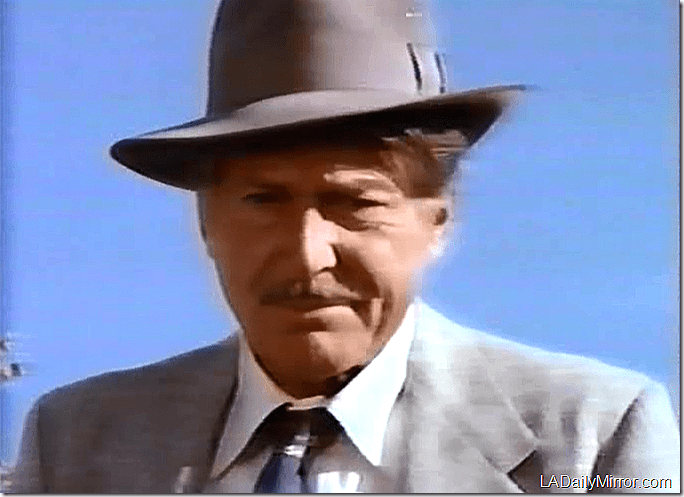
Efrem Zimbalist Jr., who died yesterday at the age of 95, is better remembered for “77 Sunset Strip” and “The F.B.I.” He’s probably even better remembered for “The Chapman Report.” But yes, he did portray LAPD Det. Harry Hansen in the 1975 TV movie “Who Is the Black Dahlia?” As far as I know, this film only exists in various bootleg versions. And for the moment, there is a copy on YouTube. The important thing to remember is that many individuals were still living when the movie was made, so their identities and details of the case were changed because of clearance issues.
L.A. Times obituary | N.Y. Times obituary

And yes, that’s the saintly Tom Bosley as reporter Bevo Means.

May 3, 1944: “The First Nighter” in a show titled “Mother’s Angel Children.” Courtesy of otronmp3.com.

Oh dear, oh dear, oh dear.
An EBay vendor has listed this hand-colored picture with bids starting at $99.99, stating that….
Well, read it in their own words:
AFTER A COUPLE OF WEEKS OF RESEARCH AND COMPARING OTHER ELIZABETH SHORTS PHOTOS AND SENDING THE PHOTO TO A FEW DETECTIVES AND ALL MY FACEBOOK FRIENDS, ALL SAY IT IS HER. THERE IS NO MAYBE’S, UNLESS SHE HAD A TWIN THIS IS HER. SO I AM SELLING THIS PHOTO AS A PHOTO OF ELIZABETH SHORT (THE FAMOUS BLACK DAHLIA). THIS WAS A ESTATE SALE FIND THAT WAS FROM A WWII SOLDIER THAT WAS NEVER MARRIED. FROM RESEARCH SHE DATED SOLDIERS SO POSSIBLY IT COULD OF BEEN FROM SOMEONE THAT DATED HER. THERE IS A PHOTO OF HER WITH A SOLDIER AND SHE IS WEARING A SIMILAR DRESS. THERE ISN’T MANY PHOTOS OF HER SO THIS WOULD BE EXTREMELY RARE. IT’S DATED 2 YEARS BEFORE SHE WAS KILLED. I PUT A PHOTO OF HER FROM THE INTERNET SO YOU CAN COMPARE THEM.
Actually no. Not even close. It’s just some random old picture from an estate sale.
This isn’t the first time a false Elizabeth Short photo has turned up on EBay. Here’s one that sold for $100 in November 2002.

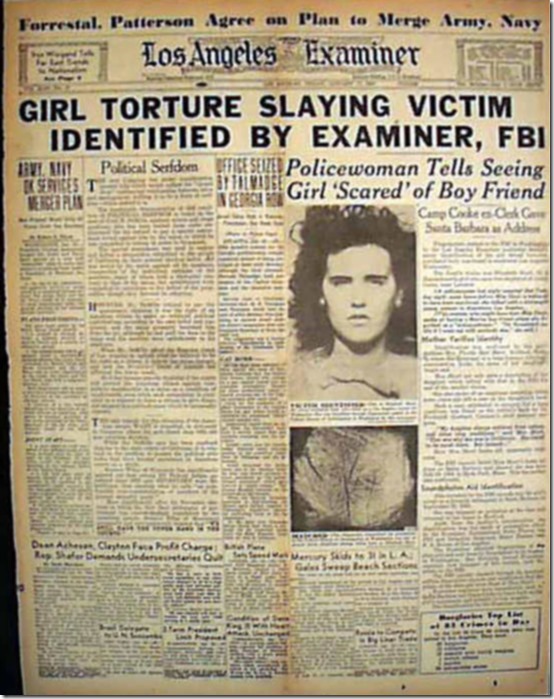
Someone bought this front page of the Jan. 17, 1947, Los Angeles Examiner, with the story about the identification of Elizabeth Short, for $511.01. Not the entire paper. Just the front page. The seller was Timothy Hughes: Early and Rare Newspapers.
The story is illustrated with her mug shot from her arrest in Santa Barbara and one of her fingerprints, which was sent by wirephoto machine to the FBI. Notice the small box in the lower right-hand corner. That was a daily listing of the major crimes that occurred in Los Angeles.
The January 1947 issues of the Examiner used to be available on microfilm at the Los Angeles Public Library, but I have been told by several people that there’s a problem with those reels. Either they are badly damaged from heavy use or keep disappearing. I copied all of them in 1996, so it’s not a concern for me, but others aren’t so fortunate.
The previous two posts gave a brief production history and plot summary of the 1928 Lon Chaney film “While the City Sleeps” and a sample of the reviews.
Today, we’ll look at some of the more unusual aspects of this print, which was provided by a longtime reader. (I have no idea as to the source of the print used to make the DVD.)
From the Vaults: While the City Sleeps
Part I | Part II |
The big question is how much of the film is missing. The short answer is: quite a bit.
Motion Picture News reported on Dec. 8, 1928, that “While the City Sleeps” had a synchronized score and sound effects and was 7,231 feet long. I’ve had a bit of trouble determining the precise speed of silent projectors to calculate the running time of the film. The standard for sound projectors was 90 feet per minute, with slower speeds for silents. So depending on projection speed, that makes the running time of “While the City Sleeps” 90 minutes at 80 feet per minute and 85 minutes at 85 feet per minute. This print times out to a fraction over 66 minutes, which means 19 to 24 minutes of the film is missing. No wonder that it’s plot is hard to follow.
Warning: Spoilers ahead.

May 2, 1944
THE MANY AND ASSORTED RUMORS that James Cagney has signed with this or that studio are all denied by his brother Bill, who says five stories are lined up to star Jimmy for his independent company. Says Bill: “If we get an outside offer that is terrific. I won’t say that Jimmy won’t be interested, but we are committed to United Artists to turn over ‘Bugles in the Afternoon,’ a historical novel by Ernest Hayeux. Then there is ‘Blood on the Sun,’ ‘Only the Valiant’ ‘Port Royal’ and an untitled murder mystery. Also, we’ll make ‘The Stray Lamb,’ the Thornton Smith comedy, without Jimmy. Altogether, these pictures represent an outlay of about $10 million.”
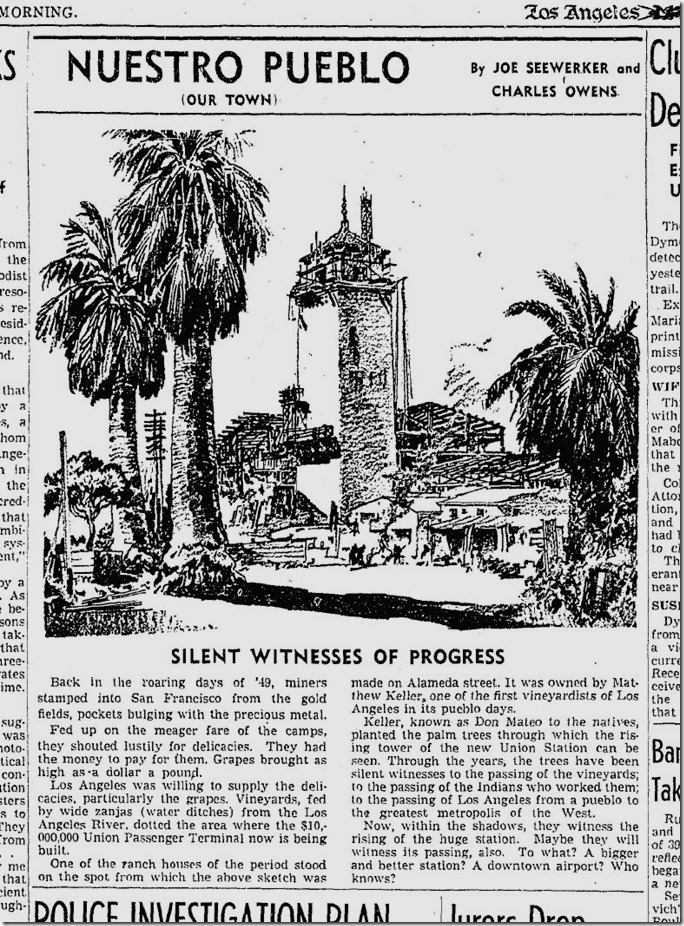
June 29, 1938: Nuestro Pueblo, by artist Charles Owens and writer Joe Seewerker, depicts the construction of Union Station.
Here are some posts that I wrote years ago, including several when Union Station turned 70.
— Grand Design for Los Angeles Proposes Union Station at 5th and Central.
— Memories of Union Station, by Keith Thursby.
— Chinatown to Make Way for Union Station.
— Los Angeles Prepares for Opening of Union Station.
In yesterday’s post, I gave a brief production history of the 1928 Lon Chaney film “While the City Sleeps,” and a summary of the rather complex plot, rendered even more convoluted because substantial portions of the print are missing, either due to content, damaged nitrate or some other reason. Based on The Times clips, the movie had a one-week run in Los Angeles after opening Sept. 21, 1928, and two brief showings (less than a week) in November, and was never mentioned in the paper again except for Chaney’s obituary.
Warning: Spoilers ahead
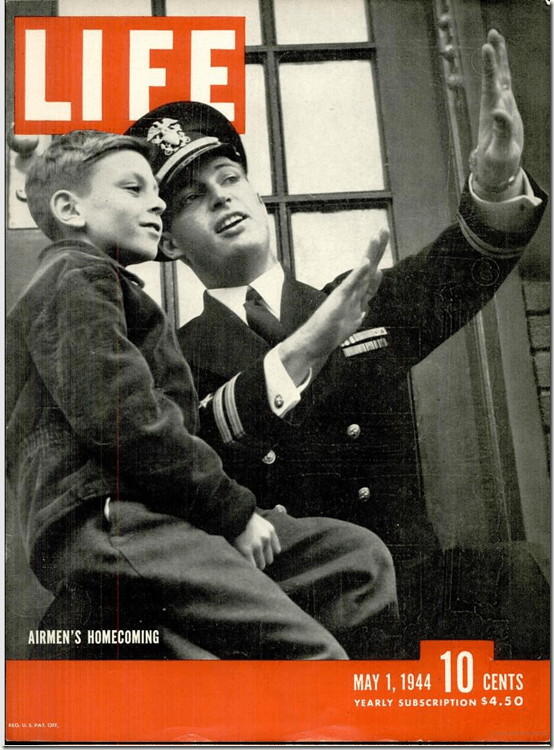
Navy Lt. Harold Vita shows young Richard Kovacks how to shoot down an enemy plane in this week’s cover story.
May 1, 1944
Life magazine looks at the travails of George Yamamoto, who keeps getting running out of town because he is —
Oklahoma City
Feb. 27, 1948

Note: This 2006 post is worth revisiting after last night’s botched execution of Clayton Lockett in Oklahoma.
Ray Parr’s story about Rich Owens, the longtime executioner at McAlester State Penitentiary, has been knocking around my home office for ages, passed along by a former co-worker many years ago. Writing for the Daily Oklahoman, Parr painted a long, vivid portrait of the man who killed 75 human beings: 65 by electrocution, one by the gallows, two with a knife, six with a gun and one with a shovel. And there could have been more: “I never count peckerwoods,” he said.
It’s worth spending a bit more time on our recent mystery movie “While the City Sleeps” for several reasons. It’s not widely available and most copies seem to be missing large chunks of the film, making the complex narrative even more convoluted. And there are some shots of Los Angeles City Hall that are worth exploring.
Warning: Spoilers ahead.

April 30, 1944
Here’s a story of forgotten heroism. I stumbled across it in the Miami News while digging out a Sidney Skolsky column.
Lt. Newell Putnam Wyman waves off rescuers trying to save him and the crew of his Catalina patrol bomber, which had crashed in the ocean 90 miles of Attu in a storm. Wyman knew that a rescue attempt was too dangerous for the planes that had found them.
The victims include co-pilot Ensign Anthony Mannix Moriarty, navigator Ensign Raymond Edwin Rozuk, flight engineer Arvo Arthur Ranta, gunner Charles Leroy Olson Jr., flight engineer Lavere Marvin Ryther, radioman George Leo Huschka and radioman Armestead Sigrest Hardee
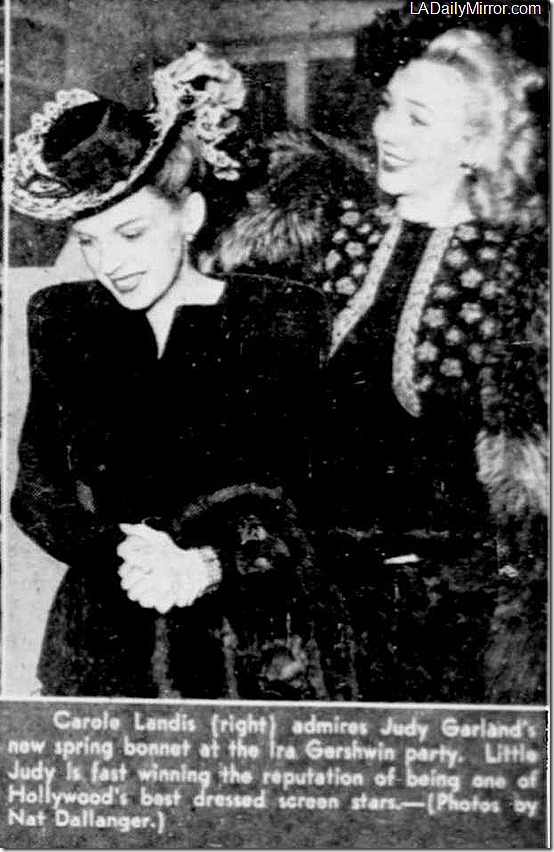
Note: This is the last of the Sidney Skolsky columns for a while. There are no online issues of the Miami News for May 1944, so that’s it until June. What do you think of Skolsky? Is he a keeper?
April 30, 1944
HOLLYWOOD, April 29 — The movies have aided the war in many ways. American Cinematographer explains that Wallace Beery’s picture “Hell Divers” “is more responsible than any other factor for the design and principles of the present aerial machine gun movie camera.”