
Note: This is an encore post from 2005 and originally appeared on the 1947project.
.
Note: This is an encore post from 2005 and originally appeared on the 1947project.
.

Note: This is an encore post from 2006.
May 25, 1907
Los Angeles
Sold on the installment plan, $1 a week with the purchase of six records at 60 cents each, the Victor Talking Machines offered performances by Caruso, Melba and Scotti, as well as John Philip Sousa’s and Arthur Pryor’s bands. Other recording artists included Schumann-Heink, Pol Plancon and Marcella Sembrich.
To sell the Victor machines, which ranged from $10 to $100 ($205.24 to $2,052.36 USD 2005), dealers in Los Angeles staged weekly concerts of new recordings. The George J. Birkel Co., 345 S. Spring St., which also sold Steinways and the Cecilian Piano Player, an external player piano device, said: “Music in the home is a necessity, not a luxury. Music has a refining influence which nothing else can give. The Victor Talking Machine brings every kind of music into your home—from Grand Opera to Ragtime.”
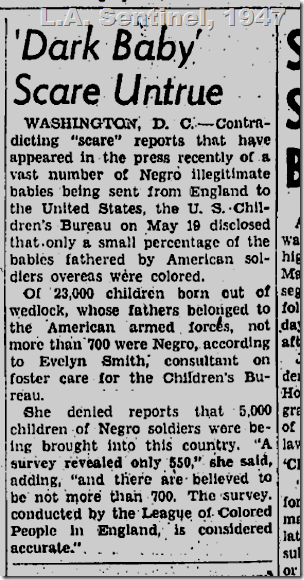
May 22, 1947: The London Daily Mail reported that “5,000 Negro-fathered babies were to be sent” to the U.S., according to the Pittsburgh Courier. The Daily Mail also reported that a ship was being provided to bring the children. Also untrue.
The Courier reported (May 31, 1947) that 22,000 illegitimate children were fathered by American GIs in Britain, including 550 with African American fathers.
Note: This is an encore post from 2005 and originally appeared on the 1947project.
Of course, all through this period is the sensational case of Bud Gollum and Louise Overell, who were accused of killing her wealthy parents by blowing up their yacht in Newport Beach.
But where was the Overell house? News reports of the time give the address as 607 Los Robles in Flintridge, which comes up as an error on Mapblast. Those of us with a 1940s Thomas Guide (which I’m sure you’ll agree is a must-have and can be found on EBay) are undeterred. The street was renamed Foxwood Drive, and according to domania.com it’s a neighborhood of $1.8-million homes.
.
 Note: This is an encore post from 2006.
May 24, 1907
Los Angeles
Otis Skinner, the actor starring in “The Duel” at the Mason Opera House,” is under arrest because of a curious regulation in which passengers of a speeding car are charged with breaking the law. Col. Henry Wyatt of the Wyatt Lyceum Circuit was giving Skinner and his manager a scenic tour of Los Angeles when Wyatt’s chauffeur was stopped by motorcycle Officers Humphreys and Green on 7th Street east of Figueroa as they returned to the theater.
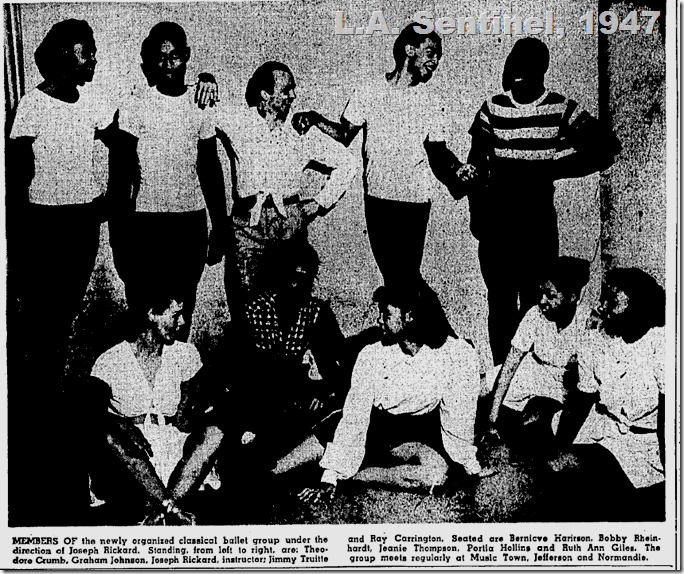

May 22, 1947: I cannot do justice to Joseph Rickard in a brief blog post. It’s enough to say that he was a visionary who began what is probably America’s first black ballet troupe, predating the Dance Theatre of Harlem by 22 years.
According to his 1994 obituary in the Los Angeles Times, Rickard, who was white, got the idea of founding the company when he saw a receptionist turn away a little black girl who wanted ballet lessons. He signed up the girl and her mother for lessons, The Times said.
Note: This is an encore post from 2005 that originally appeared on the 1947project.
The May 23-24 papers are full of great, crazy stories. It’s hard to choose just one:
Is it Britain about to partition India, which got buried on an inside page?
The Nebraska picnic, or the goat that had quintuplets? You could be serious and talk about the cost of living being at an all-time high. But then again, you’ve got two Irish setters being served with summonses because their late master, Carleton R. Bainbridge, left most of his $30,000 estate for their support.
Maybe it’s film composer Franz Waxman being reviewed (positively) as a symphony conductor. Or J. Robert Oppenheimer giving a talk at Caltech.
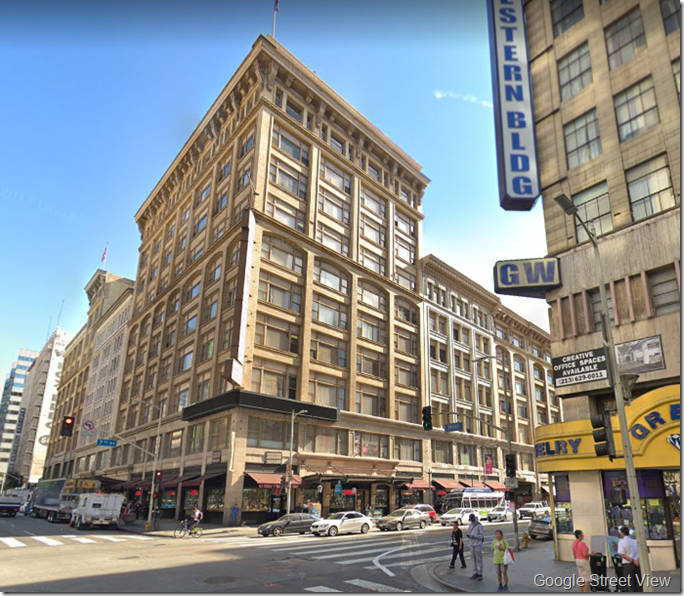
The former Bullock’s downtown store at 7th and Hill Streets, via Google Street View.

May 22, 1947: The campaign to integrate the tea room of Bullock’s downtown store apparently began with Edith Cotterell, who had an account at the department store for two years. Cotterell and two of her friends were escorted to a table, given menus and water. And then they sat.
Twenty minutes later, Cotterell asked the hostess why they hadn’t been served. She was told that the waitresses “refused to serve Negroes and there was nothing that could be done about it,” the Sentinel said.
The store’s manager, Franklin Archer, told Cotterell that the store did not discriminate, but “if the waitresses refuse to served anyone, there is nothing the management can do about it.”
Cotterell and her friends weren’t the only African Americans to receive such treatment. One prospective patron waited five hours without being served, the Sentinel said. White patrons who asked why the black customers hadn’t been served were told “It’s none of your business.”
Note: This is an encore post from 2005 and originally appeared on the 1947project.
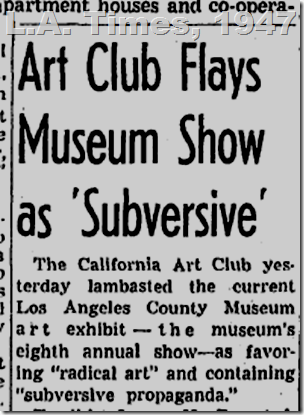
The California Art Club yesterday lambasted the current Los Angeles County Museum art exhibit—the museum’s eighth annual show—as favoring “radical art” and containing “subversive propaganda.”
…Edward Withers, painter and retiring president of the 500-member club, wrote [museum Director James H.] Breasted Jr. that his group cannot “condone the expenditure of tax funds for the display of subversive propaganda inimical to our form of government.”
Note: This is an encore post from 2006.
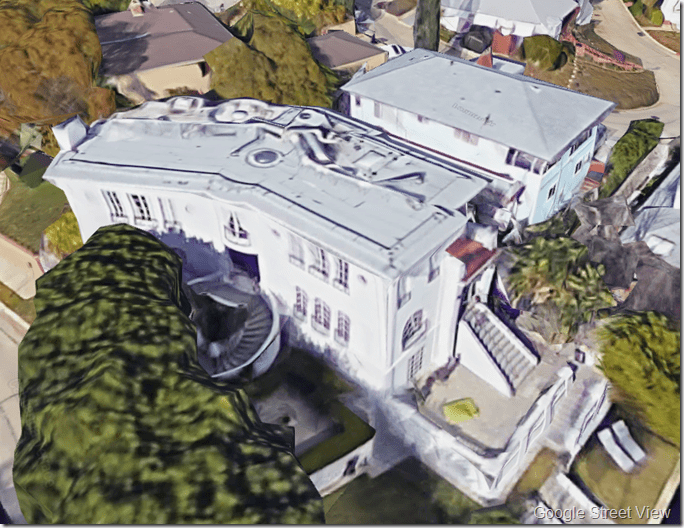
An overhead view of 6533 Cahuenga Terrace, via Google Street View.
Hyperbole reigns in the world of real estate listings, inflating a dump into a dream palace or attempting to gild a lily. Nowhere is this more prevalent than around the Los Angeles and Hollywood area, where fictionalized listings purport to be the former homes of motion picture stars, particularly Theda Bara, Charlie Chaplin, and Valentino. Most of the time, reality far outshines the make-believe concocted by realty agents. Such is the case with 6533 Cahuenga Terrace, which listings have claimed possessed Theda Bara, Pola Negri, and Rudolph Valentino as owners, but was built in 1923 for opera prima donna Maude Lillian Berri, a little gal from Fresno, with a story fit for the movies.
Born Maude Lillian Berry July 10, 1871, in San Francisco, the star-to-be grew up as one of the daughters of “Commodore” Fulton Berry, early California pioneer. The family moved to Fresno when she was a child, where her father became a raisin and oil industrialist and later member of the Bohemian Club and top yachtsman. Miss Berry, raised to be a lady, lived at home and sang in the local church choir before moving to San Francisco and singing in the First Presbyterian Church choir. The young lady also possessed a wicked sense of humor, with the Marion Daily newspaper reporting August 15, 1907, “Miss Berri says she began to sing when she began to talk.”
Mary Mallory’s latest book, “Living With Grace: Life Lessons from America’s Princess,” will be released June 1. Update: June 30.
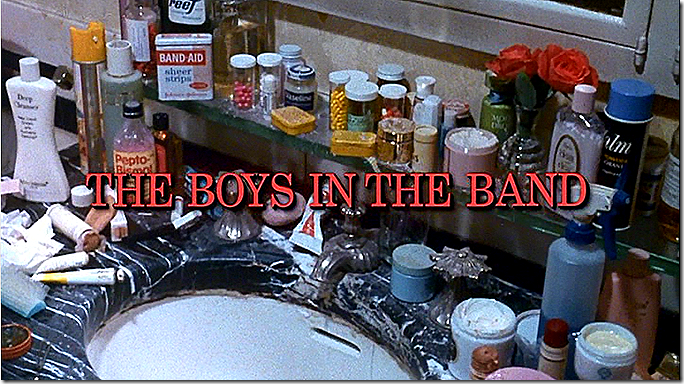
This week’s mystery movie has been the 1970 film “The Boys in the Band,” with Kenneth Nelson, Frederick Combs, Cliff Gorman, Laurence Luckinbill, Keith Prentice, Peter White, Reuben Greene, Robert La Tourneaux and Leonard Frey. Written and produced by Mart Crowley, photographed by Arthur J. Ornitz, production design by John Robert Lloyd, costumes by W. Robert La Vine, set decorations by Phil Smith, editing by Carl Lerner and Gerald Greenberg, directed by William Friedkin.
“The Boys in the Band” is available on DVD from Amazon.

Note: This is an encore post from 2005 and originally appeared on the 1947project.
For the record
An earlier headline on this post incorrectly reported the length of the jury’s deliberations. It was five hours and 15 minutes, not 15 minutes.
A few weeks after the acquittals in the lynching of Willie Earle, who was suspected of killing a cabdriver, Los Angeles Assemblymen [Gus] Hawkins and [??] Allen introduced a resolution in Sacramento urging Congress to pass a Federal anti-lynching law. [In 1962, Augustus Freeman “Gus” Hawkins became the first African American elected to Congress from a Western state].

Note: This is an encore post from 2006.
In a jailhouse interview before he was taken to San Quentin, James G. Fleenor, the barefoot burglar, set the record straight on his escapes, his relationship with a white woman and how he began a life of crime.
It had been rumored that Fleenor returned to Los Angeles after escaping from a San Francisco jail because of his relationship with Mrs. B.J. Byres of 1669 Tennessee St. He insisted that he hopped the first freight train leaving the yard and discovered later that it was going to Los Angeles.
Note: This is an encore post from 2005 and originally appeared on the 1947project.

Note: This is an encore post from 2006.
May 20, 1907
Los Angeles
Night jailer O.L. Gilpin thought the man in the drunk tank looked familiar—and indeed he was. Despite passing himself off as George Thompson, it was our old friend James G. Fleenor, otherwise known as the “barefoot burglar,” who walked out of a San Francisco jail en route to serving a prison term at San Quentin and hopped a freight train to Los Angeles.
“I was fair about the whole thing,” Fleenor told The Times. “When the officers left here I told them I would escape, but they were not bright enough to realize I meant what I said. When they placed me in that cell in the San Francisco station, I walked about and inspected it. Awaiting my time, I pried open the door.
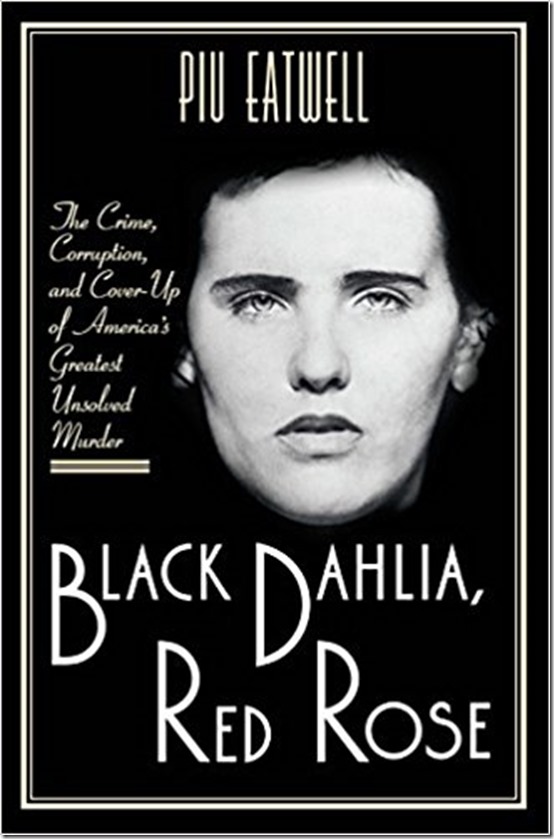
Dear fans of Piu Eatwell’s “Black Dahlia, Red Rose” (I know there’s at least a few of you because you write to me):
Leslie Dillon was absolutely, positively in San Francisco when Elizabeth Short was killed.
Nothing else matters. Not allegations of police corruption, not claims about coverups, nothing about what may have happened at the Aster Motel. All of that is merely camouflage to conceal the fact that Dillon was hundreds of miles away when the killing occurred.
End of argument.
Note: This is an encore post from 2005 that originally appeared on the 1947project.
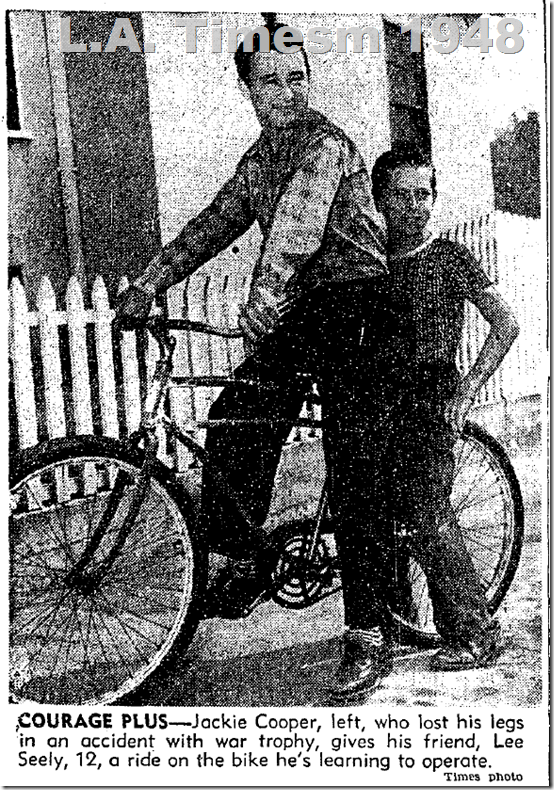
Members of Cub Scout Pack 522-C gathered more than 32 tons in a paper drive to help buy artificial legs for injured pack member Jackie Cooper, 12.
Jackie and his friend, Lee Seely, 11, are being treated at General Hospital after an April 26 blast that occurred when one of the boys dropped an unexploded bazooka shell that someone found at Seal Beach, home of the Naval Weapons Station. Lee was hit in the abdomen with shrapnel and Jackie’s legs were amputated, his right leg below the knee and his left leg at mid-thigh.

Florence Avenue and Hooper Avenue, via Google Street View.

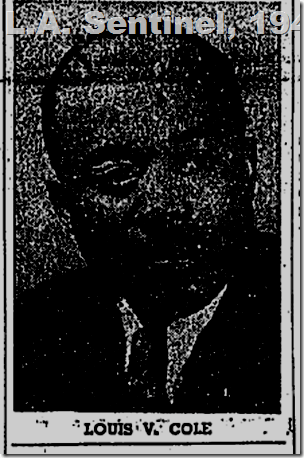 May 15, 1947: About 3 a.m. on April 17, 1947, Louis V. Cole of the Sentinel advertising department was delivering tear sheets of that week’s ads when his car stalled.
Cole was standing at Florence and Hooper Avenues trying to hail a cab when a patrol car from Firestone substation of the Sheriff’s Department passed and apparently circled the block and stopped.
Deputy L.A. Thorne approached Cole and ordered him to take his hands out of his pockets.
“Cole’s compliance was apparently not quite rapid enough,” the Sentinel said. “Thorne ‘assisted’ him with a stunning blow on the arm” with the barrel of his pistol.

Note: This is an encore post from 2006.
May 18, 1907
Los Angeles
William Mullen, a black strikebreaker for the Pioneer Truck Company, was delivering a shipment of lumber when he realized that he had lost some of his load and retraced his route to look for it.
At the Southern Pacific railroad crossing at Alameda and 2nd streets, Mullen noticed some lumber leaning against a shack belonging to a railroad flagman named Caulfield, who was presumably white. Mullen asked Caulfield if there was more of his lumber inside the shack and Caulfield said no.
 ladailymirror.com