Note: This is an encore post from 2005 and originally appeared on the 1947project.

Note: This is an encore post from 2006.
June 29, 1907
Los Angeles
Through the jail cell’s bars, the officer asked, “Where did you get that blood on your shirt?”
E.H. Phelan, a barber at the Hotel Alexandria, said: “No, I did not beat my wife.” He whispered: “She was drunk and fell down.”
And the blood?

Above, Cab Calloway is at the Million Dollar Theater with “Ding Dong Williams.”
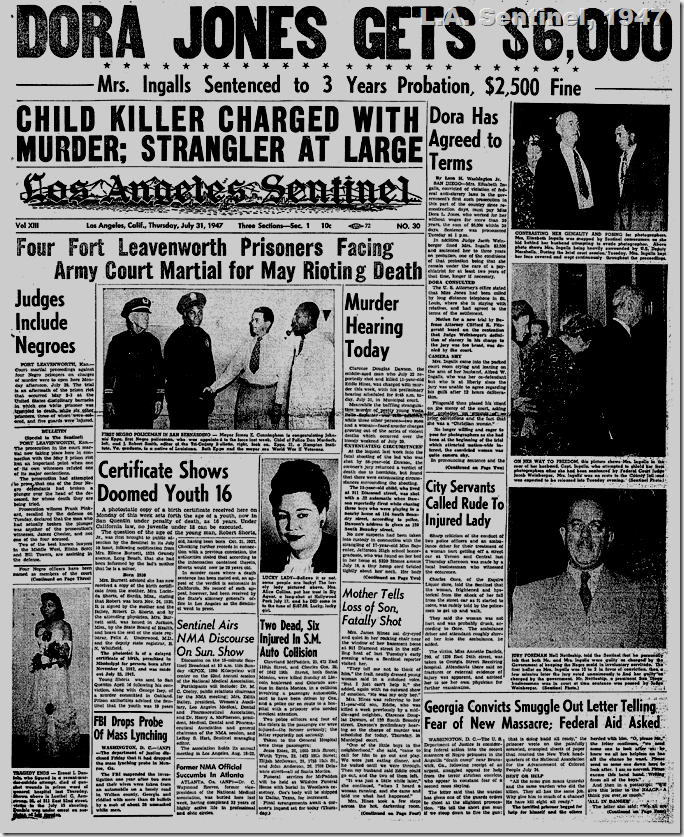
June 26, 1947: Jury selection begins in San Diego in the case of Alfred and Elizabeth Ingalls, who are accused of holding Dora L. Jones as a slave.
The Sentinel runs a banner headline, an interview with Elizabeth Ingalls, a summary of the case, and interviews with people hoping to watch the trial.
![]() |
![]() |
Note: This is an encore post from 2005 and originally appeared on the 1947project.
Meet Paul Popenoe, who appears in hundreds of stories in The Times (including 11 in 1947), often as the elder statesman of family counseling in Los Angeles in later years. Among other things he said in 1947 was that childless couples were far more like to divorce than married couples and therefore recommended having children to preserve families, the more, the better. He also noted that people who were married by a justice of the peace were only half as likely to stay married as those married by a minister. At a presentation featuring Mills College President Lynn T. White Jr. on how “Colleges Can Help Reduce the Divorce Rate,” Popenoe said: “Too much feminine domination during a boy’s formative years leaves him unprepared and inadequate to face the man’s world, including marriage.”

Note: This is an encore post from 2006.
June 28, 1907
Los Angeles
Give cars to a bunch of wealthy Los Angeles residents and what do they do? Race them, of course. Not on a track this time, but in an endurance test from Los Angeles to Lakeside. And yes, it’s a bit warmish for an endurance race, especially once the drivers get further inland—100 degrees.


Note: This is an encore post from 2005 and originally appeared on the 1947project.
I’ll be putting that little landmark on my tour of the Black Dahlia crime scene, which is about three miles away. Bradbury’s first book got a press run of about 3,000 copies and sells for $1,000 to $4,000 and up.

Note: This is an encore post from 2006.
June 27, 1907
Los Angeles
Louise arrived in Los Angeles three months ago from Norway with her four young children. She met a man who worked in San Pedro (we only know his initials, F.G.) and before long, they were married and living in his small home at 825 Tennessee St.
One morning, she got up to make coffee, turned on the stove, took a glass of dark liquid from a shelf and poured it into the coffee pot.

Above, the marriage of Fred G. Rohn and Louise Johnson, in the Los Angeles Times, April 23, 1907.
Update June 27, 2018: The Times story is incorrect in a few ways. (The Herald added its own error in identifying the family as Rohan.)
The family was actually named Rohn. The husband was Fred G. Rohn. He and Louise married April 22 1907. According to their marriage license, he was born in Germany about 1876. She was the former Louise Johnson, born in Norway about 1873.

June 26, 1947: Los Angeles Sentinel columnist Edward Robinson takes a trip to the University Station after LAPD officers discover that he is carrying two driver’s licenses. One identifies him as “white” and the other identifies him as “Negro.”
With all the digging I have done in old Los Angeles newspapers, I have never come across anything like this.
Note: This is an encore post from 2005 and originally appeared on the 1947project.
An unknown press photographer in Long Beach captured them in a small fraction of a second, the old three-masted square-rigger and the brand-new helicopter: old and new, past and future.
Helicopters were exotic aircraft in 1947 and newspapers coined names like “the Flying Eggbeater” and “the Whirlybird” for them. Their strengths were quickly recognized, however, and in 1947 Los Angeles became the first U.S. city to use them for mail and express service. (Apparently the mail pilots had a habit of hovering over sunbathers, prompting a lawsuit by women members of the Santa Monica Ambassador Club). The DWP also began using copters to check power lines and they proved themselves in fighting a 3,600-acre wildfire in Big Tujunga Canyon, which killed two men and injured at least 75 more.

Note: This is an encore post from 2006.
June 26, 1907
Los Angeles
Fred D. Samuels is a monster and nothing less, according to his aunt, Sister Kostka, assistant mother superior of the Ursuline Convent in Frontenac, Wis. As her mother, Maria S. Bowman, lay dying at her home, 1266 E. Adams, Samuels refused to let Sister Kostka (nee Minnie Bowman) see her.
In fact, Kostka charged, Samuels refused to let a Catholic priest visit Mrs. Bowman and refused to grant her a Catholic funeral. Instead, Bowman received two services, one at St. Patrick’s on Central Avenue and another at the Lutheran church on East 46th St.

This week’s mystery movie has been the 1929 MGM picture “Hallelujah,” with Daniel L. Haynes, Nina Mae McKinney, William Fountaine, Harry Gray, Fanny Belle DeKnight, Everett McGarrity, Victoria Spivey, Milton Dickerson, Robert Couch, Walter Tait and the Dixie Jubilee Singers. Scenario by Wanda Tuchock, treatment by Richard Schayer, dialogue by Ransom Rideout, art direction by Cedric Gibbons, wardrobe by Henrietta Frazer, photography by Gordon Avil, story and direction by King Vidor.
“Hallelujah” is available on DVD from Warner Archive.

Note: This is an encore post from 2005 and originally appeared on the 1947project.
Gov. Warren is justified in his concern over the growth of gangsterism in California, dramatized by the effective and efficient taking-off of the charming but unlamented Bugsie Siegel.
The governor notes that the arrival in a community of one criminal is a relatively small matter. Likewise, the assassination of a crook is of no particular importance to a community, and grief at his passing is restricted to a minor and unselect circle. Gang wars have a way of settling themselves, and if the murderer of Siegel is caught, law enforcement officers are apt to express, in a mild manner, their gratitude.

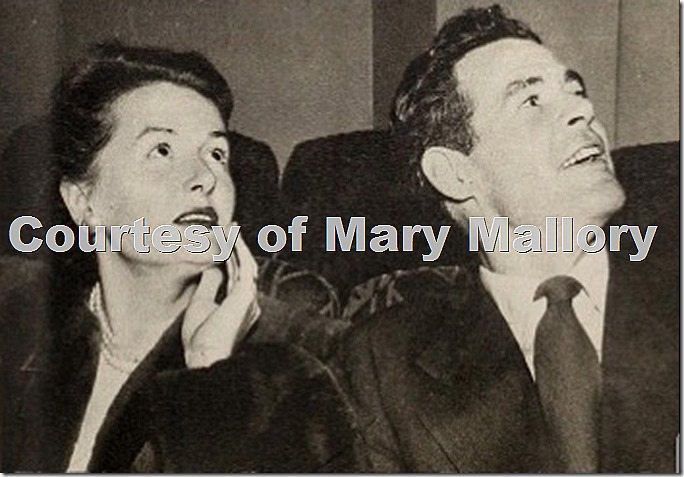
Virgil Apger, photo courtesy of Mary Mallory
Note: This is an encore post from 2013.
Metro-Goldwyn-Mayer studios excelled in most areas of film production, including that of still portrait photography. Several of its head portrait photographers, like Ruth Harriet Louise, George Hurrell and Clarence Sinclair Bull, are recognized for their unique style and artistry in creating some of the most iconic portrait photographs in Hollywood history. While not as flashy or dramatic as these lensers, Virgil Apger, MGM’s leading gallery photographer for over 20 years, created classy, understated head shots of leading stars that made them more accessible to the movie-going public.
Born in Grantland, Ind., June 25, 1903, to the local sheriff, Virgil Apger was drawn to motion pictures as a young man, working as an usher and assistant to a projectionist in a local movie theater, per John Kobal’s “The Art of the Great Hollywood Portrait Photographers.” Apger and his family moved to Los Angeles in 1916, where he worked for six months in an iron foundry business before joining the Marines. During his two-year term, Apger was stationed in Hawaii, Philippines and the Orient.


Note: This is an encore post from 2005 and originally appeared on the 1947project.
For the rest of his life, Sugar Ray Robinson was haunted by that eighth round in Cleveland. Haunted by the hard left to the jaw of Jimmy Doyle, who until the moment his head hit the canvas with a sickening thud was riding a string of victories to a chance at the title of welterweight champion.
Doyle, born Jimmy Delaney, was a classy fighter who made his professional debut June 6, 1941, at the Olympic. “Jimmy first attracted our attention by his old-fashioned standup stance,” Times sports columnist Al Wolf wrote. “He looked like a throwback to the days of John L. and Gentleman Jim as he stood there stiff-backed and stiff-necked, feet firmly planted, left arm extended in an upward arc. It could have been a picture from the Police Gazette of yesteryear.”

Note: This is an encore post from 2005 and originally appeared on the 1947project.
For me, stumbling across Jim Tully is one of those wonderful accidental discoveries that are a byproduct of research. He’s as obscure and forgotten today as he was famous in the 1920s. (His name has appeared exactly once in The Times in the last 20 years).
An Irishman with a natural gift for storytelling, Tully was almost entirely self-taught, which gave him a spare, unpretentious style that translates well to modern times, unlike the stale, artificial constructions of his more literary contemporaries.

Note: This is an encore post from 2006.
June 23, 1907
Los Angeles
The Auto Club of Southern California has begun posting white enamel signs with blue lettering along Foothill Boulevard between Los Angeles and Riverside.
Spending about half a day, auto club President George Allen Hancock and Charles Fuller Gates, who is in charge of the county’s signage, staked the route through Highland Park, South Pasadena and Pasadena, Lamanda Park, Baldwin’s ranch, Monrovia, Azusa, Glendora, Claremont, Uplands, Cucamonga, Etiwanda, Stalder (34.0119/117.3125 to folks with GPS) to West Riverside.
Continue reading
Note: This is an encore post from 2005 and originally appeared on the 1947project.
The son of slaves and a World War I veteran, Edgar G. Brown was a frequent visitor to Los Angeles gathering support for various issues, such as the anti-lynching law. He urged blacks to increase productivity rather than protests during the Korean War, but also called on President Eisenhower to appoint a black Cabinet member.
Brown visited Los Angeles in 1950 to gather signatures on petitions seeking to prevent the execution of Army Lt. Leon A. Gilbert of the 24th Infantry Regiment.
Note: This is an encore post from 2006.
June 22, 1907
Los Angeles
Let’s suppose for a moment that you are a handsome former Army sergeant who has served in the Philippines. Let’s further suppose that you get into a fight in a bar on South Main Street and hit another patron in the face with a heavy beer glass. Then let’s suppose you escape to St. Louis, change your name and start life over.

Is it possible to write fiction about Los Angeles in the 1940s without falling into one of the common traps? I believe Beth Hahn has done it.
I have read many works of fiction set in Southern California of the 1930s to the 1950s, what I call the Raymond Chandler era of L.A., and most of them are problematic. Some are absurdly fabricated, like the later books of James Ellroy. Some are mildly anachronistic, like John Gregory Dunne’s “True Confessions.” Some careen into “Noirland,” never to be seen again. And some take a sort of “cosplay” approach to the past that works so hard to make sure the woolen suit is pressed and the seams on the nylons are straight that the writing becomes labored and burdened with extraneous and excessive detail.
Hahn has written “A Person of the World,” an unpublished novel somewhat inspired by the story of Elizabeth Short, although nobody should expect a fictional telling of the Black Dahlia. Her character is named May rather than Elizabeth or Betty/Beth. Still, Hahn has taken some of the better-known elements of the case and woven them into her book. The short story “A Girl Like You” is adapted from her novel and uses brief, fragmentary scenes to assemble a portrait of gritty life in postwar L.A.
Here’s the link. It’s definitely worth a read.
![]()
Nina Mae McKinney, above, was “toned down” for MGM’s movie cameras in filming “Hallelujah,” Harry Levette said.

June 19, 1947: Harry Levette, a longtime Sentinel columnist, sports editor and publicist, reflects on the Lafayette Players. The Lafayette Players was established in 1916 by Charles Gilpin as Harlem’s “first black legitimate theater group,” according to the New York Times.
Levette wrote that they arrived too soon to work in the current theater or in films, mainly because of Hollywood’s changing tastes in only casting actors with dark skin.