 Note: This is an encore post from 2005 and originally appeared on the 1947project.
Her name was Iva and she was born in Watts on the Fourth of July, attended high school in Compton and graduated from UCLA with a degree in zoology. For a while, she lived at 11668 Wilmington Ave.
Then came the trip to Japan on behalf of her mother who, was too ill to visit relatives.
“My mother had high blood pressure and diabetes. She wanted very much to see her sister in Japan,” Iva said. Because her mother was unable to make the trip, “she asked me to go.” Iva left from San Pedro on July 5, 1941.
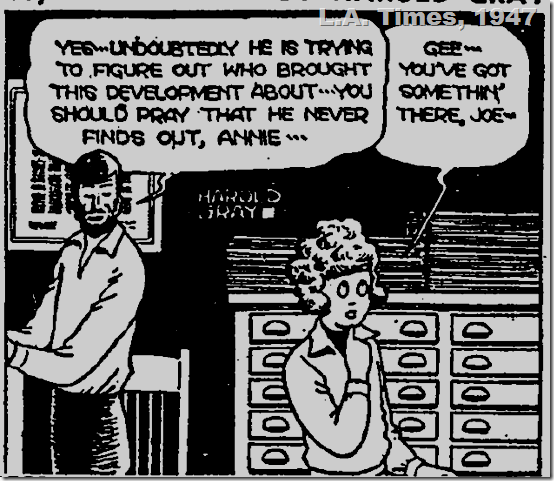
She said that she was supposed to return to the U.S. on Dec. 1, 1941, but there was a problem with her passport and was stranded when the war broke out. Then came the broadcasts that earned Iva Toguri of Los Angeles the nickname “Tokyo Rose,” although she called herself “Orphan Ann” or “Orphan Annie.”
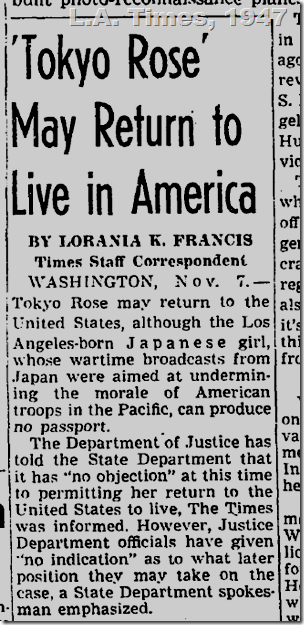
In November 1947, she applied to return to Los Angeles. Nobody seemed to care about her, one official said. But the next year she was brought to the U.S. and accused of treason before a jury from which blacks were systematically eliminated by prosecutors. She was released after serving six years of a 10-year term.
In the ensuing years, a movement grew for a presidential pardon—supported by Times editorials—which was granted by Gerald Ford in January 1977 on his last day in office. The Los Angeles City Council, however, refused to rescind its 1947 condemnation of Toguri.
In 1976, The Times published a belated fan letter from a former Marine corporal urging Ford to pardon Toguri:
“I first heard her on Guadalcanal in 1942. Some of us had salvaged an excellent shortwave receiver from one of our own dive bombers which crashed trying to take off with a cold engine….
“The records she played were old, nothing later than the mid-1930s, as I recall, and her chatter was corny, harking back to the days of coonskin coats and ukuleles. We were hooked. We listened to her every chance we got as we island-hopped through the South Pacific.
“A typical Orphan Annie program might open with Guy Lombardo’s band and the trembling trio singing “Boo-hooooo. You’ve got me crying for youuuuuuuu.” Then Annie would come on with: ‘Hiya keeds, I mean all you poor abandoned soldiers, sailors and marines vacationing on those lovely tropical islands. Gets a little hot now and then doesn’t it?
‘Well just remember, fellas, while you’re sweating it out on the islands, your little sweet patootie back home is having a hotcha time with some friendly defense worker. They’re probably dancing right now to this number… it used to be your song…. Remember?’
“The fame of Tokyo Rose spread quickly throughout the 1st Marine Division—which is to say the world if you were in the 1st Division on one of those islands. We would tune in the show on our radio Jeep at platoon headquarters and pipe it through the phone system to our gun emplacements up and down the beach. Sometimes battalion headquarters would run it through the switchboard so marines on the perimeter lines could listen Nobody worried about morale. We liked her.
“As far as I’m concerned, and I suspect I speak for most of us who listened to her shows, it was difficult then and is impossible now to consider [the broadcasts] treasonous. Given the opportunity, we might have voted her a medal for her contributions to our morale.”
Ex-Cpl. Charles S. Hurley
333893 (USMCR)
Bonus factoid: As of this writing Iva Toguri is alive and has a website: http://www.dyarstraights.com/orphan_ann/orphanan.html

 Note: This is an encore post from 2006.
 Note: This is an encore post from 2005 and
  Note: This is an encore post from 2006.


 Note: This is an encore post from 2005 and
 Note: This is an encore post from 2005 and






 ladailymirror.com