
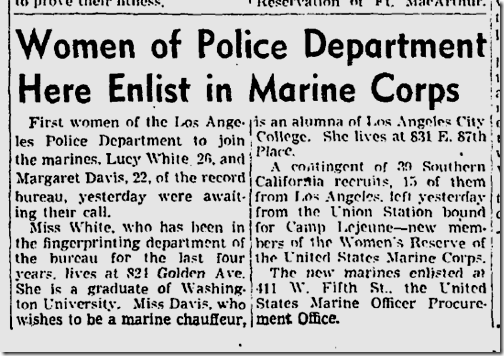
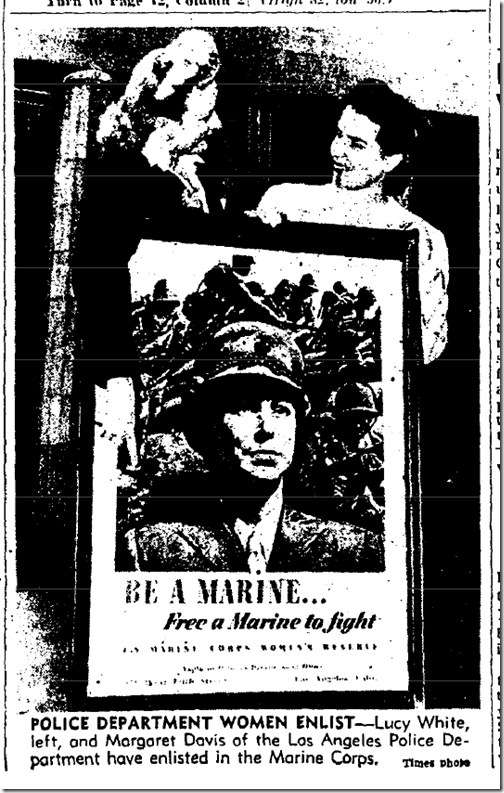
Aug. 21, 1943: Two women from the LAPD are joining the Marines: Lucy White, 26, who works in the fingerprinting department, and Margaret Davis, 22, of the record bureau.
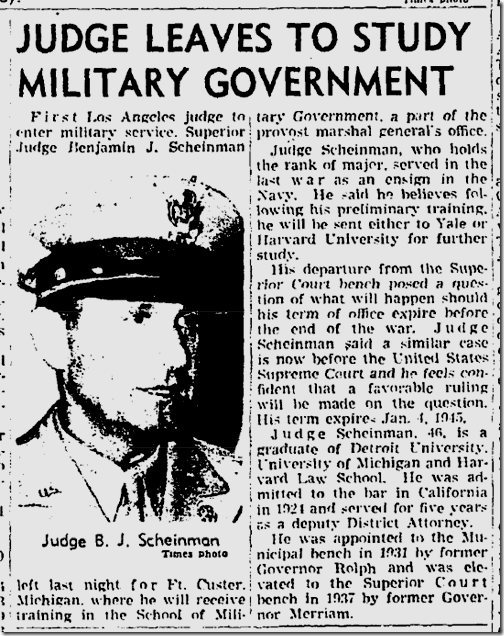
Judge Benjamin J. Scheinman is leaving the municipal bench to join the service, where he will study military government. Scheinman, 46, is the first local judge to join the service, The Times says. Scheinman, who refused to grant Joan Crawford a divorce from Franchot Tone in 1939 until she appeared in court, died in 1954 of pancreatic cancer at the age of 57.
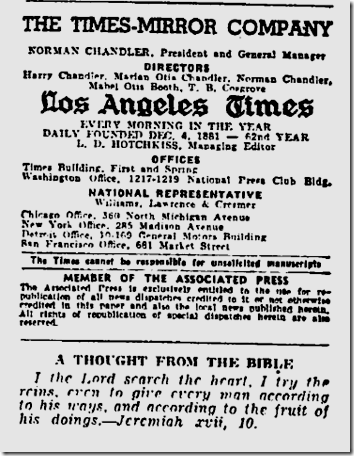
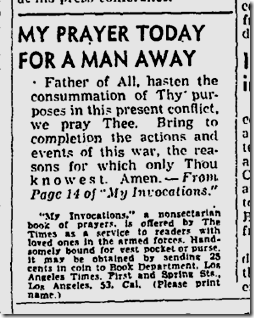
In addition to the daily Bible passage, a feature of The Times editorial page for decades, the paper publishes “My Prayer for a Man Away” as a nonsectarian prayer for readers with loved ones in the service.
Big band leader Jimmy Dorsey and his wife are ordered to pay June Price for damage caused by their pets.
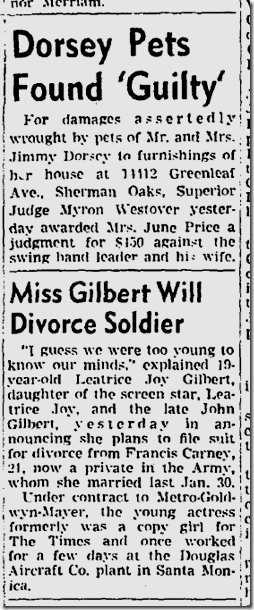
Leatrice Joy Gilbert, 19, the daughter of actor John Gilbert and Leatrice Joy, divorces Army Pvt. Francis Carney. The story says she once worked as a copy girl for The Times. I was under the impression that newspapers only had copy boys in this era.
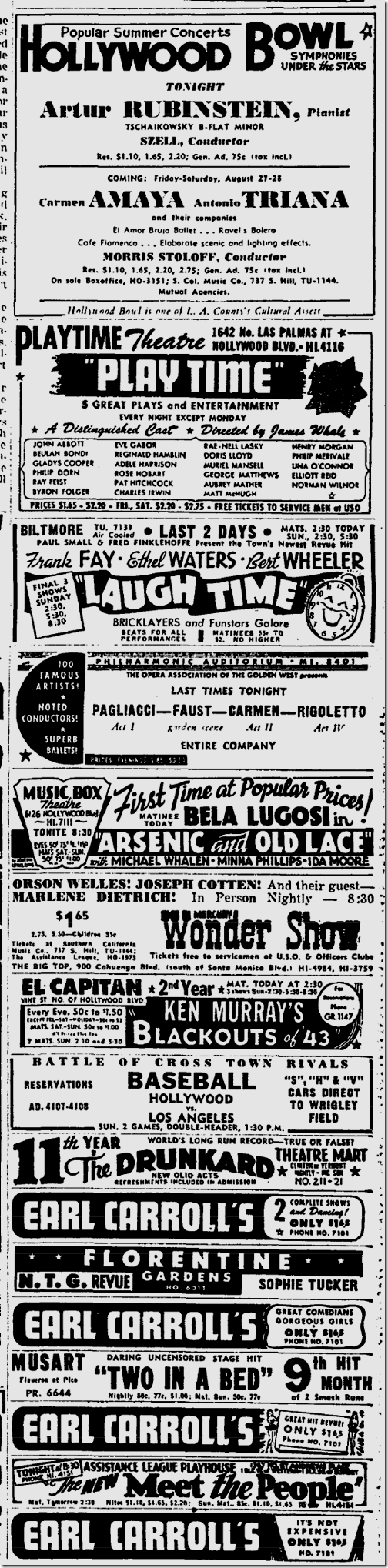
George Szell will conduct Tchaikovsky’s Piano Concerto No. 1, with soloist Artur Rubinstein, at the Hollywood Bowl.
Bela Lugosi appears in “Arsenic and Old Lace” at the Music Box Theatre.
Hollywood vs. Los Angeles in a battle of the cross-town rivals at Wrigley Field.
“The Drunkard” is in its 11th year.
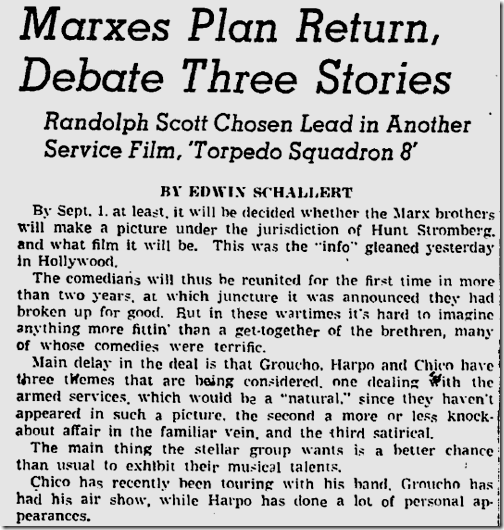
Industry gossip says that the Marx Bros. will reunite for a film, according to The Times’ Edwin Schallert. “Main delay in the deal is that Groucho, Harpo and Chico have three themes that are being considered, one dealing with the armed services, which would be a “natural” since they haven’t appeared in such a picture, the second a more or less knockabout affair in the familiar vein, and the third satirical,” Schallert says.
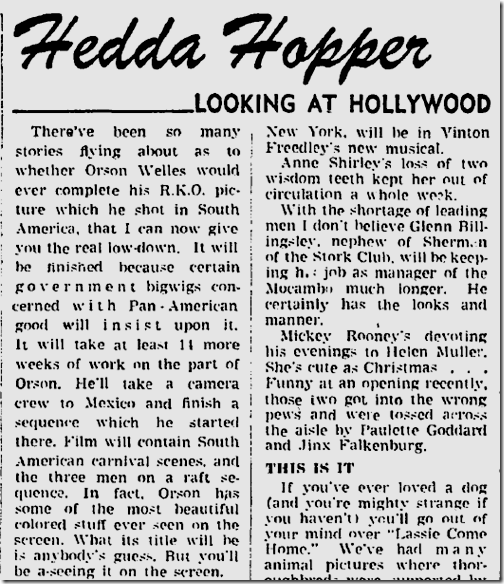
Hedda Hopper says that despite rumors, Orson Welles will complete his RKO picture shot in South America.
“Film will contain South American carnival scenes and the three men on a raft sequence,” Hopper says. In fact, Welles never finished “It’s All True.”

 ladailymirror.com
Saw “It’s All True” years ago on either TCM or AMC. It was black and white, not color, with a music soundtrack added later. Artfully filmed footage, mostly of life and death in a Brazilian fishing village. Not a conventional movie, but perhaps Orson Welles’ most famous boondoggle.
LikeLike