Black Dahlia breakthrough!
Note: This is an encore post from 2013.
Let us suppose that there was a mathematician. A retired mathematician who once taught at a major university, who published and received tenure, and retired as a well-regarded member of the faculty.
Let us further suppose that in retirement, this mathematician wrote a book and on the day of publication called a news conference to announce his stunning discovery:
1 + 1 = 3.
The way the retired mathematician derived this amazing breakthrough was not through the typical methods that have been used for millennia. Instead, the mathematician had spent hours and hours gazing at photographs and paintings of the number “1” and the number “3.”
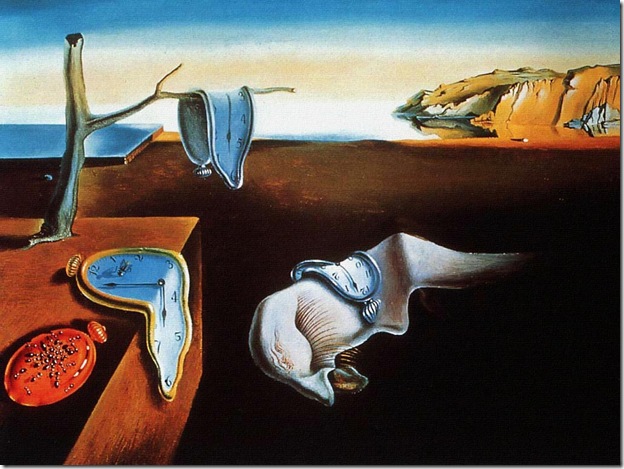
Until finally, seizing upon Salvador Dali’s surrealist painting “Persistence of Memory,” the mathematician found the proof he was seeking.
1 + 1 = 3. Don’t you see it?
To skeptics who insisted that he was wrong and that any child with a calculator could prove that 1 + 1 = 2, the mathematician would say that there was a vast, shadowy conspiracy among the calculator and adding machine cartels of the world, who were ruthlessly suppressing the facts. Indeed, much of the book was devoted to the massive “coverup” mounted by Texas Instruments, Casio, Hewlett-Packard and other office machine manufacturers to prevent anyone from learning the truth.
Once he embarked on his theory, the mathematician would go on to make other, similar discoveries: 2 + 2 = 5, therefore 2 x 2 = 5, thus rendering any number times itself an odd number. He capped his theory with the long-sought and elusive square root of –1, widely assumed to be an “imaginary” number, (or “Error” to the calculator and adding machine cartels determined to ruthlessly suppress the truth), which was 42.
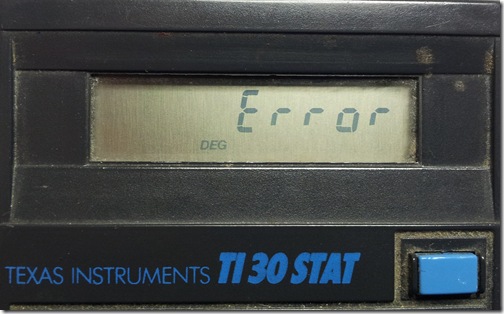
Proof of the coverup by the calculator and adding machine cartels!
In the ensuing years, the mathematician built up elaborate theories about other mathematical concepts that were wrong, including the secret messages contained in five-place log tables, publishing more books, maintaining a website and delivering occasional public appearances about his increasingly complex theory, all of it based on 1 + 1 = 3 and the shadowy conspiracy of the calculator and adding machine cartels determined to suppress the truth.
The mathematician gained a number of followers, who likewise insisted that “I think he’s proved it!” and “Yes, 1 + 1 = 3.” The supermarket media adored the mathematician, writing headlines such as: “Math Prof Claims 1 + 1 = 3!” It was never necessary to interview anyone else about the validity of the theory. “Math Prof Claims 1 + 1 = 3” was sufficient. The mathematician sold books (some of them self-published), gave lectures and all was well.
But not really, because 1 + 1 = 2 and any elementary school pupil who turned in 1 + 1 = 3 was marked wrong.
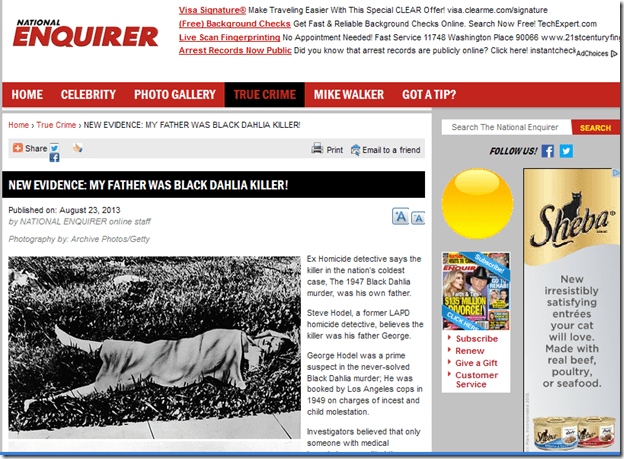
Black Dahlia breakthrough! Former homicide cop says dad was Black Dahlia killer!
Which brings us to the George “Evil Genius” Hodel Franchise.
Recently, author Steve Hodel has received publicity about “new evidence” in the Black Dahlia case.
Ignoring the problems of the “old evidence,” which is the foundation of everything that follows, including the “new evidence.”
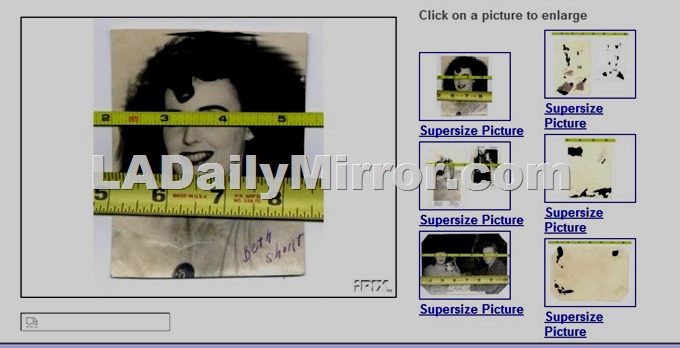
And that is this: The photographs found in the belongings of Dr. George Hodel after his death – claimed in the “Black Dahlia Avenger” series to show Elizabeth Short – are not Elizabeth Short.
One might question the validity of the original assumption – that both photographs were of the same woman, and that woman was Elizabeth Short – when one of the women came forward and identified herself as Marya Marco.
The remaining and unidentified (at least for now) photo is likewise not Elizabeth Short. This is according to the family of Elizabeth Short, whom I consider definitive.
And if the spurious photo is removed, the entire George “Evil Genius” Hodel scenario collapses like a house of cards in a strong wind. Because without this spurious photo, there is nothing to show that Dr. George Hodel and Elizabeth Short ever met.
I have heard one of Steve Hodel’s presentations, and when confronted with this statement, he talked his way around it by saying that the photos merely served to get him interested in the case and that it was irrelevant whether they were Elizabeth Short. But at that time he said he believed they were her.
The truth is that there is nothing to show that George Hodel and Elizabeth Short ever met.
In other words: George Hodel + Elizabeth Short = 0

 Fidel Castro, the bearded boy wonder of Cuba, has been sassing his kindly, benevolent, slightly wealthy Uncle Sam lately.

 Jan. 18, 1959: OK, it was a benefit game. But still..
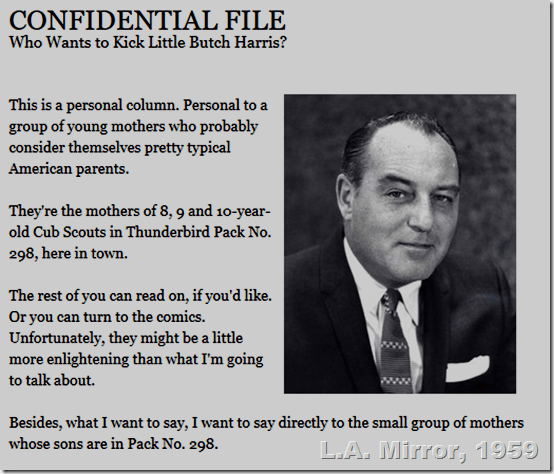


 Jan. 17, 1959: It was Saturday in 1959, so Paul Coates ends his week with a letters column. Pretty standard for those guys who wrote six columns a week. (In case you don’t know, afternoon papers did not publish on Sundays).


 ladailymirror.com