Blogging the Wolfe Book, Phoning It In


I’m blogging in real time as I read Donald H. Wolfe’s “The Black Dahlia Files: The Mob, the Mogul and the Murder That Transfixed Los Angeles.” So far we have seen very little of “The Mob” and nothing at all of “The Mogul.” There has been a murder but Los Angeles has yet to be transfixed.

This is tediously slow work and all I can say is that what I’m doing is absolutely the worst way to read a book; most shouldn’t be read at the molecular level, but “Mogul” demands nothing less. In fact, as I looked down Page 42, I saw an incredible whopper. It’s stupefying that someone could run all the Black Dahlia books through a blender, toss in some outright fabrication and come up with such a mishmash covered with a veneer of “research,” but Wolfe has done it.

Page 42

So far, Wolfe is using what has become the “paint by numbers” story structure in the Black Dahlia case: the anonymous, butchered body is found and the tale of discovery is told in flashbacks. This is the “Laura” format, a great framework for fiction that’s lousy for history because in reality the investigation wasn’t linear but was a sprawling mess.

We have reached the point in the story where the Examiner is extracting information from Phoebe Short by telling her that her daughter Elizabeth has won a beauty contest, then revealing that her daughter has been killed. This episode survives as one of the most outrageous and cruelest moments in journalism. Let’s see how Wolfe handles it.

Wolfe attributes this section to the standard sources: Will Fowler’s “Reporters,” Jim Richardson’s “For the Life of Me,” and a 2003 interview with Will, who by that time was fairly far gone as far as I know and died the next year.

Some of these errors are so trivial I was going to let them slide, but I changed my mind. Although one mistake by itself is insignificant, when taken together, the preponderance of errors presents a poisonous atmosphere of indifference to the truth, the facts and reflects a rather stunning lack of skepticism and the willingness to repeat—unchallenged—what is obviously impossible. This, folks, is bad work.

First, Wolfe says Phoebe Short was told that her daughter won a beauty contest in Santa Barbara. Of course by then, everybody knew better than that. Phoebe knew she was in San Diego and Richardson knew that Elizabeth Short had been arrested in Santa Barbara in 1943 and shipped home. And why would a Los Angeles paper be calling about a beauty contest in Santa Barbara? Wolfe is just picking up the extraneous, fabricated details from Will’s account in “Reporters,” Page 79.

Richardson’s version, written in 1954, is slightly different. He says Wain Sutton came up with the idea of the story about the beauty contest, “For the Life of Me,” Page 299. And Richardson certainly doesn’t give a location. That’s one of Will’s foxy grandpa embellishments.

But there’s a worse mistake. Wolfe says Phoebe told the Examiner that Elizabeth was returning to Los Angeles with a man named Red.

Now that’s totally wrong. Phoebe actually told the Examiner that her last note from her daughter was sent from San Diego. So let’s see if we can backtrack this gaffe to “Reporters.” Nope, Will says Phoebe read a letter to Sutton that Elizabeth had written from San Diego. “This information made way for another scoop: The disclosure that Elizabeth had left San Diego with a man known only as ‘Red.’ ”

Compare that with “Mogul.”

“Phoebe told Sutton that many men found Betty to be attractive and commented on a letter she had only recently received from her daughter, dated January 8, 1947: ‘It had been written while visiting friends in San Diego,’ she said, and indicated that she was returning to Los Angeles ‘with a gentleman, Betty referred to as ‘Red.’ ”

In reality, Phoebe Short knew nothing about Red. The letter, as quoted in the Examiner on Jan. 17, 1947, said:

“Dear Mother, I’m in San Diego now. I’m living with a girlfriend, Vera French, and I’m working at the naval hospital. I’m feeling fine.”

Where on earth does Donald H. Wolfe get this nonsense of Phoebe Short knowing about Red Manley? Beats me. This is totally fabricated. For what purpose, I can’t imagine. But it’s completely false.

Page 43

Ah. Wolfe is going to repeat Will’s old tale about the Examiner flying Phoebe Short out to Los Angeles and getting a place for her to stay. None of that’s true, since she stayed with her oldest daughter, Virginia, in Berkeley.
Being in my first year of research on the Dahlia case and still placing trust in Will, I might have fallen for that one myself. I liked the man, he was charming and funny, but he lied his head off to me. I don’t think it was malicious, but Will loved to tell tall tales.

And Wolfe says Phoebe flew out for the inquest, which was scheduled for Jan. 22. In fact, the inquest couldn’t be scheduled until someone (ultimately her) identified the body, so this is all totally wrong. It’s amazing how someone can take the facts and garble them so completely.

Before we knock off for the day, what’s the important lesson here?

Will told a vivid story about Sutton’s conversation with Phoebe Short. But to the best of my knowledge, Will wasn’t there and didn’t witness the incident; he only heard about it through newsroom lore. Richardson’s autobiography isn’t perfect, but he at least he was a participant.

In other words, for a conscientious researcher, secondary sources are the root of all evil—well, at least a lot of misinformation.

I just ran across another headache. Remember that Wolfe says Examiner artist Howard Burke went to the morgue to do a sketch of Jane Doe? And that Will says Burke worked from Felix Paegel’s photographs, not the body? (Surely you remember this tedious detail, no?) Well, I just noticed that Richardson says he sent a staff artist to the morgue, “For the Life of Me,” Page 297. Either way, nobody recorded the reaction of Capt. Jack Donahoe, whom Wolfe describes as furious.

Some days, slogging through this book is like digging coal.

Shout out to:

Israel: (217.132.70.253)

Queen Mary And Westfield College (138.37.20.15)

Elsevier Science Publishers (145.36.63.11)

Ntl Infrastructure – Cardiff (86.3.206.64)

Chanute Air Force Base (132.45.192.8)

Hurry back!

Posted in Uncategorized | Comments Off on Blogging the Wolfe Book, Phoning It In

Blogging the Wolfe Book, Tick, Tick, Tick


Page 39

We’re blogging Donald H. Wolfe’s “The Black Dahlia Files: The Mob, the Mogul and the Murder That Transfixed Los Angeles.” Yesterday, one sentence. Today, let’s try to double that, eh?

“The Examiner headline story of Friday, January 17, included the Santa Barbara police photos and an interview with Santa Barbara policewoman, Mary H. Unkefer. Juvenile Officer Unkefer had been called into the 1943 case when Elizabeth Short was arrested for drunk and disorderly and was identified as a minor.”

Hm. I’d really like to move more quickly, but writing such as this doesn’t lend itself to light treatment.

I simply don’t know what Wolfe means when he says “the Examiner headline story” because all newspaper stories have headlines. In fact, as shown on Page 30 of Wolfe’s book, the Elizabeth Short story took a banner headline, about an 8-72-2 all caps with a 4-42-2 ital and a 2-30-2 with the story set at two-column. I won’t bother to decrypt that for the non-pros. Anybody who understands that knows exactly what I’m talking about. Note the eight-column layout, unlike today’s six-column pages.

The Examiner ran one of the Santa Barbara police mug shots—singular.

And no, she wasn’t arrested for drunk and disorderly. It was for being a minor in possession of alcohol. Nothing more.

Further, Unkefer was more correctly a jail matron. Note that Wolfe describes her as a police officer and a juvenile officer, as if he’s not sure exactly what she did.

Page 40

Wolfe goes on to state, without the least factual basis, that Elizabeth Short’s neighbors complained about wild parties.

Uh-oh. Now this is wrong:

“It was obvious to the arresting officers that the soldiers were staying there over the weekend with the girls and that a good deal of drinking was going on.”

This statement is attributed to absolutely no one and is untrue. Nothing like this was ever published in any of the original newspaper stories and is nothing but a pointless and gratuitous smear for the sake of smearing. Real historians don’t do this.

Notice what Wolfe does:

“Miss Green claimed that one of the soldiers found in her bedroom was her husband,” Officer Unkefer recalled. “But we later learned her husband was a soldier overseas.”

Actual quote from the Examiner:

“She was living in a court with a Vera Green,” Miss Unefer [note Wolfe has fixed the spelling—lrh] also said. “There were four soldiers from Camp Cooke in their cottage when they were arrested. Miss Green said one of them was her husband, but we later learned her husband was a soldier overseas.”

Nothing about the bedroom. That’s another gratuitous smear, just for the sake of smearing. This is poor work, folks.

Page 41

A brief and apparently superfluous detour into the use of henna and speculation on how recently Elizabeth Short hennaed her hair before she was killed.

Oh this is cute: “It was also observed that bleach had been applied to her eyebrows.”

Quick, let’s check that…. Wolfe’s thrown it in so causally, but it’s not true. And of course he says: “IT” was also observed. By whom?

Not the end notes again, Holmes!

Absolutely, my dear Watson.

Ha!

HA!

Unattributed. Tsk. Tsk. Tsk.

Now for the record, this nonsense about the bleached eyebrows doesn’t turn up until well after the body was found. And it appeared in the Daily News, along with some other nonsense about the killer trying to change Elizabeth Short’s appearance. Eventually all of this grew into the wholly absurd—but incredibly popular—myth that the killer gave Elizabeth Short some sort of postmortem makeover: washed and set her hair, did her eyebrows, etc.

Oh this is just nuts.

“When Will Fowler returned to the Examiner city room with copies of the Santa Barbara photos and arrest record, Richardson assigned rewrite man Wayne Sutton to locate Elizabeth Short’s mother.”

There are a couple things wrong with this, besides the obvious mistake that Will probably didn’t even go to Santa Barbara. In order for this story to work, Will has to drive up to Santa Barbara, do a bunch of reporting, drive back to Los Angeles and talk to Richardson, who only then has Sutton call Elizabeth Short’s mother.

Total time, four or five hours, given a minimum three hours round trip (probably more before the freeways), plus allegedly finding Unkefer, plus allegedly getting the stuff from the police, (copies of her arrest record? This is in the days before Kinko’s. Imagine the time it would take for a Photostat or a picture to be developed). That would be half a news cycle or more. Any paper that operated like that would be absolutely clobbered by the competition and rightly so.

Did I mention Sutton’s name is spelled “Wain”? Almost everybody gets that wrong. Even Will. Oops.

Time for my walk.

Ps. I can’t imagine anybody finds this all that interesting, but my traffic statistics indicate otherwise. I guess there are some real research buffs out there.

Shout out to:

Griffis Air Force Base (192.100.90.81)

Curitaba, Brazil (200.181.213.181)

Sheppard Mullin Richter & Hampton (12.146.203.100)

Fannie Mae (198.204.133.208) Good grief, still using Windows 98? Upgrade!

And my favorite mystery guest: (172.19.158.186)

Hurry back!
Posted in Uncategorized | Comments Off on Blogging the Wolfe Book, Tick, Tick, Tick

Blogging the Wolfe Book, Wreck of the Old 97


Uh-Oh. All I had to do was read the opening line in this section of Donald H. Wolfe’s “The Black Dahlia Files: The Mob, the Mogul and the Murder That Transfixed Los Angeles” to know…

This is not going to be pretty.

“When the Los Angeles Examiner identified the victim as Elizabeth Short, editor [City Editor—lrh] Jim Richardson sent Will Fowler to Santa Barbara to find out more about her 1943 arrest.”

First of all, what amazes me is how Wolfe has reduced the vast cast of characters in the Black Dahlia case to a handful of people. So far the Los Angeles Police Department consists of the head of homicide, Capt. Jack Donahoe, and the two lead investigators, Detectives Harry Hansen and Finis Brown. The newspapers consist of one city editor (Jim Richardson) and two reporters: Aggie Underwood for the Herald and Will Fowler of the Examiner.

This is like performing Verdi’s “Aida” with a cast of five.

Although Will told me lots of stories—some of them possibly true—about his involvement in the Black Dahlia case, the trip to Santa Barbara wasn’t one of them.

Let’s see what Will says. Quick, Watson, to “Reporters,” Page 77.

What’s this? Will says Elizabeth Short’s autopsy was performed on the afternoon of Jan.15, the day the body was found. But the inquest transcript says that it was performed the next day. As if I needed more proof that “Reporters” is problematic.

Hm. “Reporters” certainly says Will went to Santa Barbara. (“Reporters,” Page 78).

Let’s check with Richardson and see what he says. Interestingly enough, Richardson’s book “For the Life of Me” makes no mention of Will Fowler whatsoever. Curious, eh? Not once.

What’s this?

“She had worked in the PX at Camp Cook [Cooke] about 160 miles north of Los Angeles and as soon as we got the word we sent Sid Hughes racing up there. He prowled the camp records and came up with a lot of stuff and the name of the girl’s mother, Mrs. Phoebe May [Mae] Short, of Medford, Massachusetts.” (“For the Life of Me,” Page 299)

Sid Hughes? Guess who never appears in Wolfe’s book. Yep. Sid Hughes.

Let’s go back to “Reporters.” Does Will mention Hughes in regard to the Black Dahlia? Not in the least. In fact, whenever I talked to Will about the case, he would put on a furious act about Hughes, saying that “his career was in the crapper by then,” and that Hughes was never at the crime scene, despite accounts by Richardson and Underwood, and crime scene pictures to the contrary.

To Wolfe’s end notes. Hm. “Mogul” cites “the Los Angeles Daily Examiner.” Lousy proofreading again by ReganBooks. Did I mention this is a $30 book?

Was Will even in Santa Barbara? His usual repertoire of Dahlia stories included showing up at the coroner’s office and trying to get a fingerprint by using lampblack and a matchbook cover; getting pictures of Red Manley from Manley’s wife, Harriette; covering Manley’s arrest in Eagle Rock; and being present when police opened Elizabeth Short’s suitcases. I don’t recall anything about Santa Barbara.

There is one more place we can check. The transcript of my Oct. 10, 1996, interview with Will, which I did at his apartment in Sherman Oaks. Hard to believe that was nearly 10 years ago.

Guess what: Zero about Santa Barbara.

For the uninitiated, Sid Hughes was an extremely colorful reporter in the 1930s to the 1950s, ending his career at the Mirror. At one time, he was considered the Examiner’s top-notch writer and it was clear from his comments that Will was fairly jealous of Hughes. Will was certainly guilty of minimizing Hughes’ role in the Dahlia case.

In memoriam, Sidney Hughes, who died of a cerebral hemorrhage in 1958 at the age of 50.

Gosh a whole day on one sentence. Well, I did warn you that this is tedious work.

Shot out to:

Portugal (82.102.46.95)

Softbank Bb Corp. of Japan (219.13.121.103)

Atkinson Andelson Loya (65.125.163.34)

Hurry on back!

Posted in Uncategorized | Comments Off on Blogging the Wolfe Book, Wreck of the Old 97

Blogging the Wolfe Book, A Rain Check


After spending so much time on Elizabeth Short’s autopsy, Wolfe is heading into autobiographical material. Given all the nonsense surrounding our last foray into the Wolfe household (remember “Uncle Vern” who used to house-sit for neighbor Bugsy Siegel, except Siegel moved in three years after the Wolfes moved out?) I may take a rain check and come back if this proves to be significant regarding the Black Dahlia case.

Page 36

Wolfe is going to talk about his stepfather, studio executive Jeffrey Bernerd, who died in 1950, although we don’t seem to get that little factual bonbon.

Lots of mob stuff regarding the role of organized crime in the studios.

Page 37

Hm. Joseph P. Kennedy founding Monogram Pictures. Now isn’t this interesting. Wolfe spends an entire page on Kennedy and doesn’t once mention Kennedy’s close associate Bernard Baruch, one of the most powerful financiers of the 20th century. Did I mention that Baruch is Wolfe’s great-uncle? Now why do you suppose he’s left out of this book? I just checked the index and sure enough, there’s no citation for Baruch.

Page 38

More about Kennedy and Wolfe’s stepfather Jeffrey Bernerd. And not a word about good old Great-Uncle Bernard.

I don’t know where any of this is going and it would be a life’s work to check everything here. It doesn’t appear to be at all related to the Black Dahlia case.

But let’s check a random fact and see how Wolfe is doing. He says his stepfather took Alfred Hitchcock out of the cutting rooms and made him at a director.

“It was at Gaumont British Studios that Jeff [Bernerd] was executive producer of such cinema classics as ‘The Lady Vanishes,’ ‘The 39 Steps’ and ‘Pastor Hall.’ ”

Quick, Watson, to imdb!

Looks like Bernerd’s producing credit somehow got left off “The Lady Vanishes.”

And “The 39 Steps.”

You want to make any bets before I check “Pastor Hall”?

Guess what.

No producing credit for Jeffrey Bernerd.

You’re surprised, right?

Sooooo. Let’s see if Jeffrey Bernerd is in Truffaut’s book on Hitchcock. Any bets before I check?

Oh my. Poor Jeffrey Bernerd, forced to make Gale Storm pictures and snubbed by Francois Truffaut. I suppose it’s some oversight that Hitchcock never mentioned him, eh?

Page 39

Wolfe concludes this section by saying the streets of Los Angeles were “mob infested” in the postwar era. Organized crime certainly flourished into the 1950s, when, for example, Jack Dragna died in his sleep (in pink pajamas) in a hotel on Sunset Boulevard. And the assassination of Jack “The Enforcer” Whalen in 1959.

Sun’s out. Time for a walk.

Shout out to:

MasterCard International: (12.22.157.254)

Chase Manhattan Bank of New York: (170.148.92.21)

Universite Du Quebec A Montreal: (132.208.158.100)

Hurry back!
Posted in Uncategorized | Comments Off on Blogging the Wolfe Book, A Rain Check

Blogging the Wolfe Book, Collecting Our Thoughts


The two-minute executive summary:

In analyzing Donald H. Wolfe’s “The Black Dahlia Files: The Mob, the Mogul and the Murder That Transfixed Los Angeles,” we have spent the last week on the identification of Elizabeth Short and her autopsy, finding fiction, literary fraud, a studious disinterest in the facts and an annoying inability to distinguish between city and county agencies.

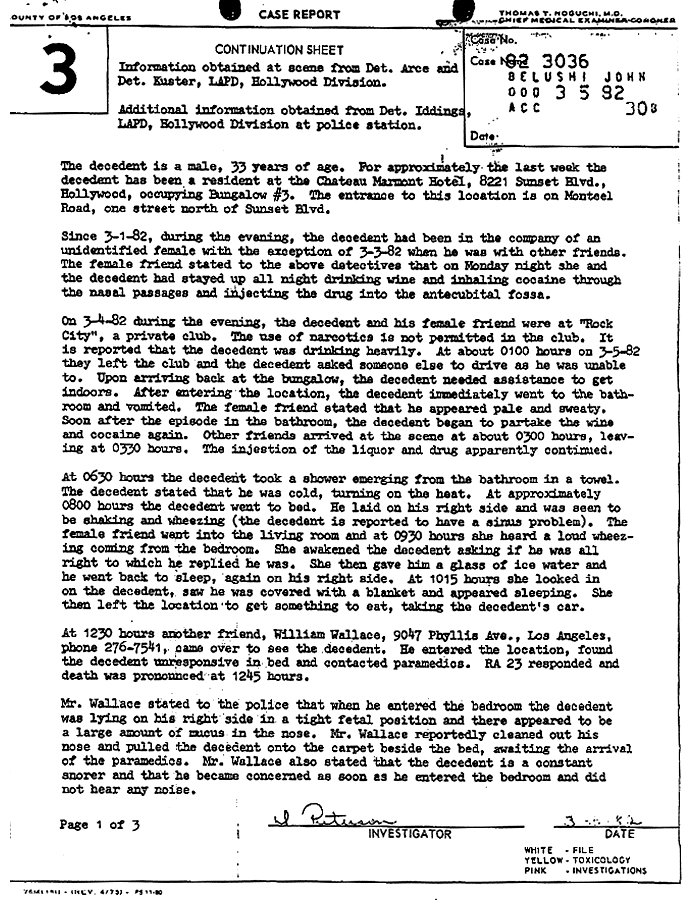
In addition, research in original newspapers has revealed that despite the claims of living near Bugsy Siegel when he was killed in 1947, Wolfe apparently lived elsewhere as his mother sold the house in question in 1944.

And most important, Wolfe makes statements about the autopsy which not only contradict the facts, but contradict his supposed sources. Specifically, Wolfe attributes a statement to former FBI profiler John Douglas that is actually the precise opposite of what Douglas says. If I were Douglas, I would be none too happy about having my work misrepresented in this manner.

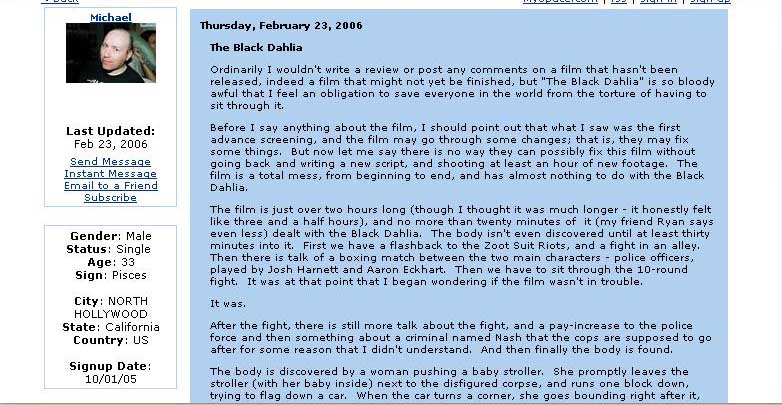
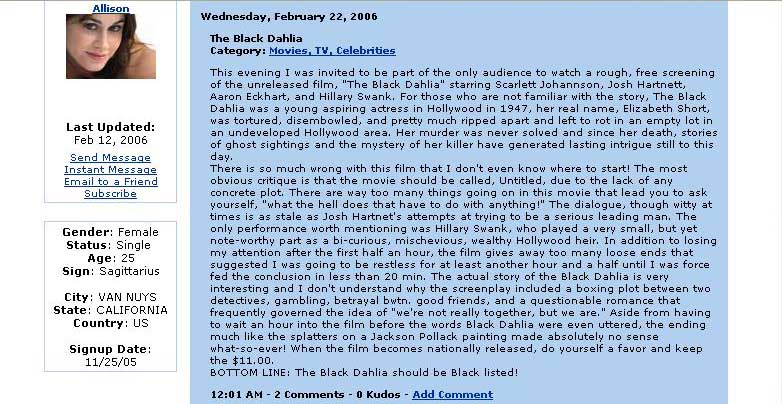
On a minor note, three bloggers have posted reviews of Brian De Palma’s “The Black Dahlia” from an advance screening in Sherman Oaks, all of them absolute pans. A sample comment: “There is so much wrong with this film that I don’t even know where to start!”

Let’s try to finish up this chapter today.

Page 33

“Mogul” states that Elizabeth Short’s autopsy has been lost.

“Yet in the 1970s, duplicate copies of all autopsy reports in Los Angeles were put on microfiche; the inevitable question arises—What secret is contained in the autopsy report that officialdom still does not want the public to know after a lapse of more than half a century?

Well, for me the inevitable question is: When did it disappear? The autopsy could have been swiped by a souvenir hunter (although I imagine it would have shown up on ebay by now) or simply discarded. Unfortunately, many public agencies regard their documents as something less than a priceless repository for historians. I don’t believe it’s any secret that before Hynda Rudd took over, the city of Los Angeles’ archives were a mess. Although Hynda has since retired, the city archives remain a tremendous resource on life in Los Angeles.

The same, unfortunately, cannot be said for the Los Angeles County material, which is a very mixed bag, as reflected by the district attorney’s collection of historic material, a terrific resource, although it is haphazard and incomplete.

“An alleged copy of the autopsy report was printed for the first time in Janice Knowlton’s book, ‘Daddy Was the Black Dahlia Killer’ (Pocket Books, NY, 1995). But this too was suspect and proved not to be the official autopsy report. It was based on a handwritten copy by an ex-officer of the Sheriff’s Department who led Knowlton to believe it was copied word for word from the original. But it was a word for word deception that once again hid the dark secret that the authorities did not want the public to know—a secret known at the time only by Capt. Jack Donahoe, Medical Examiner Dr. Newbarr, Finis Brown, Harry Hansen and the killer or killers.”

Hm. Note the “killer or killers,” taken from the same page of “Cop Talk 101” as “the male suspect exited the vehicle and fled on foot westbound.” Based on the absolutely false claims earlier about two styles of knife work in the killing, I’d say Wolfe is setting us up for some sort of dual murder.

And it’s time to drag in Janice Knowlton. The poor woman was so crazy; absolutely detached from reality. She would call my answering machine and leave long, angry, rambling messages every time a story appeared anywhere about the Black Dahlia case. It was easy to make fun of her while she was alive, but since she committed suicide I’ve only felt pity for her.

Like the coroner’s “Death in Paradise,” “Daddy Was the Black Dahlia Killer” is one of those books I don’t even let in the house. But I do have a photocopy of the section on Elizabeth Short’s autopsy and it’s clear Wolfe isn’t being entirely accurate here.

Luckily, amazon’s search engine will help us out. Hm. Janice Knowlton (and Michael Newton) say they got access to five autopsies on unsolved cases. Let’s see if we can figure out which ones:

First of all, they requested the Gertrude Landon autopsy and were told it was missing (Page 118). (An LAPD case).

Ditto Mary Tate (Page 208). (An LAPD case).

Perhaps they got the autopsy of Laura Trelstad (Page 212), although they don’t say definitively (Page 360). (Long Beach Police Department).

Maybe Geneva Ellroy (Page 277). Ah. They got the Geneva Ellroy autopsy (Page 360). Interesting. Of course, it’s not an LAPD case, but a sheriff’s case.

Maybe Helene Jerome (Page 279).

Well, I just used up my allotment of amazon searches for the day, so this not necessarily burning question will have to wait.

I’ll spare you the word for word textual comparison on the different versions of the autopsy in the interest of time. What I’m doing here is a beach book compared to that.

How accurate is “Daddy’s” version of the autopsy? The base of reference has to be the sworn testimony included in the transcript of the inquest, which Wolfe publishes, Pages 327-338, in a cleaned-up version. (What? It’s been cleaned up? Yep. It’s been photoshopped. If you know where to look, you can see the vestiges of little circles drawn around many of the line numbers. Case in point, Page 336, line 7).

The important note is that as Dr. Frederick Newbarr read his report into the public record, he was interrupted by Deputy Coroner Edwin Lenox, who told him to hurry things along and simply state why Elizabeth Short died. As a result, the inquest transcript is incomplete—sworn testimony, taken under oath, but incomplete.

There’s also a version of the autopsy in the LAPD summary on the case contained in the district attorney’s files. I wonder why Wolfe hasn’t referred to it. Hm. I hope we find out later. If not, that’s a huge omission.

Compared to the inquest transcript, the “Daddy” version makes some copying errors and the are some sections that appear nowhere else. Is it accurate? It’s impossible to say. But it is equally impossible to say that it was a malicious deception. We have to treat it as an unverified (and so far, unverifiable) copy and as such give it less credence than the two official sources: The inquest transcript and the LAPD summary.

Is the autopsy in “Daddy” a “word for word deception?” Frankly, if there’s anything guilty of that, it’s “Mogul,” given the book’s dismal record in distorting the facts and fabricating misinformation.

Let’s push ahead and finish the chapter.

Wolfe says Jim Richardson (again, he was the city editor, not the editor) asked Donahoe for a copy of the autopsy.

Oh no, Will Fowler in action! Here’s a laugh from beyond the grave:

“Fowler disclosed that Richardson was informed by Donahoe that the killer had inserted an earlobe as well as the tattooed flesh cut from the victim’s leg into her vagina.”

Of course, Elizabeth Short had no earlobes and her ears weren’t pierced. Will used to make up things about her earlobes all the time. A foxy grandpa to the end.

I could quibble more, but let’s pack it in for the day.

Oh by the way, in case you thought I forgot, “Daddy” wasn’t the first book to publish Elizabeth Short’s autopsy. That achievement belongs to “Severed,” (1994) Pages 121-124. Now why do you suppose Wolfe doesn’t tell us that? Could it have something to do with the autopsy information being attributed to the fictional Detective Herman Willis?

I wonder.

Shout out to:

France (82.242.89.143)

Hurry back!

Posted in Uncategorized | Comments Off on Blogging the Wolfe Book, Collecting Our Thoughts

Blogging the Wolfe Book, Missing Man Formation


Our story so far: I am blogging—in real time—as I read Donald H. Wolfe’s “The Black Dahlia Files.” It’s been slow going and this is an especially tedious part because I’m examining Wolfe’s treatment of Elizabeth Short’s autopsy. I’m not through and I’ve turned up some outright literary fraud, so it’s prudent to be particularly careful.

Page 33

Let’s pick up where we left off yesterday:

“Yet there is not another cold-case homicide on record in Los Angeles in which the autopsy report has not been made available to the public.”

This statement makes it sound as if autopsy reports are on file at the public library or some reading room, where the curious can simply browse at will.

Let’s take a famous cold case. How about the murder of Geneva Ellroy in 1958? I have an autographed copy of James Ellroy’s “My Dark Places” that deals with his mother’s death, so let’s see. (Bonus fact, James signed every copy of this book in a brilliant publicity stunt—if you call a scrawled “JE” an autograph—so it’s nothing for an ebay dealer to say he has one. What would be rare is to have one that isn’t autographed).

Unfortunately, the curse of having too many books is that you know you own it but don’t know exactly where it is. Luckily, thanks to Google’s search engine on amazon.com, we can delve through the text. (Which is preferable anyway, since “Dark Places” isn’t indexed). Did James get a copy of his mother’s autopsy? Indeed he did. Ah. But did he get it from the Los Angeles County coroner’s office?

No.

He got it because it was in the sheriff’s reports. For the record, retired Sheriff’s Detective Bill Stoner, a wonderful man who worked with James on “My Dark Places,” told me he was extremely unhappy that the polygraph keys were disclosed in the book, even though the murder was decades old at that point. Note particularly that the Ellroy case was a sheriff’s investigation, not the LAPD. Had Geneva Ellroy been killed in the city of Los Angeles instead of El Monte, I doubt very much if James would have gotten access to his mother’s files.

How about closer to home? If the Los Angeles County coroner routinely hands out autopsy reports like the fliers for landscaping and tree trimming hung on the front doors on every home in Los Angeles, I have to assume Wolfe is going to give us the Bugsy Siegel autopsy.

Well, gosh, I broke my vow of not reading ahead to thumb through the section on the Bugsy Siegel murder.

Guess what.

No Siegel autopsy.

(I hope you’re not surprised by that. I’m certainly not). For the record, even the coroner’s own book, “Death in Paradise,” was written based on newspaper clippings rather than official reports and has no bibliography. For the Elizabeth Short autopsy, writers Tony Blanche and Brad Schreiber used newspapers and—incredibly, “Severed,” which is, as I’m fairly sure I’ve said, 25% mistakes and 50% fiction.

What’s this? A search inside “Death in Paradise” doesn’t have a single reference to Dr. Frederick Newbarr, the chief autopsy surgeon in the 1940s. Hm. Well there is a reason I don’t even own this stinker. There are some books I won’t even let in the house and this is one of them.

But here’s a bigger mystery about Wolfe’s book.

Where’s my old pal, Detective Herman Willis? We haven’t gotten to him yet, and we’re nearly done with Elizabeth Short’s autopsy.

For the uninformed, Detective Herman Willis is John Gilmore’s leading source in “Severed” for the Black Dahlia autopsy. It is Herman Willis who provides lots of gruesome details about the coroner’s office, with descriptions of bodies stacked like cordwood. And it is Herman Willis, who in “Severed” provides the key details on Elizabeth Short’s purported “infantile genitalia.”

So where’s Herman Willis in Wolfe’s book? Missing. And why would that be?

As I have pointed out many times, Detective Herman Willis doesn’t exist. The name Herman Willis does not appear in the Los Angeles Times in any relation to the Los Angeles Police Department, he doesn’t appear in phone books or city directories of the period, he doesn’t appear in the ranks of police officers, nor in the directories of deceased or retired officers.

And no retired Los Angeles police officer has ever heard of him.

Years ago, I issued a challenge on this key source of “Severed’s” claims about Elizabeth Short’s purported “infantile genitalia”: What was his serial number? When did he graduate from the Police Academy? When did he make detective?

No attempt has ever been made to answer those questions. Instead, John Gilmore says he changed the man’s name.

Real journalists don’t do this except in rare occasions and they certainly never offer a false name without telling readers that it’s fictitious. Of course the threshold is far lower for a “true” crime book published by Zanja Press and picked up by Amok—if, indeed, these publishers can be said to have any threshold whatsoever.

Of course, the district attorney’s files list everyone who actually attended the autopsy of Elizabeth Short and all people are accounted for without any extra detectives. But I’m getting ahead of myself.

Did I mention that “Severed” is 25% mistakes and 50% fiction? Did I mention that John Gilmore wrote a book jacket blurb calling the Wolfe book “destined to become a true-crime a classic” but has since dismissed it as “crap”?

gtg

Shout out to:

Kddi Corp. (210.234.20.212)

Hurry back!
Posted in Uncategorized | Comments Off on Blogging the Wolfe Book, Missing Man Formation

Blogging the Wolfe Book, Loyalty

Just out of curiosity, I did a Google image search for “loyalty.” I got Johnny Cash flipping the bird (turned into a mock motivational poster); another poster for the Army on its values; a picture of a dog, a huge tattoo reading “Love” and “Loyalty” featuring rosary beads, a cross and other Christian symbols; James Montgomery Flagg’s famous World War I recruiting poster of Uncle Sam; a boomerang; and a couple of ships.

A search for “loyal” brought up a company’s logo; an image of the Boy Scouts; and the cover to Tupac Shakur’s “Loyal to the Game.”

Why am I trying to illustrate loyalty? Because I’m a very lucky man. Lucky because I get to attend the gatherings of two groups whom I respect very much: Retired Los Angeles police officers and retired Los Angeles Times reporters and editors. These are two groups of extremely fine men (and they are mostly men, given the professions and the era) and despite what you might expect, they are very much alike.

Both groups have drinks before lunch, which is a pleasant but not particularly distinguished meal, there’s a little business and a few announcements, a moment of silence for the recently departed and then a speaker. The retired officers say the Pledge of Allegiance, the retired reporters don’t. There’s a little more socializing and then they clear the room.

There’s many other things they share, but what struck me especially, as I attended the retired officers’ luncheon yesterday, was loyalty—loyalty to one another, loyalty to the department (or The Times) and most of all loyalty to the profession.

There are many reasons people become police officers (or reporters) and I don’t think anybody goes into either profession to get rich. Both professions, despite their many differences, require a dedication to integrity and indeed that’s exactly what I have found with both groups. Are there bull sessions? You bet. But what comes through again and again is professionalism and dedication.

I was reminded of that again yesterday when my host told me he was once assigned to ride with an officer who had been transferred over his role in “Bloody Christmas.” My friend told me he rode with this officer for two days, then went to the lieutenant and asked to be reassigned to another partner. He didn’t want to ride with the man because he was too prone to violence.

The reason I’m talking about all of this is because of the portrayals of several figures in the Black Dahlia case: former Chiefs Thad Brown and William H. Parker, and former Capt. Jack Donahoe, who was head of homicide during the Black Dahlia investigation. It is difficult to find three more respected men in the department and until Steve Hodel’s “Black Dahlia Avenger” came along, you never heard a bad word about any of them.

There are certainly those who have a different view of Parker. One of the singular moments of my life was interviewing the late U.S. District Judge David Williams, the first African American federal judge west of the Mississippi, who called Parker “the king of bastards as far as the black community was concerned.”

But among police officers who knew him, Parker is always given the highest respect and admiration, as are Brown and Donahoe. And quite frankly, these retirees take the corruption and cover-up charges against Parker, Brown and Donahoe in “Black Dahlia Avenger” and the other Black Dahlia books as a deep, personal insult. They are nothing less than furious.

Page 33

“Although many former LAPD Homicide detectives, including Harry Hansen, long ago conceded that the murderer was deceased, up until the end of the twentieth century, the Los Angeles County Coroner’s Office continued to refuse the release of Elizabeth Short’s autopsy report, claiming that this public document was being retained because the case was unsolved. Yet, there is not another cold-case homicide on record in Los Angeles in which the autopsy report has not been made available to the public.”

OK, first of all does the LAPD concede that Elizabeth Short’s killer is dead? These detectives were sharp men and always left themselves a way out. They will always qualify it by saying “probably” dead. Considering the number of surviving World War II veterans, it would be illogical to assume conclusively and absolutely that the murderer is dead. He may well be. But we don’t know definitively.

I’m not sure Hansen specifically addresses the issue in the 1971 feature in The Times. Let’s check.

Ah, what’s this? Remember when we talked about: “The fact that the body had been bisected by someone with advanced surgical knowledge was never disclosed at the time and the withholding of this vital information led to a misconception of the crime by both the press and the public that has been perpetuated for decades.”

And what does the 1971 Times profile of Harry Hansen say? “Most bizarre of all was that the corpse had been occupationally bisected and scrubbed clean, points which gave rise to later speculation that the killer had to have possessed more than a passing knowledge of surgery.”

Oops.

And what do we find in Hansen profile? Exactly what I said.

Voila:

“While he was on the case, Hansen refused to speculate either way, saying he preferred facts to suppositions. But, today, so many years after the fact, Hansen does permit himself the subjective luxury of his own opinion.

“It’s fairly realistic to figure the killer is no longer alive. By now, he would have done something, said something, that would have attracted attention. If he is still alive, he’s got it made unless he slips up and blows it. That’s a lot of years that’ve gone by; it would be hard now to go back and dig up new witnesses, new evidence.”

I have to go. In the meantime, let’s play a game: You tell me how many autopsies of unsolved, cold cases have been released in Los Angeles County; cold cases in which no suspect has ever been identified. Wolfe makes it sound routine, but offhand, I’d say the number is few to none.

Shout out to:

Dark Horse Comics (70.96.128.8)

University of Michigan Medical Center (141.214.17.5)

Nashua, N.H. (24.63.32.220)

Hurry back!
Posted in Uncategorized | Comments Off on Blogging the Wolfe Book, Loyalty

Blogging the Wolfe Book, He Walked by Night


Much has been written about poor crowd control at the Black Dahlia crime scene. Here’s an example of LAPD crowd control from the 1948 film “He Walked by Night,” which was the genesis of “Dragnet,” first as a radio show and then as a TV program. The idea of “Dragnet” arose during filming of “He Walked by Night” as Homicide Sgt. Marty Wynn, the technical advisor on the film, talked with actor Jack Webb about all the mistakes Hollywood made in portraying police work.

A frame grab from the movie shows the ropes used to keep people away from the car where a police officer has been killed. Retired Capt. Ed Jokisch has told me many times that in the 1940s, when he worked homicide, the call car had ropes used for crowd control.

Posted in Uncategorized | Comments Off on Blogging the Wolfe Book, He Walked by Night

Blogging the Wolfe Book, The Pinata


So what’s your point, Harnisch? Isn’t there a little schadenfreude here in dismantling Donald H. Wolfe’s “The Black Dahlia Files: The Mob, the Mogul and the Murder That Transfixed Los Angeles”? Didn’t you make your point at the preface?

Absolutely. So, as Sandy Koufax said: “The question is why.”

The answer is that time after time, people insist this book is thoroughly researched and well documented. And this nonsense spreads from one writer to another until it’s in wikipedia and in otherwise reputable books. One of my goals is to show what real research is like: Tedious, time-consuming, labor-intensive, picayune and thorough. And of course I never imagined when I set out that Wolfe’s book would present such a rich lode of fiction and fraud. As the old saying goes: “Even a blind pig finds an acorn once in a while.”

Another blog review of the Sherman Oaks “Black Dahlia” screening is posted and it’s the worst one yet.

Ordinarily I wouldn’t write a review or post any comments on a film that hasn’t been released, indeed a film that might not yet be finished, but “The Black Dahlia” is so bloody awful that I feel an obligation to save everyone in the world from the torture of having to sit through it.

Before I say anything about the film, I should point out that what I saw was the first advance screening, and the film may go through some changes; that is, they may fix some things. But now let me say there is no way they can possibly fix this film without going back and writing a new script, and shooting at least an hour of new footage.

The film is a total mess, from beginning to end, and has almost nothing to do with the Black Dahlia.

Here’s a screen shot:

Page 33

It is impossible for me to translate the noise I just made into type. I scanned the page and it’s loaded with nonsense. Get ready for a long sit.

“The slashed mouth and the blows to the head were characteristic of a rage murder, while the meticulous mutilation and bisection of the corpse with a surgical instrument were indices of a more methodical pathology, suggesting that more than one person may have been involved in the murder and disposition of the body.”

To the end notes, Watson, old boy.

Aha. Wolfe needs an expert so he gets one of the best: John Douglas. But we’re already in shaky territory. Does Wolfe actually interview Douglas? Nope. Another book from the five-foot shelf of secondary sources.

Let me make it perfectly clear: True researchers never use secondary sources if they can avoid it. Repeat after me: Never.

To the bookshelf to dig out “The Cases That Haunt Us” by Douglas with Mark Olshaker. (Hm. I seem to have two copies of “For the Life of Me,” one autographed that I got someplace and another that was a present from Will Fowler for having him over for Thanksgiving one year—Will was a charming man. A real teller of tall tales, but a very charming man).

No.

No!

NO!!!

Oh come on, this can’t be right.

Wolfe cites Pages 324-333 in “The Cases That Haunt Us.” Now in my copy (which, granted, is a uncorrected advance proof) this portion of the book deals with:

Are you ready?

JonBenet Ramsey.

Now I’m going to count to 10 and come down off the ceiling.

OK. Let’s run that quote again:

“The slashed mouth and the blows to the head were characteristic of a rage murder.”

And what does John Douglas (whom I interviewed, by the way—more about that later) say?

Guess what:

“The homicide falls under the heading of lust murder.” (Douglas and Olshaker, “Cases That Haunt Us,” Page 240).

So not only does Wolfe send us to the wrong place (and fudge the details by citing an entire chapter as the source for one sentence). He completely misrepresents what’s said in his alleged source.

To cite a source, make it difficult to verify and then completely contradict what’s said is nothing less than literary fraud that shows utter contempt not only for the readers but for the publisher. ReganBooks, you’ve been had. Did I mention this is a $30 book?

“Autopsy records are ordinarily part of the public record; however, Elizabeth Short’s autopsy report has never been made available to the public. The original explanation for the sealed report was Capt. Donahoe’s claim that it contained certain information that would be known only to the killer and that Homicide [note to ReganBooks’ proofreaders: why is this capitalized?] could use this secret information as a ‘control question’ when establishing the credibility of a prime suspect.”

Again, this is wrong. Autopsy reports are indeed public records when they involve what are deemed natural deaths (like John Belushi) or solved crimes. Autopsy reports on unsolved crimes are normally sealed unless the media go to court in an attempt to gain access. For example, the autopsy of Lana Clarkson, allegedly killed by Phil Spector, has not been released. (Citation: “The full autopsy report was not released at the request of prosecutors, a coroner’s spokesman said.”)

The point is, Elizabeth Short’s autopsy was sealed as are all medical examinations in unsolved crimes.

That’s it for today. Time for my walk.

Shout out to:

Bayreuth, Germany (80.136.118.180)

Hurry back!

Posted in Uncategorized | Comments Off on Blogging the Wolfe Book, The Pinata

Blogging the Wolfe Book, The Funny Papers


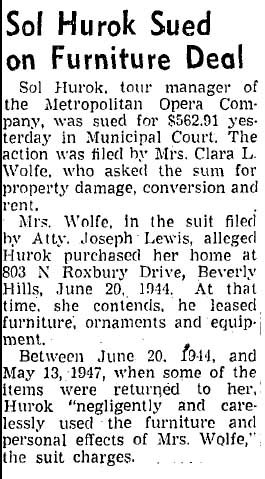
Oh dear…. oh dearie, dearie, dear. Just out of curiosity, I decided to check the address Wolfe gave as his home when Bugsy Siegel was killed. This was 803 N. Roxbury Drive (“Mogul,” Page 26).

First the good news. Wolfe actually lived there. Now for the bad news: It turns out that Wolfe’s mother sold the house to Sol Hurok in—what’s this—1944? That’s three (count them 1… 2… 3…) years before Siegel was killed.

This is where Perry Mason would say: “No further questions.” The whole business with Bugsy Siegel and Wolfe’s family is an out and out lie.

Another blog review of the “Black Dahlia” screening is in and it’s even worse than the first.

“There is so much wrong with this film that I don’t even know where to start!”

Where was I? Oh yes. I was about to have a rhetorical conversation with myself about some nits being too small to pick. Let’s backtrack for a moment (what do you mean, backtrack? We’re only on Page 32) to Page 4 in Donald H. Wolfe’s “The Black Dahlia Files: The Mob, the Mogul and the Murder That Transfixed Los Angeles,” which refers to the Examiner press line publishing the paper, including “Felix the Cat.” That didn’t sound familiar to me but I didn’t have the time to check. Then a couple days ago I went down to the Los Angeles Public Library and pulled the microfilm on another story from 1947 and took a moment to check the comics page.

Guess what.

No “Felix the Cat.”

I do have a copy of the Aug. 10, 1945, Examiner in my archives so I checked that too.

No “Felix the Cat.”

The comics lineup for the Los Angeles Examiner in 1947 was:

“Steve Canyon,” “Buz Sawyer,” “Rip Kirby,” “Barney Google and Snuffy Smith,” “Little Miss Muffet,” “Lone Ranger,” “Little Annie Rooney,” “Mandrake the Magician,” “Bringing Up Father,” “Blondie,” “Tillie the Toiler,” “The Nebbs,” “Secret Agent X-9” and “Tommy of the Big Top.”

And yes, I also checked the Sunday comics.

No “Felix the Cat.”

Does this matter in the least? By itself, not in the least. Piled on the heap of other mistakes, misrepresentations and fiction? It shows that even the smallest details in “Mogul” may not stand up to scrutiny. And compared to Wolfe not living near Siegel when he was killed it’s small potatoes indeed.

Now back to the autopsy of Elizabeth Short.

Page 32

“Dr. Newbarr was quoted by the press as saying that he believed the victim was ‘killed and mutilated while tied in a bath tub.’ ”

Well no, Newbarr didn’t say that. He did speculate that she was cut in half in a bathtub [note to ReganBooks proofreaders, bathtub is one word not two. Did I mention this is a $30 book when you include sales tax?], but he never said anything about her being killed in a bathtub, nor that she was tied up at the time.

Of course, we’re not going to get any help from the end notes. Wolfe doesn’t even bother to attribute this because he can’t, so he just says Newbarr was quoted in the press. And of course Newbarr was a smart medical examiner (despite what you may read in Janice Knowlton’s “Daddy Was the Black Dahlia Killer” about him missing things) so he only offered the use of a bathtub as a possible scenario.

Yikes! The following paragraph is totally wrong and completely made up:

“What was clear to Dr. Newbarr and those who had studied the condition of the corpse on Norton Avenue was that the deep cuts were not brought about by the same instrument that was used to severe
[severe? How about sever? Did I mention this is a $30 book?] the corpse. The slashed mouth and cheek areas exhibited the ragged cuts of a knife, while the mutilation and bisection of the body was accomplished methodically with a surgical instrument by someone who was proficient in surgical procedure—two different cutting instruments, two MO’s. One instrument was employed before death and the other was employed after death. The fact that the body had been bisected by someone with advanced surgical knowledge was never disclosed at the time and the withholding of this vital information led to the misconception of the crime by both the press and the public that has been perpetuated for decades.”

Aha. Now here is where Wolfe is apparently planting what he’s going to use as a smoking gun later on. This is only a guess on my part, but since it’s totally false and completely fabricated, I strongly suspect we’re going to hear about this again.

Let’s break this down:

“What was clear to Dr. Newbarr and those who had studied the condition of the corpse on Norton Avenue was that the deep cuts were not brought about by the same instrument that was used to severe [sever!] the corpse.”

  • Danger sign No. 1: This isn’t attributed to anyone. Wolfe never talked to Newbarr, who died in 1976, so it’s a complete mystery as to where he supposedly got it.

  • Danger sign No. 2: Nobody who was at the crime scene ever said this on the record; not Will Fowler, not Detective Harry Hansen, not Detective Finis Brown (the two lead investigators), not reporter Aggie Underwood and not anybody else I can think of.

  • Danger sign No. 3: Nothing like this is in the excerpts of the autopsy report published in the transcript of the inquest.


For Wolfe to just drop this in as though it was well-known fact is nothing more than sheer fiction.

“The slashed mouth and cheek areas exhibited the ragged cuts of a knife, while the mutilation and bisection of the body was accomplished methodically with a surgical instrument by someone who was proficient in surgical procedure—two different cutting instrument, two MO’s.”

The surgical proficiency of whoever killed Elizabeth Short has been well-established. The FBI files excerpt published by Wolfe on Page 341, citing FBI document No. 62-82627-24, correctly states: “The body was cut into around the waist with a very sharp instrument and the cut was very cleanly done—none of the internal organs being touched except [censored]. There is some speculation that the murderer has had some training in the dissection of bodies.”

But there is absolutely nothing about the lacerations to the face being ragged, or anything about them at all.

“The fact that the body had been bisected by someone with advanced surgical knowledge was never disclosed at the time, and the withholding of this vital information led to the misconception of the crime by both the press and the public that has been perpetuated for decades.”

Now wait. Let’s backtrack and pull out Jack Webb’s treatment in “The Badge,” which dates from 1958. I have been told by people (usually dealers who were trying to sell a copy for lots of money before it was reissued—I’m thinking of a particular shop in Pasadena) that this account is the best thing ever written on the Black Dahlia case. Actually, it’s full of mistakes and overlaid with a snide, superior, moralistic commentary on how it’s Elizabeth Short’s fault that her murder was never solved.

But even Webb (“The Badge,” Page 31) alludes to the killer’s proficiency: “Afterwards he (or she) drained the system of blood, scrubbed the body clean and even shampooed the hair [that’s one of Webb’s many mistakes, folks]. Then it was neatly cut in two and deposited at 39th and Norton.”

The perpetuated misconception about the crudeness of the bisection arises in (as we might expect) John Gilmore’s “Severed.” Gilmore, curiously and despite a growing body of evidence to the contrary, continues to insist that the body was sawed or hacked. Have I mentioned that “Severed” is 25% mistakes and 50% fiction?

Tomorrow, Page 33.

Shout out to:

Naperville, Ill. (12.31.231.1) My hometown!

A certain Air Force base in Virginia

RMW Architecture and Interiors (63.124.221.4)

Hurry on back!

Posted in Uncategorized | Comments Off on Blogging the Wolfe Book, The Funny Papers

Blogging the Wolfe Book, The Cloudy Crystal Ball


I have a poor track record with movie screenings, being one of the few people to walk out halfway through a sneak preview of “Boogie Nights,” which I thought was terrible. Of course the kid who conned me into seeing it told me it was “a Burt Reynolds movie” (a few years ago, any passing warm body on Colorado Boulevard in Old Pasadena was at risk of getting dragged into a theater for a screening). The polka music inserted as a placeholder for the soundtrack didn’t help. Imagine my surprise when everybody I knew absolutely adored it.

So I said “no” when someone asked me last week if I wanted to get into the sneak screening of the Brian De Palma movie “Black Dahlia” on Tuesday night in Sherman Oaks. Some people burn ardently for a movie deal, but I’m not one of them. I’m still thinking of David Thomson’s line in his New York Times review of Steve Hodel’s “Black Dahlia Avenger”: “Kevin Spacey should buy the film rights to this book quickly.” I don’t think there’s any way Hollywood could do a film about the Black Dahlia without turning it into a gruesome slasher flick. And I’m certainly not interested in that.

The verdict from someone who did attend last night’s screening: This movie, while FAR from finished, is a disaster of tremendous proportions. Given the quirks of blogs, there’s no telling how long this will stay up, so here’s a screen shot.

On the other hand, after reading a New York Times article about violinist Christian Tetzlaff yesterday, I dug out a recording of his fabulous December 2002 debut with the New York Philharmonic. Not to brag, but I do have my moments.

Page 31

Time for the autopsy in the coroner’s offices in the basement of the Hall of Justice. “Mogul” calls the area “rat-infested.” Sigh. To the end notes once again, Watson. Hm. The sources are Will Fowler’s “Reporters” and coroner’s inquest documents. Will had vivid stories about the coroner’s office, but none of them involved rats. Even John Gilmore’s account in “Severed” attributed to the nonexistent Detective Herman Willis doesn’t mention rats. I don’t buy it.

And now the autopsy, performed by Dr. Frederick Newbarr and Dr. Victor Cefalu. Ah this interesting. One of the telltale markers in bad Dahlia research is the misspelling of Cefalu as “CeFalu” in “Severed.” (Like the Crime Library. Though to be fair, they have asked me to contribute something and I’ve been too busy so far). Wolfe sidestepped that one at least.

Uh-oh. We have just gone from warp speed to impulse power. This could take a while.

“Dr. Newbarr concluded that the immediate cause of death was hemorrhage and shock due to the deep knife lacerations of the face and repeated blows by a heavy metal object to the face and right forehead.”

As Peter Abelard used to say: “Sic et Non,” though not about “true” crime books.

To quote the inquest transcript in Wolfe’s own book, Page 336: “The immediate cause of death was hemorrhage and shock due to concussion of the brain and lacerations of the face.”

I can’t think of a single original source on the Dahlia case that mentions a heavy metal object. And there’s nothing about deep knife lacerations, just lacerations.

Page 32

“There were deep ridges on her ankles, thighs, wrists and neck indicating she had been tied with rope or wire,” Dr. Newbarr stated to an INS reporter. “The victim’s mouth had been slit at each side to the ear while she was still alive. The excruciating pain of this would bring on shock… The blows to the face and head and the brain concussion came from blows from an iron instrument with a blunt edge.”

Now this is bad work, nothing more than an out and out lie. Newbarr never said anything like this to anybody as far as I know. But let’s check to be sure.

Here’s a little background that should help narrow the source: INS (International News Service) was owned by Hearst, so that would indicate a story that appeared in another Hearst paper (for example, the San Francisco Examiner) when it picked up a Los Angeles Examiner story.

Back to the increasingly well-thumbed end notes. Supposedly this is from the Examiner, Jan. 17, 1947. Now there’s absolutely no reason for the Examiner to run an INS story about something that happened locally, so this is extremely suspicious.

And in tracing Wolfe’s citation, we find a dead end. The photocopies of the Jan. 17, 1947, Examiner reposing happily in one of my file cabinets show the only direct quote from Newbarr is: “hemorrhage and shock due to lacerations of the face and concussion of the brain.”

Now there’s a reason Newbarr not only didn’t say this but wouldn’t have said it. Note that Elizabeth Short had been struck in the head. The doctors I’ve consulted tell me that when her face was cut she was almost certainly unconscious from being hit in the head. Alive, yes. Conscious, no.

A day on 2½ paragraphs. Not as bad as a day on one sentence, which I think is a record. But there’s no way to be quick and thorough. And I’m all for being thorough.

Feedback, by the way, seems to be 100% in favor of continuing on Donald H. Wolfe’s “Black Dahlia Files,” so I shall.

Here’s a shout out to:

Croatia (213.191.154.202), who knew?

The Hague (81.69.98.82)

Houghton Mifflin (65.213.77.129) 1 hour, 5 minutes.

GDS Publishing (195.188.172.11)

Pixar (138.72.11.136)

Hurry back!

Posted in Uncategorized | Comments Off on Blogging the Wolfe Book, The Cloudy Crystal Ball

some code


Once Upon a time there were three bears. A papa bear, a mama bear and a baby bear. They all lived together in a big house in the forest. One day

Posted in Black Dahlia, Books and Authors, LAPD, Streetcars | Comments Off on some code

Blogging the Wolfe Book, The FBI Story


There is an individual on ebay who sells copies of Elizabeth Short’s FBI file for $22 and some bidders drive the price even higher. The fact that the files are available online for free has curbed the demand somewhat. But I don’t know which is worse: a seller offering something that anybody can get for free (oh yes, you do get a “bound” version, if you consider a cheap plastic spiral a “binding”) or the people who buy it for $44.89, like sydney20030_3 .

Update: The price on ebay has gone up to $23, plus $5 shipping. Still free on the FBI’s website.

Page 28

In his treatment of the Black Dahlia case, Donald H. Wolfe is going to deal with the relationship between the police and the newspapers in the 1940s, which was definitely cozier than it is now.

“While today there is only one daily metropolitan newspaper in Los Angeles, back in 1947 there were five and all were zealous competitors—especially on a major murder case that had captured the public’s attention.”

I’m at a bit of a loss as to which papers Wolfe is talking about. I can think of four majors in 1947: The Times and the Examiner in the morning, the Herald-Express in the afternoon and the Daily News (no relation to the Daily News of Los Angeles). There were suburban papers in Pasadena, Hollywood, Long Beach and elsewhere, but I wouldn’t call any of them major. And of course while The Times is the major paper today, there is still the Daily News of Los Angeles, which covers the San Fernando Valley, and the Orange County Register (nee the Santa Ana Register).

And the next milepost in the Black Dahlia story, wiring the fingerprints to Washington. Again, Wolfe’s got it wrong:

“According to reporter Will Fowler, when the Examiner learned that the crime lab had sent the fingerprint card of Jane Doe #1 to Washington, editor Jim Richardson had managing editor Warden Wollard call Capt. Donahoe and request that the LAPD supply the Examiner with a copy of the prints.”

Oh boy. This is a trifecta of errors.

First of all, in newspaper hierarchy, the managing editor outranks the city editor, Jim Richardson. Second, Wollard didn’t ask Donahoe for a copy of the prints. And third, when you fingerprint a corpse, you obviously can’t use a fingerprint card. Instead individual squares are applied to each finger.

Watson! The end notes!

Just as I thought. Wolfe attributes this to Will, in a 2003 interview (by then Will was pretty far gone, I imagine) and Will’s autobiography “Reporters.” The question is why Wolfe doesn’t use Richardson’s autobiography, “For the Life of Me.” This is especially mysterious since Wolfe cites the book in his bibliography. Of course we have already found instances of Wolfe citing a book in the bibliography or end notes and ignoring it so this isn’t a first, alas. But it is significant.

Let’s see what Richardson has to say (“For the Life of Me,” Page 298):

“I thought I had done everything that could possibly be done. I couldn’t think of an angle we hadn’t covered. But I missed on one. I missed one that Warden Wollard, then assistant managing editor (note: not the managing editor—big difference) and now editor of the Examiner, spotted that gave us the first big jump on the story, the jump that made it our story from then on.”

[snippage]

“After I had left for the night, Warden was still around when a couple of homicide squad detectives came to the Examiner and asked if they could have our artist’s drawing of the girl for use in the police bulletin.”

Wollard overheard the conversation and suggested sending the prints to Washington by Soundphoto. He didn’t call the police; the police came to the Examiner.

Page 29

More nuts and bolts of sending Elizabeth Short’s fingerprints to the FBI. It’s wrong but not worth pointing out. Just take my word for it, the book is wrong.

Ah, but what’s the source of Elizabeth Short’s fingerprints? Hm. We’re not told and material like this should be attributed. Just as I thought, the Examiner only ran a close-up of one print, not all 10. A puzzlement. Humph. Not in Steve Hodel’s “Black Dahlia Avenger” but there’s a ratty copy in John Gilmore’s “Severed,” although the source isn’t listed. This is shoddy work, folks.

Page 30

“Elizabeth Short had been arrested on September 23, 1943, with a group of soldiers and other girls who were drinking and causing a disturbance near Camp Cooke, an army base north of Santa Barbara, California.”

Uh. No. She was arrested in Santa Barbara, and unless you consider 53 miles “close,” it wasn’t near Camp Cooke. There was no report of a disturbance, nor was she with a big mob of rowdy people. More correctly, she was on a double date and was a minor in possession of alcohol or a minor in a liquor establishment. There’s no excuse for getting these small details wrong since Wolfe clearly had access to the original Examiner (copies of which are included in his book). More important, this constitutes Elizabeth Short’s entire criminal record.

That’s it for today. Tomorrow, it looks like Wolfe is going right to the autopsy. That should be interesting.

Here’s a shout out to the World Book (208.222.174.2)

Rutgers (204.52.215.23), 4 hours and 57 minutes? I’m flattered.

Hurry back!
Posted in Uncategorized | Comments Off on Blogging the Wolfe Book, The FBI Story

Blogging the Wolfe Book, The Houyhnhnms


Our story so far, the two-minute executive summary:

Donald H. Wolfe’s book “The Black Dahlia Files: The Mob, the Mogul and the Murder That Transfixed Los Angeles” has introduced the character of “Uncle Vern,” not a blood relative but the boyfriend of the author’s grandmother.

Uncle Vern is presented as:

  • a disgraced former prosecutor, which he wasn’t (disgraced, yes; prosecutor, no)

  • a mob lawyer (lawyer, yes; mob mouthpiece, not a chance)

  • a house-sitter for Bugsy Siegel in 1946, which is impossible because Siegel didn’t live at the house in question until 1947. Uncle Vern is the source of a story about the murder of Thelma Todd by Bugsy Siegel, buttressed by the book “Hot Toddy” that is entirely suspect.


“Mogul” continues a studied disinterest in the truth, confusion about the jurisdiction of various local government agencies and a nasty phobia about original documents. On the good side, Uncle Vern was an actual person, attorney Vernon R. Hamilton, unlike many of the people in “Severed.”

And in what raises the bar several notches in terms of bizarre endorsements/non-endorsements, “Severed” author John Gilmore is listed in Wolfe’s acknowledgements and even contributed the book jacket blurb: “A haunting account, destined to become a true-crime classic. A must read!” then repudiated this book and told L.A. Weekly he couldn’t appear to support this book in any way.

That’s bizarre—even in the genre of “true” crime.

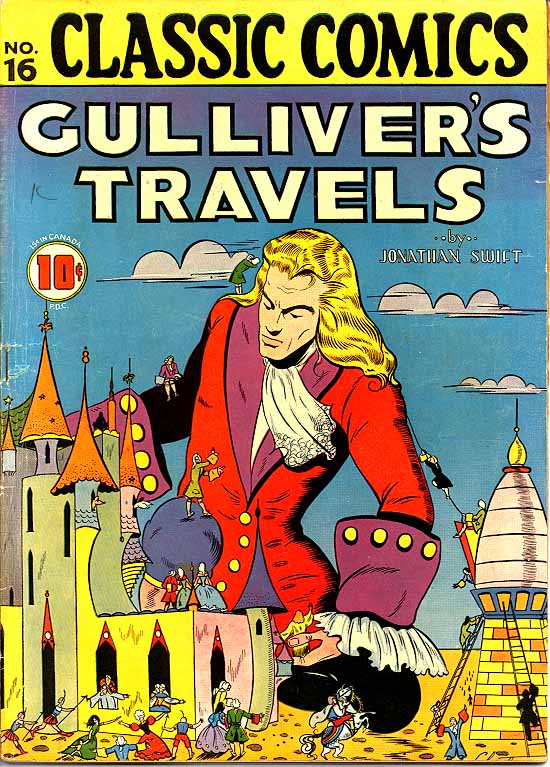
Above, Jonathan Swift’s “Gulliver’s Travels.” Although several segments of the book are quite well known, such as Gulliver’s encounter with the Lilliputians, the final portion of the work, a somewhat utopian society of horses called the Houyhnhnms is largely ignored. They are perfect for our purposes, however, since their vocabulary doesn’t have a word for lying and Gulliver must explain it as “the thing that is not.” Alas, we have found in “Mogul” many instances of “the thing that is not” and I suspect there are more occurrences ahead.

And no sign of how the death of Thelma Todd is in any way related to the Black Dahlia.

Page 26

“On the night Bugsy Siegel was shot to death while sitting on the sofa in his living room reading the Los Angeles Times of June 20, 1947, Vern and one of his pals lugged a large padlocked steamer trunk over to our house and stashed it in the garage. It contained something that belonged to Bugsy and remained in the garage for a number of months.”

Quick, Watson, the end notes. Ah, this is interesting (at least to a total research drudge, I suppose). Page 25 is attributed to the FBI’s files on Siegel, released through the Freedom of Information Act. Unfortunately, there are 2,421 pages in Siegel’s files and we’re not given the document number. An oversight, I’m sure. Luckily they are online (although heavily censored) right here.

Hm. Another volume from Wolfe’s five-foot shelf of secondary sources, “We Only Kill Each Other” by Dean Jennings. I checked to see if Florabel Muir’s “Headline Happy” is in the bibliography (it is) but there’s no use of her description of the crime scene, an unforgettable account (unless you are the author of “Mogul,” apparently) about Siegel’s eyelid being plastered on the wall and blood puddled on The Times dripping down on her satin evening slippers.

Curiously, Wolfe’s bibliography is missing “Beverly Hills Is My Beat,” by Beverly Hills Police Chief Clinton H. Anderson. Although Anderson was out of town on the night Siegel was shot, he fills in details about security in the city, including the fact that police cruised past Siegel’s house every 30 minutes. Given the basic procedures for crowd control and crime scene protection in place in the 1940s and depicted in Anderson’s book, the notion that Uncle Vern and an unidentified friend could spirit away something as large as a steamer trunk is virtually impossible. In light of the many “things that are not” concerning Uncle Vern, I wouldn’t believe this story unless I saw a picture of him and the trunk.

“Uncle Vern also knew a lot about the Black Dahlia case.”

This is a neat little way to tie the murder of Elizabeth Short into what so far has been a long and not terribly accurate digression into vintage malfeasance. Of course, given all the “things that are not” it’s hard to imagine Uncle Vern, the old souse, knowing much about anything.

Page 27

Once again, Wolfe shows an increasingly annoying ignorance of the difference between city and county jurisdictions, saying that Ray Pinker, head of the LAPD crime lab, inked Elizabeth Short’s fingers and obtained prints. This would actually be the job of the coroner, a Los Angeles County agency. Not the city of Los Angeles.

“When Donahoe learned that Examiner staff artist Howard Burke had been allowed into the morgue to make a sketch of the murder victim for identification purposes, Donahoe became angry and questioned the merits of the procedure.”

This is such junk. Attributed to a 2002 interview with Will Fowler, who by that time was barely lucid—at least whenever I talked to him. Will never told me anything like this and I spent lots of time with him. Let’s see if his book “Reporters” says anything about this.

Good for you, Will. Reporters, Page 77: “With no pictures other than the body of the unidentified girl to publish, artist Howard Burke created a likeness of the dead girls’ face from Paegel’s photos.”

That’s enough for today. I have to get going.

ps. OK regular readers (you know who you are)…. Should I keep going or have I made my point? Let me know. I may even enable commenting if you promise to behave yourselves.

Posted in Uncategorized | Comments Off on Blogging the Wolfe Book, The Houyhnhnms

Blogging the Wolfe Book, Uncle Vern

Page 24-25

I was breezing along (“breezing” being a relative term in reading a book at the molecular level) when I came across this little bon mot tucked into a sentence:

“Angry about the threats she was receiving if she didn’t cooperate with Bugsy Siegel and his pals, on December 11, Thelma made the mistake of going to District Attorney Buron Fitts’s office and lodging a complaint against the mobster who had muscled in on her café. She had no knowledge, of course, that the District Attorney of Los Angeles was on the mob payroll and that word would soon get back to the very people who had threatened her.”

Oh? And who might be the source for this little nugget of information? Quick, Watson, to the end notes.

Humph: “Hot Toddy,” Pages 171-172, 184. Now it doesn’t take much skill to find quibbles with Andy Edmonds’ book, even without buying it, nor to discover other accounts that Todd went to the police rather than the district attorney (recall that Wolfe has the annoying little problem of mixing up city and county government).

I’m going to take a rain check for now, but it’s terribly irresponsible to make such accusations without attribution, even if it’s to a potboiler on Hollywood scandals.

Time to trot out Uncle Vern again, the disgraced prosecutor who never was.

Aha! And it is Uncle Vern who tells young Donald his tales about Thelma Todd. Oh I see, Bugsy Siegel killed Thelma Todd, did he? Uncle Vern was working in the D.A.’s office, eh? I didn’t realize the district attorney was operating out of 405 Subway Terminal Building (MU-3790) in the 1930s. (Los Angeles Times, Oct. 27, 1934).

Hm. Hamilton represented Esther M. Jones in her divorce suit against her husband? (Los Angeles Times, Oct. 10, 1935). I guess we can conclusively write off any notion that Uncle Vern was ever a prosecutor.

But what’s this? On Aug. 5, 1942, Uncle Vern (attorney Vernon R. Hamilton) was bombed with tear gas by the Los Angeles County Sheriff’s Department because he had barricaded himself in his home and wouldn’t come out? He was put in jail? And where was this house? 407 N. Normandie? That would be nearly seven miles from South Camden Drive. Oh my! Looks like Judge Edward R. Brand found Uncle Vern in contempt for appearing in the court while he was drunk. And sent Uncle Vern to … jail?

And Uncle Vern was supposedly an attorney for the mob? Getting into the newspapers for showing up tanked in court, being gassed by the police and thrown into the graybar hotel by the judge? For the record, Jerry Giesler was Siegel’s defense attorney in the 1942 trial on charges of killing Harry “Big Greenie” Greenberg and I doubt very much if Giesler would let Uncle Vern as much as carry his briefcase.

Hm. Now Wolfe gives his address as 803 N. Roxbury, a bit of a drive for Uncle Vern if he’s in his cups.

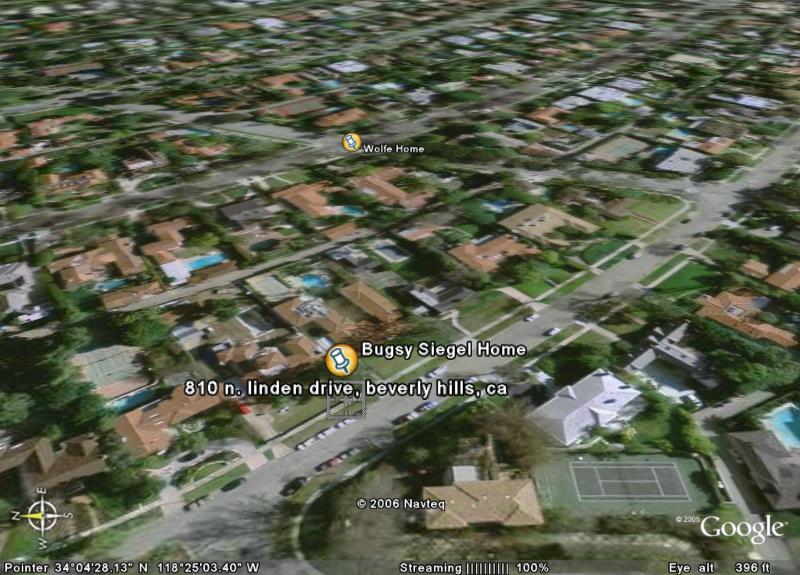
“…Bugsy Siegel and his girlfriend Virginia “Sugar” Hill, lived just behind us at 810 Linden Drive.”

The wonders of Google Earth. Notice the generous definition of “just behind.”

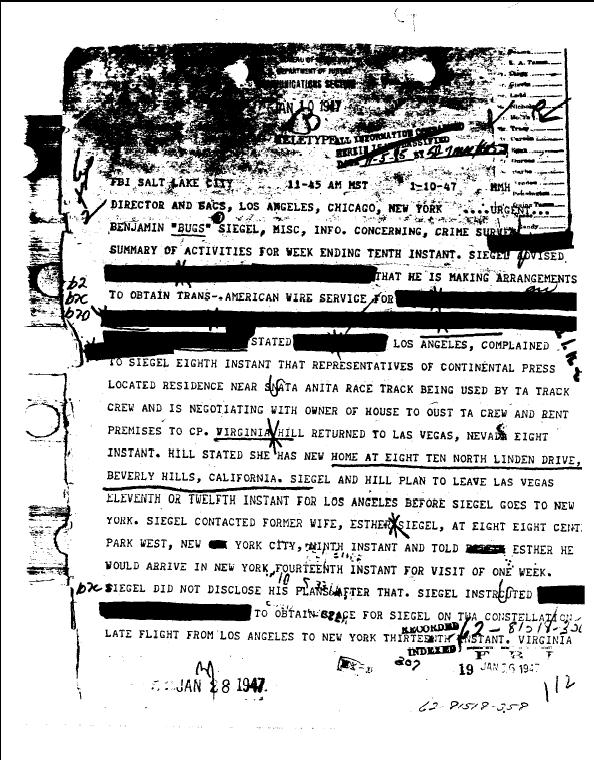
Now Wolfe builds to Uncle Vern the disgraced prosecutor who never was, the mob mouthpiece who never was, having a key to the home on North Linden Drive and taking care of it in 1946 while Siegel and Hill were off in Las Vegas building the Flamingo.

Except for one problem. Siegel didn’t move into the home on Linden until January 1947. How do we know? Because the FBI had him under surveillance.

Her new home? Jan. 10, 1947? And just whom was Uncle Vern house-sitting for in 1946?

Uh-oh.

ps. I’m quite serious about blogging this in real time. Well-intentioned people have tried to clue me in about what’s coming up next. I appreciate your concern, but please don’t spoil the fun, thanks.

Posted in Columnists, Uncategorized | Tagged | Comments Off on Blogging the Wolfe Book, Uncle Vern

Blogging the Wolfe Book, the Lookies


At right, one of the formative publications of my youth, which was included with the purchase of the World Book Encyclopedia. The Lookies had a wonderful motto: “We don’t guess, we look it up.”

Page 22

I really don’t want to get derailed into Thelma Todd as I can’t see what it has to do with the Black Dahlia case. I’m going to take a rain check with the simple proviso that given Donald H. Wolfe’s track record, there are going to be errors and misstatements. I’ll dig into it later if necessary, but this will have to do for now:

“Nevertheless, D.A. Buron Fitts insisted that her death was a suicide, though there were rumors among the movieland cognoscenti that Thelma Todd had been murdered by one of her intimate acquaintances—a mob boss who suddenly left town on the night of Thelma’s ‘suicide.’ ”

In fact, Fitts said: “We want it distinctly understood that we aren’t imputing this to be a murder. But there are circumstances that do not satisfy us. We intend to clear them up.” (Los Angeles Times, Dec. 19, 1935)

Moreover, the Los Angeles Police Department, under the auspices of crime lab chief Ray Pinker (the same man who had his hands in his pockets at the Black Dahlia crime scene), took Todd’s Lincoln and, using a volunteer, sealed the garage and started the engine to see how long it would take to render him unconscious. In 90 seconds, Detective Joe Whitehead was pounding on the door to be let out of the monoxide-filled garage.

It should also be noted that Todd’s death was investigated by the Los Angeles County Grand Jury. And in testifying before the grand jury, Pinker said that blood found inside Todd’s car contained carbon monoxide, excluding the possibility that the stains occurred before she started the car’s engine. According to testimony before the grand jury, Todd became unconscious from the fumes and struck her head as she collapsed, causing a wound that bled.

Eventually, the jurors found the evidence of suicide or accident so compelling that several of them refused to hear any more testimony.

I’ll leave Thelma Todd at this: It’s impossible to say Dist. Atty. Buron Fitts tried to cover up the case when it went before the grand jury.

What are the sources for this nonsense?

Samuel Marx and Joyce Vanderveen, “Deadly Illusions”; Andy Edmonds, “Hot Toddy”; and the Thelma Todd inquest report. Apparently Wolfe has some aversion to original sources such as newspapers. I’m mildly curious about the source of the Todd inquest. But not enough to go digging for it.

Page 24

Oh, more on Uncle Vern, the disgraced former prosecutor who never worked for the district attorney’s office. I don’t have time for this today.

Posted in Uncategorized | Comments Off on Blogging the Wolfe Book, the Lookies

Blogging the Wolfe Book, a Moment of Silence


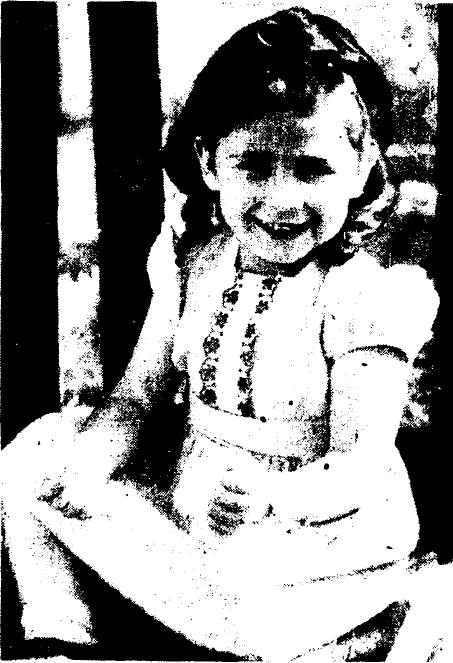
Wednesday was the 61st anniversary of the kidnapping of 6-year-old Rochelle Gluskoter from the frontyard of a home around the corner from where her parents, Abe and Miriam, were preparing to open their market at 8464 S. Central Ave. Rochelle’s skeletal remains were found in a remote part of Orange County on Nov. 9. 1947. The case was never solved.

Page 21

Now back to all Wolfe’s stuff about “Uncle Vern,” who is presented as a disgraced former prosecutor but really wasn’t. This is terrible research and worse writing. Just an out-and-out lie.

“… resigning in 1938 under a cloud of scandal, along with Mayor Frank Shaw and District Attorney Buron Fitts.”

These comments, along with remarks about Dist. Atty. Steve Cooley assembling an archive of city and county documents on old cases, show a distressing unfamiliarity with local government. The district attorney is a Los Angeles County post, an entirely separate jurisdiction from the city of Los Angeles.

Wolfe is also wrong when he says Frank Shaw resigned—he was defeated in the Sept. 16, 1938, recall election and on Sept. 26, 1938, greeted his successor, Fletcher Bowron, and turned over the keys to his office.

But wait. Buron Fitts not only didn’t resign as district attorney in 1938, he held office for two more years until he was defeated in the 1940 election by attorney John Dockweiler, who had the endorsement of—Mr. Corruption himself, Joe Shaw, Mayor Shaw’s brother. (For the record, The Times endorsed Fitts).

What’s this? Fitts got an indictment against Joe Shaw? Fitts won a conviction against Joe Shaw and William Cormack on 63 counts of selling answers to Civil Service exams for the police and fire departments? Shaw and Cormack were sentenced to five to 70 years in prison?

My goodness. It’s certainly a challenge to say Fitts and Mayor Shaw were in a corrupt conspiracy when Fitts sent the main offender, his brother Joe Shaw, to prison.

Oh boy. We’re heading quickly into vintage malfeasance: Paul Bern and Thelma Todd. I consider myself a specialist rather than a generalist and stick to the Black Dahlia case so I may take a rain check on some of this material unless it turns out to be somehow connected to the murder of Elizabeth Short.

Wolfe dispenses with Bern’s suicide in one line:

“Before the days of tabloid scandal sheets, Buron Fitts had covered up enough crimes and scandals to decimate forests of tabloid pulp. One of the notorious scandals had involved the alleged suicide of Jean Harlow’s husband, Paul Bern, who many believed had been murdered by mobster Longy Zwillman.”

“Many believed?” Like who?

For the record, Bern’s nude body was found Sept. 5, 1932, in the closet off his bedroom, a bullet in his temple and a .38 revolver clutched in his hand in what was apparently a death grip. A suicide note on the table:

“Dearest Dear: Unfortunately, this is the only way to make good the frightful wrong I have done you and to wipe out my abject humiliation. Paul.” He added the postscript: “You understand that last night was only a comedy.”


In 1933, the Los Angeles County Grand Jury opened an investigation of Bern’s death. Fitts said: “If information should be disclosed warranting a reopening of the Bern case, such action will be taken.” The grand jury interviewed more than 50 witnesses and issued a long statement concluding: “We are definitely of the opinion at this time that Paul Bern died as a suicide.

“After a thorough and exhaustive examination, we are of the opinion that the facts as disclosed do not warrant the expenditure of public moneys for further proceedings in this case.” I invite anyone who cares to read the entire statement to peruse the March 1, 1933, Los Angeles Times, first page of Part II.

Not exactly a cover-up, is it?

Suggested further reading: “The Lid Off Los Angeles,” a series of weekly articles in Liberty magazine, Nov. 11-Dec. 16, 1939, which prompted a libel suit by former Mayor Shaw. It’s available on microfilm at the downtown Los Angeles Public Library.

A day’s posting on one sentence doesn’t bode well, does it? Especially when Wolfe says exactly the opposite of what actually occurred.

Techie note: I have enabled an RSS feed. The link is http://lmharnisch.blogspot.com/atom.xml This seems to work once I stopped writing in Microsoft Word and pasting it into Blogger. Blogger, btw, has a toolbar for writing in Word and posting directly to Blogger. We’ll see how it works.

A shout out to:

Texas A&M University (165.91.69.122)

South Bank Polytechnic in London (136.148.1.142)

Vastra Gotaland in Sweden (213.80.115.71)

Broadband Access Pool of Finland (80.220.223.10)

Naples, Fl, Philharmonic (63.107.11.106)

Lucas Film (63.82.98.50)

Hurry on back!

Posted in Uncategorized | Comments Off on Blogging the Wolfe Book, a Moment of Silence

Blogging the Wolfe Book, Time for a Reality Check

I was all set, or so I thought, for today’s entry. And then something fell in my lap that I simply couldn’t ignore.

Let’s suppose you are an established author with a well-known book on a particular subject. Let us further suppose that another writer comes along, uses your book as the backbone for his work, runs a picture of you and praises you in his acknowledgements.

He even has a blurb from you on the book jacket saying that his work is a classic.

Now, someone comes along and interviews you about this book. Do you say it’s a classic? That your picture is in it? That you’re praised in the acknowledgements?

Absolutely not. Instead you completely disavow this book.

I just reread that and it doesn’t make any more sense to me now than when I typed it.

Here is a scan of the acknowledgements from Donald H. Wolfe’s “The Black Dahlia Files: The Mob, the Mogul and the Murder That Transfixed Los Angeles.”

It says: “John Gilmore’s Severed was the nonfiction forerunner of investigative books into the murder of Elizabeth Short and proved to be the Baedeker to Dahlia-land. Thanks, John, for all your help.”

And here’s a scan of the blurb from the book jacket.

And now here is L.A. Weekly’s interview with John Gilmore. In a screen shot—so there’s absolutely no question that any of this is made up.

This would be like James Ellroy endorsing my research in the documentary “Feast of Death,” and then writing an introduction to Steve Hodel’s “Black Dahlia Avenger,” endorsing George Hodel as the killer. And then refusing to talk about it.

Oh wait. That actually happened.

Curiously enough, L.A. Weekly’s Anthony Mostrom doesn’t seem to ask John Gilmore, “How can you say: ‘There was no way I could appear to be supportive of him in any way’ when you call his book ‘a must-read!’ “?

Nor did Mostrom ask: “Well, John, after writing the jacket blurb for Donald Wolfe’s book saying that it’s a classic, why are you calling it ‘crap?’ Isn’t that considered bad form in the book publishing industry?”

I can only assume follow-up questions aren’t part of Mr. Mostrom’s repertoire. You might want to work on that, Anthony, old boy.

Time for a walk—a long one.

Here’s a shout out to:

UCLA (128.97.48.42)

The Air Force Systems Command (138.13.212.7)

Symantec (65.88.178.10) (you guys rock).

Boeing (130.76.64.15)

Telekom Malaysia Berhad (218.111.148.106)

National Archives and Records Administration (207.245.173.48)

and the Internet Assigned Numbers Authority (173.40.11.131)

Hurry on back!
Posted in Uncategorized | Comments Off on Blogging the Wolfe Book, Time for a Reality Check

Teutonic Thoroughness, Nathan Marsak Style


You might ask yourself what bright, well-educated people with an arts background (art history for Nathan Marsak and Kim Cooper, musicology for yours truly) discuss when they get together.

Of course, the subject is the prevailing market value of Jabberjaw lunchboxes on ebay.

Kim, consulting her laptop: “32 bucks!”

Nathan: “Nooooo! I should never have blown mine up with an M-80!”

This was followed by an e-mail discussion of “Jabberjaw” broadcasts in German, discovery of a catalogue raisone of “Jabberjaw” episodes and the following riff by Nathan:

Jabberjaw: Ich, Jabberjaw. Die Seele von der Nation schlägt als ein Herz im Willen des Mannes.

Glückliche Kinder: Ja, Herr Jabberjaw. Wir sind Ihre Günstlinge. Lehren Sie uns die Wahrheit, als wir von Zarasthustra gelehrt worden sind.

Jabberjaw: Sie können nicht gelehrt werden. Sie können zerstört werden. Das ist Ihr Gebrauch zu mir. Der Wille von den Staatlichen Nachfragen nein weniger.

Glückliche Kinder: Ja, Jabberjaw! Formen Sie uns mögen so viel teutonisches Ton!!

Posted in Uncategorized | Comments Off on Teutonic Thoroughness, Nathan Marsak Style

Blogging the Wolfe Book, Teutonic Thoroughness


Several years ago, I was interviewed by a writer for the German magazine Stern about the Black Dahlia case. In explaining what was wrong with the various Dahlia books, I said: “They lack Teutonic thoroughness.” Of course, it was to be amusing and the writer thought it was an uproarious thing to say. But as a German, he could appreciate the full meaning of that statement, while most American writers wouldn’t understand it.

Here are two models of the good side of Teutonic thoroughness: Ritter von Koechel, above, and Wolfgang Schmieder, who catalogued the works, respectively, of Mozart and Bach. You know from the title that “Das Bach-Werke Verzeichnis,”at left, isn’t going to be a light read.

Page 21

“It was the Hearst papers that gave the Black Dahlia story the biggest play.”

This is certainly true in comparison with The Times, but the Daily News scored several firsts in the Dahlia coverage and even The Times scooped the Examiner on occasion. The competition between the four major papers ensured that no single paper prevailed every day.

Hm. Wolfe’s going to get into his grandmother Bessie Harkins and her boyfriend “Uncle Vern,” a.k.a. Vernon Hamilton, supposedly a former prosecutor. Not a familiar name. Let’s see what happens.

“Vern’s name was Vernon Hamilton, and he had been an assistant district attorney in Los Angeles before resigning in 1938 under a cloud of scandal, along with Mayor Frank Shaw and District Attorney Buron Fitts.”

Wolfe is certainly right that Frank Shaw was corrupt and that he was defeated in a recall election by Judge Fletcher Bowron.

Good grief…. Here’s a historic sidelight. A Vernon Hamilton (a different one, I’m sure) of the Westminster-Midway City Lions Club appears in a minstrel show in June 1956. The idea that people were still doing minstrel shows in blackface in the 1950s is, I must say, breathtaking. Even for Orange County. As for The Times running a picture of two men joking around in blackface, it’s pretty painful.

Hm. This is looking really, really bad. Vernon Hamilton was an attorney in Los Angeles, all right, and—what’s this? had an office in the Subway Terminal Building in 1934? Looks like quite a colorful character who handled several murder cases as a defense attorney. I don’t see anything about him ever being a prosecutor though. Let me double-check. Private practice in 1942, private practice in 1934, private practice 1931, private practice 1928.

Nothing about him resigning in 1938, nothing about him being a prosecutor—ever. Kind of unusual for a defense attorney to take a job that pays less with the district attorney’s office. Looks like Vernon Hamilton was well established in private practice as early as the 1920s. There’s nothing in The Times about Vernon Hamilton being a prosecutor with the district attorney’s office or resigning in 1938—zero. Given Wolfe’s poor track record on accuracy, I’ll have to assume Hamilton probably wasn’t a prosecutor unless I see some conclusive proof.

I hope Wolfe doesn’t hang much of his story on “Uncle Vern” because I don’t want to get derailed into debunking all of this—it’s very removed from the Dahlia case. On the other hand, if Hamilton’s connection to the district attorney’s office is entirely fabricated, “Mogul” is worse than I ever imagined. And it looks like we’re heading into the Thelma Todd case, very far afield from Elizabeth Short.

On the bright side—if one can say there’s a bright side to what appears to be a total lie—is that at least there was a Vernon Hamilton in Los Angeles in the time period and he was even a lawyer. This is light-years ahead of “Severed,” which is filled with purported “interviews” of people who don’t even exist.

I have to go for a walk and clear my head.

Here’s a shout out to:

The Rand Corp. 130.154.0.250

Vatterott College 67.130.177.34

City of Los Angeles 161.149.63.203

Chase Manhattan Bank 170.148.92.42

Fidelity National Title Co. 63.164.5.222

and

Chicago-Kent College of Law 66.158.3.199

Hurry back now.

Posted in Uncategorized | Comments Off on Blogging the Wolfe Book, Teutonic Thoroughness