Blogging the Wolfe Book, Our Far-Flung Correspondents

Large ImageI’m blogging in real time as I read Donald H. Wolfe’s “The Black Dahlia Files: The Mob, the Mogul and the Murder That Transfixed Los Angeles.” Wolfe is using the “Laura” format in which the anonymous, butchered body is found and the narrative is told in flashbacks. We’re at the point in the story where Elizabeth Short has gone to San Diego about a month before she was killed.

I was voicing skepticism yesterday about what movie was playing at the Aztec Theatre, an all-night movie house in San Diego, on the date in question. “Mogul” claims it was the “Al Jolson Story,” which is extremely unlikely.

A regular reader writes:

On 6th and 7th of December 1946, the Aztec played “The Blue Dahlia” and“Firebrands of Arizona.” During the day of the 8th, the Aztec played “Dead or Alive” and “Alibi. “For some reason, problems with the “Dead” film(?), the Aztec reverted to “The Blue Dahlia” and “Firebrands” on the night of the 8th. And on the 9th of December 1946, the Aztec played “Dead or Alive” and “Alibi.”

That sounds more likely. Of course, I still need to check for myself because that’s how I work, but those movies sound more reasonable. The Aztec was a second-run movie house that was converted from a former meat market. The “Al Jolson Story,” as Donald H. Wolfe and I know, comes from another story in the district attorney’s files. It was playing at the Pantages in Hollywood.

Large ImageDoes this seem trivial? Absolutely. By itself, it is meaningless, but taken in concert with all the other fabrication in the book, this small fact proves once again that Wolfe is absolutely untrustworthy in terms of details.

Page 61

By now, Elizabeth Short is befriended by Dorothy French, a cashier at the Aztec. Wolfe claims that Elizabeth asked about a temporary job.

Now here’s something interesting. A longish quote from Dorothy French:

“When she said ‘temporary,’ I thought it meant she wasn’t looking for a permanent job,” Dorothy recalled, “and that she didn’t intend on staying in San Diego. I suggested that she talk to the manager the next day. There was something so sorrowful about her—she seemed lost and a stranger to the area, and I felt I wanted to help her. I wasn’t sure how. She apparently had no place to stay. I suggested she come home with me and get a good night’s sleep, if that would help. She said she was thankful for my generosity.”

If this is from anywhere, it should be from John Gilmore’s “Severed,” because nobody else has ever claimed to have interviewed Dorothy French, except perhaps the 1947 newspapers and I don’t recall her ever saying anything like that in print.

Come along, Watson. Surely you know the way by now.

Yes, Holmes, the end notes say: “Severed,” Page 96.

Then let’s just check on “Severed,” shall we?

Large ImageGood grief, Wolfe can’t even lift a quote from “Severed” without changing it.

See for yourself:

“When she said ‘temporary,’ ” Dorothy says, “I thought it meant she wasn’t looking for a permanent job. I suggested she talk to the manager the next day. There was something so sorrowful about her—she seemed lost and a stranger to the area and I felt I wanted to help her. I wasn’t sure how. She apparently had no place to stay. I suggested she come home with me and get a night’s sleep on our couch, if that would help. She said she was thankful for my generosity. She used the word ‘generosity,’ and said things were difficult in Hollywood because of the strikes.”

But what about “Mogul’s” “She didn’t intend on staying in San Diego”? Concocted entirely by Donald H. Wolfe. Aided and abetted by agent Alan Nevins of The Firm and editors Cal Morgan and Anna Bliss. This is poor work, folks.

Large ImageBut let’s take a step back. Ever wonder why nobody quotes Dorothy French except for Gilmore? And why nobody else has been able to find her? Interestingly enough, there aren’t any notes in the Gilmore archives at UCLA from an interview with French. In fact, there aren’t notes of any interviews with anybody in the Gilmore archives, which I find incredibly suspicious, since I keep notes on all my interviews. The only exception is the transcript of a session with Jack Wilson that reveals he was being paid to say he killed Elizabeth Short. (There is an interesting collection of rejection letters on “Severed” that is almost worth the trip to Westwood).

In case you’re curious, the reason nobody’s gotten interviews with Dorothy French is that she died more than 20 years ago.

Let’s check in with Gilmore’s onetime Dahlia partner Mary Pacios. Any quotes from Dorothy French in “Childhood Shadows?”

Hm. Now isn’t this just the most interesting thing? Pacios (“Childhood Shadows,” Page 111) talks about doing interviews in 1988, long after Dorothy French was dead.

Nope, no Dorothy French quotes: (“Childhood Shadows,” Page 86)

“Elvera’s daughter Dorothy said she met Beth at the Aztec Theater in downtown San Diego. Dorothy, working as a cashier, felt sorry for the dark-haired young woman sitting forlornly in the theater. Times had been rough since the end of the war eighteen months before.”

Did Gilmore actually interview Dorothy French? I’d like to know. I’d especially like to see some notes and know what name she was using at the time.

Good grief. I was going to pass on the next paragraph, figuring it was a straight lift from “Severed.” But no. Wolfe has to embellish it.

“Severed,” Page 96:

Large Image“Elvera French was sitting in the kitchen with a cup of coffee and the newspaper. She apologized for the mess in the house—she had not expected company. Dorothy quickly told her that Beth was going to ‘camp out’ on the couch for the night since she’d missed a ride and was a little stranded.”

“It seemed as soon as Dorothy brought her a blanket and pillow, and Beth lay down, she was already fast asleep. In the kitchen, Elvera told her daughter that the girl looked ‘pale.’ Dorothy said Beth had been coughing and it sounded like some sort of congestion. Her mother suggested the girl should see a doctor.”

“Mogul,” Page 61

“…Dorothy’s mother, Elvera, was still awake, having a snack in the kitchen. Introducing the unexpected guest, Dorothy explained that Elizabeth had no place to stay. Elvera remembered that she was pale and didn’t look well. She brought Elizabeth a pillow and a blanket and suggested that she sleep on the sofa.”

OK, now what’s wrong with this picture, aside from the trivial questions of whether Dorothy or Elvera French got the blanket and pillow, and whether Elvera was drinking coffee or eating a Krispy Kreme New York cheesecake doughnut. I mean, the whole thing is made up so it hardly matters which vein of fiction you follow.

Does anybody remember what Elvera French did for a living? A job that enabled the French family to live in government housing in Bayview Terrace?

She was a nurse at the Navy hospital in San Diego and obviously well-equipped to diagnose whatever was allegedly ailing Elizabeth Short in “Severed.”

Oops.

Large ImageTime for my walk.

Here’s a shout out to:

Germany (80.139.111.99)

France (80.124.192.14) 22 hours? Tiens!

Hoffman Lewis (66.124.85.31)

Hurry back!

Posted in Uncategorized | Comments Off on Blogging the Wolfe Book, Our Far-Flung Correspondents

Panoramas of Los Angeles

http://video.google.com/googleplayer.swf?videoUrl=http%3A%2F%2Fvp.video.google.com%2Fvideodownload%3Fversion%3D0%26secureurl%3DpAAAAKHhiUpYCQm53irsrf5q7FURGDcBHXL8MU0gBXbiRI_Vzd5EOr-_F9uz178McOQhS4iDk1vgCFQpRjVcP580V0Ou5qTWyRjx4ZKgszV36VtKIM7yCS_blm3ht32MvJeR1paoXgwnI_oTcZdcST4xXSeB2_gk2Upp-u-ji2dpsn9GS6NX6ld_qxGMZ1M2D1SnSuF3_LIfSK3KxW79l_USuXX40pWZGY3g-A5mI4B8ai4N%26sigh%3DFyrfHCWz_TIp7xzK0jHDo3KrrL8%26begin%3D0%26len%3D1373633%26docid%3D7314420685757075146&thumbnailUrl=http%3A%2F%2Fvideo.google.com%2FThumbnailServer%3Fcontentid%3D8a5b2e8a069ae23f%26second%3D5%26itag%3Dw320%26urlcreated%3D1142495904%26sigh%3D7J5-LjyDNX5EDXwL16KlbCHLIVo&playerId=7314420685757075146

My little ode to my favorite city, covering a roughly 20-year period centered on 1907 with the idea of giving a general introduction to Los Angeles from the 1890s to the eve of World War I. (The Times bombing and the air meet at Dominguez Hills were in 1910, for example). The Skunks of Los Feliz actually discovered this sometime back but I didn’t want to tip my hand by saying anything. Fortunately, I received some very flattering comments. Although the music sounds very contemporary, I chose it because it was written in 1907.

Here’s a high resolution version, but it only works with the newest versions of Windows (sorry folks with Win 98SE) and doesn’t play well with Mac OS X.

Posted in Uncategorized | 2 Comments

Blogging the Wolfe Book, the Face Is Familiar

Large ImageI’m blogging in real time as I read Donald H. Wolfe’s “The Black Dahlia Files: The Mob, the Mogul and the Murder That Transfixed Los Angeles.” Wolfe is using the “Laura” format in which the anonymous, butchered body is found and the narrative is told in flashbacks. We’re at the point in the story where Elizabeth Short has left Los Angeles for San Diego in December 1946, about a month before she was murdered.

Page 60

Wolfe is talking about Elizabeth Short’s stay at the Chancellor on North Cherokee. Everything seems to be lifted more or less from newspaper accounts.

Holmes, I don’t even need to ask. The end notes.

Well, Watson, Wolfe says he consulted the Oakland Tribune, Jan. 21, 1947, a bit unusual. Most people don’t bother with the Oakland papers as they’re hard to get. Let’s check his work. He says that’s where he got this quote:

“She had lots of telephone calls, mostly from a man named Maurice, and she was out almost every night. The morning she left, she was very anxious about something. Beth said to me: ‘I’ve got to hurry! I’ve got to get out of here.’ ”

Let’s pull our copies of the Oakland papers, Watson. Jan. 21, 1947, Oakland Tribune.

My dear Holmes! The quote isn’t there!

Hum. A United Press story datelined Los Angeles. Foul work, Watson. Foul work indeed.

Large ImageLet’s press on. Wolfe talks about a trip to San Diego by Examiner reporter Tommy Devlin and then drags in George O’Day, a name I don’t recognize. I have a terrible feeling I’m about to encounter the three most terrifying words in the English language: “Will Fowler recalls.”

Nope, not attributed to anybody. Who on earth is George O’Day? Let’s check Will Fowler’s “Reporters.” Ha! Page 81 of “Reporters” but not attributed in “Mogul.”

Holmes, why are you never wrong?

Who is this mysterious George O’Day fellow?

“Reporters,” Page 14.

“George O’Day, an ex-professional boxer with a large front gold tooth, grabbed his four-by-five Speed Graphic camera and a bag of negative plates and flash bulbs. We two-stepped it down a couple flights of cast-iron stairways at the rear of the building and out to O’Day’s car in the parking lot.” Well, not a reporter, anyway, but a lensman.

But I don’t seem to recall any Examiner pictures from San Diego. Let’s see. Well, the Examiner ran a photo of Dorothy French but didn’t provide any sort of credit—very unhelpful of them. The Herald ran the same picture a bit later. Normally the Examiner credited photos with a line like “Examiner photo.” But that’s the only picture the Examiner ran from San Diego. Inconclusive.


Page 61

Wolfe picks up the mistake from John Gilmore’s “Severed” about the Aztec Theatre, where Elizabeth Short was befriended by cashier Dorothy French as she was spending the night. “Severed” (25% mistakes and 50% fiction) fabricates an entire scene out of this moment:

Large Image“After leaving the cafe [I’ll spare you that story], Beth walked up Fifth Street to the Aztec Theater where a double feature was playing. The sign outside said “OPEN ALL NIGHT.” She bought a ticket and soon after settling into one of the plush seats, fell asleep while the movie was playing.

“Twenty-one-year-old Dorothy French worked as a cashier and usher at the Aztec. When the houselights came on she saw the girl sleeping near the front row, the only person left in the theater except for Dorothy and the janitor.

“Dorothy woke the girl and told her the theater was closed. Beth seemed confused and mentioned the sign that said the movie house was open all night. ‘I have to apologize for that,’ Dorothy said. ‘The sign is not supposed to be out there. The policy has been changed because we’re under new management.’ ”

In fact, according to the San Diego newspapers, the Aztec was still an all-night movie theater, one of several in the city. So much for “Severed.”

Wolfe further states that “The Jolson Story” was playing at the Aztec, but note that his source is “Severed,” which doesn’t mention the name of the film and in fact says a double feature was playing. This is bad work, folks. I was fairly certain I had the movie listings for the Aztec from 1946, but I can’t locate them quickly.

Large ImageTime for my walk.

Shout out to:

Dark Horse Comics (70.96.128.8) one of my regular visitors.

Sheffield, England (83.100.194.228)

Lanham, Md. (216.164.63.205)

Boston (4.156.114.95)

Rutgers University (204.52.215.23)

Hurry on back!

Posted in Uncategorized | Comments Off on Blogging the Wolfe Book, the Face Is Familiar

1907: In Which We Begin

As I began to write my grand opening about Los Angeles in 1907, I felt a ghostly hand pluck ever so gently at my sleeve.

“Promise me, dear boy, you’ll remember to say that women couldn’t vote in 1907.”

“Yes, of course.”

Now where was I? Ah yes. The street names are deceptively familiar: Broadway, Spring Street and Main. But stand up on Bunker Hill and look at the city below and you might pick out the Bradbury Building and the Alexandria Hotel. Maybe the Pan American building at Broadway and 3rd Street, kitty-corner from the Bradbury and currently undergoing loft conversion, and the Rosslyn Hotel on Main.

Nothing remains of the old City Hall on Broadway but the parking lot between the Los Angeles Times garage and Victor Clothing, otherwise known as the Hosfield Building, erected as an annex for city offices in 1914 and opened in 1915 as City Hall South.

There are no freeways in this alien city. No television, no radio (or “wireless” as it was previously known) and no movie theaters. There aren’t even any comic strips in The Times, let alone crossword puzzles. Luckily, the operatic repertoire hasn’t changed greatly; Angelenos in 1907 could hear “Carmen” and “La Traviata.”
The ghostly hand intruded again, a bit more forcefully.

“Dear boy, remember about women not being able to vote?”

“I’ll get to that.”

There are a few automobiles (or “machines” as they were called) sold by dealers who set up shop on South Main around 12th Street. Reo, Rambler, Jackson, Pope-Toledo, Stevens-Duryea and Overland. Buick, Cadillac, Oldsmobile and Packard are the only familiar names. But machines seem only a bit more common than Segways are today. There are no more than 30 cars listed for sale in The Times classified ads for March 14, 1907, far outnumbered by horses; buggies and wagons, streetcars and bicycles appear to be the main modes of transportation.

Sample ad:

POPE-TOLEDO 24-H.P. TOURING CAR
with touring car body, canopy top and run-
about body. This car has just been thoroughly
overhauled and is in first-class condition.
The BIGGEST bargain offered in
Los Angeles
$1,000 ($20,523.57 USD 2005)
Western Motor Car Company
415 S. Hill

Patent medicine, séances, licensed saloons and something called a blind pig. The pages of The Times are brimming with vintage malfeasance.  

“Ow! You don’t need to pinch me.”

“Dear boy, women’s suffrage?”

“Very well.”

Women in Los Angeles couldn’t vote until 1911, when a new law allowed them to cast ballots in the local elections. The 19th amendment, granting women’s suffrage, was ratified by California on Nov. 1, 1919, and proclaimed by the secretary of State on Aug. 26, 1920.  (Not passed by Mississippi until March 22, 1984? Are you serious?)

“I’ll even mention suffragette Rachel Foster Avery’s visit in August 1907. How’s that?”

“Thank you.”

Posted in 1907, 1908, 1911, 1914, Black Dahlia, Books and Authors, City Hall, Freeways, LAPD, Streetcars, Theaters | Comments Off on 1907: In Which We Begin

L.A. Historians’ Clearing House

Large ImageA researcher writes asking for help with information on an enclave of radicals living in an Echo Park neighborhood nicknamed “Red Hill” and sometimes known as “Red Gulch.”

A Proquest search of The Times finds a passing reference in the 1980s, but no details. Some Times stories from 1944 refer to the Echo Park Communist Club.

Anyone with information is asked to post a comment (they are moderated, remember, and posts that are off-point, extraneous or profane are rejected).


Posted in Uncategorized | Comments Off on L.A. Historians’ Clearing House

Blogging the Wolfe Book, the Whole Nine Yards

Large ImageI’m blogging in real time as I read Donald H.Wolfe’s “The Black Dahlia Files: The Mob, the Mogul and the Murder That Transfixed Los Angeles.” Wolfe is using the “Laura” format in which the anonymous, butchered body is found and the narrative is told through flashbacks.

At this point in the story, Wolfe is exploring Elizabeth Short’s time in Hollywood in late 1946, about a month before the murder.

Page 59

After deftly handling the nebulous role of Sgt. Chuck, whom investigators and reporters could never locate—or even determine that he existed, Wolfe moves on to the apartment house on Cherokee where Elizabeth stayed briefly in late 1946.

Wolfe begins the next phase of the story: “Will Fowler recalled,” three words that make me shudder. I liked Will; he was charming, funny, outrageous and bright, and I considered him a friend. But he was also an incredible teller of tall tales. Wolfe refers to Will’s “Reporters,” Page 81, which says that an anonymous tip sent newsmen poking around Hollywood trying to sniff out anything about Elizabeth Short.

In fact, in the days after Elizabeth Short’s murder, an almost countless variety of sightings were reported; as if she had been a regular at every bar in Los Angeles. Of course, not a single person ever conclusively identified her as far as police were concerned—and even the more conscientious newspapers hedged their accounts:

The Daily News of Jan. 21, 1947, said of the reporters’ club crawling: “Other results of the nightlong canvass indicated that the Black Dahlia had lent her beauty to innumerable swank and tawdry night spots in the months before her death—that is if the eyes and memories of bartenders and waiters are sound.”

Note also the date: Nearly a week after the murder. It’s interesting to see how storytelling collapses time, erasing the intervals between events until they appear to be related.

Large ImageOf course, Wolfe is going to treat this all as solidly established truth because that’s where this story is heading. Let’s see where he attributes this. Hm. Still using “Reporters.” But what’s this? Will drags in his old drinking buddy Paul Burke, a bartender and sometime actor who appeared in the TV show “Twelve O’Clock High.” (Sorry, amazon only has the movie, not the TV series). One time, many years ago, Will and Burke called me up absolutely snockered and talked to me about the Black Dahlia case. They were flying high and having a good old time.

Now I’ve talked to Burke, who according to “Reporters” says: “Years later, when I was with 20th Century-Fox, actor Paul Burke told me he’d known the Dahlia when he was a Hollywood bartender. He had corroborated the fact that lesbians had been interested in Elizabeth but she hadn’t responded to them.”

So does Burke appear in “Mogul”? Let’s just see for the fun of it. Nope, he doesn’t. I wonder why not. Maybe we’ll find out.

And now we enter very deep and troubling waters.

“Reporters found Elizabeth Short’s name still on the mailbox of Apartment 501. There were five other girls sharing the apartment, which was on the top floor overlooking the street below. The building was managed by Glenn Wolfe, a suspected narcotics dealer who recruited girls for the Syndicate brothels.”

Let’s dissect this little item (truncated, because it runs over to the next page).

Minor quibble, as the photograph shows, the name on the mailbox is “Betty Short.” One of the first decisions anybody has to make in writing about Elizabeth Short is what to call her: Elizabeth, Beth, Bette or Betty.
Also, estimates of the number of young women in the apartment vary, some sources say four, others say eight. Wolfe is the first as far as I know to say five.

But what we really need to look at is Glenn Wolfe. He’s called “a suspected narcotics dealer,” although we’re not told who suspected him.

Not the blasted end notes again, Holmes!

Forward, my dear Dr. Watson.

Large ImagePage 366

“Glenn Wolfe was also listed as a suspect within the Black Dahlia Case files, which profiled his narcotics and procuring activities. The files indicate that the Chancellor [was] owned and managed by the Syndicate.”

I suppose what Wolfe means by this is that if you dig through the two boxes of jumbled paper at the district attorney’s office you will eventually find Glenn Wolfe’s name. OK, well you’ll find that his name was really Glynn Wolfe.

Now usually in such a case, you might expect a line like “Glenn/Glynn Wolfe, no relation to the author,” so I’m not sure if this is an oversight or if Donald H. Wolfe is going to claim him as some sort of distant relative with mob ties. Recall that Donald H. Wolfe has been very circumspect about certain members of his family, namely his father, Sailing Wolfe, and great-uncle, Bernard Baruch.

For the benefit of those who don’t have the Examiner files on Glynn Wolfe, let me pull my material and see what we’ve got:

Yow! The Examiner and The Times had great fun with our friend. He had at least 17 different wives (no, that’s not a typographical error) and married a couple of them several times according to a March 18, 1969, story in The Times.

But the newspapers are curiously silent on his alleged drug dealing and procuring for the Syndicate.

As we found yesterday in exploring the story of Sgt. Chuck, we know that Frank Jemison summarized a list of about 22 suspects. And yes, Glenn/Glynn Wolfe is one of them.

What does the D.A. actually say? I’m referring specifically to Jemison’s Feb. 20, 1951, memo. Page 6.

Large Image“Glenn Wolfe is the owner of the Chancellor Apartments, 1842 Cherokee, Hollywood. It was the last place where victim resided in Los Angeles before she met Carl Balsiger and then left for San Diego. He was residing at 1617 North Las Palmas in an apartment house owned by Kate Harris at the time of the murder. He admitted knowing victim. She lived in a six bed apartment at the Chancellor Hotel and left there on December 6, 1946, as she did not like the place. Wolf is known as a sexual maniac by other women. Ray Pinker, LAPD Crime Laboratory chemist, checked the rooms in which he resided for blood and got no positive reaction. This was done upon request of the undersigned. Marvin Hart, now living at Lido Apartments, Hollywood, lived at the Chancellor Apartments at the time of the murder. He has not been questioned. Alyce Lebedeff, private investigator, 1967 Carmen Strett, HI llside 6279 states that a Miss Schell, who runs a hot dog stand on Santa Monica boardwalk, slept in the upper bunk of the bed occupied by victim on December 1, 1946, at the Chancellor Apartments. Further that Polly Blits, Hollywood real estate broker is a known queen queer and knows plenty. There is reliable information that some of the five girls in the room at the Chancellor living with victim were queers. Victim stated on several occasions, however, that she had no use whatsoever for queers.”

Large ImageHm. Note that I have preserved the wording exactly as it appears in the memo, down to the frequent use of “queer.” Nothing about Glynn Wolfe being a drug dealer. Nothing about Glynn Wolfe being a procurer for Syndicate brothels. Nothing about the Chancellor being owned by the mob. This is all fabricated by Donald H. Wofe, aided and abetted—according to his acknowledgements—by his agent, Alan Nevins of the Firm; and editors Cal Morgan and Anna Bliss. And ReganBooks, known as the publishing house without proofreaders.


Time for my walk.

Shout out to:

Allstream Corp. (216.123.180.34)

City of Los Angeles (161.149.63.203)

CBS.com (170.20.96.116)

Kindred Healthcare (207.15.10.211)

O/S breakdown

Some flavor of Windows: 81%

Mac OS X 18%

Unknown: 1%

Hurry back!

Posted in Uncategorized | Comments Off on Blogging the Wolfe Book, the Whole Nine Yards

Blogging the Wolfe Book, Who Was That Masked Man?

Large ImageI am blogging in real time as I read
Donald H. Wolfe’s “The Black Dahlia Files: The Mob, the Mogul and the Murder That Transfixed Los Angeles.” Wolfe is telling the story in “Laura” format with the discovery of the anonymous, butchered body and the narrative proceeding in flashbacks. At this point, Elizabeth Short is in her late teens and living at Camp Cooke, Calif., after an argument with her father.

The two-minute executive summary: We have caught Wolfe in a nasty bit of literary fraud. In order for his story to work, he has to ignore a crucial document in the Los Angeles County district attorney’s files (remember, the title of this book is “The Black Dahlia Files”).
June 1, 1946” and “After June 1, 1946,” demolish
He writes that “little is known about Elizabeth Short’s time in Miami,” despite having access to documents that spell out her actions precisely. He does this because the documents “Movements of Elizabeth Short Prior to
the remainder of his book. On the other hand, he wants to use some of the juicy material inthem, so he attributes the information to other documents. The bottom line: Wolfe’s maneuver in quoting from the documents while failing to disclose their existence proves conclusively that this book is deliberately concocted with ruthless disregard of the facts.

Wolfe also, for reasons that completely escape me, identifies Mary Pacios as “Mary Hernon.” I would never presume to speak for Mary (whom I consider a friend) but if I were her I would be furious.

I also explored the roles of Wolfe’s conspirators in this book: Agent Alan Nevins, researchers Alan and Cathy Buster, and editors Cal Morgan and Anna Bliss. I have no idea what Morgan and Bliss did on the project, but I can tell you precisely what they didn’t do. The interest in checking the facts in this book appears to be absolutely zero.

Voting in my informal poll on whether to continue this blog is 11 in favor and no opposition. The blog continues. The poll is no longer “sticky.”

As for commenting. Note that it is moderated, in other words, nothing gets posted without my permission. I’m inclined to be fairly strict in rejecting posts that are off-topic and for reasons of propriety—no profanity, please. I have to think of my younger readers, like the folks at Montclair (N.J.) High School (209.158.115.50).

I mention this after I rejected a post yesterday because of profanity and because its contents couldn’t be verified—and that’s the way we do things around here.

Small ImageStill, the post raised an interesting point. The thrust went along the lines of “If you’re so smart, why aren’t you rich?” and contrasted my quibbles with Wolfe’s book and the absence of my book (still in progress) with “Mogul’s” track record on various bestseller lists.

I have to admit I’m guilty as charged. My book is still in the works and Wolfe’s book was selling well, at least briefly (current Amazon ranking: 36,283, which puts it ahead of Steve Hodel’s “Black Dahlia Avenger at 92,884 and behind John Gilmore’s “Severed” at 19,483).

Of course, this assumes that book sales are one’s only criterion. There is something to be said for being able to sleep at night and look myself in the mirror.

Behold “In the Aeroplane Over the Sea,” ranked by Amazon at 19,940, ahead of “Mogul” and nearly even with “Severed.” Shout out to crime buddy Kim Cooper.

As for the bestseller lists, friends tell me that Book Soup is trying to figure out how to unload a bunch of autographed copies of a certain Black Dahlia opus. It seems they’re not selling.

Page 58

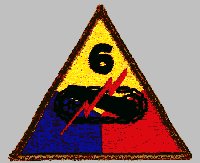
Large ImageTime for Sgt. Chuck, a purported member of the 6th Armored Division, whom Elizabeth Short supposedly met in Los Angeles in January 1943—two months before the 6th even got to Camp Cooke. (Note to Wolfe’s editors Cal Morgan and Anna Bliss: This what we call fact-checking and you may find that it comes in handy. With the advent of the Internet, this takes all of two minutes).

Wolfe says:

“Investigators learned that Elizabeth had been living at Camp Cooke with ‘Chuck,’ the sergeant she had met in Los Angeles, and Chuck had threatened and beaten her. Elizabeth had filed a complaint with his commanding officer and she tried to attach Chuck’s paycheck and obtain damages. But damages were denied, and the sergeant was shipped overseas. Elizabeth then moved from the army
[note to ReganBooks, this should be capitalized as it referred to a branch of the armed forces] to Vera Green’s apartment on Montecito Street in Santa Barbara….”

No, Holmes, not the end notes again!

Watson, get a grip man.

Ha. “Information regarding ‘Chuck’ was found within the Black Dahlia Case files of the Los Angeles District Attorney.” Of course that’s Los Angeles County, but Wolfe finds local jurisdictions terribly confusing.

What’s interesting here (“interesting” being a relative term; interesting to a research drudge) is that this refers to two boxes of jumbled papers. Of course Wolfe knows precisely where he got it, and so do I. Let’s get it.

As I’m digging out the document, ponder this: Where don’t we find Sgt. Chuck? And how come he has no last name? Is that a bit odd?

Well it is. First of all, does our pal Chuck appear in the undated LAPD summary of the case in the district attorney’s files? Nope. Wouldn’t Chuck appear in the summary if he were deemed an important part of the case? Yes. Hmmmm.

So where do we find Sgt. Chuck? Aha. He appears in a memo dated Feb. 20, 1951, by Frank Jemison of the district attorney’s office among a list of 22 suspects, including “A Chicago police officer,” “Sergeant ‘Chuck’ name unknown, Dr. George Hodel, Dr. Paul DeGaston, Dr. A.E. Brix, Dr. M.M. Schwartz, Dr. Arthur McGinnis Faught, Dr. Patrick S. O’Reilly and someone quaintly referred to as “Queer Woman Surgeon.”

Medium ImageNow what does Jemison have to say about old Chuck?

“Sergeant ‘Chuck’ (last name unknown) was seen with victim on numerous occasions at Camp Cooke in the spring of 1943. She testified that he had assaulted her at the court-martial proceedings there and he was ordered overseas as a result of it. She then attempted to obtain his personal property which it was necessary for him to leave behind. It is agreed by investigators that this could be a revenge murder committed by such a person as Sergeant ‘Chuck.’ Thus far numerous associates of victim at Camp Cooke have been interviewed and a search has been made for the records of this court-martial proceedings which would reveal the full name, background and information on this suspect. Thus far they have not been found. The investigation of this suspect is pending. See Los Angeles Police Department reports.”

In other words, there were lots of rumors about Sgt. Chuck and in fact the reporters looking into the Black Dahlia case turned up similar accounts, which are what appear in “Severed,” Page 28:

“Because the housing shortage was bad on base, Beth hadn’t been assigned quarters and was sleeping wherever she could find the space. One sergeant tried to stake a claim on her by appearing generous, sympathetic. He said he felt sorry for her since she couldn’t quarters and offered her the spare cot in his house trailer temporarily, if she wanted it. She eagerly moved in, but she thought he understood the situation: It wasn’t romance she was after—just a roof over her head while she tried to save enough money to get to Hollywood.

“The manager was disappointed the day Beth notified him that she wasn’t well and couldn’t show up for her shift. Whether the sergeant thought she’d been overly encouraging or not would never be clear. She rebuffed his advances—he called her a ‘tease’ and struck her, giving her a black eye.

“She complained to the commanding officer and quickly was moved into quarters with Mary Stradder, a WAC sergeant.”

Well “Severed” presents its own bundle of problems and I don’t want to explore them today, but we don’t have all the details that appear in “Mogul.” Let’s check in with Mary Pacios’ “Childhood Shadows.” Hm. She should cover it on Page 20, but is silent on the subject.

How about Steve Hodel, “Black Dahlia Avenger?” Hm. Also silent.

Isn’t it peculiar that nobody has been able to identify Sgt. Chuck? Not the Los Angeles Police Department, with all its resources and the military’s cooperation? Not the Los Angeles County district attorney’s office? Not the Los Angeles newspapers? (Although reporters did find rather vivid accounts of a particularly violent, brutal MP who was sent overseas—again, never identified).

For the record, I’ve never found anything definite about the man either. To the point that I wonder if he even existed.

Contrast the nebulous stories about Sgt. Chuck with the verified account of Elizabeth Short’s boss at PX-1, Inez Keeling, in the Jan. 17, 1947, Los Angeles Examiner: “She never visited over the counter with any of the boys and always refused to date them. She was one of the few girls in my employ who didn’t smoke or occasionally take a drink. She lived in camp and never went out nights.”

Nothing about Elizabeth Short living off the base, nothing about her living in a house trailer and nothing about any sergeant.

At a minimum, any credible account of the Black Dahlia should hedge the story of our old pal Sgt. Chuck by stating that he could never be identified nor any of the stories verified.

Time for my walk.
Shout out to:
Medium Image
Montevideo, Uruguay (201.217.134.244)

Organisation for Economic Co-operation and
Development, France (80.124.192.14)

Kerkira, Greece (213.80.115.71)

Toronto, Ontario (216.123.180.34)

AOL user in Reston, VA (152.163.101.5)


O/S breakdown

Some flavor of Windows: 95%

Mac OS X 3%

Linux 2%

Hurry back!

Posted in Uncategorized | 1 Comment

Blogging the Wolfe Book, Aiding and Abetting

http://rcm.amazon.com/e/cm?t=heaveishere-20&o=1&p=8&l=as1&asins=B0008464L2&fc1=000000&IS2=1&lt1=_blank&lc1=0000ff&bc1=000000&bg1=ffffff&f=ifrI’m blogging in real time as I read Donald H. Wolfe’s “The Black Dahlia Files: The Mob, the Mogul and the Murder That Transfixed Los Angeles.”

Wolfe is telling the story of Elizabeth Short in the “Laura” format: The anonymous, butchered body is found and the narrative proceeds in flashbacks. At this point he is covering Elizabeth Short’s mid- to late teens and we have just uncovered a nasty bit of work on Page 57.

Here’s the deal: The Los Angeles County district attorney’s files include significant documents titled “Movements of Elizabeth Short Prior to June 1, 1946” and “Movements After June 1, 1946” that place Wolfe in a terrible bind. He has to pretend he hasn’t seen them because they completely demolish what’s coming up about Elizabeth Short’s supposed involvement with Hollywood madam Brenda Allen, gangster Bugsy Siegel and Times publisher Norman Chandler. In other words, they send Wolfe’s book to the Insinkerator.

But he wants to use the information in the documents. What is a crime author to do? His solution is to attribute the data to other documents in the files, figuring that nobody will know the difference. Frankly, it’s not a bad guess. Only half a dozen people have seen the Black Dahlia material, so who will know?

Well, all it takes is one other person who’s seen the documents to blow the whistle on the worst sort of literary fraud.

Of course, Wolfe didn’t publish this book by himself. He just wrote it (well most of it, but I’m getting ahead of myself). Let’s check the acknowledgements on Page 321.

Aha.

“And to Alan and Cathy Buster, I owe a special debt of gratitude for their excellent research, advice and friendship.”

I think I’ve already established rather exhaustively that the research displayed so far in this book is not really up to snuff, given the incredible lack of primary source material, so I’ll skip them for now.

And I’ve already beaten up on the late nonsense maestro Robert Slatzer, so I’ll pass on him.

Here we go:

“Once again, the gold-medal winner of the paper chase is my agent, Alan Nevins, of The Firm. Alan believed in the book from day one, and saw it through all its travails.”

You know I’m going to Google him, don’t you. Ooh. Nevins represents that giant of letters, Goldie Hawn:

http://rcm.amazon.com/e/cm?t=heaveishere-20&o=1&p=8&l=as1&asins=B000BULMPG&fc1=000000&IS2=1&lt1=_blank&lc1=0000ff&bc1=000000&bg1=ffffff&f=ifr“The hotly pursued memoir, currently titled A LOTUS GROWS IN THE MUD: FOOTPRINTS OF A SPIRITUAL LIFE, will be written by Ms. Hawn. G.P. Putnam’s Sons, who acquired world rights, will publish the book in hardcover in 2004, followed by a paperback edition from Berkley in 2005.”

And Heidi Murkoff, author of the noir thrillers “What to Expect at a Play Date” and What to Expect When You Use the Potty.”

Hm. Nevins supposedly represents Snoop Dogg, who purportedly has “an upcoming illustrated memoir,” or did as of 2004, and a dual biography of Robert DeNiro and Martin Scorsese, although I don’t seem to find them on amazon.com.
http://rcm.amazon.com/e/cm?t=heaveishere-20&o=1&p=8&l=as1&asins=0694013307&fc1=000000&IS2=1&lt1=_blank&lc1=0000ff&bc1=000000&bg1=ffffff&f=ifr
Apparently Nevins believed in Wolfe’s book, because he seems to have been singularly uncurious about whether it was even slightly factual.

But Nevins was just the agent, in charge of getting a good deal for his client. There are a couple people listed as editors as well:

“I am indeed grateful to Judith Regan of ReganBooks
[otherwise known as the publishing house without proofreaders] and would like to express my gratitude to my editors, Cal Morgan and Anna Bliss, for their support and excellent advice and assistance.”

http://rcm.amazon.com/e/cm?t=heaveishere-20&o=1&p=8&l=as1&asins=B0009K76BW&fc1=000000&IS2=1&lt1=_blank&lc1=0000ff&bc1=000000&bg1=ffffff&f=ifrSo who are Cal Morgan and Anna Bliss? Oh let’s find out.

Ah…. The critics rave:

Brian Kilmeade’s “Games Do Count.”

Regan Books was the publisher
, and in the acknowledgements, Kilmeade thanks a slew of people from the publishing company, including Judith Regan, Cal Morgan, Cassie Jones, Anna Bliss, Marissa Shalfi, and Liz Grotyohann for various tasks. None, apparently, was the proofreader, and if they were, Kilmeade should not be thanking them. The book is marred by more dropped words, duplicated phrases, and misspellings than I have seen in a professionally published book in a long time.

Cal Morgan is also referred to in a Salon article on ReganBooks asking Michael Moore to revise “Stupid White Men” to be less critical of President Bush.
http://rcm.amazon.com/e/cm?t=heaveishere-20&o=1&p=8&l=as1&asins=006098726X&fc1=000000&IS2=1&lt1=_blank&lc1=0000ff&bc1=000000&bg1=ffffff&f=ifr
HarperCollins also wanted him to take out the chapter “A Very American Coup,” about Dubya’s dubious victory in Florida, and it objected to the title of an essay about race in America, “Kill Whitey.” According to Moore, his editor at ReganBooks, Cal Morgan, explained, “It’s not the dissent we disagree with, it’s the tone of your dissent. You can’t question the president about his past felonies or alcohol problems right now.” (Cal Morgan did not respond to requests for comment.)

Apparently ReganBooks has no such qualms about being critical of people who are conveniently dead and beyond the reach of libel suits.

If nothing else, everybody involved in this project showed a rather remarkable lack of skepticism and emphatic disinterest in asking even the most rudimentary questions about the truth.

Now where was I?

Page 58

Oh this book is so ridiculous.

“When Cleo [Short] spoke to the police and the press in 1947, alcohol might have impaired his memory of the visit to Los Angeles with his daughter in January 1943 and the circumstances of Elizabeth’s departure.

“Although Cleo had permanently relocated to Los Angeles in 1945, he insisted that he had never seen or spoken to Elizabeth in the four years since she left for Camp Cooke; nevertheless, in Harry Hansen’s statement to grand jury investigators, he made it clear that at one time Cleo had been a suspect in the Black Dahlia murder.”

Ah yes, that’s right. In Wolfe’s book, Cleo goes from tee-totaling Baptist on Page 51 to alcoholic barfly by Page 56. Apparently editors Cal Morgan and Anna Bliss don’t get intellectual whiplash from statements like this.

In fact, Harry Hansen did discuss Cleo Short, but with the Los Angeles County Grand Jury, not the investigators. Wolfe has a terrible time sorting out the nuts and bolts of local government; the distinctions between city and county government are simply lost on him; divisions within an agency (grand jury vs. district attorney’s investigators) are hopelessly elusive.

More important, although it sounds significant to say that Cleo Short was a suspect in the Black Dahlia case, one shouldn’t attach that much importance to it. In fact, the murder was so challenging that original investigators treated everybody who ever knew Elizabeth Short as a suspect who had to be eliminated.

Time for my walk.

Check out the 1947 Project if you get a chance.

http://rcm.amazon.com/e/cm?t=heaveishere-20&o=1&p=48&l=st1&mode=gourmet&search=yogi%20tea&=1&fc1=&lt1=&lc1=&bg1=&f=ifr

Shout out to:

National Internet Backbone, India (210.212.48.3)

Mumbai, India (59.184.19.251)

Rutgers University (204.52.215.23) 21 hours, 20 minutes

O/S breakdown

Some flavor of Windows: 78%
Mac OS X: 18%
Linux: 3%
Unknown: 1%

Some variation of Firefox: 51%
Some variation of Internet Explorer: 34%
Safari: 10%
Opera: 4%
Netscape: 1%

ps. Yes, I’m experimenting with ads, thanks to my crime buddy’s suggestion. Let’s see how they go.

Posted in Uncategorized | 1 Comment

Here We Go!

Spring Street, Los Angeles, California

Check back often!

Posted in Uncategorized | Comments Off on Here We Go!

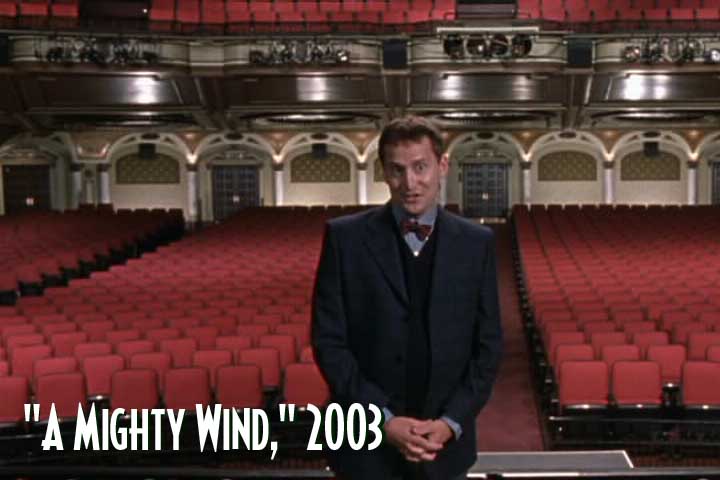
Location Sleuth, "A Mighty Wind"


Hey look! That’s the Orpheum Theater on Broadway in Los Angeles, not Carnegie Hall.

http://rcm.amazon.com/e/cm?t=heaveishere-20&o=1&p=8&l=as1&asins=B0000ALFVD&fc1=000000&IS2=1&lt1=_blank&lc1=0000ff&bc1=000000&bg1=ffffff&f=ifr

Posted in Uncategorized | Comments Off on Location Sleuth, "A Mighty Wind"

Blogging the Wolfe Book, Slasher Flick


I have my search engines set to scour the Internet for material related to the Black Dahlia and this morning discovered yet another slasher version of the Elizabeth Short case. Think nudity and blood. It is a shame to see such talent wasted, but proves my contention that Hollywood is incapable of telling the story of Elizabeth Short without reducing it to sex and gore.

Where was I? Ah yes. I am blogging in real time as I read Donald H. Wolfe’s “The Black Dahlia Files: The Mob, the Mogul and Murder That Transfixed Los Angeles.” Wolfe is using the “Laura” format in which the anonymous, butchered body is found and the story is told through flashbacks. We’re at the point where we are exploring Elizabeth Short’s mid- to late teens, and have found a particularly nasty bit of fiction in which Wolfe has identified Mary Pacios, author of “Childhood Shadows” as “Mary Hernon.”

I had to take a day off to process the memorial to Otis Chandler and am in the middle of taking a poll to decide whether I should continue this time-consuming little project. So far, nobody is begging me to quit.

Page 56

This book is such junk.

OK, here we go:

“Elizabeth found that the sunshine in Vallejo, California, was often obscured by fog and the Bay area was a long way from the glittering glamour of movieland. She tried to persuade her father to take her south to Los Angeles for a visit, but Cleo thought her movie star dreams were foolish.”

Now there is absolutely no basis in reality for this. Obviously Wolfe is building up Elizabeth Short as a star-struck young woman (no shortage of them in the 1940s—or now, for that matter). Let’s see where he got it.

My dear Holmes, not the end notes again!

Watson, don’t complain. Research is rarely pretty.

Ha! Not attributed to anyone. Wolfe is simply making things up. Even John Gilmore’s “Severed” (25% mistakes and 50% fiction) doesn’t have the nerve to channel this fabricated scene—or maybe it just didn’t occur to him.

Page 57

Well, now this is an interesting blend of fact and fiction. Wolfe says that according to the district attorney’s files on the Black Dahlia case, Detectives Harry Hansen and Finis Brown called on Cleo Short after Elizabeth was killed and found him in a drunken stupor. That’s true

But what’s next is totally wrong. So wrong that I won’t entirely untangle it.

Wolfe says Cleo and Elizabeth stayed in Vallejo for a few days (he gets the people wrong) before they (so far, true)—accompanied by “a Mrs. Yanke” went to Los Angeles. In reality, Mrs. Yanke stayed in Vallejo and lent her apartment to Cleo and Elizabeth Short.

Not the end notes again!

Watson, the end notes are our friends.

Ha. Attributed to Harry Hansen’s grand jury statement in the district attorney’s files. Some of it is there. But much more isn’t. For example, Harry Hansen never discussed Mrs. Yanke in his grand jury testimony. Of course, the only people who would know that are the few of us who have seen the files.

Did I mention I inventoried and catalogued the Black Dahlia files?

So where does Wolfe find this business about Mrs. Yanke if it isn’t where he says it is? Hmmmm. Could it be in the document that Wolfe doesn’t want to acknowledge “Movements of Elizabeth Short Prior to June 1, 1946” because it trashes his Bugsy Siegel scenario. And if that gets trashed, he has no book?

Oh let’s check.

Holmes! Why are you never wrong?!

Here’s the beginning of

MOVEMENTS OF ELIZABETH SHORT
Prior to June 1, 1946


Sometime in 1942 E. and her mother, Phoebe Short (1) saw the father, Cleo Short (19) on the street in Medford, Mass., at which time Cleo Short (19) had a conversation with E., according to Mr. Short (19). Later, E. corresponded with him and wrote to him that she would like to come out to California and live with him and care for him. E. did come in December of 1942 and stayed with him for a few days when he was living on Nebraska Street with Mrs. Yankee (20) [note that this document was dictated and transcribed, so many names are spelled phonetically—quite annoying for a researcher] in Vallejo, Calif. E. then went with her father to 1028½ W. 36th St., Los Angeles, and there lived at Mrs. Yankee’s place for approximately three weeks. Mrs. Monte (21) who lived in the rear of this address saw E. there at the time.

In other words, Wolfe knows without question that what he’s putting forth is nonsense because he has the evidence in his hand of where Elizabeth Short really was. But like the three card monte swindler, he’s going to keep it hidden, figuring that nobody will ever know the difference.

Busted again.

And even worse:

“According to Mrs. Monte, Cleo was an alcoholic and was drunk most of the time, and he and his daughter had many arguments over money and his drinking.”


Now correct me if I’m wrong, but didn’t Wolfe just say that Cleo was a churchgoing Baptist who berated Elizabeth about her trampy lifestyle? Are we supposed to have forgotten that little nugget? From way back on Page 51:

“It was said that Elizabeth had begun dating a number of servicemen, and Cleo complained that she was seeing a different boyfriend every evening and staying out very late—sometimes all night. A churchgoing Baptist, Cleo admonished Elizabeth for living a licentious life.”

So how did Cleo go from being an abstemious Baptist to total sot in five pages? And here’s an even bigger laugh:

“While in Los Angeles, Elizabeth had met “Chuck,” a sergeant in the Sixth Armored Division stationed at Camp Cooke, north of Santa Barbara. Mrs. Monte recalled that on January 29, 1943, following an argument over her father’s drunkenness, Elizabeth had left word that she was heading north to Camp Cooke with the sergeant.”

There’s lots of ways to disprove this: Mrs. Monte never said a word about “Sgt. Chuck.” In fact, police were never even able to locate “Sgt. Chuck,” although he appears rather prominently in “Severed.”

But let’s have more fun. How much do you want to bet that the 6th Armored Division wasn’t at Camp Cooke in January 1943?

Why Holmes! The 6th Armored Division didn’t arrive at Camp Cooke until March 1943!

Watson, some people can do research and some people cannot. It’s that simple. If our “Sgt. Chuck” even existed, he would have been in balmy, beautiful Freda, Calif., in early 1943. (Here’s a satellite picture of Rice Army Air Field, which was nearby).

And for even more fun (OK fun for a total research drudge) let’s see how Steve Hodel handled this phase of the story in “Black Dahlia Avenger.” Oh my, it’s even worse.

“Black Dahlia Avenger,” Page 18.

“In January 1943, Elizabeth traveled to Santa Barbara, California, where she applied for and was hired at the post exchange at the Camp Cooke military base. [California geography certainly puzzles some people doesn’t it?] Her employment there was brief, after which she left to seek her father, who, she discovered, was living close by in Vallejo, California. She stayed with her father briefly, but both were uncomfortable with the living arrangements and she returned to Santa Barbara in September 1943.”

Time for my walk.

Shout out to:

Argyle, Texas (63.158.242.89)

Inktomi Corp. (68.142.251.22)

O/S breakdown:

Some flavor of Windows: 84%
Mac OSX: 14%
Unknown: 2%

Hurry back!

Posted in Uncategorized | Comments Off on Blogging the Wolfe Book, Slasher Flick

Otis Chandler Tribute


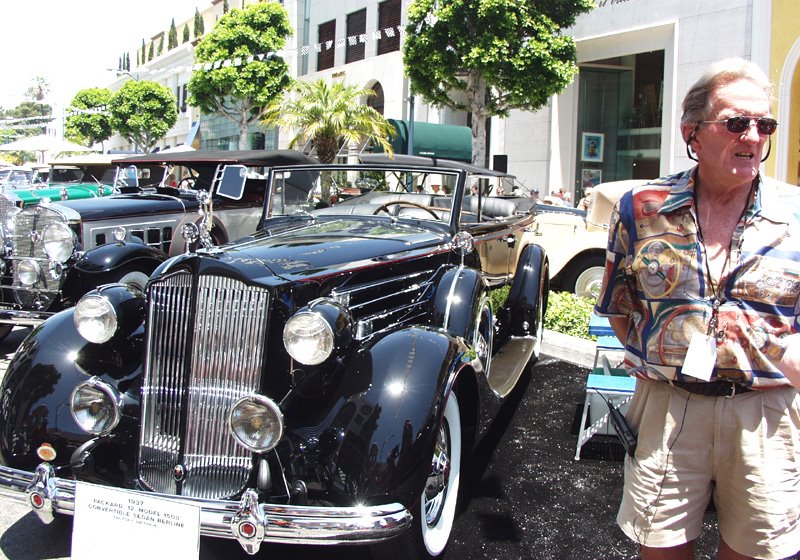
These are audio files I made of the in-house memorial to Otis Chandler (at right with his 1937 V-12 Packard, originally owned by Bette Davis), conducted March 7, 2006. These are field recordings and the audio quality isn’t great. But I am offering them for their historic value. Tom Johnson, the moderator, spoke throughout the ceremony. Each segment lasts an hour.

Part 1:

Speakers are Jeff Johnson; Tom Johnson; Harry Chandler; Cathleen and Michael Chandler; Bill Thomas; Anthony Day; Paul Conrad; and Jean Sharley Taylor.

Part 2:

David Laventhol; Richard Schlossberg III; Francis O’Toole; William Niese; Shelby Coffey III; Bill Boyarsky; John Carroll; and Bettina Chandler.


Posted in Columnists, Uncategorized | Tagged | Comments Off on Otis Chandler Tribute

Blogging the Wolfe Book, Mystery Woman

I’m blogging in real time as I read Donald H. Wolfe’s “The Black Dahlia Files: The Mob, the Mogul and the Murder That Transfixed Los Angeles.” Wolfe has begun with the butchered, anonymous body and is telling the story in flashbacks—at this point, we’re at Elizabeth Short’s mid- to late teens and she’s about to be reunited with her father, Cleo, who abandoned the family years earlier.

So far, the vote on continuing the blog is entirely favorable, with one request for information about my theory (sorry, I don’t want to mix that with the Wolfe material) and one suggestion for an ad revenue stream. Thanks crime buddy!

http://rcm.amazon.com/e/cm?t=heaveishere-20&o=1&p=14&l=st1&mode=dvd&search=%22lord%20peter%20whimsey%22&=1&fc1=&lt1=&lc1=&bg1=&f=ifr

I’ve made a podcast of this session just to give the idea of what it’s like doing this in real time. The audio quality is lousy and there’s an annoying hum. And mostly it’s the sound of me typing. Feel free to ignore it. I would. The music playing in the background is Schubert’s Symphony No. 9 performed by the Pittsburgh Symphony under Mark Wigglesworth.

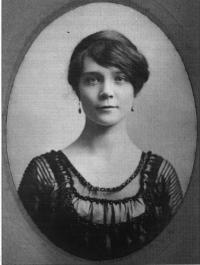
The image, by the way, is the young Dorothy L. Sayers, mystery novelist and Christian dramatist, who could write circles around Agatha Christie on the best day Christie ever had. I would gladly trade every Hercule Poirot story ever written for one Peter Whimsey.

Page 56

“A dozen years after Cleo had vanished and was presumed dead, Phoebe received a letter from him. She was shocked to learn that Cleo was alive and working in the shipyards in Northern California.”

Very well, Watson, to the end notes.

Why my dear Holmes, it’s from John Gilmore’s “Severed,” Page 26.

Now according to Los Angeles County district attorney’s files (“Movements of Elizabeth Short”) Phoebe Short and Elizabeth were walking in Medford and ran into Cleo. Remember that this book is titled “The Black Dahlia Files.”

Oh, but we’re not going to actually use the Black Dahlia files. Why not?

This is actually pretty funny. Wolfe can’t reveal this document because it completely contradicts his nonsense theory about where Elizabeth Short was in the 1940s (remember “Very little is known about Elizabeth’s time in Miami”?) so he’s stuck with “Severed.” It’s much easier to be honest, isn’t it?

http://rcm.amazon.com/e/cm?t=heaveishere-20&o=1&p=8&l=as1&asins=B000CEGW1A&fc1=000000&IS2=1&lt1=_blank&lc1=0000ff&bc1=000000&bg1=ffffff&f=ifr

Oh dear, oh dear. Wolfe says:

“Mary Hernon, a girl who lived next door to the Shorts, remembered that all Elizabeth could talk about during the week before she left for California was Hollywood. “I asked her if she was going to be a movie star,” Mary recalled. “she laughed and told me that’s what she hoped to do, and if you wanted to be a movie star, it wasn’t going to happen to you in Medford. She’d have to go to Hollywood.” An so, on an icy day in December 1942, Elizabeth Short boarded a train in Boston and departed for the land of sunshine—and shadow.”

Now for our source material in “Severed”:

Mary, the little girl next door to the Shorts, remembers the week Betty left. “She was all dressed up in something light blue, and she took my hand as we crossed Salem Street and headed toward the gas station. I remember the station manager stopping his work to come over and talk to her. I guess I stood there shifting from one foot to the other as they chit-chatted and he made a date to see her before she left for California. She said something about Hollywood and as we walked to United Farmers, I asked her if she was going to be a movie star. She laughed and told me that’s what she hoped to do and if you wanted to be a movie star, it wasn’t going to happen to you in Medford. She’d have to go to Hollywood.”


(Oops, I owe Donald H. Wolfe an apology. He got the item about Elizabeth Short replacing a Tremont theater usher who had been drafted from “Severed,” Page 24. Of course it’s not true but then that’s the case for most of “Severed.” And also note that “Severed” doesn’t identify the theater as the Tremont.)

Here we go. I found our mystery girl: “Severed,” Page 25

“Betty would often take long walks by herself, or she would walk and talk with Muriel or the neighbor’s little girl, Mary.”

Now for fun, let’s look at “Childhood Shadows.”

Uh-oh. Mary Hernon is really Mary Pacios!

Don’t tell me you’re surprised.

“Childhood Shadows,” Page 20

On one of our walks, we stopped at the gas station that had replaced the vacant field across Salem Street. The manager stopped what he was doing and came right over to Bette [Pacios’ version of Elizabeth Short’s name]. I can remember standing there and shifting from one foot to the other as the two grownups exchanged a few words, laughing and planning to meet later that night.

Afterward, Bette told me she wasn’t going to Florida. “This year I’m going to California.”

I figured that Bette was going there to be a movie star.

“Well, that’s what I am hoping,” she said. “Not right away. It takes time. But if you want to break into the movies it can’t happen in Florida… or in Medford.”

Now making up names for people is veering dangerously close to “Severed,” which is full of people who don’t exist and things that never happened. I can’t imagine where Wolfe got the name Hernon or why he didn’t identify the woman as Mary Pacios, since he is clearly basing this on “Severed” and “Childhood Shadows.” This is foul work, folks. Did Wolfe honestly think nobody would check this?

I guess he did. Oops.

Time for my walk.

Shout out to:

Sydney, Australia (203.173.142.116)

Los Angeles Public Library (206.170.105.11) Librarians rule! Windows 2000? Upgrade!

Leavenworth, Kans. (4.244.147.63) Windows 98? Upgrade!

Brea, Calif. (68.234.184.255) One of my most loyal visitors.

Reston, Va. (152.163.101.5) Windows ME and IE 5.5 Upgrade!

Hurry back!

Note: I am experimenting with Amazon ads. The first one is supposed to be for Dorothy Sayers items. However it appears to be defaulting to other items.

Posted in Uncategorized | 1 Comment

Comments, Please

Large ImageI’m waiting.

The vote so far:

Keep going: 10 (1 via e-mail).

Stop the insanity! 0

Disclaimer: I’m not a Susan Powter fan. In fact, she drives me crazy.

Special note: Comments are moderated. In other words, nothing gets posted without my prior approval. Anything off-point or extraneous isn’t making the cut.

Posted in Uncategorized | 10 Comments

Blogging the Wolfe Book, Bust of a Man


I have been blogging in real time as I read Donald H. Wolfe’s “The Black Dahlia Files: The Mob, the Mogul and the Murder That Transfixed Los Angeles.”

At this point in the story we are deeply mired in Elizabeth Short’s childhood and have just caught Wolfe in an incredible lie:

“Very little is known about Elizabeth’s time in Miami.”

Of course the Los Angeles County district attorney’s files include a detailed list of where Elizabeth Short lived and worked, including her exact addresses, so this is a through-and-through lie.

Page 54

Let’s see where Wolfe goes with this. I expect the worst.

Hm.

“A former Miami police officer
[note to ReganBooks proofreaders, Miami is not Miami Beach] believes Elizabeth may have initially stayed in the home of a relative of the Short family—Philip Short, who was a lieutenant in the Miami Police Department in the early 1940s and was said to be connected with Meyer Lansky and Syndicate in the Miami area.”

Oh, so, so, desperate for a mob connection, are we? And what is the source for this bit of fiction?

Lead on, Watson.

Not again, Holmes!

Hm. Retired Miami Officer James Newton, 2003. And who precisely is James Newton, a name with which I am not familiar? Let’s see if he is ever further identified.

OK, now before I even start digging, look at all the things we don’t know about James Newton. He’s only introduced as “a retired Miami police officer,” so we don’t know when he retired, his rank, what his assignments were or anything else. For that matter, we only get his name if we go to the end notes. Otherwise he could be another Herman Willis, the fictional detective in John Gilmore’s “Severed.” He could have served from 1970 to 1995, for instance, and not know anything more about Elizabeth Short than Joe Six-Pack.

Any bets before I look as to whether we get any of this crucial information?

To Amazon’s “search inside” feature.

Just as I thought. Not a single word. There are times when I hate being right. This is bad work, folks.

Hm. Wolfe says Elizabeth Short had modeling jobs in Florida. Attributed to an interview with Mary Pacios. I’ve never read anything about that in the original sources.

Page 55

Man, Wolfe is a bold as they come:

“Returning to Medford in the spring of 1942, Elizabeth worked as an usherette at the Tremont, one of her favorite Boston movie palaces, where she replaced a young man who had been drafted.”

First of all, even most superficial research reveals that the Tremont was an old, second-run movie house and there’s nothing to indicate she replaced a man who had been drafted. This is just blue skying some details that nobody will ever check—OK, almost nobody.

In fact, Elizabeth Short worked at the Tremont in 1940. Very poor work on the part of Mr. Wolfe.

Time to smear some conveniently dead people: Elizabeth Short and Donald Griffin, who apparently owned a cafe in Medford, Mass., in a story attributed to Eleanor Kurz.

Oh Holmes, not again!

Watson, research is not pretty.

Pacios’ “Childhood Shadows,” Page 53. Gilmore’s “Severed,” Page 22

Ready for some torture?

“Severed”:

“Eleanor Kurz, a friend of Dottie’s [Elizabeth Short’s older sister] saw Betty often before the war, usually in the restaurant on Salem Street across from City Hall. Mr. Griffin, the owner, was in his fifties, short and stocky, with thinning grey hair, and he wore gold-rimmed glasses.

The restaurant had only a counter with stools. “I remember I hadn’t seen Betty in a while,” Eleanor says, “and she was sitting very straight on the stool farthest from the door, dressed to the minute in a leopard fur coat and hat. She made me feel like a country bumpkin. I thought to myself, Dottie’s kid sister sure has grown up!”

Eleanor said something about not recognizing Betty and how great she looked. “Some people said that Mr. Griffin was Betty’s boyfriend, but I think it was just that he wanted to help her in a fatherly way.”

“Betty had her legs crossed, and she wore dark stockings and suede pumps and a lot of makeup by Medford standards. She was in her teens but looked older—sophisticated.”

Next, “Childhood Shadows”: (Quoting Eleanor).

“Last time I saw Bette [remember, this is how Pacios refers to Elizabeth Short] was in 1941, just before the war, at Griffin’s across Salem Street from our house. Do you remember it? A small square ice cream parlor, it later became a fried chicken place. When you walked in, the stools and counter were to the right. I remember Bette sitting at the stool wearing a leopard fur coat and hat. Dressed to the minute. Sophisticated. I was very impressed! She was so striking! And I thought ‘Dottie’s kid sister has sure grown up! I felt like a country bumpkin. Bette had just come back from a trip. She was very up. Looked like she could have been a movie star.”

“I thought she might be going with Mr. Griffin,” my [Pacios’] mother said. “Bette was in a restaurant across the street all the time. I think she had a father complex. I never saw her with a man, except once on the trolley, coming home from work. She was with an older man.”

Note: Mrs. Pacios only saw Elizabeth Short with a man one time. But thought she was going with Mr. Griffin. Isn’t that rather a leap?

Now what does Wolfe do with all of this?

“When Elizabeth returned to Medford, she was no longer the innocent schoolgirl who had reminded Mary Pacios of Snow White. Eleanor Kurz, a friend of Elizabeth’s older sisters, Dottie and Ginnie, remembered that when Elizabeth returned from Miami, she wore heavy makeup and would often hang around a popular cafeteria on Salem Street owned by Donald Griffin. Elizabeth had only recently returned from Florida in 1942 when Eleanor spotted her in Mr. Griffin’s cafeteria.

“I remember I hadn’t seen Betty in a while and she was sitting very straight on a corner stool furthest [note to ReganBooks, it’s farthest. Even “Severed” has it right] from the door, dressed to the minute in a leopard fur coat and hat,” Eleanor recalled. “Betty had her legs crossed and she wore dark stockings and suede pumps and a lot of makeup by Medford standards. She was in her teens, but she looked older—sophisticated. She made me feel like a country bumpkin. I thought to myself, Dottie’s kid sister sure has grown up!”

Although Mr. Griffin was quite a bit older than Elizabeth, Eleanor recalled there were rumors circulating in Medford that Mr. Griffin and Elizabeth were having an affair. “Some people said that Mr. Griffin was Betty’s boyfriend,” Eleanor stated, “but I think it was just that he wanted to help her in a fatherly way.”

Notice that Wolfe has transposed this incident to after the beginning of World War II. I don’t know if this is accidental or intentional. And of course, Griffin’s little cafe, which didn’t even have tables, gets expanded into a cafeteria. Most of all, Wolfe dives for the bait on Elizabeth and Griffin having an affair.

And of course he doesn’t tell us that Eleanor Kurz is Mary Pacios’ sister.

Oh, oops.

It would be nice to know more about poor old Mr. Griffin, but my archives are a bit thin on Medford city directories and I’d have to check them at the Los Angeles Public Library. Out of the question for this little exercise.

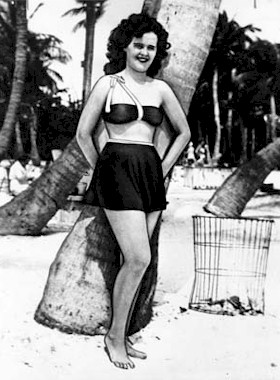
Here’s the bottom line. Everybody’s talking about how sophisticated Elizabeth Short looked when she came home from Florida. OK, here’s one of the pictures from Miami Beach that’s all over the Net. You tell me if this is the image of a femme fatale.

Nope, this is what everybody imagines when they think of the Black Dahlia: Stephen Peringer’s illustration for James Ellroy’s novel.

Now here’s the deal. This blog is incredibly time-consuming. I don’t really need to go any further to prove my point. I’ve caught Wolfe in any number of fabrications and distortions. I have passed the number of pages that correspond to my age, so I’m in fair territory. I’m going to throw this blog open for comments for a week to see if there is enough interest in continuing. I have lots of other irons in the fire, like the upcoming rollout of the successor to the 1947 Project, that are much more fun—and more satisfying.

So, if there’s interest in continuing, I will. Otherwise I’m going to hang it up. I guarantee you, the book is not going to suddenly improve.

Shot out to:

Schifferstadt, Germany (84.173.83.104)

Intercontinental Fragrance, Houston (65.16.203.153)

Bexar County Information Services, San Antonio, Texas (206.254.152.1)

Hollywood Production Center (67.151.223.83)

Let me know!

Posted in Uncategorized | Comments Off on Blogging the Wolfe Book, Bust of a Man

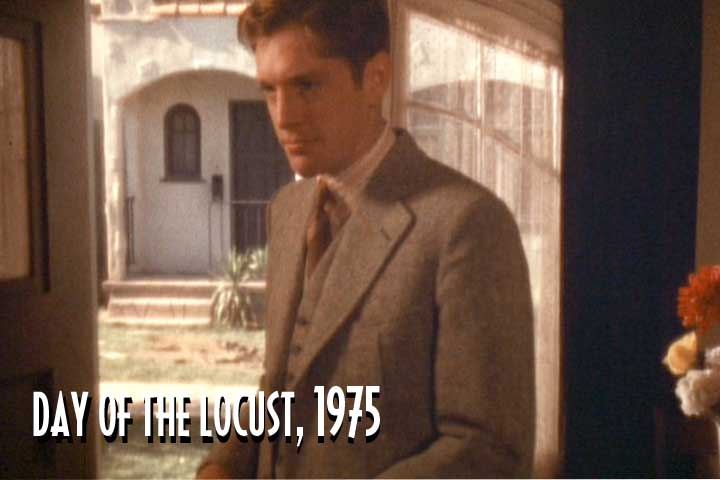
Location Sleuth, "Day of the Locust"


Hey look who’s in “Day of the Locust”: What’s his face from “Ghost Busters.”

Posted in Uncategorized | Comments Off on Location Sleuth, "Day of the Locust"

Blogging the Wolfe Book, Paint by Numbers


I’m blogging in real time as I read Donald H. Wolfe’s “The Black Dahlia Files: The Mob, the Mogul and the Murder That Transfixed Los Angeles.”

Page 52

Wolfe is using the “Laura” format and we’re at the point in the story where we learn about Elizabeth Short’s childhood. Wolfe has dispensed with her father, Cleo Short, at least for now, and is dealing with Elizabeth Short’s childhood illnesses. The narrative about the murder investigation has gone into hibernation as the book introduces buckets of background material.

Page 53

Mary Pacios, author of “Childhood Shadows,” is described as one of Elizabeth Short’s schoolmates, but that’s not really true as Elizabeth was quite a bit older and in fact was Mary’s babysitter.

Good grief. Bob Pacios is introduced as Mary’s younger brother. He’s an older brother and served in World War II. Well, Wolfe had a 50% chance of getting that right and still goofed it up.

Page 54

Now why on earth does Wolfe do this:

“…when Elizabeth was sixteen, Phoebe made an arrangement for her to stay with ‘friends’ in Miami Beach during the winter.”

There’s absolutely no reason to set off “friends” in quote marks unless he’s trying to make some point, although I can’t imagine what it is.

Not the end notes again, Holmes!

Lead on, my dear Dr. Watson.

Hm. “Childhood Shadows,” Page 16.

Well, this is far worse than I thought. Here’s the whole quote from “Mogul”:

“Elizabeth began having asthma attacks shortly after the family moved to the walkup on Salem Street. Muriel remembered that sometimes the attacks were so bad that their mother would have to call the doctor in the middle of the night to give Elizabeth an adrenalin [note to ReganBooks’ proofreaders, that should be capitalized as it’s a trademark] shot. In February 1939, she had to be sent to Boston Hospital for an operation to clear her lungs. The doctors told Phoebe that it would be better for her daughter to be in a milder climate during the wintry months; and in 1940, when Elizabeth was sixteen, Phoebe made an arrangement for her to stay with ‘friends’ in Miami Beach during the winter. In Miami [note: Miami and Miami Beach aren’t the same, as any resident will tell you], she obtained a part-time job at a beach resort and wrote that she hadn’t had an asthma attack or cold during the entire winter.”

And here’s Wolfe’s purported source material from “Childhood Shadows.”

“That same year, Bette Short [note that Mary Pacios refers to Elizabeth Short as Bette, one of several names Elizabeth used during her brief life] turned sixteen and started traveling. Her asthma and lung problems had worsened and she developed bronchitis. Mrs. Short thought Bette might be better off in a warmer climate, away from the coldness and the dampness. She arranged for Bette to stay with family friends in Miami Beach. Bette could spend the winter there earning money as a waitress, figured Mrs. Short, and come back in the spring.”

So where on Earth did Wolfe get this stuff about the doctor making a midnight call to administer an adrenaline shot?

Let’s take a wild guess and try John Gilmore’s “Severed.” Because if it isn’t there, I can’t imagine where he got it.

Holmes! Why are you never wrong! [You know, I’m sure that’s in one of the Sherlock Holmes stories but I’ll be darned if I can find it. One of my favorite quotes, too].

What we have here, Watson, is a brief, unattributed appearance from “Severed,” Page 20.

“Says Muriel, ‘She had asthma like me and Ginnie, but sometimes she had it worse than we did. Sometimes the three of us would be sitting up all night struggling to breathe. We’d take turns sitting in the rocking chair, but when it got really bad Mama would have to call the doctor. He’d come even in the middle of the night and give us a shot of adrenaline.’ ”

Still, nothing about Boston Hospital or an operation in February 1939. I haven’t a clue where Wolfe got that; it’s certainly not in his alleged source material. This is poor, poor works, folks. Obviously, these end notes are merely window dressing that Wolfe never imagined would be verified by a research drudge.

Oh let’s have some fun and check Steve Hodel’s “Black Dahlia Avenger” just for the heck of it. Buried at the bottom of the pile of Dahlia books. How symbolic. Then again, I won’t let Janice Knowlton’s “Daddy Was the Black Dahlia Killer” in the house or it would be at the bottom of the pile. Sheesh, Hodel doesn’t even have an index entry for Medford, Mass. Well, nothing about midnight shots of adrenaline, thanks to amazon’s online search.

And you know what’s really odd? To the best of my knowledge the Shorts were so poor they didn’t have a phone, which was a luxury in 1947. Remember that when Wain Sutton of the Examiner contacted Phoebe Short to give her the song and dance about Elizabeth winning a beauty contest, he called a neighbor.

Page 54

Ho-ho! I wish crime buddy Nathan Marsak were here to lead us all in a chorus of the SLA’s slogan. Donald H. Wolfe, you are so busted!

Here:

“Very little is known about Elizabeth’s time in Miami. The family did not reveal where she stayed, what she did, or who her acquaintances had been. There were only the photos found in Elizabeth’s memory book of unidentified companions and servicemen she met.”

OK, dear readers. The Los Angeles County district attorney’s files list Elizabeth Short’s precise whereabouts in Miami Beach; where she lived and where she worked. The documents in fact, are titled: “Movements of Elizabeth Short Prior to June, 1, 1946” and “After June 1, 1946.” And of course, the people in Elizabeth Short’s scrapbooks were identified. One needn’t look any further than Wolfe’s own book, Page 86.

I swear, the man is absolutely incapable of reading what’s in front of him.

There’s certainly a reason Wolfe doesn’t want to play fair with his readers, and although I’m not positive, I imagine it’s so he can concoct some nonsense about Elizabeth Short’s time in Los Angeles, lifted right from “Severed,” which has fabricated several years’ worth of imagined events such as Elizabeth Short being a junior hostess at the Hollywood Canteen and knowing murder victim Georgette Bauerdorf. (Did I mention that “Severed” is 25% mistakes and 50% fiction?)

So Wolfe is just going to pretend that awkward little list of Elizabeth Short’s jobs and residences stays well hidden.

And this book calls itself “The Black Dahlia Files.”

Time for my walk.

Shout out to:

Manila, Philippines (222.126.25.202), home of the other side of the George Hodel family.

Luxembourg (83.99.59.36)

Dark Horse Comics (70.96.128.8) Usagi Yojimbo rocks!

Greenville, SC (165.247.185.63)

University of Michigan Medical Center (141.214.17.5)

Symantec (65.88.178.10)

East Kentucky University (157.89.225.46)

Hurry back!

Posted in Uncategorized | Comments Off on Blogging the Wolfe Book, Paint by Numbers

Blogging the Wolfe Book, Limbo

I’m blogging in real time as I read Donald H. Wolfe’s “The Black Dahlia Files: The Mob, the Mogul and the Murder That Transfixed Los Angeles.” At the moment we’re enmeshed in the backstory on 1940s newspapers that hasn’t transfixed anyone.

The two-minute executive summary:

After spending several days slogging through Elizabeth Short’s autopsy and pondering the absence of John Gilmore’s key source on the Black Dahlia’s purported “infantile genitalia,” the nonexistent Detective Herman Willis, we’ve found the late Will Fowler, former Examiner reporter and Dahlia source, played several tricks on Wolfe. We also discovered some more ties between Wolfe’s stepfather and Joseph P. Kennedy, but a troubling disinterest in saying anything about Wolfe’s Great-Uncle Bernard Baruch, one of Kennedy’s close associates.

Worst of all, we have found some random smears against Elizabeth Short in which Wolfe cites a source and then embellishes it for no apparent purpose. There are times when I wonder if the man is capable reading what’s in front of him.

Wolfe is telling the story in “Laura” format, in which the discovery of the anonymous, butchered body sets off a series of flashbacks. We’re at the point where Wolfe introduces Elizabeth Short’s father, Cleo, who is going to say she’s no good. It’ll be interesting to see how Wolfe portrays him. And of course Elizabeth Short and the murder have gotten completely lost by now, which is the problem with the “Laura” format when it comes to history. Then again, I’m not sure we can call this book “history.”

Page 50

So far Wolfe picks up the standard newspaper quotes, citing, let’s see… the Herald-Express, Mary Pacios’ “Childhood Shadows” and John Gilmore’s “Severed,” the two former writing partners reunited again.

Page 51

But aha. Here’s another gratuitous smear thrown in for some effect or other:

“It was said that Elizabeth had begun dating a number of servicemen, and Cleo complained that she was seeing a different boyfriend every evening and staying out very late—sometimes all night. A churchgoing Baptist, Cleo admonished Elizabeth for living a licentious life.”

“It” was said? Who is “It?” And what’s the source for this little factual bonbon?

Not again, my dear Holmes!

You know where to take us, Watson.

Ha! Just as I thought. We’re meant to think this is from the Herald, but there’s nothing about her staying out all night. And while the Shorts certainly attended the Baptist Church in Medford, it was only after Cleo abandoned the family. There’s no evidence that he was a regular churchgoer, although being from the South, I’m sure he had been taken to church at some point in his life. (Bonus fact, St. Peter’s Chapel on Mare Island was the Navy’s first nondenominational church in the West. A very cool building).

Oh this is interesting. Wolfe quotes Elizabeth Short’s youngest sister, Muriel, but I doubt very much if she spoke with him. Hm. Let’s check “Severed,” Page 18, the purported source.

Quick, Watson, to the pile of Dahlia books!

Let’s hope it’s not JonBenet Ramsey
. Nope, a perfect word for word quote from “Severed.” I think that’s a first. Of course it’s good to be careful about people who are still alive.

Page 52

Ohhhh. I don’t remember this quote.

“Unlike her sisters, Elizabeth had mood swings, emotional ups and downs. ‘She was happy one moment—sad the next,’ Phoebe said.”

OK, now so far that’s seems to be one of the standard newspaper quotes that everybody uses. But Wolfe adds this:

“I guess she was what you would call a manic-depressive.”

Ooh. This is exciting (OK, “exciting” being a relative term; exciting at least to a research drudge). Source, please!

Los Angeles Examiner, Jan. 19, 1947. Any bets on whether there’s a line about manic depression before I check?

To the file cabinet, Watson. (The first thing anybody should do in tackling the Dahlia case is buy a bunch of four-drawer file cabinets. I promise, if you do the job right they’ll be jammed before you’re done).

OK, Los Angeles Examiner, Jan. 19, 1947.

“Trail New Suspect in Torture Slaying.”


Guess what.

Let’s go back and check the end notes, just to be sure. Yep. Jan. 19, 1947.

Fine. Here are Phoebe Short’s actual quotes (she was interviewed in Los Angeles en route to Berkeley to stay with her oldest daughter, Virginia, until the inquest):

“If I ever get my hands on him, I believe I’d kill him myself.”

Speaking of her return here later in the week, she added:

“The worst is to come.”

In a sidebar, she says:

“Thank goodness the Los Angeles Examiner made it possible for the FBI to identify my daughter in such a short time.”

“Your quick action perhaps saved me many weeks of anxiety and anguish. I prayed that it wouldn’t be she… but it was. I can do nothing more.”

Now isn’t that a fine kettle of fish? Nothing about mood swings, and certainly nothing about being a manic-depressive.

If I were an attorney in court, I’d say it’s not there (correctly) and be done with it. But since I’m taking a scholarly approach, let’s dig up the exact quote. It’s in the Herald-Express for Jan. 18, 1947.

“Elizabeth always wanted to be an actress,” she [Phoebe Short] said. “She was ambitious and beautiful and full of life, but she had her moments of despondency. Sometimes, she would be gay and carefree one moment—then in the depths of despair another.”

That still isn’t Wolfe’s quote, but it’s what you might recall if you were trying to summarize it. Poor work all the same and there’s nothing about manic depression. That’s strictly Wolfe’s embellishment.

Here’s something really cool: A concordance to the Sherlock Holmes stories.

And a cool view from somebody’s office:

Shout out to:

Lucas Film (63.82.98.50) (Running Linux, I’m so impressed).

Bergen (85.164.217.243) and Monet (84.53.11.22), Norway. I’m waiting for my homies in Andoya (current temperature 25 degrees)!

Mr. Pocket PC in Seattle (67.150.216.66)

Reston, Va. (152.163.101.5) MSIE 5.5? Upgrade!

And the same goes for all of you with outdated versions of Firefox!

Hurry back!

Posted in Uncategorized | Comments Off on Blogging the Wolfe Book, Limbo

Blogging the Wolfe Book, Pied Type


I’m blogging in real time as I read Donald H. Wolfe’s “The Black Dahlia Files: The Mob, the Mogul and the Murder That Transfixed Los Angeles.”

At this point in the story, Elizabeth Short’s body has been discovered in Leimert Park, and it has been taken to the morgue and identified. However Elizabeth Short has virtually disappeared as Wolfe bogs down in an explanation of competition between the Los Angeles newspapers in the 1940s.

Page 47

Good grief. It’s hard to believe anybody could make such a major error and state it with utter confidence:

“However, many Angelenos were aware that the identification story had already appeared in the Examiner on the previous day, and Richardson had his revenge by running an interview with FBI Bureau Chief J. Edgar Hoover the following day, congratulating the Examiner for assisting the FBI in the “spectacular identification achieved under extraordinary circumstance.”

The Los Angeles Examiner, Jan. 17:

GIRL TORTURE VICTIM
IDENTIFIED BY EXAMINER, FBI

Los Angeles Times, Jan. 17:

Sex Fiend Slaying Victim Identified
by Fingerprint Records of FBI

Does Wolfe give any citation for this incredible error or did he make it on his own?

Not in the end notes. He did it on his own. I really wonder if the man is capable of reading what is put in front of him.

And while we’re on the subject, one thing that’s revealed in Elizabeth Short’s FBI files (don’t buy them for $23 on ebay; they’re free from the FBI’s website) is the bureau’s sophistication in dealing with the news media.

Hm. This looks worse than I thought.

Now here is what’s in the Examiner, Jan. 17, 1947:

“Praising the Examiner’s enterprise and the clarity of the INP [International News Photo] Soundphotos, the FBI said it considered the identification ‘an outstanding achievement.’ ”

But Elizabeth Short’s FBI file, (uncatalogued, but probably part of document 62-82627-39) includes a tear sheet of the Examiner’s story by Ray Richards, Jan. 17, 1947, that indeed quotes Hoover:

“The action of the Los Angeles Examiner in transmitting to the FBI the fingerprints of the unidentified murder victim was an excellent illustration of cooperation of the press with law enforcement.

“It is such cooperation that aids law enforcement in curbing the increase in crime.”

The article concludes: “In the FBI’s Washington records the case was [illegible] as a ‘spectacular identification’ meaning one [made] under extraordinary circumstances.’ ”

Note: That quote isn’t attributed to Hoover. Now what’s really curious is why this story ran somewhere in the Hearst empire, (we know that because we have the tear sheet) but not in the final, microfilmed edition of the Los Angeles Examiner. How incredibly odd.

Let’s press ahead. Wolfe’s talking about Aggie Underwood. The big thing in the Dahlia case is that as told in her autobiography “Newspaperwoman,” Underwood was pulled off reporting partway through the coverage to work on the city desk and then put back on the story. Let’s see of Wolfe mentions that.

Page 48

Aha, the Black Dahlia nickname. It’s about time. Wolfe gets Aggie’s version from “Newspaperwoman,” (she said she got it from homicide Detective Ray Giese), but misses Jack Smith learning the name from the drugstore in Long Beach and even worse says Underwood sent Bevo Means down to Long Beach to investigate. She was a fellow reporter at that point and wouldn’t have been sending Means anywhere.

For the record, Underwood, Means and Smith got the nickname and both afternoon papers, the Herald Express and the Daily News, used it Jan. 17, 1947.

The important thing, missing in “Mogul,” is that the Herald had come up with its own nickname, “the Werewolf Murder,” and continued favoring “Werewolf” over “the Black Dahlia,” although it used both.

End of the chapter, time for my walk.

Shout out to:

United Arab Emirates (83.110.218.233)

Bangalore, India (61.95.192.96)

Hawthorn, Australia (203.113.238.14)

Branson, Mo. (4.244.183.130) Windows 98? Upgrade!

Note to Internet Explorer 7.0 user (69.232.110.80). Firefox in its various versions is way out in front. Clearly whoever is reading this is into alternative browsers.

Hurry on back!


Posted in Uncategorized | Comments Off on Blogging the Wolfe Book, Pied Type

Blogging the Wolfe Book, Foxy Grandpa


I’m blogging in real time as I read Donald H. Wolfe’s “The Black Dahlia Files: The Mob, the Mogul and the Murder That Transfixed Los Angeles.”

We’re at the part of the story, being told in flashback, where Elizabeth Short has been identified, her mother has learned about the murder from the Examiner, and now there’s bruising competition among the newspapers to find out everything about the murder victim. I’m guessing the yarn of Bevo Means and the Black Dahlia nickname should be next or at least soon.

Page 43

Wolfe is getting into Will Fowler’s biography. I’ll take a rain check on the old foxy grandpa. Like his cartoon counterpart, Will loved nothing better than to pull one over on his gullible nephews. “Tell us about the Black Dahlia case, will you, Foxy Grandpa?” “Oh sure, kids, come on in and I’ll give you the whole story about me and the Black Dahlia.” And then he’d chuckle.

(Sigh. Note to ReganBooks’ proofreaders: Coast Guard should be capitalized. Did I mention this is a $30 book?)

Hm. Next a history of Manchester Boddy’s Daily News, originally known as the Illustrated Daily News.

Oh man, Wolfe is wading into the history of newspapers in Los Angeles. This is why the “Laura” structure (anonymous, butchered body is found and her life is told in flashbacks) is terrible for telling history. The murder story comes to a complete halt for three pages of non-thrilling background on the nuts and bolts of Los Angeles journalism.

I know if I slowed down and read this section I would find mistakes because this book is a bonanza of errors. But in the interest of time I’ll only point out the worst clinkers and come back later if it’s pertinent.

Page 46

I am going to stop up here, though, for one of the worst errors:

“When the Black Dahlia case broke, the editors at the Times would have preferred to keep the hideous murder story on the back pages, however, they were compelled to put the story on the front page for a period of time to compete with the sensational Hearst coverage. Primarily printing Donahoe’s handouts, the Times had few investigative reporters working the case, and much of what appeared in the morning Times was simply a rehash of what had appeared in Heart’s Evening Herald Express or the previous day’s Examiner.”

As anybody with access to the paper knows, the Los Angeles Times never put the Black Dahlia case on Page 1 except for the day when it looked as if Cpl. Joseph Dumais was the killer. The rest of the stories appeared on the first inside page or somewhere near the front because The Times considered itself a family paper. There’s no excuse for getting this wrong. The Times, while certainly behind the Examiner in covering the Black Dahlia case, scored its share of scoops and covered the case to the best of its ability.

The idea of “Donahoe’s handouts” is particularly amusing. The LAPD in the 1940s had no public information officer issuing press releases. Reporters talked directly to the police officers involved in an investigation. This only changed in the 1950s.

What’s the source for this nonsense? Will?

Not the end notes again, Holmes!

You know it, Watson.

Oh, we’re going to hang this on David Halberstam’s “The Powers That Be,” yet another in our five-foot shelf of secondary sources.

To the bookshelf, Watson. Halberstam, Pages 94-122. I hope this doesn’t turn out to be about JonBenet Ramsey, like Wolfe’s citation of “The Cases That Haunt Us.” Nope it’s the whole chapter about the Los Angeles Times. Don’t recall Halberstam writing about the Black Dahlia case, though. (Man, Halberstam’s portrait of Times political editor Kyle Palmer is devastating. Absolutely damning). Nope, not a word on the Black Dahlia case. Nothing about The Times being forced to put the Dahlia on Page 1 to compete with Hearst. This is just Wolfe throwing in nonsense for no apparent purpose.

But don’t take my word for it. As readers of the 1947project know (Happy Foot to crime buddies Kim Cooper and Nathan Marsak. You rock!) the Los Angeles Times is available online through Proquest from the 1880s to 1985. This service is available free through the Los Angeles Public Library (you need a library card to sign on).

Well worth it. There’s a reason historians love libraries!

Shout out to:

Italy (87.6.39.98)

Finland (80.221.155.57)

Branson, Mo. (4.244.183.184) home of the Boxcar Willie Center for the Performing Arts.

Hurry back!
Posted in Uncategorized | Comments Off on Blogging the Wolfe Book, Foxy Grandpa