Blogging the Wolfe Book, the Subject Is Roses

I always cut my roses on Jan. 15 as a memorial to Elizabeth Short, because I remember that on the night before the body was found a neighbor had a strange encounter at the crime scene when he went there to dump some rose clippings.

Frankly, it’s scary to chop my roses down to sticks but sure enough by Valentine’s Day they are coming back to life, especially now that they’ve gotten some 12-18-6.

A couple things before we move on.

I thought it would be interesting to see how Steve Hodel, the retired homicide detective, treated the handling of the crime scene in hopes that “Dahlia Avenger,” despite all its problems, would be more accurate than “Severed” and “Mogul.”

The depiction of the press isn’t all that accurate (“Dahlia Avenger” talks about keen competition for a byline when even the briefest glance at the 1947 papers show that reporters never got bylines except in rare instances). And “Avenger” uses Will Fowler’s yarn—of course I fell for that myself the first time around. Will worked for years to embed himself in the Dahlia case.

But there’s none of the absurd claims of discarded cigarette butts and flashbulbs, curiosity-seekers circling the block and people standing on cars.

Here’s the two-minute executive summary before we move on to Chapter 2:

In the preface and first 20 pages, Donald H. Wolfe’s “Mogul” has made sweeping statements of staggering fiction (“there was no nightlife in the 1940s”), gotten access to original documents but rejected them in favor of a sleazy, sensational paperback written in 1994 (“Severed” instead of the original LAPD summary of the case) and shown a complete disinterest in minor details of spelling names (Betsy Bersinger instead of “Betty Bersinger”).

He has also relied on two mutually exclusive accounts (Will Fowler in “Reporters” and John Gilmore in “Severed” even though Will voices utter disdain for Gilmore). Further, he cites other books as sources but completely contradicts them (Mary Pacios’ “Childhood Shadows” on Betty Bersinger not recalling anything about the body, while “Mogul” goes into great detail on what Bersinger supposedly remembered).

In short, “Mogul” is a $30 book with lousy proofreading and even worse fact-checking that wouldn’t pass muster as a high school research paper.

I’m blogging “Mogul” in real time and not reading ahead, though I did skip to the footnotes and bibliography as any historian would. I don’t know any more about this book aside from the “high concept” (Elizabeth Short gets wrapped up with call girl Brenda Allen, is carrying the love child of Times executive Norman Chandler and refuses to get an abortion, so she’s killed by Bugsy Siegel). But the prospects that “Mogul” is going to suddenly turn into a model of scholarship are not good.

I warned you this would be tedious for readers. It’s even more tedious for me. I don’t need to read another word to know I’m going to find many more gaffes ahead. The only reason I’m doing it is because people keep telling me what a wonderful book this is.

Still, I must say I find the interest in this blog so far quite gratifying. Here’s a shout out to:

Loyola Marymount University, Cal State Northridge, University of Missouri at Rolla, Rutgers University and Tufts University in Elizabeth Short’s hometown of Medford, Mass.

Buena Vista Datacasting (12.31.170.30), Turner.com (64.236.221.6) and castandcrew.com (63.113.17.130).

The U.S. Senate sergeant at arms (156.33.165.26).

Someone in Falls Church, Va., the home of a law enforcement expert whom I respect tremendously.

Somebody in Salt Lake City, home of an enthusiastic but fairly reclusive collector of Elizabeth Short material. Twenty-three visits totaling 5 hours and 17 minutes, thank you, 70.56.97.241!

And who knew the Dahlia would be so popular in Sweden. Four visits for a total of 16 hours? Thank you, 213.80.115.71!

And Pendleton, S.C. Now that’s a surprise. Hurry on back!

Let’s move ahead.

Oh dear.

“The Los Angeles Times put the murder story on the front page of the morning edition of January 16; the headline was less lurid, yet the article vividly described the mutilated victim.”

For the record, as the conservative family paper of Los Angeles, The Times was the only newspaper to keep the Black Dahlia story off the front page except for one day when it covered the false confession of Joseph Dumais. My story on the 50th anniversary was only the second time in half a century that the Black Dahlia made Page 1 of the Los Angeles Times.

This book is brimming with instances in which Wolfe seems absolutely incapable of reading what’s directly in front of him.

I’m going to go check my roses.

Posted in Uncategorized | Comments Off on Blogging the Wolfe Book, the Subject Is Roses

Blogging the Wolfe Book, I’m My Own Grandpaw

Page 16

In the Black Dahlia books, all roads lead to William Randolph Fowler and it would be interesting to see how a sociologist would make a graph of the incestuous literary kinship system.

Will talks to Mary Pacios, who collaborates with John Gilmore on “Severed.”

Will talks to Donald H. Wolfe (“Mogul,” footnotes Pages 361-362).

But there’s more.

Will talks to Robert “I was married to Marilyn Monroe for three days until the studios scotched the deal” Slatzer. “Reporters,” Pages 286-288.

In fact, Will told me repeatedly that he was the ghostwriter on Slatzer’s bogus 1974 book “The Life and Curious Death of Marilyn Monroe.”

“Until recently I considered Slatzer to be a harmless faker—that is, when he lately deceived an entire network with a made-for-TV movie with a title something like, “Marilyn and Me.” (“Reporters,” Page 288).

But wait. There’s more.

Wolfe also talks to Slatzer. In fact Wolfe, the author of “The Last Days of Marilyn Monroe” and “The Assassination of Marilyn Monroe,” mentions Slatzer in his acknowledgements as a friend and contributor. (“Mogul,” Page 322).

And….

Wolfe talks to John Gilmore, who provides a jacket blurb: “A haunting account, destined to become a true crime classic. A must read!”

But wait. There’s still more.

In the unpublished version of “Severed,” in the Gilmore archives at UCLA, there’s a ridiculous section claiming that Elizabeth Short had a lesbian affair with (surprise) Marilyn Monroe, as told by, yes, Robert “I was married to Marilyn Monroe for three days until the studios scotched the deal” Slatzer.

I would be hard-pressed to pick a group of writers less likely to tell the truth than this crowd.

The most interesting thing about all of this is that when I met Wolfe at the district attorney’s office as he was going through the Black Dahlia files, he was incredibly disparaging about—William Randolph Fowler. In fact he told me a very interesting story about a restraining order involving Will. So imagine my surprise to find Will so heavily credited in “Mogul.”

Page 17

Back in those days, few people had television. The one Los Angeles television station, KTLA, was only on the air for three hours in the evening, and the news still belonged to the paper and ink and the radio waves.

For the record, there were two TV stations in Los Angeles in 1947: KTLA and Don Lee’s W6XAO. But at the time TV sets were incredibly rare and broadcasts consisted of test patterns and “Queen for a Day.” Of course television didn’t really get underway until March with the heavily promoted “T-Day.” See the 1947 Project for much, much more on television in early Los Angeles.

The good news is we’re finished with Chapter 1. The bad news is my head is spinning for trying to unravel the tangled web of Dahlia writers. I have to go for a walk.

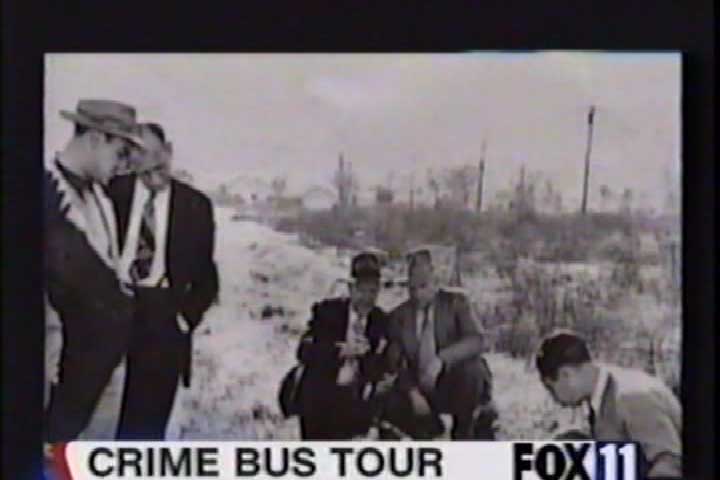
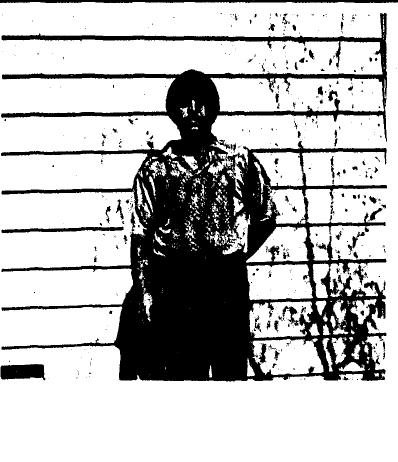
Bonus picture: Will Fowler and Ray Pinker on the sidewalk at the crime scene. Note that Pinker’s hands are in his pockets, exactly what you’d expect from the head of the crime lab. The only person close to the body is Gilbert Laursen, the LAPD photographer. No cigarette butts and no blackened flashbulbs, just as I said yesterday. I don’t like posting the crime scene pictures. I’m showing this intentionally murky image simply to prove that the investigators didn’t mishandle the crime scene, as is so frequently claimed.

Posted in Uncategorized | Comments Off on Blogging the Wolfe Book, I’m My Own Grandpaw

Blogging the Wolfe Book, the Thrill Is Gone

Page 14

“Hansen studied the body and the ‘sacred setting’ for some time before he stood up and said to Finis, ‘We won’t know what we’re really dealing with here until we get a post mortem.’ He requested that the body be covered until Ray Pinker of the crime lab arrived.”

I could quit here and be a happy man. Wolfe has been given access to the district attorney’s files. He even reprints the first two pages of the LAPD summary on Pages 325-326 of “Mogul.” But clearly Wolfe hasn’t read his own book. If he had, he would know that Pinker beat Hansen and Brown to the crime scene.

No, instead we get “Severed,” Page 10, with its assertion that the body was covered with newspapers until Pinker arrived. (And as a bonus, “Severed” claims Elizabeth Short was cut in half with “something like a bread knife.” I invite anybody who cares to attempt this to carve a turkey with such an implement next Thanksgiving. Let me know how you do).

Time for more Boy on the Bicycle stories (by now he was trolling Norton Avenue from 4 a.m. to when Will got there at 9 a.m. Apparently the Schwinn was getting a five-hour workout that morning).

“Investigators found a man’s wristwatch in the weeds near the body. It was determined that the watch had only recently been lost as it did not appear to be weathered.”

Until Steve Hodel dredged up this wristwatch in “Dahlia Avenger,” it was a footnote to a footnote. Of course Hodel uses it as yet another piece of incriminating evidence to implicate Dr. George “Evil Genius” Hodel in the killing and goes so far as to produce pictures of his father wearing a watch.

Another bit of three-card monte. Wolfe makes it appear that the watch was found by detectives in proximity to Elizabeth Short at the time the body was discovered.

No

And

No

And

No.

First, according to the Herald-Express and the Los Angeles Times, the watch wasn’t found until about four days later.

Second, it wasn’t discovered by investigators, but by Daniel Wright Jr., 16, of 3535 S. 5th Ave.

Third, the watch was found 200 yards south of the crime scene.

“Mogul,” however, reports sternly: “The person, or one of the persons, who disposed of the body, may have discovered that his watch was missing and suspected it had been lost at the site. Perhaps concerned that a fingerprint could be found on the face or back of the steel casing, the owner might have returned in the black sedan in an attempt to retrieve it. Thought it was stated by the press that ‘Police chemists were checking ownership of the military watch,’ no follow-up stories appeared regarding results of the examination for prints.”

Time for my walk.

Posted in Uncategorized | 1 Comment

Location Sleuth

Look what I found while watching the opening of “Some Like It Hot.” Why it’s signage for a 1950s Standard gas station. Hey isn’t that going to be in the shot? Naw, don’t worry about it.

Posted in Uncategorized | Comments Off on Location Sleuth

Blogging the Wolfe Book, the Riddler


Pages 12-15

Here’s a riddle: Let’s suppose for a moment that you are writing a historical piece; nothing terribly esoteric for a scholarly journal but something for the average reader. You have a choice between a schlocky, sensational paperback and original documents that few people are allowed to see.

Wrong.

If you’re Donald H. Wolfe, you’d forget the LAPD summary in the district attorney’s files and pick the schlocky, sensational paperback, “Severed.”

“Mogul,” Page 12; “Severed,” Page 9

“By the time Hansen and Brown reached the new location, reporters from L.A.’s newspapers had converged on the area, littering the street and sidewalk with cigarette butts and blackened flashbulbs from cameras. Several more police and onlookers had found their way to the site—some were driving around the block while others parked and stood on the roofs of their cars for a better view.”

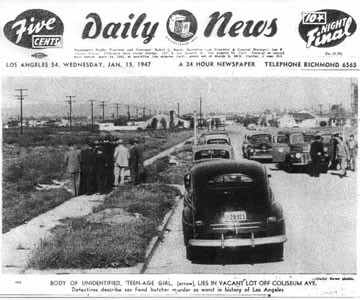
Let’s have fun with this. Here’s a better picture of Aggie Underwood at the crime scene. Note 1) that she is standing in the street. Note 2) the police officer next to her also isn’t permitted to get any closer to the body and 3) notice that the news photographer has to stand on the roof of a car because he isn’t allowed any closer to the body. Also note that nobody is tromping through the crime scene. The books that insist the crime scene was violated are lying.

We turn to Wolfe’s bibliography to check his sources and Ach! Mein Gott this is worse than I thought! Wolfe reproduces the first two pages of the police summary (“Mogul,” Page 325-326) and totally ignores it. In-cred-i-ble.

As clearly stated in the LAPD summary as reproduced on “Mogul,” Page 325, police officers present at the crime scene included, along with responding Officers Perkins and Fitzgerald: “Sgts. Wynn, Vaughn, Forensic Chemist Ray Pinker, photographer Laursen from Sci. Investigation Division, and representatives and photographers from the newspapers. Pictures had been taken by the newspapers of the body. They were later joined by Lt. Leland V. Jones of the Scientific Investigation Division.”

Do any of these people appear in Wolfe’s treatment of the crime scene? Except for Pinker, no. For an alleged history, this is extremely poor work. It’s one thing not to have access to material and quite another to be granted access and ignore it.

Instead Wolfe recycles “Severed’s” treatment of the crime scene, with Hansen bellowing at Pinker in the best Moe Howard fashion “Get over here!” (Cue SFX: bop, slap, bonk!). I almost expect Gilmore to have Hansen say: “Spread out!”

More important, the contention in “Severed” and all the books that follow is an insult to the men who worked the Black Dahlia case. This was not a case of dozens of police officers tromping through the grass, as portrayed in either “Who Is the Black Dahlia?” or more likely “True Confessions” (sorry, I know it’s in a film, but I forget which one).

For the record, there isn’t a single crime scene photo showing anyone in the grass and weeds to the west of the body except for the two lead investigators, Harry Hansen and Finis Brown, and they don’t approach the body until they have been cleared by Gilbert Laursen, the gent in the sweater seen in so many gruesome pictures on the Internet.

Take a look at the picture above: Nobody is standing in the grass but keeping carefully on the sidewalk. People aren’t circling the block to get a better view. There’s nobody standing on a car except the photographer who took this picture, and that was because he couldn’t get any closer. Bonus fact: This picture is from a website that doesn’t reveal its extreme manipulation of photos. This image has spread and is now deemed an authentic picture of the Daily News front page. In fact, the real Daily News front page had a large white arrow painted on the picture to indicate the body.

If you’ll notice in the pictures, Ray Pinker—one of the leading forensic chemists of his day—has his hands either in his pockets or otherwise secured so he won’t touch anything. These investigators were the elite of their era. Any statement other than that is simply not supported by the facts.

This is why I keep saying “Severed” is 25% mistakes and 50% fiction.

(And let’s backtrack for a moment to “Mogul,” Page 11. Wolfe puts the Hollywood Citizen-News at the crime scene, but that’s not so easily established. The Citizen-News’ Page 1 story reads like a rewrite of the Herald but makes a significant error, wrongly stating that Elizabeth Short’s right leg was broken, virtually ensuring that the writer didn’t see the body. This error gets picked up in a few minor treatments of the Dahlia case, but luckily hasn’t assumed the status of an Internet virus).

“Watson, you see, but you do not observe.”–“A Scandal in Bohemia”

Posted in Uncategorized | Comments Off on Blogging the Wolfe Book, the Riddler

Blogging the Wolfe Book, a Moment of Silence, Please

Today is the anniversary of the Feb. 10, 1947, Jeanne French murder. Frequently linked to the Black Dahlia in the popular imagination and absurdly claimed as one of the umpteen victims of Dr. George “Evil Genius” Hodel in “Black Dahlia Avenger,” French was a tragic, broken-down alcoholic. Spending the last night of her life in a Westside cafe, she dumped the contents of her purse on the bar and picked through the debris in hopes of finding enough money for just one more drink. She had no paper money, nothing more than a few coins. Whoever killed her beat her with the handle of a socket wrench, pushed her out of his car into the street and stomped on her until a rib broke and punctured her heart. A bleak, terrible death.

Her son, David Wrather, told the coroner’s inquest: “She’s gone now and I’m sure she would want me to say the right thing—she made a lot of her own trouble.”

Incidentally, I’m not the only one faulting “Mogul.” Carolyn See’s Washington Post review calls the book: “Old-fashioned porn for those who look at a pretty girl and think of a chain saw.”

Pages 9-11

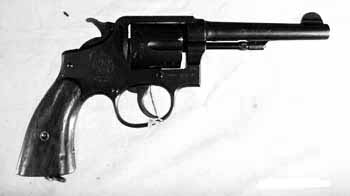
Now it’s time for Will Fowler’s well-worn story about being the first person at the crime scene, Felix Paegel taking a picture of him with the body (“all aloonnnnnee” “nooooobody around”), the cops showing up and pulling their guns (below a Smith & Wesson .38 Victory Model), Will distracting the police with the boy on the bicycle, heading back to the Examiner to put out an extra and then returning to the crime scene to “throw off the competition.”

I fell for this story, even though Will couldn’t produce the picture of himself with the body—and it turns out nobody has ever seen it. He always claimed “somebody swiped during a drinking party or I gave it away or something.”

But like most of Will’s yarns (closing Elizabeth Short’s eyes, loading the body into the hearse, walking through the crime scene so he could fire off the quip: “You know how much these suicides upset me” and the infantile genatalia) it’s simply not true. Will wasn’t the first person at the crime scene and the Examiner never put out an extra. Of the dozens of crime scene photos, not a single one shows him or any reporter anywhere except the sidewalk or the street.

Wolfe lifts Will’s explanation of a 390W, right down to the erroneous meaning of a 415. Will calls it indecent exposure, but any fan of Jack Webb knows it’s disturbing the peace (“The Badge,” Page 305). Will made sure anyone who interviewed him knew it was a 390W as an attempt to get that detail in a story. He once asked me: “Isn’t it amazing that I remember the radio call after all these years?” He fooled me with some of his tall tales, but even I recognized that as an obvious plant.

“Mogul” takes Will’s story pretty much verbatim from “Reporters,” but even here mangles some of the quotes:

“Reporters,” Page 72: “Jesus, Felix, this woman’s cut in half!”

“Mogul,” Page 9: “God, Felix, this woman’s been cut in half!”

And “Mogul’s” facts are wrong too, referring to Officer William Fitzgerald instead of Wayne Fitzgerald, but this is to be expected since Wolfe is referring to “Severed,” Page 3. (If I didn’t mention it, although I’m fairly sure I did, “Severed” is 25% mistakes and 50% fiction).

Good grief! Wolfe can’t even quote from “Severed” without making an error.

Actual name: Wayne Fitzgerald

“Severed”: Will Fitzgerald

“Mogul”: William Fitzgerald

Yet another lesson in why any good writer should do his own research. And avoid secondary sources.

More important, Wolfe ignores Will’s time line.

In “Reporters,” Page 71, Will puts himself at the crime scene at 9:05 a.m., nearly 90 minutes before Betty Bersinger discovered the body, according to Elizabeth Short’s inquest.

Uh-oh.

Instead, “Mogul” rolls the clock ahead to place Will at the crime scene at 10:45 a.m. This is still a neat trick, because according to the inquest, police didn’t get the original call reporting the body until a little before 11 a.m.

What’s this? My eyes just fell on Page 11, in which Wolfe calls it a 309W. (Did I mention this is a $30 book? Where are ReganBook’s proofreaders?)
And I have to come to the defense of Aggie Underwood. Wolfe picks up Will’s story about her kneeling over the body when Will made his second trip to Norton Avenue. In reality, Underwood had been to the crime scene and was long gone by the time Will got there, as shown in pictures taken by the police and news photographers.

Worse yet, Wolfe picks up “Severed’s” claim that “You could see the color drain right out of her like you’d opened a spigot on her bottom side.” Although Aggie had seen many murder victims in her career, the sight of the mutilated body lying in the weeds near the sidewalk knocked her off balance, and [Officer] Perkins remembered that she “staggered backwards, almost right off the edge of the curb—and almost fell down on her keester.”

Can Wolfe quote “Severed” correctly? Of course not.

“Severed” Page 6

“It sort of tickled us standing there,” he says, “and watching her back up—walking backwards almost right off the edge of the curb—almost down on her keester.”

Luckily, we have Underwood’s own account of the Black Dahlia, in her 1949 biography “Newspaperwoman,” written with Foster Goss.

“Newspaperwoman” Page 6.

“One of the four radio patrolmen, who had arrived ahead of homicide detectives, tried to stop me. I said I was from the Herald-Express and brushed past him. I’ve learned that to halt for explanations brings arguments and wastes time.

“In a vacant lot amid sparse weeds a couple of feet from the sidewalk lay the body. It had been cut in half through the abdomen, under the ribs. The two sections were ten or twelve inches apart. The arms, bent at right angles at the elbows, were raised above the shoulders. The legs were spread apart. There were bruises and cuts on the forehead and the face, which had been beaten severely. The hair was blood-matted [note: this is wrong, lrh]. Front teeth were missing [also wrong]. Both cheeks were slashed from the corners of the lips almost to the ears. The liver hung out of the torso, and the entire lower section of the body had been hacked, gouged and unprintably desecrated. It showed sadism at its most frenzied.

“Some of the police argued that she was a woman of thirty-six. Noting the youthful condition of the breasts and the smooth thighs, I said she was much younger.”

Not exactly the account of someone who nearly fell on her keister (note proper spelling).

For the record, here’s a shot (swiped off the Internet) of Aggie Underwood at the crime scene. I have a better version but you don’t need to see it. Nobody does. But note that she’s standing out in the street, well away from the body. The police protected the scene much better than crime authors would have you believe.

Will did get one thing right about the Dahlia case, however. He dispensed with the books in one word: “Lies!”

Posted in Uncategorized | Comments Off on Blogging the Wolfe Book, a Moment of Silence, Please

Blogging the Wolfe Book, Neutral Milk Hotel


I was at a signing at Book Soup last night for Kim Cooper’s “In the Aeroplane Over the Sea” (important note: there’s parking behind the store, otherwise you have to contend with West Hollywood’s insane parking situation. Those people aren’t cruising Sunset Boulevard, they’re just looking for a parking place). The attendant at the lot two blocks away ($7) asked me if I was headed for the Roxy, which made me laugh all night. Yeah, that’s me, Mr. Viper Room.

A common question at the signing: C’mon, Harnisch, are you really going to blog the entire Wolfe book?

I don’t know. People tell me what a great book this is, so I’m obligated to read it. Especially since 1) I met Donald H. Wolfe at the district attorney’s office when he was researching the Dahlia case and even sent him some documents, and 2) he uses some of my material (sans permission or acknowledgement) without changing a comma.

Still, there are rewards to reading a book at the molecular level. For example, I’m continually entertained by “Black Dahlia Avenger’s” absurdly confident statement (Page 3) that the Los Angeles Police Department handled such important murder cases as the “Red Light Bandit” (Caryl Chessman, left, was executed even though he never killed anybody, which was one reason his case was so controversial), Bugsy Siegel (Beverly Hills Police Department) and Fatty Arbuckle (take that, San Francisco Police Department).

Here’s the two-minute executive summary on “Mogul”:

This book is bad. It is based on secondary sources (and doesn’t even handle them well), misspells names, mangles the facts, exaggerates details and suppresses crucial information. All this in the first eight pages of background. Believe me, if a book can’t be trusted with simple information, it isn’t going to suddenly get better when the material gets more complicated.

OK, executives, you can stop reading now. Anyone else, as they say in the Marines: “Follow Me.”

Page 8

The legs were disconnected from the waist… The breasts seemed to have been detached…

I don’t like talking about the condition of the body but this makes it sound as if the legs were separated at the pelvis. Elizabeth Short was cut just above the waist. And the claim about the breasts is wrong, according to the transcript of the autopsy included in the inquest.

Mrs. Bersinger noticed that the head had been badly damaged and that there were red marks on the face. She suddenly stopped pushing the baby stroller and stared at the broken head in frozen disbelief as she realized that the red marks were congealed blood…

This is a nice bit of literary three-card monte (shout out to Nathan Marsak, thanks for the picture, crime buddy). Wolfe needs to introduce the condition of the body so he hangs it on Bersinger, except it didn’t occur that way.

Let’s take “the breasts seemed to have been detached.” To whom did it seem that way? Bersinger? For the record, she doesn’t give interviews. I was lucky enough to talk to her and her husband, John, in 1996, and they are wonderful, gracious people. But she does not like discussing the Black Dahlia murder doesn’t talk to the media any more.

In her interview with me, however, she described her encounter as being very brief. She did not stand and gape at the body, but saw it out of the corner of her eye as she was focusing on the stroller, looked just long enough to realize what was in the grass and hurried down the street to report it.

Since she didn’t talk to Wolfe, he used the original Examiner story and “Childhood Shadows.”

And what do we find in “Childhood Shadows” Page 68?

Uh-oh.

“The head was turned slightly toward her, but Mrs. Bersinger couldn’t see the features. Everything was blurry.”

But what about: “Mrs. Bersinger noticed that the head had been badly damaged and that there red marks on the face”? What about she “stared at the broken head in frozen disbelief”?

Nope. Nobody has ever said that. Not Wolfe’s two supposed sources and especially not Bersinger in her interview with me. Historians don’t get the protection of artistic license—this is called lying.

I mean, don’t you think if you cite something in your bibliography you should use it rather than completely contradict it? Otherwise it’s window dressing. I’m sure they taught students how to write a research paper, with proper footnotes and bibliography, at Beverly Hills High. (“Mogul,” Page 6). That’s the least we demand from students doing elementary research papers in remedial English. Why should we expect less from a $30 book? This means you, ReganBooks.

And for the record, the killer washed and scrubbed the body, so there wasn’t any congealed blood.

I have to go for a walk.

Posted in Uncategorized | Comments Off on Blogging the Wolfe Book, Neutral Milk Hotel

A "C" From the Health Inspector

Page 8

In those days Leimert Park was a nice, middle-class neighborhood on the fringe of the more fashionable Adams District west of downtown Los Angeles.

Here, in a few words, “Mogul” demonstrates its lack of familiarity with two historic Los Angeles areas that are nearly three miles apart, a definition of “West Adams adjacent” that even the lowest real estate agent would find excessive. Wolfe’s psychological map of Los Angeles (an exercise wonderfully described in “Shotgun Freeway”) is a little distorted. (Here’s a clip of the movie).

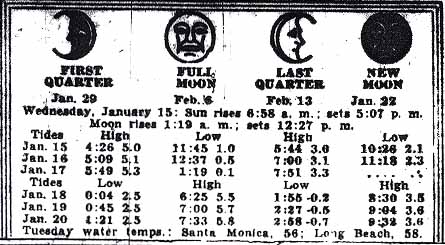
Sunrise was at 6:53 a.m. on Wednesday, January 15, 1947.

Incredibly, even this simply verified fact is wrong. Does this matter by itself? Not unless your faith dictates that you make a religious observation at a particular time. Does it become worrisome when added to all the other errors? Absolutely. More important, if a researcher can’t get simple things correct, how can he be trusted with far more complicated material still to come?

What “Mogul” is setting up in all of this is the discovery of the body, which I assume (remember I’m blogging in real time and not reading ahead) will be followed by the rest of the story told in flashbacks.

This is the standard “Laura” treatment of the Black Dahlia murder, following the structure of the Vera Caspary novel made into the 1944 movie with Gene Tierney, Dana Andrews and Clifton Webb. As Caspary discovered, this is a wonderful structure for a novel—which is quite good and I recommend it—a classic film noir, a crummy play and above-average radio play that aired on the Lux Radio Theatre several times.

Flashbacks are the standard structure used in “Severed,” John Gregory Dunne’s “True Confessions” and James Ellroy’s “The Black Dahlia.” Even Robert Lenski used it in the Lucie Arnaz TV movie “Who Is the Black Dahlia?” Of course the problem is that although this is fine for fiction, it’s terrible for history because the investigation wasn’t linear or chronological. So we’ll see how Wolfe handles this.

At about 10:30 a.m. a Leimert Park resident, Betsy Bersinger….

Uh-oh. This is bad. Really, really bad work. In our mythical restaurant inspection, this would be like the health department discovering roaches in the guacamole. The woman who found the body (a very gracious lady whom I interviewed) is named Betty, not Betsy. This is like writing a history of World War II and referring to Arnold Hitler.

The literary health inspector has just slapped a C on “Mogul.” One more slip and I’m closing you down.

Posted in Uncategorized | Comments Off on A "C" From the Health Inspector

Blogging the Wolfe Book, the Boy on the Bicycle

Page 7

What’s this? Another day on Page 7? Theological scholars don’t scrutinize the Bible this carefully and this is a book you could read in a few hours waiting for a plane at LAX. Don’t give up, we’re closing in on Page 8. I warned you from the beginning that this would be tedious. But you asked why I don’t read Black Dahlia books. This is why. It’s painful.

In the small hours after midnight, Bobby Jones, a young man in his early teens, wheeled his bicycle through a vacant lot near Thirty-Ninth Street and Norton Avenue in Leimert Park.

This is the elusive story about the Boy on the Bicycle at the crime scene. It’s one of Will Fowler’s yarns and the original version goes like this: Will was at the crime scene with photographer Felix Paegel (Will usually threw in lots of distracting details about what kind of flashbulbs Paegel used to divert attention from the fact that Will didn’t have a copy of the picture Paegel supposedly took of him with the body. “And nooooooobody around,” Will always said. “All alooonnnnne.”

In his often-told tale, the cops showed up, pulled their guns and Will explained who he was, suggesting they go talk to the Boy on the Bicycle who was standing nearby.

My first hint that anything was wrong with this was when I told Will I’d found one of the first two police officers at the scene and was going to interview him (which I did). Will became extremely uncomfortable and said something like: “Gee, (nervous laugh) I wonder if he’ll remember pulling his gun?”

When I sat down with the officer, Wayne Fitzgerald, he said: “Bullshit!” And then to make sure I got the point, he said it again: “Bullshit!”

And as time proved, Will wasn’t the first reporter at the crime scene. It took me years to untangle the truth and by then Will was in terrible shape, dying of cancer and in mental decline. One time I was coming over to visit and asked if there was anything I could bring him. Will asked me to pick up some Kleenex and toilet paper. At his apartment on Stern in Sherman Oaks, Will told me where to put the items and when I opened the cabinet, the shelves were full of Kleenex and toilet paper. He was embarrassed and said: “I guess I forgot.”

He got even worse. Before his death in 2004, Will called up and said he’d been institutionalized for six months because he had become violent with someone (Will was a boxer—or at least claimed he was a boxer in his early years. His father, Gene, was friends with Jack Dempsey so I assume at least some part of his boxing stories is true). I never had the heart to call him after that.

I have never located the Boy on the Bicycle, but it isn’t for lack of trying. He’s never mentioned in any of the news reports or documents in the Los Angeles County district attorney’s files.

Here’s Will’s version of the Boy on the Bicycle from “Reporters,” Page 75: “As [the officers] started their investigation, I pointed toward Crenshaw. There was a pre-teenager straddling his bike a block away. ‘Why don’t you question that kid over there? Maybe he knows something,’ I said. I was anxious to get to a phone.”

He next turns up in “Severed,” Page 1:

“Shortly after six o’clock that morning, a boy walked his bicycle through the weeds of a stretch of vacant lots south of Hollywood.”

I read something like that and I just sigh. Leimert Park, despite what you read elsewhere is nowhere near Hollywood.

“Severed” continues: “The boy slowed down to glance back at the sound of a car, an older black sedan, possibly a Ford. The early morning light reflected on the windshield and he couldn’t see anyone behind the wheel…. Almost late for his paper route, the boy gave no further thought to that lone car on Norton. But soon he would find out that someone—whoever had been in that car—had left something so terrible in the vacant lot that for the rest of his life the boy would remember that windshield. He would try to picture a face behind the glass but he never could see one.”

Note that Will puts the Boy on the Bicycle a block from the crime scene on Crenshaw at the time the body is found while John Gilmore, in “Severed,” rolls the clock back to dawn and puts him on Norton Avenue. Wolfe places the Boy on the Bicycle even earlier, “in the small hours after midnight.” And “Severed” never identifies him or gives his age, while Will gives his name as Bobby Jones and calls him a preteen. Wolfe, however, makes him a bit older.

But of course there’s more to the story. Let’s flip back to Todd (also known as Tod) Faulkner’s 1971 feature in The Times. Aha! It’s our friend, the Boy on the Bicycle. But wait. Here’s what Faulker says:

“[Harry] Hansen remembers that reporters and photographers were already on the scene when he and [Finis] Brown arrived. So was a man who had been out walking his dog. So was Bobby Smith, an 11-year-old from down the street who usually played in this field and who now sat quietly astride his bicycle and watched and would remember.”

Nothing about a paper route, nothing about him seeing a car, nothing about spending the rest of his life trying to visualize the face behind the windshield of the car, as portrayed in “Severed.” Faulker wraps up the story of the Boy on the Bicycle by saying: “Bobby Smith, the 11-year-old who sat and watched it that morning from his bike, works for a motor home company out in Van Nuys.”

I’ve never found this kid, nor the motor home company in Van Nuys where he supposedly worked. The Times did publish his picture, however.

Here’s the genealogy of the Boy on the Bicycle story:

1971, Todd Faulkner, Los Angeles Times (making his debut as Bobby Smith)

1991, Will Fowler, “Reporters” (name changed to Bobby Jones)

1994, John Gilmore, “Severed” (not identified)

2006, Donald H. Wolfe, “Mogul” (using the name Bobby Jones), crediting “Severed” and a 2003 interview with Will, who was barely coherent at that point in his life—at least when I spoke with him.

Fortunately “Black Dahlia Avenger,” either misses or ignores this story, or the Boy on the Bicycle (evil genius George Hodel in disguise perhaps?) would be swept up in the vast, shadowy conspiracy in which the LAPD concealed dozens of murders because Dr. Hodel knew who was walking around Los Angeles with a case of VD. I hope that sounds as absurd to you as it does to me.

So how does the story go from Will Fowler to John Gilmore? Through Mary Pacios, author of “Childhood Shadows.” Will describes his encounter in “Reporters,” Pages 88-91:

“Then there was a 13-year-old boy named John Gilmore, the son of a Los Angeles policeman at the time of the Dahlia murder. The elder had little to do with the case then. But after many years of listening to his father recount the unsolved slaying over and over, young John finally published a Black Dahlia piece in what is known in the industry as a ‘junk magazine.’ ”

“It was my impression that John finally succumbed to the fictional bizarre when he claimed to have met Elizabeth [Short’s] killer, ‘Mr. Jones.’ And… heavens to Betsy… John’s informant, who led him to Mr. Jones, was no other than the reliable source: nationally respected ‘Mr. Smith.’ ”

Will continues to describe meeting Mary Pacios, (then Mary Humphrey).

“As a down payment in order to more closely study this woman who desperately yearned for some kind of recognition, I offered to guide her along the difficult route of writing a first book. In good faith, I handed her my Dahlia chapter, the Crane scenario [too much Dahlia insider stuff even for me—lrh] some photo negatives and John Gilmore’s erroneous magazine piece. This, with the proviso that the material would serve only as a guide, and that she would not publish or publicly refer to any of the same until after ‘Reporters’ was published.”….

“It wasn’t until 1990 when Mary sent me her final letter. She wrote that she and John Gilmore had met and the two were going to collaborate on a Dahlia book.”

“My God,” I thought, “now two confused Dahlia nonentities have coupled.”

“Some time later I happened to catch the two on a television talk show where they starred as the ultimate Black Dahlia authorities. They had unblushingly enlarged on their fancies. Now John claimed the murderer had confessed to him before death, and not to police. And Mary had raised Elizabeth in her social station, having had her double-dating with Marilyn Monroe and appearing at fashionable Hollywood nightclubs with the likes of Franchot Tone.”

Does the Boy on the Bicycle really exist? The Times ran a picture of somebody in 1971. But the smart money says he is fiction.

The larger question, however, is why Wolfe draws on “Severed” as well Will Fowler and “Reporters,” which is so dismissive and sarcastic about John Gilmore. Since I’m blogging this as I read in real time, I don’t know the answer. Maybe we’ll find out and maybe not.

Whew. I have to go for a walk. But as promised we are on Page 8.

Posted in Uncategorized | Comments Off on Blogging the Wolfe Book, the Boy on the Bicycle

Blogging the Wolfe Book, Weather Report

Page 7 (Continued)

If the temperature dropped below 35 degrees F in the San Fernando and San Gabriel Valleys, the ranchers had to go out and light their smudge pots to ward off the frost that could damage the citrus crops.

On the night of Tuesday, January 14, 1947, the fruit frost warning had been posted and broadcasted on the ten o’clock news. At that hour few people were out on the streets.

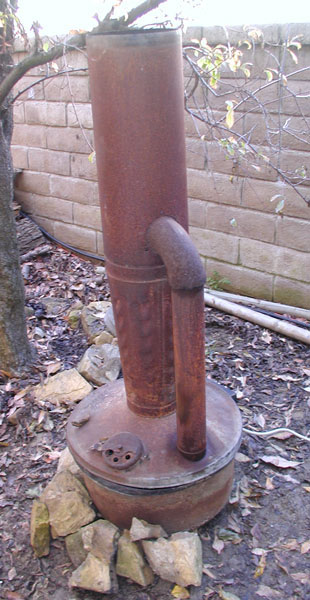
At left, a smudge pot, now nothing but an unpleasant antique in California. In the late 1940s and early 1950s, hundreds of these evil devices, burning diesel fuel, made the air over Los Angeles so polluted that there were days you couldn’t see City Hall from across the street.

I just sighed when I saw this. Time to cue the leaden skies from “Severed.” (Hm. I’d forgotten I was using a flier on hemorrhoids from the National Institutes of Health as a bookmark in “Severed” Clearly I don’t refer to either one very often).

Smudge pots burned for the first night that winter to keep the frost from killing the citrus. The cold had settled in from the cloudless sky that by dawn shone like dull gray metal that revealed no shadows. (“Severed,” Page 1).

Now to dig out the files on the weather, because it’s always reported incorrectly. First with “Severed” and then everyone who follows.

City

High

Low

Date

Los Angeles

60

39

Jan. 15. 1947

L.A. Ground Temperature

61

38

Jan. 15, 1947

Burbank

60

32

Jan. 15, 1947

Pasadena

61

35

Jan. 15, 1947

San Gabriel

60

32

Jan. 15, 1947

Los Angeles

64

39

Jan. 16. 1947

L.A. Ground Temperature

65

31

Jan. 16, 1947

Burbank

63

51 (probably an error for 31)

Jan. 16, 1947

Pasadena

60

40

Jan. 16, 1947

San Gabriel

63

33

Jan. 16, 1947

Southern California forecast for Jan. 15, 1947: Generally sunny today and tomorrow, but with some scattered cloudiness. Slowly rising daytime temperatures but continued cool.

Sunny today? What about “a cloudless sky that by dawn shone like dull gray metal that revealed no shadows?” A cloudless sky that revealed no shadows? How is that possible? And where are the smudge pots?

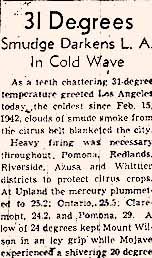
The answer: On Jan. 16, 1947, the Herald-Express ran a story headlined “31 Degrees; Smudge Darkens L.A. in Cold Wave.” Of course, since the Herald was an afternoon paper, it was speaking about the day after the body was found: “As a teeth chattering 31-degree temperature greeted Los Angeles today, the coldest since Feb. 15, 1942, clouds of smudge smoke from the citrus belt blanketed the city.”

Tsk, tsk, tsk. This is what happens when you trust someone else’s research instead of doing your own, especially when you take anything from “Severed,” which I’m fairly sure I mentioned is 25% mistakes and 50% fiction.

As everyone who knows me is well aware, I don’t like the crime scene pictures, but this photo of Los Angeles Times reporter Marvin Miles at the crime scene is appropriate because he’s wearing sunglasses. Regardless of what you read in any of the Dahlia books about brooding darkness and leaden skies, it was a bright, sunny day.

Is it being too petty to note that ranchers have cattle and farmers grow crops? And wonder why Wolfe writes 10:00 p.m. and ten o’clock on the same page instead of 10 p.m. and 10 o’clock? I suppose it is. Broadcasted? ReaganBooks should really hire a couple of good copy editors.

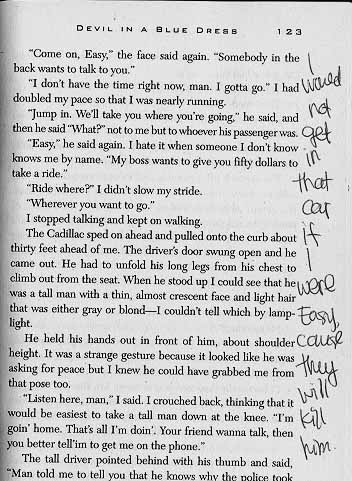
As a writer, I have a visceral reaction to finding books in the trash. They’re so much work. Writers should never be allowed to see the overfilled trash barrels at any publication that does book reviews, where prerelease copies are unceremoniously dumped, not even read, like dead leaves in the fall. So when I took some boxes to Out of the Closet over the weekend I had to rescue a copy of Walter Mosley’s “Devil in a Blue Dress” that was in the dumpster behind the store. The book was annotated on nearly every page, as follows:

Posted in Uncategorized | Comments Off on Blogging the Wolfe Book, Weather Report

Blogging the Wolfe Book, Sniff Test

And how are we doing? Some glaring omissions, a few mangled facts and some major errors. In all, the book isn’t doing well and we’re only on Page 6. If this were a restaurant, the health department would give it a “B” grade and start looking for vermin infestations and improper storage of food. The suppression of any information about the author’s links to Los Angeles Realtors and one of the leading financiers of the 20th century is particularly troubling—and certainly raises the question of whether the book is going to play fair with the reader.

In all honesty, if this were any other book, I would have already quit, because it’s clear that this is going to be a problematic manuscript all the way to Page 402, and life is short.

Still, people keep telling me what a great book this is, so let’s forge ahead.

Page 7

In the 1940s you could listen to … Edgar Bergin.

Oh dear. Clearly, along with purging the staff of fact-checkers, ReganBooks has fired its proofreaders. “Gang Busters” instead of “Gangbusters” might be forgivable. But Edgar Bergen as Bergin? That’s really no way to treat one of the Beverly Hills neighbors.

But by 10:00 p.m. the entertainment came to an end and you knew it was time to go to sleep when the fruit frost warnings came on.

Hm. Let’s dig into the radio logs, shall we? Looks like programs ran until at least a bit past midnight on Jan. 15, 1947.

Posted in Uncategorized | Comments Off on Blogging the Wolfe Book, Sniff Test

Blogging the Wolfe Book, Extra! Extra!

P. 5

Extra! Extra!

I was raised on the wrong side of the tracks in Beverly Hills.

This is the most marvelously amusing statement. I suppose there are people—somewhere—who might find this believable. But for anybody local, especially a homebuyer, a comment like this is almost indescribably hilarious and I’m starting to wonder if Wolfe was a comedy writer at some point in his career.

In the 1940s, Beverly Hills was a ritzy, exclusive, lily white enclave separate from the city of Los Angeles, with rigidly enforced deed restrictions to keep out non-whites. The only people of color ever seen in Beverly Hills in this era were the maids and chauffeurs. The deed restrictions were so vital to the people of Beverly Hills that several of them filed lawsuits that forced non-whites out of their homes; a very ugly period in Los Angeles history.

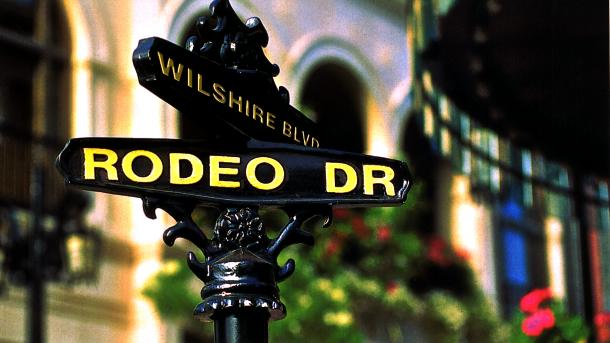
The average reader would probably skip by this comment en route to more important things, but then I’m not the average reader and I have a few extra tools at my disposal. So let’s pull the comps on all of Wolfe’s riff-raff neighbors on South Camden Drive. (Note to out-of-towners, Camden is one block west of Rodeo Drive).

On Feb. 18, 1940, the house at 473 S. Camden Drive sold for $13,000 or $172,992.24 USD 2005.

May 25, 1941, a real estate sales report describes a nine-room Spanish home being sold at 309 S. Camden Drive.

June 10, 1941, a report described the sale of a two-story Colonial at 474 S. Camden Drive.

Jan. 31, 1943, the two-story Monterey home at 426 S. Camden sold for $11,500 ($130,353.54 USD 2005).

July 25, 1943, two-story Spanish home at 416 S. Camden sold for $15,000 ($170,026.35 USD 2005)

Aug. 21, 1949, two-story Colonial home, four bedrooms, two baths, den with a half-bath, breakfast room and servants quarters (ahem) at 446 S. Camden Drive. No price listed.

Mind you, even the inflation-adjusted prices are misleading. Anything with four walls and a roof in Beverly Hills goes for megabucks today. For example, the starter house at 344 S. Camden Drive is currently on the market for a little over $2 million.

What’s especially interesting in “Mogul” is that Wolfe’s neighbors included “strictly name below the title folks” like Joe E. Brown. In 1940, Brown sold his house at 707 N. Walden for $35,000 ($465,748.34 USD 2005), a considerable sum for the era.

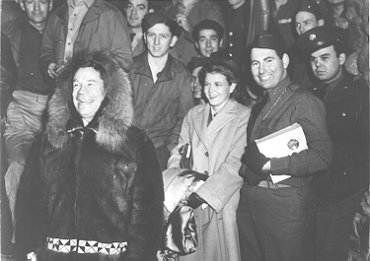
And if I were writing this story, I wouldn’t be so hard on Brown. A little research shows that he pretty much abandoned his movie and stage career after his son Don was killed on a training flight in 1942 and Brown, shown with servicemen in Alaska, devoted the following years to entertaining the troops in his son’s memory.

Now granted, I don’t read most books at the molecular level as I’m doing here. But most books don’t need to be read at the molecular level either. I warned you this would be tedious. But when Wolfe complains about his pitiful youth on “the lower depths of the south side” it’s a bit much. Of all the Dahlia authors, I’d say Steve Hodel, whose mother went to jail for child neglect, has a genuine right to talk about a harsh childhood. But the wrong side of Beverly Hills? Oh really. It is difficult to generate much sympathy for someone who first saw “Gone With the Wind” in the living room of the producer’s home.

But wait…. there’s more

Page 6

After my parents divorced in 1943, my mother married Jeffrey Bernerd, a movie producer, and we moved north, across the tracks to the land of the majors, where we lived behind one of those mansion doors where “there’s often a great deal of unhappiness.”

The name Jeffrey Bernerd means nothing today, but imdb.com lists him as working on such cinematic triumphs as “Women in Bondage” (1943) and “Black Market Babies” (1945). Bernerd’s Aug. 11, 1950, obituary says that he lived—what’s this?—at 226 S. Camden Drive.

Time to go to the files and dig out the 1946 map of streetcar routes and see exactly where these horrid tracks were (again, not everybody has a 60-year-old streetcar map just sitting around waiting to be consulted, but as I think we’ve conclusively established, not everybody is me and certainly most people don’t read a book this way).

Ah! The map shows a Red Car headed west along Santa Monica Boulevard. Those poor people living in the ghetto south of Wilshire Boulevard—how did they ever make ends meet?

But let’s have a little more fun. We find with a little digging that Wolfe’s mother, Elizabeth, married Bernerd on April 2, 1945, at Bernerd’s home. We also learn that Wolfe’s father was Sailing Wolfe, a real estate salesman who was a nephew of Bernard Baruch. (Sailing Wolfe was apparently named for Baruch’s grandfather).

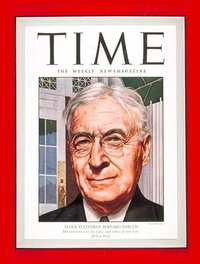
I’m blogging this as I read, so I have no idea what’s coming up. But I just flipped to the index to see if maybe we’re going to learn something about Sailing Wolfe or Bernard Baruch, left, in one of his three appearnces on the cover of Time magazine.

Not a word.

Hm. This is starting to look bad. I think if I were the grand-nephew of one of the world’s leading financiers I might just drop it in somewhere. Not make a big deal out of it but maybe I’d allude to it.

And about that impoverished childhood? We find that in 1941, Mrs. Sailing Wolfe was a member of Beverly Hills Assistance League (helping the less fortunate, presumably) and seemed to have had enough disposable income to collect Currier and Ives prints.

I have to go for a walk.

Posted in Uncategorized | Comments Off on Blogging the Wolfe Book, Extra! Extra!

Blogging the Wolfe Book, "The Monster"


Page 3

There wasn’t much nightlife in Los Angeles back in the 1940s.


Most people went to bed early.

Even in Hollywood the streets were empty and the town was pretty dead by 10 p.m.

My goodness, I had to go for a walk around the block and clear my head after that.

Entire books could be written on the subject of Los Angeles nightlife in the 1940s—fairly entertaining ones, at that; but they would be more than a little off the subject. It’s difficult to imagine a simple declarative sentence that presents such sweeping absurdity with such bold confidence and authority, except to say: “There wasn’t much water in the ocean in the 1940s” or something similarly ludicrous. As any competent historian—or fan of the 1947 Project—knows, Los Angeles had a thriving entertainment industry during World War II and the postwar period and the liquor flowed freely.

P. 4.

Wolfe paints a vivid portrait of “the Monster,” the presses at the Examiner coming to life—with one problem. He describes the paper putting out one edition, when it published something like seven throughout the day.

When the Black Dahlia murder hit the headlines on January 15, 1947, it led to one of the biggest press runs in the history of the newspaper. More copies of the Los Angeles Examiner were printed and sold on that day than any edition during World War II.

This is more or less Will Fowler’s contention, amended slightly. Will always maintained that the Examiner’s extra on the Dahlia killing was the biggest edition since V-J Day. In “Reporters,” P. 76, Will says “It ended up being the second-largest run in the Examiner’s history, bettered only by the VJ Day extra in 1945.”

But in reality, no copy of this mythical extra has ever been found. It doesn’t exist on the microfilm nor among the original newspapers, according to people who have seen them. I can only conclude that the fabulous extra edition was only to be found in the tales of William Randolph Fowler. The Examiner and The Times printed nothing about the Elizabeth Short murder on Jan. 15, 1947, and the Herald-Express ran a brief story on Page 1. Only the Daily News put a picture on the cover with a story. The headlines didn’t really hit until the next day, Jan. 16, 1947.

…there were those in the City of Angels who knew what was printed in the L.A. newspapers about the Black Dahlia case wasn’t worth two cents.

This is another sweeping absurdity made with simple, brazen confidence. As police officers at the time bitterly complained, reporters were so aggressive in gathering and reporting the story—accurately—that detectives were afraid the papers would jeopardize the investigation.

Gosh… I think I need to go for another walk.

Posted in Uncategorized | Comments Off on Blogging the Wolfe Book, "The Monster"

Blogging the Wolfe Book

People keep asking me: “Have you read the Wolfe book?” meaning Donald H. Wolfe’s “The Black Dahlia Files: The Mob, the Mogul and the Murder That Transfixed Los Angeles.” My answer is always the same: I bought a copy but I haven’t read it yet.

Still, people keep telling me it’s a wonderful job and solves the murder, usually prefaced by the statement that “I don’t know anything about the case, but…”

So here we go, in excruciating detail, with frequent detours, asides and references to the five-foot shelf of Black Dahlia books. Since I have to read this turkey, you might as well suffer right along with me. If you’re not interested in Black Dahlia minutiae you will find this a painfully tedious process, which is why I don’t read other Black Dahlia books—they’re junk.

The dedication: “To Vince Carter… and all the honest cops who took the oath and kept it.”

Vincent Carter is, in fact, the author of a 1993 crackpot, self-published book titled “LAPD’s Rogue Cops, Cover Ups and the Cookie Jar.” At right, the cover (not that one can always judge the quality of a book this way, but the outsider artwork doesn’t exactly say: “I’m a definitive source, trust me.”). More—much, much more—about “Cookie Jar” later. At least Vincent Carter actually exists, however, unlike the nonexistent Detective Herman Willis who is one of the purported sources in John Gilmore’s “Severed.”

Next page: “It was that name, Black Dahlia, that set this one off…” quoting Detective Harry Hansen.

This is from The Times’ often-cited March 28, 1971, article titled “Farewell, My Black Dahlia,” by Todd Faulkner. One of the more interesting aspects of this article is that Faulkner mysteriously christened Elizabeth Short with a fictitious middle name, Ann, that is now taken as gospel—even infecting her FBI file, and used rather amusingly as a smoking gun in Steve Hodel’s “Black Dahlia Avenger” to prove his father’s guilt, an “exacta” that shows 1) “Dahlia Avenger” is poorly researched and 2) mercilessly distorted to support its reverse-engineered assumption that Dr. George Hodel committed every unsolved murder in L.A. for several decades.

The Faulkner article isn’t listed in the book’s bibliography, so apparently we’re to assume it’s from an interview (a neat trick since Hansen died in 1983). But any thorough researcher would recognize the source immediately.

More to the point in the 1971 piece, however, is Hansen’s emphasis that Elizabeth Short “was a man-crazy tramp but she wasn’t a prostitute.” This is the sort of thing that a conscientious and dedicated researcher is going to take to heart—and a quick-buck artist is going to sweep under the rug in favor of a shadowy conspiracy involving circles within circles of purported corruption, call girls and mobsters.

Preface Page XI

“Often referred to as ‘a riddle wrapped in a mystery inside an enigma….’ ”

The Black Dahlia case was often described that way by the late Examiner reporter and foxy grandpa Will Fowler (see the readable but heavily fictionalized “Reporters: Memoirs of a Young Newspaperman,” P. 92). I’ve never heard anybody else ever call it that. “Mogul” certainly doesn’t credit Will for this statement.

…The Black Dahlia case remains stamped “Open and Unsolved.”

It’s unsolved all right, but nobody went through the pages pounding them with a rubber stamp. That’s a little ridiculous.

Page XII

In 2002, Los Angeles District Attorney Steve Cooley began establishing an archive of historic twentieth century crime investigations culled from the immense LAPD warehouse and files of the district attorney’s office.

Now wait…. This is not just wrong; it’s a serious error. The district attorney is a Los Angeles County jurisdiction while the Los Angeles Police Department is a city agency. It’s amusing to think of Cooley traipsing into the city archives at the C. Erwin Piper Technical Center on Ramirez and making the staff hand over their material from the LAPD.

What actually happened is that the district attorney’s office was cleaning house and shoveled papers that looked important into boxes. The papers aren’t the least bit organized and material from one investigation is mixed up in another. I should know—every Wednesday for a year, I visited the district attorney’s office and read old murder cases, thanks to the very generous people there.

In the case of the Black Dahlia material (which I thoroughly inventoried and indexed, and yes, I have a copy of every bit of it except for the body shots—which nobody is allowed to copy) items from several other murder investigations have been erroneously included to rather awkward results. An unlabeled photograph in the Dahlia files is identified in “Mogul” as poor old Maurice Clement—when in fact it’s Salvadore Torres Vara, a suspect in another murder. The only people who would know better are those of us who have seen not only the Dahlia files but other cases.

I’m getting way ahead of myself. But it’s disturbing when a purportedly well-researched and well-documented book about a crime tries to sound authoritative while making a gross factual blunder on such an elementary issue.

For the first time, the district attorney’s files reveal the bizarre modus operandi of the crime, establish a time line of where the victim lived in the last years of her life, identify the people she knew, and provide a list of all the suspects….

Well, not for the first time. The transcript of the inquest appears in one form or another in several books. But the time line in the district attorney’s files is quite pertinent to “Mogul,” for it shows conclusively that Elizabeth Short wasn’t anywhere near Los Angeles in 1944 or 1945 (despite the lengthy treatment in “Severed” or “Dahlia Avenger.” There goes the Georgette Bauerdorf/Hollywood Canteen connection) . Another inconvenient little detail swept under the rug because only the people who have seen the files know better.

The files also reveal the Herculean effort by the upper echelons of the Los Angeles Police Department to cover up the nature of the crime.

In a word: No. There’s nothing about any sort of cover-up in the district attorney’s files. In fact, the files reveal just the opposite–no sign of anything other than a harried and harassed Police Department victimized by the overzealous police psychiatrist, Dr. Joseph Paul DeRiver, who sincerely but erroneously believed he had solved the case by accusing Leslie Dillon. DeRiver’s actions prompted the 1949 Los Angeles County Grand Jury to investigate the case, the reason for the district attorney’s files on Elizabeth Short. The Dillon matter constitutes the vast majority of the district attorney’s files.

The next paragraph is quite handily done. Wolfe quickly dispenses with “Dahlia Avenger,” Mary Pacios’ “Childhood Shadows,” Janice Knowlton’s “Daddy Was the Black Dahlia Killer” and makes peace with “Severed,” paving the way for inclusion of John Gilmore’s book, which is 25% mistakes and 50% fiction, as we’ll see later.

Will Fowler, first reporter on the scene….

Ah, no. Even I fell for that one. Will was one of the last ones there. His story about arriving at the crime scene with Felix Paegel, getting his picture taken with the body (he always claimed the photo had “vanished”), rushing to the Examiner to put out an extra, and returning to the crime scene to “fool the competition” is utterly false. No copy of the supposed extra has ever surfaced and photos of the crime scene completely disprove his claims of being the first reporter at the crime scene.

Gosh, we’re not even through the preface and we’re out of time for the day. This is not a project for anybody in a hurry. Stay tuned….


free page hit counter

Posted in Uncategorized | 1 Comment

Product Placement

New York Times, June 15, 2005
William Hamilton:

“I‘ve never before felt like losing was winning,” said Lee Mindel of Shelton, Mindel & Associates, a New York architecture firm, who was the underbidder. Cristina Grajales, the New York dealer who won the table, looked alternately shocked and pleased as she swigged hard on a bottle of Poland Spring water and accepted incredulous congratulations from colleagues.

Posted in Uncategorized | Comments Off on Product Placement

That Little Old Thing Called Attribution

From the New York Times, June, 1, 2005
David M. Halbfinger

The diminutive Mr. Greenwald, 61, is leading this assault on the retailing behemoth of Bentonville, Ark., from a converted hot-sheets motel in Culver City, Calif. There, where MGM executives once conducted their trysts, he and a dozen or so young producers and editors are compiling digital video from interviewing teams across the country, while spreading the word through advocacy groups and labor unions to invite whistleblowers to come forward.

I would really enjoy knowing the source of the background on this hotel. The name, for example, or who exactly provided the information on its tawdry past.

Posted in Uncategorized | 1 Comment

That Little Old Thing Called Attribution

From the New York Times, June, 1, 2005
David M. Halbfinger

The diminutive Mr. Greenwald, 61, is leading this assault on the retailing behemoth of Bentonville, Ark., from a converted hot-sheets motel in Culver City, Calif. There, where MGM executives once conducted their trysts, he and a dozen or so young producers and editors are compiling digital video from interviewing teams across the country, while spreading the word through advocacy groups and labor unions to invite whistleblowers to come forward.

I would really enjoy knowing the source of the background on this hotel. The name, for example, or who exactly provided the information on its tawdry past.

Posted in Uncategorized | Comments Off on That Little Old Thing Called Attribution

Squinting at the Distant Paradise, Take II

L.A. Existential

By BRUCE WAGNER
New York Times,
May 23, 2005

Los Angeles
NO one here even knew there was an election last week.

I couldn’t have said it better than the San Francisco Chronicle (as quoted in L.A. Weekly):

Wagner’’s fiction reads like pornography for California-haters,” noted the book critic for the San Francisco Chronicle, David Kipen, who is an admirer, nonetheless. “All their cozy East Coast prejudices, all their suspicions about ‘Lotusland’ come echoing back to them in Wagner’’s fiction, confirmed and exaggerated.”

Posted in Uncategorized | Comments Off on Squinting at the Distant Paradise, Take II

Squinting at the Distant Paradise

Manohla Dargis writes in the May 10, 2005, New York Times:

LOS ANGELES – Los Angeles is in love with the idea of its own self-destruction; it’s hard to think of another American city so similarly possessed.

Actually, no. New York publishers are in love with the idea of destroying Los Angeles.

This view of Los Angeles is really quite simple: A landscape of car-obsessed kooks and cult members who live in Malibu and only venture beyond the San Diego Freeway for breakfast at Farmers Market or lunch at Du-Par’s (ever eaten at Du-Par’s? The food is lousy and the service is terrible). They earn pallets of money producing crappy movies or crappy albums (or starring in crappy movies and making crappy albums). Or the South L.A. version: bling-swaddled gang members who only venture north of the Santa Monica Freeway for Lakers games and produce crappy movies or crappy albums (or star in crappy movies and make crappy albums).

Posted in Uncategorized | Comments Off on Squinting at the Distant Paradise

Writing Cliche No. 1

New York Times, April 26, 2005
BOCAS DEL TORO, Panama – Dr. Jeremy Jackson is in an open boat, speeding across the waters of Laguna de Chiriquí, on the Caribbean coast of Panama. His graying red pony tail is frizzing and flapping in the wind, and he is gesticulating wildly, waving his long arms, his lanky frame twisted toward his fellow passengers.

Nothing–and everything–is wrong with this lede. If it had never been done before, it would be fine. The problem is that the anecdotal lede in present tense is a formula that has been done to death. In some newspapers, half the Page 1 stories start in exactly this way. I wish line editors would ban this old chestnut for about 10 years, just to give it a well-earned rest.

Posted in Uncategorized | Comments Off on Writing Cliche No. 1