Blogging the Wolfe Book, Evil Genius

Large ImageI’m blogging in real time as I read Donald H. Wolfe’s “The Black Dahlia Files: The Mob, the Mogul and the Murder That Transfixed Los Angeles.” Wolfe is using the “Laura” format, in which the anonymous, butchered body is found and the narrative proceeds in flashbacks. We are at the point in the story when police have detained Robert M. “Red” Manley, the last person known to have been with Elizabeth Short.

Regular Anonymous Correspondent submitted a comment yesterday about an appearance at the Pompidou Centre by Steve Hodel, author of “Black Dahlia Avenger.” Now really, can’t we all just try to be happy for Steve Hodel? Obviously, his book is junk, but if the French want to spend money to bring him over and listen to his mumbo-jumbo about “flashing red lights” and “thought prints,” more power to him. What do you expect from a nation that considers Jerry Lewis a comic genius?

In truth, I would be far more indulgent of the ridiculous claims of “Black Dahlia Avenger,” “Mogul” and “Severed” to name but a few, if they didn’t inflict uncountable grief on the loved ones of Elizabeth Short—as well as the rest of the Hodel family (“Avenger” was written in total secrecy, remember. Even relatives didn’t know), along with the survivors of George Hodel’s alleged co-conspirators.

Large ImageIn reality, George Hodel’s worst crime was to bring children into the world and abandon them to his ex-wife, a hopeless alcoholic who went to jail for neglecting her kids, instead of gaining custody and ensuring that they had a safe and nurturing home. And that, in my book, is not a trivial offense.

Page 76

Wolfe is in the middle of fabricating a little romantic interlude between Elizabeth Short and Red Manley at the Mecca Motel. Attributed to nobody. This is more or less a lift from Aggie Underwood’s well-published jailhouse interview with Red, so I’m going to press on.

Page 78

A couple of major and minor errors. Wolfe says that Elizabeth Short wrote her mother that she was driving back to Los Angeles with Red. Recall that Phoebe Short told Wain Sutton of the Examiner that as far as she knew Elizabeth Short was still in San Diego. Source: None.

Large Image“As observed by Forrest Faith, the Frenches’ neighbor across the street, Manley parked his tan Studebaker coupe in front of the Frenches’ residence in the late afternoon of January 8.”

  1. Faith lived next door. 2) The Studebaker was black, as shown in the Los Angeles Times photographs.


OK, more of a lift from the Underwood interview and Red’s interrogation by Frank Jemison of the Los Angeles County district attorney’s office—which Wolfe continues to call the Los Angeles district attorney. I wish he could sort out the difference between city and county agencies, it isn’t brain surgery.

Ah-ha. Finally, Wolfe is going to quote something from the district attorney’s files. You think you’re going to get it straight without lots of snipping and deletions?

Large ImageNope.

Wolfe ruthlessly trims Red’s statement. It’s too long to quote here, but this is a sample:

Page 80

Jemison:
During the course of your conversation with her, during that five or six hours when you were driving to Los Angeles … what did you talk about?

Manley:
Things we talked about were so unimportant, I don’t even remember them. In fact, she talked very little on the way to Los Angeles. I don’t know what was the matter with her. I don’t know if she was worried about something or what.

Note the telltale ellipses. That’s your warning sign.

Large ImageHere’s the actual interchange, from Page 3 of the interrogation:

Jemison:
During the course of your conversations with her, during that five or six hours when you were coming to Los Angeles, did she speak about how she liked to go dancing or that she liked to go dancing?

Manley:
Oh yes, she liked to dance, alright. Things we talked about were so unimportant I don’t even remember them. She didn’t talk much on the way in. I don’t know if she was worried about something or what.

And what does Wolfe do without warning? He jumps to Page 6 of the interview for the next paragraph without telling the reader.

And that’s it for the Manley’s entire interrogation, which last 12 pages.

Oops.

Large ImagePage 81

“In his Herald Express interview with Aggie Underwood, Manley said it was in Laguna that Elizabeth told him that she had to make a phone call to somebody in Los Angeles. He waited in the car until she returned. Manley stated he didn’t know who [note to ReganBooks, the publishing house without proofreaders or fact-checkers, that should be “whom”] the call was to, but thought it may have been to her sister, Mrs. Adrian West (Ginnie), who [ReganBooks: whom] Elizabeth said she was supposed to meet in L.A.”

Holmes, shall we check some end notes?

Yes, Watson, lets.

District attorney’s files and Underwood’s interview.

Let’s pull Underwood’s interview, shall we?

Large Image“Then we drove to Laguna Beach. There we stopped and got gas. En route she asked whether she could write to me. She said she was going to meet her sister from Berkeley, Mrs. Adrian West.”

My dear Holmes! There’s nothing about a telephone call from Laguna Beach!

Precisely, Watson. This is bad business all around. Very bad business indeed.

Want to see some more fabrication in action? Here we go:

Page 81

“I asked where she
[Elizabeth] was going to meet her [Virginia West] and she said, ‘The Biltmore Hotel.’ …. When we got into Los Angeles, she wanted me to take her to the Greyhound bus station so she could check her bags before she met her sister. I drove her to the bus station and carried her bags in. I had to go out to move my car, but told her I would drive around and pick her up and take her to the Biltmore.”

Large ImageNote the telltale ellipses. That should be your warning. Here’s the actual interview:

“I asked where she was going to meet her, and without waiting for her to answer I said ‘the Biltmore’? and she answered yes.

“She wrote my name and business address in her notebook so she could write to me.

“When we got in to Los Angeles she wanted me to take her to the Greyhound Bus Station so she could check her bags before she met her sister. I drove her to the Greyhound Bus Station and carried her bags in. I had to go out to move my car, but told her I would drive around and pick her up and take her to the Biltmore. I didn’t want to leave her in that neighborhood.”

Large ImageI swear, the man is absolutely incapable of reading what’s in front of him.

Shout out to:

Istanbul, Turkey (85.97.33.46)

TV Guide (144.198.2.240)

Regular reader in Kerkira, Greece (213.80.115.71)

My pals at Dark Horse Comics (70.96.128.8)

Regular reader at Cambrex Corp. (216.83.185.164)

OS breakdown:

Some flavor of Windows 87%

Mac OS X 11%

Unknown 2%

66% are using some flavor of Firefox.

Hurry back!

Posted in Uncategorized | Comments Off on Blogging the Wolfe Book, Evil Genius

Blogging the Wolfe Book, Tell It to the Marines

Large ImageI’m blogging in real time as I read Donald H. Wolfe’s “The Black Dahlia Files: The Mob, the Mogul and the Murder That Transfixed Los Angeles.” Wolfe is using the “Laura” format, in which the anonymous, butchered body is discovered and the narrative proceeds in flashbacks. We are at the point in the story when police are questioning Robert M. “Red” Manley, a traveling salesman who gave Elizabeth Short a ride from San Diego to Los Angeles in January 1947.

The two-minute executive summary:

We have seen that although this book is titled “The Black Dahlia Files” half of it is taken from Will Fowler’s “Reporters,” John Gilmore’s “Severed” and the Los Angeles Examiner. The district attorney’s files account for 8% of the book so far. In relying on “Severed,” Wolfe picks up and embellishes Gilmore’s ruthless smear of Elizabeth Short as a lazy tramp. Wolfe also reduces the vast number of detectives working the case to three: Homicide Capt. Jack Donahoe and Detectives Harry Hansen and Finis Brown, forcing them to be supposedly be in San Diego, Los Angeles, Santa Barbara and Lompoc at the same time. A neat trick, you must agree.

Large Image
In addition, “Mogul” shows once again that Wolfe isn’t shy about citing a source and then contradicting it completely, in this case the account of retired Officer Vincent A. Carter. Wolfe states that according to Carter, Red admitted having an affair with Elizabeth Short, while Carter’s own book states the exact opposite.

A regular correspondent writes to share a news release on an upcoming appearance by “Black Dahlia Avenger” author Steve Hodel at the Centre Pompidou. I don’t think anyone has ever accused the French of lacking a sense of humor.

Page 75

Wolfe is doing what Raymond Chandler used to call “passage work” in covering Red’s background and Elizabeth Short’s fairytales to the people who befriended her that Red was a Marine pilot. Then he picks up more of Aggie Underwood’s jailhouse interview with Red.

But not so fast. Wolfe attributes the Red Manley material to the district attorney’s files. Here’s his exact citation: “Manley’s service record and the notations regarding his ‘Section Eight’ are included in the Black Dahlia Case files at the office of the Los Angeles District Attorney.”

I really wish Wolfe could sort out the various agencies in play here. The district attorney is an elected officer for Los Angeles County and Wolfe keeps treating the job as if it were part of the city of Los Angeles bureaucracy. That would be the city attorney, another elective office.

Large ImageBut the real humor, of course, is that Wolfe’s citation leads to two boxes of jumbled paper. Somewhere in there, supposedly, is Red’s service record and material about his discharge from the Army for being mentally unfit.

Let’s go pull the box of district attorney’s files in the Dahlia case and see what we’ve got, eh?

Now I can tell you before I even look, that Red’s Army records (when he enlisted, when he was discharged, evaluations, etc.) are not there. There is a transcript of his interrogation by Frank Jemsion of the district attorney’s office, conducted Feb. 1, 1950, but there’s nothing about his service record in it.

Hm. Nothing about Red’s Army record in the LAPD summary of the case.

Let’s keep looking. Well, how about the list of 22 suspects?

Nope.

Let me check my index of the district attorney’s files.

Guess what.

Nada.

Large ImageThe truth is I could spend an entire day digging through these files and might still come up empty-handed. The point being that the material on Red’s service record isn’t in the main places you’d look: His interview, the LAPD summary and the list of suspects (in fact, in the interrogation, Jemison goes out of his way to emphasize that Red was not a suspect).

Now let me skip over some of the Underwood interview to get to:

Page 76

Because Wolfe is going to fabricate out of thin air, a tryst between Red and Elizabeth Short at the Mecca Motel.

OK, folks, watch a master fabricator at work. If you ever want to know how to make up some bogus material, this is how it’s done:

“At this point Manley hesitated in his story. Correcting himself, he said, ‘No—we started to drive to the Club, and it took us two and a half or three hours to find it… Boy it’s sure easy to get lost in San Diego!’ ”

Large ImageThat’s verbatim from Underwood’s interview, except that she didn’t capitalize “club.” A point apparently lost on ReganBooks, the publishing house without proofreaders or fact-checkers.

Ready? Here we go!

“Before correcting himself, Manley may have been about to say that they left and tried to find a motel. Though Manley told Aggie that he had left Elizabeth Short at the Frenches, and then found a ‘room’ up the coast, and registered ‘for myself,’ the Examiner reporters had discovered that both Manley and Elizabeth Short had registered at the Mecca Motel on the day in question—December 16. The ‘two and a half or three hours’ supposedly spent trying to find the Hacienda Club were more than likely spent at the motel where they had both registered before going to the club, which was only a fifteen-minute drive from the French residence in Pacific Beach and only ten minutes from the Hacienda Club. Manley continued: ‘When we got to the Hacienda Club, we had a few drinks and danced a few times. Then it was twelve o’clock. We went to a drive-in, had a sandwich, and I took her home.’ ”

Large ImageNotice that this makes no sense. Let’s run that again:

The ‘two and a half or three hours’ supposedly spent trying to find the Hacienda Club were more than likely spent at the motel where they had both registered before going to the club, which was only a fifteen-minute drive from the French residence in Pacific Beach and only ten minutes from the Hacienda Club.

In other words, the nightclub is only 10 minutes from itself. OK California geography can be complex, but not that complex. Let’s give him the benefit of the doubt and assume (or “speculate with confidence” as Hodel is so fond of saying) that Wolfe means the motel was 15 minutes from the Frenches’ home and 10 minutes from the Hacienda Club.

Of course, for this to work, Wolfe must have found the Hacienda Club. Think so? Let’s dig through the book and see if he says where it is. I’ll bet he doesn’t know.

Nope. Wolfe hasn’t a clue where the club was. In truth, the reason Red had such a hard time finding the club is because it wasn’t anywhere near Mission Valley.

Oops.

But there’s more.
Large Image
Red didn’t stay at the Mecca Motel on the December trip, but on his second trip in January.

Excuse me? What’s my source? It’s an unidentified newspaper clipping in the Gilmore archives at UCLA. Box 16, Folder 3.

Here’s the headline:

‘Red’ Here Night Girl Slain. L.A. Police Checking His Alibi.

Tell them I sent you.

And here’s something really peculiar. Gilmore doesn’t even use his own material (“Severed,” Page 106).

Time for my walk.

Shout out to:

Riverdale, Ill. (12.100.216.67)

Salem, Ore. (67.166.94.152)

France (80.124.192.14) (Tiens! Going to the Hodel appearance?)

Windows 98 user in Portland, Ore. (24.21.137.251) Upgrade!

Hurry back!

Posted in Uncategorized | 1 Comment

Blogging the Wolfe Book, Imagine My Surprise

Large ImageI’m blogging in real time as I read Donald H. Wolfe’s “The Black Dahlia Files: The Mob, the Mogul and the Crime That Transfixed Los Angeles.” Wolfe is using the “Laura” format, in which the anonymous, butchered body is discovered and the narrative proceeds in flashbacks. We’re at the point in the story when police have arrested Robert M. “Red” Manley, the last person known to have been with Elizabeth Short.

I was, I have to admit, skeptical of the claim by former Officer Vincent A. Carter that he was at Hollenbeck Station when Manley was interrogated. But I found a picture of him in October 1947 teaching youngsters how to shoot. So that part of the story holds up. Of course, while Carter says Elizabeth Short wouldn’t sleep with Red, Wolfe turns this into:

“According to Administrative Vice officer Sgt. Vincent Carter who was at Hollenbeck when Manley was interrogated, the story Manley told [Aggie] Underwood for public consumption wasn’t exactly the same story he had told detectives and Brown during the interrogation. Desperately trying to save his marriage, Manley publicly denied having an affair with the murder victim, while privately admitting that he had indeed been intimate with Elizabeth Short.”

Page 74

This appears to be a straight lift from Aggie Underwood’s jailhouse interview with Red Manley, which appeared in the Herald-Express Jan. 20, 1947. Let’s see if it is.

Well, no, it isn’t a perfect quote. Wolfe drops words here and there and swaps “Miss Short” for “her.” Nothing crucial, but it shows a certain disinterest in treating quotes as anything other than raw material.

Large ImageBut here’s something interesting: Wolfe adds “Manley said he drove around the block before pulling his car up to the curb where Miss Short was standing.” Now that isn’t anywhere in Underwood’s story. In fact it isn’t anyplace in the official documents or original news reports and I can’t imagine where Wolfe got it unless he simply made it up. Who’s going to know?

Hmmmm. We know from our statistical analysis, that Wolfe’s three major sources are 1) Will Fowler’s “Reporters,” 2) John Gilmore’s “Severed” and 3) the Examiner. Let’s check in with Will.

Nope. But here’s one paragraph from “Reporters” that Wolfe didn’t use:

Page 87

“A reliable nonfiction author must always deal with facts, even though he has the privilege to dissect and conjecture them. The author must not ever be tempted to stray from the basics in a moment of weakness to dream up these pieces of sensational non-information in order to entertain his readers.”

Large ImageI wonder if Will appreciated the irony of that statement. He was a smart man. I’m sure he did. And obviously, it was totally lost on Donald H. Wolfe.

How about “Severed”?

Oh this is hilarious!

“Severed,” Page 103-104.

“The street he’d just turned onto was one-way, so if the girl crossed the street when the light changed, he might not be able to get around the next block to catch her before she disappeared into one of the office buildings.”

As I believe I’ve said, “Severed” is 25% mistakes and 50% fiction. Elizabeth Short was standing across the street from the Western Air Lines office when Red picked her up. And where exactly was the office? As anybody who has researched the story knows, the Western Air Lines office was on Pacific Highway, the main drag along the coast. Not a exactly a little, one-way street in downtown San Diego. California geography really baffles some people, doesn’t it?

Large ImageBut nothing about circling the block. In fact, “Severed” says (wrongly) that Red couldn’t have circled the block.

My head’s spinning. That’s it for today.

Hurry back!


Posted in Uncategorized | Comments Off on Blogging the Wolfe Book, Imagine My Surprise

Wayward Youths

Technology has changed, but people have not. Simply because they lived nearly a century ago doesn’t mean Angelenos were unable to indulge their vices, they simply procured them in a different manner.

One of the main staples was the throngs of young bicycle messengers who traversed the city in packs.

Rivalry was intense and the groups frequently fought with one another. However, an attack on one messenger was an attack on them all, as one hapless teamster discovered when his horse trampled a youth’s bike.

On their errands about town, the boys quickly learned to answer the most popular questions: where to buy drugs and where to find women of easy—if any—virtue.

Of course those who trafficked in drugs and women found that the easiest reward was a sample of their trade. The Times said: “I want a wise kid,” is one of the most frequent instructions women of the half world telephone into messenger offices. And so in short time the most unsophisticated boy becomes close-mouthed and open-eared.

“Temptation comes and he grows suddenly from a raw boy into an immoral man. Then begins his training as a panderer. It comes through association and big tips. Many women hire messenger boys each night to take them to places where they room. They do this in order to avoid interference by the police. ‘Wise’ messengers get fees and favors through turning the footsteps of men in certain directions.

“Thus, handling trays [of food being taken to criminals], carrying notes, doing confidential errands, procuring opium, helping make assignations and in practically all their work, these boys are simply aiding in some form or other of vice.”

There were, according to The Times, two destinies for such youths: Hopeless drug addiction or prison.

“One of them, ‘The Gopher Tooth Kid,’ hangs about a North Main Street pool hall, getting odd tips from players for errands. He uses the money to buy morphine, which he snuffs.

“Of the other class, there are many examples. Irving Long, now serving sentence in San Quentin for passing bad money, was formerly known to the police as a highwayman. The Power boys, George and Pat, are others. There is Goldie Herbert, who did time in Folsom, and Kid Humphries, who served a prison sentence from a northern county, where he committed burglary. All these started as Los Angeles messenger boys.”

Lmharnisch.com


Lmharnisch.blogspot.com

Posted in Black Dahlia, Books and Authors, City Hall, Food and Drink, LAPD, Streetcars | Comments Off on Wayward Youths

Blogging the Wolfe Book, The Numbers Game

Large ImageI’m blogging in real time as I read Donald H. Wolfe’s “The Black Dahlia Files: The Mob, the Mogul and the Murder That Transfixed Los Angeles.” Wolfe is using the “Laura” format in which the anonymous, butchered body is discovered and the narrative proceeds in flashbacks. We are at the point in the story when Elizabeth Short has left the French family in San Diego and is with Robert M. “Red” Manley, a traveling salesman who picked her up and is giving her a ride back to Los Angeles. Police have detained Red and are questioning him about the Black Dahlia.

Do you like statistics? No? Good. Let’s have some.

Just for fun (OK, my idea of fun may not be yours), I added up the different citations in Wolfe’s end notes to determine his primary source. Recall that the book is titled: “The Black Dahlia Files.” So they are going to be the main source, right?

Uh. No.

Up to Page 73, Wolfe’s leading source is:

William Randolph Fowler—interviews and “Reporters.” (22.5%)

Followed by John Gilmore’s Severed” (16%) and the Los Angeles Examiner (10.5%). Statistically, those three sources account for nearly half of Wolfe’s source material.

To be sure, the district attorney’s files are there, accounting for a whopping, mind-boggling, eye-popping….

8.0645161290322580645161290322581%

Large ImageOr as noted critic Lorenzo Matawaran (OK, well the contributor of exactly one review to Amazon.com) raved:

At last, a Black Dahlia book with plenty of photos, illustrations, and source notes. It even had an index! Wolfe’s book is well researched, fascinating, and it has a great deal of new information. For those who are interested in the true story behind the Black Dahlia murder this is a must read.Lorenzo Matawaran

Hard to imagine that a rewrite of “Severed” and “Reporters” is new information but apparently it is to some people.

Wolfe’s total end notes as of Page 73 = 124

Citations of Will Fowler = 28

Citations of John Gilmore/“Severed” = 20

The Los Angeles Examiner=13

District attorney’s files = 10

Large ImagePage 73

Recall from last time that Wolfe has ruthlessly reduced the legions of forces in the Black Dahlia investigation to a paltry three police officers: Homicide Capt. Jack Donahoe and a mere two detectives, Harry Hansen and Finis Brown. This, of course, requires Hansen and Brown to be up in Santa Barbara and Lompoc investigating Elizabeth Short’s months at Camp Cooke at the same time they were in San Diego interviewing the French family AND giving Red Manley the third degree as well as two polygraph exams.

Donahoe, meanwhile, was doing nothing but lounging around the homicide office, sitting next to the phone in case Los Angeles Examiner City Editor Jim Richardson called with another tip, at least in Wolfe’s account of the case.

But it’s time to introduce another police officer into the mix. Our old pal Vincent Carter, author of “L.A.P.D.’s Rogue Cops Cover Ups and the Cookie Jar” from the noted publishing house Birmingham Printing and Publishing Co., 130 S. 19th St., Birmingham, Ala. 35233.

Large ImageHere are some other books in this publisher’s catalogue:
James R. Bennett, Old Tannehill: A History of the Pioneer Ironworks in Roupes Valley, (1829-1865), (Birmingham, AL: Birmingham Printing and Publishing Co., 1986) ISBN 0-9617257-0-2
Eve Ida Barak Briles, Moods, Seasons, and Love. Birmingham, Ala.: Birmingham Printing and Publishing Co., 1982.

Richard H. Gamble, A Competitive Spirit The Story of Central Bank of the South Birmingham, AL, Birmingham Printing and Publishing Co., 1987, Hardcover, Fine in Fine dust jacket 0961809108 Inscribed by author. Dust in brodart mylar protective cover! Fully Indexed. 8vo; 191 pages; Signed by Author (Banking, History, South, Author Signed)

Helen Irvine, June 2002, “The Legitimizing Power of Financial Statements in the Salvation Army in England, 1865-1892”, Accounting Historians Journal, Edition.1, Issue.1, Volume.29, Birmingham Printing and Publishing Co, Birmingham, pp.1-36.

Large ImageMary H. and Dallas M. Lancaster, The Civil War Diary of Anne S. Frobel of Wilton Hill in Virginia. 1986

William Lindsay McDonald, History of the First United Methodist Church, Florence, Alabama, 1822-1984. Birmingham, Ala.: Birmingham Printing and Publishing Co., 1983.

Now here’s their website
:

Now I don’t find any books on their site, but they do have a long list of equipment. In other words, this looks like a job shop. You bring in your precious tome and voila, out comes the printed word. It would be rather a challenge to assume these fine Alabamans exercised any editorial control over this opus. And I doubt they had anything to do with the “update” on the Black Dahlia case that has been photocopied, stapled and just stuck into the front of the book. Not something you see in ReganBooks’ finest efforts.

Large ImageSo let’s keep checking:

Desert View Books
PO 1604
Lucerne Valley, CA 92356

Well let’s check their catalogue. Hm. I can’t seem to find anything from this publishing house aside from Carter’s book.

In other words, this is a self-published book. I write whatever I want, take it to the printer (in this case, the folks in Birmingham) and out comes “Rogue Cops.”

Just so you know who we’re talking about.

The good news is that Vince Carter is a real human being, unlike, Detective Herman Willis, one of the main sources in “Severed.” And in case there was any doubt, Wolfe includes a picture of himself with Carter.

Large ImageSo what does Wolfe say about Carter?

“Aggie recalled that she primed Manley with a few casual queries before he began to open up and tell the whole story, which was printed in the Herald Express that evening. But according to Administrative Vice officer Sgt. Vincent Carter
[note to ReganBooks: proper style would be “administrative vice Sgt. Vincent A. Carter,” although Cal Morgan or Anna Bliss are apparently not the kind of editors who lose sleep over such trifles] who was at Hollenbeck when Manley was interrogated, the story Manley told Underwood for public consumption wasn’t exactly the same story he had told detectives and Brown during the interrogation. Desperately trying to save his marriage, Manley publicly denied having an affair with the murder victim, while privately admitting that he had indeed been intimate with Elizabeth Short.”

Now this is going to be bad business, folks, because Wolfe is not only smearing Red Manley, but the police and Aggie Underwood are being tarred with the same brush. On the basis of what is supposedly found in this self-published autobiography. Already my spider sense is tingling.

Large ImageThe end notes, Mr. Gallagher?

Absolutely, Mr. Shean.

Oh, this is much worse than I thought. After all my buildup, Wolfe doesn’t even attribute the above paragraph to Carter’s book. In fact he doesn’t attribute it at all—not even to an interview with Carter.

The fact-checker in me just licks my chops over this one.

Any bets on whether this is in “Rogue Cops” before I start looking? Because if it’s not here, Wolfe has really hit a new low in fabrication.

First, let’s check Carter’s index.

OK, Robert Manley, Pages 10, 175-177, 179, 181.

Page 10. Hm. Carter calls her Elizabeth Ann Short, even though she had no middle name. Obviously a real student of the case since it’s well known that she had no middle name.

Carter quickly establishes himself as a master of understated insight:

“It was obvious that the murder and mutilation of the body had not taken place at the site where the body had been found.”

Large ImageAha. This makes a bit more sense:

“I was on duty when Manley was brought in for booking. I had been on the force for five years and had later taken a job with the Reserve Unit in the Hollenbeck Division in order to have more time to study for an upcoming sergeant’s exam. I also wanted to get into the detective bureau. I was more than casually interested in the Black Dahlia case which I quickly recognized as the kind of crime of passion that is normally solved comparatively quickly.”

But what’s thissssssss? “Rogue Cops,” Page 11.

“…although I never worked directly on the Black Dahlia murder, I never lost interest in it.”

Large ImageUh-oh.

Now let’s press ahead here.

Donald H. Wolfe, you are busted again!

You knew this was going to happen, right?

“Rogue Cops,” Page 176.

“When Manley picked Elizabeth up at the French home in San Diego on January 8, he took her to dinner and then to a motel where he rented a room. When she would not consent to have sex with him, they left and drove to Los Angeles.”

This is where Perry Mason smiles and says: “No further questions.”

Time for my walk.

Shout out to:

United Way of Greater Los Angeles (207.105.48.253)

Timber Ridge Group (66.138.106.188)

Radboud University Nijmegen (131.174.206.125)

Burns Flat, Okla. (216.89.32.23)

Batelco Jeraisy Autonomous System (83.101.150.115)

University of Wisconsin at Madison (146.151.18.95) Here’s to all my Norske homies! Let the Rosemaling begin.

Hurry back!

Posted in Uncategorized | Comments Off on Blogging the Wolfe Book, The Numbers Game

Fashion Week

Clarence Westfall, 22 years old, was taken into custody at San Pedro yesterday afternoon when a boat from San Diego docked. He was arrested for having masqueraded in female attire and was taken to the Central Police Station, where he told a story that nearly resulted in his being liberated. When the police received the report from the station at San Pedro, however, that Westfall, in posing as a woman, had endeavored to be assigned to a woman’s stateroom, he was locked up.

He said he was frequently obsessed with the desire to don women’s clothing, do fancy work and generally “act like a girl.” He had about convinced the detectives that he was a fit subject for alienists to examine when he was recognized as a former prisoner. He was locked up on a charge of vagrancy.

Dec. 4, 1911

A random discovery too good not to share.

Lmharnisch.com


Lmharnisch.blogspot.com

Posted in 1908, 1911, Black Dahlia, Books and Authors, Fashions, LAPD, Streetcars | Comments Off on Fashion Week

Blogging the Wolfe Book, Slinging Hash

Large ImageI’m blogging in real time as I read Donald H. Wolfe’s “The Black Dahlia Files: The Mob (and were are those pesky thugs, anyway?), the Mogul (missing in action so far) and the Murder That Transfixed (fixed, yes, but transfixed, hardly) Los Angeles.” Wolfe is using the “Laura” format in which the anonymous, butchered body is discovered and the narrative proceeds in flashbacks. We’re at the point in the story when Elizabeth Short is in San Diego in the last month of her life and has just met Robert M. “Red” Manley.

Page 70

Wolfe is discussing Manley’s arrest in Eagle Rock after his return from a sales trip to San Francisco. Remember that while Los Angeles police and reporters were madly searching for the mysterious red-haired man last seen with the Black Dahlia, he had left his car in the garage of a friend and driven up to San Francisco.

The usual source for this episode is Will Fowler, who claimed to have witnessed the arrest. I would imagine Wolfe lifts this more or less from “Reporters.” It is amazing, isn’t it, that although the book is called the “Black Dahlia Files” it consists mostly of an embellished rehash of “Reporters” and John Gilmore’s “Severed,” which is 25% mistakes and 50% fiction. With a bit of garnishing from Jim Richardson’s “For the Life of Me” and Mary Pacios’ “Childhood Shadows.”

Now Wolfe is going happily along insisting that Richardson, the Examiner’s city editor, called poor old hapless homicide Capt. Jack Donahoe to tell him about Red Manley. Wolfe presumably wants the reader to think Donahoe did nothing in the way of investigation but baby-sit the phone waiting for newsmen to call him with tips.

Large ImageAh, here’s a nice bit of fiction.

“It was hours before
[Manley’s companion] Palmer’s car finally showed up, and Robert ‘Red’ Manley stepped out. Dressed in a heavy, gray overcoat and broad-brimmed hat that partially concealed his red hair, he briefly stood near the curb talking to Palmer. As he turned toward his tan Studebaker parked in the driveway, the police detectives jumped out of their car with guns drawn and closed in on the fugitive suspect. Spotting the detectives, Manley quickly raised his arms high in the air and said, ‘I know why you’re here, but I didn’t do it.’ ”

This reads like a lift from “Reporters.”

The end notes, Holmes?

Yes, Watson, lead on.

Hum! Wolfe is getting sloppy about his noting. He attributes the quote “I know why you’re here, but I didn’t do it” to “Reporters,” but not the rest.

Watson, the haz-mat pile of Dahlia books!

Large Image“Reporters,” Page 82

“Ferde Olmo and I sat in the back seat of a homicide stakeout car being used by Sgts. J.W. Wass and Sam Flowers. We were parked at the curb of Palmer’s Eagle Rock house, waiting for his car to drive up.

“Eventually, it arrived and when Manley stepped out, the detectives with guns drawn, darted toward him. Manley raised his arms and Olmo flashed pictures. Manley said, ‘I know why you’re here, but I didn’t do it.’ Dressed in a heavy gray overcoat and broad-brimmed hat, he was frightened out of his wits.”

Notice the economy that Will uses and how Wolfe loads his writing down with extraneous words:

Wolfe: Manley quickly raised his arms high in the air.

Fowler: Manley raised his arms.

One thing about Will—he knew how to write tightly; it’s that newspaper training.

Notice that Will doesn’t have anything about Manley’s tan Studebaker parked in the driveway. And why is that?

Large ImageAs anybody who has read The Times’ account knows (and isn’t it interesting Wolfe hardly refers to The Times), it was parked in the garage. In fact The Times ran pictures of the car—and by golly it was black, not tan.

More important, you’ll notice in the photos that it’s daylight outside, not evening, which is when Manley was arrested.

Hmmmm.

I’m going to skip ahead a bit and simply point out that Wolfe has reduced the LAPD’s homicide bureau to three men: Donahoe and Detectives Harry Hansen and Finis Brown. In reality, of course, everyone in the Homicide Bureau was working the case, along with men borrowed from other jurisdictions. But the barrage of unfamiliar names is far too complicated, so Wolfe just tosses them out and has Hansen and Brown do everything.

Meaning that they’d have to be giving Manley polygraph exams in Los Angeles while they were down in San Diego interviewing the Frenches and up in Lompoc and Santa Barbara digging into Elizabeth Short’s time there.

A rather neat trick, wouldn’t you say?

Large ImagePage 72

“According to practice, the official record of Manley’s full statement to the police was sealed within the LAPD Dahlia file, which remains locked in the Los Angeles Police Department warehouse; but in an unusual procedure, Capt. Donahoe allowed reporter Aggie Underwood to visit the suspect. As the Examiner’s blazing headlines about Red Manley’s capture landed on thousands of Los Angeles doorsteps on Monday morning, January 20, Aggie Underwood of the Herald Express was escorted by Harry Hansen to Manley’s cell for an exclusive interview with the exhausted suspect.”

There are so many mistakes in this paragraph that I could easily spend a day on it.

Here are a few goofs:

  • The Black Dahlia “file,” actually an entire file cabinet, is not in some LAPD warehouse, but locked up in Robbery-Homicide at Parker Center.

  • Donahoe and Hansen had nothing to do with Underwood interviewing Red Manley.

Large ImageLet’s check Wolfe’s source on this. Ah! Proof that Donald H. Wolfe is absolutely incapable of reading what is in front of him. As I said previously, I don’t know what editors Cal Morgan and Anna Bliss did with this book, but I can tell you all things they didn’t do, which is to check a single reference.

Wolfe cites Underwood’s autobiography (written with Foster Goss) “Newspaperwoman,” Page 63.

OMG. Let me check this citation again. Yep, “Newspaperwoman,” Page 63.

Well, it isn’t JonBenet Ramsey, but by golly it is close:

“Newspaperwoman,” Page 63:

“On December 5, 1932, an adventurer atmospherically named Captain Walter Wanderwell was shot and killed while in the cabin of his boat, the Carma, tied up at a Long Beach dock. It was a mystery slaying, spiced with attractive girls in the passenger-crew list of a party planning an exotic voyage. For “class” purpose, the vessel became a yacht; the case was dubbed the “yacht death,” the tag preceding by almost fifteen years the similarly identified Overell case at Santa Ana, California, in 1947.”

As Aggie Underwood writes on Page 63:

Large Image“What the hell is going on here?”

So, as a service to everybody who doesn’t have a copy of “Newspaperwoman” handy, here is the relevant citation on Pages 7-8.

“Look, fella,” I continued as [Red Manley] inhaled [a cigarette]. “You’re in one hell of a spot. You’re in a jam and it’s no secret. If you’re innocent as you say you are, tell the whole story; and if you haven’t anything to hide, people can’t help knowing you’re telling the truth. That way, you’ll get it over with all at once and it won’t be kicking around to cause you more trouble.”

“She’s right,” said Harry S. Fremont, homicide detective. “Tell her everything that happened. I’ve known this lady for a long time on lots of big cases, and I can tell you she won’t do you wrong.”

Harry Fremont?

“What the hell is going on here?” “Newspaperwoman,” Page 63.

Time for my walk.

Note to prospective commenters: Consider the phrase in Steve Hodel’s “Black Dahlia Avenger” : “It’s possible to speculate with confidence.” (Page 368).

We don’t do that around here. The whole point of this blog is to NOT speculate. Remember the motto of my old pals, the Lookies: “We don’t guess, we look it up.”

Speaking of Hodel, how about his treatment of this episode? He takes it fairly straight from “Newspaperwoman.” In this case, that puts him ahead of Wolfe.

Large ImageShout out to:

Swiss Federal Government (193.5.216.100) Windows 2003? What kind of OS is that?
State of Minnesota (156.99.14.161)
Macedonia (212.110.86.34)
Cardica.com (64.160.34.10)

Cummins Engines (12.148.202.85) (Between Grimstad, Norway; Minnesota; and Stoughton, Wis., we got Norskes all over the place). Ever read “Wisconsin Death Trip”? It is too gruesome for words; sort of a “Dairy State Babylon.”

Hurry back!

Posted in Uncategorized | Comments Off on Blogging the Wolfe Book, Slinging Hash

A Page From Dickens

For some time, the teachers at the Casco Street School had been concerned about the pupils from the nearby Christian Orphanage. But finally the problems became too great to ignore.

“One small boy, an especial pet and a delicate child, was found, one cold, rainy morning, filling his blouse with the filthy scraps of bread from the garbage pails in the rear of nearby residences. He was so hungry. ‘Aunt Ada’ had sent him to bed without any supper because he was naughty and she had slapped him in the morning because, like Oliver Twist, he had asked for more mush,” The Times said.

The Miss Ada in question was Ada Bisbee, a member of the local Women’s Christian Temperance Union who ran the orphanage at 1724 Kent, part of the Florence Crittendon Home for Unwed Mothers. (Recall that this was an era when abortions were illegal and Margaret Sanger was charged with obscenity for sending information on birth control through the mail).

Bisbee, who had taken over after a much-beloved Flora Sallee, denied that there was anything wrong after a confrontation with school Principal Gertrude Horgan.

Horgan found the plight of the orphanage youngsters so dire that she fed them all after discovering that their packed lunches consisted of two crackers and an apple. That would be all until dinner—if, indeed, Bisbee allowed them to have dinner, for they were often sent to bed hungry as punishment.

“The teachers held an indignation meeting. It was raining and all that could be procured in the shape of food were a number of loaves of bread and some molasses and such a feast was held in the school that day that the teachers will never forget. It was painful, they one and all assert, to see the wolfish hunger with which the children devoured the food.”

One of the older girls at the orphanage said she complained that fish being served to the children was spoiled, only to be rebuked. “Why did you say anything?” Bisbee reportedly said. “The children would not have noticed it.”

“Very soon the children were ill, presumably from spoiled fish,” The Times said.

School authorities contacted the superintendent for the home for unwed mothers, A.C. Jeffers, who dismissed claims of harsh treatment.

“When the affair was reported to A.C. Jeffers yesterday he declared that Miss Bisbee is a good disciplinarian but not nearly as severe as his own mother was, and to his mind she makes an excellent matron,” The Times said.

“Yesterday, a delicate, shrinking little fellow, who has to be encouraged to say a word of his own accord, came to school with a long cut on his neck. The watchful eye of the principal saw it. The child said a man at work there [at the orphanage] struck him with a rawhide whip because he refused to do something he was told.”

As a result of Horgan’s complaints, the children appear to be eating more, but she has incurred the wrath of Bisbee, who is said to be taking out her anger on the children.

Casco Street School was renamed Rosemont Avenue School in 1912. The campus is located at 421 N. Rosemont Ave. Gertrude Horgan died in 1919 after a short illness. No record can be found of Ada Bisbee or A.C. Jeffers.

Orphanages in Los Angeles, 1907: Los Angeles Orphan Asylum, Christian Orphanage, Boys’ and Girls’ Aid, South Pasadena Home, Catholic Orphanage, Boyle Heights Home, Victoria Home and Volunteers of America.

Lmharnisch.com


Lmharnisch.blogspot.com

Posted in 1907, 1912, Black Dahlia, Books and Authors, Education, Food and Drink, LAPD, Pasadena, Religion, Streetcars | Comments Off on A Page From Dickens

Blogging the Wolfe Book, Trying to Make It Real Compared to What


Large ImageI’m blogging in real time as I read Donald H. Wolfe’s “The Black Dahlia Files: The Mob, the Mogul and the Murder That Transfixed Los Angeles.” Wolfe is using the “Laura” format, in which the anonymous, butchered body is discovered and the narrative proceeds in flashbacks. We are in the last few weeks of Elizabeth Short’s life, in which she met Robert M. “Red Manley,” a traveling salesman from Los Angeles who picked her up on a trip to San Diego.

Imagine my surprise—no, my shock—to read this in L.A. Weekly. Here’s a screen shot to show I’m not making this up.

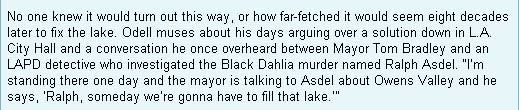
A writer named Jeffrey Anderson is exploring the legacy of Owens Valley and interviewed a man named Don Odell, identified as: “a semi-retired lawyer and former member of the Inyo County grand jury.”

“Odell muses about his days arguing over a solution down in L.A. City Hall and a conversation he once overheard between Mayor Tom Bradley and an LAPD detective who investigated the Black Dahlia murder named Ralph Asdel. “I’m standing there one day and the mayor is talking to Asdel about Owens Valley and he says, ‘Ralph, someday we’re gonna have to fill that lake.’ ”

It’s a nice picture; Odell overhearing a conversation between Bradley and Asdel, a former LAPD detective who was loaned to the Black Dahlia investigation.

But you’re not going to like this.

Large ImageRalph was a friend of mine. I was a pallbearer at his funeral in 2003. He was working in Boyle Heights when he was loaned to the Dahlia investigation. He later worked as a detective in the San Fernando Valley, before going to motors.

And according to his obituary in the Los Angeles Times:

“Asdel, who later became a motorcycle officer, injured his leg in an on-duty accident and was forced to go on medical retirement in 1965.”

Tom Bradley was indeed mayor of Los Angeles.

From 1973 to 1993.

Do you think something could something be wrong here? Note: Ralph’s obituary is online and easy to find.

Page 69

Large ImageWolfe is telling the Red Manley saga, using Will Fowler’s yarn virtually intact. In Will’s version, he goes to the Manleys’ home in Huntington Park, interviews Manley’s wife, Harriette, and tells her not to open to the door to nosy reporters.

The source for this ought to be either Will’s “Reporters,” or an interview with him. As I said before, one of the most frightening phrases in the English language is “Will Fowler recalls….” but let’s check.

Yep, “Reporters,” Page 81 and 82.

Should I take the time to see if this is screwed up? OK, I will.

Watson, to the haz-mat pile of Dahlia books!

Why am I not surprised?

Now with any other writer, I wouldn’t bother. This seems to be a straight lift job. But I swear, Wolfe can’t read what’s in front of him.

Here’s Will’s version:

“While I was there, the phone rang. It was Red and Harriet put her hand over the mouthpiece and asked: ‘Do you want to talk to him?’ ”

“ ‘You better not tell him I’ve been here,’ I said.”

Compare this with “Mogul”:

Large Image“When Harriet learned that her husband was being sought by the police, she became nervous but cooperative. She told Fowler that she had just heard from her husband, who had telephoned from San Francisco.”

OK, Will, let me get this straight: Every police officer and every reporter in California is looking for the mysterious red-haired man in the murder of Elizabeth Short. You’re at the man’s home, talking to his wife. He calls. She asks if you want to speak to him.

And you say:

No.

If that were a true story and I were your editor, you would be out the door.

And here we see Wolfe’s skill in creating quotes for conveniently dead people:

“Reporters,” Page 82

“She didn’t seem to object when I asked for them all [family photographs] and instructed her—a bride of only 15 months—not to talk to anyone, especially if newspaper reporters started coming around the house.”

“Mogul,” Page 69

“Electing not to inform Mrs. Manley that her husband was the number one suspect in the murder of Elizabeth Short, Fowler cautioned her not to talk to anyone about her husband—especially ‘any nosey reporters who may come knocking at your door.’ ”

Large ImageOf course, Will’s story (which I heard from him countless times) was that he bamboozled his way in the door by flashing his badge (reporters were indeed issued badges by Sheriff Eugene Biscailuz that were later confiscated by Sheriff Peter Pitchess) and claiming that Red had lots of unpaid parking tickets.

Was there any truth to it at all? I don’t know. Maybe. Will also claimed that he was on the stakeout when Red was arrested in Eagle Rock and present when police showed up at the Examiner with Elizabeth Short’s luggage. Since those events occurred at roughly the same time, he couldn’t have been in both places.

Time for my walk.

Shout out to:

Dark Horse Comics (70.96.128.8) man you guys are really going nuts on this site!

Grimstad, Norway (62.101.234.10) (say hi to my homies in Andoya!)

Oecd.org of France (80.124.192.14)

Mysterious visitor (75.1.5.136)

Chicago Linux user (4.252.208.102)

Hurry back!

Posted in Uncategorized | Comments Off on Blogging the Wolfe Book, Trying to Make It Real Compared to What

Blogging the Wolfe Book, Family Ties

Large ImageI’m blogging in real time as I read Donald H. Wolfe’s “The Black Dahlia Files,” more properly titled “Stuff I Scraped Out of ‘Severed’ Thanks to John Gilmore, Who Calls My Book ‘a True Crime Classic’ and ‘Crap’ ” (If you figure that one out, you’re good).

Wolfe is using the “Laura” format in which the anonymous, butchered body is found and the narrative is told in flashbacks. We just finished the portion of the story in which Elizabeth Short has been befriended by the French family in San Diego in the last month of her life.

I heard from one of Elizabeth Short’s sisters yesterday, as I do from time to time. Out of concern for her privacy, I won’t quote the e-mail, but she asked what I knew about the upcoming Brian De Palma movie. I told her I turned down a chance to attend the sneak preview, but that several people who saw the movie said it was horrid. Sample comment: “There is so much wrong with this film that I don’t even know where to start!”

Large ImageThe sister expressed dismay that so many people are so hungry to cash in on the family’s tragedy, and so totally hardened to the grief they continue to feel nearly 60 years after the murder. As I have said again and again, for the Short family, the murder is not some macabre curio of old Los Angeles; for them it’s as if it just occurred. The continuing flood of sleazy, crackpot books only reopens old wounds. And don’t even get me going about the websites plastered with body shots that have made their way onto record jackets. And the free FBI files going for $25 a pop on Ebay. You know who you are.

To the haz-mat pile! The good news is that we’re on

Large ImagePage 68

Total pages (not counting “end notes” and the index) 357. Hey, we’re nearly 20% of the way through the book.

OK. This chapter is titled “Red,” so I’m going to guess (remember I haven’t read ahead) that it is lifted more or less intact from Aggie Underwood’s jailhouse interview with Robert M. “Red” Manley, the only bylined story of any original account of the Black Dahlia case. With some garnishes from “Severed,” which is 25% mistakes and 50% fiction.

Hm. Wolfe is starting with Jim Richardson suspecting that Red and Elizabeth Short might have left San Diego for Los Angeles late in the day. He continues to call photographer George O’Day a reporter, but at least he is consistent in his mistake. Recall that Elizabeth Short’s father went from strict churchgoer to Jack Daniels’ best amigo in a few pages, something that caused no intellectual whiplash to Wolfe’s agent, Alan Nevins, nor to his two editors, Cal Morgan and Anna Bliss.

Any bets as to whether Wolfe bothers to attribute this? It should be in Richardson’s “For the Life of Me” if it’s anywhere.

Large ImageLead on, Watson!

Well, Holmes, it’s supposed to be from “For the Life of Me,” Page 301.

Quick, Watson, the haz-mat pile!

Ah. This is more like it:

“For the Life of Me,” Page 301

“She left the French place about six o’clock on the evening of January 8 with a man known as Red,” Tommy [Devlin] reported. “This Red sent her a telegram January 7 from Huntington Park saying he would pick her up the next day. She told Mrs. French and Dorothy he was taking her to Los Angeles A couple of weeks before she left, Elizabeth told Dorothy one morning that she had a friend named Red who was at a motel near San Diego. When Red picked her up January 8 he had his car and carried her bags out to it. Mrs. French and Dorothy met him and I’ve got a good description of him. He’s our baby. Send somebody out to check that telegram. He may have given an address when he sent it. I’ll start prowling the motels around here for the license number of his car.”

So it wasn’t Richardson’s idea, it was Devlin’s. And notice, please, no mention of photographer George O’Day. That comes from Will Fowler’s “Reporters.”

Oh this is interesting (well, OK, to a total research drudge):

Large Image“But at the Mecca Motel, known to be a ‘hot pillow joint’ located less than twelve miles north of Pacific Beach, the clerk recalled a couple that matched the description; however, they had not registered in January. The clerk recalled them registering back in mid-December. ‘Yes, the man was tall, freckle-faced, had red hair, and was in his mid-twenties,’ the clerk recalled, ‘and he was with a striking young woman with jet-black hair.’ ”

Now if you haven’t spent years researching Dahlia stuff you wouldn’t notice what’s going on here. Wolfe is claiming that Red and Elizabeth Short checked into a motel during his previous visit to San Diego—something that is totally unsupported in the original documents. And this nonsense about the Mecca Motel being a “hot pillow joint”—where on earth did Wolfe get that?

Let’s just see if he hangs this on anybody.

Aha. Maybe from “Reporters.” I swear, one of the most frightening phrases in the English language is “Will Fowler recalls…” I considered him a good friend and he lied his head off to me.

Large Image“Reporters,” Page 81

“In the meantime, the crew of George O’Day and reporter Tom Devlin continued checking hotels and motels, looking for anything that would lead them to the identification of ‘Red.’ And coming up with a winner, Devlin located a motel where a red-haired man had registered the previous December. Unbelievably, he hadn’t signed in with the usual Mr. and Mrs. Smith. He had actually entered Elizabeth Short’s real name at the motel a dozen miles north of San Diego. He also signed his name: Robert Manley from Huntington Park.”

Note, please. Nothing about freckles, nothing about O’Day being a reporter and most of all, nothing about the Mecca Motel being a “hot pillow joint.” That’s strictly Wolfe’s handiwork. Now Red did check into a motel along the highway south of Pacific Beach, but by all accounts Elizabeth Short did not accompany him. In fact, he picked her up on a corner across from the Western Air Lines office, gave her a ride to the Frenches, went to the motel to clean up and came back and picked her up. They went out and he dropped her off at the Frenches.

Period.

So where does this quote come from?

“ ‘Yes, the man was tall, freckle-faced, had red hair, and was in his mid-twenties,’ the clerk recalled, ‘and he was with a striking young woman with jet-black hair.’ ”

Beats me. From the fertile mind of Donald H. Wolfe, apparently.

Large ImageI’m increasingly puzzled about the title of Wolfe’s book because the district attorney’s files (remember, this is called the “Black Dahlia Files”) are virtually absent. Wolfe’s main sources seem to be “Severed” and “Reporters.”

And even then, Wolfe is very selective. Here’s another section from the same page of “For the Life of Me” that Wolfe is using. But he leaves this out:

“She had been a pitiful wanderer, ricocheting from one cheap job to another and from one cheap man to another in a sad search for a good husband and a home and happiness. Not bad. Not good. Just lost and trying to find a way out. Every big city has hundreds just like her.”

But of course that’s completely counterproductive in the “Elizabeth Short turns bad girl” motif, so it’s ignored.

Time for my walk.

Ps. I also heard from Mary Pacios yesterday. She says the Wolfe book makes her so angry she can’t read it. Mary calls it “dishonest” and it is surely that.

Shout out to:

Warner Music Group (65.244.245.5)

Larkspur Hospitality Company (12.154.206.226)

My regular visitor in Kerkira, Greece (213.80.115.71)

New Orleans (68.14.106.216)

Sydney, Australia (203.217.66.172)

Raleigh, N.C. (69.134.176.51)

Win98 user at the University of Windsor (137.207.132.38)

The dudes at Inktomi (72.30.133.13)

Youngstown State University (150.134.171.163)

Hurry back!

Posted in Uncategorized | 4 Comments

Acrobats

http://video.google.com/googleplayer.swf?videoUrl=http%3A%2F%2Fvp.video.google.com%2Fvideodownload%3Fversion%3D0%26secureurl%3DlwAAAEBwZKJSCLV1FyCOYE1YAMWrPouE5wKbCyZRY8lCyIQoLowu5TeWScVQptvXc6Qoh5jBD1EkPJCGlVG1n4bpXNGh2XxPD_fjWY4mgR1Zy1eXcbTE5kcoPH8ns78r1eH2FbRVLGWnfx8pqoPeqs80yKH67NfXmiJ7Z6Ja0mU3NVlWaA3R18Dv18cbVSevZ1ellKjxDrIIG0D18uE6bhOuNfo%26sigh%3DkwxJKz6zGChG7Q7mpY5EqH-vPec%26begin%3D0%26len%3D122566%26docid%3D696846189715300295&thumbnailUrl=http%3A%2F%2Fvideo.google.com%2FThumbnailServer%3Fcontentid%3D2473d1209e2ffe3a%26second%3D5%26itag%3Dw320%26urlcreated%3D1142977903%26sigh%3DSOyXHx0gc7hRju_PaUL-cfzmExE&playerId=696846189715300295

Americans at the turn of the century lacked many things, but they had some amazing live entertainment. Here’s a snip of a performance courtesy of Edison Studios, 1904. These guys rock. I have watched them dozens of times now and I still find them amazing.

Enjoy!

lmharnisch.com

lmharnisch.blogspot.com

Posted in Uncategorized | 1 Comment

Blogging the Wolfe Book, An Army of One

Large ImageI’m blogging in real time as I read Donald H. Wolfe’s “The Black Dahlia Files: The Mob, the Mogul (and where is that darn Mogul, anyway?) and the Murder That Transfixed Los Angeles.” Wolfe is using the “Laura” format in which the anonymous, butchered body is discovered and the narrative is told in flashbacks. We’re at the point in the story when Elizabeth Short has been befriended by the French family in San Diego about a month before her death.

Page 65

Wolfe is inexplicably in the middle of an account in which he claims Elizabeth Short impulsively decided to leave San Diego. In fact, the French family asked her to leave after she had been with them a month. In the book’s “Elizabeth Short goes bad girl” section, she is enthusiastically portrayed as a lazy tramp, completely at odds with the facts but lustily depicted in John Gilmore’s “Severed,” which is 25% mistakes and 50% fiction.

Oh my. Wolfe says Elizabeth Short contacted Red Manley, who replied with the telegram saying he was going to be in San Diego and wanted to see her. I don’t think even “Severed” says this. Let’s see.

Nope. I mean Wolfe isn’t shy about attributing something from “Severed” to the Los Angeles Examiner, but he doesn’t bother attributing this to anybody. It certainly isn’t in the district attorney’s material (recall, if you will, that the title of this book is “The Black Dahlia Files.”). Stay tuned, maybe we’ll find out.

Large ImageWhat happens next:

“When the Examiner reporters
[recall that Wolfe is erroneously referring to photographer George O’Day as a reporter—of course we only have Will Fowler’s “recollections” that O’Day was even there] phoned in their story, [Jim] Richardson knew he had his scoop—Red may have been the last person to see Elizabeth Short alive. Knowing he had secured his exclusive, Richardson took two of the little, white nerve pills he was in the habit of taking when the scoop-cooker was coming to a boil, and then picked up the phone to clue in Capt. [Jack] Donahoe about Red and Elizabeth Short’s stay in San Diego. Donahoe agreed that ‘Red’ was the prime suspect in the Black Dahlia murder, and Richardson set the Examiner headline for Saturday, January 18.”

Large Image
Hm. I don’t think this is what Richardson said–exactly.

The end notes, Holmes?

Precisely, Watson.

Hum. “For the Life of Me,” Page 302.

I do hope this isn’t about JonBenet Ramsey.

To the haz-mat pile.

(This is torture: listening to Schoenberg and reading nonsense about the Black Dahlia case).

Well this makes much more sense:

“For the Life of Me,” Page 302.

Large ImageRichardson is talking about the identification of the mysterious “Red” (the Frenches didn’t know his name, but told police that Elizabeth Short left with him). In San Diego, Examiner reporter Tommy Devlin was checking motels to see if Elizabeth Short and Red Manley checked in someplace.

“This is where a city editor sweats it out. This is where he needs those little white pills. This is where he needs everything he’s got and everything his reporters have, too. It’s not fun while it’s happening. It’s only fun to think of it afterward, if things go right.

“All through the night and into the next day I waited for word from Tommy and when he called I could have kissed him.

“ ‘I’ve got it,’ he said. ‘I found the motel where he stayed the first time he was down here and where he stayed with the Dahlia the night they left the Frenches.’ ”

Now let’s pull the Examiner for Jan. 18, 1947.

Ah.

Large Image“When told she had to leave the French home, she must have communicated with the ex-lieutenant, described as a tall, red-haired, freckle-faced man of 25.”

Here’s where Wolfe gets the freckles, then, and the conjecture that she contacted Red Manley. But note that she didn’t impulsively leave, either. She was told to hit the road.

But the main point, at least to me, is Wolfe’s contention that Donahoe had no clue about where Elizabeth Short was or anything about Red Manley until he got a call from Richardson.

Nope.

In fact, the French family contacted San Diego police after seeing Elizabeth Short’s picture in the newspapers. They were questioned by San Diego homicide detectives (after all, she was last seen alive in San Diego) as well as Los Angeles homicide detectives. Reporters got the information because Elizabeth Short’s mother, Phoebe, gave out the Frenches’ address when she talked to Wain Sutton.

This is why the Black Dahlia story gets so complicated: There are an incredible number of unfamiliar names and various agencies, and several competing newspapers. The narrative becomes tangled very quickly unless the people get boiled down to a symbolic one or two—at least in fiction. In the TV movie “Who Is the Black Dahlia?” for example, the vast throng of reporters gets reduced to one—Bevo Means played by the very saintly Tom Bosley.

Large ImageIn the same way, Wolfe reduces the number of investigators to two: Harry Hansen and Finis Brown. Wolfe has Hansen checking Red’s telegram and Brown down in San Diego. Oh but wait, then Hansen is down in San Diego interviewing the Frenches.

In fact, an entirely different crew of other investigators handled the San Diego investigation. And a still different crew of investigators checked Hollywood. Wolfe has nothing of the massive forces involved in the real investigation. It works for fiction, but for history—it’s absurd.

Wolfe ends the chapter with a quote from the Frenches’ neighbor and an all-points bulletin for Red in a funky typewriter font.

In reality, folks,

THE INTERNAL POLICE COMMUNICATIONS IN THE DISTRICT ATTORNEY’S FILES WERE WRITTEN IN ALL CAPS LIKE THIS AND PRINTED OUT ON WHAT LOOKS LIKE HIGH-ACID, PULP TELETYPE PAPER.

End of the chapter. Time for my walk.

Large ImageShout out to:

State Of Louisiana Office Of Telecommunications Management (204.196.188.18)

Mercury Interactive (199.106.64.21)

Columbus, Ohio (65.60.227.100)

Nashua, N.H.( 24.128.128.31)

Van Nuys, Cailf. (71.143.151.127)

OS Breakdown:

Windows XP 84%

Windows 2000 7%

Mac OS X 5%

Linux 3%

Windows 98 1% (you know who you are).

Hurry back!

Posted in Uncategorized | Comments Off on Blogging the Wolfe Book, An Army of One

St James Raises a Church

The Methodist Episcopal congregation, formed from a merger of the Centennial and Central churches, planned a wonderful new building at 22nd Street and Union. Although the congregation studied the idea of a new location, the members finally decided there was no better place than the one they had.

The church was designed by A. Dudley using an old English half-timbered style with a Gothic tower. The vaulted ceiling was highlighted with gold and the pews were arranged in concentric circles around a corner pulpit.

The Times noted:

“The congregation of St. James gives promise of becoming one of the strongest in the outlying parts of the city. Its pastor [the Rev. Robert S. Fisher] is a young man who has made his way rapidly toward the front and only last fall declined to accede to the wishes of the bishop that he accept a leading church in San Francisco.”

St. James was dedicated on Feb. 11, 1917, under the Rev. Bede A. Johnson, with a final design by architect Arthur G. Lindley.

While some historic Los Angeles buildings have been destroyed by earthquakes and others by developers, St. James fell to an unhappier fate.

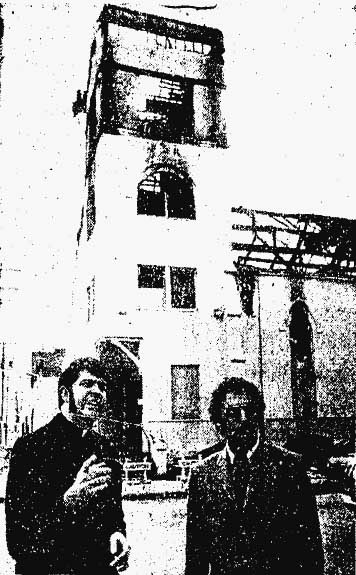
By the 1970s, the church was the home of Metropolitan Community Church, which ministered to homosexuals. On Jan. 27, 1973, the church was gutted by a fire in an apparent hate crime.

Lmharnisch.com

Lmharnisch.blogspot.com


1973: The Rev. Troy Perry and Jerry Small outside the burned remains of St. James Methodist Episcopal Church, burned in an apparent hate crime targeting gays.

Posted in Black Dahlia, Books and Authors, LAPD, Streetcars | Comments Off on St James Raises a Church

Blogging the Wolfe Book, Wax On, Wax Off

Large ImageI’m blogging in real time as I read Donald H. Wolfe’s “The Black Dahlia Files (which have been mostly ignored so far): The Mob (a bit of that), the Mogul (no sign yet and we’re 63 pages into the book) and the Murder That Transfixed Los Angeles.”

Wolfe is using the “Laura” format, in which the butchered, anonymous body is discovered and the narrative is told in flashbacks. We’re at the point in the story in which Elizabeth Short has been befriended by the French family in San Diego about a month before her murder in 1947.

The two-minute executive summary:

In the last week, we have seen a continuing disinterest in facts, heavy reliance on John Gilmore’s “Severed” (to the extent that it’s rather amazing that Gilmore can dismiss “Mogul” as “crap” since it relies so heavily on his book) and bold fabrication. We have also found that Wolfe is not the least bashful about making statements that are easily disproved. Glynn Wolfe is casually described as procurer of girls for Syndicate brothels in a complete fabrication of what allegedly exists in the Los Angeles County district attorney’s files. Nor is Wolfe shy about making up quotes and attributing them to fairly inaccessible sources, down to making up what movies were playing in San Diego theaters.

Let’s press on.

Large ImagePage 63

Wolfe is in the middle of an enthusiastic smear in the “Elizabeth Short turns bad girl” section of the story, apparently assuming that we won’t feel sorry when she’s killed if he makes her into a lazy tramp.

We’re told that the Frenches noticed that Elizabeth Short used melted candle wax to fix the cavities in her teeth (in reality, the source of the story is her roommates at the Chancellor), but it gives Wolfe a nice opportunity to refer to a “job interview,” which seems to be turning into some sort of hint at prostitution(although we’re not there yet.

Man. California geography is so confusing to some people. Not only does Wolfe talk about Elvera French supposedly coming home for lunch from her job at the Navy hospital (10 miles each way to Pacific Beach(before freeways), now we’re told Elizabeth Short was talking about getting a job at the Naval Air Station, which is on Coronado Island. A mere 14 miles.

Attribution? You must be kidding.

Large Image
Page 64

Now this is interesting. Wolfe has taken an incident that supposedly occurred with a man whose name is given variously as Sam Nevarra or Sam Navara, a jealous boyfriend who supposedly scratched her arms in a quarrel.

Instead of Nevarra/Navara, Wolfe attributes this to the unidentified manager of the Aztec Theater.

To the end notes, Watson!

“Severed,” Page 98, Holmes.

The haz-mat pile of Dahlia books, Watson.

Hum! Here we are. It’s part of the story about late-night shish kabobs being the food of romance. Too bad “Severed” isn’t indexed because it would be fun to look for good old Sam Nevarra/Navara. But I don’t see him in “Severed’s” pages about San Diego. I wonder why Gilmore left him out. Ah well.

This is looking mostly like a lift from “Severed.” I know I mentioned it before, but I wonder how Gilmore can call this book “crap” when so much of it is taken from “Severed.” Maybe that’s the part of the book he was talking about in the jacket blurb that called it “destined to become a true-crime classic. A must read!”

Oh this is funny, Wolfe is calling Examiner photographer George O’Day a reporter. Oops. Supposedly attributed to Jim Richardson’s “For the Life of Me,” Page 300.

Let’s see.

Oh guess who isn’t mentioned on Page 300 of “For the Life of Me.”

Go ahead.

Large Image
Now here’s Wolfe:

“When Examiner reporters
[Tommy] Devlin and O’Day questioned Elvera and Dorothy French about the identity of Red [Manley], they recalled that one day in mid-December, Elizabeth had brought to their home and ‘old acquaintance’ she had bumped into near the Western Airlines [note to ReganBooks proofreaders: Western Air Lines] office in downtown San Diego. Elizabeth said he was an ex-Marine Corps flyer and referred to him as Red. She had told them that Red was now flying for Western Airlines and was helping her get a job there as a stenographer. According to Elvera. Elizabeth dated Red every night from December 16 to 21 and then he suddenly left town. Elvera remembered that Elizabeth went out with other men almost every night until Red returned in the first week of January to drive Elizabeth back to Los Angeles. Elvera and Dorothy both described him as a tall-red-haired, freckle-faced man in his mid-twenties. They recalled that his first name may have been Bob, but they didn’t know his full name.”

And Richardson? Now I just double-checked the end notes and Wolfe says he got all of that from Page 300 of “For the Life of Me.”

Large ImageReady?

“I called Tommy Devlin to the desk. He’d been standing by for just such a break [as when the Examiner talked to Elizabeth Short’s mother, Phoebe]. Tommy is my top reporter on crime. He’s better than any detective I know. It wasn’t two minutes before he was on his way to San Diego. He actually ran out of the local room.”

And that, folks, is it. Nothing about freckle-faced Red Manley.

Uh…. How about “Severed?”

Good grief: Gilmore refers to “Gordan Fickling” (Page 100). Did I mention that “Severed” is 25% mistakes and 50% fiction? Nope, I don’t see freckle-faced Red Manley there. How very odd it all is.

Back to Wolfe. Oh man.

“Dorothy revealed that when Elizabeth suddenly decided to leave San Diego, she seemed disturbed and agitated, and Dorothy attributed it to an incident that had occurred on January 6.”

Now look, it’s been well-established in the original newspaper accounts that the Frenches asked Elizabeth Short to leave after a month. It wasn’t an impulsive act by Elizabeth Short. She was asked to leave.

What do you want to bet there’s no source for this before I look?

Holmes! Why are you never wrong?

Page 65

Let’s see here…. Some people come by the Frenches’ house looking for Elizabeth Short, check. Los Angeles Examiner, Jan. 20, 1947.

Large ImageAny bets? Now at least some of this is bogus.

OK. Los Angeles Examiner, Jan. 20, 1947. Arrest of Red Manley in Eagle Rock. Well at least we know Wolfe had access to the story about who allegedly scratched Elizabeth Short’s arms. Nothing about the Aztec Theater manager. I swear the man can’t read what’s in front of him. “An Italian with black hair.” Bet you didn’t know late-night shish kabobs were an Italian dish.

The story mentions Elvera French, all right. But there’s nothing like this:

“Some people came to our door and knocked. There was a man and a woman, and another man was waiting in a car parked on the street in front of the house. Beth became very frightened(she seemed to get panicky and didn’t want to see the people or answer the door.” They finally went back to the car and drove away. Even our neighbors thought all of this was very suspicious….”

Did you notice the use of “Beth?” Now whom do we know who refers to Elizabeth Short as Beth?

Did someone say “Severed?”

Oh let’s just check the haz-mat pile.

Holmes! It’s here!

Large Image“Severed,” Page 110

“Dorothy recalls, ‘a couple of days later some people came to our door and knocked. There was a man and a woman, and another man was waiting in a car parked on the street in front of the house. Beth became very frightened(she seemed to get panicky, and didn’t want to see the people or answer the door. They finally went back to the car and drove away. Even our neighbors thought all of this was very suspicious.”

Book him Dano.

Time for my walk.

Shout out to:

Galveston, Texas (70.120.168.198)

Seattle, Wash. (67.150.89.248)

Australia (218.185.83.46)

Hm. Linux 8%

Mac OS X 5%

Posted in Uncategorized | Comments Off on Blogging the Wolfe Book, Wax On, Wax Off

Blogging the Wolfe Book, Snooze Alarm

Large ImageI’m blogging in real time as I read Donald H. Wolfe’s “The Black Dahlia Files: The Mob, the Mogul and the Murder That Transfixed Los Angeles.” Wolfe is using the “Laura” format, in which the anonymous, butchered body is discovered and the narrative is told in flashbacks. We’re at the point in the story when Elizabeth Short has been befriended by the French family and we have seen a fair amount of embellishment of what was already a fabrication in John Gilmore’s “Severed.”

Page 63

Wolfe is in the middle of an enthusiastic smear in the “Elizabeth Short goes bad” section of the tale, assuming, apparently, that we won’t feel as much sympathy when she gets killed off if he makes her into a lazy tramp.

“Because Elizabeth slept until noon, Elvera found herself tiptoeing around the house as she prepared herself breakfast and got ready for work. Soon she began wondering why she had to tiptoe around her own house when Elizabeth should have been out seeking employment instead of sleeping in late. It wasn’t long before Elvera began slamming the door on her way out, and as the days went on, Elvera and Dorothy French would have arguments over the merits of sheltering Elizabeth. She had overstayed her welcome as far as Elvera was concerned, but Dorothy felt sorry for her and kept persuading her mother to ‘be patient for a little longer.’ Dorothy and Elvera both felt as if she were hiding out. She was in the habit of chewing her fingernails down to the quick and at times she seemed despondent and fearful, as though she had been in some kind of trouble before she left Hollywood.”

Now without looking, this sounds like it’s right out of “Severed,” (odd, isn’t it, that Gilmore says Wolfe’s book is “crap” when it relies so heavily on his own work?) But I don’t recall anything about Elvera French slamming doors and tiptoeing around the house(or arguing with Dorothy over the woman who came to dinner. Of course, I can’t claim to have memorized “Severed” either.

Large ImageCome along, Watson.

Look here, Holmes! There’s no attribution! None whatsoever!

Hum. Let’s go to the Dahlia pile, Watson.

Gad! I picked up Steve Hodel’s “Dahlia Avenger” by mistake. I’m surprised the haz-mat team hasn’t shown up and confiscated all these Dahlia books.

Ha! Just as I thought, “Severed,” Page 100. Just a little unattributed lifting by Mr. Wolfe. Note that these details only occur in “Severed” and any books that might rely on “Severed.”

Holmes, why are you never wrong?

Now the interesting thing here, Watson, is that “Severed” has Dorothy French’s teenage brother wanting to take the couch and let Elizabeth Short have his bedroom. I wonder if Wolfe is going to use that.

“Severed,” Page 100:

“When Dorothy told her mother what Cory [note: everybody gives a different name for the brother. Sometimes it’s Cory. Or Cary. Or Carey. Or Gary. Wolfe, Lord help us, calls him Corey] had suggested, Elvera said, ‘That’s his room, and for the love of God, we’ll never get things back to normal around here if she moves in there.

“Elvera found herself tiptoeing through the living room while getting ready for work. She’d ask herself why she was tiptoeing through her own house(the girl should have been up, dressed, and looking for work instead of sleeping or fancying herself up for dates.”

Now here’s the point all this scrutiny: Let’s recall the story of Robert “Red” Manley, the traveling salesman who picked up Elizabeth Short in December 1946 and then gave her the ride from San Diego to Los Angeles in January 1947.

Large ImageRemember what he said to the newspapers? Elizabeth Short told the Frenches that Manley helped her get a job at Western Air Lines. In other words, as far as the Frenches knew, Elizabeth Short was gone all day because she claimed she was working. It was a lie, of course, but she was getting up and leaving the house every day as if she had a job.

This is, as I believe I have said before, very bad work.

Shout out to:

Santa Fee Lofts (transedge.com 171.85.219.209.)

Bexar County Information Services (206.254.152.1) one of my regulars.

Galveston, Texas (70.120.168.198)

Chadbourn, N.C. (4.88.1.11)

Operating system breakdown:

Some flavor of Windows 88%

Mac OS X 8%

Linux 2%

Unknown 2%

Hurry back!

Posted in Uncategorized | Comments Off on Blogging the Wolfe Book, Snooze Alarm

Bright Young Faces


“Who was the first man?” asked the teacher of an American boy.

“Washington,” was the reply. He was reminded of Adam and observed: “Yes, if you count foreigners.”

Henrietta B. Freeman paid a call on a schoolroom somewhere in Los Angeles in March 1907. She didn’t say where, nor did she give the teacher’s name, just that the teacher was a woman.

All Freeman says about the classroom is that there was a blackboard. For visual aids, the teacher had picture cards: a boy fishing, riding a bicycle and rolling a hoop; a girl washing her doll’s clothes in a tub, using a bar of soap.

There’s little more information about the students, except that there were 30 of them, ranging in age from 7 to 14. A few of them are identified: Onya, Ivan, Josefina and Leah. A Russian girl wears a handkerchief over her flaxen braids. The one thing in common is that none of them speaks English.

It was time for the music hour when Freeman arrived, so the teacher began singing a tune to her students: “Loo, loo, loo.”

“Instantly, every child in the room began to imitate the teacher, and within an astonishingly short time the hum of voices, at first discordant and out of time and tune, rose rhythmically and evenly and within three minutes every child had caught the air and was “loo-loo-looing” away with all his might,” Freeman says.

The teacher wrote the numbers 1 through 8 on the blackboard to represent the scale and in 10 minutes, Freeman says, the students knew that 8 meant the highest note and that 4 meant “fa.”

Next, the teacher began singing words to the song. Holding up a pencil, she sang: “Put away your pencil.” Then, as she demonstrated, she sang “Hands up. Hands down. I have two eyes. I have two ears. I have one chin.”

The language hour was next. The teacher put the picture cards on a rail below the blackboard and asked each student to pick his or her favorite and then talk about it. What was the boy or girl in the picture doing? What are the colors? “One little Spanish lass managed to lip out ‘girl has one soap,’ before the lesson was over,” Freeman says.

Freeman apparently made quite an impression on the youngsters during her visit. When they were told that she worked for The Times, one boy asked if she drew the pictures of Buster Brown.

It’s always interesting to see a woman’s byline in the newspapers of this era and especially so in Freeman’s case. She frequently wrote as Sydney Ford and it was under this pen name that she filed stories for The Times, which sent her on an 11-month trip around the world in 1910.

Forty years later, at the age of 90, she told The Times: “ ‘Miss Freeman,’ she declared with emphasis on the Miss. ‘And don’t you call me an old maid–I never made the mistake of getting married–I’m just a bachelor girl.’ ”

Her key to longevity, she said, was: “Don’t worry. Live cheerfully. Have your friends. Trust in God and say your prayers. And when it’s time–just go.”

Because of printing problems, many of Freeman’s stories about her around-the-world tour are illegible. Fortunately, they were gathered in a 1912 book “Journeying Around the World.”

Lmharnisch.com


Lmharnisch.blogspot.com

Posted in 1907, 1910, 1912, Black Dahlia, Books and Authors, Education, LAPD, Music, Streetcars | Comments Off on Bright Young Faces

Blogging the Wolfe Book, Nothing but Compost

Large ImageI’m blogging in real time as I read Donald H. Wolfe’s “The Black Dahlia Files: The Mob, the Mogul and the Murder That Transfixed Los Angeles.” Wolfe is using the “Laura” format in which the anonymous, butchered body is discovered and the narrative is told in flashbacks. We are at the point in the story when Elizabeth Short has been befriended by the French family in San Diego in December 1946, about a month before her murder.

Page 62

Let’s pick up where I left off yesterday. In Wolfe’s portrayal (which is completely at odds with the facts), Elizabeth Short has given the Frenches a phony story about waiting for a friend to wire some money that “never seemed to arrive.” In fact, she got $100 almost the next day, courtesy of her former boyfriend, airline pilot Gordon Fickling.

Now here is a total smear by Wolfe:

“Elvera [French] worked as a civil employee at the San Diego Naval Hospital, and when she came home for lunch, she’d often find Elizabeth still sleeping on the sofa with her fancy clothes strewn about the living room and her exotic lingerie hanging over the furniture.”

I could spend all day on this paragraph. And maybe I will…..

California geography is certainly a challenging subject for some writers. According to Wolfe, Elvera French was working at the Navy hospital in Balboa Park (true) and living in Pacific Beach (also true). So let’s check google maps to see how far she would have to travel to come home for a bite of lunch. Ready?

Large ImageGosh 10 miles. Really now, does it make any sense to claim that somebody is going to drive 10 miles on their lunch hour instead of eating a meal, for example, in the hospital cafeteria or bringing something? C’mon!

My hunch is this is another “Elizabeth Short goes bad” story from John Gilmore’s “Severed,” because “Severed” really piles it on at this point. Then again, as we have seen, Wolfe has no qualms about fabricating stories at this point and not attributing them to anyone, so we may hit a blind alley.

Lead on, Watson!

My dear Holmes! No attribution!

Let’s not give up, shall we, Watson? Let’s turn to the Elizabeth Short photo held by Detective Harry Hansen adjoining Page 211 of “Mogul.”

What we know is that the photo Hansen is holding was taken at the end of Elizabeth Short’s life by a young man who picked up Elizabeth Short in late 1946 and took some photos of her at John Marshall High School. In fact, other photos from this session appear on Pages 516 and 519 of Steve Hodel’s “Black Dahlia Avenger” (is it my imagination, or is the “Avenger” paperback printed on high-acid paper that is already starting to turn yellow?). These are the last pictures taken of her while she was alive.

Now, tell me, does that look like an expensive outfit? I mean, really!

Large ImagePage 63

It looks like Wolfe is getting ready to kill off Elizabeth Short, and so we won’t feel too sorry for her, he has to make her a lazy, no-good tramp. Luckily for him, he gets yeoman assistance from “Severed.” The reality, of course, is that according to testimony by her roommate Ann Toth in the district attorney’s files (remember, this book is ostensibly based on the “secret district attorney’s files”) Elizabeth Short was very particular about her clothing, very neat and fastidious; didn’t borrow anyone’s clothing and certainly didn’t lend her things to anybody else. But if we go around saying things like that, the reader might actually—horrors!—feel some sympathy for her.

To Pages 96-97 of “Severed” (25% mistakes, 50% fiction), Wolfe’s alleged source of this material.

Aha! Now here is were we get some of the “Elizabeth Short goes bad” material. I thought it sounded awfully familiar.

“Severed,” Page 97

Large Image“Beth slept till half-past eleven almost every morning. The evening before, she’d told Elvera that she was probably starting a new job the next day with Western Airlines, and though she wasn’t sure of the duties, she would begin training soon. Elvera came home for lunch and she found Beth sound asleep on the couch, her clothing spread about the living room—hanging over chairs, on top of the radio, and laid out as though on display.”

Oh my gosh. I just saw the worst nonsense in “Severed.” But I can only debunk one book at a time and “Severed” would be a life’s work. But this stuff in “Severed” about the Aztec Theater manager inviting Elizabeth Short home for shish kabob is just hilarious. Where on earth does “Severed” get this stuff!

I don’t think even Wolfe fell for that one. Nope, Wolfe is completely silent on the subject of late-night shish kabobs with theater managers bent (presumably) on seduction. Late-night shish kabobs, the food of romance!

Get this book out of my face. Back to the pile, “Severed.”

Large ImageAnd speaking of “Dahlia Avenger,” let’s see what Hodel has to say about Elizabeth Short’s days in San Diego. Probably something about his evil genius father disguising himself as an itinerant Gypsy fortune teller and pot mender to commit more malfeasance with Man Ray, Diego Rivera and Grandma Moses or something.

Well, Hodel says nothing about exotic lingerie. And except for the idiotic notion that Elizabeth Short bounced between San Diego and Los Angeles like a Wham-O SuperBall to explain all the unverified sightings during the “lost week,” “Avenger” sticks to the newspaper reports. Hodel picks up the $100 money order from Fickling and wisely sidesteps the “lazy tramp” stuff from “Severed.”

You know, there are times when I wonder if my pile of Dahlia books is going to melt down into a very unpleasant heap. Maybe good for the roses.

I can see Wolfe plans further character assassination as he turns Elizabeth Short into a lazy no-good tramp destined for the murderer’s knife. But that’s it for today.

Large ImageShout out to:

Richard Griswold del Castillo, author of “The Los Angeles Barrio 1850-1890.” Published in 1979. This looks like great stuff.

Inktomi Corp. (72.30.133.13)

nat1.santamonica.corp.yahoo.com (67.72.118.244)

Los Angeles Mac/Firefox User (69.239.63.239) 11 hours!

Los Angeles Win XP/Opera 8.52 User (69.228.149.70)

Hurry back!

Posted in Uncategorized | Comments Off on Blogging the Wolfe Book, Nothing but Compost

L.A. Historians Clearing House

Large ImageA researcher writes to say that he is looking for images to accompany a book on African American Los Angeles in the 1940s. I always recommend the following sites for online images of Los Angeles:

Large Image

Texts

Note: Even if you don’t find what you’re looking for (and you probably will) I guarantee you’ll have a fascinating chat with Delmar Watson. My experience has always been that news photographers go everywhere and know everybody.

If you have any other suggestions, post a comment (moderated, remember).

I’m always happy to help other researchers. Everyone has certainly been helpful to me.

Posted in Uncategorized | Comments Off on L.A. Historians Clearing House

Blogging the Wolfe Book, Honored Guests

Large Image
I’m blogging in real time as I read Donald H. Wolfe’s “The Black Dahlia Files: The Mob, the Mogul and the Murder That Transfixed Los Angeles.” Wolfe is telling the story in “Laura” format in which the anonymous, butchered body is discovered and the narrative is told in flashbacks. We’re at the point in the story in which Elizabeth Short is in San Diego about a month before her murder in January 1947.

I got a phone call last night from retired Police Capt. Ed Jokisch about the copy of “Mogul” I gave to him. He started out: “That no-good S.O.B. Vince Carter” and it went downhill from there. Ed, who is in his 90s, is a good friend and worked in homicide in 1947 after serving in the Navy during World War II. Ed was a close friend of Capt. Jack Donahoe, the head of homicide during the Black Dahlia investigation, and is staunchly loyal to him. As far as Ed is concerned, there were few finer people in the world than Donahoe, an opinion shared by everyone except a few scurrilous Black Dahlia books.

Another opinion
:

Large ImageDonald H. Wolfe’s new book The Black Dahlia Files (HarperCollins Canada, $36.95) is the latest of numerous works about a gruesome 1947 Los Angeles murder, never solved, in which a young woman was cut in half and dumped in a vacant lot. One earlier author suggested that his own father committed the crime; others were almost equally imaginative. Wolfe’s thesis is that the murderer was the mobster Bugsy Siegel. In making his argument, he also devotes several pages to a cold-case investigation done by [John] Douglas in 1999. Douglas theorised that the killer was someone who had a “rigid, patient, compulsive and deliberate” personality—and probably “stuttered…”. If he were alive, Siegel, who was indeed a psychopathic killer, would probably sue for libel.

Page 62

I’m taking a rain check on some aspects of the French family, who befriended Elizabeth Short for most of December 1946 before asking her to leave in January 1947.

Medium ImageWolfe makes an incredible statement:

“Mrs. French’s husband had been killed in the war and Elizabeth told her that she, too, was a war widow—that her ‘husband,’ Major Matt Gordon, had been killed in a plane crash in India while flying for the army’s air force.
[note to ReganBooks, the publishing house without proofreaders: branches of the service are capitalized].”

And there are some other little goodies here:

“…initially the Frenches believed that their houseguest often wore black because she was in mourning for her dead husband and baby. But her frequent late night dates and frivolous lifestyle seemed to belie that conclusion.”

The material about Elizabeth Short’s claim that she was a widow whose son had died is certainly true. That was one of the regular sob stories to get sympathy. But I don’t recall ever reading that French’s husband was killed in the war or that the Frenches believed Elizabeth Short work black because she was in mourning.

Large Image
I know, Holmes, the end notes!

Shall we guess, Watson? I suspect John Gilmore’s “Severed,” although I’m not positive. That doesn’t sound like Mary Pacios’ “Childhood Shadows” or Will Fowler’s “Reporters.”

Just as I thought. Wolfe doesn’t bother to attribute that to anybody—of course that’s because he can’t. Nobody’s ever said that Elvera French was a war widow or mentioned the notion that Elizabeth Short might have worn black because she was in mourning. This is very poor work, folks. As for wearing nothing but black, recall Red Manley’s description that she was in a frilly white blouse and beige topcoat the last time he saw her.

What more proof could you want than Wolfe’s own book? Look at the photo of Harry Hansen holding a picture of Elizabeth Short adjoining Page 211. Guess who isn’t wearing black. Go ahead—guess.

Let’s press on.

“Elizabeth told the Frenches she had been working in Hollywood as a movie extra and was expecting some money to be sent to her at the Western Union office.”

“The expected money-wire never seemed to arrive and instead of getting up in the morning to look for employment, Elizabeth would stay out late at night—sometimes until two or three in the morning—and then sleep until noon. Her late dates, she said were ‘with prospective employers.’ ”

Large ImageNow anybody who has read the original newspaper accounts (and I assume that includes Wolfe) knows this is wrong. The day after being befriended by the Frenches, one of them took Elizabeth Short to the Western Union office to get $100 sent by Gordon Fickling, her former boyfriend.

And all the stuff about her staying out late and sleeping until noon sounds like “Severed” (25% mistakes, 50% fiction), so let’s see where Wolfe got it.

Lead on, Watson.

My dear Holmes! There’s no attribution whatsoever!

And the line about her staying out until 3 a.m. with “prospective employers?” No attribution at all, Holmes!

Nasty business, Watson. An unsubstantiated smear by our friend Mr. Wolfe. Nasty business.

Large Image
Time to go.

Shout out to:

Kuala Lumpur (219.95.246.89)

My old pal in Kerkira, Greece (213.80.115.71)

George Washington University (128.164.135.250)

University of Quebec at Montreal (132.208.158.16)

Encinitas, Calif. (68.66.128.117) 23 hours!

Large ImageO/S Breakdown

Some version of Windows: 92%
Mac OS X 5%
Linux 2% (my regular reader on Road Runner in San Diego) 204.210.54.41
Unknown 1%

Check out my post on the 1947 Project
.

And hurry back!

Posted in Uncategorized | Comments Off on Blogging the Wolfe Book, Honored Guests

Elijah Washington

Elijah Washington died because he didn’t like being called a six-letter word for black people.

And a San Bernardino jury decided that Tough Webster had done nothing wrong in killing him, even though Webster’s friends said the slaying was unjustified.

On Oct. 1, 1906, Lon “Tough” Webster, a recent arrival from Oklahoma, and Fred Drew of Ontario went out in a horse and buggy to hunt doves in the fields east of Pomona. It was a hot day and after a bit of hunting, the men decided to go drinking at the Sandos winery, an unlicensed saloon frequently closed by authorities.

Drew and Webster pitched horseshoes with the blacks and cholos gathered there, and whoever lost bought drinks for everyone.

The Times described Washington as “a splendid figure of a man, standing about six feet and weighing about 180 pounds. For one of his race he was unusually handsome.”

“Webster, [Drew] said, had resented the attitude of the Negro and said that he would take no insult from any Mexican or …” and here is where we find our six-letter word.

Washington began to take off his coat, a gesture that the men interpreted as if he wanted to fight, so Webster ran to the buggy and got the shotgun, which was lying on the floorboards, loaded and cocked.

“Why you wouldn’t kill a man, would you?” Washington asked, and Webster shot him in the neck with both barrels. Washington collapsed in Drew’s arms.

At the coroner’s inquest, Webster’s friends said the killing was completely unjustified. He was bound over for trial and when the judge refused to grant bail, several prominent local businessmen began to raise money for his bond, which was ultimately set at $5,000 ($102,617.85 USD 2005).

During the trial, the court was presented with an affidavit from Webster’s hometown in Oklahoma, saying that he had a good reputation and that “Tough” was merely a nickname from his schooldays.

The jury returned a verdict of not guilty in 10 minutes, according to The Times for March 14, 1907.

About the six-letter word. You know what it is as well as I. It was frequently used in newspapers, appearing in at least 39 stories in The Times for 1907. But you won’t read it here, at least from me. If a man died because he didn’t want to be called a certain word, it seems criminal to describe him that way nearly a century later.

By the way, I was surprised to find usage of “cholo” this early. I assumed it was a bit more recent. Live and learn.

Lmharnisch.com


Lmharnisch.blogspot.com


Posted in 1907, Black Dahlia, Books and Authors, Education, LAPD, Streetcars | Comments Off on Elijah Washington