

This is an encore post from 2006.
Note: $90 a month is $1,847.12 USD 2005 and $3,197.41 in 2026 dollars.
This is an encore post from 2006.
Note: $90 a month is $1,847.12 USD 2005 and $3,197.41 in 2026 dollars.
Welcome to the seventh session of the Black Dahlia Book Club!
I finally got tired of talking about George Hodel and Steve Hodel (at this point, I know Steve’s monologues from memory) so I decided to spend some time looking at portrayals of the murder and the investigation. I consider myself first and foremost a historian of the Black Dahlia case, and think it’s important to examine the source material in detail to emphasize the challenges of researching the murder of Elizabeth Short.
Next month: Black Dahlia Ask Me Anything, August 4 on YouTube.
Black Dahlia Book Club: The Los Angeles city archives, August 18 on YouTube.
Reminder: July 29 is Elizabeth Short’s birthday. If you observe it, please be respectful, especially at her grave. She didn’t drink, so don’t leave liquor at her grave, and she didn’t smoke, so don’t leave cigarettes. Be Respectful. Above all, don’t be like paranormal “influencer” Dalen Spratt and try to communicate with Elizabeth Short using a ridiculous “spirit box.” Continue reading
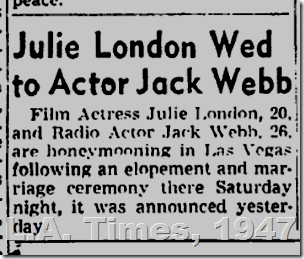
Note: This is an encore post from 2005 and originally appeared on the 1947project.
In the courthouse corridor, just after she received one of the biggest divorce settlements in Los Angeles history, someone asked her: “If you had your choice between half a million dollars and a happy home, which would you take?”
“A happy home.”
“With this husband?”
“I guess so.”
She walked to the elevator, looking unhappy.
Note: This is an encore post from 2006.
July 21, 1907
Los Angeles
President Theodore Roosevelt suggests “reading of certain books of pure fiction that have the prime quality of being interesting.”
Continue reading
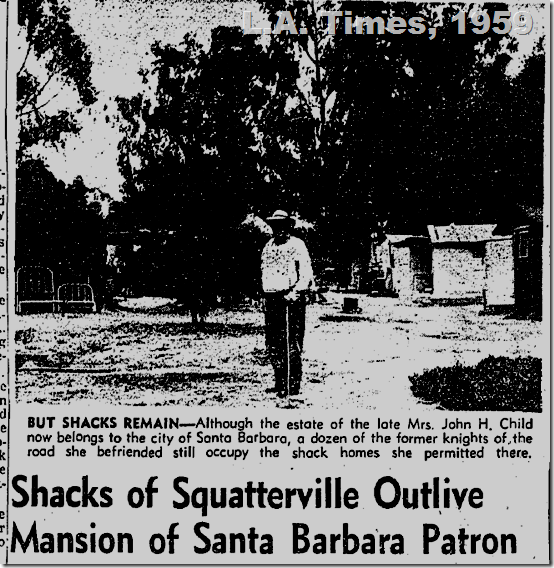
Note: This is an encore post from 2005 and originally appeared on the 1947project. This was a follow-up to a post by Kim Cooper.
Lillian Child died in 1951 at the age of 75, four years after setting up provisions for a hobo jungle nicknamed Childville at her 17-acre estate on East Cabrillo Boulevard. Two years later, the property was deeded to the city of Santa Barbara by the Santa Barbara Foundation, the original recipient.
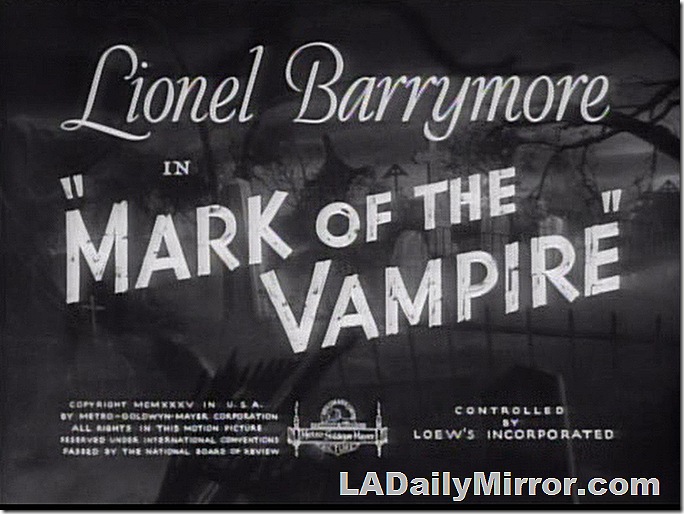
This week’s mystery movie was the 1935 MGM film Mark of the Vampire, with Lionel Barrymore, Elizabeth Allan, Bela Lugosi, Lionel Atwill, Jean Hersholt, Henry Wadsworth, Donald Meek, Jessie Ralph, Ivan Simpson, Franklyn Ardell, Leila Bennett, June Gittelson, Carol Borland, Holmes Herbert and Michael Visaroff. Continue reading
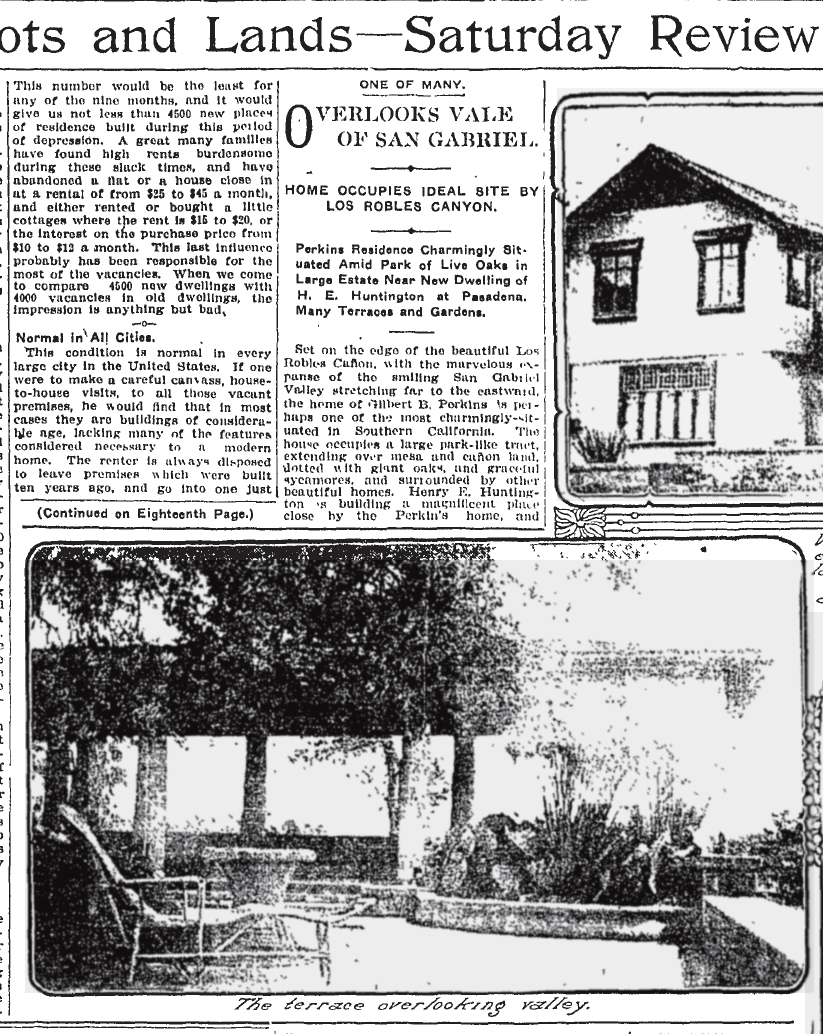 Above, details of the Gilbert B. Perkins home on Hillcrest in Pasadena.
 his was a fun little mystery, complicated by The Times using the wrong middle initial for Gilbert Perkins in the caption.
Perkins sold the home in 1914 to oil executive Frank W. Emery for a reported $125,000 ($2,591,561.05 USD 2007). After Emery died in 1920, the property at 1400 Hillcrest Ave. was sold to Mary Virginia McCormick, daughter of Cyrus H. McCormick, the head of International Harvester. (The Times originally identified her as his sister — ahem).

Note: This is an encore post from 2006.
July 19, 1907
Covina
Lavish preparations are underway for an enormous, free picnic to celebrate the opening of a Pacific Electric streetcar line to Los Angeles. “Covina had long awaited the approach of those shining iron bands that connect the pretty little valley town with the metropolis of the West, and is very happy,” The Times said.
E.H. Fabrick has created a gigantic coffeepot for the occasion, holding 250 gallons. “A large man looks like a pigmy beside this immense urn, fashioned for a race of giants,” The Times said. It’s accompanied by an equally enormous, 300-gallon bean pot patterned after an original (presumably normal size) pot in a Boston museum.
Continue reading

Note: This is an encore post from 2005 and originally appeared on the 1947project.
NANCY
BY ERNIE BUSHMILLER
Panel 1:
Exterior, Day. A city sidewalk. Nancy and Sluggo are carrying heavy packages on their shoulders.
NANCY: Wow… These packages are heavy
SLUGGO: Yep—but the man gives us a nickel for each one we deliver

Note: This is an encore post from 2006.
July 18, 1907
Santa Monica
Officials of Santa Monica and Ocean Park are fighting a lawsuit that seeks to block the discharge of raw sewage into the ocean. According to testimony, the outfall pipe sags so badly that it isn’t always cleared and as a result, sewage molders in the pipeline, a problem aggravated by warm summer temperatures.
Judge Bordwell, however, ruled that he was unable to render a specific decision because the case was improperly presented. Bordwell ordered Santa Monica and Ocean Park to find a way to ease the situation within 15 days.
Continue reading
Note: This is an encore post from 2005 and originally appeared on the 1947project.
By mid-July, Arnold Schoenberg was hard at work on a composition he had conceived several months earlier, when choreographer Corinne Chochem sent him details on a song for a potential commission.
Although the price was too high for Chochem, Schoenberg remained focused on the idea of a work of up to nine minutes for a speaker, orchestra and chorus, saying: “I plan to make it this scene—which you described—in the Warsaw ghetto, how the doomed Jews started singing before going to die.”

Note: This is an encore post from 2006.
July 17, 1907
Los Angeles
A serial arsonist has been at work in Hollywood, setting six fires in the last three weeks. The community’s small volunteer fire department has been overwhelmed by the crimes.
“The entire neighborhood rushed to the scene,” The Times said of one blaze in June. “The volunteer fire department hurried out their hose cart and laid a long line of hose, but the water pressure was not sufficient to send a stream that would reach the burning dwellings.”

Note: This is an encore post from 2005 and originally appeared on the 1947project.
Sojourn Over—James Brink and his wife and their nine children as they prepared to depart yesterday for their Oklahoma ranch after spending two and a half years here on as much as $278-a-month relief ($2,631.04 USD 2005). The county fixed up their car and is paying all expenses back to Oklahoma.
July 15, 1957
Los Angeles
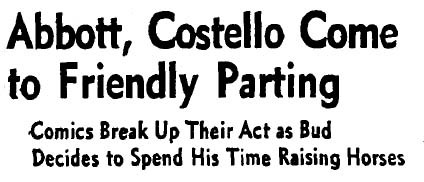
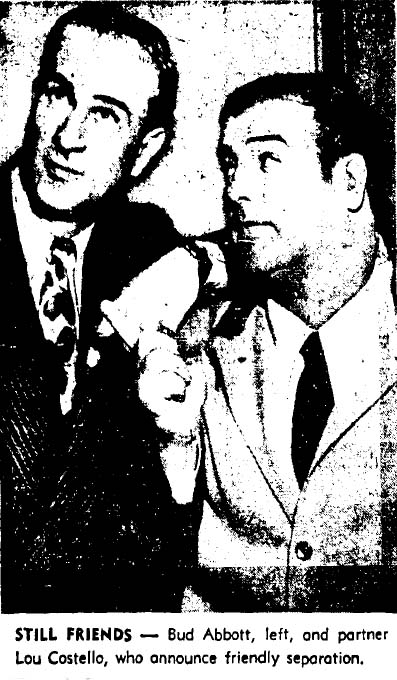 They had been through triumph and tragedy, and spent more time together than many married couples. But it was time for a change. The scripts were lousy and getting worse. One of them wanted to keep working and the other wanted to quit and raise thoroughbreds.
So Bud Abbott and Lou Costello split the act. Abbott, the straight man, was going to retire to his ranch in Ojai. Costello, the pudgy comedian, was going solo–he didn’t want to work with anyone else.
Soon it was Abbott vs. Costello in a $222,465 lawsuit over money from a TV contract, although the men apparently remained friends.
And in less than two years, Costello was gone. He was hospitalized after he collapsed in an apartment at 4222 Ethel Ave., where his family was living while a home was being built at 3322 Longridge Terrace, Van Nuys. At the time of his death, Costello had some TV dates on Steve Allen’s show and was to appear at the Dunes in Las Vegas. Continue reading

The Hollywoodland Sign, in a photo published in the Los Angeles Evening Herald, Dec. 8, 1923.
Note: This is an encore post from 2017.
Originally constructed as a publicity gimmick and branding symbol to help generate sales for a real estate development, the Hollywood Sign is now a worldwide icon just as powerful as Big Ben, the Eiffel Tower, and the Statue of Liberty, signifying a land of glamour and opportunity. Myths have always existed about it, from the date of its construction to how the city of Hollywood obtained it. After in-depth research by both historian Bruce Torrence and myself, we can conclusively say the sign was constructed in late November and early December 1923, and illuminated in that first week of December.
Like me, a California transplant involved in history, research, and writing since I was child, Torrence has always been fascinated by Hollywood history, perhaps because his two famous grandfathers contributed much to it. His paternal grandfather, Ernest Torrence, starred in many classic silent films such as “Steamboat Bill Jr.” and “Peter Pan” after a successful career as an opera singer. His maternal grandfather C. E. Toberman could be called the builder of Hollywood for his construction of so many iconic structures around Hollywood Boulevard. Bruce began a photo collection of Hollywood in 1972 with thirty photographs, which has blossomed into thousands. He employed these photos in writing one of Hollywood’s first detailed history books in 1979 called “Hollywood: The First 100 Years.”
Hollywood at Play: The Lives of the Stars Between Takes, by Stephen X. Sylvester, Mary Mallory and Donovan Brandt, goes on sale Feb. 1, 2017.
Reminder: The next Black Dahlia Book Club will be Tuesday, July 21, at 10 a.m. Pacific time on YouTube. In this session, I will discuss the Los Angeles County district attorney’s files in the Black Dahlia case.
For review: True Detective magazine, October 1948.
Email me your questions and I’ll answer them!


Note: This is an encore post from 2006.
July 14, 1907
Los Angeles
Led by the Rev. Juan Caballeria (or Cabelleria), the city is preparing to celebrate its 126th anniversary Aug. 2 with concerts, Mass in the Plaza church and cannon fire. The old artillery piece will be lit by Gen. Jose Aguilar, a former member of the Mexican army who battled the Americans and later joined Gen. John C. Fremont.

This week’s mystery movie was the 1933 Majestic Pictures film The Vampire Bat, with Lionel Atwill, Fay Wray, Melvyn Douglas, Maude Eburne, George E. Stone, Dwight Frye, Robert Frazer, Rita Carlisle, Lionel Belmore, William V. Mong, Stella Adams and Harrison Greene. Continue reading

Note: This is an encore post from 2005 and originally appeared on the 1947project.
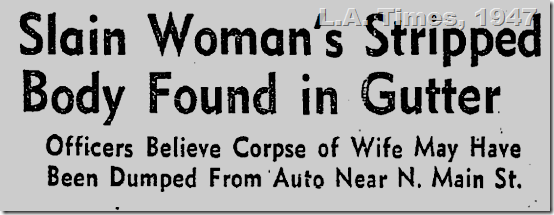
Here’s a perfect illustration of the difference between The Times and the Examiner, which has a completely different version of Antonio Mondragon’s actions on the night of the murder:
According to the Examiner, Mondragon told detectives he was awakened after midnight and served with divorce papers. He and his wife, Rosenda, who was drunk, argued until she left at 2:30 a.m.

