The Changing Face of the City

Jan. 17, 1907
Los Angeles

On a trip from Utah to visit his daughter, H.E. Gibson keeps getting lost as he wanders around Los Angeles. No, it’s not because Gibson is 80, for his mind is still sharp. It’s because he hasn’t been back since 1848 and things have changed just a bit.

Even the old familiar landmark of Ft. Hill is covered with homes, he says. About the only spot in town he recognizes is the Plaza, where he keeps returning to get his bearings.

Gibson came to California with the “Flash Emigrant Colony” to establish Mormon settlements. The group couldn’t raise the money to buy Rancho Cucamonga, so they bought a parcel of land in San Bernardino, The Times says.

Land was “dirt cheap” in 1848, with entire blocks selling for $500 to $1,000, ($9,910.34-$19,820.69 USD 2005), Gibson said. But instead of becoming a real estate speculator, he left for Utah to bring the news (published in a New York newspaper that came around the Horn) proclaiming that Brigham Young had been appointed governor of the Utah Territory.

Note: Today presented a difficult decision, but I passed on some incredibly offensive caricatures of an African American who had been arrested, accompanied by quotes in dialect: “Ah dunno nothin’ about no stolen chickens” indeed.

Lmharnisch.com
Lmharnisch.blogspot.com

E-mail: lmharnisch (AT) gmail.com

Posted in 1907, African Americans, Black Dahlia, Books and Authors, LAPD, Real Estate, Streetcars | Comments Off on The Changing Face of the City

Union Rescue Mission

Posted in Black Dahlia, Books and Authors, LAPD, Streetcars | Comments Off on Union Rescue Mission

Also on EBay


Jan. 16, 2007

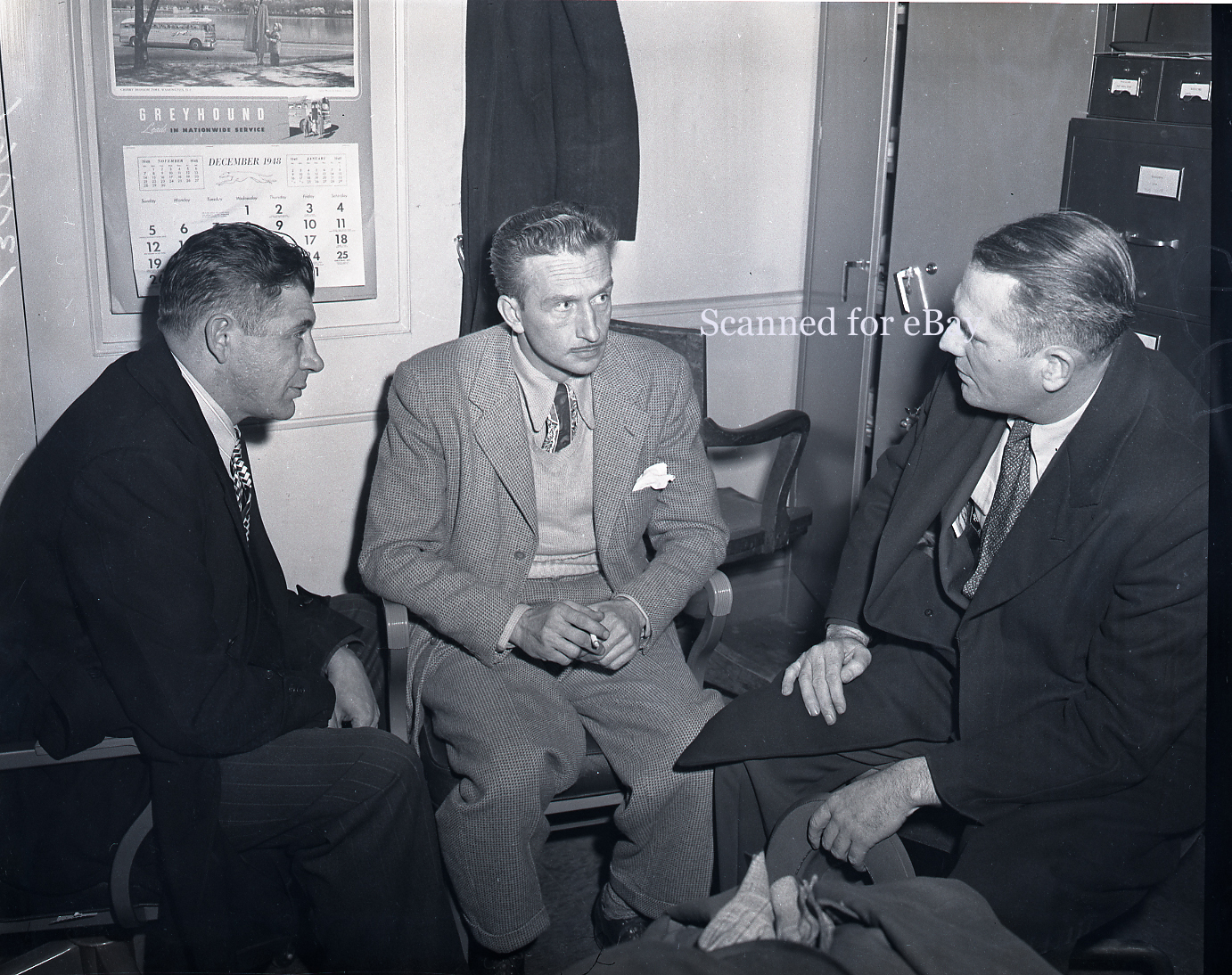
Sfxarchive is selling a 4- by 5-inch negative ostensibly from the Black Dahlia case. I don’t recognize any of these individuals, nor have I ever seen the image. It doesn’t show any of the main suspects, nor does it show the main detectives, Harry Hansen and Finis Brown.

I would say its importance is limited. Note that the seller’s date (January 1949) is contradicted by the calendar in the picture, which says December 1948.

The bottom line: I would not spend any serious money on this image.

Lmharnisch.com

Lmharnisch.blogspot.com

E-mail: lmharnisch (AT) gmail.com

Posted in 1947, Black Dahlia, Books and Authors, Cold Cases, Crime and Courts, Homicide, LAPD, Uncategorized | Tagged , , , | 2 Comments

Another EBay Mystery

Jan. 15, 2007

Los Angeles

While making my daily check of EBay, I found another envelope from 1907, this one addressed to A. Victor Segno, 701 N. Belmont.

A brief check of Proquest reveals—what’s this? A major scam artist, self-help author and wife-stealer.

A. Victor Segno turns out to be the operator of the American Institute of Mentalism. Here’s how it works: Members agree to send Segno $1 ($21.30 USD 2005) a month. In return he sends out a “success wave” twice a day.

According to Segno’s literature: “The vibrations which Prof. Segno is able to produce in people, through being in harmony with their mentalism, is often felt by them, though thousands of miles distant, as a sensation similar to a slight electric shock.”

And a testimonial: “When I commenced taking the treatments with your club I was full of doubts as to the effects, but as I was anxious to be successful and had little to lose and all to gain I continued to take them. I have been a member less than two months and the following are the results:

“At the time I joined the club I was sick, but compelled to work and for very small wages. Shortly after I began to feel better. On the 7th of this month my employer sold me his stock of goods on credit. By the 21st I had paid $100 on the cost of the stock and on the 24th I sold the stock for ($300 or $800) over the cost and reserved an interest in the business.

“You no doubt will be glad to learn that since joining your club I have improved in health, supported myself and little baby girl and made over $1,000, and risen from a servant to be a proprietor. I have also secured a position as traveling agent for a Chicago firm at a large salary. It is wonderful to me.”

Busy though he was sending out success waves, Segno was able to write two books: “How to Live 100 Years” and “How to Be Happy Though Married,” available from the institute for $3 each. Later works included “Personal Magnetism,” “The Law of Mentalism” and “How to Have Beautiful Hair.”

Apparently Segno did a thriving business because in a few years he was able to plan a large estate at Belmont and Kane, which was featured in The Times. The letter, addressed to 701 N. Belmont, was presumable sent to the institution on “Inspiration Point” over Echo Park, although I can’t locate it now.

In 1911, however, Segno left Los Angeles, ostensibly to set up a similar school in Russia. Shortly thereafter, his longtime personal secretary, Mrs. Irene Weitzel, a recently married woman whom he had employed since she was a young girl, vanished on an alleged trip to Chicago to visit her parents.

In response to reporters’ questions about whether Segno had run off with his secretary, his wife, Annie Dell Segno, replied: “It isn’t true, unless my husband has lost his senses.”

“An official of the school admitted that Mrs. Segno is greatly perturbed and admitted that there had been talk about Segno and the girl for some months,” The Times says. “She said that when such stories came to her ears she had hotly denied them because Segno’s teaching and life stood out in her mind as everything ideal.”

A. Victor Segno and “success waves” in action, from one of his books.

Divorce eventually followed as Segno set up an identical scheme in Berlin. He returned to the United States about 1915 as the clouds of World War I formed over Europe. Thereafter, Segno vanished from the news while his ex-wife was mentioned in a 1923 story because she had married Harry T. Robinson, apparently a member of a robbery gang.

Thanks, EBay!

Lmharnisch.com

Lmharnisch.blogspot.com

E-mail: lmharnisch (AT) gmail.com

Posted in 1907, 1908, 1911, Black Dahlia, Books and Authors, Education, Found on EBay, LAPD, Streetcars | Comments Off on Another EBay Mystery

At the Del

Posted in Black Dahlia, Books and Authors, LAPD, Streetcars | Comments Off on At the Del

In Cred I Ble

The sale of 1940s mug shots, including one of Elizabeth Short, sold Jan. 12, 2007, for $1,802.77 (more than $78 per picture) to phenomaly. Although EBay now conceals bidders’ identities, we can see that the next highest bid was $1,777.77. Obviously, people are willing to spend serious money for these mug shots.

Please understand, the Elizabeth Short mug shots were printed up in bulk during the investigation and handed out freely. The mug shot was also distributed by the wire services. Translation: There were many copies of this picture. Think carefully before getting into a bidding war over one of them. They turn upon EBay every couple of years.

Lmharnisch.com
Lmharnisch.blogspot.com

Posted in 1947, Black Dahlia, Books and Authors, Cold Cases, Crime and Courts, Homicide, LAPD, Uncategorized | Tagged , , , | 5 Comments

Not in My Back Yard


Jan. 13, 1907
Los Angeles

The Times takes a light, humorous look at the destructive wanderings of Eaton Wash: a docile stream, if not entirely dry, most of the year, turned into a churning monster by heavy rains.

“The little river that makes so much trouble lives somewhere in the fastness of Eaton’s Canyon during the summer months,” The Times says. “In the rainy season it always comes prowling out for a wild outing.


“Not having a respectable bed like other rivers, it comes bursting down from the mountains and goes wherever anyone will let it go.

“When the rains began this year, it stole trustfully—undiscouraged by its previous disappointments—down from the mountains.

“It sneaked on a pleasant-looking ranch in the valley. And the farmer found it there—as it covered about half his ranch—and rushed out with shovels and teams and turned it back on someone else’s ranch.

“And the ranchman who owns this second ranch on which it was driven came out in a rage and shook his fist, bellowing: ‘Here, come and take back your old river. It can’t stay on my place.’ And he said other things.”

The engineers of the Southern Pacific railroad built a massive culvert to protect the tracks from washing out. But another neighbor, Annie Adams, hired men to turn the fences on her 36-acre ranch into a barrier.

“The only way for the river to get on Miss Adams’ ranch was to jump the fence,” The Times says.

“Anyone familiar with the eccentricities [of the river] can guess readily enough what happened then,” The Times says. “That fine and elegant new culvert of the railroad company lasted about a minute.”

More men and teams of horses built a barrier of sandbags to stop the river. “It went. It rippled forlornly down the side of the high embanked track trying to find a hole through the sandbag dike—but nothing doing.

“Then it came to a long, hard, fascinating looking strip of road leading through the middle of the little town of Savannah. It turned down this road with a little gurgle of joy,” The Times says.

“And the things that it did to that county road is enough to make the county supervisors weep in anguish.

“It was a beautiful oiled road—smooth and flat and even. The river gouged out chuckholes as deep as a well. It made ruts in which you could drydock a ship. It ruined several hundred dollars’ worth of highway in less time than it takes to write it.”

Lawsuits followed and a committee was appointed to pick a course for the river. But none of the ranchers wanted the river on his property.

“In the end, the court will undoubtedly select a straight, direct route, with the proper angle and fall and slope from the canyon to the river, and order a right of way condemned—let it cross whose ranch it may,” The Times says.

Bonus factoid: The story uses the phrase “No. 23 skiddoo,” which I’ve always associated with the 1920s. Apparently the anonymous writer was ahead of his time.

Lmharnisch.com

Lmharnisch.blogspot.com

E-mail: lmharnisch (AT) gmail.com

Posted in 1907, Black Dahlia, Books and Authors, Crime and Courts, LAPD, Streetcars | Comments Off on Not in My Back Yard

Last Rites for an EarlyChurch


Jan. 12, 1907
El Monte

For half a century, the Baptist Church of El Monte and the Mason’s Lexington Lodge No. 104 shared a clapboard building on Main Street, the worshipers on the first floor and the Masons, as always, on the second.

Then came the developers and the urge to grow.

“Seized with the thrill of the new trolley boom, the lodge members are about to put up a new Masonic temple; the Baptists, who have shared quarters with the Masons of El Monte for more than 50 years, are also said to be ambitious for a new place,” The Times says.

Taking the original name of the settlement, the Masons founded Lexington Lodge in May 1853, making it one of the oldest in California, and sent for regalia that came around the Horn from the East. One of the early lodge members, Elkenna Parrish, can still be seen driving his buggy around El Monte, The Times says.


The Baptists, meanwhile, built the first Baptist church south of the Tehachapi, using ox teams to haul lumber from San Bernardino. The Rev. J.C. Freyer arrived after a six-month journey from Alabama and was the first Baptist minister ordained in Southern California, The Times says.

The Baptists had outgrown the structure, built in 1866, and wanted a new church, but the Masons refused to yield their half, so they purchased the building in 1906 in an attempt to save it. By the next year, however, they agreed to let the small, old building come down.

Lmharnisch.com

Lmharnisch.blogspot.com

E-mail: lmharnisch (AT) gmail.com

Posted in 1907, Black Dahlia, Books and Authors, LAPD, Streetcars | Comments Off on Last Rites for an EarlyChurch

On the Frontiers of Medicine

Jan. 11, 1907
Los Angeles

A woman living on a hog ranch near the Santa Fe railroad crossing over the Los Angeles River contacted police after seeing dismembered human bodies in the old dumping ground near George Street.

Investigators dug through the dump, retrieving the body of a child that was nearly intact, along with bits and pieces of a man and a woman, including their skulls. In addition to the remains, police found books and papers traced to the University of Southern California Medical School.

“Whoever is responsible for the depositing of the remains on the garbage heap should be severely censured,” Coroner Roy S. Lanterman told The Times.

“It seems quite heartless enough to give up the human body to further science but when the students have finished dissecting the remains they should see that they are interred with the proper respect. I cannot understand the action of those responsible for sending the bodies to the garbage heap.”

For further reading on the sorry state of medical schools at the turn of the 20th century, read Abraham Flexner’s “Medical Education in the U.S. and Canada.” Note that in this era, doctors didn’t even need to be high school graduates.

Lmharnisch.com

Lmharnisch.blogspot.com

E-mail: lmharnisch (AT) gmail.com

Posted in 1907, Black Dahlia, Books and Authors, Education, LAPD, Streetcars | Comments Off on On the Frontiers of Medicine

The Floods


Jan. 9-10, 1907

The worst storm in 23 years blew across Southern California with the force of a gale, dumping more than an inch of rain in Pasadena, killing an Orange County rancher, washing out railroad tracks and collapsing tunnels, and leaving nearly every small ship in Santa Barbara sunk, driven ashore or pounded to pieces.

Floodwaters destroyed a railroad bridge under construction near Ventura, cutting off the Southern Pacific’s coastal rail service, and at Summerland, oil rigs along the shore were ripped to pieces. The San Fernando Valley was especially hard hit: The Times reports that a bridge over the Big Tujunga Wash was underwater and that the river was a mile wide and impassible. The roar of water at Pacoima can be heard two miles away, The Times says.

The Arroyo Seco tore out a railroad line and threw freight cars as if they were toys, carrying a torrent of trash and broken trees down from the mountains through Pasadena.

South of downtown, the Los Angeles River was at flood stage and threatening to destroy the 7th Street Bridge, where pedestrians were warned that they crossed at their own risk.

Many avenues were flooded from curb to curb and churning water threw aside heavy iron manhole covers and flowed from the storm sewers, turning streets (paved and unpaved) into rivers. Streetcars plying the flooded boulevards looked like ships sailing in canals and gallant conductors carried female passengers through the water to the curb.

A 75-year-old Santa Ana rancher was killed when the buggy in which he and his brother were riding was washed away as they tried to trying to cross Santiago Creek. The horse panicked in the raging flood and the buggy overturned. Ralph Williams, who was visiting from the East, was able to grab a willow branch and save himself, but his brother Charles was carried downstream, where his body was eventually found.

“The fording of torrents on the hill streets has seemed fraught with peril,” The Times says, “but the thousands of hardy adventurers, who have braved the currents all live to tell the tale. None has been swept away to a watery death in the many deep lakes which were formed about the city.”

Lmharnisch.com
Lmharnisch.blogspot.com

E-mail: lmharnisch (AT) gmail.com

Posted in 1907, Black Dahlia, Books and Authors, Downtown, LAPD, Pasadena, San Fernando Valley, Streetcars, Transportation | Comments Off on The Floods

The Biltmore, Jan. 9, 2007


Posted in Uncategorized | 1 Comment

A Cold Dose of Reality


Jan. 8, 1907
Los Angeles

Perhaps Mayor Arthur C. Harper and the incoming slate of officials are focused on how they will divide the spoils of the city and assign patronage jobs, although the mayor says the “last seat at the pie counter” was taken days ago.

The average Angeleno is more worried about getting even a bit of coal for the furnace. Conditions in Pasadena have been so dire that people are going to the coal yards with wheelbarrows in hopes of getting enough to scrape by. The Times notes that throughout the city, people are rummaging through attics and basements looking for anything that might be burned for a little heat.

Today, an anonymous writer provides a humorous look at trying to get some coal.

“I am a prominent citizen of Los Angeles,” he says. “I state the bald fact because my book of press notices has gone. We threw it into the dying stove immediately following the burning of the family photograph album. Unless we get fuel today, the baby’s cradle follows the book of press notices.”

“We breakfasted in furs. We had cold milk and doctor somebody’s breakfast food, which latter is a poor substitute for sofa stuffing.”

Coal was apparently being rationed in Los Angeles, five sacks to a customer, and the buyers had to go down to the coal yard and get it themselves. “Sixty cents a sack and 5 cents apiece for the sacks, and you do your delivering. Best we can do,” says a clerk.

In the rain, the writer says, he found an express man willing to get the coal and bring it to the house. Normally, the deliveryman might charge $1 ($20.52 USD 2005) for a four-hour job, but now he wanted 75 cents an hour.

“I gave him the money to buy the coal and saw him disappear in the drizzle,” the writer says. “I hurried off home as fast as I could to revive the flagging spirits of my family….

“In just a little while, I told them, we would be sitting by the side of a cheery, crackling blaze.”

Hour after hour, and no coal.

Finally the deliveryman arrived. With an empty wagon.

“Say mister,” he said. “Honest I didn’t have the nerve to stay there any longer and use up your money. You won’t never get no coal.”

“No coal,” I echoed.

“Sure not. When I went down there I found nearly 30 wagons lined up there at the yard waiting to get coal. And the fellows shoveling it out weren’t in any hurry, either. When I came away, there were at least 30 or 40 more wagons waiting behind me. The coal yard looked like a country fair.

“I waited four hours and I didn’t seem much nearer the coal than when I started. I thought you might need a little of your money yourself. So I gave it up and came back.”

The writer concludes: “I have paid $3; I have wasted a day telephoning to people who laughed at me. I have probably sacrificed my immortal soul.

“But I haven’t got any coal.”

The precise reasons for the “coal famine” would take a bit too long to track down for today’s post. From late 1906 to early 1907, The Times is full of stories about coal shortages throughout the U.S., complicated by allegations of price fixing, trusts, trade restriction and diversion of coal shipments to other cities, such as San Francisco, that were also out of fuel.

One news story sums it up nicely: “Has the coal famine become widespread? Listen to an old-timer on the market: ‘The only place that hasn’t complained for the lack of coal is hell.’ ”

Lmharnisch.com

Lmharnisch.blogspot.com

e-mail: lmharnisch (AT) gmail.com

Posted in 1907, Black Dahlia, Books and Authors, Food and Drink, LAPD, Pasadena, Photography, Streetcars | Comments Off on A Cold Dose of Reality

TLC


Jan. 7, 1907
Long Beach

Elizabeth Mahler, a dainty brunette with a “sunny and jolly disposition,” is one of the bright spots at Long Beach Hospital. She had many male suitors and a few a months ago became engaged to a young man from Rialto whose last name was Kingman.

In tending to the afflicted of Long Beach, however, she became well-acquainted with Lynn E. Babcock, the business partner of one of her patients, Jay Cooke.

Although Mahler was already engaged, Babcock courted her ardently, provoking jealousy from her fiance. On Christmas, both men presented her with gifts and Kingman (who is not otherwise identified) insisted that she reject Babcock’s gift.

Mahler refused and the engagement was broken.

“This was Babcock’s opportunity and he was quick to ask Miss Mahler to become his wife, and was made happy by an acceptance. Miss Mahler sent in her resignation to the hospital and is now busy with her dressmaker preparing her trousseau,” The Times says.

Some might end the story here with a rosy, romantic fadeout, but let’s check with Proquest. Oh my. The record is incomplete, but messy.


Nine years later, there’s a nasty pair of divorce cases working their way through the Long Beach courts. Mrs. Fannie Wildrig accuses her husband, Henry, of extreme cruelty stemming from his infatuation with Mrs. Elizabeth Babcock. Mrs. Babcock, in the meantime, is accusing her husband, Lynn, of cruelty.

Here, The Times becomes a bit enigmatic: “Justice Underwood of Long Beach was a witness in Mrs. Wildrig’s suit and testified to the arrest of Mr. Wildrig in the Babcock case. He said the charge of misconduct was dismissed for the sake of the children of the couple.”

The Times notes that the court battle between the Babcocks will constitute an effort by Elizabeth “to clear her name of the imputation cast on it.”

Unfortunately, no further entries can be found. Such are the rewards and frustrations of research.

Lmharnisch.com

Lmharnisch.blogspot.com

e-mail: lmharnisch (AT) gmail.com

Posted in 1907, Black Dahlia, Books and Authors, Crime and Courts, LAPD, Religion, Streetcars | Comments Off on TLC

Architectural Ramblings

A Trip to Oxford Avenue

Here’s an interesting contrast: Oxford Avenue between Washington Boulevard and the Santa Monica Freeway and Oxford Avenue north of Washington. South of Washington, Oxford seems a bit wider and the land between the curb and the sidewalk is fairly generous. Not so north of Washington and the lots seem a bit smaller. Wide strips of land between the curb and the sidewalk (more than the 5 feet that is common in much of Los Angeles) were one of the points urged by Charles Mulford Robinson in his “city beautiful” proposal.

Bonus fact: Robinson also said Angelenos should plant lots of jacaranda trees along the streets, so you can thank him for all those purple blooms.

First of all, here’s our featured house at 2045 S. Oxford Ave. from 1907. Note the stucco.


And here are some of the neighboring homes:

Note: More stucco!


All things considered, I’d have to say this stretch of Oxford is a one of the more interesting areas that I’ve visited. The neighborhood is mostly intact and there’s a 1920s-style church at the end of the block next to the Santa Monica.

Now for one of the homes in the 1700 block of Oxford Avenue, which is a little funkier. Recall that the precise address listed in The Times couldn’t be located.

And for the vehicle of the week, here’s a stretch limo I saw at the Los Angeles County Arboretum in Arcadia:


lmharnisch.com
lmharnisch.blogspot.com
e-mail: lmharnisch (AT) gmail.com

Posted in 1907, Architecture, Black Dahlia, Books and Authors, Freeways, LAPD, Streetcars | Comments Off on Architectural Ramblings

Engine Co. 10 Weeps


Jan. 6, 1907
Los Angeles

The Los Angeles Fireman’s Relief Association is staging a benefit for the young widow of ladderman Adolph Hermansen, who plunged out a window and fell five stories while fighting a spectacular blaze that destroyed the new Cohn and Goldwater Building at 216 S. Los Angeles St.

According to some accounts, Hermansen was struck by a blast of water from a fire hose that knocked him out the window, while others say he stumbled or was knocked backward while moving a hose. He fell to the street and although he wasn’t killed, doctors said he was paralyzed below the waist and had a 1 in 100 chance of survival.

Hermansen lingered for about a day, with his new bride “waiting for the dying man’s last word,” as fellow firefighters from Engine Co. 10 visited his hospital room, The Times says.

“The accident is one of the saddest in the history of the Los Angeles Fire Department,” The Times says. “Hermansen was much esteemed by his superiors. He was relief driver of Engine Co. 10, as well as ladderman.”


Each fire company sent two men in uniform to accompany his casket, which was escorted by every man from Engine Co. 10. There were so many flowers at his funeral that two wagons were needed to carry them all to the cemetery.

Placed on Hermansen’s casket was a floral reproduction of Fire Alarm Box 39, “in answer to whose call Hermansen had met his death,” The Times says.

Cohn and Goldwater announced that they would rebuild the destroyed structure.


Lmharnisch.com

Lmharnisch.blogspot.com

e-mail: lmharnisch (AT) gmail.com

Posted in 1907, Black Dahlia, Books and Authors, LAPD, Streetcars | Comments Off on Engine Co. 10 Weeps

Speaking of City Hall

Here’s one of my favorite views of Los Angeles: City Hall at night with the Lindbergh Beacon.
Posted in Black Dahlia, Books and Authors, City Hall, LAPD, Streetcars | Comments Off on Speaking of City Hall

A Fatal Can of Beans

Jan. 5, 1907
Los Angeles

Charles Edward Abbott, 23, of Artesia had lived his entire life in California without seeing snow except on faraway mountains and suggested that Mabel Carter, 28, and her father, Henry, 63, join him on a trip to Cucamonga Canyon.

The Carters, who once owned a grocery story at 10th Street and Alvarado before moving to Ontario, and Abbott went to Cucamonga, expecting to spend several days there.

During their stay, they ate a can of pork and beans that had been purchased in September and stored with other provisions in a commissary box under an orange tree in the yard outside the cabin.

Henry Carter was the first to fall ill. Assuming some other cause, he encouraged his daughter and Abbott to take a hike while he stayed behind. They were too ill to go far, however, and returned to the cabin, where they ate another can of pork and beans.

The three victims returned to the Carter home in Ontario. Mabel Carter was the first to die, tended by Abbott, who was next, followed by Henry Carter.

Four physicians attending the victims were unable to explain what killed them. “The case has different features than any they have yet dealt with,” The Times says. The victims complained of “double vision, numbness of the limbs and a paralysis of the tongue. A few hours before death the eyelids closed and it was impossible for them to open them. None of the three experienced any pain and the case throughout is most puzzling.”


A triple funeral was held at First Methodist Church of Ontario. The Carters were buried at Bellevue Cemetery in Ontario while Abbott was buried in Artesia.

Lmharnisch.com

Lmharnisch.blogspot.com

e-mail: lmharnisch (AT) gmail.com

Posted in 1907, Black Dahlia, Books and Authors, LAPD, Streetcars | Comments Off on A Fatal Can of Beans

The Mayor Departs From His Prepared Remarks

Jan. 4, 1907
Los Angeles

Mayor-elect Arthur C. Harper stood before 200 members of the Municipal League and their friends in a dinner at Levy’s who were eager to hear what he planned for his incoming administration.

Harper took his typewritten speech from his pocket, showed it to the crowd, and laid it aside. Harper said he changed his mind “and would wait a little longer before telling the public exactly what he intended to do,” The Times says.

In brief comments, Harper promised to look at every department in city government and said he had complete faith in the Owens River project.

Niles Pease, the incoming president of the City Council, was likewise evasive. “He said that he could not tell what the council would do and he doubted if anyone in the world could predict that body’s actions,” The Times says. “He declared that good men had been elected and prophesied a careful, businesslike administration.”

The star of the evening was William Mulholland, the moving force behind the Los Angeles Aqueduct, who received a five-minute standing ovation.

J.A. Anderson, head of the Board of Public Works, pleaded for unity among the branches of government, while City Auditor W.C. Mushet urged the council to study accounting systems of other cities and adopt one of them to ensure better financial reporting.

“He said that he had found in a slight examination of the books of the city that practically nothing except a daily cash book had been kept as a record of the business done. He explained that there were no arrangements for accounting for liabilities or assets of the city and that the expenditure of $100,000 ($2,052,357.03 USD 2005) for any one purpose would appear only as a disbursement with no other record kept of the sum.”

It turns out that Mayor Harper indeed has plans, but they involve kickbacks from one of the local heads of the underworld involving profits from a bordello in the Tenderloin.

Above, City Hall on Broadway, located on what is now the vacant lot next to the Victor Clothing Building, which was originally built as a City Hall annex.


Lmharnisch.com

Lmharnisch.blogspot.com

e-mail: lmharnisch (AT) gmail.com

Posted in 1907, Black Dahlia, Books and Authors, City Hall, LAPD, Streetcars | Comments Off on The Mayor Departs From His Prepared Remarks

For Sale on EBay


“escalante_sandy” is offering an original mug shot of Elizabeth Short, with bidding starting at $50. The seller says this mug shot, among a lot of 23 photos, belonged to a retired detective and is not a reproduction, a claim that appears true.

The most interesting thing about this copy of the mug shot (which was printed up in bulk and handed out freely during the investigation) is what’s written on the back. It’s obvious that the detective was assigned to sweep the neighborhood around the Biltmore in an unsuccessful attempt to see if anyone noticed her.

Note the inscriptions: “Hill St. 2nd to 8th St. W. to Fig. Hotels + Bars” Translation: Visit the hotels and bars between Hill Street and Figueroa from 2nd Street to 8th Street. Apparently the police were checking a period between 4 p.m. on Jan. 9, although Red Manley said he dropped her off at the Biltmore a few hours later, until daylight Jan. 15, the day the body was found.

I don’t recognize any of the other pictures, but one is identified on the back as underworld figure Nick Licata.

Lmharnisch.com

Lmharnisch.blogspot.com

e-mail: lmharnisch (AT) gmail.com

Posted in 1947, Black Dahlia, Books and Authors, Cold Cases, Crime and Courts, Homicide, LAPD, Uncategorized | Tagged , , , | Comments Off on For Sale on EBay

Some Nice Boring Statistics

Jan. 2, 1907
Los Angeles

Some diligent soul at The Times dug through the number of marriage licenses and divorces and put together a small story that traced the city’s growth through the increase in couples that joined or separated. This is the kind of information you could never find if you were looking for it; only through happenstance can you discover this data.

So here we go:

Year

Marriages

Divorces

1906

4,714

719, 13 annulments

1905

3,841

567

1904

3,283

557, 10 annulments

1903

3,005

473, 7 annulments

1902

2,351

386

1901

1,917

1900

1,503

1899

1,505?

1898

1,381?

1897

1,432

1896

1,405

1895

illegible

1894

1,251

1893

1,201

1892

1,023

1891

1890

1,182

1889

576

Apparently Los Angeles did not have a thriving reputation as an early day Reno. Divorces were only granted to those who had lived here for a year. The Times writer notes a difference between a final decree and an interlocutory decree: Those with a final decree could remarry while those with an interlocutory decree had to wait a year. For 1906, the figures were 719 interlocutory decrees and 542 final decrees.

The Times also notes that given the Episcopal Church’s tight restrictions on performing marriages of divorcees, the number of ceremonies by justices of the peace has increased markedly.

As regular blog readers will recall, getting a divorce in 1907 could be quite a challenge.

Lmharnisch.com
Lmharnisch.blogspot.com

e-mail: lmharnisch (AT) gmail.com

Posted in 1907, Black Dahlia, Books and Authors, City Hall, LAPD, Streetcars | Comments Off on Some Nice Boring Statistics