
March 8, 1907
Los Angeles
 lmharnisch.com
lmharnisch.blogspot.com
E-mail: lmharnisch (AT) gmail.com


March 7, 1907
Los Angeles
A dreadful disease called acute glanders has been discovered in a horse and veterinarian R.J. Ramage ordered that the animal be destroyed immediately.
In addition to rapidly causing death, acute glanders can be spread from horses to humans and there is no known cure, at least in 1907. Apparently several men in Los Angeles County died of acute glanders in 1893.
Since glanders is often found in horses’ nasal passages, local veterinarians want to ban wooden water troughs from city streets, saying that they are a breeding ground for the disease.
In 1911, Pasadena authorities ordered that 14 horses owned by the Pasadena Ice Co. be shot to death because they had the disease. The county veterinarian also quarantined a stable occupied by a dozen horses and “a number of Chinese” after detecting acute glanders.
“The disease is so infectious that it can be contracted by a horse sneezing in one’s eye,” said county Veterinarian W.B. Rowland.
In 1909, Ramage, of 831 S. Los Angeles St., went on a violent rampage at the Alpine Tavern on Mt. Lowe and it took 11 men to get him under control.
“At the tavern, the man created notice by talking continually to himself and created a disturbance by falling on his knees in the ashes of the fireplace; bowing his head down almost to the embers and offering violent words of prayer,” The Times says.
“Two physicians, formerly of the Southern California Hospital for the Insane at Patton, happened to be present and, taking ropes which were brought, demonstrated that they knew how to handle a crazy man.”
After being taken to Pasadena, Ramage was put in a car for the ride to the county hospital. “All the way to Los Angeles, the unfortunate man screamed and struggled, endeavoring to throw himself from the swiftly moving machine,” The Times says.
Eventually, Ramage recovered and told hospital attendants that he had suffering from mania for years. “He had only a dim recollection of the trouble he went through there.”
Lmharnisch.com
Lmharnisch.blogspot.com
E-mail: lmharnisch (AT) gmail.com


March 6, 2007
San Francisco (VIA Associated Press)
The Irish of San Francisco are furious over a play at the Davis Theater called “The Belle of Avenue A,” which features a character named Mrs. McCluskey who drinks a glass of beer in the first act.
“Three times, about 40 people charged the stage and the actors and actresses feared they were about to be attacked,” The Times says.
“Indignant because the woman’s part in the first act called for the drinking of a glass of beer, two score men, members of the Irish societies of this city, charged the stage and for half an hour refused to allow the play to go on.”
The riot was reported to the police and the protesters were eventually thrown out of the theater.
Lmharnisch.com
Lmharnisch.blogspot.com
E-mail: lmharnisch (AT) gmail.com
Bonus shot:

Los Angeles, before the days of Google Earth, at the junction of Main Street, Spring Street and 9th Street, 1873.


March 5, 1907
Los Angeles
What shall we do with Emma? She’s gone off to New Mexico and married a Chinaman. Her horrified mother hopes to get the marriage annulled, but Emma is an independent-minded young lady.
Emma’s mother, Mary Culver of Monrovia, says she will do everything she can to undo her daughter’s marriage to Frank Chew, which The Times describes as “a sort of missionary revivalist,” noting that “Miss Emma had longings to help the heathen herself.”
Chew asked Culver for permission to marry Emma, but “it was bluntly refused,” The Times says. “Emma had a mind of her own and her answer was ‘yes,’ regardless of her mother’s wishes.”
Even worse, Chew could be an illegal immigrant and if he’s deported, Emma says she will be willing to go to China with him. She made this vow, even though she was warned that Chew would sell her into white slavery as soon as he got her to China.
Emma isn’t the only one in trouble. Members of the Chinese Baptist Mission are equally furious, saying that Chew borrowed jewelry from members of the congregation under the pretense of defending himself against deportation when in fact he used the money for his elopement.
In August 1907, Emma sent a letter from Hong Kong to her family, saying that their fears were baseless and that she and her husband had opened a day school where they taught English.
The next year, Emma mailed a photograph of her students and tried to recruit more women to come to China.
“With her husband, Frank Chew, she has established an English school which is attended by the sons of well-to-do, educated Chinese gentlemen. The Chews have prospered beyond their wildest dreams,” The Times says.
“Every family in Hong Kong seems anxious to have its children learn English and the pupils themselves study the language eagerly.”
Lmharnisch.com
Lmharnisch.blogspot.com
E-mail: lmharnsich (AT) gmail.com


March 3, 1907
Los Angeles
Stroll into the Los Angeles Public Library on Central Avenue with me for a moment, over to the children’s section. The librarian says there are about 15,000 to 16,000 books, only half of what is needed, because about third of them are checked out every month.
The most popular titles are “Little Women,” “Little Men” and “Old-Fashioned Girl,” The Times says. Although the library has 25 copies of each book, it’s rare to find them on the shelves.
Among boys, Civil War stories are the most popular, “the Henty books, Barbour’s athletic tales, ‘Tom Sawyer’ and Dunn’s Young Kentuckian series of which there are a dozen copies each in stock,” The Times says.
“The children delight to search through the card catalogue and select their books,” The Times says. “It is interesting to watch the youngsters as they stand, pad and pencil in hand, and with a grownup air of importance, write down the names of the books they want.”
The story describes several young library patrons, but this is the one that stays with me:
“One of the constant patrons of the juvenile department is a tall, pale-faced lad who walks on crutches. A cruel accident so injured him that he is unable to attend school, but he has found an excellent substitute in the serious study of electricity at the library.
“He greedily devours everything he can lay his hands on about electricity. Day after day this delicate, white-faced boy pores over the books. He talks intelligently about induction coils, ohms, volts and motors.
“ ‘I intend to be an electric engineer,’ he declares as he limps away on his crutches. And the chances are that he will be.”
Lmharnisch.com
Lmharnisch.blogspot.com
E-mail: lmharnisch (AT) gmail.com

March 2, 1907
Los Angeles
March 1, 1907
Los Angeles
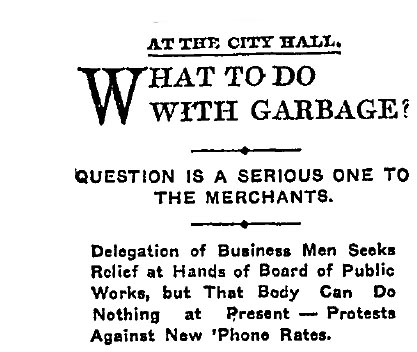
Downtown businessmen are at a complete loss over what to do with the garbage from their operations and want the city to either take it or designate a dump they can use.
“They declare that the Board of Health has refused to let further deposits of garbage or refuse be made at the old dumping ground to the southeast of the city and state that if the city does not come forward with a proposition to locate a new dump, or to cremate the stuff, they will be helpless to get rid of the accumulations of each day’s business,” The Times says.
City officials say they don’t know what to do because the local sanitation system is strictly for residential use. The Times says that local ordinances define garbage as “animal and vegetable refuse from the kitchens.” As a result, officials feel no need to deal with commercial waste, although they concede it is a problem.
“We can scarcely take care of the garbage we are now forced to collect, one Board of Public Works commissioner says. “We don’t want to take care of any more of it, even if it is hauled to the crematory without cost to the city.”
Lmharnisch.com
Lmharnisch.blogspot.com
E-mail: lmharnisch (AT) gmail.com


Feb. 28, 1907
Los Angeles

An old and massive California live oak used to mark the division between three Spanish land grants lies in pieces on the ground because an Edison foreman refused to run a transmission line around it.
“The tree was a full hundred feet in its spread,” The Times says,” and stood on the end of a little plateau, all alone in its greatness. The massive trunk could not be circled by three men stretching their arms and touching their fingertips—hardly by four men. Above, it split into four great branches that spread out and out and then again downward, containing with an evergreen shield a refuge where two full companies of soldiers might have bivouacked in comfort.”
The live oak marks the junction of the San Rafael, Los Feliz and Providencia land grants, The Times says, adding: “The tree itself stands within the Providencia but it was a starting point from which direction was taken.”
“The foreman is said to be in grave danger of losing his position and is very repentant,” the paper says. “He bawled like a spanked bad boy before the board (note: the property was owned by the Water Board, which had given Edison permission to run the line). However the great old tree is lying among a smother of chips and there is no way to replace the work of nature’s 300 years.”
Bonus fact: The San Rafael, Providencia and San Rafael land grants touched at a point in Burbank that is circled by the on-ramp for the southbound Golden State Freeway at the westbound lanes of Burbank Boulevard.
Lmharnisch.com
Lmharnisch.blogspot.com
E-mail: lmharnisch (AT) gmail.com


Feb. 27, 1907
Los Angeles

A thick cloud of smoke from a raging fire in the basement swept through the Germain building on South Spring Street at lunch hour, engulfing businessmen and office workers. In a fraction of a second, the building’s occupants were transformed from powerful executives conducting elaborate stock deals into blind and struggling humans groping on their knees through the hallways to save their lives.
There were many daring rescues and examples of selfless sacrifice. One man was saved as he was about to commit suicide rather than die in the fire. Firefighters battled the blaze until they were at the point of collapse, left to revive themselves and then returned. The only fatality was Emma Stewart, a secretary who died because she turned back from her flight to telephone her employer about the fire.
Her last words were: “Mr. Germain, there is a fire in the basement. Come quickly.”
Reporter E.O. Sawyer dragged her to safety after finding her next to the telephone, the receiver hanging loose from its hook. Doctors spent an hour trying to revive her but she never regained consciousness.
Lmharnisch.com
Lmharnisch.blogspot.com
E-mail: lmharnisch (AT) gmail.com


Feb. 14-26, 1907
Los Angeles
The Rev. Ervin S. Chapman, a Presbyterian minister who heads the Anti-Saloon League of California, has won a victory through an address that persuaded an Indiana judge to rule that saloons are unconstitutional.
Chapman concluded his series of points by saying:
Our national Supreme Court, in decisions which it has rendered, has designated the liquor traffic as mala in se by characterizing it as
Harmful to material prosperity.
Injurious to life.
Destructive of manhood.
Disastrous to peace and happiness.
Fatal to morals and.
Productive of crime and misery.
That court having thus characterized the liquor traffic will surely declare that traffic mala in se and hence unlawful and incapable of being granted legislative standing or protection by any branch of civil government either national or local.
Whenever the public mind has become sufficiently enlightened and the public conscience sufficiently quickened to justify and make effective such a decision our national Supreme Court, which has always led public sentiment respecting this question, will place its brand of outlawry upon that traffic which McKinley characterized “as the most degrading and ruinous of all human pursuits.”
Los Angeles saloonkeepers shrugged their shoulders and said they believed the ruling would have no effect on them.
The Times quoted one bartender: “ ‘Stop saloons unt drinking!’ one barkeeper screamed in astonishment. ‘Go vay. You might as well try to stop kissing.’ ”
Chapman died in 1921, two years after the passage of the Volstead Act.
Lmharnisch.com
Lmharnisch.blogspot.com
E-mail: lmharnisch (AT) gmail.com


Feb. 24, 2007
Eagle Rock
The Eagle Rock Bank, with aluminum windows and stucco, and braced with threaded rods. Here’s to you, Samuel Tilden Norton….

Feb. 24, 1907
Eagle Rock
Architect Samuel Tilden Norton has designed a bank building for Townsend Avenue and Colorado Boulevard in Eagle Rock, The Times says.
Just to make research interesting, The Times misspelled his name as S. Tilton Norton. According to his 1959 obituary, his mother was the first Jewish child born in Los Angeles. After studying architecture in Los Angeles and New York, he designed the Wilshire Fox Building and Sinai Temple.
He was a board member of Temple B’nai Brith during its move from Hope and 9th Street to Wilshire and Hobart and was an honorary consultant on plans for the temple, which was designed by A.W. Edelman.
Norton was lifelong friends with Rabbi Edgar F. Magnin, who presided over the funeral. Norton was a member of many professional, religious and social organizations, including Hillcrest Country Club, Nathan Strauss Israel Society, Jewish Federation, the Friends of the Hebrew University and the Zionist Organization of America.
Lmharnisch.com
Lmharnisch.blogspot.com
E-mail: lmharnisch (AT) gmail.com


Feb. 23, 1907
Los Angeles
The Scotch Thistles beat the English Victorias 3-2 in Southern California’s first soccer game since the Caledonians and the Pasadena team met at Agricultural Park in 1890, The Times says.
Despite the poor condition of the field, the players displayed excellent skill and teamwork. The Times said the teams were only formed three month before and notes that more teams were expected next year.

“As a good, healthful sport, requiring both athletic training and skill, ‘soccer’ seems to have a place to fill here as elsewhere. Apparently, however, it is even less qualified than rugby to take the place of American football,” The Times says.
Lmharnisch.com
Lmharnisch.blogspot.com
E-mail: lmharnisch (AT) gmail.com


Feb. 22, 1907
Los Angeles
Here’s how The Times weather stories read a century ago:
“For all the daylight hours yesterday, the rain drizzled down, much of the time like a heavy Scotch mist, but toward nightfall the storm deepened and the rain began to fall in earnest. For two hours in the early part of the night there was a constant downpour that soon set the gutters running full and brought about the usual results to the streets near the hill district.
“The wash from the highways intersecting the hills poured down onto the streets of the business section and deposits of sand and gravel caused much inconvenience to electric cars. At several of the intersections on Broadway and Hill streets, men were stationed with shovels to keep the tracks passable for cars.
“The rain disarranged schedules for several of the car lines and much trouble was experienced on both the Belt line and the Brooklyn Avenue line to get the cars around the numerous curves overwashed with gravel.”
“No special damage was done by the storm in Garvanza, although the streets were cut up in some cases. At Highland Park, a swift current flowed down Pasadena Avenue, cutting that street badly in several places.
“Right in the midst of yesterday’s rain, a water pipe on Broadway in front of the Ville de Paris broke and when workmen made excavations to mend the pipe, the water got beyond control and shot up into the air on a level with the fourth story of the building. Hundreds of pedestrians stopped in the rain to watch the great fountain play and it added much to the waters rushing down the street.”
Normally, I don’t like to merely copy what ran in The Times, but sometimes it’s impossible to rewrite the stories and preserve the original flavor.
Lmharnisch.com
Lmharnisch.blogspot.com
E-mail: lmharnisch (AT) gmail.com


Feb. 21, 1907
Los Angeles
Someone who hates animals is at work in Angeleno Heights, having poisoned 10 valuable dogs and several cats, The Times says.
The killer has an eye for purebreds, the paper says, avoiding mutts and mongrels.
“Detective George Home of 901 Carrillo St. lost a fine bulldog and Patrolman C.L. Johnson of Bellevue Avenue lost a trained birddog which he had for 15 years,” The Times says.
The killer’s methods remain a mystery. Many of the poisoned animals were never allowed out of the yard and one Saint Bernard was always kept chained up, the newspaper says.
Lmharnisch.com
Lmharnisch.blogspot.com
E-mail: lmharnisch (AT) gmail.com

 Feb. 20, 1907
Los Angeles
Apparently mowing the lawn was a formal occasion.
lmharnisch.com
lmharnisch.blogspot.com
E-mail: lmharnisch (AT) gmail.com


Feb. 19, 1907
Los Angeles
A quick trip to the Thomas Bros. will show that Los Angeles County doesn’t look like this, but it’s not for lack of trying. The wealthy men of Los Angeles and Orange counties are furious with one another over an attempt by Assemblyman Phil Stanton to give Los Angeles County a strip of coastal communities as far south as Newport Beach.
The arguments in favor are simple: Los Angeles County money built those communities and Orange County is, at least as far as the Angelenos are concerned, poorly run.
The Orange County faction accuses its northern neighbors of a land grab and notes the distance people would have to travel to serve on juries, for example. The Orange County businessmen say wealthy Los Angeles members of the Bolsa Chica Gun Club are seeking revenge after losing a lawsuit in Santa Ana against local peat farmers who were hunting ducks in the area.
Bonus fact: The Times says that Los Angeles has abandoned its efforts to annex San Pedro. (For now, anyway).

The rising city: Brentwood.
Lmharnisch.com
Lmharnisch.blogspot.com
E-mail: lmharnisch (AT) gmail.com

Feb. 18, 2007
Los Angeles
The buildings featured in The Times for this week have been torn down, but in glancing through the listings, I found the sale by the Althouse brothers of a lot at 3006 S. La Salle.

3006 S. La Salle

I can’t say the house was particularly interesting, although I was happy to find it still standing. Still, it was an interesting neighborhood to visit and the house at 2921 S. La Salle cries begs out for rehabbing.

This house is in the 2900 block; I didn’t get the exact address.

2921 S. La Salle

3015 S. La Salle

3027 S. La Salle
Lmharnisch.com
Lmharnisch.blogspot.com
E-mail: lmharnisch (AT) gmail.com

 Above, a vanished landmark: The Schermerhorn Inn, at Potter Park, a street that has disappeared.
Feb. 17, 1907
Los Angeles
West 12th Street between Main and Hoover is maddeningly crooked, but how to fix it? One set of residents has agreed to cut the boulevard through front yards because having the street as straight as an engineer’s ruler will raise property values. The other set says that homes will be ruined and that residents will be assessed too much to pay for the work.
Those in favor of the improvement include W.H. O’Melveny (hm. Isn’t that a familiar name?) while opposition is led by Mr. Kincaid, the developer of the Kincaid Tract.
“When the matter was brought up before the City Council several weeks ago, there was a merry tussle, but the side favoring the proposition won out,” The Times says.
Alas, city planners in 1907 failed to anticipate a large sports arena blocking traffic.
Lmharnisch.com
Lmharnisch.blogspot.com
E-mail: lmharnisch (AT) gmail.com


Feb. 14-15, 1907
Los Angeles
An 11:30 a.m. blast caused by an accumulation of gas shattered the Rawson building at 114 W. 2nd St. in an explosion blamed on a gas company employee who struck a match to check the meter. Four people were killed immediately while three more died of their injuries and 30 were hurt, some of them so badly that their crushed limbs were amputated.
The explosion killed two waitresses, La Von Meyers and Annie Crawford; retired farmer John W. Main; and tailor J.M.C. Fuentes. Charles G. Haggerdy, who worked in a tailor shop, died a few days later of his injuries, as did janitor Ferdinand Stephen.

Waitress May Anderson, 25, who also worked at the Anchor Laundry, lingered for months before she died. “Although she suffered excruciating pain, she bore up bravely,” The Times said. “The doctors and nurses said that only her grit kept her alive. She realized that she could not live, however, and her great regret was that she would have to part from her mother, a devoted and constant attendant at the hospital cot.”
Mr. Cressaty, the restaurant proprietor, said it was only after he made a series of complaints to the Los Angeles Gas and Electric Co. that Harvey A. Holderman came to inspect the meter and called for assistance.
“It is at this point that stories conflict,” The Times says. “It was asserted by some of the restaurant employees who escaped that [Charles J.] Blumenthal or Holderman lit a match to make an inspection under the floor of the supposed leaky pipes. They had already turned off the gas at the main.”
Although gas company officials denied that the workers struck a match, one company employee testified at the inquest that inspectors sometimes used matches for illumination because they didn’t have flashlights.
A fund drive to aid victims of the explosion raised nearly $10,000 ($205,235.70 USD 2005).
Lmharnisch.com
Lmharnisch.blogspot.com
E-mail: lmharnisch (AT) gmail.com


