Korngold dies

Erich Wolfgang Korngold, 1897-1957

The suite from "Robin Hood" is playing at the Daily Mirror HQ as I post The Times obituary on Korngold, one of the great film composers of his generation. And he lived in the Valley!


1957_1130_korngold

My goodness. Well, this is too good not to share.

Caine_mutiny_color
A few months before Korngold’s death, Times Hollywood writer Philip K. Scheuer responded to recent articles in Variety and the New York Times puzzling over the popularity of soundtrack albums (please trust me, this actually happened). According an article by Fred Hift in Variety, film producers and distributors were stunned that the soundtrack album for "Around the World in 80 Days" had sold nearly 1 million copies. (And yes, as soundtrack collectors know, that thing is in every Salvation Army record bin in America).

But why on earth are soundtrack albums popular, Hift asks. "Music in these pictures was penned to help to create and underscore a mood set by the film. Heard by itself, some of that music doesn’t sound like much. Some trade people speculate that the glamour illustration and screen names appearing on the album fronts do the trick. Others point out that in today’s crazy inflation, Americans are buy-happy."

Scheuer ticks off a list of current, popular soundtrack albums:

"The Man With the Golden Arm," "Saint Joan," "A Face in the Crowd," "The Pride and the Passion," "Picnic," "The Ten Commandments," "The Rainmaker," "The Sweet Smell of Success," "War and Peace," "Baby Doll," "An Affair to Remember," Band of Angels," "Trapeze," "Men in War" and the Benny Goodman, Glenn Miller and Eddy Duchin stories.

Golden_arm
All of which were dismissed by legendary New York Times music critic Harold C. Schonberg.

"Take away the film and let the music stand on its own. Then what? The chances overwhelmingly are that the product suddenly becomes synthetic, a collection of musical banalities and inanities. What may work in a film does not necessarily work elsewhere," he wrote.

For example, Schonberg wrote, " ‘Saint Joan’ has a medieval setting. Thus (Mischa) Spoliansky has inserted into his score many sections of a quasi-modal character, even resorting to a basse dance at one point. The scoring, however, pays the usual debt to Rachmaninoff. One organ interlude could be by Franck. A big Hollywood musical sunburst ends the score.

" ‘The Pride and the Passion’ has a Spanish locale and (George) Antheil throws in the works–Albeniz-sounding Iberianisms, flamenco, nightclub-like heel and toe suggestions, and sections that nod fraternally to Ravel’s ‘Bolero.’ What a hodgepodge!"

Scheuer concludes that although some composers (like Korngold) write good music, they are the exceptions that prove the rule. "These scores just do not stand up as hi-fi listening."

Email me

Posted in Film, Music | Tagged , | Comments Off on Korngold dies

Dec. 1, 1957


1957_1201_cover

Posted in Uncategorized | Tagged , , | Comments Off on Dec. 1, 1957

Hippodrome mystery

A trip to the archives clears up the mystery about what became of the Hippodrome. As I suspected, the back of the theater was demolished, but the facade was saved.


Hippodrome_1952_1020_lat_bw

Photograph by the Los Angeles Times
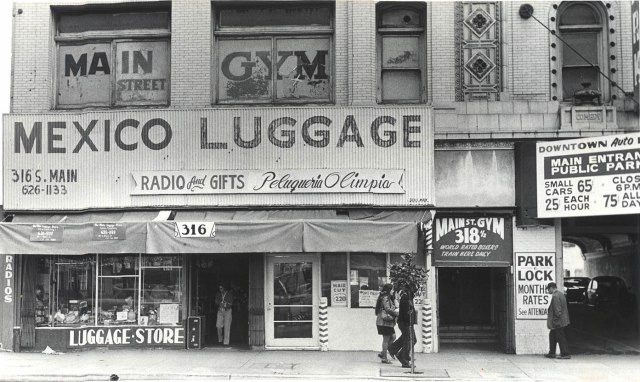
Notice that the Main Street Gym doesn’t seem to have set up business yet (the sign over the door reads "Here Television," although a 1984 article says that the gym moved to 318 1/2 S. Main in 1951 after its old building across the street burned down). There’s a cafe at 318 S. Main, which was replaced with Mexico Luggage and a barbershop by 1984.

Notice that the building was also called the Adolphus Theatre. This is another mystery. According to The Times, the Adolphus opened on Main Street "across from the Belasco" (335 S. Main St). on Nov. 27, 1911. It vanished from the clips after July 14, 1912. The Hippodrome opened Aug. 31, 1913. A one-year gap would allow for construction of another theater (the Hippodrome seated 3,000 while the Adolphus seated 1,450), but I can’t find anything in the clips. Stay tuned…


Hippodrome_1952_1026_jack_carrick3

Photograph by Jack Carrick / Los Angeles Times
And here’s the demolition of the Hippodrome’s proscenium, Oct. 26, 1952.

Email me

Posted in Downtown | Tagged , , , , | 1 Comment

Nov. 30, 1957


1957_1130_cover

Posted in @news | Tagged , , , | Comments Off on Nov. 30, 1957

At the Coliseum

Brian Hanrahan, one of my friends at the website, asks if there are any historic pictures of the Coliseum at the Daily Mirror HQ.

The answer is "of course." In fact, here’s a photo showing Los Angeles police officers at the Coliseum.


Lapd_1933_0528_coliseum

Photograph by the Los Angeles Times
Here are Mayor Porter (in the white suit) and Police Chief Steckel inspecting LAPD officers on May 23, 1933.


Motorcycles_1928_0112_harleys

Photograph by the Los Angeles Times

Los Angeles County Supervisor Beaty and Sheriff’s Capt. Cannon inspect new Harley-Davidson motorcycles (with an amazing innovation: front-wheel brakes) at the Coliseum, Jan. 12, 1928.


Olympics_1932_coliseum01

And here are some images of the Coliseum from the Olympics. No, not the 1984 Olympics, the 1932 Olympics! These photos are from a large series of pictures published in Germany in the 1930s.


Olympics_1932_coliseum02

And another view


Olympics_1932_coliseum03_2

And here’s a mystery photo. Who is this distinguished-looking gent in the VIP box?

  • Avery Brundage? Interesting guess. But no.
  • Gov. James "Sunny Jim" Rolph Jr.? Very interesting guess. (But no).
Posted in LAPD, Sports | Tagged , , , | Comments Off on At the Coliseum

Main Street Gym

I dug out the old photos of the Main Street Gym and fired up the scanner at the Daily Mirror HQ.

main_street_gym_1976_0210_marilyn-k-yee

Photograph by Marilynn K. Yee / Los Angeles Times

Then I took a closer look at this picture from 1976. Continue reading →

Posted in Downtown | Tagged , , , , , | 6 Comments

Nov. 29, 1957

1957_1129_cover

Posted in @news | Tagged , , , , , | Comments Off on Nov. 29, 1957

Aaron baseball sold


Nov. 29, 1957

Adjusted for inflation, this baseball went for $7,165.28 in 2006 dollars.


1957_1129_henry_aaron

I can hear every memorabilia collector in America screaming.

Posted in Sports | Tagged , , , | Comments Off on Aaron baseball sold

Photo shoot

Here’s how news editors (now they’re called "page designers") used to crop feature pictures down to a one-column mug.

The original portrait. Here’s hoping the poor AP photographer never saw how it got butchered. 


Nancy_valentine_1950_0104_how2crop

First, rotate the picture so the person’s head is "straight."


Nancy_valentine_1950_0104_how2cropb

Now cut it down to one column and paint out the background.


Nancy_valentine_1950_0104_how2cropc

Voila!  A Nancy Valentine mug shot. Newspaper design as it was practiced in 1950. (And no, The Times doesn’t do this anymore. Thank heavens).

Email me

Posted in Film, Hollywood | Tagged , , , | Comments Off on Photo shoot

Woman kills robber


1957_1128_maddox

Nov. 28, 1957

Los Angeles

The last bad decision in James B. Burton’s 42 years of bad decisions was to light a cigarette.

Because to light the cigarette, he had to put down his gun. 

Of course he had been drinking, which is not necessarily a bad
decision, but it is a poor choice if you’ve taken a woman and her
teenage daughter hostage and are threatening to kill them as you wait
for the husband to get home so you can rob him.

1957_1128_perri_3
Maybe Burton didn’t think he needed to worry because Zenobia Maddox,
32,  and her daughter Tony, 15, were tied up. And because his partner
was outside the home at 4715 S. Gramercy Place waiting to ambush Thomas Maddox, a real estate agent.

James Bedford Burton was an old, seasoned criminal who had served time
in Kentucky, Nevada, Utah and California and had a record going back to
1935. He and his partner forced their way into the Maddox home by
trying to collect on what they said was a bad check.

The men tied up the two women and while his partner waited outside,
Burton ransacked the home, threatening to kill the family if they
didn’t find any money. As he rummaged through the house, he drank from
a liquor bottle and continued threatening the Maddoxes.

In the meantime, Zenobia managed to work free of her restraints and
when Burton put down the gun to light a cigarette, she grabbed the
pistol.

Burton told her that the gun wasn’t loaded, but she proved him wrong–five times.

Then she got a lamp and beat him with it.

Then she got another lamp and beat him with it.

Then she got a third lamp and beat him with it.

After being shot five times and beaten with three different lamps,
James Bedford Burton was not feeling too well. In fact, he was pretty
much dead. And his partner was long gone, having run off when he heard
the gunshots.

Zenobia A. Maddox died May 6, 2002, according to the Social Security Death Index. Nice work, ma’am.

Email me

Posted in Homicide, LAPD, Robberies | Tagged , , | 5 Comments

Nov. 28, 1957


1957_1128_cover_4
   

Posted in @news | Tagged , , , , | Comments Off on Nov. 28, 1957

In memoriam


Nov. 25,
1957
Los Angeles

The Daily Mirror is in mourning.


1957_1125_minor


Email me

Posted in Music | Tagged , , | Comments Off on In memoriam

Kennedys have girl


Nov. 27, 1957

1957_1127_caroline_kennedy

Posted in @news | Tagged , , , | 1 Comment

Rampages revisited


307_tamarac

Photograph by Larry Harnisch / Los Angeles Times
Here’s 307 Tamarac Drive, where Harvey F. Rawlings killed his family and committed suicide.


1954_1220_oilar_2

And this is 555 Avenue 64, where Harold Oilar killed his family in 1954.


555_ave_64_1954_1220

And here’s the home as it appears today


555_ave_64

Photograph by Larry Harnisch / Los Angeles Times

How terribly tragic and utterly needless. Whatever problems these men had, surely there was nothing so great or so permanent that could explain or justify their actions.   

Email me

Posted in Homicide, Suicide | Tagged , , , | 5 Comments

Murder-suicide

1957_1127_rawlings


Nov. 27, 1957

Los Angeles

Everybody says the Rawlings family are fine people. They have a big house at 307 Tamarac Drive in San Rafael, one of the finer neighborhoods in Pasadena.

Nice house, isn’t it? Four bedrooms, two baths, 2,300 square feet by
the arroyo. Maybe you’d figure whoever lived here was happy. That’s
what the neighbors thought about Harvey Francis Rawlings Jr. They were
wrong.

It’s about 5 a.m. and still dark outside. This is a bloody, nasty
crime scene that involves a couple of kids. If you don’t want to go in,
that’s fine with me.

OK, keep your hands in your pockets and don’t touch anything.

1957_1127_cats
Quite a place, isn’t it? The whole house is wired for the hi-fi system.

Harvey is a 43-year-old attorney with a legal practice in Pasadena. Has
an office on East Green Street. Except for a round of golf now and
then, Harvey’s life is his job.

His wife is named Marjorie Ruth but she goes by Ruth. She’s 43, a UCLA
graduate, sorority girl–Gamma Phi Beta–and keeps busy with women’s
clubs like the Lawyers Wives of Pasadena.

They have two boys. The older one is Robert. He’s 16. The younger one
is Raymond. He’s 12. For a while they thought Raymond was mentally
disabled, but it looks like he was just partially deaf and the doctors
have been treating him for it.

Nice home, good family. You’d think Harvey would be grateful a few days
before Thanksgiving. But underneath whatever looked like success, his
life was a mess. He was worried about Raymond and deep in debt from
some bad investments.

This is him, lying in the bathroom with a bullet between the eyes.

Let’s keep going.

This is Ruth, lying in the hallway. From the way it looks, Harvey
attacked her first by beating her in the head with a brass ball peen
hammer. Then he went into Raymond’s room and shot him as he was
sleeping.

Looks like the gunshot woke up Robert because he’s lying next to his
bed. Police will figure that Harvey shot him as he was getting up.

Ruth wasn’t dead though. You can see her trail of blood where she went
into Raymond’s room and bent over him. Then she came out here to the
hallway and Harvey shot her twice in the head.

These are their cats, Charcoal and Cinder. One of the neighbors heard
screams and shots but "didn’t want to interfere." He’ll get home from
work tonight and wonder why the Rawlings home is so quiet except for
the cats yowling because they are hungry. He’ll get a ladder and look
in one of the windows.Then he’ll call the police. 

We don’t know exactly what made Harvey go crazy. Before he killed
everybody, he called a doctor and said he was under enormous strain.
The doctor wanted him to come over to the office right away, but Harvey
refused. Other attorneys say Harvey was having a hard time but seemed
to be "over the hump."

Nice folks, the Rawlings family. The neighbors say they are "wonderful people."

Some will say this reminds them of the
Harold Oilar case. That was the Alhambra rug dealer back in 1954 who
slaughtered his family with a hatchet a few hours after having friends
over to sing Christmas carols.  There was a little girl, one of his
daughter’s friends, sleeping over and he made her go out on the porch
before he finished everyone off. Less than a mile from here at 555 Avenue 64.

He didn’t manage to kill himself, though. They found him hanged with some towels on death row in San Quentin.

Ready? Let’s get out of here.

Email me

Posted in Homicide, Suicide | Tagged , , , | 4 Comments

Nov. 27, 1957


1957_1127_cover

Posted in @news | Tagged , , | Comments Off on Nov. 27, 1957

Caryl Chessman

Nov. 26, 1957
Los Angeles

Here’s an update on two stories we have been following….

After 98 witnesses and eight weeks of testimony, the prosecution is about to rest in the murder trial of L. Ewing Scott.

Throughout the trial, the defense raised objections that there was no evidence Evelyn Throsby Scott was dead because no body had been produced. However, the motions were always overruled by Judge Clement D. Nye.*

Meanwhile, Caryl Chessman is getting a new defense attorney and awaiting a decision on whether the manuscript of a proposed book, "The Kid Was a Killer," will be returned to him.  The manuscript was seized in 1954 by Harley O. Teets, the late warden of San Quentin.

Caryl_chessman_1957_1128_dan_mccorm Photograph by Dan McCormack / Los Angeles Times
Deputy Atty. Gen. William Bennett, left, watches as San Quentin Warden Fred Dickson displays the manuscript of Caryl Chessman’s "The Kid Was a Killer," which was seized on the belief that it was "prison labor." Chessman is flanked by attorneys A.L. Wirin, left, of the American Civil Liberties Union, and Paul N. Posner.  The man in the background leaning on a counter is Dist. Atty. William R. McKesson.


Caryl_chessman_1957_1204_lt_obrien_ Photograph by Bruce H. Cox / Los Angeles Times Chessman finally received the manuscript, a novel about a boxer, in December 1957, from Lt. L.T. O’Brien of San Quentin.  It was published in 1960.

Email me

*Judge Clement "D. Nye." Only in L.A.

Posted in #courts, Caryl Chessman, Homicide, LAPD | Tagged , , | 2 Comments

Mystery photo

I came across this photo in the archives and thought I’d share it. This is Orson Welles at the Stork Club in New York in early 1946. Who’s the blonde?


2007_1126_mystery_photo
Los Angeles Times file photo
 

  • Virginia Mayo? Interesting guess! But no.
  • Mayo Methot? Sorry, no.
  • Zsa Zsa Gabor? Interesting! But no.
  • Frances Farmer? Alas, no.
  • Lily St. Cyr? Aha. Interesting guess. (But no).
  • Nancy Valentine? (Greg Clancey). Bravo! Yes, it’s the future star of "-30-."

Email me

Posted in Film | Tagged , , | 1 Comment

Nov. 26, 1957


1957_1126_cover

Posted in @news | Tagged , , , , , , , | Comments Off on Nov. 26, 1957

Things to come


Nov. 25, 1957
Los Angeles

The designers display a painting of the proposed Theme Building at LAX:


1957_1125_lax

Posted in Transportation, travel, UFOs | Tagged , , | Comments Off on Things to come