Paul Coates


Feb. 28, 1958

Paul_coates
The following is not to be construed as against womanhood.

Because, in all sincerity, I think women are necessary.

They serve a purpose.

Just like trees and oceans and poison ivy, they’re part of the scheme of things.

In fact, they’re one of the more attractive parts of the scheme of things. They’re nice. I like them. 

But they bother me.

Of all the female species, they’re the most sensitive, defensive irrational people I know.

Basically, they’re a miserable, unhappy lot.

But suggest to them that they themselves might be partially responsible
for their uncomfortable, awkward position in American society, and
you’ll be attacked by an avalanche.

I did it, last week, indirectly. I ran an interview with a man whose platform was to put the American woman back in the home.

He even intimated that it might be an idea to take the Levi’s and motorcycle boots off of her.

This, maybe, is being a little severe.

It’s attacking–or at least it sounds like it is–all women for the actions of a few.

1958_0228_ads
But the problem comes with the realization that the "few" are growing in number, rather than diminishing.

They have moved into pants, into bars, into cuss-down contests and into
the dominant figure in too many American homes. They’ve invaded the
most stenchy corners of the male domain.

Today, there’s nothing a man can’t do bad that a woman–with a little effort and encouragement–can’t do worse.

I, for one, am quite willing to admit that the male is as responsible, if not more responsible, for the evolution.

We botched. We didn’t live up to the obligations and duties of our sex.

We allowed the woman to move in and take over our responsibilities, and then we treated her with a crude lack of deference.

Most men are willing to admit this.

The man I interviewed last week was.

But ask a woman?

I’d guess that 90% of the calls and correspondence I received following
last week’s column was from two women who felt the male was 100% to
blame.

There were no maybes, no ifs.

Even women who claimed perfect husbands, perfect homes, perfect
adjustment, came to the aid of their less fortunate, more masculine
sisters.

It’s all man’s fault, they told me.

I’m afraid that so long as we men go on playing willing scapegoats for
the abnormal behavior of women, they can rationalize their invasion of
our responsibilities and vulgarities.

And they can go right on recruiting their sisters.

MIDNIGHT MEMOS: Miyoshi Umeki (you heard me, what I said) opened at Mocambo the other night.

The young Japanese film star, who has won an Academy nomination for her
performance in "Sayonara," has all the necessary ingredients for a top
nightclub act. She is lovely looking, has a warm, husky voice quality
and a charming sense of humor.

If there was any lack on opening night, it was that her selection of
numbers was not too well chosen. A little advice on what a good, strong
closing song means would help her considerably.

Her costar is baritone Johnny O’Neill, who has been here before, but fared considerably better this time out.

Ringsiders included the Harry Jamesons, Claudette Colbert, Dr. Joel
Pressman and the Bill Goetzes. There were others, but it was too dark
to see.


Posted in Columnists, Paul Coates | Tagged , | Comments Off on Paul Coates

Pacific Electric station

Pacific_electric_hill_street_nd


Regular reader Callbox Sam passes along a photo showing the Pacific Electric building on Hill Street. Hmm. This doesn’t look like the drawing in the Feb. 28, 1908, Times. Aha! Note that the story says the 1908 station is only going to be a temporary facility until another terminal is built on the site of the Masonic Temple — shown in this picture. So I would assume this station is just to the north of the current Subway Terminal Building.

Email me

Posted in Downtown, Transportation | 1 Comment

Feb. 28, 1958

1958_0228_tv


Studio executive Harry Cohn dies … On the jump, the rest of the Cohn obituary … A man commits suicide by jumping from the Subway Terminal Building … Pilot whale Bubbles "celebrates" a year in captivity … The Fire Department rescues a boy who was trying to trap pigeons beneath the 4th Street bridge over the Los Angeles River … And Gene Sherman’s column.

1958_0228_cover


Email me

Continue reading →

Posted in broadcasting, Downtown, Film, Hollywood, Television | Tagged , , | Comments Off on Feb. 28, 1958

Feb. 28, 1938

1938_0228_reed


Paul Wright, found not guilty of killing his wife and best friend while they were doing something that couldn’t be printed in The Times, walks out of jail and hopes to be a forgotten man … World War I hero Gen John "Black Jack" Pershing lingers near death … Note the lead story from Graz, Austria, where forces are trying to block a Nazi march to Vienna. As a reader pointed out, the police chief of Graz in this era was a fellow named Gustav Schwarzenegger.

1938_0228_cover


Posted in #courts, Film, Front Pages, Hollywood | Tagged , , , | 1 Comment

Feb. 28, 1908

1908_0228_ads


Now this is interesting: Plans for a new Pacific Electric depot on the west side of Hill Street between 4th and 5th. Hm. Isn’t the Subway Terminal Building on Hill Street between 4th and 5th? Sure is … Powdered eggs … A man commits suicide by stepping in front of a switch engine … A court ruling may affect the sentence of Michael Meskil in the slaying of a Officer Patrick Lyons … And an adopted child tries to find his biological parents …

1908_0228_cover

Email me


Posted in #courts, Front Pages, LAPD, Transportation | Tagged , | Comments Off on Feb. 28, 1908

Matt Weinstock

Feb. 27, 1958

Matt_weinstockd_2
John Cusic, 25, a Northrop Aircraft worker, his wife, Irma, and their
daughter, Pamela, 5, drove to the downtown district of Fullerton one
day recently to pay some bills.

As Mrs. Cusic came out of a utilities office on Spadra Street, her
husband picked up a plastic pistol on the seat, pointed it playfully at
her and snarled in accepted gangster fashion, "Come on, get in!" Their
daughter plays Annie Oakley with the pistol.

They drove off and stopped at several more places to pay bills, unaware
that two teenage boys on bicycles had seen the pistol-pointing and
excitedly reported it and the car’s license number to police.

AS THEY stopped at a doctor’s office they noticed a police car behind them but thought nothing of it.

And then suddenly outside a market they were surrounded by three police
cars and five motorcycle officers. Red lights flashed and an officer
with his real gun drawn ordered them out of the car. He saw quickly
that the pistol was a toy, of course, and after a few questions the
tension dissipated.

But it proved a fine dry run for the gendarmes and a lesson for
everyone. The Cusics were "apprehended" 17 minutes after an APB went
out on the "kidnapping."

Hereafter they’re keeping the plastic pistol at home.

1958_0227_hifi


THE SOCIETY to Discourage Dimly Lit Restaurants will come to order.

A bon vivant named Tom ordered some canapes (it’s easier to spell than
hors d’oeuvres) in an elegant Palm Springs spa and a lady named Ann, a
member of the party, dipped what she thought was an Oriental tidbit
into the hot sauce and began chewing. Turned out to be a tiny Turkish
towel, pre-soaked in warm water, for wiping the hands after eating the
real canapes.

THE WAY George
Q. Ibid heard it, a Frenchman went into a wine shop and asked for his
favorite Bordeaux. He found it only in small bottles and asked if it
were available in larger sizes. "Oh yes," said the clerk, "we have the
bigger bottles in the cellar."

"Eh bien," beamed the Frenchman, "take me to your liter."

AND IF THAT doesn’t
shake you up, Bill Graydon has been speculating on  a possible
aftermath to the AP story from Hong Kong stating the Chinese Communists
have banned such degenerate, reactionary juke box tunes as "Love for
Sale" in favor of numbers like "I Want to Cooperate With My Commissar."

As Bill sees it, this harsh crackdown doubtless will cause the Peiping
sideburn set to reminisce about the good old days when their favorite
was "Give Me That Old Soft Chou."

AIRY NONSENSE — Lee
Goodman reports that when he boarded a plane in S.F. on what is
advertised as a "red carpet" flight to L.A. the stuff he walked on was
definitely linoleum … And while on a nonstop flight from S.F. to
Chicago, Jimmy Baker, producer of "Stars of Jazz" got to talking with
an elderly lady who thought she was going to L.A. Wrong plane, proving
it can happen.

AROUND TOWN — The
driver of a mail truck misjudged the distance as he stopped for a
pickup at Wilshire and Westlake Avenue and rammed the mailbox. Yep,
Jean Gelber said it: "The mail must go through!" … Bob Keeshan, who
portrays the 60-year-old Capt. Kangaroo on KNXT at 7 a.m. is only 30.
Incidentally, he used to be the Clarabelle of the Howdy Doody
children’s show … A bar on Pico Boulevard near Hoover which is
getting a face lift has a large sign in front, "Open During
Altercations." But all was peaceful as Bill Biggers drove by … A
knight in armor is picketing the Old Curiosity Shop, 8629 Melrose Ave.,
carrying a sign stating the place is "Unfair to Other Antique Dealers"
because its prices are so low. Only in L.A.


Posted in Columnists, Matt Weinstock | Comments Off on Matt Weinstock

Paul Coates

Feb. 27, 1958

Paul_coates_2
This is a story that never ends.

It started two years ago when a man in his early 20s came into my
office. He had a problem: Heroin. He’d had it for three or four years.

He wanted to do something about it, he told me. Maybe he just wanted to talk about it–but at least to him that was something.

We talked, I remember. He told me about his wife and two kids. In
return, I offered what encouragement, what stimulation I could. I think
I mentioned a hospital or two.

And he left.

I never heard from him again–until, that is, last Monday. This time he
phoned me. He said it was pretty important that I come to see him at
his home. It was a story for me.

I said I’d try, and he told me it was very important. So I said I would.

And the following afternoon, I did. That was Tuesday.

His wife answered the door. She was blond and didn’t look old enough to
be the mother of the two girls–ages maybe 6 and 4–at her side. She
invited me in.

It’s OK," she called to her husband. He appeared from another room.

1958_0227_ads
Switching a glass of orange juice from his right hand to his left, he shook hands with me.

"I didn’t think you’d come," he said.

His wife ushered the two children out of the room and he and I sat down and talked.

He filled me in on the last couple of years.

"I took your advice," he said. "I went to Fort Worth. To the hospital."

He let me wait a minute before he continued.

"But–well. I got impatient. I split. I cut out."

The reason? He was worried about his wife and kids. He came back to town and started working. He was all right.

For a year he was, anyway. Then he fell back with the same bad crowd and the same bad habit.

As we talked, my friend cast repeated glances at the window. Twice, in
the period of half an hour, he asked me to step to the back of the
house.

Both times, his wife went to the door and said no, her husband wasn’t home.

"Those hypes," he growled. "They never quit. They come by like it’s a parde.

"Hypes," he said, disdainfully.

Then he explained. He said he’d kicked it this time, on his own. This, he told me, was the eighth day.

He waved a fresh glass of orange juice at me. "Today’s the first day I’ve been able to keep it down."

I asked him if that was why he’d called me, why he wanted me to come over.

"That’s part of it," he said. "The other part’s the reason why I
kicked." He led me to a bedroom and showed me a baby, maybe 3, 4 weeks
old.

"A boy this time," he said. "He needs a man for a father."

We talked for a while longer and I asked about the men who had come to the door. "How come you didn’t talk to them?"

"Not yet," he told me. "Maybe in two months, a month. Then I’ll walk right by them on the street and I won’t bat an eye."

I was invited for dinner, but I said I had to leave. I wished them both a lot of luck. I told them to keep in touch.

And I figured, I suppose, that maybe I’d hear from them in a couple more years.

But I was wrong.

My friend phoned again yesterday. "I’m sorry," he said. "I’m real sorry. I goofed."

"What happened?" I asked.

"I answered the door."

[Note: The Daily Mirror mourns the passing of Vivian Sheehan, speech therapist who worked with Paul Coates after his 1966 stroke].


Posted in Columnists, Paul Coates | Tagged , | Comments Off on Paul Coates

William F. Buckley, RIP

May 6, 1962

1962_0506_buckley_2


Aug. 19, 1963

1963_0819_buckley_4


Dec. 2, 1963

1963_1202_buckley

 
Jan. 1, 1965


1965_0101_buckley


June 19, 1967

1967_0619_buckley


Jan. 8, 1969

1969_0108_buckley_2


Dec. 12, 1969

1969_1212_buckley


Posted in Uncategorized | Tagged , | 6 Comments

Feb. 27, 1958

1958_0227_court_2


A wayward blimp … A "short, swarthy man" and his partner menace a Pasadena matron (and no, The Times never followed up on this story) … Nixon knows what to do if something happens to Ike …

1958_0227_cover


Email me

Posted in #courts, Front Pages | Tagged , , | Comments Off on Feb. 27, 1958

Raymond bombing

Feb. 27, 1938
Los Angeles

1938_0227_stover


1938_0227_viewpark


It’s Sunday in Los Angeles, time for the funnies, like "Smokey Stover," one of the most eccentric American comic strips.  Above, Crenshaw Boulevard and Vernon Avenue. Today, we would probably call this area Leimert Park …  Below, an event that reminds me of the Raymond Chandler line about "standing out like spats at the Iowa Picnic" … and Earle Kynette remains in jail in the Harry Raymond bombing. On the jump, meter readers in Chinatown.

1938_0227_kynette


Continue reading →

Posted in #courts, City Hall, Front Pages, LAPD | Comments Off on Raymond bombing

Feb. 27, 1908

1908_0227_times

An interesting slice of life in Los Angeles a century ago: If you have ever seen old pictures of downtown you know the significance of the story about removing excess utility poles. The streetscapes in the old days were a tangle of overhead wires … The toxic effect of fake jewelry … A doctor uses fright in an attempt to awaken Beulah Hawkins, the unfortunate comatose woman at county hospital … An actor getting off a streetcar at 4th and Hill falls over a pile of dirt and is hit by another streetcar. But the show goes on … More than $1 million in scrip, used "in lieu of cash during the dull days" is incinerated.

1908_0227_cover


Email me

Posted in Front Pages | Comments Off on Feb. 27, 1908

Matt Weinstock

Feb. 26, 1958

Matt_weinstockd
After a hard day at the office, two fellows named Bob and Mike like to
drop into a Hill Street dive for a cooling draught, to brood, to
contemplate the infinite or merely to read THE evening paper, which
they prop up conveniently against the beer taps.

But several times lately they’ve found their favorite stools occupied
by sturdy customers who, they instantly decided, it would be unwise to
try to evict.

So Bob, who has access to such things, had two place cards printed stating these stools were reserved in their names.

BARKEEPS Joe,
Johnny, Luigi and Ray have cooperated in this little enthusiasm. When
Bob and Mike enter, they roust the peasantry from these reserved
stools.

However, the genial prop. of the joint, Uncle Abe, has confided that
while he is not averse to their project, he has a certain apprehension
about the implications. Of course, he puts it another way.

He points out that his trade represents a specialized economic niche in
Hill Street cafe society and he doesn’t want the customers to get the
idea that the Rainbow has become a kind of Romanoff’s Downtown.

Next thing, he fears, the unshaven horde to which he caters may demand vintage muscatel.

For the moment, however, Bob and Mike are sitting pretty.

ONE OF THE delights
of bored Civic Center workers is encountering young couples who get
lost while seeking the marriage license bureau in the Hall of Records.
They are uniformly shy and embarrassed.

One such bewildered couple came into an office in City Hall, the wrong
building, and a girl employee heard the bride-to-be whisper to the
young man, "Go ahead, ask her."

He came up to the counter and said, "That girl behind me wants to know where to get a marriage license."

FOR RESOLUTE action
in the face of adversity, the Henpecked Husbands Society, an
underground organization, has nominated an Irwindale man for president.

This man’s phone bill for December and January totaled $94, the result of his wife’s chit-chatting with old friends back East.

1958_0226_hifi_2

Did he sigh and pay up? Did he start a futile argument? No. He firmly
ordered the phone yanked out. That was three weeks ago and it’s still
out. A fanfare, please.

SEMANTIC NOTE — Dr.
H.W. Magoun, anatomy prof at UCLA Medical School, has received a
distinguished achievement award from the journal Modern Medicine,
states a press release, "for studies in neurological science leading to
the appreciation of the clinical importance of basic advances."

And this, obviously, is not something that happens every day.

ONLY IN BEL-AIR — A
householder asked his neighbor if he could park his 1958 Cadillac in
the neighbor’s garage for a while. A landscape man was coming over to
give an estimate on some work, he explained, and he didn’t want the
fellow to think he was "that rich."

MISCELLANY — Every
time Don Messick passes the sign on Riverside Drive between Glendale
and Burbank stating "Litter Laws Strictly Enforced" he gets the feeling
it has something to do with restricting the dog population … Vivian,
7, a second-grader, came home from school and proudly advised her
father she’d learned all about the "terrified" forest … Post-flood
meditation by Bill Eberline: A fortune awaits the person who devises
cork hubcaps for small foreign cars–to ride out the deep water. With
oars, of course … An exhibitor at the Hi-Fi Show at the Biltmore
defines a dedicated audio fan as one who insists on reproduction of low
notes he can’t hear but only feels and of high notes he can’t hear but
only hopes are there.


Posted in Columnists, Matt Weinstock | Tagged , | Comments Off on Matt Weinstock

Paul Coates

Feb. 26, 1958

Paul_coates
The ghouls never die. Not in L.A., they don’t.

They fade away, lay low, sometimes. But always they come back–with new schemes as fantastic as they are sadistic.

They dedicate their lives to devising profitable little plots to salt
the open wounds of individuals hit by gross tragedy. They specialize in
operations which permit them to turn a fast buck and get their
unnatural kicks at the same time.

In the past, I’ve mentioned a few of their abnormal games.

A couple of Christmases ago, there was the flourishing group which dealt in names taken from local obituary columns.

They visited the dead parties’ next of kin to "deliver" a Bible
which–they told the grieving relative–had been ordered by the
deceased.

With solemn irreverence, they explained:

"He ordered it for you. He even asked that your name be engraved on it. In gold."

The ghoul would then open the book and show the victim his or her name. In gold.

"I’m sorry," he would continue, "but it hasn’t been paid for yet. Of
course, if you don’t want it, if you don’t want to abide by your loved
one’s final wish–"

It would almost be sacrilege to say no, even if the price was exorbitant. Which it usually was.

This pleasant little game is revived periodically.

And so are some others.

There’s the professional "blesser," who searches out homes where there
is serious illness. She blesses the clothing, the curtains, the bed,
the silverware–and, of course, the money.

1958_0226_rambler
And too frequently, after she’s left, the victims open the handkerchief
or holy cloth in which she blessed the money and valuables only to find
that some of them left with her.

There are the witchdoctors and the cancer quacks who accept your money
in exchange for voodoo and sugar pills. And watch you die slowly and
painfully.

And then there are those who "contact" you after you’re dead, and pass
along spirit messages to your kin advising them to invest in phantom
gold mines.

These people are ghouls.

But yesterday a man in our town went all of them one better.

With no hope of profit, no plausible chance for personal gain, he
elected to telephone Mrs. Mary Bowman that he and his "partner" had
Tommy and that the boy was alive and well.

Since the boy’s disappearance in the foothills above Pasadena, the
Bowmans have never given up the hope that their son is living and will
someday be returned.

So naturally the child’s mother was willing to listen to anything, to anybody.

The caller instructed her to stand outside and wait.

She did. It was raining, but she stood there for quite a while.

"Maybe it wasn’t long," she told me afterward, "but just thinking that
maybe, possibly, Tommy would come back to us made it seem like hours."

Finally, she gave up the vigil, stepped back into the house and called the police.

Unwillingly, she admitted to herself that Tommy was no closer to home
this week than he was last week or the week before. She simply had been
the victim of an evil hoax.

It’s hard for me to believe that anyone could have a mind so
degenerated, so deranged that he could get his pleasures by heaping
additional torture into the already tortured life of Mrs. Bowman.

But there is somebody like that.

He’s sick, I suppose.

But that kind of sickness turns my stomach inside-out.


Posted in Columnists, Paul Coates | Tagged , , | 1 Comment

An urge to kill

Feb. 26, 1958
Stanford

Thomas was handsome, clean-cut, 19-year-old sophomore on the tennis team at Stanford, where his father had gone to college and was a prominent alumnus.

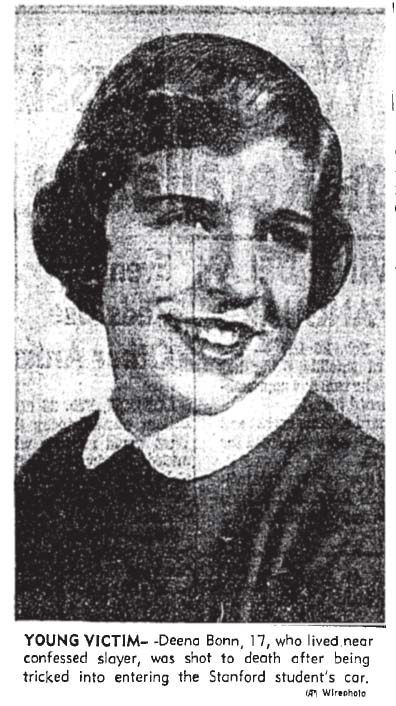
He lived at 248 Edlee Ave., across the street from Mr. and Mrs. John E. Bonn and their only child, Deena, 17. She was an attractive young woman and the faculty at the Cubberly School in Palo Alto described her as “one of the finest young ladies we’ve had here.”

But despite the wholesome face he  presented to the world, Thomas was
deeply troubled by the dark and unexplainable urge to kill, a desire
that became stronger every day.

And so he planned the killing carefully: He would find a girl and lure her into his new 1957 convertible. Once in the car, he would kill her, take her into the Stanford foothills and rape her, then hide her body. Continue reading →

Posted in #courts, Homicide | Tagged , , , , | Comments Off on An urge to kill

Raymond bombing


Feb. 26, 1938
Los Angeles

Mason_opera_dracula

Above, now playing at the Mason Opera House. Below, Harry Raymond’s wife identifies Police Capt. Earle Kynette as a prowler she saw near their garage before the bombing that nearly killer her husband … Charges of accepting money in return for influencing legislation? … Dark times in Austria … On the jump, the rest of the Kynette saga.

1938_0226_cover


Email me

Continue reading →

Posted in #courts, City Hall, Downtown, Front Pages, LAPD, Stage | Tagged , | Comments Off on Raymond bombing

Japan attacks L.A.?


Feb. 26, 1942
Los Angeles

1942_0226_japanese

Above, suspicious Japanese Americans are rounded up after the great battle of Los Angeles. Yes, it was a false alarm that left parts of the city peppered with unexploded ordnance. A special thanks to my colleague on the business copy desk, Bob Bayer, for pointing out the anniversary.

1942_0226_cover

1942_0226_photos

Email me

Posted in Front Pages | Tagged , , | 1 Comment

Matt Weinstock

Feb. 25, 1958

Matt_weinstockd
Everyone, it
seems, is trying to write television scripts, but Al Blake hadn’t given
it a thought until a friend called him one day and said, "Al, I’m in an
awful fix. I’ve got a job as a writer and I don’t know what to do."

Al,
whose only claim to writing fame was his unpublished book titled "How
to Become a Successful Thief," dealing with crime and punishment, of
which he has a firsthand knowledge, offered to help.

The friend
gave him the rundown, and Al batted out a script, which the friend
submitted and which was accepted. Under his friend’s goading, Al
ghosted four more which were also accepted.

THEN ONE DAY the
friend said, "Al, I’ve got some news for you. You just quit. That is, I
quit. I got another job. But I told them you’d been writing the scripts
and recommended you."

To Al’s surprise the producer called him and he continued writing them for more than a year.

1958_0225_ladyThat’s all over now but it gave Al a foothold in the business. He now writes for "Preliminary Hearing" on Sunday, Channel 9.

A MIMEOGRAPHED interoffice
letter from the big boss at Rocketdyne, subject: "Letter of
Congratulations," went out to all employees. It began, "The historic
launching of the first American satellite by our Redstone engine
reemphasizes the vital role our division is playing in the nation’s
security and progress…."

Remarked one horse-playing employee: "What have we got to crow about? We only got show. The Russians still have win and place."

VIA DOVE, sent out by a flood-marooned wife in Rolling Hills, comes a dramatic tale of the elements.

During
last week’s storm, it came time for her very shaggy collie dog to go
outside. The pooch was reluctant but she finally shooed him out the
door. Whereupon a gust of wind from the howling gale struck him
broadside, where his wind resistance was greatest, and knocked him
down, with great loss of dignity.

A LADY GARDENER named
Hilda has lost another bout with a very smart gopher–but with a
strange denouement. It had eluded her traps and the water cure so she
placed poisoned wheat in its burrow. Old gopher wouldn’t go for it but
she had a wonderful crop of wheat growing out of the burrow.

THEN THERE’S the
green-thumbed lady named Carol who found  a bag of strange-looking
stuff in the garage. She took a sample of it to a nursery and was told
it looked like bone meal. So she worked a lot of it in among her
rosebushes and they’re doing better than ever before.

But a few
days ago her handyman was building a planter and after fussing around
in the garage asked what had happened to the bag of fire clay he’d left
in the garage.

You can’t beat that Laurel Canyon soil, insists Carol.

AT RANDOM —
Merle
Zee would have us believe that on the first day of the recent bus
strike a driver of Irish descent put a sign on his bus, "Flaherty will
get you nowhere" … Sam Dodd of Glendale has had tiny tabs printed
stating "I object to this kind of advertising. Please don’t send me any
more" –which he puts on junk mail with prepaid return postcards … A
TV pitchman said that his firm was overstocked with fine used cars
because new car sales "have been skyrocketing upward." If they ever
started redundancying downward he’d really be in trouble … There were
so many boat trailers on the highway to and from Palm Springs Sunday
that Harold Mallon wondered if he ought to get a mariner’s license …
When his companion declined his offer to buy a drink, a man in a
downtown bar remarked, "The trouble with you is you’re vitamin happy!" 
   

Posted in Columnists, Matt Weinstock | Tagged , | 1 Comment

Paul Coates

Feb. 25, 1958

Paul_coates
The biggest hero is often the last heralded.

He acts with such quiet, automatic efficiency that he destroys the
drama of his own actions. He remains anonymous, unknown and unthanked
for his service.

Today I have a nominee to join the ranks of such men. His name is Bill
Squires. He’s a mechanic by trade and he lives in a section of Carbon
Canyon, near Pomona, known as Sleepy Hollow.

He was involved in a headline story over the weekend. He was, in fact, its hero.

But he performed his heroics so well, so quietly, so efficiently that not one article about the incident mentioned his name.

Although he didn’t know it at the time, Bill became involved with the
story at 6 p.m. Friday, when he stopped off at a neighborhood cafe on
his way home from job-hunting.

The cafe–ordinarily jammed on Fridays–was without a customer.

Bill joked with the owner about it. "What have you been feeding them?" he asked.

The owner laughed, grimly. "Haven’t you heard?"

Bill hadn’t.

"There’s a maniac on the loose," the owner continued. "Killed a
policeman and ran off into the woods. Supposed to be around here
someplace. The police have warned everybody to stay inside."

Although it didn’t particularly worry Bill, he decided to get along
home to his wife and five kids. When he reached there, a few minutes
later, he mentioned the incident.

Then it was dropped, forgotten.

Shortly after dark, the Squires family retired. Garey, the oldest boy
at 9, went to his bedroom on the upper level of the hillside house. The
others retired to their rooms downstairs.

At about 11:30, Lucille, Bill’s wife, heard someone walking around
upstairs. She called out, but Garey didn’t answer. Her husband awakened,
and he called too. Still no answer.

So he moved quietly up the stairs, with his wife following him. The
Squires’ living room, with an outside entrance and kitchen, are also on
the upper level.

Bill checked the bedroom. Garey was asleep. Then he walked into the
living room and by the dim light of the night, he saw a figure lying on
the couch.

"Hello there," Bill spoke.

"Hi," was the reply.


1958_0223_bonds

Bill flipped on the light. The figure was that of a man, bearded and
slightly wild-eyed. The man was smoking. His wet shoes and socks and
pants lay on the floor, and he was covered by some clothing belonging
to Bill’s children.

Bill asked, "What’s the matter? Are you lost?

The man grunted. "I’m just tired."

Are you hungry?" said Bill. "You want some coffee?"

The man said yes. So while Mrs. Squires went into the kitchen, Bill
remained. He figured this was the dangerous fugitive whom 150 police
were tracking the hills to find. He knew the man was armed, but he
couldn’t see the gun. So he made conversation–easy, friendly
conversation.

The Squires had no phone. So when Mrs. Squires returned with the coffee, Bill made a decision.

"How would you like a beer, mister,?" he asked.

The man grunted yes.

Bill explained that he didn’t have one in the house, but that there was
a store about a block away. He’d go down and bring back a couple
bottles, he said.

It was tough to decide who should go, Bill admitted later. But his wife
was expecting a child within a few weeks and he didn’t want her running
down the hill to the store.

Bill left when he decided the intruder would be content for a few
minutes. The round trip–to get the beer and notify police and
return–took about three minutes.

He poured his guest’s bottle into a plastic mug, gave it to him and
then continued with the idle conversation. The man wasn’t much of a
talker, but he did mention that he’d picked cotton in Texas and
Mississippi.

The 10 minutes it took the police to arrive seemed like hours, but when
they came they moved in fast. And before Lester Dean Bonds, the
deranged killer of an Ontario policeman, knew what was going on, he
found himself handcuffed and on the way to jail.

[Note: California death records say Lester Dean Bonds died April 13, 1986, in Alameda County at the age of 73.]

Continue reading →

Posted in Columnists, Homicide, Paul Coates | Tagged , , | Comments Off on Paul Coates

Voices, Frank Heller

Linda_mintz_1958_1111_frank_heller_
Photograph by the Los Angeles Times

Frank Heller and Linda Mintz in a photograph published Nov. 11, 1958, in The Times.


Linda_mintz_1958_0226_terry_winfrey Frank Heller was a defense attorney for
Linda Mintz, the housekeeper charged with beating her employer Thelma Macomber to death with a vacuum cleaner. A former Marine who served in the Pacific during World War II, Heller graduated from Southwestern School of Law, was admitted to the State Bar of California in 1954 and still practices law. He and his wife, Rosalie, have been married 62 years.

I was born and raised in Chicago and came out here to California. It’s God’s country… I came out here in 1948… I was in the service, stationed out here. I fell in love with California. I was stationed at Camp Pendleton…. 

Actually, I’m going back a little bit before the war. I guess I was in high school when I used to ride out here… on the rails… as a kid… In those days it was safe. The so-called hobos would take care of young kids. My mother never knew. I had an uncle and aunt who owned a deli in City Terrace so I came up and worked in the deli…. I fell in love with the place.

I got out in 1945 when World War II ended… WWIII started when I got married… [This is, of course, a joke–lrh] I spent time catching up on my education…. I was in the tavern business in Chicago….

I came out to California in 1948 or ’49, one of the two, and what did I do?  I was continuing on my education and took the bar. I like to tell everybody I took the bar so long ago it was with Abraham Lincoln… I’m still practicing, by the way. I joined the bar in 1954. I enjoy living here…. I enjoyed going to school. I had a good time becoming a lawyer.

At that time, there were very, very few women passing the bar or taking the bar, very few female lawyers, judges. Then they invaded our field. But we had some good ones. Mildred Lillie, she was fantastic. In my class I think there was only two or three women who took the bar and they all passed the first time. And the women I graduated with all became fantastic lawyers, judges and I work with them every day of my life.

I hooked up with a couple of lawyers who were quite a bit older than me, Charles Taylor and Paul Sherman…. Two of the most fantastic guys you ever wanted to meet. Even in my first year of practice I ended up doing a lot of criminal work.

Charlie Taylor (above, with Officer Terry Winfrey in a Times photograph by  Bob Martin) was one of the best criminal lawyers in this area. A lot of times we were together because he wasn’t well. I got a lot of experience.

The first year out of school I handled my first first-degree murder case. It came out OK, but I came out thinking how much I did not know.

Judge [Charles W.] Fricke was the dean of criminal law. He wrote a book [California Criminal Law–lrh], and we used to use it as a bible. I enjoyed working in his courtroom. I enjoyed Judge [Clement D.] Nye, Judge [Allen T.] Lynch, Edwin Jefferson, he was the one who presided in the Linda Mintz case, Judge [LeRoy] Dawson, Judge [Herbert V.] Walker….

And the D.A.’s office… There’s a little twist to all of this: Despite the fact I did defense work, I was the civil attorney for the D.A’s investigator association. Even though we fought like blazes in court, we were all friends outside.

Linda_mintz_1957_0620_ray_pinker__2 Photograph by the Los Angeles Times
Police chemist Ray Pinker, left, discusses the vacuum cleaner used to kill Thelma Macomber as defense attorney Grant Cooper and defendant Linda Mintz listen.

As time went on, my two partners weren’t feeling too well. They died at early age and I sort of took over. They let me try a lot of cases when I was young.

The Linda Mintz case started out to be Taylor’s case. He was with me for a while but didn’t feel too well, so I took it over.

If I recall there was a first trial… He was an exceptionally good lawyer. She had a good defense. It was a hung jury 7-5 for conviction and our case, if my memory serves, was 8-4 for acquittal.

She was very difficult to handle at times, the poor lady. Everybody felt sorry for her. She always felt she was being persecuted. Even here. I remember here one time there was a court reporter, a young guy, Nordic looking, she kept telling me she felt he was a Nazi agent following her.

You can imagine what she went through as a concentration camp victim.

Linda_mintz_1957_0601_frank_q_brownShe was a little bit of emotional times at times. She was cooperative with me… I understand a little bit of German, so I could communicate better. But she spoke English.

By the way the homicide detectives on that case were fantastic. A really fantastic police officer. He told exactly the way it happened. There was one investigator maybe with the Fire Department…. I think some of his testimony was contradicted, but they all did a pretty good job giving out the facts.

I do recall she once said there was a photographer who visited the house. And a young man who lived in house…..

I do recall somebody purportedly saw her trying to wipe blood off the walls…. It was a pretty ugly scene… It’s so long ago….

Usually, lawyers talk to jurors. I talked to them… Completely diverse opinions of what took place.

[Joseph L.] Joe Carr, the D.A., I remember vividly. I was active in criminal law at that time. Mrs. Mintz (above right in a Times photograph by Frank Q. Brown) was Jewish, Joe Carr was Jewish, the judge was black. She couldn’t say she was being persecuted but she did. I felt Joe Carr did an exceptionally good job… They reviewed the case and with two hung juries they figured they’d never get a conviction so they decided to dismiss the case and let her go. I remember walking out of courtroom with her. She had a son, I understand.

The following statement is strictly a joke. As soon as she was exonerated, I said I would bring her home as a housekeeper. Unfortunately, she was suspicious of everybody. I think there was a reporter, Paul Coates… He wrote some rather interesting articles about her. Very fair, not pro or con. She had a bit of a problem being incarcerated…. People go through that horrible experience. I felt she was normal. The D.A. felt she was insane at times. I didn’t think so. I just felt sorry for her.

After the trial, I lost track of her, but then Joe Carr a year or two later said she was up north. That was the last we ever heard of her…. I often wonder what happened to her son… Her son was living in West L.A., in a home. He was 13.

I may be the only one still alive from that case.

[Note: Stay tuned for Part II of Frank Heller’s recollections–lrh]

Email me

Posted in #courts, Homicide, LAPD | Tagged , , , | Comments Off on Voices, Frank Heller

Mystery photo

2008_0225_mystery_photo Photograph by Jack Gaunt / Los Angeles Times

OK, who’s the blond with Mickey Cohen? (No, it’s not Walter O’Malley).

  • Candy Barr? (Two people). Nope, Candy Barr looks like this. The Daily Mirror doesn’t do reruns!
  • LaVonne Cohen? Sorry, no.
  • Virginia Hill? Sorry, no.
  • Cheryl Crane? Sorry, no.
  • Liz Renay? Sorry, no.
  • Sandy Hashagen? (Nathan Marsak). Absolutely. This is Claretta Hashagen, a.k.a. Sandra or Sandy Hagen. Where is she now? I cannot find a trace of her in The Times after the Mickey Cohen saga. 

Mickey_cohen_1960_1202_sandra_hagen
Photograph by Nelson Tiffany / Los Angeles Times

Mickey Cohen, Sandra Hagen and attorney A.L. Wirin, in a photograph dated Dec. 2, 1960.
Mickey_cohen_1962_0205_sandra_hagen
Photograph by Hugh Arnott / Los Angeles Times

Sandra Hagen and Mickey Cohen leave federal court after bail for Cohen was denied, in a photo dated Feb. 5, 1962.
Mickey_cohen_1962_0217_sandy_hagen_ Photograph by Larry Sharkey / Los Angeles Times

Sandra Hagen kisses Mickey Cohen on the cheek as he leaves County Jail in a photo dated Feb. 17, 1962.

Email me

Posted in Mickey Cohen | Tagged | Comments Off on Mystery photo