
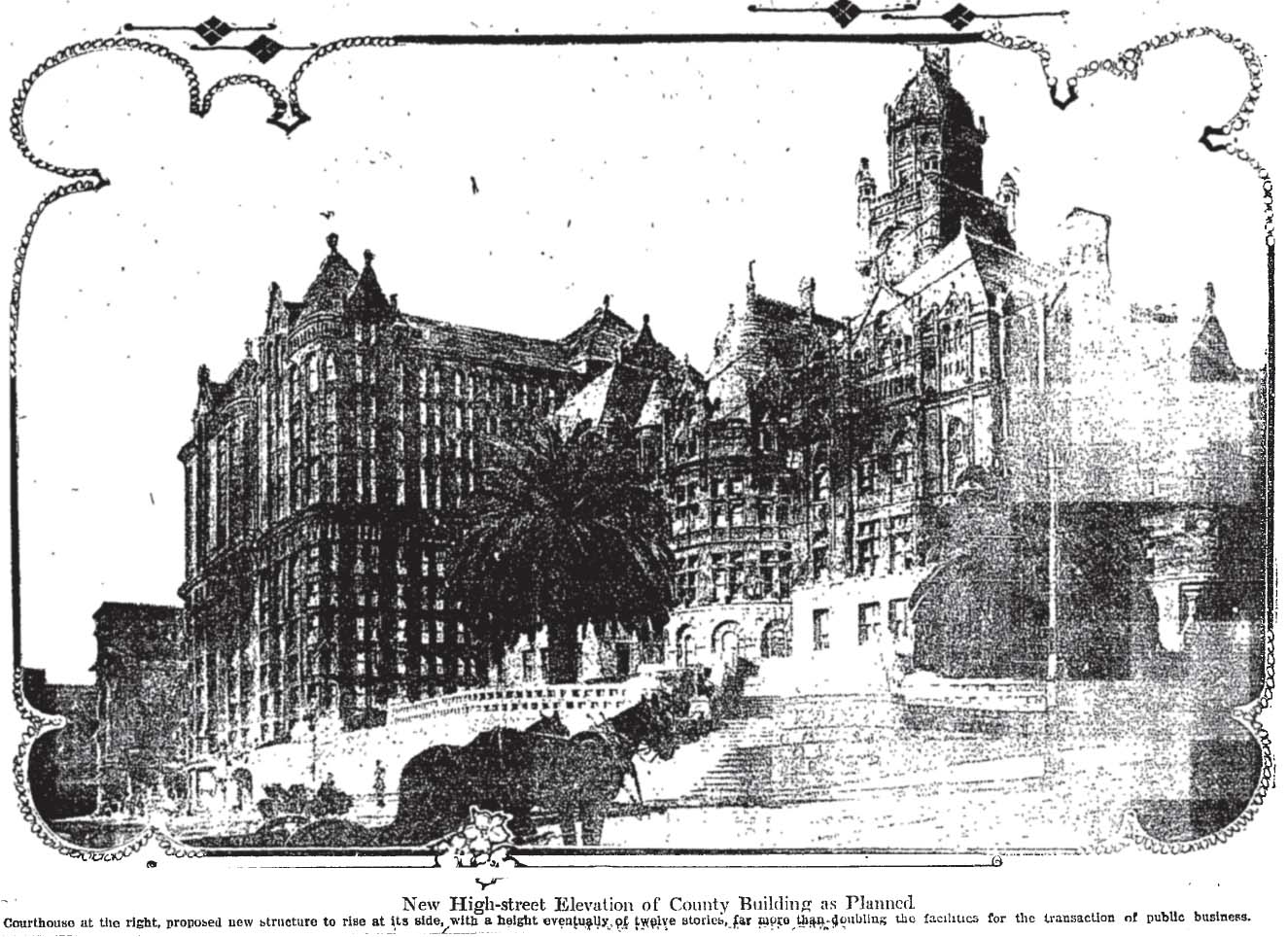
Above, an artist’s concept of the proposed Hall of Records, a white gingerbread building between Broadway and New High Street that was one of the landmarks of old Los Angeles.
Above, an artist’s concept of the proposed Hall of Records, a white gingerbread building between Broadway and New High Street that was one of the landmarks of old Los Angeles.
March 21, 1908
Los Angeles

I stumbled across the story of Penelope Murdoch yesterday but didn’t have time to pursue it until now. This photograph and few inches of
type from The Times may be all that remains of the aspirations of a Polytechnic High School student who hoped to become an architect. I can
find no further record of her.
Sadly, the anonymous Times reporter treats Penelope with humorous scorn and amused disdain, as if she’s a trained circus seal that can play a tune on bicycle horns and now has grand plans to write a symphony.
“One day, when other girls
were dreaming of party dresses and conquests, Miss Penelope, very
serious and very busy, up in the architect department, pursed her
pretty mouth and wrinkled her smooth young forehead.”—snip—
“But with the same demure calmness with which she might tell you how
she had decided on a ‘Merry Widow’ instead of a ‘Military’ for her
summer hat, she explained all about the relation of the Mission to the
Moorish style, and made bewildering allusions to Gothic arches and
Ionic columns and Dravidian pyramids, and told why you must never,
never use a fluted column on one sort of architecture–I forget what.”Chiseling away these writerly aerobatics and pompous digressions is slow, frustrating work and leaves the careful researcher with precious little information. We don’t even know, for example, Penelope’s age or
whether she was a freshman or a senior (bonus fact: Polytechnic was 4 years old and about to graduate its first class–not that you’d learn it from The Times).
What we do know is that there was a young woman who believed in herself and hoped to be an architect. She received the encouragement of
educators–if not The Times–and we can hope she achieved some success. The absence of her name in later editions of the paper is disquieting,
as if a spotlight shone on a young person of promise for a moment and then left her in the dark.
March 21, 1958

Rather suddenly, after several years of unaccustomed luxury to which
people became accustomed, and forgetful, the world seems to have gone
sharply economic again.
Once more the big talk is of nickels and dimes. Oops, better make that dollars. Inflation, you know.
In any event, the familiar incongruities and paradoxes are showing up.
A MAN ON an
Olympic bus was overheard by Don Drake saying to his companion, "Jerry
and his family are really up against it. He’s been out of work for more
than three months."
"Well," came the query, "he’s drawing unemployment insurance, isn’t he?"
"Sure, but after they make the payment on the car what have they got to live on?"
THE WAY BOB LEE (who
ought to be ashamed of himself) tells it, there was this gullible and
cooperative halibut which saw a baitless fishhook drifting loose
through the water off Manhattan Beach and said, "OK, take me to your
leader."
THE PIXIES have been busy again.
A motorist trying futilely to break into the jammed traffic on Fairfax
Avenue north on Wilshire, reports Larry Thor, was waving a white
handkerchief in token of surrender.
And Don C. Harvey broke up at a line some leprechaun wrote on a sign on
Hollywood Ranch Market warning that illegally parked cars would be
impounded and hauled away, to wit, "My big brother can whip your big
brother."

MEMBERS OF Gamma Delta Upsilon, City College journalism fraternity, will observe their 28th anniversary tonight at the Press Club.
As usual, special tribute will be paid to a talented and ubiquitous
member, Bart Reynolds. He’s everywhere, he has done everything,
including getting out the tong’s fine, recently published book,
"Paisano," consisting of eloquent letters written by members in the
service during World War II.
Now it can be told that Bart Reynolds doesn’t exist except as a
fictitious byline created by the fun-loving members. He’s their ideal,
the guy they all wanted to be in their youth. Which makes him one of
the longest-running gags in existence.
TO THE QUESTION,
"Who’s watching the store?" let us present Miss Gladys Paul. For 50
years she has presided at the same main floor counter at the Broadway,
handling women’s neckwear, ribbons and cuffs. Monday, in observance of
this half-century, she’ll receive a diamond-studded watch. Many persons
would say, "Monotonous, wasn’t it?" Not Miss Paul. She enjoyed every
day of it.
ONLY IN L.A. — A
waitress in a lunchroom near 6th and San Pedro streets was overheard by
Alan Ferber saying to a customer, "Sure he ought to see a psychiatrist
but they charge about $25 an hour and he hasn’t got the money. That’s
the trouble, poor people can’t afford to find out what’s wrong with
them."
AROUND TOWN — A
Santa Monica restaurant has a refinement on the "Happy Birthday"
routine. Instead of the cake and candles business, a waitress marches
to the celebrators’ table carrying a plate of pastries with two Fourth
of July sparklers alight … Coronet has a scary article on
"California’s Sinking City" –Long Beach … A La Mirada entrepreneur
figures to do all right. He’s selling car stickers stating both "Help
Stamp Out Republicans" and "Help Stamp Out Democrats" … The ultimate
in this particular category, however, was spotted by Cully of Culver
City, a sign on a Cad, "Help Stamp Out People" … While hiking on
Mulholland Drive, Arlene Cersky came upon a sign, "Site of Future
Bel-Air Presbyterian Church. Trespassers will be forgiven."
March 21, 1958

A month ago I wrote a column concerning a mysterious medal.
About the size of a half-dollar, it had the embossed figure of a stork on its face side, plus the lettering "Wanstead High School." On the reverse was the inscription:
"Hurdles. Open. D. Farrell. 1927."
There was nothing unique about the medal. It looked like any medal any kid in any high school might win.
But the element of mystery about it came in the letter to me which accompanied it.
The letter was from Mrs. Eleanor Hatch of Hollywood.
She found the medal, she told me, in a small can which had been around
her house for maybe 20 years. It was among a miscellaneous assortment
of rusty nails, hooks and buttons.
"I never heard of D. Farrell," she wrote me, "nor have I heard of Wanstead high School."
She added that she had no use for the medal, but somehow couldn’t bring herself to throw it away.
"That’s why I’m sending it to you," Mrs. Hatch said. "In the hope that
you can find its real owner. It might have some special significance."
I mentioned Mrs. Hatch’s discovery and wish in this column, figuring that no one would claim it–but anyway, I’d made an effort.

Immediately, it was obvious I was wrong.
The column ran the same day that a man named Donald Farrell made the
papers by completing a simulated week’s flight into "outer space" in a
U.S. government experiment.
Lots of letters and calls came in asking if this man might be a descendant of D. Farrell, the 1927 hurdles champ.
There were other calls from other Farrells, plus two from persons who
told me that Wanstead High School was located a short distance from
London, England.
One call was from Bob Jarvis, president of the advertising firm of
Prestige Inc. He told me that his friend, David Farrell, president of
Trust Deed and Mortgage Exchange, thought the award-winning D. Farrell
might be a long-lost relative.
Did I have any clues, he asked?
I mentioned the two calls about Wanstead High School being near London. And from there, Jarvis took over.
He cabled the London Times for an exact location of the school.
A reply came stating that there was a Wanstead County High School near London with the address: Redbridge Lane, Wanstead E. 11
Then Jarvis sent a cable care of the school’s headmaster. Did they ever
have a student name of D. Farrell? If so, did they have a current
address on him?
The reply came this week, signed A. Ingram, Headmaster.
It read:
"Thank you for your telegram asking about D. Farrell, an old boy of this school from 1926-8.
"I am sorry to report that he was killed in the war.
"He was a Sgt. Observer in a Wellington Bomber killed in action Sept.
11, 1941. The plane was shot down in the Channel and his body washed
ashore at Dieppe.
"The last address we have of his family was: Mr. W. Farrell (father) 50 Park Road, Kingston Hill, Surrey.
"Although I have only been headmaster since 1948 there are a few colleagues who remember him.
"I am sorry I cannot be more helpful. We are proud to have his name on our War Memorial."
When Jarvis phoned me yesterday, he said that Sgt. Observer D. Farrell was no relation to his friend, David Farrell.
Afterward, I called Mrs. Hatch. Again I read her the letter from
London. With a certain sadness, she said, "I’m sorry. I’m sorry to hear
it."
"You knew him? You remember him now?" I asked.
"No," she said. "I still don’t have any idea who he is or how he got his medal.
"But I’m sorry we’re too late to get it back to him."

Below, despite concessions from Lithuania, war remains a possibility between the nation and neighboring Poland … Mexico nationalizes foreign oil companies … An estimated 30,000 troops have died in fighting between Japan and China … And United Press helpfully identifies Mrs. Franklin D. Roosevelt as "the wife of the president." I’m so glad we didn’t get her confused with some other Mrs. Franklin D. Roosevelt.

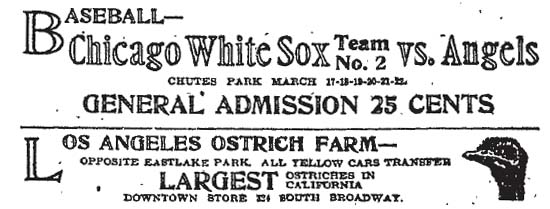 Above, baseball and ostriches. Below, the Rev. G.W. Woodbey, an African American minister described in The Times as a rabid radical, is convicted of speaking on a street corner without a license. Continue reading
March 20, 1958

Perhaps you, too, have caught the lilting language of the missile
experts. To them a satellite or a missile is "the hardware." It is said
to be propelled by an "exotic" fuel.
Already such terminology is having an effect. Two L.A. men, homeward
bound on a United Air Lines plane, were overheard discussing the
stewardess’ "perigee" and "apogee." In case you forgot, these words
mean the points at which the orbit of a celestial body is at its
nearest and farthest distances from earth. They may not exactly have
been talking about missiles, but that’s what they said.
As missiles soar, the vocabulary is bound to expand. It could go on and
on, the sky being the limit. After all, these scientists live in the
land of the huggermugger.
And as for those nose cones on the satellites, they look mighty esoteric to me.
WORKMEN ARE refurbishing
Grauman’s Chinese Theater for the advent April 8 of the Cinemiracle
production "Windjammer." The other day they uncovered a lesser miracle
at the extreme right of the forecourt, which, as everyone knows,
abounds with footprints of the famous.
Underneath an advertising panel which had covered it for years they
found a footprint, a bare five-toed footprint, and alongside it the
name Pat.

This is to advise that blasphemous rascal Pat, whoever he is, that fame has come at last.
ON THE OTHER side
of a screen in the occupational therapy section of General Hospital,
Buck Hathaway heard a mixture of women’s voices. He isolated one
asking, "How much have you in that stack, Alice?" Then heard the reply,
"Well, altogether, $25,480." Another voice chimed in, "I’ve got $2,310
here." Another, "I’ve got $15,000 even."
These are not the kind of sums one usually hears around General
Hospital so Buck peeked. The ladies turned out to be Gamma Phi Beta
members headed by Mrs. James Seminoff, wife of the basketball referee,
counting about $100,000 worth of trading stamps and sales slips donated
for the orthopedic children’s ward. They’ll be turned in for athletic
equipment to help rehabilitate disabled youngsters.
ONE OF THE soiled
doves who frequent a Hill Street bat cave came in the other day, shaky
but buoyant. She’d had her first bout with the dreaded DTs, she
reported, and it wasn’t as bad as she’d feared. All that happened was
that several large but quite friendly cats wearing hip boots kept
wanting to shake hands. When she extended her hand they dissolved.
Everybody felt much better.
OUT OF TOWNERS sometimes
get strange ideas about our little frontier. Price Norris,
Allegheny-Ludlum steel executive from Pittsburgh, admonished a car
rental agency at the Statler Hilton, "Please make sure I get one with
windshield wipers." He was assured all their cars have wipers.
"Oh," he said in all seriousness, "I understood they were optional out here."
AROUND TOWN — The
SC bookstore has reduced the price of a book titled "The Moon to Play
With" from $3.50 to 35 cents. Obviously Trojans would rather play with
other things … Opening of the Hollywood Rollerbowl April 9, said Joe
Yocam, "will launch a couple of thousand people into orbit" … From a
distance it looked to Rick Vance like two men were picketing a
barbershop just off the Ventura Freeway. As he got closer he saw their
signs stated, "This shop fair to average working man. Haircuts $1.25.
Boys $1. Dick and George’s Head-Quarters" … California may not agree
with Arizona on such things as Colorado River water rights but it has
approved the "annexation" of the 306 x 52-foot Grand Canyon Diorama at
Disneyland to our neighbor. The area will be officially proclaimed as
belonging to Arizona when it opens March 31.
March 20, 1958
 Barbara Ridley is 25. She’s the mother of four sons, ages 6, 4, 3 and 1.
She’s also part of the unpleasant headlines you’ve been reading this week.
She’s the wife of 36-year-old James Vernon Ridley, who yesterday confessed to the brutal raping of two girls, 11 and 9, in the San Fernando Valley.
I talked with Mrs. Ridley shortly after her husband confessed to the crimes. It wasn’t a pleasant conversation for either of us. But the more we talked, the more I got the feeling that it was an important one.
Not just to us. But to everybody.
Barbara told me that she was 17 when she married Ridley. She’d known him two months before they ran off and eloped.
 It had to be that way because Barbara’s parents were against the marriage.
Her husband, she told me, was quite a nice guy — good-natured, generous, wonderful with the kids.
"He was more patient with the children than I was," she said.
But he was sick and, little by little, it became apparent to Barbara that her husband needed help.
A couple of years ago, his nervousness increased alarmingly. At Barbara’s urging, he visited a doctor — a medical doctor.
The doctor said he was suffering from a vitamin deficiency. James Ridley took his pills regularly, but his nervousness increased. Everyone was against him, he’d confide to his wife.
The next step was an obvious one: a psychiatric examination.
Barbara suggested it, but her husband said he was all right, he wasn’t crazy.
But a few weeks later, after James Ridley had walked out of the house supposedly to go to work, his wife received a phone call from General Hospital. Her husband — she was told — had committed himself for examination.
In two more weeks, he was home again.
"They told me he was suffering from schizophrenia–to have him committed to Camarillo," she explained.
The Christmas holidays came, so the Ridleys waited. They wanted a family Christmas.
They had it, and shortly afterward Ridley was committed to Camarillo for 90 days.
"Then they put him out — on indefinite leave, they called it," Mrs. Ridley told me. "I said I didn’t think he was ready. I felt it especially after he told me that he never got to talk to a psychiatrist. Just shock treatments — that’s all they gave him, I guess."
Then Barbara Ridley tried to get her husband some outpatient psychiatric care — with no success. "We couldn’t get it from the county and couldn’t afford a private psychiatrist," she said.
What happened after that is ugly current history. Two young girls have been attacked.
You can blame James Ridley. He’s not sane.
But you have to wonder if somebody else isn’t to blame too. And wonder if some terrible tragedies could have been averted if some of the persons we pay to represent us and protect us hadn’t ignored James Ridley when he wanted and needed help.
In a community of millions, there’s bound to be more than one James Ridley. And until our officials decide to protect us from them — either to cure them or keep them locked up — we’re going to have more tragedies.
When I talked with Mrs. Ridley, I asked her if she planned to stand by her husband.
"I don’t know," she said. "I don’t want the kids to know. If it’s a choice between my children and my husband, no, I can’t stand by him.
"I’ll just pray to God that he finally gets the help he needs. For his sake and for the sake of children like those little girls…."
For the first time, Mrs. Ridley broke down.
"If he gets help, he can take care of himself.
"My children — they can’t."
"Your children, of course, don’t know," I said.
"The oldest boy overheard us today — talking about it," she answered. "My father-in-law was saying, ‘They’re taking Jim to the County Jail.’
"And my boy said to me, ‘Mommy, is that where Daddy is? Is he in jail?’
"I told him, ‘No, baby, that’s somebody else’s daddy. Your daddy is in the hospital.’
"But he shook his head. ‘Mommy,’ he told me, ‘I just can’t understand what’s going on.’ "

Above, more layoffs, this time in Los Angeles’ auto assembly plants in South Gate, Van Nuys and Maywood, recall the recurring theme of unemployment in recent columns by Matt Weinstock and Paul Coates. Below, the Navy discovers that a mystery object believed to be an enemy submarine was really a whale … Rhonie David Rhonemus is captured … On the inside cover, Councilman John C. Holland asks for a congressional hearing on the city’s contract with the Dodgers for a stadium at Chavez Ravine … And actress Lana Turner returns from a Mexico vacation with Johnny Stompanato. Turner and Stompanato are met at the airport by Turner’s mother and her 14-year-old daughter, Cheryl Crane.
Quote of the Day: "There is definitely no romantic interest between us." –Lana Turner, on her relationship with Johnny Stompanato.

Above, an interesting wrinkle in the campaign to recall Mayor Frank Shaw. Below, Lithuania concedes to Poland and the nation’s celebration turns to rioting in Warsaw’s Jewish ghetto … On the jump, more than 500 people protest outside the German-Austrian Consulate in Los Angeles, 117 W. 9th St. In Vienna, the Nazis close synagogues. Nazi storm troopers force hundreds of Jewish men, and a few women, into cleanup crews. "The Nazis told them it would do them no harm ‘to learn what real manual labor means,’ " United Press reported.
Quote of the Day: "The windows of hundreds of Jewish-owned shops were smashed and strong police guards encircled Warsaw’s ghetto to prevent large crowds from invading it…. Orators talking about Lithuania hardly could be heard above crowds shouting ‘Down with Jews!’ and ‘To Madagascar with the Jews!’ " –Associated Press, via The Times


March 20, 1938

Wow! Here’s a "Joe Palooka" strip from 1938. All of Ham Fisher’s white characters are drawn realistically and the African American is this ghastly caricature who speaks in dialect. Seeing something like this in the daily press on the eve of World War II takes my breath away. And not in the good way.
March 20, 1938


A German politician speaking in the Reichstag provokes snide remarks from the press gallery for saying "a Negro also has an immortal soul." Below, an Examiner reporter is jailed in the theft of photos that were published in the Hearst paper. He is the third Examiner newsman to be jailed in the incident, The Times notes … And Stanford is in a stalemate with students over the dismissal of 12 men who took part in an "anti-faculty parade."

March 19, 1958

Books never grow old for me.
Somehow, I rarely find time to
read them when they come out but months or years later I find them on
the shelves and they are as fresh as if newly published.
If
they’re good they stay good and it is this permanence and availability
in books that will never be replaced by, shall we say, the more
transient arts. Furthermore, having a batch of unread books gives a
person something to look forward to.
Of course, I am reconciled
to never making it with certain books which glare at me daily. Marcel
Proust, for instance, in two volumes. Marcel, I’ve tried, but I don’t
follow you.
THERE ARE brooding
boys and ponderous boys and the obscurity boys and sometimes, as in
William Faulkner, it’s worth fighting your way through a page-long
sentence to find a glittering phrase. But I find I am increasingly
impatient with the soul-tortured boys, including Thomas Wolfe, who take
too long to say what they have in mind. I prefer the precision guys.
And there are plenty of men and women writing today who can say more in
a short story than the so-called masters do in a long novel.
Actually,
reading is a matter of mood. I can always get a lift from the casual
but sharply etched writings of E.B. White, James Thurber and the mad
precision of S.J. Perelman. For that matter, I can lose myself for
hours in Bartlett’s Familiar Quotations.

For a jolt I turn to Ray Bradbury, J.D. Salinger, Roald Dahl, John Collier, Elizabeth Enright–the
list is endless. I always come back to Ernest Hemingway, John
Steinbeck, Somerset Maugham, Norman Douglas and Henry James. And it’s
always a satisfaction to turn to books not so well known.
I wonder how many persons who hear Eric Severeid
on TV know he wrote an excellent book, "Not So Wild a Dream." Or ever
heard of Laurens Van Der Post’s "Journey to the Interior" or have read
H.L. Davis.
All of which is another reminder that this is national Library Week. A treasure awaits your pleasure.
IT IS CUSTOMARY for persons receiving awards to express deep gratitude to their mothers, wives, fellow actors, producers and discoverers.
On receiving one from TV-Radio Life the other day, Desi Arnaz
said, "I would like to thank those guys who started the revolution in
Cuba in 1933." Creating in Desi a wild desire to be elsewhere.
Stan Freberg, who received an award, although his KNX
show was canceled in mid-satire, said: "We tried to avoid cliches on
the program and one of the most successful eliminations was the phrase,
‘And now a word from our sponsor.’ "
IN CASE YOU hadn’t heard, the third stage of the Vanguard which is orbiting along with the satellite is named Toozigoot. Where, you are bound to ask, did it get a name like that?
Well,
the YMCA sponsors a Y-Indian Guide program designed to establish closer
companionship between fathers and sons between the ages of 6 and 9.
Different groups take different Indian names.
Charles E. Bartley, head of Grand Central Rocket Co. of Redlands, which made the Vanguard’s third stage, and his son Steve, 7, belong to the Toozigoot tribe which, according to archaeologists, existed in Arizona AD 1000-1400. So there you are.
THOUGHT FOR TODAY — Listening to a recording of Gertrude Stein (a rose is a you know what) reading her own stuff, writer Lou Huson remarked, "How can you tell when the record gets stuck?"
AROUND TOWN — No matter what anyone else says, Mrs. Evangeline Benitez of East L.A. received a letter from Lupe Gutierrez in Torreon, Coahuila, Mexico, addressed to "Los Angeles 22, Calif. Heaven" … Attorney Pat Cooney
received a check the other day from James Termini of Hollywood. On St.
Patrick’s Day 10 years ago, he recalled, Termini was arrested for
selling shamrocks downtown without a license. Cooney took the case and got an acquittal … Doreen Jakubowski’s
favorite Mrs. Malaprop was an elderly Cockney housemaid who always
explained an absence with, "Couldn’t come yesterday, ma’am, it’s me ‘ardening of me artilleries."

Los Angeles Times file photo
Emmett Kelly, right, in an undated photo, with a mystery guest. The picture was apparently a publicity photo for the Jan. 21, 1962, television program "Project 20," which featured the Clyde Beatty Circus.
By Keith Thursby
Times Staff Writer
It was an unlikely sports story—a clown announcing the end of
his connection with the Dodgers.

Emmett Kelly said the Dodgers had failed to renew his
contract for the 1958 season. Kelly, a longtime performer with Ringling
Brothers and Barnum and Bailey Circus, was no mere clown act. He had performed
on Broadway and in movies and had taken off the 1956 season to serve as the
Dodgers’ mascot in Brooklyn. (You can still find Dodger pennants from that era
with Kelly’s portrait.)
The Associated Press story noted that Kelly’s "glum face had
been a source of laughter to millions of children."

Photograph by Art Rogers / Los Angeles Times
Emmett Kelly cleans his plate–in this case home plate–during a Dodgers-Braves game on April 15, 1962, for Senior Citizens Day at Dodger Stadium.
He blamed the Dodgers’ selection of the Coliseum for the
decision. He said the team’s first home in Los Angeles was "too big for one
clown."
The story said Kelly was
returning to his first love, the circus. He died in 1979.

Photograph by Art Rogers / Los Angeles Times
Emmett Kelly jokes with an umpire at Wrigley Field in a photo published June 30, 1957. [No, it wasn’t "photoshopped." The print was so big that I had to scan it in two sections and paste it together.–lrh]

Los Angeles Times file photo
Emmett Kelly, possibly in Vero Beach, Fla., in a photo dated June 27, 1957.

Above, a look at the making of "The Defiant Ones." Below, we drop the masthead to run a terrific horizontal shot as a test pilot who bailed out of an F-4D Skyray is rescued from the ocean … President Eisenhower tries to pull the U.S. out of a recession … The Fed cuts its rate by half a point … The "moving mountain" in Elysian Park is once again threatening the Pasadena Freeway … And Chrysler and Ford sales are up.


Above, a feature on Woodrow Wilson "Woody" Strode, athlete and actor, who starred in "Sergeant Rutledge." Below, Poland prepares for war with Lithuania … The forces of Generalissimo Francisco Franco bomb Barcelona while loyalist forces sink one of Franco’s cruisers … And former President Hoover, on a tour of Europe, says there won’t be a major war in the near future. On the jump, prominent Austrian Jews commit suicide as the Nazification of the nation’s Jewish businesses proceeds … Anthony H.G. Fokker, who built German warplanes in World War I, predicts devastating attacks by hundreds of planes carrying 3,000 pounds of bombs in "the next war."
Quote of the Day: "There is a general realization everywhere, I think, that civilization as we know it cannot survive another great war." –Former President Herbert Hoover, on his tour of Europe


Above, development spreads across Southern California. And of course, once people move to Chino they will need some sort of transportation … Below, a clever fraud by a clever, affable insurance man who fakes a death … At an African American dance in Redlands, local prizefighter Harry Beal is stabbed when he tries to stop a fight between two men over a woman. During the fight, one of the two suitors drew a gun and fired three shots, wounding another woman. One man fled from the party while the other was jailed, only to dig his way out "with the aid of some 50 other Negroes," The Times says … And Roland McDonald is in jail after promenading around the city with his new–and loaded–Luger pistol in his pocket.

March 18, 1958

Yesterday I told about a man sent out by this office to visit a few of
the hundreds of persons in Southern California who represent themselves
as "income tax experts."
We gave him the name of Victor Romano. Occupation, insurance salesman. Wife, Mary. Her occupation: beauty operator.
Romano left my office armed with a set of facts and figures pertaining
to his family’s 1957 earnings and expenses plus some mock W-2 forms to
support them.
He visited many "experts" –finally settling on four to fill out his
1040 form and determine the government’s bite on the $7,635.25 combined
income of himself and his wife.
Two of the tax "specialists" he picked at random. The third was an
official accountant for the Internal Revenue Service. And the fourth
was a member of a recognized accounting firm.
The results: No. 1 stated that–in addition to the $874.40 income
withheld–he owed Uncle Sam $98.07. No. 2 said he deserved a refund of
$101.93. The Internal Revenue Department figured his refund at $112.69,
while the recognized accounting firm came up with a refund of $302.66.
The discrepancy of more than $400 was pretty frightening. It was $400 in or out of taxpayer Romano’s pocket.
But the figure wasn’t half so frightening as some of the miscalculations and omissions by Experts No. 1 and No. 2.
It’s pretty obvious that neither knew what he was doing. Both made
mathematical errors. Both cheated Romano out of money. And yet both
made him liable for cheating the government.
The mythical Mr. Romano’s wife earned $2,400 working in a beauty salon.
Yet both Experts No. 1 and No. 2 ignored the fact that beauty operators
receive tips for their work.
Therefore, the Romanos’ tax form would never have been approved by a government auditor.
Other errors which might have been caught included:
1–An illegal $400 deduction, claimed because Mrs. Romano bought some
beauty parlor equipment which Expert No. 2 labeled as a "loss" when she
abandoned her small home beauty salon business.
2–$30 overestimate on her uniform cleaning bills.
3–A miscalculation in the number of miles Romano drove his car. Romano
stated he drove his car 1,200 miles a month, yet Expert no. 2
multiplied that by 12 months and arrived at the figured 18,000.

But, if you’ll note their final figures, you’ll see that they cheated the Romanos more than they did Uncle Sam.
Expert No. 1 didn’t even bother to ask Romano if he used his new car in
his business. Neither No. 1 nor No. 2 figured in any depreciation for
the car.
These omissions alone cost Romano a lot of his own money.
Other deductions completely overlooked by Nos. 1 and/or 2 (and legally
listed by the government and accounting firm men) included various auto
upkeep expenses, cost of utilities in operating home beauty parlor,
purchase of briefcase for business, use of home phone for business and
depreciation of typewriter.
Victor Romano paid out $21 to one man, $16 to another for professional
service. In return, he got a jumble of practically meaningless figures.
Either through incompetence, ignorance or a greed to get on to the next sucker’s tax forms, they gouged him good.
Yet one of them, through sheer luck and miscalculation, came within $11
of the Internal Revenue Service auditor’s final figures–while the
established accountant disagreed with Uncle Sam’s agent by $189.97.
I showed the latter two forms to two independent certified public accountants.
Both forms–they told me–were errorless. Human nature accounted for
the wide variance, with the government man favoring his uncle and the
public accountant favoring the taxpayer.
One disagreement came in tips received by Mrs. Romano, with the
department man setting an arbitrary figure of $250 (25% or her net
income) and the PA setting it at $100 (10%).
Romano stated $100 when asked, but acquiesced when the federal auditor told him $250 was a more "realistic" figure.
Other major disagreements came in use of auto in business (90% against
50%), parking ($5 a week against $2.50 a week) and depreciation of car
(where the PA used depreciation scale more favorable to taxpayer).
The independent CPAs who studied the two forms both said they felt the
PA’s totals were more "realistic" than the government man’s.
And the accountant who arrived at the $302.66 refund figure said he’d be willing to fight Uncle Sam about it tomorrow.
"If the government auditor was reasonable–not arbitrary–we’d win
right away," he said. "If the first one wasn’t reasonable, we’d
eventually get high enough up to find a man who was."
Usually, this type of dispute would end in a compromise.


