From the Daily Mirror mailbox


The inbox, Williams and Walker

My Sept. 7 piece in "Then and Now" on the black minstrel teams of McIntyre and Heath and Williams and Walker — based on this Daily Mirror post — drew a fair number of responses.

It’s really nice to have such great readers, and folks, you are welcome to criticize me all you like, but please base it on what I actually said rather than what you think I said. I wrote: "While researching Heath and McIntyre, I ran across another team of
entertainers who were far more obscure: Bert Williams and George Walker."

You may notice that in my original Daily Mirror post, I said: "In researching Heath and McIntyre, I ran across another team, perhaps not as well known: Bert Williams and George Walker." Somewhere in the process of turning the post into a story, the "O-word" was introduced, possibly by me or possibly by someone else–I don’t recall now. But my name is on the story, so I’ll take ownership of it.

My point was (and remains) that in their day, specifically the 1898 booking where they appeared together at the Orpheum in Los Angeles, the team of Williams and Walker wasn’t as prominent as the team of McIntyre and Heath. I think that’s a pretty defensible argument. 

I would invite you to read Bert Williams’ March 6, 1922, obituary from The Times, which was evidently based on material Williams provided. Notice that it says he went to school in San Pedro. Curiously enough, it makes no reference to his appearances with the Ziegfeld Follies, but says that Florenz Ziegfeld Jr. sent flowers upon learning of Williams’ death. Although the original writer isn’t around to answer why there’s no mention of Williams’ achievements in his later solo career, the Daily Mirror is fortunate to have readers who can add their voices in ways The Times could never imagine in 1922.

Bert Williams obituary, Part 1

Bert Williams obituary, Part 2

Thanks for reading!

Larry

ps: Here’s a wonderful item I found on Bert Williams from 1920 (and not listed in imdb). Unfortunately, it appears that the movies were never made.

1920_0410_williams_2


Mcintyre_heath_1937_0819

McIntyre and Heath in an undated photo that was published in some editions of The Times when McIntyre died in 1937.

McIntyre and Heath

I was glad to see your piece on McIntyre and Heath in today’s paper. In their time, they were among the biggest of acts, and probably the longest-lasting partnership in all of show business. Both were also fabulously wealthy from their investments in Long Island real estate. An interesting interview with Jim McIntyre is in an early issue of VARIETY (actually sworn testimony in court). Both men had long since abandoned the minstrelsy, yet McIntyre described himself and his partner as "nigger singers," a common show-biz term for a pair of minstrels.

It’s generally the case with modern accounts of those days to deplore the use of such language and such characters, and to write them off as the products of insensitive times. True, perhaps, but a reading of the trade press of the time shows that a number of potentially-offensive acts existed for any ethnic or racial stereotype you can possibly name. Blacks, of course, get the majority of the attention today, but there were also character Jews, Germans, Mexicans, Englishmen, Frenchmen, Swedes–you name it. And each had an associated stereotype with characteristics that would readily play in front of a cold vaudeville audience–cheap, hungry, lazy, etc., etc. If a performer had just 14 minutes to put an act over, he or she had to work quickly. Coming out in character makeup was instant familiarity.

In the trade, these character types were generally labeled with the roughest of slang. But never the performers–just their characters. I firmly believe this is where the racial and ethnic stereotypes we so deplore today originated. They were characters on the vaudeville stage, and they later migrated to radio. Scratch Amos and Andy and you’ll get McIntyre and Heath. You will find a pretty fair introduction to McIntyre and Heath in my 2003 biography of W.C. Fields. McIntyre’s papers, incidentally, surfaced a few years ago and are now in a university library in the Pacific Northwest.

Two points to be made about Bert Williams: He was so light skinned he had to wear blackface on stage. Moreover, as I understand it, he grew up in Riverside. The other day I was driving through one of those vintage neighborhoods adjacent to the Mission Inn and got to wondering if Williams’ house still stands. The local history museum in Riverside, of course, makes no mention of him. A little film of him survives, along with some crude recordings. It’s too bad he didn’t live another ten years, so that his great routines could have been preserved on the talking screen. There are at least three book on Williams, the earliest published in 1923, the latest in 2005. The best known, NOBODY, was a minor bestseller in the late 1960s.         

Cheers.

James Curtis


Just wanted to say how moving I found your piece about blackface.  It was so interesting how early the black guys died and how long the white guys lived…

Also look forward to the time when our current crop of performing drug addicts, exhibitionists, criminals, porn addicts and losers become as extinct as this form of "entertainment"…

Just one grandma’s opinion.

Thanx.

Jheri St. James


Bert_williams_1919_crop

Los Angeles file photo

Bert Williams in his solo act after the death of partner George Walker.

Williams and Walker

Larry, I very much enjoyed your article on McIntyre and Heath. As a collector of old sheet music of that era I have a substantial number of sheet music covers that featured the images of blackface performers. Below is a copy of an 1897 song featuring Williams and Walker. A dealer presently is offering a copy for $200.00.

Williams_walker_enjoy_2

Williams was not considered black enough, so when he appeared on stage he was corked up in “blackface.”

Williams_walker_1903_crop

Williams (left) and Walker 1903

While Williams and Walker may have been more “obscure” as you stated, but Bert Williams was a giant in the entertainment industry. He wrote successful songs, was one of the most successful recording stars of the era, starred in the Ziegfeld Follies, starred in film.

I have numerous music sheets with his image and many of his must successful songs.

I have attached a slightly redacted copy of his bio from Wikipedia. Give us some more articles like this.

Best,

James Nelson Brown, Esq


Themiddle ma is an off-handed depiction of the dignified interlocutor, who was addressed as Mr. Interlocutor by Mr. Bones, or whoever. 

Bert Williams was one of the most famous performers of his day. His song, "Nobody" is still considered a show-stopping classic.

B.J. Merholz
http://www.Pacific-Eclectic.com


In today’s Los Angeles Times, I found your article about McIntyre, Heath, Williams and Walker interesting.  I was surprised that you weren’t familiar with Williams & Walker.

In 1987, when my wife and I lived in Atlanta, we saw a wonderful play called "Williams & Walker".  It was put on by Jomandi Productions, National Black Touring Circuit, Inc., and American Place/Federal Theater Production.  The play starred Ben Harney and a young Vondie Curtis-Hall. 

I’d like to see you do a follow up article and talk about Williams & Walker in more depth.  I’m sure Vondie Curtis-Hall would be a wealth of knowledge.  Also, I’ve included a helpful link below.

http://www.si.umich.edu/CHICO/Harlem/text/williams_walker.html

Sincerely,
Leroy McKinney
North Hills


Enjoyed your LA THEN AND NOW article today.  I am the Executive Director of the Conejo Players Theatre in Thousand Oaks.  We have announced our 2009 season which includes a new musical "Bert n’ Eddie" the story of Bert Williams and Eddie Cantor.  It covers the Ziegfeld Follies time in these two performers lives.  The author and composer of original music and lyrics is Richard DeBenedictis who has
been a TV, film and stage composer here and in New York.  I have been easearching Bert Williams in preparation of our production next year.  Upon reading your article I thought you might appreciate what Bert Williams did after his partner George Walker passed away.  He became a Broadway headliner for Ziegfeld and worked with WC Fields, Will Rogers, and did an onstage skit with Eddie Cantor in blackface. 
See attached. Yours truly, Dick Johnson.


Fine article in today’s times.  I had never heard of McIntyre and Heath, but I
was familiar with Bert Williams mostly through a wonderful Ry Cooder album (is
there any other kind) called "Jazz" released in 1978.  On it is a Bert Williams
composition with a beautiful melody and brilliant lyrics called "Nobody".  If
you get a chance give it a listen if you haven’t already.  I think it reveals a
lot about the deep soul that was Bert Williams. 

Howard Gewirtz


.hmmessage P
{
margin:0px;
padding:0px
}
body.hmmessage
{
}

In your piece "Jarring look at an earlier entertainment era" (9-7-08), you wrote
"these fellows sounded fairly interesting and worth investigating" about the
team of Bert Williams and George Walker. Hello! Did you not as a professional
writer fortunate to have a job as a writer immediately recognize Bert Williams
needed no investigation as he is a legend, the first African-American superstar
performer, the first Black man to headline Broadway, the performer all
subsequent African-Americans emulated? You failed to mention this in your
research. A paragraph explaining he went on to major stardom following his going
solo was needed to round out your piece. And you get a paycheck for such
sloppiness?


I have been a Bert Williams fan and was happy to learn he graduated from San Pedro  high school but Wikipedi says he graduated from Riverside High . Do you know for sure ? MARK BEGOVICH  San Pedro 

I love Ry Cooder’s version of his song  NOBODY !


I enjoyed seeing the article about McIntyre and Heath and Williams and Walker in today’s L.A. Times.  However, you missed the most compelling story.  Williams and Walker had a career that went way beyond what African-Americans of that time ever conceived of – producing some of the first all-black musical-comedies and bringing them to Broadway.  As a solo performer, Bert Williams became the only African-American to work in the Zeigfeld Follies – the pinnacle of variety entertainment at the time.  No less a person than W.C. Fields called him "the funniest person I ever met…and the saddest."  He grew up in Riverside.  For more on this era, check out Allen Woll’s "Black Musical Theatre: From Coontown to Dreamgirls" or Ann Charter’s "Nobody: The Story of Bert Williams."  As far as I know, Bert Williams and George Walker never played in minstrel shows.  They did blackface entertainment in the saloon variety shows out of which vaudeville developed.

Yours,
Andy Davis

Asst. Professor
Liberal Arts & Sciences
Otis College of Art & Design.


I’m glad you ran the article on both white and Black minstrel performers in L.A. What Larry Harnisch didn’t mention was that after his partnership with George Walker broke up (in 1909, two years before Walker’s death), Bert Williams went on to major stardom, becoming the only African-American ever to star in a “Ziegfeld Follies,” recording for Victor and Columbia and even making three short films, two of which he produced himself. At least four biographies of Williams have been written, and his most famous song, “Nobody” (which he wrote), is still performed occasionally.

For anyone who wants to hear the team of Bert Williams and George Walker, at least two of their records — “My Little Zulu Babe” (1901) and “Pretty Desdemone” (1906) — are available as free downloads on the Web site http://www.archive.org

Sincerely yours,

Mark Gabrish Conlan


In the late forties, while having lunch with Eddie Cantor and Steve Barrie, p.r., for American Cancer Society and a double for Cantor, and being entertained with Cantor’s experiences in vaudeville, in early films and radio, I happened to bring up Bert Williams.   Although I had never seen Williams I said how much I enjoyed the weekly minstrel shows at Steel Pier in Atlantic during my 12 week summers.   It was there I originally met and became friendly with Lou Costello, who was part of the minstrel shows with Bub Abbott.

“Barney, Bert was the sweetest, loving, human being I ever had the pleasure of working with” Cantor began..  He was the kind of man you wanted as a friend.  When I said I would like him to travel with me on some of my engagements he balked.”

“Mr. Eddie” he said, “Traveling with you would mean trouble with my hotels.   I wouldn’t like sleeping where black folks can while across town you’re in some ritzy white man’s palace. I’d feel hurt we couldn’t be together”.

“Well…I know what I had to do” Cantor continued.   “I didn’t want him to be separated from me.  He was my friend.   I made him a promise that wherever I stayed, he would stay, too”.

“What are you some kind of a magician” Bert asked with a smile.

“And I quickly replied, ‘Bert, I’ve got to be a magician.  Who else has five daughters’.   Well….we both laughed and I made it happen.   Whatever all-white hotel I was booked into, I made arrangements with the manager.   If he would let Bert have a room, that both  Bert and I would enter and leave the hotel by the service entrance”.

“How wonderful” I interrupted.   “And if not, you probably would have stayed with him where the colored folks stayed”.

“I never thought of that, Barney” Cantor replied with a frown.  “I would never ever let that happen.   I just thought I could make the manager see that by using the service elevators we’d be invisible to the rest of the guests.   And you know what I never figured….how Bert would take such an arrangement.  But I soon found out”.

“You mean he was upset that he could stay in a while hotel but resented the way he had to come and go”.

“Let me tell you, Barney….precisely what happened.” Cantor offered.   “It was in Detroit.  Opening night.   The audience went wild with the show. They must have applauded for five minutes.  We were so pleased.   In fact, we were overjoyed.   And as we left the theatre, Bert was quiet.   He was so loquatious.  Not this time.   Knowing Bert like I did I thought he’d tell me when he was ready.   That night we did.

“While riding up in the service elevator Bert kept repeating, ‘I just don’t get it.   Eddie I just don’t understand’.

“What is there to understand” I replied with a chuckle, “We’re together.  We’re both riding up in the service elevator together.  There’s no shame”.

“You don’t understand, Eddie” Bert continue almost in tears.  “Yes, I’m going up to my room in this service elevator…but don’t you understand, Eddie….I can still hear that thunderous applause in my ears.  And it was from the white folks.  There were no coloreds in the theatre. Just plain              white folks who came to be entertained…..and I’m riding up in the service   elevator”.

“Look at this way, I said to Bert….    Yes….the theatre was packed with white folks….and look at me….I’m white….and I’m still riding up in the service elevator”.

Barnard Sackett


Your LA Then and Now in today’s L A Times misses some points about vaudeville and minstrel shows that I think are terribly important.   

To say that Bert Williams was obscure is totally unfounded.  He was a great star of vaudeville, recording for Columbia Records.  His "Sermon on Throwing Stones" was a classic.

Minstrel was an important part of American entertainment.  Unfortunately "politically correct" dialogue doesn’t even allow a fair telling of the story.

Bill Peters


I enjoyed your article in Sunday’s paper; wonderful tidbits exhumed from
the Times’s morgue about some famous old time entertainers.  Perhaps you
already know, but Williams’s life has been amply documented:  two
biographies have been published, one by Anne Charters, and the other, just
this year, by Camille Forbes.  Also, all of Williams’s recordings have been
reissued on CDs.  By the way–though he may have been "from" Los Angeles at
the time of the Times’s article, he was born in the Caribbean–Jamaica, I
believe.

Cordially,

Norm Cohen
Portland OR (temporarily in Ojai)


I am writing in response to the excellent article.

While much of the emphasis was on McIntyre and Heath, I was especially impressed with your segments on the life of Bert Williams.

I first encountered him in a graduate music course at Brooklyn College and have been enthralled with him ever since.

Most people have not heard of Bert Williams, but he was a tremendously influential pioneer who opened doors for Black entertainers.

He was the first Black member of the Ziegfeld Follies.  When the rest of the troupe threatened to quit if Ziegfeld hired him, Ziegfeld told them that they were all expendable, except for Bert.  They shut up immediately.

I have studied screen writing with a professor at New York University for several years and one of my projects was a screenplay about the life of Bert Williams.  After copious research, I wrote the initial draft.  It has had numerous revisions and re-writes, and a staged workshop reading.  I have recently breathed new life into it.

My screenplay is a lively and sometimes gut-wrenching account of Bert’s ascendancy to show business stardom.

I re-create scenes in which Bert and his partner, George Walker, were threatened with violence and humiliated unmercifully.

I show Bert’s initial hostility to the practice of blackface and his eventual success in that idiom.  He became the highest paid entertainer in the world, his salary exceeding that of the President.

I believe passionately that Bert’s story needs to be told.

Black and white audiences alike should be aware of this man’s singular achievements and accomplishments.

If this email goes on a blog, I would like to invite any interested actor or director to contact me.

Thanks again for shining the spotlight on this exceptional man – Bert Williams.

Daniel Ezell
Queens, New York


I was delighted to see Bert Williams featured in the Times (LA Then & Now, Sept. 7), but puzzled by Larry Harnisch’s characterization of Williams as "obscure." During the height of his career, Williams was arguably the country’s most popular comic of any race. Williams and Walker’s 1902 production "In Dahomey" was the first major Broadway musical written and produced by black artists. Williams was the recording industry’s first black star; his 1906 signature hit, "Nobody," was later voted into the National Academy of Recording Arts and Sciences Hall of Fame. He was also Broadway’s first black artist to receive star billing, appearing in eight editions of Ziegfeld’s Follies, and the first black member of Actor’s Equity.

Jim Tranquada


Larry Harnisch contention that the comedy team of Bert Williams and George Walker was
"far more obscure" than McIntyre and Heath may be accurate, however any reference to Williams as obscure is wildly off the mark.

Bert Williams – likely due to his "blacking-up" – had over 25 recordings carried by the "Lilly white" shops on the hit list of the era (Joel Whitburn: Pop Memories 1890-1954) and his trademark song, "Nobody" (written by Williams) sold over a million copies both as sheet music and recording.

In addition Williams leapt from vaudeville to Broadway in the early 1900 going on solo to headline the Ziegfeld Follies. There are films of many of his performances. Among the best are featured in Broadway: The American Musical: Episode One.

He became one of the countries most popular singers and comics for the 2 decades before his death. Hardly obscure.
Name :Hugh Harrison


1897_0509_minstrelry


Minstrel shows

I think you have written a very pleasant article about a bygone era that not many people know about. I see them occasionally on AMC or Turner Classics on TV. You did an admirable job of discussing the entertainment of that time, in a short article and the read was compelling.

But, your setup to an article that was written by the Times in 1898 was childish.

You wrote, "Be warned: The racial references in the Times review from 1898 will set your teeth on edge."

Why are you apologizing for an article that was written over 100 years ago. All you had to say was that this was the story written by the Times in 1898 and thats it. Its like your distancing the Times from that article, which they themselves wrote at that time. Do you have a guilty conscience about something? Did you write that article in 1898?

A have a feeling you do not consider yourself a great writer yet, because the great ones just write and dont apologize, they let the reader figure it out. Nowhere in the article did you make a judgement about Minstral shows (pro or con), you were just translating a story about two sets of comedians. And you did it well! Then you had to make an incorrect judgment call on something that had no bearing on the story you were telling. Dont manipulate the reader. I read the story and the one thing that still sits in my mind is "will set your teeth on edge", because it didnt and you said it would. I feel like I missed something.

Be a better writer and leave those setup comments out of future writings.

In closing, again you did a good job and am looking forward to future offerings.
Gary Popiela


so nice to see History and education in the paper instead of all the woe & hardships, Death & distruction.Not only to our humanity, but to our lands as well!
I rember as a child seeing the "darkies" as they decided not to leave the employ of our family! We never mistreated or demeaned the "coloreds" as they preferred to be called.

throughout my lifetime we have gone from a variety of "names" for them in society. However we always called them as they did us "Miss Rita" Mr James" "Miss Louella" "Miss Agusta" or "Mr Tomas"..no different ! however I must say it was whimsical when you reffered to the one gentlemans mother being "Spanish and African-American" that was Porto Rican to us! (Just FYI)

I enjoied your article Mr Larry….
Thank You,

  ~~ Rita R. Doyle ~~


Your article points out (indirectly) that minstrel shows afforded many black performers another entry into showbiz, where they were recognized for their often considerable talents.

A friend of mine, now deceased, came from an Afrcan American family which worked in theatres doing Uncle Tom’s Cabin part of the year.

There are those who are guilty of superimposing today’s "political correctness values" on events of the past, seeing everything in extreme either/or terms (black & white as opposed to gray terms). Minstrel shows were part of vaudeville, and were copied in miniature by marionette vaudeville performances, which also depicted horse races and wild west shows on the puppet stage.

Last Spring, my alma mater, Pomona College for the first time, omitted singing the Amla Mater during Aumni Reunions and at Graduation Ceremonies because some annymous person(s) rediscovered the fact that the first airing of the Alma Mater was during a student minstrel show. They came across a college recording made in the 1970s which mentioned that history on an LP record cover. So suddenly after numerous generations that the Alma Mater brought students, faculty, administration and alumni together, this song was deemed offensive.

I’d be very surprised if it was ever sung again during a student minstrel show.

Gary Jones, a Black puppeteer now headquartered in Los Angeles (previously working in Chicago with the once-famous Kungsholm Restaurant’s mniature puppet opera theater) once performed his own show set in a Southern plantation, presided over the white owner & his wife, who entered, were seated to watch a series of Black puppets sing or dance. One could see this as a parallel to minstrel shows.
Gary performs under the name "Blackstreet", which I think is still HQ’d on Washington Blvd, L.A.

In the 1970s, the Los Angeles Municipal Art Gallery presented an exhibition of art by local Black artists, and  each was allowed to pick another artist of any color to also exhibit. This was probably the only official City event that year in honor of Martin Luther King, Jr. At the opening reception, they served watermelon. (A Black person on the food committee thought it would be funny.

Obviously perceptions change over time, but we must not rewrite history as Joe Stalin and Adolf Hitler did, or we wll be unable to learn how we got where we are and where we go next.

Perspective is needed. I hope a certain committee in Claremont CA has read your helpful article on local minstrel history, and will refrain from throwing baby out with the bathwater, and bring censorship of a serviceable Alma Mater to a quick end.

Now if you would just write another article about white people’s perspectives of American Indian culture, that might help folks at Pomona College too—one of the classic college songs, TORCHBEARERS—was also censored last Spring on the Claremont campus

There is a wonderful mural in Frary Dining Hall at Pomona College, by Jose Clemente Orozco, a major force in Mexican mural history in the 1930s. It depicts Prometheus bringing fire to human beings (ie: enlightenment to the people) Campus authorities came perilously close to whitewashing it because it showed a naked man). Now it is an international art treasure.

Campus censorship can be very dangerous and counter-educational.

ALAN COOK, Pomona College Class of 1953.
Curator, International Puppetry Museum, Pasadena


Posted in books, Film, Hollywood, Music, Stage | 2 Comments

Los Angeles history — smog


Smogtown

I
stumbled across a blog devoted to air pollution called Smogtown,
written by Chip Jacobs and William J. Kelly, authors of a forthcoming book by the
same name.

Overlook, their publisher, says: "Smogtown is the story of
pollution, progress, and how an optimistic people confronted the epic
struggle against aerial poisons barraging their hometowns. With wit,
verve, and a new look at history through never-before-compiled sources,
it highlights the bold personalities involved, the corporate-tainted
science, the terrifying health costs, the Buck Rogers-like attempts at
cleanup, and how the smog battle helped mold the modern-day culture of
Los Angeles. There are scofflaws too and plenty of dirty deals, plus
murders, suicides, spiritual despair, and an ever-present paranoia
about a mass disaster."

The book goes on sale Oct. 2, according to Amazon.


Posted in books, Environment, Science, Transportation | Comments Off on Los Angeles history — smog

Times opposes recall of Los Angeles mayor, September 11, 1938


1938_september_11_boys


Los Angeles Times supports Mayor Shaw

In a Page 1 editorial and an accompanying news story, The Times says the recall movement consists of ‘totally inexperienced reformers, political self-seekers, radicals and racketeers,’ adding: ‘It is unnecessary to burn the barn down to get rid of a few rats.’


1938_september_11_page1

1938_september_11_runover


1938_september_11_sports


I knew this day was coming and it is still a shock. Apparently, as far as The Times editorial was concerned, there was nothing wrong with having police officials try to kill people with bombs or the mayor’s brother selling civic jobs out of City Hall. 


Thinking_big_cover
I haven’t had an opportunity to check the microfilm of other papers, but "Thinking Big," by Robert Gottlieb and Irene Wolt, which takes a critical look at The Times, says it was the only one to oppose the recall. Based on reading The Times, I would quibble with Gottlieb and Wolt’s statement that: "Its support of Shaw was weak and attacks on Bowron were kept to a minimum." The Times lavished praise on Shaw’s experience and the general efficiency of city government. As far as I can tell, The Times’ silence on Bowron was the paper’s way of ignoring the issue.


On the runover, The Times also endorses Proposition 1, which would limit picketing to one person at each entrance to a business, with a minimum of two at least 25 feet apart. 

In sports, Eddie Mayo hits a home run as the Angels beat the Sacramento Solons 11-6 at Wrigley Field. The Cincinnati Reds beat the Cubs 9-1 to tie for second place in the National League … USC and UCLA are scrimmaging in advance of season openers …

In writing about USC, Braven Dyer says: "I can almost hear you saying–‘There he goes again’–The guy’s balmy as ever. He must smoke marihuana every time he gets inside the gates at Bovard Field because everybody knows we Coliseum fans never see any of those plays he says are unveiled in practice.’ " 


Posted in City Hall, Current Affairs, Front Pages, Hollywood, LAPD, Sports | 3 Comments

Britain at War


Blitz

Associated Press

The blitz over St. Paul’s Cathedral, London, 1942

I found a wonderful feature on the Telegraph website this morning called "Britain at War." The newspaper is posting its original articles, along with a time line, photos and the first-person account  of 92-year-old W.E. Deedes retracing the route his battalion took in 1944-45 from Normandy to Hanover, Germany.


Posted in @news, Current Affairs | 1 Comment

British diplomat meets with German leader, Detroit wins against Cleveland, September 10, 1938

British envoy meets Hitler in bid to avoid war

1938_september_10_cover

Above, Britain’s Sir Nevile Henderson with Adolf Hitler. Britain tells Germany that it "will not stand aside if Czechoslovakia is attacked."

1938_september_10_runover

Opponents denounce Bowron

1938_september_10_sports

Greenberg hits No. 47

At left, it’s certainly not hard to tell where The Times stands on the recall election of Mayor Frank Shaw.

In addition to the previous editorials dismissing efforts to remove Shaw, The Times gives extensive, one-sided coverage to the critics of Judge Fletcher Bowron, who is challenging Shaw as a reform candidate.


1938_september_10_radio The recall is all over the radio, though The Times has been ignoring it until this week.


At left, Hank Greenberg hits his 47th home run. Note the photo of Loyola’s football players, especially Walt McCowen, who is one of two African Americans on the team, along with George Sims. Loyola encountered some rough games because of its black players and the contract of at least one opposing team from Louisiana  insisted that only white players take the field for their games.

Really.

Posted in #courts, @news, City Hall, Current Affairs, Front Pages, LAPD, Sports | Comments Off on British diplomat meets with German leader, Detroit wins against Cleveland, September 10, 1938

Movie star photo mystery

2008_0908_mystery_pix

Los Angeles Times file photo

OK, who are they?

Update: This is Cary Grant and Myrna Loy from the 1935 film "Wings in the Dark," recognized by Alexa Foreman, Howard Decker and regular reader Zabadu, with Michael Ryerson correctly guessing Myrna Loy and Amy Disch recognizing Grant.   

2008_0825_mystery_photo

Update: This woman is not Veda Ann Borg. Her photo was placed in that file by mistake. Any ideas?
Who is eating dinner with the Reagans? And who is the Reagans’ mystery dinner companion?

Hint: Hoosier hoopster. NBA. Now ask yourself, does this gent look like an athlete? Someone said something about the Pacers…. You’re red hot!

Sam Nassi? (Jerry Sondler) Congrats! You nailed it. 

Posted in Film, Hollywood, Mystery Photo | 12 Comments

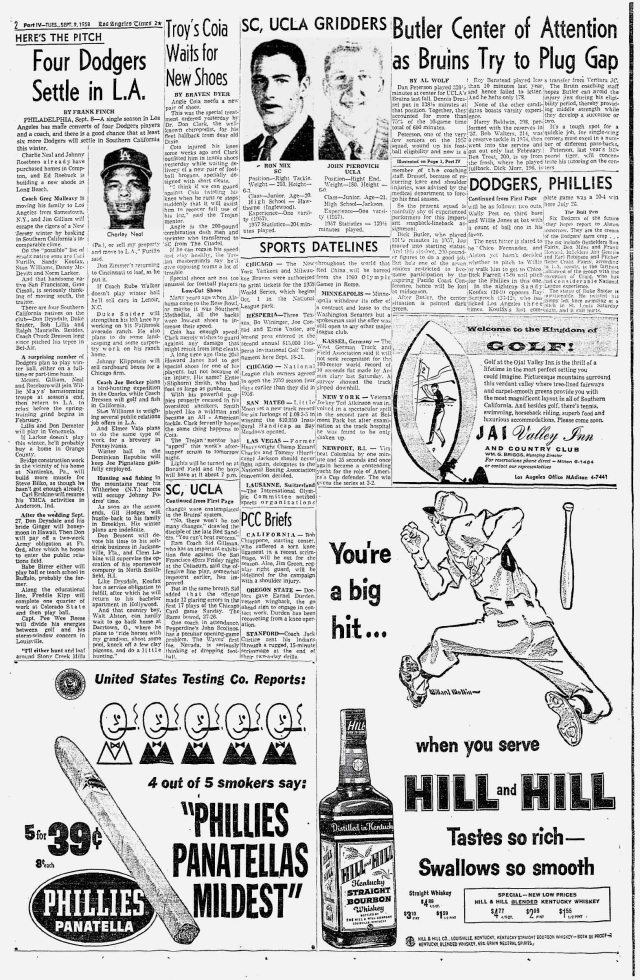
Dodger players buy homes in Compton, September 9, 1958

Continue reading →

Posted in Dodgers, Front Pages, Sports | 2 Comments

PBS host says career women are ‘monsters,’ September 9, 1958

PBS host offers views on American women


1958_september_09_cooke_2


Alistair Cooke: The career woman " is a monster … the supreme escapist from the role of being a woman. I’m not talking about the working wife whose job supplements the family income. I think the difference in the two is in happiness. I never met a happy career woman."

1958_september_09_page
There are times when these old articles take my breath away — and this is one of those times. In-cred-i-ble.

But wait, there’s more … At left, Eddie Fisher denies rumors of a romance with Elizabeth Taylor. He says they are just good friends … Brigitte Bardot plans to marry guitarist Sacha Distel … An LAPD officer searching for a 33-year-old escapee shoots a 14-year-old boy in the back by mistake.

Times columnist Gene Sherman (sorry, I previously credited Gene Blake) says this month’s Better Mottoes Assn. winner is: "Are you working on the solution or are you part of the problem?"

The Army confirms that satellites will be used to photograph the Earth for "weather data." 

Posted in @news, broadcasting, Columnists, Film, Front Pages, Hollywood, LAPD, Parks and Recreation, Sports | 2 Comments

Former Los Angeles councilwoman in the news


2008_0513_mystery_photo

Photograph by the Los Angeles Times

Ronald Reagan and City Councilwoman Rosalind Wyman, June 3, 1958.

Former L.A. Councilwoman still making news

The New Yorker’s Talk of the Town profiles Rosalind Wyman in the Sept. 8, 2008, issue. 

Dorothy Wickenden writes:

080908_talkwkndnillu_p2331
New Yorker Illustration by Tom Bachtell

"Rosalind Wyman—seventy-seven years old; doughty feminist; political fund-raiser and philanthropist; hostess to J.F.K., Jimmy Carter, and Bill Clinton, and Hollywood types too numerous to count; youngest elected member of the Los Angeles City Council (at the age of twenty-two); first woman to run a national political convention (the Democrats in San Francisco, 1984)—may well be the most indomitable member of Hillary Clinton’s Sisterhood of the Travelling Pants Suits."

And yes, she was an early supporter of bringing the Dodgers to Los Angeles and building a stadium in Chavez Ravine.


Posted in @news, City Hall, Current Affairs, Dodgers, Politics | Comments Off on Former Los Angeles councilwoman in the news

Accident kills children of ex-football star, Dodgers beat Cardinals, 7-5, September 8, 1958

Football star watches deputy coroner examine site of tragedy

Tragedy strikes at Big Bear Lake

Lightning bolt kills two children as father and brother watch from a distance, unable to help.

Former football star's children injuredThe family’s two-week summer vacation at the cabin in Big Bear was
nearly over. Soon they would be heading back home to La Crescenta, where Bob was a manager at Los Angeles Automotive Works and his wife, Betty, was a homemaker.

On that morning, Bob took their four children down to the lake while Betty
stayed behind at the cabin about three miles away. While Bob and his son, Bob Jr., went out fishing in a boat, the other three children
played along the shore: Mark, 7; Trudy, 13; and Diana, 14.

In a moment, there was a cloudburst and the three children ran into a shed
to get out of the rain. Before Bob and his son could get to shore, a
bolt of lightning hit the shed. Mark and Trudy were unconscious and
Diana was injured. Bob put the three children into the family station
wagon and on the way to Santa Anita Hospital at Lake Arrowhead, he and
Harvey Pedersen, a teenager from nearby Fawnskin, gave mouth-to-mouth
resuscitation to two of the youngsters.

At the hospital, emergency crews from the Big Bear and Fawnskin fire departments gave the children oxygen.

Mark and Trudy were pronounced dead. Although the first day’s story said
Diana was burned, blinded and partially paralyzed, doctors found her
injuries to be far less serious. According to The Times, she suffered
only a slight eye injury that would not affect her sight. Her hand,
which had been paralyzed, returned to normal, and she hadn’t been
burned.

At the funeral, the Rev. Bernard Traveille of First Baptist Church of La Crescenta urged mourners "not to let our memory enshrine despair." Instead, he said "to have faith, to harbor hope that Mark and Trudy have found a better life and to have
confidence in the love of God."

Mark Lawrence Reinhard, 7, and his sister Trudy Lee Reinhard, 13, were
cremated and their remains were entombed at Grand View Memorial Park.

Bob Reinhard, who was named All-American in 1940 and 1941, was captain of
the Los Angeles Dons. He was the No. 1 draft choice of the Chicago
Cardinals in 1950 but was traded to the Rams in exchange for Bob Shaw,
Tom Keane and Gerry Cowhig. He retired in 1951 to pursue a career in
engineering.

Bob Reinhard Jr. went on to play football for Stanford, where he was a punter, and he was drafted by the Packers in 1970. 

More information about the problems at Grand View Memorial Park is here.

Dodgers win against Cards, 7-5 In sports, Gil Hodges hits two home runs (Nos. 21 and 22 of the season) as the Dodgers win against the Cardinals, 7-5. Charlie Neal also hit his 22nd run of the season.

Jockey Johnny Longden suffers a broken leg when Gallant Royal collapses from a heart attack at Del Mar and plunges into the rail … Calvin Griffith, president of the Washington Senators, denies rumors that he plans to ask the American League to move the franchise to Minneapolis … Althea Gibson scores a comeback victory over Darlene Hard in the U.S. finals at Forest Hills, N.Y. "I may never play tournament tennis again," Gibson says. Instead, she plans to focus on a singing career, she says.


Posted in Cemeteries, Dodgers, Front Pages, Religion, Rock 'n' Roll, Sports | Comments Off on Accident kills children of ex-football star, Dodgers beat Cardinals, 7-5, September 8, 1958

1920s movie star Anita Page gets her first three roles, July 8, 1928


1928_july_08_anita01

1928_july_08_anita02

Anita Page, who died early Saturday at the age of 98, is interviewed by The Times’ Alma Whitaker in 1928, after Page started her career with three pictures in three months.

"In ‘Telling the World,’ I am rather sweet and modest, even if I am a poor little cabaret dancer," Page said. "In ‘Dancing Daughters’ I am a sophisticated flapper and with Lon Chaney [in ‘While the City Sleeps’] I am a little underworld roughneck. Such wonderful chances to show what I could do."

She gets 20 or 30 fan letters a day!

Posted in Film, Front Pages, Hollywood | 2 Comments

City attorney expects court battle to delay Dodger Stadium, September 7, 1958


City attorney sees long battle for Chavez Ravine

Dodgers owner Walter O’Malley expects legal challenges to be resolved quickly and predicts stadium construction will begin in February 1959.

1958_september_07_sports
By Keith Thursby
Times staff writer

Jeane Hoffman’s interview with Los Angeles City Atty. Roger Arnebergh would leave most Dodger fans planning to return to the Coliseum for more than just 1959.

Just to review, the Dodgers signed a deal with the city to move to Los Angeles and get a stadium in Chavez Ravine. Voters in June, 1958 passed Prop. B, approving the stadium plan. But about a month later, a Superior Court judge, acting on a taxpayer’s lawsuit, declared the contract invalid and placed the Chavez Ravine plans in limbo.

Arnebergh said the city had filed a petition with the state Supreme Court to reverse the Superior Court decision. Unless the writ of prohibition was granted, "I don’t think there’s a chance we can get this thing cleared through the courts until 1960 and even with that break, I estimate it will take another year and a half to grade and build the location," Arnebergh said.

So Dodger fans should be pessimistic, right? Not so, according to Walter O’Malley.

"I have been told that in six months the legal issue will be resolved and I am an optimist enough to believe that it will be decided in our favor," O’Malley said in an Aug. 16 story on his appearance at a Rotary Club luncheon. According to the story, O’Malley selected February 1959 as starting date for construction of the new stadium.

The Times’ Hoffman also interviewed O’Malley for a story that ran Sept. 2. The topic was attendance, as in could the Dodgers someday attract up to 3 million fans a year?

"I’m delighted that we’ve done this well," O’Malley said. "I think we’ll beat our all-time Ebbets Field record of 1,800,000 in a season in which we had to operate under difficulties to say the least–going without such traditional baseball features as beer, hot dogs in the stands, a roof on the park, etc."

As for the 1959 season, O’Malley planned to bring in the right-field fence and schedule more night games at the Coliseum. "Unlike Chicago, this is just not an afternoon town," he said. "And when we eventually get our own park, the next item will be to put more attention on auto parking, probably introducing valet parking for box seat holders."

keith.thursby@latimes.com 

Posted in #courts, @news, Architecture, City Hall, Current Affairs, Dodgers, Downtown, Sports | Comments Off on City attorney expects court battle to delay Dodger Stadium, September 7, 1958

Death stalks Spanish nobleman, Angels win, September 7, 1938


1938_september_07_roy_rogers

Roy Rogers and Smiley Burnette: happy trails!

1938_september_07_cover

Death stalks Spanish nobleman

In Miami, the the former heir to the Spanish throne dies from injuries in a car crash because he carries the hereditary disease of hemophilia. His companion, a nightclub singer, is charged with manslaughter … Emil Hansen is convicted of killing two lawyers in the Hall of Records because he was a "sore loser" in a civil suit.

On the jump, taxpayers ask the state Supreme Court to help halt to the recall election against Mayor Frank Shaw.

In sports, the Angels sell Rip Russell and Ed Carnett to the Cubs.


1938_september_07_runover

Singer charged in death

1938_september_07_sports

USC to meet Alabama


Posted in #courts, Current Affairs, Downtown, Film, Front Pages, Hollywood, Music, Sports, Stage | Comments Off on Death stalks Spanish nobleman, Angels win, September 7, 1938

LA history–Nuestro Pueblo, September 7, 1938


1938_september_07_nuestro

Above, an unusual house in the 6500 block of Monterey Road. Below, Monterey Road as shown in Google maps’ street view. California death records list a Stanton D. Fraser (1903-1974), but it’s unclear if this is the man in the story.


Posted in Architecture, Nuestro Pueblo | Comments Off on LA history–Nuestro Pueblo, September 7, 1938

Times’ new feature on LA history


421312371_2

Photographs from the Huntington Library

Above, the Shorb home, torn down by Henry Huntington to make way for his mansion.

Lost L.A.

Today’s Home section introduces a new feature by Sam Watters. The first installment looks at the history of the Huntington estate in San Marino.


421313371
The Shorb home after extensive remodeling.

Watters writes: When the current mortgage crisis ends, someone is going to make big bucks. Probably developers. They’ll buy up houses at bargain prices, tear them down, put in a subdivision and start hawking mortgages. The L.A. investor’s rule: It’s never about the house; it’s about the land. Few knew this better than speculator Henry E. Huntington.

Daily Mirror readers will recall an earlier post on Huntington’s project. 


Posted in Architecture, art and artists | Comments Off on Times’ new feature on LA history

Woman missing with family ‘fortune’; Golden Boy knocked out, September 6, 1958


Art Aragon on the ropes

Art ‘Golden Boy’ Aragon on the ropes


Stella Collins vanishes with family fortune

Woman vanishes with family ‘fortune’

We don’t know when Stella Collins started lying. Maybe it was in 1940,
when she married Stanley. Or maybe it was later. We don’t know why she
started lying and we certainly don’t know how she continued the act all
those years. We don’t even know how she got to Los Angeles. The only
thing we know is that when Stanley finally learned the truth, the meek
little man erupted in rage.


Stanley, 42, Stella , 41, and their two daughters lived with her
parents in Philadelphia. For the last 18 years, they had lived on what
she made as a waitress while banking everything Stanley earned as a
welder. Whenever life was difficult, perhaps they took consolation in
the knowledge that someday there would be enough money to buy a house
of their own.


As far as Stanley knew, their nest egg was growing nicely in two
Philadelphia banks until it reached $18,000 ($127,729.92 USD 2008).
Then one day in the summer of 1958, it came time to buy their dream
house. Stella went to get draw out their money–and vanished.


Police officers found her at 5th and Hill with no idea how she got to Los Angeles. 


The Times’ Jerry Hulse wrote: 


She stared blankly through horn-rim glasses, words trembling on her thin, pale lips.


"I don’t know," she answered softly. "I don’t know."


She touched her straight, dark blond hair. "I’ve been trying to figure it out. I don’t know how I got to Los Angeles."


"The only thing I remember is a man asking me, ‘Are you sick?’ I said I was. I was sick. This man called the police."


Could she remember her husband? Or her daughters?


"All I can remember is one daughter. That’s all."


Stanley Collins hides from reportersReporters met Stanley at the airport at 2 a.m. Did he need a ride to the city jail? The newsmen happily offered to take him.


During the drive, "he rested his stubbly chin in his hands and sighed in weary bewilderment," The Times said.


"I don’t know what happened to the money," he said. "I’d been giving
her my paychecks since we were married. She told me we had $18,000 in
the bank, but she told my mother there was only $10,000.


"She must have been playing the ponies. I can’t understand it. It hit
me right between the eyes when I found out the money was missing."


But when the mild little welder from Philadelphia saw his wife, he erupted.


"He flailed out with a suitcase and tried to hit a photographer between the eyes," The Times said.


"Hide! Hide!" he screamed to his wife as she stepped off the jail elevator.


Pulling his coat up over his face, he ran toward her but in his excitement, he went past her.


Stanley Collins of Philadelphia, still shielding himself with his coat,
grabbed Stella by the arm and dragged her outside to catch a taxi to
the airport as he punched and kicked at reporters.


After boarding the plane, "Stanley Collins, exhausted and discouraged, stared numbly out the window," The Times said.


All that was left of the mythical $18,000 was $2.67 ($18.95 USD 2007) that Stella had in her purse when she was picked up.


Actress describes Communist group

Actress describes Communists

Basilio kayoes Aragon

Dodgers beat Cards, 2-1


Posted in Dodgers, Downtown, Front Pages, Sports | Comments Off on Woman missing with family ‘fortune’; Golden Boy knocked out, September 6, 1958

LA Shrine convention card found on EBay


1907 Shriner convention postcard

This postcard now listed on EBay is one of the many souvenirs from the Shriners’ 1907 national convention, which was held in Los Angeles. This gathering also generated pins, fans, postcards, plates, cups, goblets and items too numerous to mention, as the auctioneers used to say. 

Shriners die in train wreck
Shriner pin
Although the Shriners apparently had a grand time in Los Angeles, the
convention ended tragically when nearly 30 of them died in a horrible train
wreck on the way home.


Posted in Uncategorized | Comments Off on LA Shrine convention card found on EBay

LA turns 157, September 5, 1938


At Plummer Park, Eugene Plummer shows Joaquin Murietta's revolver

Capt. Eugene Plummer is featured in a story about Plummer Park in West
Hollywood
. According to the caption, the revolver he’s holding belonged to Joaquin Murietta.


Los Angeles celebrates its birthday

Davis Cup results, 1938


At left, Mayor Frank Shaw and actor Leo Carrillo help celebrate Los Angeles’ 157th birthday. The activities include a 28-mile marathon around the perimeter of the original settlement as well as a national radio broadcast from the Avila Adobe.

Speaking of Frank Shaw, you would never know from The Times that he was facing a recall election. The only mention is on the editorial page: "The recall fight has to stoop to get under the subway." 


Joaquin Murietta's revolver
Take a look at Joaquin Murietta’s revolver. It appears to be a 12-shot.


In sports, Times columnist Bill Henry files a report from the 1938 Davis Cup in Philadelphia. Henry writes about the bad luck of Pomona’s Joan Bigler, who injured her eye with a curling iron on the eve of her semifinal match with Helen Bernhard … Ben Hogan and Vic Ghezzi take the Hershey tournament with Paul Runyan and Sam Snead finishing second. It’s the first of Hogan’s 64 career tournaments.

Aviator Douglas "Wrong Way" Corringan takes an at-bat from Charlie Root during a game between the Cubs and the Reds at Crosley Field in Cincinnati, hits a foul ball–and runs to third base.


Posted in #games, @news, broadcasting, City Hall, Current Affairs, Downtown, Front Pages, Hollywood, Music, Parks and Recreation, Politics, Sports | Comments Off on LA turns 157, September 5, 1938

Barack Obama, Harvard Law Review editor, March 19, 1990


Barack Obama’s Law Personality:

Harvard Law Review’s first black
president plans a life of public service. His multicultural background
gives him unique perspective.


By Tammerlin Drummond
Times Staff Writer


Barack Obama stares silently at a wall of fading black-and-white
photographs in the muggy second-floor offices of the Harvard Law
Review. He lingers over one row of solemn faces, his predecessors of 40
years ago.

All are men. All are dressed in dark-colored suits and ties. All are white.

It is a sobering moment for Obama, 28, who in February became the
first black to be elected president in the 102-year history of the
prestigious student-run law journal.


The post, considered the highest honor a student can attain at Harvard
Law School, almost always leads to a coveted clerkship with the U.S.
Supreme Court after graduation and a lucrative offer from the law firm
of one’s choice.


Yet Obama, who has gone deep into debt to meet the $25,000-a-year cost
of a Harvard Law School education, has left many in disbelief by
asserting that he wants neither.


"One of the luxuries of going to Harvard Law School is it means you
can take risks in your life," Obama said recently. "You can try to do
things to improve society and still land on your feet. That’s what a
Harvard education should buy-enough confidence and security to pursue
your dreams and give something back."


After graduation next year, Obama says he probably will spend two
years at a corporate law firm, then look for community work. Down the
road, he plans to run for public office.


The son of a Kenyan economist and an American anthropologist, Obama is
a tall man with a quick, boyish smile whose fellow students rib him
about his trademark tattered blue jeans.


"I come from a lot of worlds and I have had the unique opportunity to
move through different circles," Obama said. "I have worked and lived
in poor black communities and I can translate some of their concerns
into words that the larger society can embrace."


His own upbringing is a blending of diverse cultures. Born in Hawaii,
where his parents met in college, Obama was named Barack (blessed in
Arabic) after his father. The elder Obama was among a generation of
young Africans who came to the United States to study engineering,
finance and medicine, skills that could be taken back home to build a
new, strong Africa. In Hawaii, he married Obama’s mother, a white
American from Wichita, Kan.


Two years later, Obama’s parents separated and he moved to a small
village outside Jakarta, Indonesia, with his mother, an anthropologist.
There, he spent his boyhood playing with the sons and daughters of rice
farmers and rickshaw drivers, attending an Indonesian-speaking school,
where he had little contact with Americans.

Every morning at 5, his mother would wake him to take correspondence classes for fear he would forget his English.


It was in Indonesia, Obama said, where he first became aware of abject poverty and despair.


"It left a very strong mark on me living there because you got a real
sense of just how poor folks can get," he said. "You’d have some army
general with 24 cars and if he drove one once then eight servants would
come around and wash it right away. But on the next block, you’d have
children with distended bellies who just couldn’t eat."


After six years in Indonesia, Obama was sent back to the United States
to live with his maternal grandparents in Hawaii in preparation for
college. It was then that he began to correspond with his father, a
senior economist for the Kenyan finance ministry who recounted
intriguing tales of an African heritage that Obama knew little about.


Obama treasured his father’s tales of walking miles to school, using a
machete to hack a path through the elephant grass-the legends and
traditions of the Luo tribe, a proud people who inhabited the shores of
Lake Victoria.


He still carries a passbook that belonged to his grandfather, an
herbalist who was the first family member to leave the small Kenyan
village of Alego, move to the city and don Western clothes.


"He was a cook and he used to have to carry this passbook to work for
the English," Obama recalls. "At the age of 46 it had this description
of him that said, `He’s a colored boy, he’s responsible and he’s a good
cook.’ "


Two generations later, at the most widely respected legal journal in
the country, the grandson of the cook is giving the orders.


Yet some of Obama’s peers question the motives of this second-year law
student. They find it puzzling that despite Obama’s openly progressive
views on social issues, he has also won support from staunch
conservatives. Ironically, he has come under the most criticism from
fellow black students for being too conciliatory toward conservatives
and not choosing more blacks to other top positions on the law review.


"He’s willing to talk to them (the conservatives) and he has a grasp
of where they are coming from, which is something a lot of blacks don’t
have and don’t care to have," said Christine Lee, a second-year law
student who is black. "His election was significant at the time, but
now it’s meaningless because he’s becoming just like all the others (in
the Establishment)."


Although some question what personal goals motivate Obama, his interest in social issues is deeply grounded.


At Occidental College in Los Angeles, Obama studied international
relations and spent much of his time helping to organize anti-apartheid
protests. In his junior year, he transferred to Columbia University,
"more for what (New York City) had to offer than for the education," he
said.


After graduating, Obama landed a job writing manuals for a New
York-based international trade publication. Once his college loans were
paid off, he took a $13,000-a-year job as director for the Developing
Communities Project, a church-based social action group in Chicago.


There, he and a coalition of ministers set out to improve living
conditions in poor neighborhoods plagued by crime and high
unemployment. Obama helped form a tenants’ rights group in the housing
projects and established a job training program.


"I took a chance and it paid off," he said. "It was probably the best education that I’ve ever had."


After four years, Obama decided it was time to move on. He wanted to
learn how to use the political system to effect social change. He set
his sights on Harvard Law School, where he quickly distinguished
himself as a top student. He was soon chosen through the strength of
his writing and grades to serve as one of 80 student editors on the law
review.


Unlike many peer-review professional journals, the law review is run
solely by students. It is widely considered the major forum for current
legal debate and consequently is watched closely by courts around the
country.


In his second year at law school, Obama decided to run for law review president after a conversation with a black friend.


"I said I was not planning to run and he said, `Yes you are because
that is a door that needs to be kicked down and you can take it down.’ "


It was a marathon selection process, an arcane throwback to the early
days of the review. The students editors deliberated behind closed
doors from 8:30 a.m. until early the next day. The 19 anxious
candidates took turns cooking breakfast, lunch and dinner for the
selection committee, whose members emerged with a historic decision.


"Before I could say a word, another black student who was running just
came up and grabbed me and hugged me real hard," Obama recalled. "It
was then that I knew it was more than just about me. It was about us.
And I am walking through a lot of doors that had already been opened by
others."


But few students at the law review were prepared for the deluge of
interview requests for Obama from newspapers, radio and television
stations. Strange letters of congratulations began arriving.


Shortly after the elections, a package turned up at the law review
office with no return address. Obama said he hesitated to open it
because of the spree of recent mail bombings targeted at civil rights
activists nationwide. When the package was finally opened, inside were
two packages of dim sum, with no explanation. Some students made light
of the media invasion, posting a memo titled "The Barack Obama Story, a
Made for TV Movie, Starring Blair Underwood as Barack Obama."


Yet tensions were building. White students grumbled about the
attention paid to Obama’s race. Black students criticized him for not
choosing more blacks for other top positions at the review. Caught in
the cross-fire, Obama, who has a tendency toward understatement,
downplayed his own achievements.


"For every one of me, there are thousands of young black kids with the
same energies, enthusiasm and talent that I have who have not gotten
the opportunity because of crime, drugs and poverty," he said. "I think
my election does symbolize progress but I don’t want people to forget
that there is still a lot of work to be done."


Describing Obama, fellow students and professors point to a
self-confidence tempered by modesty as one of his greatest attributes.


"He’s very unusual, in the sense that other students who might have
something approximating his degree of insight are very intimidating to
other students or inconsiderate and thoughtless," said Laurence Tribe,
a constitutional law professor. "He’s able to build upon what other
students say and see what’s valuable in their comments without
belittling them."


But what truly distinguishes Obama from other bright students at
Harvard Law, Tribe said, is his ability to make sense of complex legal
arguments and translate them into current social concerns. For example,
Tribe said, Obama wrote an insightful research article showing how
contrasting views in the abortion debate are a direct result of
cultural and sociological differences.


As law review president, Obama is the last person to edit student
articles, as well as longer pieces by accomplished legal scholars. The
review publishes eight times a year and receives about 600 free-lance
articles each year.


Referring to his fellow students at the review, whom he edits, he
said: "These are the people who will be running the country in some
form or other when they graduate. If I’m talking to a white
conservative who wants to dismantle the welfare state, he has the
respect to listen to me and I to him. That’s the biggest value of the
Harvard Law Review. Ideas get fleshed out and there is no party line to
follow."


Obama spends 50 to 60 hours each week on law review business. The
full-time volunteer job leaves little time for an additional 12 hours
of class, plus homework. When it comes to choosing between the two, as
it often does, Obama usually misses class.


One of Obama’s most difficult tasks as editor in chief is keeping the peace amid the clashing egos of writers and editors.


"He is very, very diplomatic," said Radhika Rao, 24, a third-year law
student from Lexington, Ind. "He is very outgoing and has a lot of
experience in handling people, which stands him in good stead."


Tina Ulrich, 24, a third-year student, wrote an article for the review
that went through several editors before her final draft landed on
Obama’s desk.


"When he sent it back, it had lots of tiny print all over it and I was
just furious," she said. "My heart just sank. But it was accompanied by
specific examples of how parts could be made better. He wound up
getting an enthusiastic response from a very tired writer."


Outside the review, other blacks at Harvard are skeptical that Obama’s
appointment will change much at the Ivy League institution, where 180
out of 1,601 law students are black.


"While I applaud Obama’s achievement, I guess I am not as hopeful for
what this will mean for other blacks at Harvard," said Derrick Bell,
the school’s first black tenured law professor.


"There is a strange character to this black achievement. When you have
someone that reaches this high level, you find that he is just deemed
exceptional and it does not change society’s view of all of the rest."

Posted in #courts, Current Affairs, Politics | 15 Comments

McCain describes Vietnamese prison camp, April 5, 1973


1967_1028_mccain

Oct. 28, 1967: The Times reports Lt. Cmdr. John S. McCain III has been shot
down over Hanoi. Note that the lede calls him "McClain." Ouch.

John McCain describes brutality in Vietnamese prison, April 5, 1973

Posted in @news, Current Affairs, Politics | 1 Comment