Movie revivals — The Godfather

Coming soon to a theater near you…

1972_godfather

Above, "The Godfather," 1972.

Sept. 19-25, 2008, ArcLight Hollywood.

"The Godfather" and "Godfather II."  Member movie.
Posted in Coming Attractions, Film, Hollywood | Comments Off on Movie revivals — The Godfather

Los Angeles history–Nuestro Pueblo

The hanging tree

Once described as the oldest rubber tree on the American continent, it was actually an Australian fig … maybe. Either way, it’s gone now. And the rustlers who were supposedly hanged here must have been awfully short because the branches are low. 

1938_0912_nuestro

2015 Long Beach Ave. in 1938 and, below, via Google maps’ street view.

Posted in Downtown, Nuestro Pueblo | Comments Off on Los Angeles history–Nuestro Pueblo

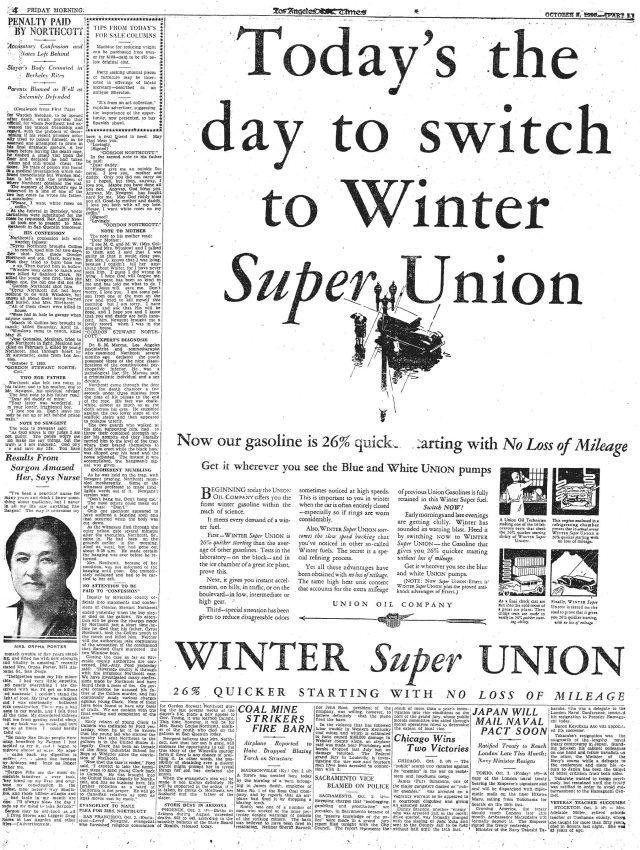
Los Angeles gets a new mayor, September 18, 1938

Bowron: Liberal, moderate and conservative

The Times’ Timothy G. Turner writes: ‘Fletcher Bowron is no longhair nor will he turn the town over to Psalm singers. He is little concerned with gambling and prostitution as such, only in their effect on political corruption.’ 

1938_september_18_pix

Above, a breath of fresh air at City Hall.
 

1938_september_18_cover

Battleship Arizona visits L.A.

Times’ veteran columnist Timothy Turner describes Bowron as a middle-of-the-road politician and a former newsman with far more experience than portrayed in our editorials.

"He will not … do anything radical in cleaning up the city. He knows the city can never really be cleaned up, that no city can. He will do the best he can," Turner says.

In sports, the Cubs move within 2 1/2 games of the Pirates in the National League pennant race. Hank Greenberg hits his 52nd and 53rd home runs, leading Babe Ruth’s 1927 record. 


1938_september_18_runover

Crash injures actor

1938_september_18_sports

Cubs beat Giants

Posted in #courts, City Hall, Current Affairs, Downtown, Film, Front Pages, Hollywood, LAPD, Politics, Sports | Comments Off on Los Angeles gets a new mayor, September 18, 1938

Rams win against Cards, September 17, 1968


Defense does job; Rams win opener

94-yard TD run starts Cardinals to 24-13 defeat.

1968_september_17_nixon

Above, Richard Nixon campaigns in Yorba Linda in the 1968 presidential race.


1968_september_17_sports
By Keith Thursby

Times staff writer

There’s still something not quite right about putting the Rams and the city of St. Louis in the same sentence.

On this Monday night, the Rams were the visiting team and the game
was still played outside (one factor in the Rams’ move to St. Louis was
the use of a fancy new domed stadium). The Times’ Bob Oates described
the weather as a "Missouri mist resembling Los Angeles smog," but it
turned out to be the perfect setting for the Rams to open their season
with a 24-13 victory over the Cardinals.

Defense and special teams played key roles. Ron Smith returned the
second half kickoff 94 yards for a touchdown and the Rams’ defense made
life miserable for St. Louis’ young quarterback, Jim Hart.

Oates’ game story was interesting for its length and attention to
detail. At times, there was a professorial tone to his writing as he
tried to explain the finer points of a sport that was becoming more
complex each season.

At one point he examined the Rams’ defense:

"The Rams were in what they call combination coverage — part zone,
part man-to-man — when quarterback Hart passed to Jackie Smith both
times the ball was intercepted. Hart was keying on the tight safety
(Ron Smith) on each occasion. He did not see [Eddie] Meador on either
play.

"NFL quarterbacks are not in the habit of watching out for free safeties when they throw the ball to the tight safety’s man."

These days, Oates would probably be working at ESPN, breaking down game films on one of the network’s endless football shows.


This post begins a look at two Los Angeles Rams seasons: 1958 and
1968. Both teams were led by future Hall of Fame coaches (Sid Gillman
in ’58, George Allen in ’68). In 1958, the Rams were coming off a 6-6
season under their young general manager, future NFL Commissioner Pete
Rozelle. The 1968 team started the season considered among the league’s
elite franchises after finishing the previous season 11-1-2, losing in
the playoffs to the eventual NFL champion Green Bay Packers. Should be
fun to retrace two very different teams in two different eras in Los
Angeles sports.

keith.thursby@latimes.com

Posted in Front Pages, Politics, Sports | 1 Comment

Dodger struck with ball, September 17, 1958


Snider hurt; L.A. loses 2

Duke hit by line drive, may miss rest of season.

1958_september_17_welk

Above, Lawrence Welk in stereo with "Swinging Pete Fountain," the clarinetist who once said "Champagne and Bourbon Street don’t mix." 


1958_september_17_sports
By Keith Thursby

Times staff writer

Scary moment for Duke Snider and the Dodgers. Snider was on third
base in the fifth inning of the Dodgers’ game at Cincinnati when he was
struck by a line drive hit by his teammate, Frank Howard.

The Times’ Frank Finch wrote that the ball "struck Snider’s right
shoulder and then his right ear a glancing blow, dropping him as though
he’d be shot by an elephant gun."

Snider was taken to the hospital but was able to speak to reporters
first. Finch noted that "although he’d escaped serious injury–even
death–by inches, the dapper Snider insisted on showering before he was
driven to the hospital."

"I saw the ball coming off Howard’s bat and I tried to duck into it
so that I would take the blow off my plastic helmet," Snider said.
"Boy, he really hit that one."

The game was the nightcap of a doubleheader. The Dodgers lost both games.

keith.thursby@latimes.com

Posted in broadcasting, Dodgers, Music, Sports, Television | 2 Comments

Los Angeles mayor removed in recall, child killer executed, September 17, 1938

Bowron defeats Shaw

Superior Court judge, elected with 65% of the vote, will take office Sept. 26. He says: ‘This election, in no sense, is a personal triumph. This is not my fight. I have merely been part of a movement — a most significant movement for clean government.’ 

1938_september_17_editorial

Above, The Times’ lead editorial laments the recall of Mayor Frank Shaw and emphasizes the inexperience of Fletcher Bowron, noting with alarm his support from subversives and radicals.
 

1938_september_17_page1

Chamberlain bows to Hitler

Another historic day: Bowron is elected, British Prime Minister Neville Chamberlain concedes to Adolf Hitler on Czechoslovakia and California executes Albert Dyer in the murders of the "Three Babes of Inglewood." Note that Dyer was hanged, the method of execution used in California before the gas chamber.

In sports, the Los Angeles Angels take the pennant in the Pacific Coast League, beating the Oakland Acorns at Wrigley Field.

Plans are underway for the 1938 World Series to begin Oct. 5. It will be the last series for Yankee Lou Gehrig, the "Iron Horse." 

1938_september_17_runover

Albert Dyer is executed

1938_september_17_sports

1938 World Series planned

Posted in #courts, @news, City Hall, Current Affairs, Downtown, Front Pages, LAPD, Politics, Sports | Comments Off on Los Angeles mayor removed in recall, child killer executed, September 17, 1938

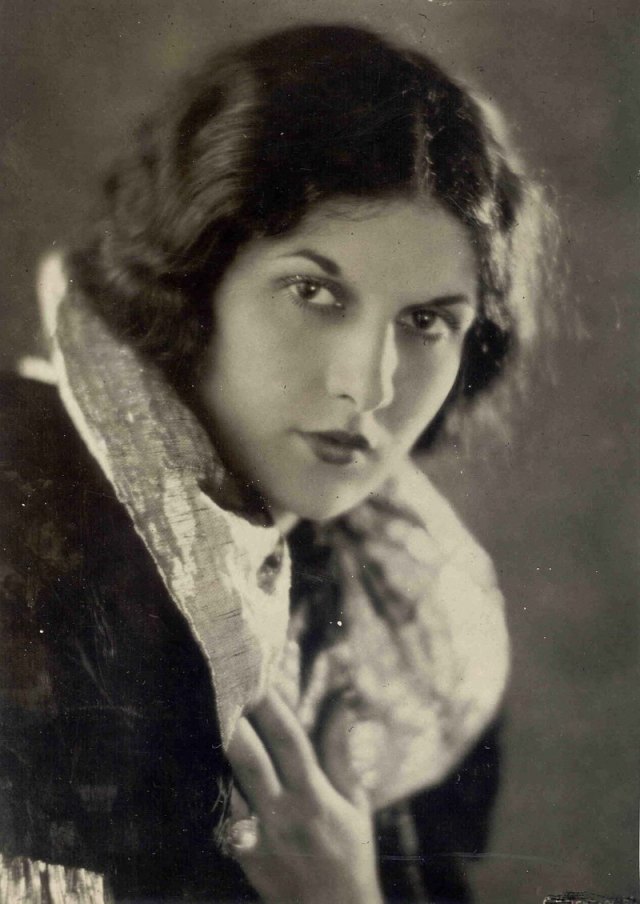
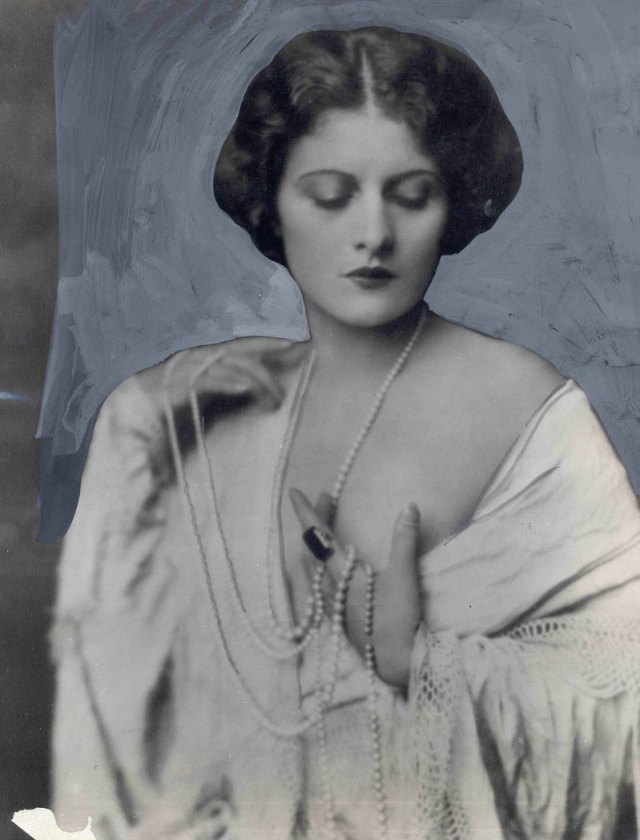
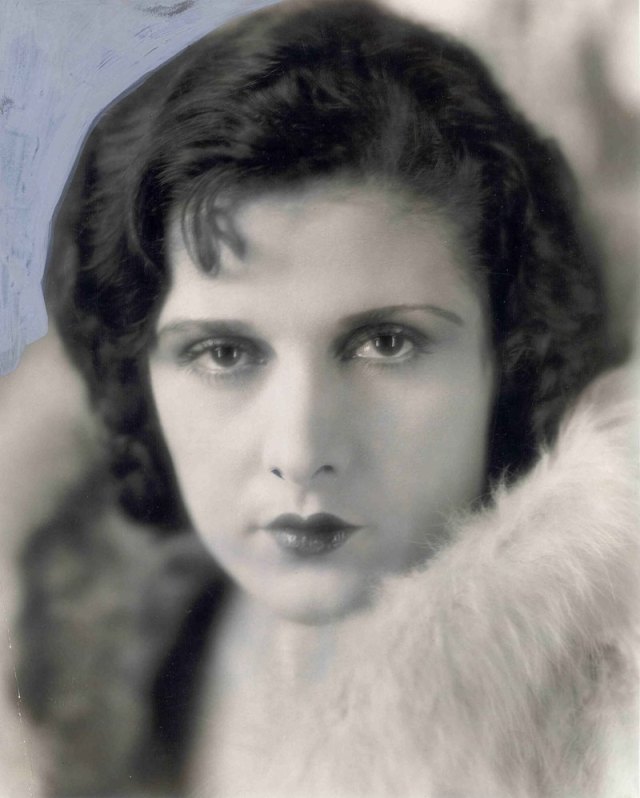
Movie star mystery photo

2008_0915_mystery_pix

Los Angeles Times file photo

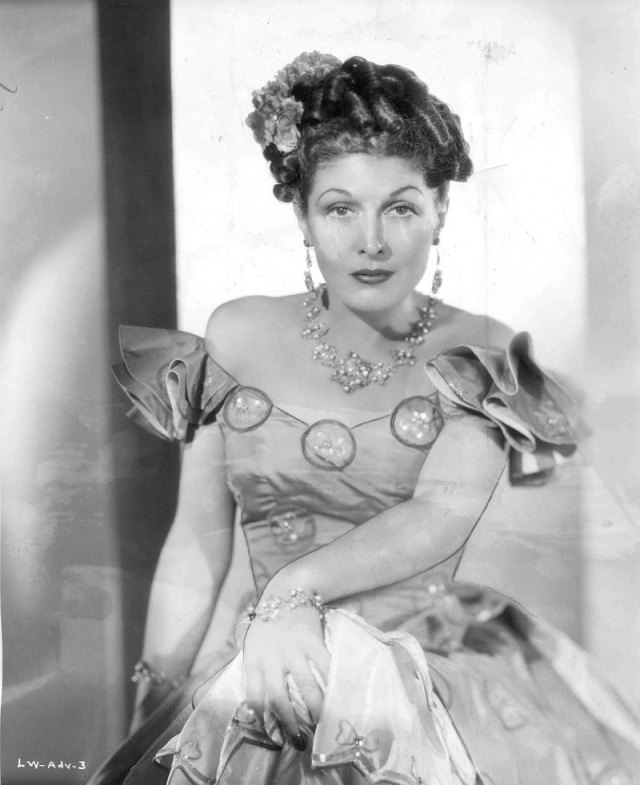
This is another photo of our mystery guest, who was misfiled as Veda Ann Borg.

So sorry, only one guess was even vaguely warm. Not Lucille Ball and not Vera Hruba Ralston…. This is going to be a toughie. 

2008_0825_mystery_photo

And the original photo of the mystery woman who is not Veda Ann Borg.
Who is eating dinner with the Reagans? Congratulations to Jerry Sondler for recognizing Sam Nassi with the Reagans. This was a tough one.
Posted in Film, Hollywood, Mystery Photo | 61 Comments

Movie revival — 2001: A Space Odyssey

1968_0603_2001 Oct. 12, 2008, 6 p.m. The Edison downtown. Tickets $20.

Stanley Kubrick’s film, written with Arthur C. Clarke.

Posted in Coming Attractions, Film, Hollywood, Science | 1 Comment

Los Angeles history–Nuestro Pueblo


Grateful family erects frontyard shrine

The doctor said Generosa Bruno was dying and there was nothing to save her. ‘You might pray,’ he told her family. And they did.

1938_0909_nuestro

739 Yale St. in 1938 and, below, Yale Street via Google maps’ street view.


Posted in Architecture, Downtown, Nuestro Pueblo, Religion | Comments Off on Los Angeles history–Nuestro Pueblo

Los Angeles votes in recall election, September 16, 1938


City voters decide on removing Mayor Shaw

Judge Bowron predicts that he will win the election by 85,000 votes. In fact, he took an early lead and defeated Shaw by 100,000 votes, The Times says.

1938_september_16_shaw

Above, a political ad for Mayor Frank Shaw. I’ll have to check his photo file to see if he shaved off his mustache, which gives him an unfortunate resemblance to someone else in the news in 1938. 

1938_september_16_editorial

The Times makes yet another appeal to retain corrupt government and preserve the status quo. Judge Fletcher Bowron is enthusiastically supported by "Communists and radical labor agitators," the editorial says.

1938_september_16_page1

Legionnaires convention begins

Sept. 16, 1938, a historic day for Los Angeles and the world. The Harry Raymond bombing and the trial of Police Capt. Earle Kynette culminate in the successful recall of Mayor Frank Shaw and the reform administration of Fletcher Bowron.

In Europe, British Prime Minister Neville Chamberlain meets with German Fuehrer Adolf Hitler over the fate of Czechoslovakia. "The ‘freezing’ of the dramatic bargaining with war or peace in Europe at stake gave Europe a brief breathing spell and appeared to have put off for six days at least the catastrophe that millions fear," the AP story says.

1938_september_16_runover

Clerk denies election is fixed.

1938_september_16_sports

350 mph at Bonneville Salt Flats

Posted in #courts, @news, City Hall, Current Affairs, Downtown, Front Pages, LAPD, Politics, Sports | Comments Off on Los Angeles votes in recall election, September 16, 1938

Los Angeles history — stage

T.C. Jones, male actress

‘T.C. Jones is the greatest female impersonator I have seen and heard since Julian Eltinge — and that’s going back a long way.’ — Philip K. Scheuer, Los Angeles Times

tc_jones_1958_1031_crop
Los Angeles Times file photoT.C. Jones in “Mask and Gown,” 1958.
1958_august_24_tc_jonesHe was one of the newest — and certainly one of the freshest — of the “New Faces of ’56,” a Broadway show directed by Paul Lynde with sketches by a variety of writers, including Neil Simon and his brother Danny.His name was Thomas Craig Jones, but he was best known as T.C. Jones and he was, according to The Times’ Philip K. Scheuer, “the greatest female impersonator I have seen and heard since Julian Eltinge — and that’s going back a long way.”In an August 1958 Times story, Charles Stinson described Jones as “a husky, medium-sized fellow in his 30s with a Yul Brynner coiffure and a most affable manner.”

Times movie critic Kevin Thomas said in response to my query: “The 1950s were his decade. He was a terrific entertainer, more a male actress, as Charles Pierce described himself, rather than a traditional female impersonator. His rendition of his signature song, ‘Ten Cents a Dance,’ was unforgettable, really wrenching.”

Jones was a Navy veteran and a graduate of Carnegie Tech who appeared on Broadway in 1944 as a dancer in “Sadie Thompson,” starring June Havoc. Before becoming a female impersonator, he had worked as a nightclub emcee, standup comic, dancer and actor. He was married, The Times says, and his wife, Donnie Dickson Jones, told Stinson “I keep his wigs in order.”

“One night when I was doing stock,” Jones said, “another of the players brought me some comic sketch material that was hilarious. The only catch was that it more or less required a woman to deliver it. He suggested I do an impersonation. I told him I didn’t know if I could bring it off. I had never done any female impersonations and I was starting a career as a male comic.

“I finally agreed to try it, though, and it surprised me and went over big. Strangly enough it was in a revue called ‘I’m Not Myself Tonight’ and I haven’t been most nights since.”

In “Mask and Gown,” Jones portrayer Bette Davis, Tallulah Bankhead, Mae West, Judy Holliday, Marilyn Monroe, Katharine Hepburn and Ethel Merman. “It is curious, in passing, how impersonators always latch on to the same handful of stars to lampoon,” Scheuer said. “They are the most distinctive!”

And, yes, he did Judy Garland too. The Times said in 1965:  “Judy Garland and her rendition of ‘Over the Rainbow’ will never be the same after the telling treatment of Jones.” The Times said: “Mrs. Jones has done a splendid job in picking out the proper attire for her husband’s vignettes. Her choice of wigs and outfits matched the mood perfectly.”


tc_jones_1965_0803_crop
Los Angeles Times file photo

T.J. Jones in 1965. He often ended his act by removing his wig to show his bald head.


Although Jones said he planned to return to Broadway in a male role in the fall of 1958, the show apparently fell through and he continued as an impersonator for most of his career, although he did appear in a male role in the 1964 production of “Three Nuts in Search of a Bolt” with Mamie Van Doren.

Jones made several records  and occasionally appeared on television, including a Jackie Gleason TV special in 1960 and a cult episode of “Alfred Hitchcock Presents.” He was in the 1968 Bob Rafelson film “Head,” starring the Monkees. Writing in 1973 on a reappraisal of the film, Charles Champlin said: “One of the lads slugs female impersonator T.C. Jones, then argues with director Rafelson whether it’s right for the image. (The grips and extras shy away from him as from someone unclean.)”

Jones died Sept. 25, 1971, at the age of 50. The Times did not publish an obituary on him.

He is also featured in a 1955 article in the Mattachine Review, “The Other Side of the Coin.”

Posted in broadcasting, Film, Hollywood, Nightclubs, Stage | 2 Comments

Movie revivals — Rosemary’s Baby/Chinatown

Chinatown_grab02

Sept. 20, 2008, 7:30 p.m. American Cinematheque at the Egyptian.
"Rosemary’s Baby" and "Chinatown." Tickets are $10/$8/$7.


Posted in Coming Attractions, Film, Hollywood | 2 Comments

Muslim leader attacks series on harems, September 7-15, 1958

U.S. Woman Tells of Life in Moslem Harem –September 1958

Ever wonder about life in a harem? Here’s your chance to find out what it’s like. Just go with this young American explorer on her most exciting adventure — behind palace walls into the closely guarded inner sanctum where wives and concubines live.

1958_september_15_harem_2

Above, Jane Dolinger’s two-part series provoked this response from Shukar Ilahi Hussain of the Los Angeles Mosque. Unfortunately, The Times wrote almost nothing about the Los Angeles Mosque in the 1950s. There’s also very little information in The Times on Shukar Ilahi Hussain (or Husain, as we sometimes spelled his name). Dolinger later turned her experiences into a book titled "Behind Harem Walls."

In researching Dolinger via Google, I contacted one of her friends, Gail Howard, who writes of Dolinger and her husband, Ken Krippene:

Yes, she is the same one and only Jane Dolinger.

Jane told us that she never encountered a man while she was "behind harem walls" doing research for her book and interviewing the women. Except for her harem experience, Jane and Ken always traveled together.

They were a great team. Their books and articles were well researched because they spent time in the actual locations from which they spun their fascinating stories. My sister, Terry, posed for photos in an Indian sari doing yoga postures, carrying water from the well, sweeping the dirt in front of a mud hut with thatch roof where she supposedly lived alone in some isolated place in Ecuador.

The story with these photos appeared in newspapers all over the world. The copy Jane sent us was in Arabic so we don’t know exactly what it said. (My sister was a television writer and producer living in New York City when she wasn’t traveling with me.)

Jane and Ken had a knack for weaving fanciful fiction from exotic locales that captured the imagination of their readers. My Ecuador web site has attracted people looking for Jane Dolinger, one who fell in love with Jane and one in love with a character in her book, the Jaguar Princess.

After Ken passed away Jane remarried. In 1992, Jane was planning to return to the Amazon for more adventures.

Sad to say, the last we heard from Jane was in 1994, while she was at a clinic in Germany in a last ditch effort to cure her terminal cancer. She died shortly after.

Losing this daring, high-spirited friend who was ready to go anywhere in the world at any time was very sad. There were very few women in the 1960’s who were as adventurous as we were.

Gail Howard

Jane_dolinger

Travel writer Jane Dolinger and her husband, writer Ken Krippene, in a photo dated July 23, 1961, courtesy of ecuadortraveladventures.com.


1958_september_07_harem

‘Five weeks in a harem was enough for me.’


1958_september_07_harem_ro

‘Inside, there was laughter, music and girlish gaiety.’

1958_september_14_page

‘Man needs a  woman for his every mood.’

1958_september_14_harem

‘Someone had cast an evil eye upon me.’

Posted in Front Pages, Religion | 1 Comment

Black newspaper publisher called a subversive, 1963

Charlotta_bass_crop

Notes from the political fringe on EBay. 

California Eagle publisher Charlotta Bass appears on a list of ‘people who are against the John Birch Society and other patriotic organizations.’

Kangaroo_court_crop_2I’m always looking for historic material on the African American papers in Los Angeles, and that includes items on Bass, especially a copy of her book "Forty Years: Memoirs From the Pages of a Newspaper."

Her name rarely pops up on EBay, but I’m patient and sometimes I’m rewarded. Imagine my surprise, however, when this little item became available. A.J. MacDonald’s "Kangaroo Court Versus the John Birch Society" was published in 1963 as a response to Mike Newberry’s 1961 "The Fascist Revival … the Inside Story of the John Birch Society."

After 40 years of journalism in Los Angeles, Bass went into politics and was the vice presidential candidate on the Progressive ticket in 1952. The Times did not publish her obituary after she died April 12, 1969.

MacDonald’s list of subversives includes Gus Hall, Dalton Trumbo, Paul Robeson, Alger Hiss, Harry Bridges, Victor Perlo, Dorothy Ray Healey and Jack Stachel.

MacDonald apparently operated out of Los Angeles. His biography says he was a fundraiser for Pat Brown. Otherwise, there is little information about him.

The Southern California Library for Social Studies and Research has more information on Bass. Photographs from the California Eagle are at USC. An index of her papers is here.


Posted in Countdown to Watts | 1 Comment

Dodgers disciplined for playing golf, September 13, 1958

Dodgers discipline two players

Duke Snider and Clem Labine face sanctions for playing golf on game day.

By Keith Thursby
Times staff writer

September 13, 1958: Sports PageThe Dodgers’ first season in Los Angeles was tough on Duke Snider.

The veteran outfielder’s power numbers were way down in 1958, thanks to knee trouble and the huge dimensions of the Coliseum that were impossible for a left-handed hitter. He would hit only 15 home runs in 1958, after hitting at least 40 home runs each season from 1953-57.

Snider received a little unwelcome publicity when The Times headlined the news that he and pitcher Clem Labine “faced the prospect” of fines or other discipline for violating a team rule on a game day in Pittsburgh.

Their offense–they played golf.
The story had a small presence on the sports cover, but it was on the cover! It wasn’t packaged with the Dodgers’ game story that night, which makes me wonder if something dropped out or came up short late. Continue reading

Posted in Dodgers, Front Pages, Sports | Comments Off on Dodgers disciplined for playing golf, September 13, 1958

Los Angeles history — noir

Noir_postcard_2

The Los Angeles Conservancy is sponsoring a one-day tour of sites titled "L.A. NOIR-chitecture, 10 a.m. to 4 p.m. on Nov. 9. The locations have become famous in noir fiction and film and include the Formosa Cafe (James Ellroy’s "L.A. Confidential"), Warner Bros. Studios (Dashiel Hammett’s "Maltese Falcon"), the Parva-Sed-Apta Apartments (Nathanael West’s "Day of the Locust") and  Southern Pacific Terminal in Glendale (James M. Cain’s "Double Indemnity"). People on the tour will drive themselves from one spot to another and go on tours led by docents. Tickets are $30, $25 for Conservancy members.

The tour is being produced in partnership with the Department of Cultural Affairs as part of the Big Read program of the National Endowment for the Arts and focuses on Hammett’s "The Maltese Falcon," which is set in San Francisco. 

Cultural Affairs is showing "Maltese Falcon" on Nov. 21-22. Venues are the Barnsdall Gallery Theater in Hollywood, the Los Angeles Theater Center in downtown Los Angeles and the Warner Grand in San Pedro. The agency plans a showing at the Warner Grand with appearances by an unidentified Hammett scholar and members of Hammett’s family.

Posted in Architecture, books, Film, Hollywood, San Fernando Valley | 1 Comment

Los Angeles broadcaster — George Putnam

George Putnam, 1914 – 2008

1958_october_01_putnam

Posted in broadcasting, Television | 6 Comments

From the Daily Mirror mailbox


The inbox, Williams and Walker

My Sept. 7 piece in "Then and Now" on the black minstrel teams of McIntyre and Heath and Williams and Walker — based on this Daily Mirror post — drew a fair number of responses.

It’s really nice to have such great readers, and folks, you are welcome to criticize me all you like, but please base it on what I actually said rather than what you think I said. I wrote: "While researching Heath and McIntyre, I ran across another team of
entertainers who were far more obscure: Bert Williams and George Walker."

You may notice that in my original Daily Mirror post, I said: "In researching Heath and McIntyre, I ran across another team, perhaps not as well known: Bert Williams and George Walker." Somewhere in the process of turning the post into a story, the "O-word" was introduced, possibly by me or possibly by someone else–I don’t recall now. But my name is on the story, so I’ll take ownership of it.

My point was (and remains) that in their day, specifically the 1898 booking where they appeared together at the Orpheum in Los Angeles, the team of Williams and Walker wasn’t as prominent as the team of McIntyre and Heath. I think that’s a pretty defensible argument. 

I would invite you to read Bert Williams’ March 6, 1922, obituary from The Times, which was evidently based on material Williams provided. Notice that it says he went to school in San Pedro. Curiously enough, it makes no reference to his appearances with the Ziegfeld Follies, but says that Florenz Ziegfeld Jr. sent flowers upon learning of Williams’ death. Although the original writer isn’t around to answer why there’s no mention of Williams’ achievements in his later solo career, the Daily Mirror is fortunate to have readers who can add their voices in ways The Times could never imagine in 1922.

Bert Williams obituary, Part 1

Bert Williams obituary, Part 2

Thanks for reading!

Larry

ps: Here’s a wonderful item I found on Bert Williams from 1920 (and not listed in imdb). Unfortunately, it appears that the movies were never made.

1920_0410_williams_2


Mcintyre_heath_1937_0819

McIntyre and Heath in an undated photo that was published in some editions of The Times when McIntyre died in 1937.

McIntyre and Heath

I was glad to see your piece on McIntyre and Heath in today’s paper. In their time, they were among the biggest of acts, and probably the longest-lasting partnership in all of show business. Both were also fabulously wealthy from their investments in Long Island real estate. An interesting interview with Jim McIntyre is in an early issue of VARIETY (actually sworn testimony in court). Both men had long since abandoned the minstrelsy, yet McIntyre described himself and his partner as "nigger singers," a common show-biz term for a pair of minstrels.

It’s generally the case with modern accounts of those days to deplore the use of such language and such characters, and to write them off as the products of insensitive times. True, perhaps, but a reading of the trade press of the time shows that a number of potentially-offensive acts existed for any ethnic or racial stereotype you can possibly name. Blacks, of course, get the majority of the attention today, but there were also character Jews, Germans, Mexicans, Englishmen, Frenchmen, Swedes–you name it. And each had an associated stereotype with characteristics that would readily play in front of a cold vaudeville audience–cheap, hungry, lazy, etc., etc. If a performer had just 14 minutes to put an act over, he or she had to work quickly. Coming out in character makeup was instant familiarity.

In the trade, these character types were generally labeled with the roughest of slang. But never the performers–just their characters. I firmly believe this is where the racial and ethnic stereotypes we so deplore today originated. They were characters on the vaudeville stage, and they later migrated to radio. Scratch Amos and Andy and you’ll get McIntyre and Heath. You will find a pretty fair introduction to McIntyre and Heath in my 2003 biography of W.C. Fields. McIntyre’s papers, incidentally, surfaced a few years ago and are now in a university library in the Pacific Northwest.

Two points to be made about Bert Williams: He was so light skinned he had to wear blackface on stage. Moreover, as I understand it, he grew up in Riverside. The other day I was driving through one of those vintage neighborhoods adjacent to the Mission Inn and got to wondering if Williams’ house still stands. The local history museum in Riverside, of course, makes no mention of him. A little film of him survives, along with some crude recordings. It’s too bad he didn’t live another ten years, so that his great routines could have been preserved on the talking screen. There are at least three book on Williams, the earliest published in 1923, the latest in 2005. The best known, NOBODY, was a minor bestseller in the late 1960s.         

Cheers.

James Curtis


Just wanted to say how moving I found your piece about blackface.  It was so interesting how early the black guys died and how long the white guys lived…

Also look forward to the time when our current crop of performing drug addicts, exhibitionists, criminals, porn addicts and losers become as extinct as this form of "entertainment"…

Just one grandma’s opinion.

Thanx.

Jheri St. James


Bert_williams_1919_crop

Los Angeles file photo

Bert Williams in his solo act after the death of partner George Walker.

Williams and Walker

Larry, I very much enjoyed your article on McIntyre and Heath. As a collector of old sheet music of that era I have a substantial number of sheet music covers that featured the images of blackface performers. Below is a copy of an 1897 song featuring Williams and Walker. A dealer presently is offering a copy for $200.00.

Williams_walker_enjoy_2

Williams was not considered black enough, so when he appeared on stage he was corked up in “blackface.”

Williams_walker_1903_crop

Williams (left) and Walker 1903

While Williams and Walker may have been more “obscure” as you stated, but Bert Williams was a giant in the entertainment industry. He wrote successful songs, was one of the most successful recording stars of the era, starred in the Ziegfeld Follies, starred in film.

I have numerous music sheets with his image and many of his must successful songs.

I have attached a slightly redacted copy of his bio from Wikipedia. Give us some more articles like this.

Best,

James Nelson Brown, Esq


Themiddle ma is an off-handed depiction of the dignified interlocutor, who was addressed as Mr. Interlocutor by Mr. Bones, or whoever. 

Bert Williams was one of the most famous performers of his day. His song, "Nobody" is still considered a show-stopping classic.

B.J. Merholz
http://www.Pacific-Eclectic.com


In today’s Los Angeles Times, I found your article about McIntyre, Heath, Williams and Walker interesting.  I was surprised that you weren’t familiar with Williams & Walker.

In 1987, when my wife and I lived in Atlanta, we saw a wonderful play called "Williams & Walker".  It was put on by Jomandi Productions, National Black Touring Circuit, Inc., and American Place/Federal Theater Production.  The play starred Ben Harney and a young Vondie Curtis-Hall. 

I’d like to see you do a follow up article and talk about Williams & Walker in more depth.  I’m sure Vondie Curtis-Hall would be a wealth of knowledge.  Also, I’ve included a helpful link below.

http://www.si.umich.edu/CHICO/Harlem/text/williams_walker.html

Sincerely,
Leroy McKinney
North Hills


Enjoyed your LA THEN AND NOW article today.  I am the Executive Director of the Conejo Players Theatre in Thousand Oaks.  We have announced our 2009 season which includes a new musical "Bert n’ Eddie" the story of Bert Williams and Eddie Cantor.  It covers the Ziegfeld Follies time in these two performers lives.  The author and composer of original music and lyrics is Richard DeBenedictis who has
been a TV, film and stage composer here and in New York.  I have been easearching Bert Williams in preparation of our production next year.  Upon reading your article I thought you might appreciate what Bert Williams did after his partner George Walker passed away.  He became a Broadway headliner for Ziegfeld and worked with WC Fields, Will Rogers, and did an onstage skit with Eddie Cantor in blackface. 
See attached. Yours truly, Dick Johnson.


Fine article in today’s times.  I had never heard of McIntyre and Heath, but I
was familiar with Bert Williams mostly through a wonderful Ry Cooder album (is
there any other kind) called "Jazz" released in 1978.  On it is a Bert Williams
composition with a beautiful melody and brilliant lyrics called "Nobody".  If
you get a chance give it a listen if you haven’t already.  I think it reveals a
lot about the deep soul that was Bert Williams. 

Howard Gewirtz


.hmmessage P
{
margin:0px;
padding:0px
}
body.hmmessage
{
}

In your piece "Jarring look at an earlier entertainment era" (9-7-08), you wrote
"these fellows sounded fairly interesting and worth investigating" about the
team of Bert Williams and George Walker. Hello! Did you not as a professional
writer fortunate to have a job as a writer immediately recognize Bert Williams
needed no investigation as he is a legend, the first African-American superstar
performer, the first Black man to headline Broadway, the performer all
subsequent African-Americans emulated? You failed to mention this in your
research. A paragraph explaining he went on to major stardom following his going
solo was needed to round out your piece. And you get a paycheck for such
sloppiness?


I have been a Bert Williams fan and was happy to learn he graduated from San Pedro  high school but Wikipedi says he graduated from Riverside High . Do you know for sure ? MARK BEGOVICH  San Pedro 

I love Ry Cooder’s version of his song  NOBODY !


I enjoyed seeing the article about McIntyre and Heath and Williams and Walker in today’s L.A. Times.  However, you missed the most compelling story.  Williams and Walker had a career that went way beyond what African-Americans of that time ever conceived of – producing some of the first all-black musical-comedies and bringing them to Broadway.  As a solo performer, Bert Williams became the only African-American to work in the Zeigfeld Follies – the pinnacle of variety entertainment at the time.  No less a person than W.C. Fields called him "the funniest person I ever met…and the saddest."  He grew up in Riverside.  For more on this era, check out Allen Woll’s "Black Musical Theatre: From Coontown to Dreamgirls" or Ann Charter’s "Nobody: The Story of Bert Williams."  As far as I know, Bert Williams and George Walker never played in minstrel shows.  They did blackface entertainment in the saloon variety shows out of which vaudeville developed.

Yours,
Andy Davis

Asst. Professor
Liberal Arts & Sciences
Otis College of Art & Design.


I’m glad you ran the article on both white and Black minstrel performers in L.A. What Larry Harnisch didn’t mention was that after his partnership with George Walker broke up (in 1909, two years before Walker’s death), Bert Williams went on to major stardom, becoming the only African-American ever to star in a “Ziegfeld Follies,” recording for Victor and Columbia and even making three short films, two of which he produced himself. At least four biographies of Williams have been written, and his most famous song, “Nobody” (which he wrote), is still performed occasionally.

For anyone who wants to hear the team of Bert Williams and George Walker, at least two of their records — “My Little Zulu Babe” (1901) and “Pretty Desdemone” (1906) — are available as free downloads on the Web site http://www.archive.org

Sincerely yours,

Mark Gabrish Conlan


In the late forties, while having lunch with Eddie Cantor and Steve Barrie, p.r., for American Cancer Society and a double for Cantor, and being entertained with Cantor’s experiences in vaudeville, in early films and radio, I happened to bring up Bert Williams.   Although I had never seen Williams I said how much I enjoyed the weekly minstrel shows at Steel Pier in Atlantic during my 12 week summers.   It was there I originally met and became friendly with Lou Costello, who was part of the minstrel shows with Bub Abbott.

“Barney, Bert was the sweetest, loving, human being I ever had the pleasure of working with” Cantor began..  He was the kind of man you wanted as a friend.  When I said I would like him to travel with me on some of my engagements he balked.”

“Mr. Eddie” he said, “Traveling with you would mean trouble with my hotels.   I wouldn’t like sleeping where black folks can while across town you’re in some ritzy white man’s palace. I’d feel hurt we couldn’t be together”.

“Well…I know what I had to do” Cantor continued.   “I didn’t want him to be separated from me.  He was my friend.   I made him a promise that wherever I stayed, he would stay, too”.

“What are you some kind of a magician” Bert asked with a smile.

“And I quickly replied, ‘Bert, I’ve got to be a magician.  Who else has five daughters’.   Well….we both laughed and I made it happen.   Whatever all-white hotel I was booked into, I made arrangements with the manager.   If he would let Bert have a room, that both  Bert and I would enter and leave the hotel by the service entrance”.

“How wonderful” I interrupted.   “And if not, you probably would have stayed with him where the colored folks stayed”.

“I never thought of that, Barney” Cantor replied with a frown.  “I would never ever let that happen.   I just thought I could make the manager see that by using the service elevators we’d be invisible to the rest of the guests.   And you know what I never figured….how Bert would take such an arrangement.  But I soon found out”.

“You mean he was upset that he could stay in a while hotel but resented the way he had to come and go”.

“Let me tell you, Barney….precisely what happened.” Cantor offered.   “It was in Detroit.  Opening night.   The audience went wild with the show. They must have applauded for five minutes.  We were so pleased.   In fact, we were overjoyed.   And as we left the theatre, Bert was quiet.   He was so loquatious.  Not this time.   Knowing Bert like I did I thought he’d tell me when he was ready.   That night we did.

“While riding up in the service elevator Bert kept repeating, ‘I just don’t get it.   Eddie I just don’t understand’.

“What is there to understand” I replied with a chuckle, “We’re together.  We’re both riding up in the service elevator together.  There’s no shame”.

“You don’t understand, Eddie” Bert continue almost in tears.  “Yes, I’m going up to my room in this service elevator…but don’t you understand, Eddie….I can still hear that thunderous applause in my ears.  And it was from the white folks.  There were no coloreds in the theatre. Just plain              white folks who came to be entertained…..and I’m riding up in the service   elevator”.

“Look at this way, I said to Bert….    Yes….the theatre was packed with white folks….and look at me….I’m white….and I’m still riding up in the service elevator”.

Barnard Sackett


Your LA Then and Now in today’s L A Times misses some points about vaudeville and minstrel shows that I think are terribly important.   

To say that Bert Williams was obscure is totally unfounded.  He was a great star of vaudeville, recording for Columbia Records.  His "Sermon on Throwing Stones" was a classic.

Minstrel was an important part of American entertainment.  Unfortunately "politically correct" dialogue doesn’t even allow a fair telling of the story.

Bill Peters


I enjoyed your article in Sunday’s paper; wonderful tidbits exhumed from
the Times’s morgue about some famous old time entertainers.  Perhaps you
already know, but Williams’s life has been amply documented:  two
biographies have been published, one by Anne Charters, and the other, just
this year, by Camille Forbes.  Also, all of Williams’s recordings have been
reissued on CDs.  By the way–though he may have been "from" Los Angeles at
the time of the Times’s article, he was born in the Caribbean–Jamaica, I
believe.

Cordially,

Norm Cohen
Portland OR (temporarily in Ojai)


I am writing in response to the excellent article.

While much of the emphasis was on McIntyre and Heath, I was especially impressed with your segments on the life of Bert Williams.

I first encountered him in a graduate music course at Brooklyn College and have been enthralled with him ever since.

Most people have not heard of Bert Williams, but he was a tremendously influential pioneer who opened doors for Black entertainers.

He was the first Black member of the Ziegfeld Follies.  When the rest of the troupe threatened to quit if Ziegfeld hired him, Ziegfeld told them that they were all expendable, except for Bert.  They shut up immediately.

I have studied screen writing with a professor at New York University for several years and one of my projects was a screenplay about the life of Bert Williams.  After copious research, I wrote the initial draft.  It has had numerous revisions and re-writes, and a staged workshop reading.  I have recently breathed new life into it.

My screenplay is a lively and sometimes gut-wrenching account of Bert’s ascendancy to show business stardom.

I re-create scenes in which Bert and his partner, George Walker, were threatened with violence and humiliated unmercifully.

I show Bert’s initial hostility to the practice of blackface and his eventual success in that idiom.  He became the highest paid entertainer in the world, his salary exceeding that of the President.

I believe passionately that Bert’s story needs to be told.

Black and white audiences alike should be aware of this man’s singular achievements and accomplishments.

If this email goes on a blog, I would like to invite any interested actor or director to contact me.

Thanks again for shining the spotlight on this exceptional man – Bert Williams.

Daniel Ezell
Queens, New York


I was delighted to see Bert Williams featured in the Times (LA Then & Now, Sept. 7), but puzzled by Larry Harnisch’s characterization of Williams as "obscure." During the height of his career, Williams was arguably the country’s most popular comic of any race. Williams and Walker’s 1902 production "In Dahomey" was the first major Broadway musical written and produced by black artists. Williams was the recording industry’s first black star; his 1906 signature hit, "Nobody," was later voted into the National Academy of Recording Arts and Sciences Hall of Fame. He was also Broadway’s first black artist to receive star billing, appearing in eight editions of Ziegfeld’s Follies, and the first black member of Actor’s Equity.

Jim Tranquada


Larry Harnisch contention that the comedy team of Bert Williams and George Walker was
"far more obscure" than McIntyre and Heath may be accurate, however any reference to Williams as obscure is wildly off the mark.

Bert Williams – likely due to his "blacking-up" – had over 25 recordings carried by the "Lilly white" shops on the hit list of the era (Joel Whitburn: Pop Memories 1890-1954) and his trademark song, "Nobody" (written by Williams) sold over a million copies both as sheet music and recording.

In addition Williams leapt from vaudeville to Broadway in the early 1900 going on solo to headline the Ziegfeld Follies. There are films of many of his performances. Among the best are featured in Broadway: The American Musical: Episode One.

He became one of the countries most popular singers and comics for the 2 decades before his death. Hardly obscure.
Name :Hugh Harrison


1897_0509_minstrelry


Minstrel shows

I think you have written a very pleasant article about a bygone era that not many people know about. I see them occasionally on AMC or Turner Classics on TV. You did an admirable job of discussing the entertainment of that time, in a short article and the read was compelling.

But, your setup to an article that was written by the Times in 1898 was childish.

You wrote, "Be warned: The racial references in the Times review from 1898 will set your teeth on edge."

Why are you apologizing for an article that was written over 100 years ago. All you had to say was that this was the story written by the Times in 1898 and thats it. Its like your distancing the Times from that article, which they themselves wrote at that time. Do you have a guilty conscience about something? Did you write that article in 1898?

A have a feeling you do not consider yourself a great writer yet, because the great ones just write and dont apologize, they let the reader figure it out. Nowhere in the article did you make a judgement about Minstral shows (pro or con), you were just translating a story about two sets of comedians. And you did it well! Then you had to make an incorrect judgment call on something that had no bearing on the story you were telling. Dont manipulate the reader. I read the story and the one thing that still sits in my mind is "will set your teeth on edge", because it didnt and you said it would. I feel like I missed something.

Be a better writer and leave those setup comments out of future writings.

In closing, again you did a good job and am looking forward to future offerings.
Gary Popiela


so nice to see History and education in the paper instead of all the woe & hardships, Death & distruction.Not only to our humanity, but to our lands as well!
I rember as a child seeing the "darkies" as they decided not to leave the employ of our family! We never mistreated or demeaned the "coloreds" as they preferred to be called.

throughout my lifetime we have gone from a variety of "names" for them in society. However we always called them as they did us "Miss Rita" Mr James" "Miss Louella" "Miss Agusta" or "Mr Tomas"..no different ! however I must say it was whimsical when you reffered to the one gentlemans mother being "Spanish and African-American" that was Porto Rican to us! (Just FYI)

I enjoied your article Mr Larry….
Thank You,

  ~~ Rita R. Doyle ~~


Your article points out (indirectly) that minstrel shows afforded many black performers another entry into showbiz, where they were recognized for their often considerable talents.

A friend of mine, now deceased, came from an Afrcan American family which worked in theatres doing Uncle Tom’s Cabin part of the year.

There are those who are guilty of superimposing today’s "political correctness values" on events of the past, seeing everything in extreme either/or terms (black & white as opposed to gray terms). Minstrel shows were part of vaudeville, and were copied in miniature by marionette vaudeville performances, which also depicted horse races and wild west shows on the puppet stage.

Last Spring, my alma mater, Pomona College for the first time, omitted singing the Amla Mater during Aumni Reunions and at Graduation Ceremonies because some annymous person(s) rediscovered the fact that the first airing of the Alma Mater was during a student minstrel show. They came across a college recording made in the 1970s which mentioned that history on an LP record cover. So suddenly after numerous generations that the Alma Mater brought students, faculty, administration and alumni together, this song was deemed offensive.

I’d be very surprised if it was ever sung again during a student minstrel show.

Gary Jones, a Black puppeteer now headquartered in Los Angeles (previously working in Chicago with the once-famous Kungsholm Restaurant’s mniature puppet opera theater) once performed his own show set in a Southern plantation, presided over the white owner & his wife, who entered, were seated to watch a series of Black puppets sing or dance. One could see this as a parallel to minstrel shows.
Gary performs under the name "Blackstreet", which I think is still HQ’d on Washington Blvd, L.A.

In the 1970s, the Los Angeles Municipal Art Gallery presented an exhibition of art by local Black artists, and  each was allowed to pick another artist of any color to also exhibit. This was probably the only official City event that year in honor of Martin Luther King, Jr. At the opening reception, they served watermelon. (A Black person on the food committee thought it would be funny.

Obviously perceptions change over time, but we must not rewrite history as Joe Stalin and Adolf Hitler did, or we wll be unable to learn how we got where we are and where we go next.

Perspective is needed. I hope a certain committee in Claremont CA has read your helpful article on local minstrel history, and will refrain from throwing baby out with the bathwater, and bring censorship of a serviceable Alma Mater to a quick end.

Now if you would just write another article about white people’s perspectives of American Indian culture, that might help folks at Pomona College too—one of the classic college songs, TORCHBEARERS—was also censored last Spring on the Claremont campus

There is a wonderful mural in Frary Dining Hall at Pomona College, by Jose Clemente Orozco, a major force in Mexican mural history in the 1930s. It depicts Prometheus bringing fire to human beings (ie: enlightenment to the people) Campus authorities came perilously close to whitewashing it because it showed a naked man). Now it is an international art treasure.

Campus censorship can be very dangerous and counter-educational.

ALAN COOK, Pomona College Class of 1953.
Curator, International Puppetry Museum, Pasadena


Posted in books, Film, Hollywood, Music, Stage | 2 Comments

Los Angeles history — smog


Smogtown

I
stumbled across a blog devoted to air pollution called Smogtown,
written by Chip Jacobs and William J. Kelly, authors of a forthcoming book by the
same name.

Overlook, their publisher, says: "Smogtown is the story of
pollution, progress, and how an optimistic people confronted the epic
struggle against aerial poisons barraging their hometowns. With wit,
verve, and a new look at history through never-before-compiled sources,
it highlights the bold personalities involved, the corporate-tainted
science, the terrifying health costs, the Buck Rogers-like attempts at
cleanup, and how the smog battle helped mold the modern-day culture of
Los Angeles. There are scofflaws too and plenty of dirty deals, plus
murders, suicides, spiritual despair, and an ever-present paranoia
about a mass disaster."

The book goes on sale Oct. 2, according to Amazon.


Posted in books, Environment, Science, Transportation | Comments Off on Los Angeles history — smog

Times opposes recall of Los Angeles mayor, September 11, 1938


1938_september_11_boys


Los Angeles Times supports Mayor Shaw

In a Page 1 editorial and an accompanying news story, The Times says the recall movement consists of ‘totally inexperienced reformers, political self-seekers, radicals and racketeers,’ adding: ‘It is unnecessary to burn the barn down to get rid of a few rats.’


1938_september_11_page1

1938_september_11_runover


1938_september_11_sports


I knew this day was coming and it is still a shock. Apparently, as far as The Times editorial was concerned, there was nothing wrong with having police officials try to kill people with bombs or the mayor’s brother selling civic jobs out of City Hall. 


Thinking_big_cover
I haven’t had an opportunity to check the microfilm of other papers, but "Thinking Big," by Robert Gottlieb and Irene Wolt, which takes a critical look at The Times, says it was the only one to oppose the recall. Based on reading The Times, I would quibble with Gottlieb and Wolt’s statement that: "Its support of Shaw was weak and attacks on Bowron were kept to a minimum." The Times lavished praise on Shaw’s experience and the general efficiency of city government. As far as I can tell, The Times’ silence on Bowron was the paper’s way of ignoring the issue.


On the runover, The Times also endorses Proposition 1, which would limit picketing to one person at each entrance to a business, with a minimum of two at least 25 feet apart. 

In sports, Eddie Mayo hits a home run as the Angels beat the Sacramento Solons 11-6 at Wrigley Field. The Cincinnati Reds beat the Cubs 9-1 to tie for second place in the National League … USC and UCLA are scrimmaging in advance of season openers …

In writing about USC, Braven Dyer says: "I can almost hear you saying–‘There he goes again’–The guy’s balmy as ever. He must smoke marihuana every time he gets inside the gates at Bovard Field because everybody knows we Coliseum fans never see any of those plays he says are unveiled in practice.’ " 


Posted in City Hall, Current Affairs, Front Pages, Hollywood, LAPD, Sports | 3 Comments