March 5, 1959: Blinded by Bullet, Officer Shoots Gunman Who Killed Partner

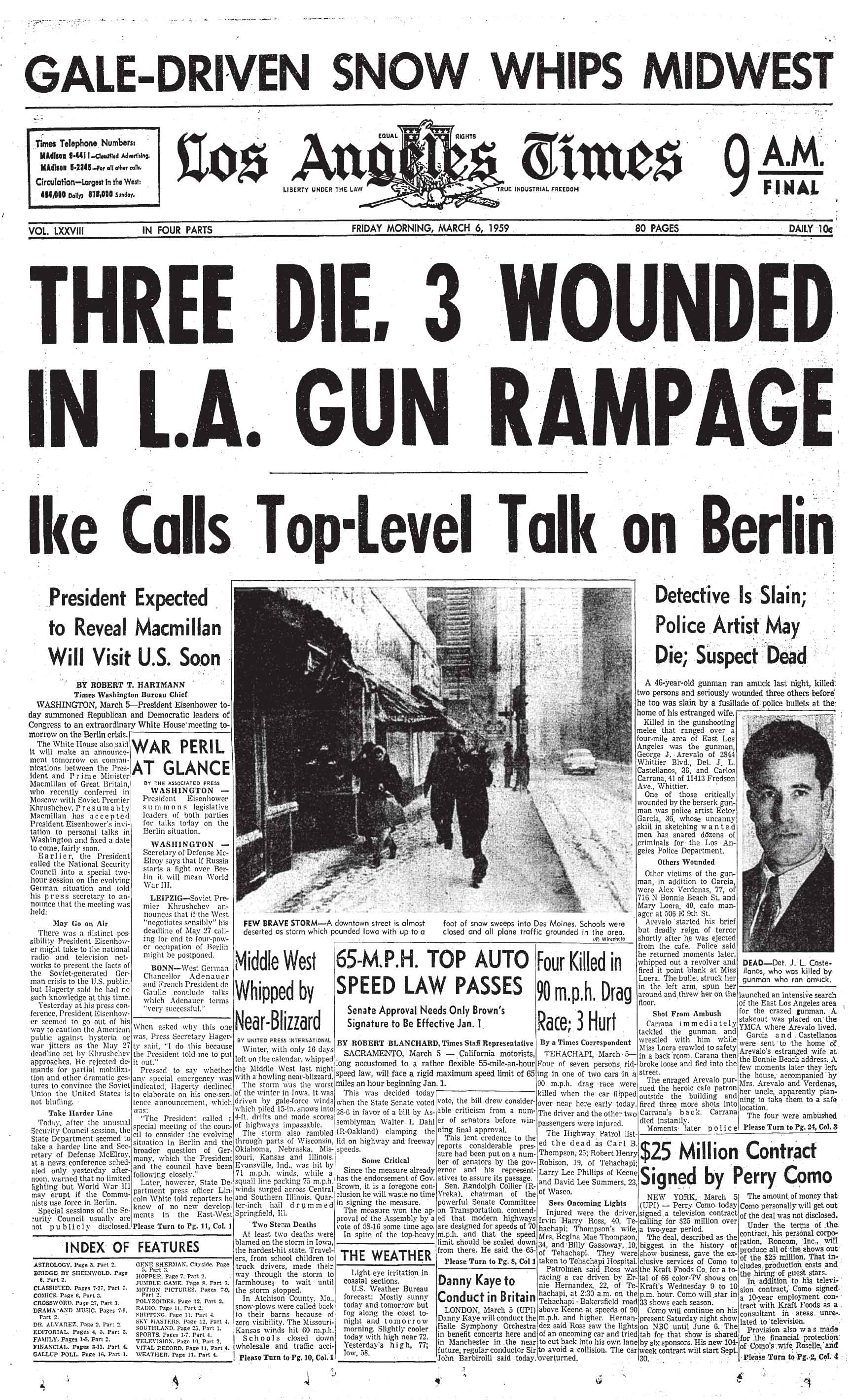
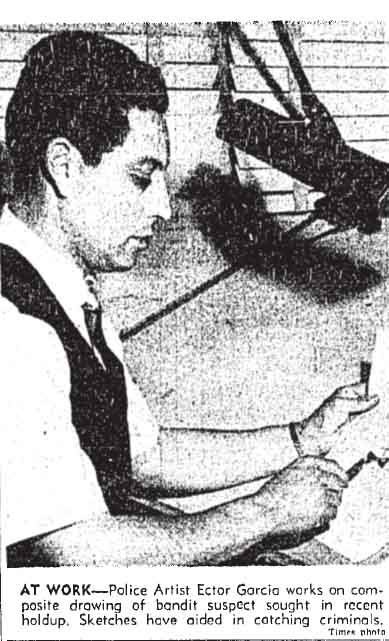
March 6, 1959: Three die, Three Wounded in L.A. Gun RampageMay 3, 1954: Police artist Ector Garcia drawing a subject.Through the 1950s, Police Officer Ector A. Garcia became a minor celebrity for producing sketches of crime suspects that were astonishingly accurate. But he wanted the excitement of being on the streets and that’s what he got.

Garcia and his partner, Detective Jose L. Castellanos, were working homicide
March 5, 1959, when they got a call that a gunman had gone on a deadly rampage at an East Los Angeles restaurant and was probably heading for the home of his estranged wife.

The gunman ambushed the detectives as they escorted the woman and her uncle to safety, killing Castellanos instantly. Although Garcia was struck by a shot that “seared across his eyes,” the police artist was able to return fire, killing George J. Arevalo, 2844 Whittier Blvd.

“We always knew he would do something like this,” Arevalo’s wife said. “He would go crazy every time he drank. Last March 27 we separated because of his drinking. He
told me when he left he would come back some day and kill the children and me.” Continue reading

Posted in #East L.A., art and artists, books, Front Pages, Homicide, LAPD | Comments Off on March 5, 1959: Blinded by Bullet, Officer Shoots Gunman Who Killed Partner

Found on EBay — Hollywood Boulevard

View Larger Map

Hollywood_postcard

Notice that there’s no traffic signal at Highland, just a stop sign.
This postcard of Hollywood at night, showing the neon signs on Hollywood Boulevard, has been listed on EBay. Bidding starts at $5.99. I suspect my crime buddy Nathan Marsak can give the history of every sign in this picture, starting with Coffee Dan’s (6776 Hollywood Blvd.) and the Pickwick bookstore, 6743 Hollywood Blvd.   
Posted in Architecture, Hollywood | 2 Comments

Matt Weinstock, March 5, 1959


Panes in Stomach

Matt_weinstockd
First let it be stated that G.K. Williams, editor of the Coronado
Journal, and Jane Reed, his assistant, are known by me to be utterly
reliable. Now go on.

They depose, on a stack of pancakes, that one day recently a red
convertible parked in front of their office. In the front seat of this
convertible was an Irish setter. While they watched, aghast, the Irish
setter began munching on the partially lowered glass of the right front
window.

While it was chawing away a lady in scarlet capris who, they
further depose, was not the type to be wearing them, appeared and
exclaimed, "You naughty dog! This is the fourth window you’ve eaten
this week!"

* *

1959_0305_teens
SPEAKING OF
windows, this scrawled message was posted in
the Burbank courthouse: "I do odd jobs like cutting yards, washing
windows. I charge $1 an hour" — with name and phone number.

* *


SHORTLY
after the polar satellite Discoverer I was sent aloft at Vandenberg Air Force Base Saturday Grant Holcomb of KNXT interviewed a high officer at the base about it.

The officer was explaining the missile’s intricate mechanism when George Hause,
sound man, broke in with, "Say, do you mind not using all that
technical jazz? Only the kids understand it, and this is a news program
for adults."

* *


BEFORE
taking off for Seattle on the 6 a.m. plane at International Airport the other day, Mark A. Kunkel of North Hollywood signed up for the maximum casualty flight insurance.

The girl at the desk looked at the form and said, "You haven’t filled in the name — who would you like as beneficiary?"

Still a little sleepy, Mark gave his own name.

"But that’s you, isn’t it?" she said.

Coming fully awake, he replied, "I guess when I made it out I believed in the hereafter."

* *


ONLY IN L.A. —
Two untidy gentlemen brought a jug of muscatel in a W 7th
Street liquor store and as one of them crumpled the paper bag and threw
it into the street a police car with siren screaming and red light
flashing bore down on them. "Man, they sure enforce that litterbug
law!" he exclaimed, retrieving it. But when the police car went past,
en route to a bank robbery at 7th and Hoover, he threw it away again.

* *


1959_0305_teens_ro
ABOUT A
week ago some pinups, mostly art studies from
Playboy, which circulates through the mails, appeared on the hitherto
pure walls of the new police buildingpressroom . A day or two later the
chief strolled in and frowned at them. Yesterday the reporters were
handed this ultimatum: "The ‘art’ work on display on this wall will be
removed forthwith, immediately and without delay. By order of Arthur H.
Hohmann, deputy chief of police."

My, my, such redundancy.

* *

IDES OF MAY
"Crewshoff" again sounds off.
His talk, with threats, just bristles:
Perhaps we shouldn’t scoff
As he flexes his muscled missiles.
— G. L. ERTZ


* *


1959_0305_abby
AT RANDOM —
A jagged hunk of iron fell off a truck on
Harbor Boulevard near Francisco Street and after about 40 cars swerved
around it, a woman stopped her Cadillac and, though wearing white
gloves and a stole, picked it up and tossed it into theiceplant . . . First message to go out on Transmit, the new teletype service, was inadvertently a letter Glen Eaken
, sales manager, wrote to his wife in Seattle. He wrote it so he could
send her the transmission tape to show how the service worked. He
didn’t know the line was open . . . Western Costume, which rents many
of the outfits for TV westerns, calls outlaws’ clothes "varmint’s
garments" . . . A patient inSawtelle Veterans Hospital puts it this way: "They gave up on me but I won’t give up." 

Posted in Columnists, Paul Coates | Comments Off on Matt Weinstock, March 5, 1959

Paul Coates — Confidential File, March 5, 1959


CONFIDENTIAL FILE

Big Money Bonanza Fails to Pay Off

Paul_coates_2
LeRoy McFarland of Huntington Park, has a money mine.

It’s in his back yard. He just discovered it.

It’s a lively one — chock full of coins, thousands of them.

From France, India, Burma, China, Germany, the United States, Mexico. Even Russia.

Big coins. Little coins. Copper coins. Silver coins.

Some of them real old. They date back to 1802.

Valuable, no doubt.

Looking at it objectively, it’s about as good a money mine as anyone could ask to find in his back yard.

1959_0305_cover
But those aren’t exactly LeRoy’s sentiments.

LeRoy hates his money mine. Hates it with a vengeance.

Little Treasure Island

LeRoy,
who’s 32, manages an apartment court at 5917 Compton Avenue. The way it
happened — the way he stumbled onto his cache — is that last Sunday
night he was cleaning up one of the carports at the rear of his
property.

There was a piece of tin dividing two of the ports which he wanted to remove.

He got a shovel and started digging.

When he got about a foot deep, he noticed that there were a few coins mixed in with the dirt. Nothing much.

A British farthing or two. A ten-franc piece. Some Mexican centavos.

But is whetted LeRoy’s curiosity.

He dug deeper. And he found more coins.

Tenants Join In

1959_0305_williams
About
a foot and half down he began running into little bags of them. Some
were wrapped in a plastic material. Others in rotting burlap.

Several of LeRoy’s tenants — surprised to see him digging and working so diligently — were attracted to the scene.

They pitched right in and helped him.

Within an hour, LeRoy had a five-gallon can full to the brim with dirty money.

Figuring
he’d done enough spading for the night, he closed up his money mine
with loose dirt, and lugged the can of treasure inside. There, he
washed it, filling a dishpan with about 40 pounds of clean coins.

Then, with his sister, Ida May, and a girlfriend of hers, he headed to the home of his father-in-law, Bert Johnson, at 5124 E 60th Place, Maywood.

Bert,
an amateur coin collector, got out his magnifying glass. Some of the
pieces were badly worn. Others were mutilated. There were a few with
the face of a U.S. penny on one side and the tail of a dime on the
other.

There was one inscribed "Gold Cup Handicap, one free play, Ocean Park," plus some streetcar tokens and some kids’ play money.

Mr. Johnson suggested that LeRoy take the whole dishpanful to the police.

1959_0305_duncanLeRoy took his advice, and that’s when his troubles started.

With the two girls, he arrived at the Huntington Park Police Station at about nine o’clock.

The whole station house was fascinated by LeRoy’s discovery.

A
sergeant contacted the FBI, and then, in turn, some Secret Service
agents for the Treasury Department. The agents told the police to hold LeRoy and his friends until they got there. 

LeRoy was led back to an interrogation room, while the girls remained up front. It was getting late.

Ida May, LeRoy’s sister explained to one of the officers that she had to get up at five in the morning to go to work.

"Do I have to stay here, too?" she asked.

"Everybody stays," replied the officer. "Those federal boys have it over us. If they say hold you, we hold you."

Ida May Talks

Ida
May is a very pretty girl. She’s a good talker, too. She explained her
problem to a couple of sergeants, and finally, they relented. She and
her friend could go home.

"Now, if I could just see my brother for a minute," she said. "I need to borrow a dollar from him for my bus fare tomorrow."

"Oh, no," answered the officer. "Nobody’s talking to him until the feds do."

1959_0305_kennedy_part1"In that case," Ida May cried indignantly, "when I go home, I’ll get a shovel and just dig up another dollar."

The police let Ida May borrow a dollar from her brother.

An officer drove the two girls home. When he returned to the station, the federal agents were there, busy with LeRoy.

There’s More

The officer broke into the interrogation session and sprinkled two more handfuls of coins into the dishpan.

"He’s got a real mint back there in the yard," beamed the officer. "I got this just turning that shovel a couple of times."

At midnight, the Treasury agents were through with LeRoy. "We’ll take the coins," they explained.

"All right," LeRoy agreed. "Would you give me a receipt for them?"

"No, sir," answered the agent. "Those belong to the government now."

"But I found them," protested LeRoy. "You can keep the mutilated ones, I just want the foreign coins back."

Peril of Jail

"No,"
was the final answer. "And if you dig up any more coins, you’ve got to
give them to us. Understand? If you hold out so much as one coin, you
can get 10 years in jail for it."

LeRoy understood. Meekly, he requested his dishpan back. Here, the agents conceded.

Then
they followed him home, briefly examined his money mine, and told him
that they suspected the bulk of the loot came from vending machines.

1959_0305_kennedy"The foreign coins too?" LeRoy
asked. "Most of them were foreign coins." Then he related a story about
what happened to him when he was digging in the rear of the car port
two weeks earlier.

Stacks of Bills

"It might be
significant," he said, "although I didn’t think anything about it at
the time. I dug up two bundles of moldy paper. Shaped just like stacks
of bills. I didn’t examine them, though. I just shoveled them into the
trash."

The Secret Service here today indicated it has been
busy on several major counterfeiting investigations — and was a little
amazed at some of the stories going around about the coins.

"Nobody asked for a receipt and the man seemed anxious to get rid of his find," Special Agent Guy Spaman said.

"We
haven’t had a chance to go through much of the stuff, but so far we
haven’t found more than 15 cents in actual U.S. money value," he
continued. "Whether some of the foreign coins might be worth more than
their face value, I don’t know."

Felony Angle

What interests the Feds, and they figure McFarland should be interested, too. Possession of coinlike pieces of metal that could be used in a coin machine is a felony.

In
fact, they theorize that somebody who operates such machines probably
buried the collection of slugs and coins to make sure they didn’t show
up in his coin machines again.

"Nobody said he couldn’t dig any more," Spaman said. "But if he finds that type of mutilated coins or coin shapes again, the law remains the same."

Posted in Columnists, Matt Weinstock | Comments Off on Paul Coates — Confidential File, March 5, 1959

In the Theaters — March 5, 1918


1918_0305

Posted in Film, Hollywood, Music, Stage | 1 Comment

Trouble Was His Business — Raymond Chandler


1939_0219_big_sleep_2

Feb. 19, 1939: "The Big Sleep," reviewed in The Times by Wilbur Needham, a name Chandler might have used for one of his characters. Needham and his wife, Ida, operated Needham Book Finders at 2317 Westwood Blvd.

Note: To mark the 50th anniversary of Raymond Chandler’s death, the
Daily Mirror is revisiting some of The Times’ stories about his life and
influence. We invite the Daily Mirror’s readers to share their thoughts.

Posted in books, Film, Hollywood, Raymond Chandler | Comments Off on Trouble Was His Business — Raymond Chandler

Rediscovering George Garner, March 5, 1939


1933_0212_garner_2

From The Times, Feb. 12, 1933.

1939_0305_garner
Seven lines of type in the March 5, 1939, issue of The Times unspooled
into quite a story. If the beginning of the tale is a bit unclear, the
end is even more enigmatic. All we’re left with is the great middle.

The focus of our story is the Rev. George Robert Garner III, who
achieved so many firsts in his lifetime that it’s remarkable so little has
been written about him:

Garner was the first African American to solo with the Chicago Symphony Orchestra, c. 1927.

He was the first African American teacher in Pasadena.

He was the first African American lead in a production at the Pasadena Playhouse.

1934_0701_george_garnerAccording to a 1933 interview in The Times, Garner was born in Chicago and his father was the longtime butler of the Timothy Blackstone household.
According to a 1932 Time magazine feature, Garner sold papers, worked as a bellhop and sang in the choir at Olivet Baptist Church as a young man.

Although Garner was clearly talented, his father opposed a career in music,
insisting instead on something more practical. Garner
eloped with a young musician (presumably pianist Netta Paullyn/Paullyin
Garner) and eventually won the financial support of Mrs. Blackstone and
other arts patrons so that he was able to study in England for six
years.

By 1933, Garner had arrived in Pasadena. The next year, he became the
first African American to star in a production at the Pasadena
Playhouse, "Finder’s Luck," by Alice Haines Baskin. By that time he had
established the George Garner Negro Chorus, which performed concerts at
the Rose Bowl and took part in the first performances of a choral symphony by David Broekman titled "Harlem Heab’n." The chorus was also recognized for performances at expositions in San Diego and San Francisco.

Garner also began the Negro Music Research Foundation, 470
Blake St., Pasadena. Unfortunately, The Times wrote very little about
it except to say that the goal was to preserve spirituals. The group
later opened a center at 440 N. Westmoreland, Los Angeles.

According to a 1938 article in The Times, Garner received a bachelor’s
degree in music education at USC and became Pasadena’s first African
American teacher.

There’s very little about him in The Times in the 1940s except that he
led an interracial chorus that performed Dubois’ "Seven Last Words of
Christ" for Palm Sunday, 1947. The Times critic described Garner as
"one of the city’s outstanding Negro choral directors."

1953_0531_george_garner
Interesting enough, by 1949, he appears as the Rev. George Robert
Garner III in The Times, which says he was regional director of the
National Assn. of Negro Musicians. He delivered the invocation at a
1953 Republican fundraiser and campaigned in Illinois for the
Eisenhower-Nixon ticket.

In the 1950s, he was music critic and arts editor for the Los Angeles
Sentinel, a weekly serving the African American community, and the
conductor of an interfaith chorus sponsored by the Pasadena YMCA.  He
was also a leader in the Los Angeles County Forum Lyceum.

In 1959, the Los Angeles County Board of Supervisors honored him as
executive vice president of the George Garner Music Research Center of
Pasadena. He was also recognized as the founder of the Pasadena Assn.
for the Study of Negro Life and History, which was founded in 1937 and met
at First Methodist Church, 500 E. Colorado Blvd.

What became of him after that is unclear. California death records list
a George R. Garner dying Jan. 8, 1971, but it’s not certain if this is the
same man. The only current reference I can find is a chapter of the National Assn. of Negro Musicians in Altadena that’s named for him.

One nice thing about history blogging is that questions can be
open-ended. I’ve asked the Chicago Symphony Orchestra about Garner’s
historic performance and I’ll be interested to see what else turns up.
And then there’s the citations at the Pasadena Public Library. If I get a chance I’ll take a look and see if I can fill in some of the blanks.


Posted in classical music, Music, Stage | 2 Comments

Found on EBay — Tick Tock Restaurant

Ticktock_ebay
This postcard of the Tick Tock restaurant, onetime Los Angeles landmark at 1716 N. Cahuenga, has been listed on EBay. Bidding starts at $5.99.
Posted in Architecture, Food and Drink | 1 Comment

Voices — Horton Foote, 1916 – 2009


Horton_foote

Photograph by Carolyn Cole / Los Angeles Times

Horton Foote at New York’s Booth Theatre, where his "Dividing the Estate" was being performed, Oct. 11, 2008.

Horton Foote: "I Stick With It"

* Theater * The playwright, 86, keeps very busy and has won a new
fan at SCR, where his ‘Getting Frankie Married’ world-premieres.

March 29, 2002

By MIKE BOEHM, TIMES STAFF WRITER

Horton Foote achieved his first great success in the theater by laying on the histrionics.

That
was some 70 years ago, when he was a schoolboy from Wharton, Texas,
competing in a statewide drama contest. The play, he recalls, was about
three college roommates. He was the one with the bad drug habit.

"He
needed a fix, and I remember [performing] this catastrophic breakdown
onstage," Foote recalled. "When it was all over, the judges called my
teacher over and said, ‘Is that boy afflicted, or is that acting?.’ She
said it was acting, so they gave me first prize."

Somewhere
along the line, Foote changed his tack. By his mid-20s he had concluded
that writing, not acting, was his true calling. And since 1940, when
his first play was produced, he has secured a niche as an admired,
Pulitzer Prize-winning dramatist who eschews stage histrionics and
invites audiences to absorb the subtle, detailed ebb and flow of life
in Harrison, Texas, the fictional small town modeled on Wharton where
his stories unfold.

On March 14, Foote spent a chunk of his 86th
birthday at New York City’s Lincoln Center, where his play "The
Carpetbagger’s Children" was in rehearsals for its New York premiere
this week. After the opening, he was planning to take a day off, then
fly to Costa Mesa in time for tonight’s first preview performance of
another new play, "Getting Frankie Married-and Afterwards," at South
Coast Repertory.

"I love the theater, and I’m always there" when
a major production is gearing up, Foote said over the phone recently
from a New York hotel room. "I’m sure I’m a bother, but there I am. I
stick with it."

Foote is five months younger than his more
famous, and similarly still productive peer, Arthur Miller. But Foote
has a four-year head start on Miller when it comes to getting plays
produced: Miller’s debut didn’t come until 1944, with "The Man Who Had
All the Luck." (Miller’s next play, "Resurrection Blues," opens Aug. 9
at the Guthrie Theater in Minneapollis.)

Foote has written more
than 60 plays. He won the Pulitzer for his 1994 drama, "The Young Man
From Atlanta." He won Oscars for his adaptation of Harper Lee’s "To
Kill a Mockingbird" and his original screenplay for "Tender Mercies."
He won an Emmy for his TV adaptation of William Faulkner’s story "Old
Man." In 2000, President Clinton awarded him a National Medal of Arts.

And now, finally, he has stuck with it long enough to see one of his plays produced on a major Southern California stage.

Overlooked in Southland Until a New Fan Emerges

His
work has been done occasionally here in small theaters. But until South
Coast Repertory secured the world premiere of "Getting Frankie
Married," the area’s leading resident companies-including the Mark
Taper Forum, Ahmanson Theatre and Geffen Playhouse in Los Angeles, the
Globe Theatres and La Jolla Playhouse in San Diego County and the
Laguna Playhouse, Pasadena Playhouse and South Coast itself-had been
pitching a career shutout against Foote.

Martin Benson, the
South Coast artistic director and director of "Getting Frankie
Married," acknowledges having overlooked Foote until the playwright’s
agent sent the "Frankie" script about 18 months ago. Benson went for it
immediately. Now he is reading his way through the Foote oeuvre, with
an eye toward producing more of his scripts–"The Trip to Bountiful,"
which was made into a movie with Geraldine Page in 1985, is a leading
candidate.

"I’m a great admirer of his now," said Benson, who
spent time in Wharton with Foote, meeting some of the townsfolk and
soaking up the atmosphere in hopes of capturing some essence of
small-town Texas onstage in Orange County "Maybe one reason he’s not
produced as much as he should be is that sometimes his plays seem
simplistic on the page. You can think, ‘Oh, rural America’ and that
it’s oversimplified and a cliche. But when you get up to act them,
they’re incredibly rich, with enormous depths. That’s been my discovery
with this play."

Foote wrote "Getting Frankie Married" around
1990, the year in which the play is set. One reason it may not have
been produced until now is that it requires a cast of 12–a huge number
for a contemporary play. Its central figures are Fred Willis, a
wealthy, 43-year-old landowner, and Frankie Lewis, the girlfriend he
has been stringing along for more than 20 years. Frankie is a wife in
all but name and an object of small-town gossip. Fred makes a series of
choices-motivated, he thinks, by love and honor-that turn out horribly
for him.

Foote rates Fred as perhaps the saddest character he
has ever drawn. "That last moment is certainly very moving. to me.
There’s nobody there to comfort him, and he has to struggle through it
for himself."

Although Southern California has been a tough nut
for Foote to crack in terms of productions, it was, long ago, the
seedbed for his theater career. After winning schoolboy laurels for his
acting in Texas, he managed to get his reluctant parents" approval of
his plan to skip college and get more theatrical training. They
wouldn’t countenance his going to New York–"They thought it was a
wicked place"–so he headed West and enrolled in the Pasadena
Playhouse’s acting conservatory. Foote said s the event that shaped him
most in Pasadena–apart from having his Texas accent whitewashed in
elocution lessons–was the touring production of "Hedda Gabler" he
attended in Los Angeles on his 18th birthday with his visiting
grandmother. Eva Le Gallienne’s performance enraptured him, and he came
back to see "A Doll’s House" and "The Master Builder," the other plays
the noted actress was performing in repertory.

"It really rocked
me," Foote recalled. "I’d had this sense of ‘Maybe I’ll end up in the
movies.’ This made me go to New York to be a [stage] actor." In New
York, Foote began writing plays as well as acting in them. "Texas
Town," staged in 1941, won a rave from New York Times critic Brooks
Atkinson who loved Foote’s writing but panned his acting. Writing
became his focus. Foote said he is searching these days for his next
idea, making notes and hoping inspiration will take hold. "There’s
something I’ve been thinking about for 20 years, searching for a way to
do it," he said. He declines to elaborate because "I think it’s death
to talk about something when you’re working on it."

Posted in books, Film, Hollywood, Stage | 3 Comments

Matt Weinstock — March 4, 1959


New Twist on Smog

Matt_weinstockd_3
Along with the rest of us, W. B. France is weary of reading about smog. But he thinks he has a solution.

It is based on a science-fiction story he read long ago. In this tale a
huge spaceship, one of ours, spent 200 years traveling around the
galaxies.

At the end of this time the spaceship headed home. As it neared earth
its homesick occupants were met by small planes and warned against
landing. The earth’s atmosphere had so changed, they were told, it
would be fatal for anyone not accustomed to it.

1959_0304_death_penaltyKEEPING THIS TALE in mind, clearly the thing for earthbounders
to do is get accustomed to smog, even encourage it. In time it would
become our natural atmosphere and we would learn to thrive in it.

And think of the advantages. We would save the millions of dollars now
being spent to combat it. It would repulse an enemy, even the little
green men from up there who might try to invade us. Most of all, it
would eliminate the constant babble about smog so we could concentrate
on crime, scandal and other wholesome topics so dear to us all.

* *


SOMETHING
has been missing since the City Hall tower
courts moved to the new courthouse and reporter John Hunt has realized
what it is. The intense threesomes — two women and a man — who used
to grace the rotunda each morning, are gone.

The man was a lawyer. One woman wore a brave smile. The other, her best
friend, mother or sister, had a look of "Wait until I get on the
witness stand and tell what I know about that guy!" They were having a
final rehearsal before going up to the separation center.

* *

CURRENT EVENTS
My youngster’s conscious of the news,
He knows his rights and states his views.
When naughty he is independent
And calmly takes the Fifth Amendment.
— PEARL ROWE

* *


A WORKMAN
on the graveyard shift in a harbor industrial
plant recently reported excitedly to his pals that an amphibian plane
had pancaked in near Berth 190. He didn’t know, as they did, that it
had crashed off Catalina some time ago and been hauled to the berth
awaiting further plans by its owners.

1959_0304_death_penalty_02The next time he looked
the plane was gone and he learned it had been trucked to a salvage firm
on S Alameda Street. By this time he knew of his original
miscalculation and remarked wryly to his cronies. "It must have set
some kind of record, flying from Catalina to Compton without wings or
tail."

* *

IT IS NOT uncommon for new MTA
drivers on the Sunset Boulevard line to Pacific Palisades to lose their
way but one eastbound bus the other day went completely off orbit.

The
driver, as if impelled by an unseen force, turned onto the San Diego
Freeway on-ramp instead of staying on Sunset. He knew immediately from
the buzzing of the passengers that he had goofed and as soon as
possible he swung off the freeway, circled back to Sunset and, reports
Mary Kay Post, secretary to the dean of women, got students to UCLA in
time for 8 a.m. classes.

* *

AROUND TOWN —
Printed sticker on a car with a Tenn. license on Olympic Boulevard: "A
big welcome to Alaska from little old Texas" . . . Ernie Maxwell
reports fromIdyllwild that it’s a big year for snow women — Marilyn Monroe prototypes. 

Posted in Columnists, Matt Weinstock | Comments Off on Matt Weinstock — March 4, 1959

Paul Coates — Confidential File, March 4, 1959


CONFIDENTIAL FILE

It Happened Here, Believe It or Not

Paul_coates_2
In big cities, little dramas are born every minute.

This one happened a few Wednesdays ago.

Its protagonist was a dark-haired lady, barely 5 feet tall, with a very soft voice. She was, I’d guess, somewhat ungallantly, just past her mid-40s.

She
had married young, raised her family, and now — well, there was time
on her hands. To fill it, she went back to work and among other things,
participated in a weekly ritual known to millions of American women as
the visit to the beauty shop.

Her beauty shop was in Bellflower.

At 7 p.m. sharp, she stepped out of the rainy night, into the same salon she’d been patronizing for years.

She greeted the girls and was led back to her regular cubicle by her regular operator. Just like always.

But halfway through her shampoo, she jerked up her head.

"Did someone call me?" she asked.

1959_0304_duncanThe
operator said yes, she thought someone did. They were paging someone to
the telephone. Quickly, the beautician rinsed the customer’s hair and
draped a towel across her shoulders.

The small lady hurried to the phone. She picked up the receiver, which was lying on the counter.

"Hello," she said.

A man’s voice answered. "You can’t see us," it spoke gruffly, "but we can see you. We’re outside."

"Is this a prank?" cried the woman.

"No," was the reply. "It’s no prank. You can come out quietly, or we can come in after you."

The woman paled. "What’s this about?"

"You know what it’s about," answered the man. "It’s about a little manner of grand theft."

Now
the woman was really frightened. She stared in disbelief into the
phone. Nervously, she hissed, "You’re crazy." She slammed down the
receiver.

But as she turned away from the phone, she saw two
men staring at her. There were standing outside the salon’s entrance. A
tall one and a shorter one. The tall one beckoned to her.

Still
slightly dazed, she moved toward them. She was wearing a shampoo cape
and the towel across her shoulders. Her hair was dripping wet.

Cautiously, she pushed the door open a few inches. "What do you want?" she demanded.

One man flashed a badge at her. "Long Beach Police Department," he said.

His
partner grabbed her arm, pulling her halfway out of the shop. "Get that
stuff off you," he snapped. "You’re coming with us."

1959_0304_abby"What did you do with that furniture?" asked the first man.

"The furniture you stole out of the apartment where you lived," added the second.

"Apartment?" cried the woman. "I’ve been living in the same house for 12 years."

Produces Identification

Suddenly, she jerked her arm free. She ran to the owner of the beauty salon. "Tell these men who I am," she pleaded.

The men were right behind her.

The
small woman grabbed her purse and fumbled through it. "I’ve got
identification," she cried. "I’ve never been in trouble in my life."

She
was so nervous that finally the owner had to help her find her wallet
with the identification cards. He handed it to the plain-clothes
officers.

Carefully, they studied the cards. Then one of them thrust the wallet back at the terrified woman.

"Sorry," he grunted. "You’re not the one we’re after."

Together, the pair turned. And they walked back out into the rainy night.

To
me, it’s a shocking story of injudicious police work. But, fortunately,
it’s a story that Long Beach’s tough Irish city councilman, Pat Ahern, is taking a close look at right now. 

Posted in Columnists, Paul Coates | Comments Off on Paul Coates — Confidential File, March 4, 1959

March 4, 1959: Lou Costello Dies!

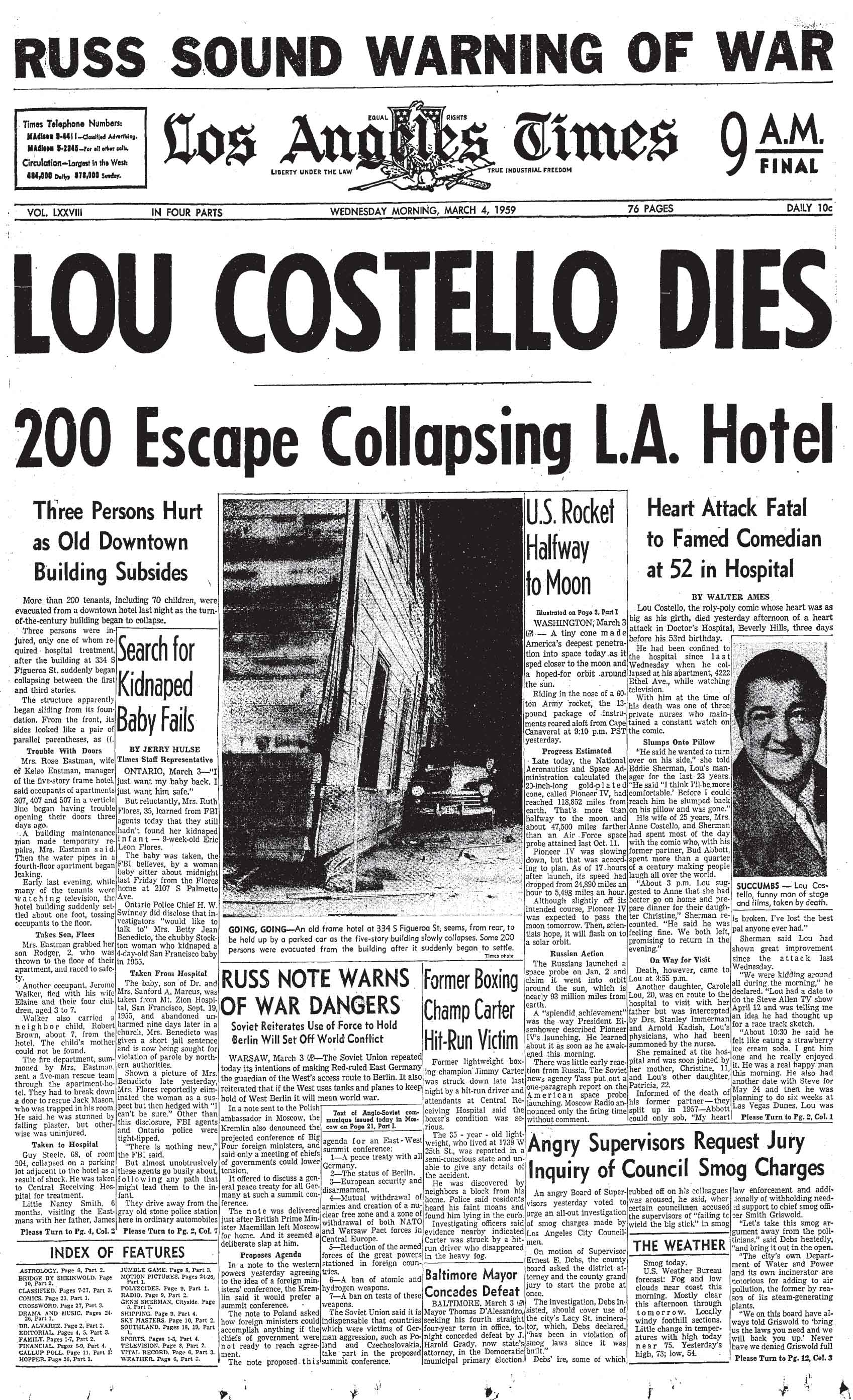
March 4, 1959: Lou Costello Dies!Comedian Lou Costello dies at Doctor’s Hospital in Beverly Hills after
collapsing the week before while watching television. He was 52. His partner, Bud Abbott, died in 1974. Continue reading

Posted in Film, Hollywood, Obituaries | 1 Comment

In the Theaters — March 4, 1916


1916_0304_theaters
Posted in Film, Hollywood, Music, Stage | Comments Off on In the Theaters — March 4, 1916

Trouble Was His Business — Raymond Chandler


Note: To mark the 50th anniversary of Raymond Chandler’s death, the
Daily Mirror is revisiting some of The Times stories about his life and
influence. We invite the Daily Mirror’s readers to share their thoughts.
 

The Raymond Chandler Lookalike Contest

RAYMOND CHANDLER’S PHILIP MARLOWE A Centennial Celebration, edited by Byron Preiss

December 18, 1988

By Kenneth Turan, Turan is film critic for Gentlemen’s Quarterly. (Note that Turan is now at The Times).

Hard-boiled
fiction is a lean, mean revolution that has grown soft and fat on its
own success. American writers, fed up with effete British detective
stories that focused as much on tea cozies as corpses, decided to liven
things up by adding a dose of reality and a dash of style. Carroll John
Daly, who favored lines such as "Dead? He was as cold as an old maid’s
smile," fired the first shot when he published a short story called
"The False Burton Combs" in the December, 1922, issue of a magazine
called Black Mask. Then came the big guns: Dashiell Hammett, Raymond
Chandler and James M. Cain, all intent, in Chandler’s often-quoted
words, on "getting murder away from the upper classes, the weekend
house party and the vicar’s rose garden and back to the people who are
really good at it."

Did they succeed? And how. Hard-boiled
fiction has become a literary growth industry paralleled only by the
boom in romantic fiction. Every year yet another brace of Chandler
imitators roars out of the blocks to admiring reviews from critics and
sizable sales to readers hungry for even a taste of the savory
satisfactions the originals gave. The ever-irascible Chandler, who
liked to refer to himself as "just a beat-up pulp writer . . . In the
United States I ranked slightly above a mulatto," would surely be
astonished by the mushrooming of the style he helped pioneer.

With
success, however, has come inevitable flabbiness. Today’s Chandler
imitators, even the best of them, are just that, imitators, unable to
match the excitement that is generated only by writing that is
provocatively original. The situation got so bad that Donald Westlake,
whose Parker novels ("Parker steals. Parker kills. It’s a living") are
in fact the best hard-boiled work of the last 25 years, was moved to
make a speech about it a few years back.

"I try to inhale and I
don’t sense any air here," Westlake said of the current state of the
genre. "What are these books? What do they connect to? The brevity of
those early Black Mask days is long gone. The relevance of those days
is gone. The vitality of novelty is gone. The reflections of any
underlying trust is gone. I’m not really sure what’s left."

What’s
left is the desire to cash in, a desire that even as prestigious a
publisher as Alfred A. Knopf, which first published Chandler and
Hammett in book form, can’t seem to resist. A few months ago, Knopf
came out with a hardcover edition of "Woman in the Dark," one of
Hammett’s more forgettable novelettes, and now comes "Raymond
Chandler’s Philip Marlowe: A Centennial Celebration."

To
commemorate the 100th year of the writer’s birth, packager Byron Preiss
came up with what must have seemed like a good idea at the time,
something reasonably dignified and quintessentially lucrative: Contact
23 current mystery writers and have each one of them write a story with
Marlowe as detective solving crimes left and right. Add "The Pencil,"
Chandler’s last story. You can almost hear those cash registers ringing
already.

Not all writers contacted, however, were delighted.
Joseph Hansen, for one, made it known that he felt the idea was
"somewhat akin to grave-robbing. Philip Marlowe is a creation of the
imaginative mind of Raymond Chandler, and I don’t believe every Tom,
Dick and Harry has the right to lay claim to him. Ethically, you can’t
do that."

Even more likely suspects than Hansen are missing from
the list, though whether it’s because they weren’t asked or because
they turned the task down is impossible to say. Westlake isn’t here,
probably for obvious reasons, and neither is Lawrence Block, the
odds-on best of the current hard-boiled writers, or Robert Parker, the
most popular.

Still, the list contains considerable first-rate
talent, people such as Loren D. Estleman, Dick Lochte, Sara Paretsky,
Roger L. Simon and Jonathan Valin. And the writers clearly tried to
rise to the occasion, often putting in nuggets of detective trivia for
fans to relish. One story has Marlowe reading Paul Cain’s "Fast One,"
one of the legendary hard-boiled novels; another has him yearning for
the powder-blue suit cognoscenti know he wore in the opening of "The
Big Sleep"; a third has Marlowe running into Chandler himself.

There
are some new twists when it comes to plots–the use of subject matter
such as child molestation, for instance, which would have been taboo in
Chandler’s day. But mostly it’s the usual round of missing persons and
blackmail, small errands that turn into big trouble. The best stories,
interestingly enough, are the ones that succeed in capturing the whiff
of melancholia that blew through Marlowe’s life like the famous Red
Wind. Mostly, however, these tales are simply too derivative to be
seriously involving. What made Chandler’s stories so readable was not
that Marlowe was in them but that they were written with a verve that
mere copies, no matter how well-intentioned or clever, cannot hope to
match. While the writers clearly had fun paying homage to a man they
rightfully respect, sharing in their enthusiasm is something else
again.

Posted in books, Film, Hollywood, Raymond Chandler | 1 Comment

Random Shot –Temple B’nai B’rith, 1896

Synagogue_bnai_brith_02_crop

Los Angeles Times file photo

I can’t even explain it, but I adore this building, Temple B’nai B’rith at Hope and 9th streets, which was built in 1896. The congregation sold the building in February 1927 and moved to Wilshire Boulevard Temple. Some people wonder why I publish black and white photos in color. This is why.

1896_0907_temple

The Times says that everything for the temple was made in Los Angeles, even the pipe organ. Notice that the chorus sang the "Hallelujah!" chorus from "Messiah."

Synagogue_bnai_brith_02_wood_crop

Notice the timbers in front of the temple. They look like railroad ties.

Synagogue_bnai_brith_02_unpaved_cro

And the streets aren’t paved.

Synagogue_bnai_brith_02_lighting_cr

I wonder if that’s the switch.
Synagogue_bnai_brith_broadway

The temple at Hope and 9th was built to replace the one on Broadway between 2nd and 3rd streets, which is now marked by a plaque.

What’s especially great about this photo of the 1896 temple is that it’s the best picture I’ve found so far of the early attempt at street lighting.
Notice that this is only the bottom of a very high pole that was topped by a carbon arc lamp–kind of like a flying saucer on a stick.

1904_november_26_detail1

Synagogue_bnai_brith_02_window_crop
And I think the windows are great.

Posted in Architecture, Downtown, Religion | 4 Comments

Avenue 21 Elementary School


1977_0527_avenue21

Daily Mirror reader Dorothy Wiskup is looking for a photograph of Avenue 21 Elementary School (which oddly enough had the address of 141 N. Avenue 22). She says that inquiries at the Los Angeles Unified School District and the Los Angeles Public Library have been unsuccessful.
Posted in Architecture, Education | 2 Comments

Found on EBay — Williams and Walker

Williams_walker_cheap_ebay The sheet music for "I Don’t Like No Cheap Man," by Williams and Walker, has been listed on EBay. Bidding starts at $5.
Posted in Music, Stage | Comments Off on Found on EBay — Williams and Walker

Matt Weinstock — March 3, 1959


Death of a Fighter

Matt_weinstockd_2
Rene Belbenoit, a gallant man, goes to his grave today at Pierce Bros. Hollywood cemetery.

Rene,
59, was found dead, sitting in a chair, in the little desert store he
had operated the last seven years in Lucerne Valley. There in the
desert he found the peace which all his life had eluded him.

A
quarter of a century ago, Rene, small in size but a giant in courage,
did the impossible — he escaped, on his fifth attempt, from the
infamous Devil’s Island off the coast of French Guiana.

Then
began another kind of fight, a crusade for a full pardon from the
French government. Rene felt he had been unjustly sentenced to the
penal colony. Even though his book, "Dry Guillotine," telling of his
ordeal, helped do away with the living death, he never gave up.

1936_0823_belbenoit_01_2
HIS PLIGHT

was first brought to print by Ernie Pyle, then a syndicated roving
reporter. He talked to Rene when he was a fugitive living in the
Central American jungle.

It was through Ernie that I became
acquainted with Rene and when Ernie was killed on le Shima in 1945, I
helped tell Rene’s story. I last saw him in 1956, the day he received
his American citizenship. It was a proud moment for Rene as he had been
a man without status since his escape. We had a drink on it at
Frascati’s on Sunset Boulevard.

Rene, slowly sipping a
Dubonnet, reiterated his intention of getting a pardon from France,
presenting his case, like Emile Zola, in a book. He was rewriting the
book, "Anatomy of Justice," when death overtook him.

There was
a final irony to his death from a heart attack. About four months ago
he had trouble breathing but he attributed the condition to his
terrible time in the jungle. However, he promised his wife that on his
60th birthday, April 4, as a gift to her, he would go to a doctor for a
check as she had been urging. He waited too long.

* *

1936_0823_belbenoit_02_2
NOT LONG AGO

the Supervisors presented a resolution to Walter Brennan for his
contribution to clean entertainment. As always, there were hecklers at
the ceremony. One of them called out, "Ha Walter, did they tell you how
much that resolution cost the taxpayers?"

"No, they didn’t," he retorted, "but offhand I’d say the taxes I pay are at least 10 times what you pay so I’m not kicking."

* *

ONLY IN HOLLYWOOD — One
day last week Mrs. E. L. saw a strange black dog in her neighbor’s
yard. Later, while at a nearby market, she looked at the free ads on
the bulletin board provided for customers and saw one offering a $25
reward for a dog answering the description of the pooch in the yard. 

She
took the number and phoned it when she got home and explained the
situation to the man who answered. In a few minutes an elderly
gentleman came in an old car, looked, said, "No, that isn’t my dog,"
and went away.

A few minutes later an elderly woman drove up in a new car, called to the dog and it happily jumped in the car.

Mrs. E. L. remains amused. She doesn’t need the money and wouldn’t have taken the reward. She simply loves dogs.

* *

1959_0303_abby_2
YOU CAN’T FOOL
the
children. There was a gripping scene in a TV western the other night in
which a naughty blond, shot by mistake in shielding the hero, hovers
between life and death as sad-faced townsfolk, suddenly realizing her
sterling qualities, look on. At which a girl watcher named Jane
remarked, "She’s dead. You can tell because the violins are playing."

* *

AT RANDOM —
Let there be no further speculation on the identity of Lately Thomas,
author of the forthcoming book "The Vanishing Evangelist," the story of
Aimee Semple McPherson’s sensational "kidnapping" and reappearance in
1926. It isn’t a pseudonym. Lately Thomas writes from S.F., "I’m sorry
to disappoint but there is no mystery. The name is the name" . . . A
man driving a small foreign car on W 2nd Street yesterday was wearing a
gas mask, the goggle and hose kind firemen use. . . . A man on W 38th
Street has a license plate tab stating, "Faubus for President," which
he says is being circulated by the American Protective Assn. of
Jackson, Miss. Wonder how the Civil War’s going?

Posted in #courts, books, broadcasting, Columnists, Matt Weinstock, Obituaries, Television | Comments Off on Matt Weinstock — March 3, 1959

Paul Coates — Confidential File, March 3, 1959


Linda_mintz_1958_1111_frank_heller_Photographs by the Los Angeles Times

Frank Heller and Linda Mintz in a photograph published Nov. 11, 1958, in The Times. 

1957_0528_hed_21

Slave Camp to Murder Trial

Nazi Victim Still Hopes

Paul_coates
For Linda Mintz, tomorrow the horror may end.

The tiny, frail Polish war refugee, who has spent most of her adult
life behind bars and barbed wire, may once again know the luxury of
freedom.

Tomorrow morning, the district attorney’s office will reveal whether it
wants to try her for a third time for a crime which she denies today as
vehemently as she hysterically denied it 21 months ago, when officers
first took her into custody.

Then, on the final day of May, 1957, the $200-a-month domestic was
formally charged with the "vacuum cleaner" murder of Mrs. Thelma Macomber, 42, her wealthy Studio City employer.

The gray doors of County Jail have blocked her from society since — as
did the grim portals of Nazi concentration camps and European
displacement centers during the 40s and early 50s.

Linda_mintz_1958_0226_terry_winfrey
Twice in the last 21 months, the state has presented its case against Mrs. Mintz.

Each time, the juries deadlocked hopelessly.

The first panel, after four days of unsuccessful deliberation, was dismissed when it stalemated 7-5 for conviction.

The second jury, released only a few days ago after a week of violent disagreement, hung at 8-1 for acquittal.

Hours ago, I left the prison ward bedside of Mrs. Mintz in County General Hospital, where she’s resting after the 13-week ordeal of the second trial.

She fears reporters, photographers, newspapermen.

But on this, the eve of the most important day of her life, she wanted to talk.

"I will tell you that I am innocent, and I am afraid," she said.

She sat upright in her bed.

1959_0303_death_penalty"Afraid of what?"

"I don’t know. I’m just afraid. I don’t think I can go through another trial. I just don’t think I can."

During her first trial. Mrs. Mintz broke up repeatedly, and when
it finished, she was treated at Patton State Hospital for a nervous
breakdown. At the second trial, she was much more composed — until the
jury foreman announced that a verdict was impossible.

"I don’t blame the United States. The United States has been good to me," she said.

Linda Mintz has a natural smile. Even when her forehead is furrowed with confusion, her lips are smiling.

She rambled endlessly as we talked, from subject to subject, from sadness to hope to sadness.

But no matter where the conversation started, it always ended up on her boy, Alex.

"When I’m free, I will study at night. Alex will go with me to school. I will never leave him."

Alex was 11 when Mrs. Mintz went to jail. Today he is being cared for in a children’s home.

"When the police took me, Alex was there. I don’t think I’d be gone for long. All I said to him- I said, ‘See you later, Alex.’

"I babied him," the boy’s mother confessed.

"But you don’t blame me. You can’t. I know how I raised my child. On
the floors of those camps, with lice and filth. I would walk 10 miles
to a farm to get eggs and milk for him."

Would Bury Sad Past

Mrs. Mintz’s steel eyes flashed when she talked of her son.

"He’s very mechanical," she continued. "Since he was a little boy, he
liked science. I want him to go to college and be a scientist."

1959_0303_death_penalty_02Money?

"It’s gone now. But I can work. It went very fast after I was arrested, all that I had saved to send my boy to college.

"But Mr. Heller and Mr. Taylor (attorneys Frank Heller and Charles Taylor, who defended Mrs. Mintz at her second trial) never asked me about money. God sent them to me."

"Have your attorneys told you whether they think you’ll go free tomorrow?" I asked.

"They
have said there is a chance," she answered. "But I’ve just got
something else on my mind. About Alex. This is a boy. He has to grow up
to be a man. I think, for him, when I am free, I would like to change
my name.

"What am I going to tell that boy?" she continued. "Look at me. I’m 37. But my hair is gray now. I don’t know if he’ll know me.

"I want someone to give me advice. What should I tell him? How should I explain?"

Hopes for Understanding

"Mrs. Mintz," I said, "if you’re freed tomorrow, what are you going to do about Alex?"

"I’m
going to run to him," she told me. "The first think I will do. I will
look at him in every place all over to see that he’s all right.

"I will look in his head. I will look in his ears."

Mrs. Mintz’s voice pitched excitement.

"I don’t know what I’ll tell him. But I’ll hold him. I will kiss him a lot.

"A lot," she repeated softly.

Smiling, she closed her eyes. A moment later she opened them. The smile was gone. She looked at me closely.

"Do you think people will ever believe me?" she asked. "That I didn’t do it?"


Posted in #courts, Columnists, Homicide, LAPD, Paul Coates | Comments Off on Paul Coates — Confidential File, March 3, 1959

In the Theaters — March 3, 1914

1914_0303_theaters
Posted in Film, Hollywood, Music, Stage | Comments Off on In the Theaters — March 3, 1914