1 Killed, 6 Hurt in Crash With Fire Engine


Fire_engine_crash_1961_0503_crop1

Photograph by George T. Fry / Los Angeles Times

Sepulveda Boulevard near Ohio Avenue, May 3, 1961.

1961_0504_crashOn a morning in May 1961, two 16-year-olds, Judith and Susan, were on their way to University High School. They were apparently juniors as The Times noted that they were wearing their 1962 class sweaters. According to The Times, the Oldsmobile belonged to Susan’s father, Roy, but the story implies that Judith was driving.

About 8:27 a.m., the car made a left turn from northbound Sepulveda Boulevard onto westbound Ohio Avenue, where it was struck by an oncoming fire engine speeding to a rubbish fire on Santa Monica Boulevard. The fire engine pushed the crumpled car 145 feet before crashing into two parked vehicles.

Judith was thrown from the car and died before ambulances arrived. Firefighters Philip Toppenberg, Ferdinand Tichenor and Ben Berk tumbled from the back of the fire engine. Driver Frank E. Miller, who was strapped into his seat, was cut on the face and body and William S. Brown, who was riding next to him, suffered a broken leg and internal injuries.

1966_0410_olander_2 And although it took rescuers half an hour to remove her from the wreckage, Susan survived, The Times said.

I found the picture of the crash while going through historic Fire Department photos last weekend. At first it seemed like one of those horrible car wreck pictures that were a staple of driver’s ed when I was in high school. Even today, it is a ghastly crash, espcially given the tender ages of the two young women.

But I kept wondering if there was more. The Times never reported anything further about the injured firefighters. A little research shows that Judith Ann Egelhoff, 16, was given a memorial service at Westood Presbyterian Church and her father, John, established a memorial fund in her name at West Los Angeles WYCA. (The Times story noted that Judith’s mother had been killed in a crash crash five years earlier). 

In what looks like a miracle, Susan recovered and returned to school, according to The Times. A year later, she was vice president of the senior class. She attended UCLA, was a member of Delta Delta Delta sorority, and in 1966 married a law student named Robert W. Thomas. 

Posted in Obituaries | 1 Comment

Nuestro Pueblo


1939_0310_nuestro

Posted in Downtown, Nuestro Pueblo | Comments Off on Nuestro Pueblo

Barbie Turns 50!


1959_1126_barbie

Note: In honor of Barbie's 50th birthday, here's Elaine Woo's obituary on Ruth Handler, the doll's creator, from 2002.

Ruth Handler, Inventor of Barbie Doll, Dies at 85

Sunday April 28, 2002

By ELAINE WOO, TIMES STAFF WRITER

Ruth Handler, the entrepreneur and marketing genius who co-founded Mattel and created the Barbie doll, one of the world's most enduring and popular toys, died Saturday.

Handler, 85, died at Century City Hospital in Los Angeles of complications following colon surgery about three months ago, said her husband, Elliot.

The longtime Southern California resident defied prevailing trends in the toy industry of the late 1950s when she proposed an alternative to the flat-chested baby dolls then marketed to girls.

Barbie, a teenage doll with a tiny waist, slender hips and impressive bust, became not only a best-selling toy with more than 1 billion sold in 150 countries, but a cultural icon analyzed by scholars, attacked by feminists and showcased in the Smithsonian Institution.

Although best known for her pivotal role as Barbie's inventor, Handler devoted her later years to a second, trailblazing career: manufacturing and marketing artificial breasts for women who had undergone mastectomies.

Herself a breast cancer survivor, she personally sold and fitted the prosthesis and crisscrossed the country as a spokeswoman for early detection of the disease in the 1970s, when it was still a taboo subject.

Recognizing the continuity in her evolution from "Barbie's mom" to prosthesis pioneer, Handler sometimes quipped, "I've lived my life from breast to breast."

Born Ruth Mosko, she was the youngest of 10 children of Polish immigrants who settled in Denver. Her father was a blacksmith who deserted the Russian army. Her mother, who was illiterate, arrived in the United States in the steerage section of a steamship. Her mother's health was so frail that Handler was raised by an older sister.

When she was 19, she left Denver for a vacation in Hollywood and wound up staying. Her high school boyfriend, Elliot Handler, followed her west and married her in 1938. She worked as a secretary at Paramount Studios while he studied industrial design at the Art Center School of Design in Los Angeles (now Art Center College of Design in Pasadena).
When Elliot made some simple housewares to furnish their apartment, Ruth persuaded him to produce more for sale. They bought some workshop equipment from Sears and launched a giftware business in their garage, making items such as bowls, mirrors and clocks out of plastic. With Ruth showing the product line to local stores, sales reached $2 million within a few years.

In 1942 they teamed up with another industrial designer, Harold "Matt" Mattson, to launch a business manufacturing picture frames. Using leftover wood and plastic scrap, they later launched a sideline making dollhouse furniture. Within a few years, the company turned profitable and began to specialize in toys. It was called Mattel, a name fashioned from the "Matt" in Mattson and the "El" in Elliot.

Early successes were musical toys, such as the Uke-A-Doodle, a child-size ukulele, and a cap gun called the Burp gun, which the Handlers advertised on the new medium of television. It was the first time a toy had been sold on national television year-round.

In the late 1950s, Elliot was so preoccupied with the development of a talking doll–eventually marketed as Chatty Cathy–that he was of little help to Ruth when she came up with an idea of her own.

Noting their daughter Barbara's fascination with paper dolls of teenagers or career women, she realized there was a void in the market. She began to wonder if a three-dimensional version of the adult paper figures would have appeal. Why not sell a doll that allowed girls, as she would later say, to "dream dreams of the future"? This doll, she mused, would have to be lifelike. In other words, Handler believed, it would have to have breasts.

When she took the idea to Mattel's executives, who were men, they sneered that no mother would buy her daughter a grown-up doll with a bosom. "Our guys all said, 'Naw, no good,' " she recalled. "I tried more than once and nobody was interested, and I gave up."

Inspired by German Doll

She let the project idle until 1956 when, during a European vacation, she spied a German doll called Lilli in a display case. It had a voluptuous figure, reminiscent of the poster pinups that entertained soldiers during World War II. Handler brought the doll home to Mattel's designers and ordered them to draw up plans and find a manufacturer in Japan who could produce it.

Handler's dream made its debut at the 1959 American Toy Fair in New York City. Named for her daughter, "Barbie Teen-Age Fashion Model" had a girl-next-door ponytail, black-and-white striped bathing suit and teeny feet that fit into open-toed heels. Mattel sold more than 350,000 the first year, and orders soon backed up for the doll, which retailed for $3. "The minute that doll hit the counter, she walked right off," Handler said.

By the early 1960s, Mattel had annual sales of $100 million, due largely to Barbie. The company, then based in Hawthorne, annually turned out new versions of Barbie as well as an ever-expanding wardrobe of outfits and accessories befitting the new princess of toydom. Soon enough Barbie sprouted a coterie of friends and family. Ken, named for the Handlers' son, appeared in 1961; Midge in 1963; Skipper in 1965; and African American doll Christie, Barbie's first ethnic friend, in 1969. The first black Barbie came much later, in 1981.

Other dolls were named for Handler's grandchildren, including Stacie, Todd and Cheryl.

Under pressure from feminists, Barbie evolved from fashion model to career woman, including doctor, astronaut, police officer, paramedic, athlete, veterinarian and teacher.

Over the years, the toy inspired Barbie clubs, conventions, magazines and Web sites. Barbie was immortalized by Andy Warhol, preserved in time capsules and inspired conceptual artists who spiked the doll's hair or posed it in pickle jars to make statements.

M.G. Lord, author of "Forever Barbie: The Unauthorized Biography of a Living Doll," called Barbie the most potent icon of American culture of the late 20th century.

"She's an archetypal female figure, she's something upon which little girls project their idealized selves," she said. "For most baby boomers, she has the same iconic resonance as any female saints, although without the same religious significance."

The National Organization for Women and other feminists targeted Barbie in the 1970s, arguing that the doll promoted unattainable expectations for young girls. If Barbie was 5 foot 6 instead of 11 1/2 inches tall, her measurements, would be 39-21-33. An academic expert once calculated that a woman's likelihood of being shaped like Barbie was less than 1 in 100,000.

(Ken was shaped somewhat more realistically: The chances of a boy developing his measurements were said to be 1 in 50.)

Handler said she did not take offense at the feminist broadsides and often noted that successful women had played with Barbie and told her the doll helped them enact their aspirations. Even artists' tortured interpretations of Barbie didn't bother her. "More power to them," said Handler, who kept a gold-plated Barbie in her Century City high-rise.

"My whole philosophy of Barbie was that through the doll, the little girl could be anything she wanted to be," Handler wrote in her 1994 autobiography. "Barbie always represented the fact that a woman has choices."

Rare Achievement for Woman of Her Era

Handler herself must have bedeviled feminists. Although Barbie was
mocked as a bimbo, her creator was ahead of most women of her generation, juggling career and children in the 1950s when the ideal woman was someone more like the cheerful and industrious television housewife Donna Reed.

By 1966, Handler was 50 and Mattel ruled the highly competitive toy world: It controlled 12% of the $2-billion toy market in the United States. "I had my career, my husband, my children, Barbie and Ken, and I was on top of the world," Handler recalled.

By 1970, however, her world began to unravel. Handler was diagnosed with breast cancer and underwent a mastectomy. New corporate managers began to diversify Mattel away from toys, and their machinations ultimately resulted in the Handlers' ouster from the company they had founded.

To make matters worse, in 1978 Handler was indicted by a grand jury on charges of fraud and false reporting to the Securities and Exchange Commission. She pleaded no contest and was fined $57,000 and sentenced to 2,500 hours of community service.

She later attributed her downfall to her illness, which she said caused her to be "unfocused" about a massive corporate reorganization she had begun. When she returned to work after her mastectomy, no one mentioned the reason she had been gone but many gave her sorrowful looks, which reduced her to tears.

"I'd been opinionated and outspoken. I had strong leadership skills. I had been running a company making hundreds of millions of dollars a year. We had 15,000 employees. I had a big job. But suddenly," she said, "I was supposed to whisper about what I'd been through."

The experience was so unnerving, she told USA Today in 1994, that "I was never able to get back in and grab hold of things as I should have."

In 1975, she and her husband were forced out of Mattel. The following year she founded a new company, but not to make toys.

Ruthton Corp. in Inglewood was the result of the humiliation Handler experienced when she sought to restore her appearance to its pre-mastectomy state. Her doctor told her to stuff the empty side of her bra with a pair of rolled-up stockings. The effect was so awful that Handler went to a Beverly Hills department store and asked a saleslady for an artificial breast. She was taken to a dressing room and with no explanation was handed a surgical bra and a couple of gloves. She eventually figured out that she was supposed to stuff the bra with the gloves.

A New Concept for Artificial Breasts

She finally found someone who made prosthetic breasts, but they were little better. "I looked at the shapeless glob that lay in the bottom of my brassiere and thought, 'My god, the people in this business are men who don't have to wear these.' " She decided she should manufacture one herself.

The Nearly Me prosthetic breast was made of liquid silicone enclosed in polyurethane and had a rigid foam backing. Handler sold it in lefts and rights according to bra size. Her goal was to make an artificial breast so real that "a woman could wear a regular brassiere and blouse, stick her chest out and be proud."
She led a sales team of eight middle-aged women, most breast cancer survivors, into department stores where they fitted women and trained the sales staffs. She fit former First Lady Betty Ford after her mastectomy. Her aggressive tactics included talk-show appearances and handwritten invitations to breast cancer patients. She also had what she called her "strip act": She would remove her blouse to demonstrate that no one could feel or see the difference between her real and prosthetic breast. She was pictured in People magazine yanking open her blouse to flaunt her bosom.

By 1980, sales of the Nearly Me artificial breast had surpassed $1 million. In 1991, Handler sold the company to a division of Kimberly-Clark.

She went on the lecture circuit to promote her product and tell women about the importance of early detection and regular mammograms.

"I didn't make a lot of money in it," she said of the prosthetics business. "It sure rebuilt my self-esteem, and I think I rebuilt the self-esteem of others."

Her son Ken died of a brain tumor in 1994. She is survived by her husband of 63 years; her daughter, Barbara Segal; one brother, Aaron Mosko of Denver; five grandchildren; and one great-grandchild.


Posted in 1959, Fashion | 2 Comments

Found on EBay — Bullock’s Wilshire

Bullocks_wilshire_hat This rather amazing hat by Sally Victor, from Bullock’s Wilshire, has been posted on EBay. It’s listed under Buy It Now at $48
Posted in Fashion | Comments Off on Found on EBay — Bullock’s Wilshire

Matt Weinstock — March 10, 1959


In Sharese-Goofs

Matt_weinstockdFellow
humans, we’ve had it. The machines apparently have taken over. A
librarian at UCLA was baffled by an incoming booklet titled
"Proceedings of SHARE," written in a strange mumbo jumbo. 

Example: "Ramshaw (UA) revealed that they were making excellent progress with their cross-bar switching arrangement for use of the periquip."

Another: "Borricius
stated that an accurate record of the difficulties had failed to reveal
any failure in core storage that were not explained by goofs in
maintenance."

The librarian called the engineering department
and learned that SHARE, the Society to Help Alleviate Redundant Effort,
is a co-operative of firms using the IBM-704 machine
.

Get the picture? The computing machines now have their own languages, SHAREse. And they’re calling us goofs.

* *

1959_0310_weinstock
HOWEVER,
there’s
evidence that humans have a fighting chance for survival. In fact, an
incident the other day indicates the machine may become so ensnarled in its own nuts and bolts it may destroy itself. 

Noel Pugh, a student at ELAJC, phoned his girl. Shirley Winstead — object, a date. Their phones are in the PArkview exchange.

Unaccountably,
business people kept cutting in on the line with irrelevant
conversations. Noel and Shirley repeatedly hung up so they could dial
again, but the intruders were still on the line.

In the hour they tried to communicate, Noel and Shirley were interrupting at least 25 times by, among others, people from the Startler and Rosslyn
Hotels, Barker Bros., Armour & Co., U.S. Steel, Standard Oil in
Taft, Westinghouse, American Airlines, a beer company either in San
Diego or Tijuana, and a lawyer in the Hall of Justice. After a while
everyone was hoarsely shouting "Hello!"

But persistence paid off. Noel made the date.

* *

HOOKED
I’m a slave to television:
My defenses are all gone.
I doze each night while watching it,
And sometimes it’s not on.
–PEARL ROWE

* *

1959_0310_ricky_nelson
LAST WEEK
after
wreckers pulled the props out from under the Vanderbilt Hotel on S
Figueroa Street and it collapsed in a cloud of dust, a wizened old guy
came up to a TV cameraman and asked where his pictures would be shown.
The photog named the channel. 

"I don’t care about the
channel," the oldster said irascibly, "I just want to know if it’s
going to be shown in the newsreel theater."

You could have heard a camera click.

* *

TODAY’S LESSON in parental ethics concerns a man who on a recent Saturday took his daughter Dorsev, 9, to the races.

She toyed successfully with show bets in the early races. Came the fifth and she instructed pater to bet the Aliwar entry on the nose, against his sage advice. It won for $10.50.

Next she wanted to bet $10 on Tall Chief II, a grey ridden by Longden,
with whom she happens to be in love. Dad lectured her sternly on the
evils of parlays, but as an indulgent parent he put a fin on it for
her. He put the other fin on New Shift, which, according to reliable
information, couldn’t lose. Longden won by three lengths. 

He
changed the $27 from her $5 ticket into ones and she was delighted. She
is also slow in arithmetic. The problem is how to give her the other
$27, when he gets it, without arousing her suspicion that the old man
is full of chicanery.

* *

MISCELLANY — The posters on the sides of busses
showing a batch of rabbits aren’t a reminder of Easter. The idea is
that such bus ads multiply sales . . . The girls who takes dictation in
offices have a gripe. They wish their bosses would refer to them as "my
secretary," not "my girl."

Note: Here’s a SHARE reference manual in case you have an IBM-704 taking up your garage.  >>> (Ramshaw was Walter A. Ramshaw of United Aircraft Corp.) 

And here’s the text of UCLA Librarian, with what appears to be the original article.

Posted in Columnists, Matt Weinstock | Comments Off on Matt Weinstock — March 10, 1959

Paul Coates — Confidential File, March 10, 1959


CONFIDENTIAL FILE

Some Sons Fail to Take After Father

Paul_coatesThere is, within the tight little confines of my ancestral Burbank home, a full-fledged Boy Scout of America.

And frankly, the kid bugs me.

At
the outset, let me go on record that I’m not opposed to the idea and
the ideals of scouting. In fact, even though I don’t look the type
today, I used to be a Boy Scout back in the dim, dead past when it was
still vogue for us to wear campaign hats and steer unwilling old ladies
across streets.

Like every other kid on my block, I joined
promptly when I turned 12. But, unlike the rest, I never got past being
a Tenderfoot.

By the time I could master the devilish
intricacies of the square knot and was ready for promotion, I was
approaching 16, considering my first shave, dating a sophisticated girl
three years my senior, and absolutely unable to fit into my khaki
scouting knickers.

1959_0310_red_streak
So I quit and joined with a group of
neighborhood ruffians who got their kicks throwing rocks at windows,
pushing over garbage cans and heisting mother-of-pearl combs from the
Five & Ten.

It was, therefore, with some relief that I saw my son not following in his father’s footsteps.

Kevin breezed through Tenderfoot knotsmanship faster than you could say Robert Baden-Powell. The boy was a whiz at woodsmanship and a veritable Arrowsmith in first aidsmanship, tying tourniquets on the veins of my forearm, which more often than not made me feel I was going to spin into a faint.

But
I didn’t object. It was worth it if — as the Scout manual so aptly
puts the phrase — I was helping build a sound mind in a sound body.

My son is developing into a striking specimen of physical and mental agility. I, however, am cracking up.

Last week he came home rather late. "Where’ve you been?" I demanded.

"Over at the fire house," he replied.

"Why
you hanging out at the fire house?" I shouted. "Civilians who hang out
at fire houses grow up to be nothing but pinochle players."

"I was there," he said primly, "because I’m trying to get my merit badge in preventive firemanship. We’re studying household fire hazards."

That was the start of a reign of terror from which I still haven’t recovered.

1959_0310_runoverIt
seems like just yesterday (actually, it was just the day before
yesterday) that Kevin was igniting whole packages of matches and
tossing them as incendiary bombs at imaginary Russians encamped on my
patio.

But the course in preventive firemanship changed all that.

Now
he has the same contempt for flame that a reformed drunk has for a
shot-glass of bourbon. He sees a potential holocaust every time we
light the stove for dinner. He watches us with unnerving suspicion when
we put a match to a cigarette.

The other day I was entertaining Mortimer Hall, who is the proprietor of Radio Station KLAC
and of a very pretty wife named Diana Lynn. I wanted to make a decent
impression on him because, as he says, "Radio is the coming thing." And
you never know when I may need him.

We were all nibbling a few fairly expensive hors d’oeuvres and making clever talk when Kevin walked into the living room and announced:

"Our garage is a mess."

I smiled uneasily at my guests, who live in Beverly Hills and don’t understand about such things.

Rags, Clothes, Cans

"Oily rags," he went on. "Boxes of old clothes, stacks of newspapers, open cans of paint thinner."

He
stormed out of the room. I tried to pick up the conversation again, but
it wasn’t easy. Mrs. Hall kept glancing furtively in the direction of
our garage.

Suddenly, Kevin came back. He was hunched over and
sniffing dramatically. We all watched as he smelled his way to the gas
heater. Then he got down on all fours and inspected it.

"You know what I think," he said frankly, looking at us. "We’ve got a leaky gas pipe. The whole place could blow up."

1959_0310_abby
Mrs. Hall put down the fairly expensive hors d’oeuvre she was nibbling and looked at Mr. Hall.

"It’s getting," she said, "rather late. We should be going."

"Ummm," he agreed. They left.

In
the silence of my lonely room, I lit a cigarette. The heir to the
mortgage on my spontaneously combustible house watched me closely.

"Why don’t you be more careful," he warned, "that you really put that match out?"

"Why don’t you," I warned him back, "go out and throw rocks at people’s windows?"

Posted in Columnists, Paul Coates | Comments Off on Paul Coates — Confidential File, March 10, 1959

Red Hot Chili Pepper!


1909_0802_chili_pepper_crop


Daily Mirror reader Todd Mecklem sends this Aug. 2, 1909, clipping from the Long Beach Press-Telegram. Unfortunately, The Times didn’t find this item newsworthy.
Posted in Food and Drink, Long Beach, Music, Stage | Comments Off on Red Hot Chili Pepper!

In the Theaters — March 10, 1929


1929_0310_theater_ads

Posted in Film, Hollywood | Comments Off on In the Theaters — March 10, 1929

Trouble Was His Business — Raymond Chandler


1943_0912_chandler

Sept. 12, 1943, a feature on the upcoming film "Double Indemnity."

Here’s an undiscovered treasure: The Times’ Philip K. Scheuer interviews James M. Cain AND Raymond Chandler on the upcoming production of "Double Indemnity." Chandler tells Scheuer that his next novel, "The Lady in the Lake," may be his last. "There’s no money in them," he says. "Not when 10,000 is considered a good sale!"

Scheuer also says Chandler doesn’t drink. Hm.

Note: To mark the 50th anniversary of Raymond Chandler’s death, the
Daily Mirror is revisiting some of The Times’ stories about his life and
influence. We invite the Daily Mirror’s readers to share their thoughts.


Posted in books, Film, Hollywood, Raymond Chandler | Comments Off on Trouble Was His Business — Raymond Chandler

Oscar-Winning Writer Dies; Wilt Gets 38 Rebounds, March 10, 1969

1969_0310_brackett

Three-time Oscar winner Charles Bracket dies at the age of 78. He also received an honorary Academy Award.

1969_0310_sports

1969_0310_sports_ro
Chamberlain, continued

Consider an NBA player getting 38 rebounds in a single game. And that’s a statistical drop-off.

Only Wilt Chamberlain could put together two games with a combined 80 rebounds. He had 38 for the Lakers in a victory over the Baltimore Bullets. In the Lakers’ previous game, he collected 42 rebounds to lead a victory over the Boston Celtics.

"He’s capable of getting 100 rebounds," Baltimore Coach Gene Shue told The Times’ Mal Florence.

Wilt said the 42 rebounds against Boston "was a good game and I’ll accept it. … It is not something you can do every day but that doesn’t mean you’re not trying."

–Keith Thursby

Posted in Film, Front Pages, Hollywood, Sports | Comments Off on Oscar-Winning Writer Dies; Wilt Gets 38 Rebounds, March 10, 1969

Civil War in Iraq; Dodgers Plan Don Drysdale Dolls, March 10, 1959

1959_0310_cover
The U.S. plans to keep nuclear bombers airborne at all times in response to the potential threat of a Soviet missile attack.
1959_0310_drown
A boy is rescued from a near-drowning at Echo Park Lake.
Duncan_gleason

The Times publishes a lengthy obituary on artist and educator Joe Duncan Gleason (above, a sample of his work). He was evidently a staunch opponent of abstract art and spoke out in a controversy over a statue planned for Parker Center. He wrote several books  and articles. A book on his work is available from John Moran Antique and Fine Art Auctioneers.

1959_0310_theater
I’m a sucker for the old movie ads ("The Giant Behemoth," above, and "I, Mobster"). Hedda Hopper’s feature on Marjorie Rambeau, at left, also makes for interesting reading. Rambeau talks about her early performing career in Alaska.

1959_0310_sports The Dodgers weren’t keeping quiet about their plans for the Coliseum in 1959.

Danny Goodman, in charge of Dodger concessions, planned to sell at least 20,000 bugles for fans to serenade the Dodgers and their opponents. And to go with the bugles, there would be Dodger hats, Dodger dolls and, well, Dodger everything you can think of.

"There’ll also be Dodger piggy banks, Dodger bath towels, Dodger pillow cases, Dodger bolo ties, Dodger cigarette lighters, bandannas, scarfs, ties, pencil sets, jackets, bracelets, binoculars, money clips, Indian belts, T-shirts, uniforms and caps," Goodman told The Times’ Jeane Hoffman.

Is that all?

Goodman said he heard one fan during the 1958 season using a bugle to play "Charge!" and thought it would be great to build a horn section within the Coliseum. "A toy manufacturer got the brainstorm of mass-producing the bugles, one-foot long, complete with the required four notes and a sheet of instructions on how to play charge," he said. "They cost $1. Now any fan can purchase a bugle and sound off in whatever key he chooses–from A minor to G flat."

Hoffman added that "you could take the noisemaker home and drive your neighbors nuts."

::

I’m not sure how many bugles it would take for the sound to make a difference in the Coliseum, a huge ballpark by baseball standards. My worry would be how a well-placed bugle might feel in my ear or across the top of my head. A low point for me at the Coliseum was a rainy Notre Dame-USC game when an Irish fan celebrating a touchdown jumped up holding his outstretched umbrella. I was sitting right behind him, so his umbrella landed on my head.

Still hurts when I think about it.

–Keith Thursby

Posted in Dodgers, Downtown, Film, Front Pages, Hollywood, Music, Politics, Sports, Stage | 2 Comments

Found on EBay — Batchelder Tile

Batchelder_ebay_pansy

Batchelder_ebay_viking


Batchelder_ebay_mayan

A vendor has separate listings for four pieces of Batchelder tile. There’s a pansy, above left, (bidding starts at $9.99); a Viking ship, middle left, (bidding starts at $9.99); and one of the Mayan pieces that seem to turn up frequently (bidding starts at $9.99).
The same vendor has listed an oak leaf tile, below left, (bidding starts at $9.99). It’s interesting to note the similarity to the tile on the lower right, which was listed here and was part of a matched set.

Batchelder_ebay_oak Batchelder_ebay_oak_reference
Posted in Architecture, art and artists | Comments Off on Found on EBay — Batchelder Tile

Matt Weinstock — March 9, 1959


Just a Low Character

Matt_weinstockd
About
a year ago evidence was disclosed here indicating that Carl Foreman had
written the Oscar-winning screenplay for "The Bridge on the River Kwai" although Pierre Boule, who wrote the novel, got the salute. 

If I do say so myself, and I do, it was a smashing, brilliantly clever bit of literacy detective work.

Basis of the contention was that three characters in "River Kwai were named Weaver, Baker and Grogan
and that Foreman had used these names of close friends in previous
stories. They were usually shady characters or people he found it
expedient to kill off.

Weaver is John D. Weaver, a writer, who
on a clear night can see the lights of Inglewood, if he bothers to
look, from his aerie in the Hollywood Hills. Baker is Herbie Baker, who
worked on last week’s TV show "Some of Manie’s Friends." The three served together in the Army. 

1959_0309_murder_suicide
Grogan is Alan Grogan, with whom Foreman is associated in Open Road Films, Ltd., London.

IN FOREMAN’S "Champion"
a fighter named Weaver was the No. 11 contender for the crown. In "High
Noon
" he was a storekeeper. In "Young Man With a Horn" Dr. Weaver
operated a sanitarium for alcoholics. In "Kwai" Weaver was a prisoner
of the Japanese, killed trying to escape with Bill Holden. Baker has
likewise suffered, as a cowardly citizen in "High Noon" and so on.

In retaliation Weaver and Baker have repeatedly given the name Foreman to their villains and other low characters.

Little
did I realize, in innocently giving this story to the world, that evil
thoughts would form in the fertile, diabolic mind of this Foreman.
However, they did and now it seems that I have made his gallery of
undesirables.

My grapevine is throbbing with the news that Weaver, Baker and Grogan have been joined in Foreman’s current opus, "The Guns of Navarone," by a character named Weinstock.

1959_0309_bestsellers
The
way the club works, I’m told, is that a new member has to start at the
bottom, so to speak, and try to work his way up into decent human
society. Thus, this Weinstock is a very nasty fellow. In fact, he’s a
Gestapo captain. Not a nice clean-cut, post-war type Gestapo captain
but a real pre-cold war heel. 

All I can do to refute this libel is to report the truth, which is that I was a corporal in the ROTC, nothing more.

* *

PIANIST George Shearing’s blithe indifference to his blindness has become a legend in the music business.

One time he arrived late for a date in Chicago and explained he’d driven over with Al Hibbler,
the sightless singer, who came with him, but en route a policeman had
stopped them and said, "Why don’t you look where you’re going?"

* *

THE HIRED HANDS
at an east side industrial plant were agog the other day to hear the
girl on the public address system announce, "Miss Brandt, you left your
nightgown!" When the message was repeated, however, they got it
correctly, "Miss Brandt, you left your lights on!"

* *

SHADES OF THE PONY EXPRESS
The stage of old is with us still,
And not just on TV.
How do we send up satellites,
1959_0309_abby
These days, to such prodigious heights?
By three-stage rocket, see?
— RICHARD ARMOUR

* *

AT RANDOM —
A student in Prof. John Smith’s literature course at UCLA devoted an
hour exam paper to the "togetherness" of Antony and Cleopatra . . .
Coffee is 5c with breakfasts at Blaine’s onLankershim Boulevard . . . When Kay Irwin, KNXT
secretary who is on jury duty downtown, drove her T-bird into a parking
lot the attendant said, "Okay, put it in the nursery over there" . . .
Sign of spring: Two quail came stomping boldly through my yard the
other day . . .

Posted in Columnists, Matt Weinstock | 1 Comment

Paul Coates — Confidential File, March 9, 1959


CONFIDENTIAL FILE

Stymied: One Nice Little Kid in Tokyo

Paul_coates
Dwight Warnecke has a remarkable wife.

By all rules of medical science, she should have died 10 years ago.

But she didn’t.

She remained alive. Very much alive.

That she is, is a tribute to her stubborn nature.

So are some other rather fantastic accomplishments during the past decade.

And so is the fact that today, she’s got herself into a rather hopeless predicament.

That’s the kind, I guess, she’s learned to handle best.

It was in 1949 that Mrs. Warnecke, now 31, was stricken with polio. She and her only son, Mike, then 4, were rushed to the hospital in the same week.

From
an oxygen tent, she overheard her doctor tell her husband that it was
just a matter of time. She was stricken too severely. She couldn’t
live.

1959_0309_red_streak
And when she contradicted her physicians on that point, she was informed that she’d never move from her bed.

There again, Lucille Warnecke took exception.

Today,
with one leg brace, she gets around fine. She does all the housework,
family cooking, drives a car. During the past half-dozen years, she has
even held down full-time office jobs.

But I’m getting ahead of the real story.

When Dwight Warnecke, who’s a year older than his wife, married Lucille, they planned to have a big family.

But
according to all domestic agencies, even adoption was out of the
question. Dwight was just an average guy, with an average income. And
then there was Lucille, who ran her home from a wheelchair.

Adoption regulations are strict.

But in 1956, the pair began sending inquiries to a Catholic orphans’ home in Yokohama, Japan.

And on Christmas Eve of the same year, their first daughter, Mary, arrived. She was 7.

1959_0309_van_de_kampShortly thereafter, the Warnecke family decided to leave their Illinois home to try their luck in California. Mrs. Warnecke
admits that the move, with no job prospects in sight and with her
husband leaving a company he’d been with for 10 years, was instigated
by her.

They settled in Glendale, and after a temporary job, Dwight became an assembly-line packer at Van de Kamp’s bakery a year and a half ago. But it wasn’t long before he was promoted to foreman.

A few months ago, the Warneckes adopted their second Japanese orphan. Mary, 5, arrived in October of last year.

Then Mike, now 14, began pestering for a brother — so last December the Warneckes began proceedings again. However, a month later, Dwight was told by Van de Kamp’s to pack his bags for Kansas City, Mo. He was being made supervisor of a new plant there.

Three weeks ago, John Joseph, age 1, officially became a Warnecke.
but he’s still in Tokyo. His new father’s in Kansas City. His mother
has until the end of this week to vacate her home in Glendale.

She
has the ticket money to fly the baby to Los Angeles. The adopted boy’s
papers are all in order. But Johnny Joseph can’t get passage.

There Must Be an Answer

No airline will take him. He’s too young to fly alone. All the airlines with Japan-U.S. flights have given Mrs. Warnecke the same answer:

It’s against policy.

It’s
also against policy to contact any passengers to see if they’ll hold a
year-old baby on their lap from Tokyo to California.

The Sisters from the orphanage have also made inquiries in Tokyo, but they’ve been given the same answers.

For once in her life, Lucille Warnecke
is at a loss to know what to do. All she knows is that when Johnny
Joseph gets here, she’ll be packing him and the other three kids into
the family car, and driving them back to Kansas City to join their dad.
 

Posted in Columnists, Paul Coates | 1 Comment

In the Theaters — March 9, 1927


1927_0309_theaters

Posted in Film, Hollywood | Comments Off on In the Theaters — March 9, 1927

Trouble Was His Business — Raymond Chandler


As with “Farewell, My Lovely,” The Times evidently did not review
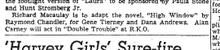
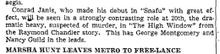
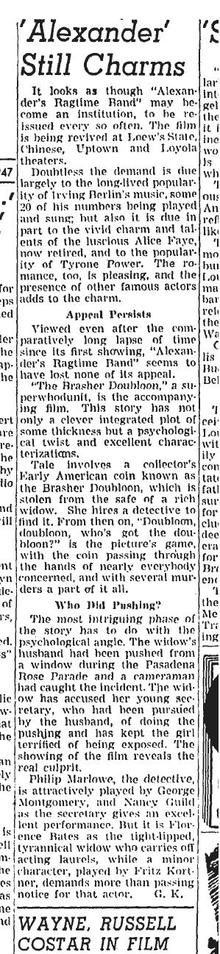
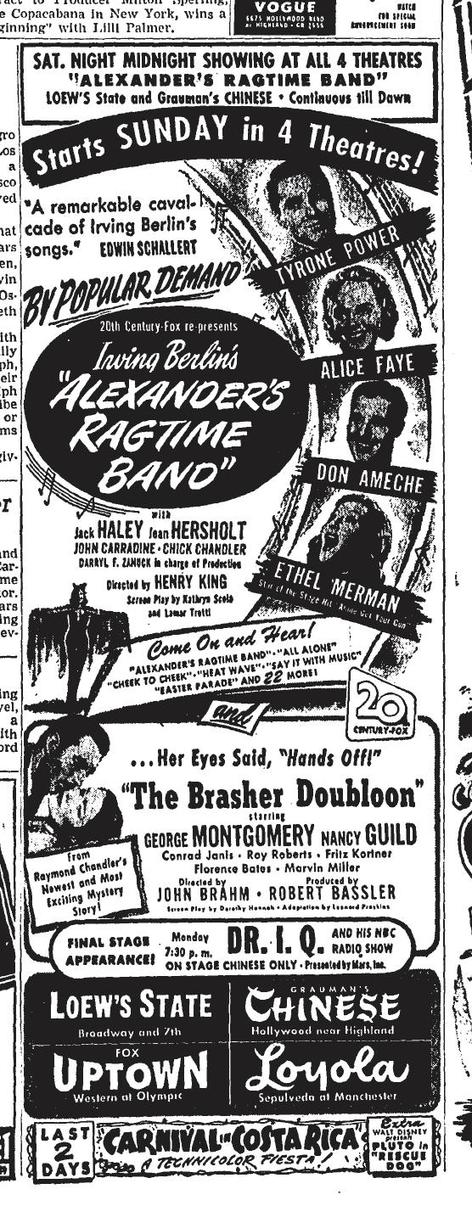
Raymond Chandler’s third novel, “High Window.” When the movie was released as “The Brasher Doubloon,” it was the bottom half of a double bill with the 1938 film “Alexander’s Ragtime Band.”
Philip Marlowe will be played by Fred “Walter Neff” MacMurray…
by Victor Mature…

by Dana “Mark McPherson” Andrews

or George Montgomery.

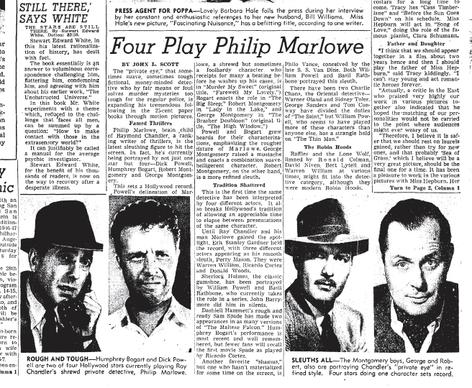
The Times, Aug. 11, 1946: Humphrey Bogart, Dick Powell, George Montgomery and Robert Montgomery all play Raymond Chandler’s Philip Marlowe.

Note: To mark the 50th anniversary of Raymond Chandler’s death, the
Daily Mirror is revisiting some of The Times’ stories about his life and
influence. We invite the Daily Mirror’s readers to share their thoughts.
 

Posted in books, Film, Hollywood | Comments Off on Trouble Was His Business — Raymond Chandler

Cooking With the Junior League


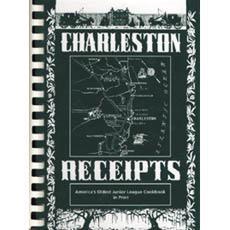
My friend Mary McCoy, of This Book Is for You (done with her husband, Brady Potts) and On Bunker Hill, has begun a new blog, Cooking With the Junior League, that will examine regional cooking as reflected in Junior League Cookbooks. Mary plans to spend a year exploring one cookbook a week. First up: Charleston Receipts, published in 1950 by the Junior League of
Charleston, S.C.She writes: “An endeavor of this scope and grandeur requires an auspicious beginning. And there is no Junior League cookbook more grand or auspicious than Charleston Receipts. First published in 1950,
it is the oldest Junior League cookbook still in print, and through its
numerous printings has raised over $1 million for the Junior League of Charleston’s
community projects. It was also a national bestseller in the 1950s, and
references to it still turn up today in the pages of publications as
varied as Gourmet, the Black Issues Book Review, and the New York Times. It was inducted into the Walter S. McIlhenny Hall of Fame for Community Cookbooks in 1990.”

Simple math shows that this will involve 52 Junior League cookbooks, but Mary assures me this is no problem: In addition to her own collection, the Los Angeles Public Library, where she works, has a large number of them. A little rummaging in ProQuest shows that the Los Angeles Junior League issued a cookbook in 1939. Anybody got one handy to share?

Posted in Food and Drink | Comments Off on Cooking With the Junior League

Defense Secretary Gets ‘Realistic’ Briefing on War; USC Stalls UCLA, March 9, 1969

1969_0309_cover
 
I got carried away today, but this was one of our huge Sunday papers.
1969_0309_bradley

Councilman Tom Bradley didn’t beat Mayor Sam Yorty–this time.

1969_0309_bradley_02
Bradley continued


1969_0309_hitchcock

Kevin Thomas talks to Alfred Hitchcock and Claude Jade about "Topaz."
1969_0309_hitchcock_02
Jade, continued

1969_0309_hitchcock_03
Jade, continued

1969_0309_sports

The sports cover

1969_0309_oj

O.J. Simpson
1969_0309_murray

Jim Murray
1969_0309_ucla

UCLA

Here’s one of those stories that could not happen today.

USC defeated UCLA, 46-44, at Pauley Pavilion one night after the
Bruins needed two overtimes at the Sports Arena to win, 61-55. Both
nights, the Trojans used a stall — they slowed the pace of the game —
which was possible before college basketball started using a shot
clock. It was a classic old-school maneuver to try to upset a better
team. And undefeated UCLA, led by Lew Alcindor, came into the two-game
series as the top-ranked team in the nation.

How rare was a UCLA loss?

UCLA had won the first 51 games played at Pauley Pavilion and won 41
games in a row since losing to Houston in the Astrodome. The Bruins had
beaten the Trojans 17 consecutive times. USC Coach Bob Boyd had never
beaten a team coached by UCLA’s John Wooden.

As for the drama, here’s how The Times’ Dwight Chapin reported the finish:

"With 1:55 to play Lew Alcindor stood there on the free throw line
and dropped in the free throw that made it 44-44. Then USC got the
ball. It had had it most of the night. The Trojans waited and looked,
dribbled and passed until 19 seconds remained and then called time.

"Bob Boyd offered some simple instructions. He told his team to keep
its court balance, set a screen for Ernie Powell, have him drive for it
and ‘put the ball in the basket.’ The seconds dwindled."

Powell got his screen, made his shot and one last attempt by UCLA’s Sidney Wicks fell off the rim.

"And the people were on the court," Chapin wrote. "They were USC
people and their fingers were jabbing the air to signify they — for
the moment at least — THEY were No. 1. It was Trojan Town."

In a sidebar by Chapin, Boyd was quoted telling his players after the game, "They’re dammed lucky we didn’t beat them twice."

Jim Murray’s column was on Wooden and the Alcindor years: "There are
those that sneer that this is a minor feat — winning with Alcindor —
compared to his winning two in a row with a team that slept in
standard-sized beds and didn’t have to stoop over to shave in the
bathroom mirror.

"I don’t think so. I think his three Alcindor years is the more
stupendous feat. I mean, anyone can win with a bunch of well-adjusted
six-footers. With those seven-footers, those last 12 inches are
sometimes all temperament."

–Keith Thursby

Posted in @news, Film, Front Pages, Hollywood, Politics, Sports | 3 Comments

Voices — Rush Limbaugh, 1989


Note: The Daily Mirror likes to revisit Times archival stories about today’s news makers. Here’s one we did on Rush Limbaugh in 1989–lrh

Rush Limbaugh Gives Liberals the Business, Gets Plenty Himself

Radio: The conservative talk-show host, whose program is nationally syndicated, is a major commercial enterprise.

November 25, 1989

By CLAUDIA PUIG, TIMES STAFF WRITER

One moment he claims to be "on the cutting edge of societal evolution," and the next he assures his radio listeners that he is "your epitome of morality and virtue. A man you could totally trust with your wife, your daughter and even your son in a Motel 6 overnight."

Never self-effacing, he repeatedly boasts that he is "recognized as one of the greatest talk-show hosts in America. . . . When I say something on a topic, there’s nothing left to say."

What nationally syndicated radio talk-show host Rush Limbaugh doesn’t say is that he is also a major commercial enterprise.

"He’s selling the product ‘Rush Limbaugh’ and doing it in a lot of different promotional ways," said Howard Neal, general manager of KFI-AM (640), which carries Limbaugh’s program weekday mornings. Limbaugh, whose program showcases his passionately conservative viewpoint on world events and features calls from equally passionate listeners, is currently heard on more than 172 stations nationwide. He has a listenership of about 900,000 during any given quarter-hour period, according to Arbitron ratings calculations.

Last week, about 550 people (300 of them from California) paid $1,500 each to accompany and be entertained by Limbaugh on a weeklong cruise through the Caribbean. The radio personality and his corporation got a percentage of each ticket sold. On the cruise, Limbaugh presided at two round-table discussions and one auditorium performance. (Among the other festivities on board: Limbaugh assembled a group to shout insults at Cuban leader Fidel Castro as the ship sailed close to that island nation.)

In addition to his radio program, which originates from New York, Limbaugh hits the stage regularly on his nationwide "Rush to Excellence" tour. He says he makes about $250,000 per year in his speaking engagements, which he holds almost every weekend.

A recent performance brought the 38-year-old Limbaugh to Irvine (home of one of the "biggest collections of rich Republicans in the country," he says), where more than 3,600 people paid as much as $25 apiece to hear Limbaugh expound on such topics as abortion ("the modern-day Holocaust"), gun control ("the liberals would have you believe that the gun actually triggers itself"), liberal politicians in general and, in particular that night, Sen. Edward Kennedy (D-Mass.) and Rep. Barney Frank (D-Mass.).

As the 6-foot, 300-pound Limbaugh stepped on stage at UC Irvine’s Bren Center, the audience rose to its feet, some standing on chairs, whistling, hooting, cheering, chanting his name and generally going wild.

"You’re sexy," yelled one woman.

"Forever my hero," yelled another.

"A lot of people think it’s going to be a lecture," Limbaugh said in an interview after the show. "They think, ‘Here comes this right-wing reactionary extremist fanatic who’s going to denounce all things that are not conservative.’ But it turns out to look to the casual observer like a rock concert."

Many Limbaugh fans–or "dittoheads," as he calls them–are willing to dish out fistfuls of cash for Limbaugh T-shirts, satin jackets, "dittohead" mugs and "Rush to Excellence" videocassettes. Nearly all of the merchandise–$10,000 worth of it–was sold at the Irvine show. Limbaugh says he gets a percentage of the profits from those sales, but won’t say how much.

Limbaugh’s shows are a lot like his radio programs–full of vitriol against liberals.

"Let’s talk a little bit about Barney Frank. . . . He claimed he didn’t know a prostitution ring was being run out of his house. Do you dare challenge the honesty and integrity of Barney Frank? Damn right I do!

"Barney said he’s been careless in his associations. Do we have blatant hypocrisy going on here? When one of our guys does something like this–like Buzz Lukens (Rep. Donald E. (Buzz) Lukens (R-Ohio) who was convicted of contributing to the delinquency of a minor for having sex with a 15-year-old girl)–the Republicans say ‘Buzz, I don’t want you here.’ There’s a major difference in the value structure of the two parties. There are glaring differences between the two parties, and I just like to point it out. By pointing it out, you are accused of being controversial. I love to point it out and I also love to illustrate absurdity by being absurd."

A pregnant pause, then: "Anybody have a condom?"

A pretty blonde in a turquoise dress, who had written to Limbaugh saying she was dying to meet him, pranced up on stage and handed the portly talk-show host a prophylactic.

Then, Limbaugh launched into a routine familiar to his radio fans. He wrapped the condom around the microphone, announcing: "This, my friends, is safe talk." The audience cheered. "You are protected from any evil because of this.

"The idea of these things is not to prevent AIDS," he said of the condom. "The idea of these things is to sell ’em. . . .."

Besides gays and drug users, the homeless are another frequent target. Last spring, Limbaugh was in the national spotlight when he announced plans to take a busload of homeless people into Malibu to see if the city’s honorary mayor Martin Sheen ("Martin Sheenski") would make good on his declaration to make the city a haven for the homeless. The plan fell through after Limbaugh was widely accused of being insensitive and exploiting the homeless.

"I made a real blunder there," Limbaugh says now. "I don’t exploit the homeless. I wanted to discredit Sheen."

Still, he continues to make the homeless an object of his mockery.

"One of the things I want to do before I die is conduct the homeless Olympics," he told his audience. Events would include "the 10-meter Shopping Cart Relay, the Dumpster Dig and the Hop, Skip and Trip," he said as the audience erupted into laughter and applause.

Limbaugh also has come under some fire for conducting on-air "caller abortions." When he doesn’t like what someone has to say, he runs a vacuum sound into the microphone and announces that the caller has been "aborted."

"I made the point with it and it’s not my intent to offend people," he said. "I’m trying to attract an audience, not drive them away and a lot of people thought it was a very tasteless thing to do."

Much of his shtick these days involves defending conservative politicians and skewering such liberals as "Sleazer of the House" Jim Wright and "U.S. Cadaver" Alan Cranston.

"John Tower’s crime was that he liked women," Limbaugh told his Irvine audience.

Then he took a familiar dig at Ted Kennedy: "But when John Tower had a date, at least he got her home alive!" The audience cheered.

Off the platform, Limbaugh claims not to take his role as spokesman very seriously and cautioned a reporter not to.

"I’m a harmless conservative," Limbaugh said. "I’m not out to poison the world. . . . I’m a lovable little fuzz ball."

Indeed, he recalled an article in the Detroit Free Press that described him as being "like the embarrassing uncle that shows up at family reunions and you hope he’s not going to say too much."

"I like the way he articulates the conservative viewpoint," said Ted Hanson, a graphic designer and self-proclaimed "rich Republican" from Carlsbad who attended Limbaugh’s Irvine show. "The man is a very succinct spokesman. He doesn’t take himself so
seriously and the humor injection softens it a bit."

Added Hanson’s wife Trayce: "And there are very few conservatives on the radio."

"It’s very seldom I get to hear the position I support on the radio," said Barbara Cross, 46, who traveled from her home in Northridge for Limbaugh’s Irvine appearance. "He’s a conservative man willing to take to the public airwaves and espouse traditional values, he’s not afraid to say God is the creator, he’s not afraid to say abortion is not right."

Only a few detractors were on hand at Limbaugh’s show.

"He’s funny but we disagree with everything he says," said Marrya Small.

"He’s making a whole career out of gay-bashing," said Ed Uehling, 49. "He says some funny things, even funny things about gay people, but to me it was hypocritical. He sets himself out to be the epitome of decency. . . . He thinks he has to pick on gay people."

"People either love or hate him," said KFI’s Neal. "There’s no middle ground."

It wasn’t always that way. Limbaugh languished in radio anonymity for almost two decades before getting the kind of attention he is receiving now.

He started his radio career 22 years ago at 16, working at his father’s radio station in Cape Girardeau, Mo. After that, he became a Top 40 deejay.

"I was always a moderate failure," the twice-divorced Limbaugh said. "As a deejay, I didn’t amount to a hill of beans."

He got his first radio talk show in Sacramento in 1984 and everything changed. He had found his calling.

Limbaugh tells his radio audience: "The American people are more and more turning to what is called traditional family values and rejecting what is abnormal or perverted."

He attributes his success to a blend of conservative ideology and an ‘Everyman’ persona.

"I don’t want to sound hokey, but I really think that one of the reasons I’m enjoying this success is because I’m just a regular guy," he says after the show. "Pompous and arrogance is the shtick, but I don’t play big time with them at all."

In addition to his stage performances, which started on a regular basis last January, Limbaugh is branching out. He has set his sights on conquering the television world. He recently auditioned for a call-in talk show on Cable News Network and for a remake of "To Tell the Truth."

"To Tell the Truth" producer Mimi O’Brien said she asked Limbaugh to try out for the show "because he’s bright, articulate, intelligent and he has one of the highest-rated radio shows at the moment." He is one of about 20 people being considered as a panelist, she said.

CNN confirmed that Limbaugh had auditioned but Paul Amos, executive vice president of programming, refused to comment further.

Limbaugh said he would like to have a television talk show that would tackle serious topical issues but also inject humor, a sort of "Tonight Show" combined with "The MacNeil/Lehrer NewsHour."

"I’d like to be a comedian and I don’t mind being a serious talk-show host," Limbaugh said. "I want to do both. And I think it can be done. I think there’s a market for it."

Posted in broadcasting, Politics | 76 Comments

Found on EBay — Batchelder Tile

Here’s a Batchelder tile of a peacock that has been listed on EBay. It’s a bit different that the other animal tiles that have been listed before. Bidding starts at $95.
Posted in Architecture, art and artists | Comments Off on Found on EBay — Batchelder Tile