Found on EBay — Earl Carroll’s

Earl Carroll Program This program from Earl Carroll's has been listed on EBay. It's interesting to contrast these programs with those from the Florentine Gardens. In many ways, they are quit similar. Bidding starts at $5.

var gaJsHost = (("https:" == document.location.protocol) ? "https://ssl." : "http://www.");
document.write(unescape("%3Cscript src='" + gaJsHost + "google-analytics.com/ga.js' type='text/javascript'%3E%3C/script%3E"));

try {
var pageTracker = _gat._getTracker("UA-8640152-1");
pageTracker._trackPageview();
} catch(err) {}

Posted in Nightclubs | Comments Off on Found on EBay — Earl Carroll’s

Matt Weinstock — May 6, 1959

Shell Game

Matt_weinstockdIt is the nature of
shell collectors to correspond with each other and, thus, adman Bennett
Foster has learned of the fantastic tale of R. Julian Dashwood, the only white man on the island of Mauke, in the Cook group, 1,000 miles from New Zealand.

Thirty years ago Dashwood
found himself on the beach in Australia, then in a depression, and he
resolved never again to be dependent on errant society. He went to Mauke, married a native girl, and was welcomed into the tribe by the
hospitable Polynesians. He built a house of coral and set about
indulging his hobby, shell collecting. He worked out a co-operative
deal with the natives and they enthusiastically went to work collecting
shells for him.

BUT ABOUT a year ago he became bored and
left for Auckland, where he opened a little shell store. After three
months he knew the dizzy pace of civilization was not for him and
returned to the atoll.

May 6, 1959, Dodgers Last year the battery went dead on his
shortwave radio, his only contact with the outside world, and he was
frantic for a while, wondering what the world was up to. Then he found
he didn't really care.

Not long ago another crisis arose. The
natives got tired of collecting shells, and his trade, carried on by
the four ships a year which call at the atoll, came to an end. No
matter what he offered them, they refused. After all, what good was
money on an island without a store and where everything they ate, drank
or wore was in natural abundance.

FINALLY he had an idea.
He sent to Auckland for a movie projector and some old films. At the
first showing the natives went wild over them. But on the night of the
next show he stood at the door and told them the price of admission was
a penny. Of course, no one had a penny.

The economic dilemma was
quickly solved, he recently wrote Foster. He pays them a penny a week
to collect shells and they pay it back to him to see the movies.

::

May 6, 1959, Comics ASIDE TO the
Detroit boys — A large lady couldn't get into the low-slung car that
was to take her to her husband's funeral, the other day, and she had to
ride with the undertaker.

::

RIGHT SCHOOL

How wise we are; what worthy labor
To note each weakness of our neighbor,
If in the night, like busy elves,
We use the list to test ourselves.

-GUY MULLEN

::

 ONLY IN L.A. —
A wife in a downtown bar became increasingly critical as her husband
gulped drink after drink long after she had pointed out it was time to
go home. Finally she asked sarcastically, "What are you doing, trying
for an Oscar?" Her befuddled spouse retorted proudly, "I already got
one!" He thought she'd said ulcer.

::

THOSE WHO felt the full force of Sunday's big wind don't think it received enough attention.

Ray Keplinger hit a full iron shot on the Hesperia course and the ball landed 10 feet in back of him.

May 6, 1959, Abby Publicist
Jim Bishop was playing volleyball at Malibu and a gust of wind caught
the ball and it went over his head. He chased it endlessly, and if a
little girl hadn't finally stopped it he'd probably have jogged all the
way to Manhattan Beach. A car was sent to retrieve him and the ball and
the speedometer measured five-eights of a mile.

::

AT RANDOM —
Sudden thought: How about an added Pulitzer prize for the unknown
reporter who had to cover the Clare Luce-Sen. Morse story in Time? …
Morey Gold, the Whittier Blvd. bicycle and key man, swears he heard a KHJ newscaster talk about a "dubbish
rump" … Cartoonist Dave Hall had a live foot-and-a-half-foot-long water
snake on his desk yesterday to take home for his youngster's nature
study class. OK, so it was in a gunny sack … Mike Goodman knows a
fellow so lazy he has to shake his self-winding watch to make it go.
Himself.

var gaJsHost = (("https:" == document.location.protocol) ? "https://ssl." : "http://www.");
document.write(unescape("%3Cscript src='" + gaJsHost + "google-analytics.com/ga.js' type='text/javascript'%3E%3C/script%3E"));

try {
var pageTracker = _gat._getTracker("UA-8640152-1");
pageTracker._trackPageview();
} catch(err) {}

Posted in Columnists, Matt Weinstock | Comments Off on Matt Weinstock — May 6, 1959

Paul V. Coates — Confidential File, May 6, 1959

Confidential File

Prince Otto I Isn't Even Housebroken

Paul_coatesThere is a base canard, perpetrated by the hopelessly sentimental, that a dog is man's best friend.

A dog, I say to you, is a false friend.

He'll
make a slobbering, emotional display of licking your hands. But on a
whim, he'll leave you without so much as a backward glance.

I had a dog once. As a matter of fact, I had him until just a couple weeks ago.

He's
a dachshund puppy, and believe me, I gave him the best years of my
life. He dined only on the most exotic creations dreamed up in the
fertile, culinary mind of kindly old Doctor Ross. He slept on a pillow
that had but recently been confiscated from beneath my head.

When,
in a fit of childish pique, he chewed up my bedroom slippers, I didn't
whack him on his baby teeth, the way I should have. I just passed it
off with a philosophical shrug.

May 6, 1959, Mirror Cover That dog had it made. But a few
weeks ago he hopped out of our parked car in the vicinity of Sunset and
Laurel, and disappeared in search of some imagined green pastures.

His
name, which I gave him in a weak moment of sheer snobbery, is Crown
Prince Otto I. But, if you call him by it, he won't answer. It
embarrasses him.

Anyway, since this four-month-old delinquent
ran away from home, the family plantation hasn't seemed the same.
There's a cloud of gloom hanging over us all.

My kids, who
usually can't be made to shut up, have hardly spoken. And my wife, in
whose care Crown Prince Otto I was at the time he lammed, has deftly
managed to transfer the blame for the whole thing over to me.

"If you had the window of the station wagon fixed like I told you to, he never would have been able to get out," she said.

"If
you knew the window of the station wagon wouldn't close you never
should have left him in the car, I replied. Overwhelmed by the utter
logic of my remark, I glanced at the kids for their approval. But they
just stared at me with grim accusation in their eyes.

May 6, 1959, Rapid Transit Plan "There's one thing you could do," my wife said after a moment. "You could mention it on your TV program."

"That's impossible," I snapped

"Impossible, impossible," she said, "everything with you is impossible." She glanced at the kids for their approval. And got it.

"If
I do a missing person's program about my own dog, everybody in town
will want me to do one about their missing dogs," I explained.

She sniffed disparagingly. "Well," she murmured, "if it's too much trouble." The kids turned their backs on me.

"It's not too much trouble," I shouted.

"It's
just…" I stalled desperately for a moment. Then, a thoroughly
outrageous inspiration hit me. "It's just that I couldn't do it. It's
against the FCC regulations."

"The WHAT?" she said suspiciously.

"The
Federal Communications Commission. They have a ruling that says no TV
commentator can make a plea in his own behalf on his own program. They
could cut me off the air, and even fine me if I asked people to bring
back my own dog."

It was a low ruse, but it worked. She fell silent, and thoughtful for a while. Finally she looked up brightly.

"Ask George Putnam to mention it on his program," she said.

"I can't do a thing like that," I replied in a shocked voice.

Kith and Kin Gang Up on Me

"Can't, can't," she mimicked. "Everything with you is can't." My children nodded in agreement.

Rather
than lose this happy home I've just described to you, I called Putnam
and told him the problem. "Gee, kid, I'm sorry to hear that," he said.
(He always calls me kid. It has something to do with the difference in
our ages.) "I wish I could help you by putting it on my program.

"But," he added, "it's against FCC regulations."

So,
if someone out there has found my dog, please bring him back. I'm
telling you for you own good. I happen to know he isn't even
housebroken.

var gaJsHost = (("https:" == document.location.protocol) ? "https://ssl." : "http://www.");
document.write(unescape("%3Cscript src='" + gaJsHost + "google-analytics.com/ga.js' type='text/javascript'%3E%3C/script%3E"));

try {
var pageTracker = _gat._getTracker("UA-8640152-1");
pageTracker._trackPageview();
} catch(err) {}

Posted in Animals, Columnists, Paul Coates | 2 Comments

A Kinder, Simpler Time Dept.

May 6, 1920  

May 6, 1920

var gaJsHost = (("https:" == document.location.protocol) ? "https://ssl." : "http://www.");
document.write(unescape("%3Cscript src='" + gaJsHost + "google-analytics.com/ga.js' type='text/javascript'%3E%3C/script%3E"));

try {
var pageTracker = _gat._getTracker("UA-8640152-1");
pageTracker._trackPageview();
} catch(err) {}

Posted in Uncategorized | Comments Off on A Kinder, Simpler Time Dept.

Memories of Union Station

Dec. 12, 1939, Union Statio
Los Angeles Times file photo

Dec. 12, 1939: Waiting area, Union Station.

Union Station has always been one of my favorite L.A. spots. The old place reminds me of family.

My dad and grandfather spent their careers with the Santa Fe
railroad. My grandfather started working for Santa Fe in Barstow, where
the Scottish immigrant first settled his young family. They eventually
moved to Greater Los Angeles — my dad went to Huntington Park High,
then worked for the railroad after World War II until heart bypass
surgery forced him to retire.

We were a reluctant railroad family. A rare perk for a Sante Fe
employee was a free pass. Kids were free too. We never went anywhere on
the train. My dad wasn't a big talker, but it was clear he didn't want
to spend a lot of time on trains after five or six days a week
repairing them.

He softened a little late in his career and took me a couple times
to a railroad museum in Perris that was just getting started. He tried
to show me the differences and the details, but it was all lost on me.

April 14, 1942, Union Station Photograph by Paul Calvert / Los Angeles Times

April 14, 1942: Men in uniform wait to buy tickets during World War II

Calling the place a museum probably was a stretch then. There were
cars and tracks and engines but not many people. Some trains weren't
even ready to be seen by the public. We walked, stared and I
listened while he tried to explain something or answer my questions. 

One visit, my dad found another old railroad guy — might have been
a staffer, might have been another veteran worker — and they talked
shop and compared notes about the old days. Probably what old newspaper
guys sound like now.

Doesn't seem like much, but it's a fond memory of time spent with a
parent who's been gone too long. The trains trigger those memories
every time I go back to Union Station — "the Depot," as it was always
called at our house.

Even with new coats of paint and retouches over the years, it will always be part of L.A.'s past. And mine.

— Keith Thursby

.

var gaJsHost = (("https:" == document.location.protocol) ? "https://ssl." : "http://www.");
document.write(unescape("%3Cscript src='" + gaJsHost + "google-analytics.com/ga.js' type='text/javascript'%3E%3C/script%3E"));

try {
var pageTracker = _gat._getTracker("UA-8640152-1");
pageTracker._trackPageview();
} catch(err) {}

Posted in Downtown, Transportation, travel | 1 Comment

Times Wins Two Pulitzers; Lakers Lose, May 6, 1969

May 6, 1969, Cover  
Above, the edition of The Times that most people received at home. A team headed by George Reasons, with Art Berman, Gene Blake, Robert L. Jackson and Ed Meagher wins a Pulitzer for a series on government corruption. Bill Tuohy wins a Pulitzer for coverage of the Vietnam War.
May 6, 1969, Mosey Edition

This is the "Mosey" edition, nicknamed for the news editor, that The Times put together for late street sales. These appear in the collections of Times' front pages because they have huge headlines–but they don't represent what the paper actually looked like. 


May 6, 1969, Lakers The Boston Celtics won the deciding game of the NBA Finals,
depriving the Lakers of a title they believed they finally would win.

Otherwise, how do you explain the balloons?

In one of the oddest footnotes in modern professional sports, the
Forum's rafters were filled with balloons that would be released when
the Lakers won. "They might remain in their roost for some time to
come," Mal Florence wrote in The Times after watching Boston's 108-106
victory.

There were plots and subplots galore.

–The Lakers were built around three superstars, with Jerry West
leading the way despite an injured leg. He was named the final's most
valuable player and got a car instead of a championship.

–Wilt Chamberlain injured his knee and left the game with about
five minutes to play just as the Lakers were cutting into the Celtics'
lead.

–Chamberlain wanted to get back in the game but was kept on the bench by
Coach Butch van Breda Kolff: "I told him that we were doing well enough
without him." The Lakers and van Breda Kolff would soon part company.

–Former Laker Don Nelson gave Boston a three-point lead with about
a minute left when his shot from the free-throw line "as luck or fate
would have it … hit the front rim, bounced high into the air and then
settled into the net," Florence wrote.

–West scored 42 points but took only one shot in the last four minutes.

–Parts of the game were far from pretty. Several players were in
foul trouble and the Lakers missed 15 consecutive shots during one part
of the third quarter.

You could feel the disappointment in The Times' coverage. Here's my favorite lead, from Chuck Garrity:

"The colorful balloons hung there in the dark rafters of the Forum.
… The USC Trojan band, hired to march around blaring "Happy Days are
Here Again" quietly tucked their instruments back into their cases. …
The Lakers were non-champions of the world of professional basketball
again."

–Keith Thursby

The fourth quarter of Game 7 has survived on Youtube. Here's a section where the Lakers rally and Chamberlain hurts his knee.

var gaJsHost = (("https:" == document.location.protocol) ? "https://ssl." : "http://www.");
document.write(unescape("%3Cscript src='" + gaJsHost + "google-analytics.com/ga.js' type='text/javascript'%3E%3C/script%3E"));

try {
var pageTracker = _gat._getTracker("UA-8640152-1");
pageTracker._trackPageview();
} catch(err) {}

Posted in Front Pages, Lakers, Sports | Comments Off on Times Wins Two Pulitzers; Lakers Lose, May 6, 1969

Cinco de Mayo, LAPD Seeks New Chief, May 6, 1939


May 6, 1939, Cover

For Cinco de Mayo, The Times features — children in Scandinavian costumes celebrating Hans Christian Andersen.
May 6, 1939, Cinco de Mayo

May 6, 1939, Chief's Exam

Above, selection of the next LAPD chief is going to prove interesting.
At left, Cinco de Mayo art, plus a photo of three women who showed up at The Times and wanted to get their picture in the paper.

var gaJsHost = (("https:" == document.location.protocol) ? "https://ssl." : "http://www.");
document.write(unescape("%3Cscript src='" + gaJsHost + "google-analytics.com/ga.js' type='text/javascript'%3E%3C/script%3E"));

try {
var pageTracker = _gat._getTracker("UA-8640152-1");
pageTracker._trackPageview();
} catch(err) {}

Posted in Downtown, Front Pages, LAPD | Comments Off on Cinco de Mayo, LAPD Seeks New Chief, May 6, 1939

Tomato Aspic c. 1964.

Aspic_r2d2 Mary McCoy, who is exploring Nashville cuisine c. 1964 this week in her Cooking With the Junior League blog, whips up a tomato aspic, at left with robot garnish. She writes that this bit of culinary history is best left unexplored.

Read more >>>

var gaJsHost = (("https:" == document.location.protocol) ? "https://ssl." : "http://www.");
document.write(unescape("%3Cscript src='" + gaJsHost + "google-analytics.com/ga.js' type='text/javascript'%3E%3C/script%3E"));

try {
var pageTracker = _gat._getTracker("UA-8640152-1");
pageTracker._trackPageview();
} catch(err) {}

Posted in Food and Drink | Comments Off on Tomato Aspic c. 1964.

Found on EBay — Oviatt’s

Oviatt's Knife

A carving knife from Oviatt's has been listed on EBay. Bidding starts at $24.99.

var gaJsHost = (("https:" == document.location.protocol) ? "https://ssl." : "http://www.");
document.write(unescape("%3Cscript src='" + gaJsHost + "google-analytics.com/ga.js' type='text/javascript'%3E%3C/script%3E"));

try {
var pageTracker = _gat._getTracker("UA-8640152-1");
pageTracker._trackPageview();
} catch(err) {}

Posted in Food and Drink | Comments Off on Found on EBay — Oviatt’s

Matt Weinstock — May 5, 1959

Non-Conformist

Matt_weinstockdThere is a
widespread belief that conformity has so overwhelmed everyone that even
the hardiest individualists have lost their incentive and inspiration.
There's evidence today that this is not entirely true.

A solid citizen, piqued at some flaw in civilization, went out on the town and, after the bars closed, followed some new-found friends to their home in Beverly Hills.

All of a sudden it was 7 a.m., time to go to work. But when he looked for his car he couldn't remember where he'd parked it.

He
took a cab downtown, but decided to stop at a favorite bar for a
refresher before going to the office. There he met a couple of cronies
and he related his misfortunes. He had neglected to go home, he was
late for work, he had misplaced his car and he had been forced to spend
$5 on cab fare.

One friend said, "I can solve all your troubles for $6 more."

This sounded like a good deal, and our hero said he'd buy it.

The
friend handed him a pawn ticket and, inadvertently coining a new
definition of the word sympathy, said, "It's for my 38 revolver — go
shoot yourself!"

::

May 5, 1959, Comics SPEAKING OF PARKING,
two married couples a few nights ago went to open house at the school
their children attend. The husbands let the wives out at the entrance
and went to look for a place to park. They drove for blocks without
finding a vacant space and then noticed a bowling alley in the
distance. The same diabolical thought — they are avid bowlers —
struck them simultaneously.

This is to report that midway in the
open house proceedings a voice came over the public-address system
announcing, "For the first time in history our school must report a
lost father. Will Mr. Blank please join his wife in Room C-2."

::

TO HAVE AND HAVE NOT

The modern generation has so much,
Nothing seems to faze or floor 'em.
The only thing they really lack
Is some good old-fashioned decorum.

-JUNE R. DRUMMOND

::

THE CITY COUNCIL, as you may have read, is considering an ordinance to make it illegal to feed pigeons. Which reminded Cal Crotsenburg of the old story about the hard-working farm boy from Morongo Valley whose parents decided he'd earned a day off.

He
was feeding popcorn to the pigeons in Pershing Square when a slicker
came by and said, "You're a stranger in town, aren't you?" When the boy
said yes, the slicker gave him a fast flash of breakfast food police
badge and said, "I figured you were. You know there's a $1 fine for
feeding a pigeon in L.A. How many did you feed?" The boy said two and
the slicker said, "That'll be $2."

May 5, 1959, Abby Relating the incident later
to his parents, the boy said jubilantly, "I sure fooled him. I told him
I'd only fed two but I'll bet I fed at least a dozen."

Now we'll have to figure out a new ending.

 ::

QUOTE & UNQUOTE —
When people ask how he feels, a man who recently underwent surgery
replies, "Well, at first I was miserable but now I'm merely
uncomfortable" … It's odd how the same expressions keep cropping up
through the years … A man noting a repeated street excavation
remarked, "They didn't find the boss' watch the first time so they had
to dig it up again" … Remember the observation here by a man recently
restored to bachelorhood that the most amazing thing was how long a
tube of toothpaste lasted? A gal who now lives alone has a different
impression: "The nights last longer."

::

AROUND TOWN —
A friendly young man named Drew Howard is known as the good Samaritan
of 1st and San Pedro Streets. He tells the near-sighted ladies waiting
there whether the approaching buses are on the SierraMadre or Sierra
Vista line. They sometimes get on the wrong one … Wildlife question
for today: Why do baby birds flutter their wings when their patients
feed them?

var gaJsHost = (("https:" == document.location.protocol) ? "https://ssl." : "http://www.");
document.write(unescape("%3Cscript src='" + gaJsHost + "google-analytics.com/ga.js' type='text/javascript'%3E%3C/script%3E"));

try {
var pageTracker = _gat._getTracker("UA-8640152-1");
pageTracker._trackPageview();
} catch(err) {}

Posted in Columnists, Matt Weinstock | Comments Off on Matt Weinstock — May 5, 1959

Random Shot

May 5, 2009, Downtown Los Angeles

Photograph by Larry Harnisch / Los Angeles Times

I snapped this photo of placards left over from the May 1 marches while waiting for the light at Broadway and 1st Street.

var gaJsHost = (("https:" == document.location.protocol) ? "https://ssl." : "http://www.");
document.write(unescape("%3Cscript src='" + gaJsHost + "google-analytics.com/ga.js' type='text/javascript'%3E%3C/script%3E"));

try {
var pageTracker = _gat._getTracker("UA-8640152-1");
pageTracker._trackPageview();
} catch(err) {}

Posted in Downtown | Comments Off on Random Shot

Paul V. Coates — Confidential File, May 5, 1959

March 12, 1959, Elizabeth Ann Duncan
Photograph by John Malmin / Los Angeles Times

Elizabeth Ann Duncan crosses her fingers during her murder trial.
 

CONFIDENTIAL FILE

Frank S. Duncan Has Come to Town

Paul_coatesIn a sparsely furnished office on the floor of a modernistic Sunset Boulevard office building, a young attorney opened up shop yesterday.

There was no celebration — no party to announce that he had joined the ranks of this town's multitude of lawyers.

His debut was most inauspicious.

But that — except for the fact that no clients were knocking down his door — is the way he wanted it. Lately, he'd been in the limelight a little too much.

The 30-year-old attorney, Frank S. Duncan, son of convicted killer Elizabeth Duncan, answered his own phone when I called him yesterday afternoon.

"I don't have a secretary yet," he explained. "In this business, you've got to have clients before you hire secretaries."

Then he laughed.

"I don't quite know where I'd put her, anyway," he said. "I just got my own desk and chair moved in today."

He added that the office furniture wasn't his own. The desk, a telephone stand, couch and volumes of law books were turned over to him by a friend who used to practice here.

"You should see the place," he told me. "Books all over. What a mess."


May 5, 1959, Cover

Yet another rail transit plan is proposed for Los Angeles. This one calls for rail lines (monorail, elevated or a subway) to downtown from Reseda, Santa Monica, Long Beach and West Covina.


For a man with four and a half years of law practice (in Santa Barbara and San Francisco) behind him, Duncan didn't sound very prosperous.

"If you'll excuse a blunt question," I asked, "are you broke?"

"I haven't been active for quite a while, as you can imagine," he said. "I've used up my savings, if that's what you mean."

That he should choose Los Angeles, so close to the scene of his mother's trial, to go into practice also bothered me.

"The story was played up all over the country," he told me. "No matter where I went, it would follow me.

"Besides, I like it here in California. It never really occurred to me to move anywhere else."

I asked him how much of a hindrance he felt the notoriety would be.

"It's not going to do my business any good," he admitted. "But how much harm it's going to do, I'll just have to wait and find out.

"To be perfectly honest, I'm quite confident that I'll do all right here. I have a good background in divorce work and criminal work. That's the area I'll stay in."

With Duncan, it isn't the usual case of building up a reputation. With him, it's living one down.

"I had new business cards printed up last Wednesday," he continued. "Plus 200 printed announcements. I picked them up today.

"I'll send them out this week," he added. "Things might be slow at first, but you expect that when you branch out on your own and move into a new town."

Inevitable Question Is Asked

"Your mother?" I asked Duncan. "Have you seen her lately?"

"I've been visiting her every week," he said. "She's at the California Institution for Women at Corona. She's in solitary."

Frank Duncan paused.

Then he continued: "It's not very pleasant there. They treat her very well — but it's just that being alone. Four cold walls to look at. When I go, I take her little presents, but with regulations what they are, there's not too much I can take.

"Like next Sunday, I'll take her a couple of jigsaw puzzles. She likes those.

"Next Sunday," Frank Duncan pointed out, "is Mother's Day, you know."

var gaJsHost = (("https:" == document.location.protocol) ? "https://ssl." : "http://www.");
document.write(unescape("%3Cscript src='" + gaJsHost + "google-analytics.com/ga.js' type='text/javascript'%3E%3C/script%3E"));

try {
var pageTracker = _gat._getTracker("UA-8640152-1");
pageTracker._trackPageview();
} catch(err) {}

Posted in #courts, Columnists, Homicide, Paul Coates | Comments Off on Paul V. Coates — Confidential File, May 5, 1959

May 5, 1939: Union Station Opens

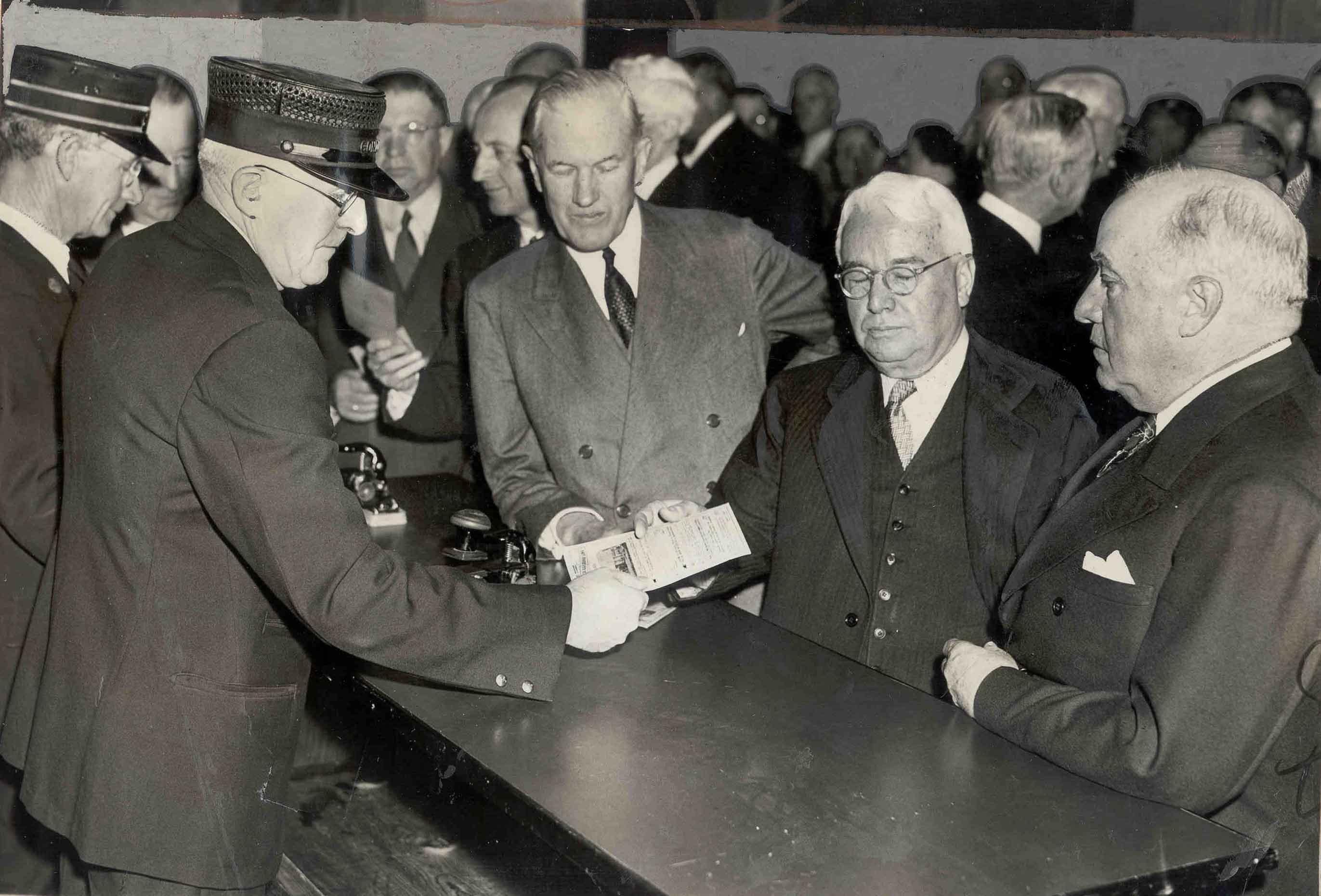
March 15, 1939: Luncheon at the Biltmore to plan the opening for union station. Guests get their tickets punched by railroad conductors. Photograph by the Los Angeles Times


March 15, 1939: At a luncheon at the Biltmore Hotel to plan the opening gala for  Union Station, R.E. Southworth stamps the tickets of A.D. McDonald, president of the Southern Pacific; J.R. Hitchcock, manager of the board that supervised Union Station, and W.M. Jeffers, president of Union Pacific.

Continue reading →

Posted in 1939, Architecture, Transportation | Comments Off on May 5, 1939: Union Station Opens

A Kinder, Simpler Time Dept.

May 5, 1918, Teeth

May 5, 1918

var gaJsHost = (("https:" == document.location.protocol) ? "https://ssl." : "http://www.");
document.write(unescape("%3Cscript src='" + gaJsHost + "google-analytics.com/ga.js' type='text/javascript'%3E%3C/script%3E"));

try {
var pageTracker = _gat._getTracker("UA-8640152-1");
pageTracker._trackPageview();
} catch(err) {}

Posted in health | Comments Off on A Kinder, Simpler Time Dept.

Voices — Dom DeLuise, 1933 – 2009

June 14, 1978, Dom DeLuise
Posted in Film, Hollywood, Obituaries | 4 Comments

Churchill Visits Ike, Dodgers Beat Braves, May 5, 1959

May 5, 1959, Cover

 
May 5, 1959, McIntyre
 
Above, efforts fail to heal a rift between President Eisenhower and former President Truman, who declined an invitation to the White House to dine with former British  Prime Minister Winston Churchill.

Assemblyman William B. Rumford (D- Berkeley) calls upon officials to treat smog with quarantines, just as the state reacts to rabies. Once an area was found to have hazardous smog, autos would be required to have emission control devices.

At left, bandleader Harold "Hal" McIntyre is near death after being badly burned when he fell asleep while smoking in the apartment of band vocalist Jeanne McManus. McIntyre, who played with the Glenn Miller band, died the next day.

May 5, 1959, John F. Kennedy

Above, it might seem unimaginable today, but Sen. John F. Kennedy's Catholic faith was heavily analyzed as a campaign issue before the 1960 presidential election.

At right, Frank Lloyd Wright drew up plans for improvements at Barnsdall Park shortly before his death. 

May 5, 1959, Frank Lloyd Wright

May 5, 1959, Dodgers May 5, 1959, Snakes

The reason arrests for drunkenness rose 15% in 1958? A New York police official blames it on the Dodgers. "That team would drive anybody to drink" he says.

May 5, 1959, Comics

What are Nancy and Sluggo up to today?

May 5, 1959, Sports

Sugar Ray Robinson is stripped of his middleweight championship for delaying too long in defending his title.

var gaJsHost = (("https:" == document.location.protocol) ? "https://ssl." : "http://www.");
document.write(unescape("%3Cscript src='" + gaJsHost + "google-analytics.com/ga.js' type='text/javascript'%3E%3C/script%3E"));

try {
var pageTracker = _gat._getTracker("UA-8640152-1");
pageTracker._trackPageview();
} catch(err) {}

Posted in Architecture, art and artists, Dodgers, Downtown, Environment, Freeways, Front Pages, Politics | Comments Off on Churchill Visits Ike, Dodgers Beat Braves, May 5, 1959

Man Charged With Defrauding Widows, July 20, 1900

July 20, 1900 Bunco Man

I came across this story while researching the Arcade Station and think it's too wonderful not to share.

var gaJsHost = (("https:" == document.location.protocol) ? "https://ssl." : "http://www.");
document.write(unescape("%3Cscript src='" + gaJsHost + "google-analytics.com/ga.js' type='text/javascript'%3E%3C/script%3E"));

try {
var pageTracker = _gat._getTracker("UA-8640152-1");
pageTracker._trackPageview();
} catch(err) {}

Posted in #courts, LAPD | 1 Comment

Nuestro Pueblo

May 5, 1939, Nuestro Pueblo

var gaJsHost = (("https:" == document.location.protocol) ? "https://ssl." : "http://www.");
document.write(unescape("%3Cscript src='" + gaJsHost + "google-analytics.com/ga.js' type='text/javascript'%3E%3C/script%3E"));

try {
var pageTracker = _gat._getTracker("UA-8640152-1");
pageTracker._trackPageview();
} catch(err) {}

Posted in Architecture, Downtown, Nuestro Pueblo | Comments Off on Nuestro Pueblo

Found on EBay — Spring Street

Spring Street Postcard Ebay This postcard showing Spring Street before it was straightened out has been listed on EBay. Bidding for the lot (which also includes a postcard of Westlake Park) starts at $4.50.
Posted in Downtown, Transportation | Comments Off on Found on EBay — Spring Street

Matt Weinstock — May 4, 1959

Meet Mr. Malaprop

Matt_weinstockdA police reporter on the Chicago American named Jim Murray is one of those rare birds, a natural malapropper,
a species which must be joyously esteemed wherever it is found. He
doesn't know it but a colleague, Pat Leeds of the Chicago Tribune, has
been jotting down hisinadvertencies. She is visiting L.A. and told them to Leo Batt, former Chicagoan now with this paper.

In giving a story to a rewrite man, Murray said, "He drove his car into a culprit."

Another time: "She had welches on her arms."

Another: "The coroner took a .22-caliber cartilage from the body."

Referring to a building across the street: "That building is a sore eye."

While working on a story: "I got a brain stroke."

Of his wife's devotion: "She thinks the ground I walk on is hollow."

Reading a paper. "The weatherman says we'll have snow furies."

When Ibn Saud came to this country: "I don't want those sheiks and their harlems in the country."

::

1959_0504_lynch_ro ONLY IN MALIBU —
A wealthy beachcomber has installed in his cottage by the sea a
wind-velocity gauge connected with a registering device on the roof
and, alongside, a barometer. He finds it comforting to sit at his bar
and thus observe the elements at their worst.

During a recent squall, as this veteran seafarer sat sipping a tot of rum, a friend asked if the barometer was falling.

"Not unless that nail comes loose," he said, "and I hammered it in good and tight."

::

SAME DIFFERENCE
As I go out to shop these days
I wonder more and more
Do I pay for what I buy or
The commercials I abhor?
-MABEL HUTCHINSON

::

DURING a discussion of people who marry out of their faith a lady Ken Tichenor knows remarked, "Worst of all, their friends sometimes osterize
them." And, as everyone knows, nothing is more humiliating than being
crammed into one of those blenders and being whirled around.

::

DO YOU, as Betty Buras does, mentally revise the cliches as you watch TV dramas? Here is some dialogue she changed:

"Darling, if I were fat and ugly and my father didn't have a cent, would you still want to marry me?" "No."

"You've
been threatened, beaten up and shot at — please forget your principles
and leave this town; I'll drive you to the city limits." "Okay, let's
go."

"Dad, he said the reason you don't wear a gun is that
you're a coward, scared that someone might pick a fight with you."
"That's right, son. I'm yellow as they come."

"What do you mean
you need a car? When I was your age I walked three miles to school,
rain or shine, and thought nothing of it." "Yeah, well, I don't think
much of it either!"

::

IN SOME instances
guide dogs are reassigned when the owners die or no longer need them.
Thus a sightless lady in a nearby city was provided with a dog which at
first caused her embarrassment. The pooch kept leading her into bars.
She doesn't drink but she soon learned that the previous master did.
Anyway, reports TV writer JimCritchfield, who knows her, she has become acquainted with almost every bartender in town.

::

AROUND TOWN ––
Note from California Club, of all places: "Whereas the possibilities of
rhyming Morse with horse and Luce with abuse are very tempting,
resolved that we will not yield to temptation and hope others will do
the same" … When JackieCardial, 5, gets excited she yells. "Woe, Bonelli
!" and her father Ron can't decide if it's a distortion of "Whoa,
Nellie!" or a warning to the self-exiled liquor czar … A lady in an
Olive St. bar ordered a "Headshrinker," and the bartender silently
served her a Martini. Gave Don Harris the sensation he had tuned in on
a new language.

Posted in Columnists, Countdown to Watts, Matt Weinstock | Comments Off on Matt Weinstock — May 4, 1959