Matt Weinstock — May 9, 1959

Hearts Respond

Matt_weinstockdOne of the
city's older elementary schools, Hyde Park, is now set aside for deaf
and hard-of-hearing children. Last weekend Michael, 7, a first-grader
learning to live in his silent world, wandered into a pool and drowned.

His
teacher visited his home and found that the family could not afford a
funeral. The alternative in such cases is cremation by the county.

So
the principal, the teachers, the clerks and the custodians chipped in
and raised $80, and the funeral was held a few days ago.

An
anonymous teacher at the school, situated at 3140 Hyde Park Blvd., was
so impressed with the gesture she thought others would like to know.

::

May 9, 1959, Sid Ziff ON JAN. 13, 1847, Lt. Col. John C. Fremont and Gen. Andreas Pico signed a Treaty of Cahuenga ending hostilities between the United States and Mexico. Historical groups regularly observe the anniversary at Camp de Cahuenga, a half-acre park across Lankershim Blvd. from Universal-International studio. Dull, eh?

Well,
a quarter-mile away Caesar's soldiers have been fighting it out with a
Roman slave army as they did in 74 BC for the film "Spartacus." The
hillside is strewn with dummy corpses and the carcasses of prop
animals. And to get away from it all, some of Julius' tired troops come
to theCampo during the lunch break and sit in the sun.

::

THE SHACKLE

Liberty and freedom were secured for us and yet
There is no freedom for the man who's constantly in debt.

– G. C. McHose

::

TOO MANY marines
on leave have become weekend highway traffic casualties and the
California Safety Council has been conducting a campaign of warning.

One day recently the 1st Marine Division at Camp Pendleton
was lined up to hear a Safety Council speaker point out the dangers of
highway driving. As an added, somewhat gruesome exhibit, a casket was
placed on the stage with a blue light over it. Afterward, when the
marines came up for a look they found themselves staring into a mirror
where the head normally would be.

The other day a Safety Council member checked with Pendleton
about the campaign and an officer said they'd had to get rid of the
casket which had been borrowed from a mortuary. A rat got into it and
chewed a hole in the lining.

::

May 9, 1959, Sid Ziff ONLY IN L.A. — Councilman Ransom Callicott
received a letter from a fraternal organization the other day informing
him the member had decided to endorse him in the May 26 election.

He's in a dilemma. He doesn't know what to tell them. He was re-elected in the April 7 primary.

::

A HANDSOME woman
who had just been awarded a divorce and what had been the connubial
home remarked with a significant smile to reporter Chester Washington,
who covered the case, "You know, I'm considered the best housekeeper in
Hollywood," A check of the records disclosed she'd been divorced three
times and each time got the house, two of them apartments. So, out of
marriage into the real estate business.

::

AROUND TOWN —
Writer Frank Barron learned his TV series "Man From Black Hawk" had
been sold when he read it in a Hollywood trade paper … DorothyHealy, long-time target of subversion seekers, spoke before SC's
Wesley Club at University Methodist Church Wednesday on "Why I Am a
Communist" – without benefit of scrutiny from the Civic Center. The
talk was one of a series of inquiries into opposing beliefs and was
orderly throughout … An Eagle Rock pastor told his congregation about
the grumpy fellow who was heard muttering as he left the church, "Well,
there's another hour all shot to heaven!" … Overheard exchange in  a Sepulveda bar:

"What do you say you and I fly to the moon, baby?"

"What are you, a spaceman, on a fly-by-night sheet?"

Posted in Columnists, Matt Weinstock | Comments Off on Matt Weinstock — May 9, 1959

Paul V. Coates — Confidential File, May 9,1959

Confidential File

Mash Notes and Comments

Paul_coates"Mr. Coates:

"Some
years ago I recall reading one of your columns that was written in a
nudist camp somewhere in the L.A. or Southern California area.

"Would you mind telling us where it's located?

"We are traveling through this area and would like to absorb some sunshine if they'll accept us.

"The whole family is agreeable to the idea, except my little boy.

"He's a very shy child, and he says that no matter what happens, he won't take off his clothes in front of a bunch of people.

"But I guess we can talk him into it."

(signed) Mrs. R. C., Los Angeles.

-Just tell him children should be seen and not heard.

May 9. 1959, Mirror Cover (Press
Release) "A company has come up with a product for utility poles that
will cut down on squirrel deaths and end power failures, line shorts
and fires," reports Electrical Wholesaling, McGraw-Hill publication.

"Squirrels,
with their affinity for power line poles and transformers, are often
welded to the spot when they nuzzle up against wires carrying 7,200
volts.

"Now an insulating cover can be fused to the metal of the
transformer with just enough juice coming through to give the squirrel
a discouraging tickle."

(signed) Publicity Department, McGraw – Hill Publications, New York City, N.Y.

– What's discouraging about a tickle?

::

"Dear Mr. Coates:

"Your Hollywood Blvd. readers of your daily column may be interested in a newcomer in the juke-box music world named Kirk Atello, because they see him around Las Palmas and Hollywood Blvd., lounging in his '39 Cadillac roadster at all hours.

"This newcomer to the juke-box singing now has a record delivering his voice and it is a record of two songs he has sincerely put on that record.

May 9, 1959, Gang Fight "The songs are 'A-ma-a' and 'Flirtatious Fool.'

"He
is aged 28, and has been living in Hollywood some four rugged years.
His 'beat' type attire and his continual study of horse racing charts
establish him as an interesting character.

"The guy is OK, Paul. He even bought me a cup of coffee while I sat and listened to his records.

"The fact is, Kirk Atello put the 20 cents in the juke box to play his records just so I could listen.

"The music tempo was too fast. The orchestration background was too loud. Kirk Atello sings all right, but he can improve.

"He must project his personal feeling and personal thinking more into the way he sings.

"He
has got to indicate an attitude of more force, or make one feel that he
sings for ONE CERTAIN ONE and is all alive with earnestness equal to a
signature to a letter."

(signed) Memphis Harry Lee Ward, newsboy, P.O. Box 1963, Hollywood.

-Memphis, the guy bought you a cup of coffee. The least you could do is give him a good review.

Posted in Columnists, Paul Coates | Comments Off on Paul V. Coates — Confidential File, May 9,1959

Vintage Motorcycles Up for Auction

Vincent Black Shadow
(Bonhams & Butterfields)

This Vincent Black Shadow sold for $383,400 in October.

By Susan Carpenter

May 9, 2009

They leak, shake, rattle and spark — and sell for hundreds of thousands of dollars.

The rarest of rare vintage motorcycles, these decades-old machines are challenging to start and difficult to ride. Yet they are becoming more expensive to purchase despite — and some say because of — the down economy.

For years, ultra-obscure bikes such as a 1936 Crocker Twin or a 1907 Curtiss V-8 were collected by a small handful of moneyed gearheads. They had such deep appreciation for the unique designs and temperaments of these machines that they'd willingly use their shins as heat guards, repurpose their feet as brake shoes and consider it a deal to pay tens of thousands of dollars to experience such evolutionary technology.

Now, they're paying six figures. And the price increases are happening even as the market for new motorcycles is tanking.

Read more >>>

Posted in Freeways, Transportation | Comments Off on Vintage Motorcycles Up for Auction

A Kinder, Simpler Time Dept.

May 9, 1930, Dog Biscuits

May 9, 1930

Posted in Animals | Comments Off on A Kinder, Simpler Time Dept.

Bradley Leads Yorty, Pro Sports in Orange County, May 9, 1969

May 9, 1969, Cover

Creative financing by L.A. Unified: Balance the budget and avoid cutbacks by overestimating the amount of money it will receive from the state.

May 9, 1969, Rick O'Shay

Hipshot Percussion sends a bad hombre to meet his maker in Stan Lynde's "Rick O'Shay." It's fun to be able to enlarge these panels to see the detail. I can't think of a single comic published today that is drawn with such realism — and certainly nothing today has violent death as a recurring theme.

May 9, 1969, John Hall May 9, 1969, Sam Yorty

At left, John Hall visits the Main Street Gym. Above, Times reporter Dick Bergholz vs. Mayor Sam Yorty. I would have paid money to see that. 

May 9, 1969, Comics

May 9, 1969, Sports The Times' Mitch Chortkoff posed an interesting question: Why can't pro sports make it in Orange County?

Of course, the definition of pro sports was a bit limited in 1969 to
a bad baseball team, a semi-pro football team, a first-year ABA team
and some golf and tennis tournaments. Depending on your point of view,
the consensus seemed to be Orange County sports fans were choosy
or they were snobs.

"People in football generally feel that Orange County is a
tremendous market. But they also know the area is sophisticated," said
Irv Kaze, business manager of the Chargers and a former public
relations director for the Angels. "You can't bring in a team without
name players and expect to draw."

Chortkoff wrote: "The days, if they were ever here, are gone when
Orange County fans will flock to an event merely because it is
happening. They must be told of the significance of the contest and if
they believe the pitch, they will attend."

Not sure I buy that. Back in 1969, the common characteristic of
Orange County teams was performance – they stunk. People had other
options, whether it was the beach, the Dodgers or USC football. It's
good for sports fans to have options.

— Keith Thursby

Posted in Downtown, Education, Front Pages, Politics, Richard Nixon | 2 Comments

Movie Star Mystery Photo


May 4, 2009, Mystery Photo
Photograph by Walter Frederick Seely, 1448 Wilcox Ave.

Jack Mulhall, Dec. 5, 1925

June 6, 1979, Jack Mulhall Update: As many people guessed, this is Jack Mulhall, a prolific actor who died at the age of 91. I had a difficult time choosing which pictures to post because there are so many good ones.

At right, Mulhall's obituary by Dorothy Townsend, June 6, 1979.

Just
a reminder on how this works: I post the mystery photo on Monday and
reveal the answer on Friday. To keep the mystery photo from getting
lost in the other entries, I move it from Monday to Tuesday to
Wednesday, etc., adding a photo every day.

I have to approve
all comments, so if your guess is posted immediately, that means you're
wrong. (And if a wrong guess has already been submitted by someone
else, there's no point in submitting it again.) If you're right, you
will have to wait until Friday. There's no need to submit your guess
five times. Once is enough. The only prize is bragging rights. 

The answer to last week's photo: George Dolenz.

May 5, 2009, Mystery Photo

Los Angeles Times file photo

July 3, 1927: Mulhall and Jane Winton in "The Poor Nut."

Here's another picture of our mystery fellow with a mystery companion. Please congratulate Mary Mallory, Alekszandr, Juile, Steven Bibb, John Hall (I'm not sure if this is former Mirror/Times/Register columnist John Hall),  Randy Skretvedt, Cinnamon Carter and Ed for correctly identifying him.

May 6, 2009, Mystery Photo

Los Angeles Times file photo

On the set of W.C. Fields' "The Old-Fashioned Way": From left, Director William Beaudine, Mulhall, Charles West, Jack Dillon and Dell Henderson.

Here's our mystery fellow with some mystery companions. Please congratulate Dewey Webb and "Laura" fan Waldo Lydecker for correctly identifying him (and to Mary Mallory for identifying the movie in the previous photo), What are these fellows doing with their hats?

May 7, 2009, Mystery Photo

Los Angeles Times file photo

March 19, 1954, Muhall and Harold Lloyd at a party for Mack Sennett.

Here's
our mystery star with a mystery companion. Please congratulate R. Ahuna
and Nick Santa Maria for recognizing our mystery fellow and cheers to
Mary Mallory for identifying the movie in the previous photo.

May 8, 2009, Mystery Photo

Los Angeles Times file photo

May 9, 1959: Made Kennedy and Mulhall in "I Remember Caviar," an episode of Screen Gems' "Goodyear Theater."

I know I said I'd identify our mystery guest today — but I'm having so much fun with these old pictures I decided to hold off until tomorrow. The man had an incredibly long career. Here he is with another mystery companion.

May 9, 2009, Mystery Photo

Los Angeles Times file photo

June 18, 1944. Mulhall and Gloria Gilbert in Ken Murray's "Blackouts of 1944." Isn't this a great picture?

Posted in Film, Hollywood, Mystery Photo | 48 Comments

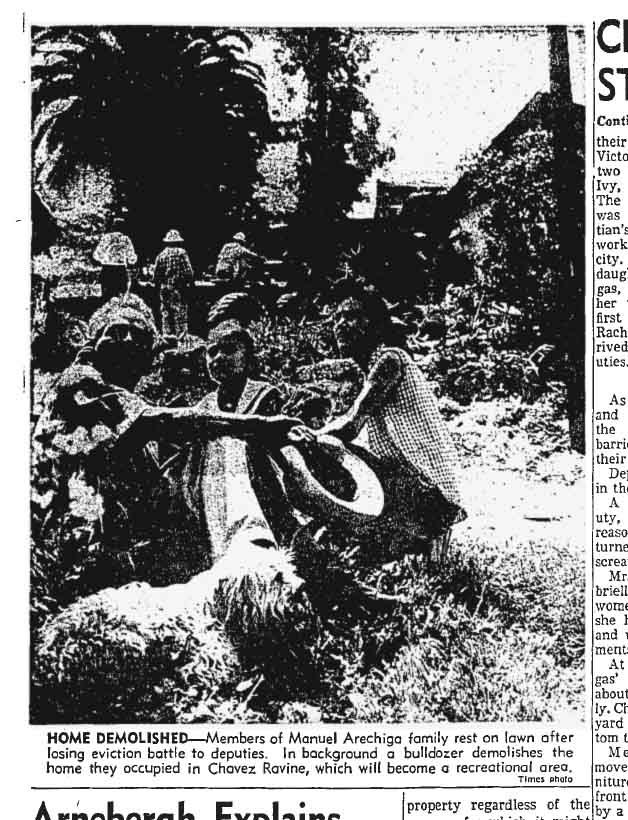
May 9, 1959: Family Evicted From Chavez Ravine

May 9, 1959: Members of the Arechiga family watch as their home is razed.

The Times’ coverage of the Chavez Ravine evictions isn’t easy reading and clearly not the paper at its best.

The construction of Dodger Stadium was something the paper campaigned for and those who opposed the plan were either ignored or minimized in print. But the events of May 8 couldn’t be ignored, in part because the evictions of the Arcechiga family and some of
their neighbors were televised.

Continue reading →

Posted in City Hall, Dodgers, Downtown, Environment | Comments Off on May 9, 1959: Family Evicted From Chavez Ravine

Found on EBay — A Night on the Town, 1944


Nightclub photos, 1944  
Nightclub_ebay_1944_crop02

Nightclub Photos, 1944

A lot of seven souvenir nightclub photos, all from 1944, has been listed on EBay. These folks clearly got around: Earl Carroll's, the Florentine Gardens, the Cocoanut Grove, plus several clubs in San Francisco.

Notice the woman at left has a flower in her hair–and no, she's not Elizabeth Short! For that matter, the woman on the right has done the same thing. My point is that for a time in the mid-1940s, this was quite fashionable and that Elizabeth Short–the Black Dahlia–was doing nothing unusual in pinning flowers in her hair.

Bidding on this lot of photos starts at $19.99. Yes, I'm tempted–don't you love the artwork on the photo holder
from the Cocoanut Grove?– but I already have more of these than I need.

Posted in Food and Drink, Nightclubs | 1 Comment

Matt Weinstock — May 8, 1959

High Finance

Matt_weinstockdTalk is not only
cheap, it's frequently boring. But once in a while, if you listen
intently, you catch an offbeat fragment that is profound or wonderful
nonsense or raffishly realistic.

Mike Molony, who helps cover Hill St. cafe society for this corner, the other day captured a little beauty.

A
character known as Mac was eloquently exhorting several acquaintances
to drink up and rush back to their jobs or if they didn't have one to
get one.

Mac is the happy recipient of a regular unemployment
check, and he doesn't conceal his hope that this desirable way of life
may continue. He refers to himself as a ward of the state.

May 8, 1959, Dodgers BUT HE HAS BEEN READING about
the shortage of tax money, and in his confused way he fears that unless
enough people keep working and get deducted the unemployment fund might
get depleted and his payments would possibly be lowered or the checks
even bounce, a thought that horrifies him.

 Mac's crusade has not
been an outstanding success. His crafty colleagues have the same ideas
about the joys of unemployment that he has. However, he claims one
convert, a fellow known asHardrock. Cynics by the way, insist Hardrock had to go to work anyway because he was broke and his pals had become, as the word is in Calcutta, untouchable.

Mac interrupts his impassioned oratory now and then to say to Mike, "Not you, kid," Mike has a steady job.

::

TO PUT IN BLUNTLY

Mother's Day is for the purpose
Of honoring those who used to burp us.

– HELEN MITCHEL

::

May 8, 1959, Comics A MAN FROM San
Francisco, urging the 1,000 Junior Chamber of Commerce members
convening in Santa Monica Auditorium to hold an upcoming meeting in his
city, offered as inducement a wonderful night out on the town, a
fashion show for wives, light opera and a chance to see the
"pennant-bound Giants." The explosive roar from Dodger partisan almost
blew him off the stage. The delegates later voted to go to San Diego.

::

SPEAKING OF the jaycees, Headlines, the L.A. Junior Chamber publication, committed this oopser
in announcing a meeting next week for new members at a Beverly Blvd.
restaurant: "Two rooms will be used for the reception with one for the
bar and the other for the orientation session. The bar will remain open
for those who wish during the indoctrination."

::

 AS SOME people
collect stamps, coins and rocks, others preserve and cherish phrases
which show up in print. The weekly Rocky Mountain Herald, published in
Denver by Tom and HelenFerril, has become a clearinghouse for this offbeat pastime.

May 8, 1959, Abby An L.A. subscriber who collects "do hereby's" reported in delight that our mayor had committed one. After a few whereases he said, "I do hereby proclaim this Folk Dancing Day."

Understand one "do hereby," considered rare, is worth two "shark-infested waters" on the open market.

::

MISCELLANY — For two weeks, Louis Chazaro reports, a chicken has been living happily in the shrubbery on an "island" on San Bernardino Freeway just off Aliso St. It was there yesterday, as usual, oblivious to the 5 p.m. bumper-to-bumper traffic … Watch out for Bob Ritchey. He tells of a chamber-music group that played a Mozart piece so badly the audience booed and the group went into Haydn.
Posted in Columnists, Matt Weinstock | Comments Off on Matt Weinstock — May 8, 1959

Paul V. Coates — Confidential File, May 8, 1959

Confidential File

Why Eyewitnesses Aren't Too Reliable

Paul_coatesYesterday I detailed three recent local cases of innocent persons being jailed by mistaken eyewitness testimony.

I told you that the cases weren't rare ones.

Today, I'm going to tell you why.

To do it, I have to point the finger at some highly respected groups who don't like people who point.

For example, the police.

Too often, their power of subtle suggestion is used to influence a witness to make a wrong identification.

As an exaggerated example, there's the "Arkansas lineup," which has become kind of a bitter joke among criminologists.

It
apparently was (and — from what I read in the papers — probably still
is) common police procedure in the state after which it was named. It
works like this:

May 8, 1959, Mirror Cover A woman reports that a crime was committed
against her by a Negro. She gives police a physical description of the
suspect. Police find a man — any man — who generally answers the
description she gave. Then they stick him — one Negro — in a lineup
with eight white men, and ask, innocently:

"You see anybody there who looks like him, lady?"

Any conscientious cop would condemn the "Arkansas lineup."

But chances are that he, to a lesser degree, is employing the same tactic.

I talked about it at length this week with Marshall Houts, a former judge and FBI man, and one of the nation's best authorities on criminal evidence.

"Just 
by handing a book full of mugshots to an eyewitness or by letting him
view a lineup of suspects, the police are planting the suggestion that
the criminal is there," he pointed out.

"It's a dangerous procedure but obviously it's necessary," he added.

Houts' criticism was of the additional persuasion and influence — often unintentionally — used too often by police.

For example, showing a witness just one suspect or his picture.

May 8, 1959, Mental Patients Or,
as is the procedure in San Francisco (you've probably seen it on the
television show "Lineup), having an officer recite the past criminal
record of a man in a line up for the witness to hear.

"Some victims are extremely susceptible to suggestion," Houts said.

In his book, "From Evidence to Proof," Houts cites example after example of persons later found innocent whose convictions resulted from "rigged" or unobjective witness-identification methods.

Houts' suggestion: "It should be standard police department practice to tape record lineups, and take pictures of them."

Houts also recited to me the dozens of cases where as many as 6, 10, 12 witnesses made identification of a suspect — and were wrong.

"And as a general rule," he said, "the real criminal bears very little physical resemblance to the falsely identified party."

The
problem today, he told me, is to educate judges, lawyers, police
officers and the public that eyewitness identification is the type of
evidence most susceptible to error.

May 8, 1959, Sports Some Strong Words Coming Up

It's also been my experience," Houts said, "that the more positive an eyewitness is, the less likely it is that he's right.

"Today,
judges and juries put too much credence in the eyewitness. In most
cases, eyewitness identification should be considered little more than
an investigative lead for the police.

"And if eyewitnesses are
used in court, I think the judge should instruct the jury in every
instance as to the unreliable nature of the evidence."

Those are strong words.

But they're coming from a man — as general counsel of Erle
Stanley Gardner's Court of Last Resort — has seen dozens of the
terrible injustices caused by equally strong words of "positive"
eyewitnesses who were wrong.

Posted in Columnists, Paul Coates | Comments Off on Paul V. Coates — Confidential File, May 8, 1959

A Kinder, Simpler Time Dept.

May 8, 1926

May 8, 1926

Posted in Food and Drink | 1 Comment

Game Honors Roy Campanella, May 8, 1959

May 7, 1959, Roy Campanella at the Coliseum
Los Angeles Times file photo

May 7, 1959: Between the fifth and six innings of the benefit game for Roy Campanella, the lights at the Coliseum were extinguished and spectators struck matches and lit cigarette lighters as a tribute to catcher, who was paralyzed in a car accident. "The flames winked like swarming fireflies in the darkness of the cavernous Coliseum," The Times' Frank Finch said.

May 8, 1959, Times Cover A record crowd of 93,103 jammed the Coliseum for an exhibition between the Yankees and Dodgers to benefit Roy Campanella.

The Times' Al Wolf and Frank Finch had some debate over the details
but they agreed the crowd overwhelmed the old ballpark. Wolf said about
20,000 people without tickets stood outside the Coliseum. Finch said
the crowd decided not to wait and "overflowed onto the playing field
itself."

John Hall, then writing for the Mirror-News, had a much more
detailed account. "It was the meanest, most unruly, worst crowd I've
ever seen at the Coliseum," said Chief John G. Degenkolb of the
stadium's Fire Department. "There was a gang element."

Hall described "fence pushing, forced gates, broken fences, jammed
ticket booths and a stampede from the peristyle to the right-field
screen." The Mirror-News headline was  "Brawls, Riots Mar Game" but
that seemed a little stronger than Hall's story.

The mess reminded me of the Dodgers' return to the Coliseum
to play the Red Sox in an exhibition game before the start of last
season. The game drew an incredible 115,000 fans. My sons and I didn't
see any trouble that night, but we arrived early, left early and took
buses provided by the Dodgers from Dodger Stadium to the Coliseum. No
facility, no matter how well-staffed or prepared, can easily handle
that big a crowd.

The Campanella game was a wonderful tribute that raised a lot of
money for the paralyzed former Dodger catcher. But those sort of events
require very large doses of patience to survive.

–Keith Thursby

Posted in Dodgers, Downtown, Sports | 2 Comments

Nuestro Pueblo

May 8, 1939, Nuestro Pueblo
Posted in Architecture, Nuestro Pueblo | Comments Off on Nuestro Pueblo

Found on EBay — Earl Carroll’s

Earl Carroll's, Jan. 31, 1948

I usually don't run the EBay photos this big, but I'm baffled by this one. Take a look at the table: These folks have dinner rolls, glasses of water, silverware, etc. and then these huge buckets of ice

Earl Carroll's Jan. 31, 1948

Is this the world's largest shrimp cocktail or what's going on? Bidding on this EBay item starts at $6.

Posted in Food and Drink, Nightclubs | 2 Comments

Matt Weinstock — May 7, 1959

Noisesome to Some

Matt_weinstockdApparently a
city employee who complained here about the music broadcast in City
Hall is not alone in his irritation. Other tortured souls have chimed
in with similar grievances.

One man writes: "Each day from 7:30
a.m. until 4 p.m. for almost eight months I had to listen to continuous
tin-can music on a job I held. I am a music lover, but this terrible
intrusion on my concentration made me nervous and angry. There wasn't a
quiet moment to relax the nerves. I felt like a slave being punished by
the notorious water torture."

A strip-tease lady named Vagablonde,
or so it states on the printed, perfumed stationery, writes: "Don't
they know down there that playing music to a captive audience is
illegal and they are breaking a federal law? After all, this is only
one step from the Commie propaganda blasted from loudspeakers in Russia
and China."

May 7, 1959, Mirror Comics She goes on irrelevantly, "Besides, soft, dreamy music belongs to the strip teaser's act in hurly
burly, and your City Hall is taking the bread right out of our mouths.
Maybe what makes the dear old baldies there so sore is that there's no
strip teaser to go along with the music to create the proper mood."

SHE CONTINUES, "I will be on my way to the goosepimple
circuit in the Middle West when you get this letter. You should have
seen the way the boys kicked up the sand on Waikiki Beach when I wore
my bikini. Will you show me some new judo holds to use on fresh guys
sometime, Matt?" Great kidder, that Vagablonde, whoever she is.

Being
an entertainer, she can be excused from a slight error about such music
breaking a federal law. She was referring, doubtless, to the case of
the Public Utilities Commission of the District of Columbia vs. Pollack
in May, 1952.

Passengers on the city transit system protested
that their constitutional rights were being infringed by programs
broadcast on streetcars. The programs were 30% music, 5% announcements
and 5% commercial advertising.

The case was taken to the U.S.
Supreme Court and, the County Law Library informs me, the stern
gentlemen in the robes decreed that no one's freedom had been violated
by the streetcar music.

May 7, 1959, Sports Bring in that violin section a little louder, Andre.

::

KID STUFF — Dick Pachtman,
deputy DA, took his son Larry, 5, to court to hear a case he was trying
and afterward asked what he thought. "Didn't you like that other
attorney?" Larry asked. "Of course," Dick said. "Then why did you keep
objecting all the time to what he said?" the boy wondered … A lady
named Julia doesn't know what she's going to do about her granddaughter
Vicki, 3 1/2, who somehow manages to get the baffled Police Department
on the phone when no one is around. Vicki explains, "They're my
friends." It seems she waves to traffic officers and they wave back.

::

ONLY IN L.A. —
As a bus driver on the 7 line stopped at 3rd and Alvarado Streets, he
opened the door and called out "Sunset!" meaning he wanted the newsboy
at the corner to bring him a sunset edition.* A few days ago he learned
a passenger had written a scorching letter about him to the management.
She'd got off the bus, thinking it was Sunset Blvd. So now he buys his
papers from Bill Franklin, who sells the Mirror News at 2nd and Spring.

::

May 7, 1959, Abby TURN ABOUT

Here is a thought
That strangely appeals:
Now we've cars with fins,
What of fish with wheels?

-RICHARD ARMOUR

::

AROUND TOWN — If the city is so desperate for new tax money, Harold Kaner of Pacoima asks, how about selling advertising space on the rear of police cars? … Wayne Pease of the U-I publicity staff is another example of the true hi-fi
enthusiast. He has $425 worth of equipment — including AM and FM
speakers and tuners and a stereo head which plays tape through them —
in his 1951 Chrysler, Blue Book valuation $285.

* The Sunset Edition was the Los Angeles Examiner's last edition of the day. Weinstock is poking a little fun at the competition.–lrh

Posted in Columnists, Matt Weinstock | Comments Off on Matt Weinstock — May 7, 1959

Paul V. Coates — Confidential File, May 7, 1959


May 2, 1959, Palumbo

Confidential File 

An Eyewitness Can Be High Executioner

Paul_coatesThere's a man in our society I fear.

He's an honest man, conscientious and law-abiding. His intentions are the best.

But
because of — rather than in spite of — his zeal to be a good citizen,
he can destroy the lives of innocent men. Maim them. Even murder them.

Murder them nice and clean and legal.

Our police and courts call him "the eyewitness."

And too often, I'm afraid, they put a little too much faith in the accuracy of his vision.

In
the last week, two examples of the destruction that the combination of
good intentions and bad memories can cause have hit the news.

A
couple of days ago Robert J. Coronado, 27, was freed from Chino Prison
after serving six months of a five-year-to-life sentence for a crime he
didn't commit.

He was sent there on the testimony of two
eyewitnesses who positively identified him as the man who held up a
West 3rd street cafe.

 
May 7, 1959, Cover Only a freak of fate kept him from
serving a full term in prison. The man who committed the robbery
happened to be sent to the same prison as Coronado (Doing time for a
different crime), happened to meet him in the shower room one day and
tell him he did it, and happened to be a decent-enough individual to
repeat his confession to the police, even though it meant implicating a
friend.

A few days before Coronado was released, Mirror News reporter Jack Searles broke the story of Mrs. Leona Palumbo, a 33-year-old Hawthorne housewife.

Eyewitnesses in two separate armed robberies had identified her as the "gun-moll" involved.

She
was sitting in County Jail awaiting prosecution when a minor miracle
happened, (A miracle activated by some fine detective work and
dedication to justice by Det. Sgt. Charles McPherson of the Lynwood Police Department.)

The real gun-moll was tracked down and arrested. Her confession freed Mrs. Palumbo
after the housewife had to spend 33 days in jail, living with the very
realistic fear that the honest mistakes of some honest people might
send her to prison for the rest of her life.

It would be nice to believe that these two cases of mistaken identification were isolated ones.

But they're not.

The Mirror News reference library has a special file labeled "mistaken identity cases." And it's a fat one.

All local cases. All within the last 10 years.

May 7, 1959, Rape There's one, dated Sept 11, 1958:

A former Los Angeles police officer, age 37, was positively identified by two victims of kidnap and rape as their assailant.

One of the victims was 17, the other, 22.

The crimes were committed months apart.

Either of them could have sent the ex-policeman to the gas chamber. He had no alibi strong enough to convince
a jury, caught up in the emotion of listening to two young women
describe their terrifying experiences, that he was innocent. That he
was the wrong man.

While be was awaiting trial, the real rapist
struck again. But that time he was caught, and he confessed to the
other two crimes.

He Who Was About to Die

If he hadn't been caught, I wonder if the state of California might have convicted and executed an innocent man.

And
I wonder how many men and women are in prison today, found guilty of
crimes they didn't commit, because of the emotion blurred vision of
eyewitnesses and the jurors who heard their stories, and because of
some highly unprofessional tactics used by some police investigators in
"helping" witnesses pick out the "right" suspects.

Tomorrow,
I'll examine why "positive" identification so often are wrong ones, and
how the power of subtle suggestions by policemen can influence a
witness to make a wrong identification.

Posted in #courts, Columnists, Paul Coates | 1 Comment

A Kinder, Simpler Time Dept.

May 7, 1922, Ads

May 7, 1922

Posted in Fashion | 1 Comment

The Latest Fashions; Dodgers vs. Angels? May 7, 1969

May 7, 1969, Broadway

OK, ladies, fess up. How many of you dressed like this? The scarf on the arm thing is really intriguing–what kept it up? And those glasses! But to be honest, I usually enjoy the bold, dramatic artwork in the fashion ads, which gave the pages some style and elegance.


May 7, 1969, Sports The Dodgers turned down a request from the Angels to extend the Freeway Series into the regular season. We're not talking about interleague play — just a long-delayed spring training game.

The Angels wanted to finish their exhibition series on an off day for both teams. You can't blame them for trying — the Angels were 6-1 against the Dodgers since they began playing each other in spring training. The teams had each won a game in 1969, with the third game rained out.

You know the regular season is going badly when you're trying to line up a meaningless exhibition.

Dodgers Vice President Red Patterson wired Angels General Manager Dick Walsh to decline (this was long before the two executives could Twitter each other). Patterson said the Dodgers would want to use one of their starting pitchers against the Angels, and "with our club shooting for a division championship, breaking into the regular rotation would not seem too wise."

Ouch.

— Keith Thursby

var gaJsHost = (("https:" == document.location.protocol) ? "https://ssl." : "http://www.");
document.write(unescape("%3Cscript src='" + gaJsHost + "google-analytics.com/ga.js' type='text/javascript'%3E%3C/script%3E"));

try {
var pageTracker = _gat._getTracker("UA-8640152-1");
pageTracker._trackPageview();
} catch(err) {}

Posted in Dodgers, Fashion, Lakers, Sports | 1 Comment

Fred Astaire Wins 9 Emmys; Braves Beat Dodgers, May 7, 1959

May 7, 1959, Times Cover

May 7, 1959, Sports The Milwaukee Braves were the class of the National League heading into the 1959 season. The Braves had faced the Yankees in the previous two World Series, winning in 1957 and taking the powerful Yankees to seven games both years. So the Dodgers' three-game series in Milwaukee was a big deal, an opportunity to prove Los Angeles belonged at the same level as the league champions.

Milwaukee won two of the three and stayed in first place, just ahead of the Dodgers. But all the games were close and the first game might have been the most suspenseful. The Braves won in 16 innings, 3-2. Henry Aaron doubled in Eddie Mathews.

The teams would meet again, with much more at stake.


::


The Coliseum Commission wanted a proposed second All-Star game played in the Coliseum. Baseball had two All-Star games each year from 1959 to 1962, providing additional money for the players' pension fund.

 ::

More than 80,000 tickets had been sold for the Dodgers' exhibition against the Yankees to benefit Roy Campanella, the Dodgers' star catcher who had been paralyzed in a car accident. The Times' story advancing that night's game predicted the crowd would be the biggest in baseball history.

Ten thousand general admission seats would be available beginning at 6 p.m., when the Coliseum opened. The price: 90 or 75 cents.

— Keith Thursby

var gaJsHost = (("https:" == document.location.protocol) ? "https://ssl." : "http://www.");
document.write(unescape("%3Cscript src='" + gaJsHost + "google-analytics.com/ga.js' type='text/javascript'%3E%3C/script%3E"));

try {
var pageTracker = _gat._getTracker("UA-8640152-1");
pageTracker._trackPageview();
} catch(err) {}

Posted in broadcasting, Front Pages, Television | 1 Comment

Low Turnout Feared in City Primary; Ladies’ Days at the Ballpark, May 7, 1929

May 7, 1929, Cover

Newspaper design as it was practiced in the 1920s: An eight-column page with an editorial cartoon front and center above the fold as the only art.
May 7, 1929, Shippey

Lee Shippey was one of The Times' institutions for many years. In addition to a column, he wrote several books, including "It's an Old California Custom" and "The Luckiest Man Alive."

I had been reading his material for several years before I realized he was blind–the result of an accident in which he was exposed to some fumes while working as a proofreader at the Kansas City Times. He retired in 1949 and died in 1969 at the age of 86. He once said: "I never saw humanity clearly until I lost my sight."

May 7, 1929, Oviatt May 7, 1929 Maddux Airlines

At left, an ad for Alexander and Oviatt at Olive near Sixth. Above, $38 to San Francisco is $456.13 USD 2007.

May 7, 1929, Fay Durst May 7, 1929, Laurel and Hardy

Above, sound films from 1929, including Laurel and Hardy's first talkie, "Unaccustomed as We Are," which features Thelma Todd. And the main feature, "Black Watch," with Myrna Loy and Victor McLaglen.

At left, Fay Durst, Miss Santa Monica, 1929, strikes a less than demure pose. 

May 7, 1929, Comics

Early episodes of "Gasoline Alley," "Harold Teen" and "Winnie Winkle," plus "The Gumps." 

May 7, 1929, Kotex

Above, solving or discussing "woman's oldest hygienic problem" was a theme in the early Kotex ads.


May 7, 1929, Sports Los Angeles Angels owner William Wrigley was in trouble with his
fellow Pacific Coast League bosses. His offense?  He let women into
Wrigley Field for free.

Four owners and a representative of another team voted to "rebuke"
Wrigley, Harry B. Smith reported in The Times from San Francisco.
Wrigley was having none of it, threatening to close Wrigley Field and
play in a smaller park if not allowed to make every game free for women.

Money, of course, played in big role in the dispute. The other
owners wanted a bigger share of the attendance and the Angels' threat
to close Wrigley Field would result in even more lost revenue. And
you've got to figure Wrigley loved the publicity and figured he'd draw
more fans in the long run.

"Instead of taking away from $7,000 to $10,000 checks the visiting
clubs will be able to take out only $1,000 for their local series,"
said J.H. Patrick, president of the Angel City Baseball Assn. "The
other league owners may think Mr. Wrigley is bluffing but if they
continue to be foolish in their actions they'll find out he means
business."

The owners wanted Wrigley to charge women on Saturdays, Sundays and the first games of series. 

–Keith Thursby

var gaJsHost = (("https:" == document.location.protocol) ? "https://ssl." : "http://www.");
document.write(unescape("%3Cscript src='" + gaJsHost + "google-analytics.com/ga.js' type='text/javascript'%3E%3C/script%3E"));

try {
var pageTracker = _gat._getTracker("UA-8640152-1");
pageTracker._trackPageview();
} catch(err) {}

Posted in art and artists, books, Film, health, Hollywood, Politics | 1 Comment