May 9, 1959: Family Evicted From Chavez Ravine

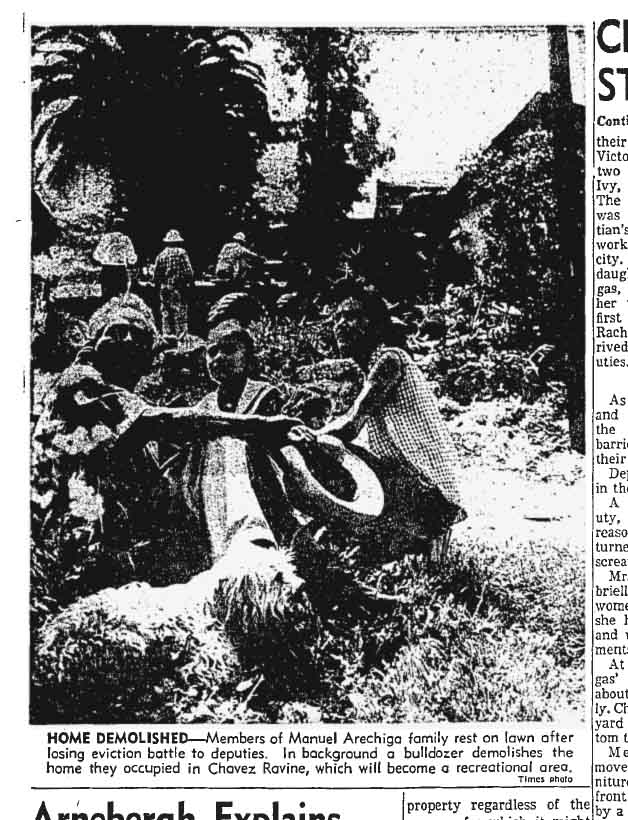
May 9, 1959: Members of the Arechiga family watch as their home is razed.

The Times’ coverage of the Chavez Ravine evictions isn’t easy reading and clearly not the paper at its best.

The construction of Dodger Stadium was something the paper campaigned for and those who opposed the plan were either ignored or minimized in print. But the events of May 8 couldn’t be ignored, in part because the evictions of the Arcechiga family and some of
their neighbors were televised.

Continue reading →

Posted in City Hall, Dodgers, Downtown, Environment | Comments Off on May 9, 1959: Family Evicted From Chavez Ravine

Found on EBay — A Night on the Town, 1944


Nightclub photos, 1944  
Nightclub_ebay_1944_crop02

Nightclub Photos, 1944

A lot of seven souvenir nightclub photos, all from 1944, has been listed on EBay. These folks clearly got around: Earl Carroll's, the Florentine Gardens, the Cocoanut Grove, plus several clubs in San Francisco.

Notice the woman at left has a flower in her hair–and no, she's not Elizabeth Short! For that matter, the woman on the right has done the same thing. My point is that for a time in the mid-1940s, this was quite fashionable and that Elizabeth Short–the Black Dahlia–was doing nothing unusual in pinning flowers in her hair.

Bidding on this lot of photos starts at $19.99. Yes, I'm tempted–don't you love the artwork on the photo holder
from the Cocoanut Grove?– but I already have more of these than I need.

Posted in Food and Drink, Nightclubs | 1 Comment

Matt Weinstock — May 8, 1959

High Finance

Matt_weinstockdTalk is not only
cheap, it's frequently boring. But once in a while, if you listen
intently, you catch an offbeat fragment that is profound or wonderful
nonsense or raffishly realistic.

Mike Molony, who helps cover Hill St. cafe society for this corner, the other day captured a little beauty.

A
character known as Mac was eloquently exhorting several acquaintances
to drink up and rush back to their jobs or if they didn't have one to
get one.

Mac is the happy recipient of a regular unemployment
check, and he doesn't conceal his hope that this desirable way of life
may continue. He refers to himself as a ward of the state.

May 8, 1959, Dodgers BUT HE HAS BEEN READING about
the shortage of tax money, and in his confused way he fears that unless
enough people keep working and get deducted the unemployment fund might
get depleted and his payments would possibly be lowered or the checks
even bounce, a thought that horrifies him.

 Mac's crusade has not
been an outstanding success. His crafty colleagues have the same ideas
about the joys of unemployment that he has. However, he claims one
convert, a fellow known asHardrock. Cynics by the way, insist Hardrock had to go to work anyway because he was broke and his pals had become, as the word is in Calcutta, untouchable.

Mac interrupts his impassioned oratory now and then to say to Mike, "Not you, kid," Mike has a steady job.

::

TO PUT IN BLUNTLY

Mother's Day is for the purpose
Of honoring those who used to burp us.

– HELEN MITCHEL

::

May 8, 1959, Comics A MAN FROM San
Francisco, urging the 1,000 Junior Chamber of Commerce members
convening in Santa Monica Auditorium to hold an upcoming meeting in his
city, offered as inducement a wonderful night out on the town, a
fashion show for wives, light opera and a chance to see the
"pennant-bound Giants." The explosive roar from Dodger partisan almost
blew him off the stage. The delegates later voted to go to San Diego.

::

SPEAKING OF the jaycees, Headlines, the L.A. Junior Chamber publication, committed this oopser
in announcing a meeting next week for new members at a Beverly Blvd.
restaurant: "Two rooms will be used for the reception with one for the
bar and the other for the orientation session. The bar will remain open
for those who wish during the indoctrination."

::

 AS SOME people
collect stamps, coins and rocks, others preserve and cherish phrases
which show up in print. The weekly Rocky Mountain Herald, published in
Denver by Tom and HelenFerril, has become a clearinghouse for this offbeat pastime.

May 8, 1959, Abby An L.A. subscriber who collects "do hereby's" reported in delight that our mayor had committed one. After a few whereases he said, "I do hereby proclaim this Folk Dancing Day."

Understand one "do hereby," considered rare, is worth two "shark-infested waters" on the open market.

::

MISCELLANY — For two weeks, Louis Chazaro reports, a chicken has been living happily in the shrubbery on an "island" on San Bernardino Freeway just off Aliso St. It was there yesterday, as usual, oblivious to the 5 p.m. bumper-to-bumper traffic … Watch out for Bob Ritchey. He tells of a chamber-music group that played a Mozart piece so badly the audience booed and the group went into Haydn.
Posted in Columnists, Matt Weinstock | Comments Off on Matt Weinstock — May 8, 1959

Paul V. Coates — Confidential File, May 8, 1959

Confidential File

Why Eyewitnesses Aren't Too Reliable

Paul_coatesYesterday I detailed three recent local cases of innocent persons being jailed by mistaken eyewitness testimony.

I told you that the cases weren't rare ones.

Today, I'm going to tell you why.

To do it, I have to point the finger at some highly respected groups who don't like people who point.

For example, the police.

Too often, their power of subtle suggestion is used to influence a witness to make a wrong identification.

As an exaggerated example, there's the "Arkansas lineup," which has become kind of a bitter joke among criminologists.

It
apparently was (and — from what I read in the papers — probably still
is) common police procedure in the state after which it was named. It
works like this:

May 8, 1959, Mirror Cover A woman reports that a crime was committed
against her by a Negro. She gives police a physical description of the
suspect. Police find a man — any man — who generally answers the
description she gave. Then they stick him — one Negro — in a lineup
with eight white men, and ask, innocently:

"You see anybody there who looks like him, lady?"

Any conscientious cop would condemn the "Arkansas lineup."

But chances are that he, to a lesser degree, is employing the same tactic.

I talked about it at length this week with Marshall Houts, a former judge and FBI man, and one of the nation's best authorities on criminal evidence.

"Just 
by handing a book full of mugshots to an eyewitness or by letting him
view a lineup of suspects, the police are planting the suggestion that
the criminal is there," he pointed out.

"It's a dangerous procedure but obviously it's necessary," he added.

Houts' criticism was of the additional persuasion and influence — often unintentionally — used too often by police.

For example, showing a witness just one suspect or his picture.

May 8, 1959, Mental Patients Or,
as is the procedure in San Francisco (you've probably seen it on the
television show "Lineup), having an officer recite the past criminal
record of a man in a line up for the witness to hear.

"Some victims are extremely susceptible to suggestion," Houts said.

In his book, "From Evidence to Proof," Houts cites example after example of persons later found innocent whose convictions resulted from "rigged" or unobjective witness-identification methods.

Houts' suggestion: "It should be standard police department practice to tape record lineups, and take pictures of them."

Houts also recited to me the dozens of cases where as many as 6, 10, 12 witnesses made identification of a suspect — and were wrong.

"And as a general rule," he said, "the real criminal bears very little physical resemblance to the falsely identified party."

The
problem today, he told me, is to educate judges, lawyers, police
officers and the public that eyewitness identification is the type of
evidence most susceptible to error.

May 8, 1959, Sports Some Strong Words Coming Up

It's also been my experience," Houts said, "that the more positive an eyewitness is, the less likely it is that he's right.

"Today,
judges and juries put too much credence in the eyewitness. In most
cases, eyewitness identification should be considered little more than
an investigative lead for the police.

"And if eyewitnesses are
used in court, I think the judge should instruct the jury in every
instance as to the unreliable nature of the evidence."

Those are strong words.

But they're coming from a man — as general counsel of Erle
Stanley Gardner's Court of Last Resort — has seen dozens of the
terrible injustices caused by equally strong words of "positive"
eyewitnesses who were wrong.

Posted in Columnists, Paul Coates | Comments Off on Paul V. Coates — Confidential File, May 8, 1959

A Kinder, Simpler Time Dept.

May 8, 1926

May 8, 1926

Posted in Food and Drink | 1 Comment

Game Honors Roy Campanella, May 8, 1959

May 7, 1959, Roy Campanella at the Coliseum
Los Angeles Times file photo

May 7, 1959: Between the fifth and six innings of the benefit game for Roy Campanella, the lights at the Coliseum were extinguished and spectators struck matches and lit cigarette lighters as a tribute to catcher, who was paralyzed in a car accident. "The flames winked like swarming fireflies in the darkness of the cavernous Coliseum," The Times' Frank Finch said.

May 8, 1959, Times Cover A record crowd of 93,103 jammed the Coliseum for an exhibition between the Yankees and Dodgers to benefit Roy Campanella.

The Times' Al Wolf and Frank Finch had some debate over the details
but they agreed the crowd overwhelmed the old ballpark. Wolf said about
20,000 people without tickets stood outside the Coliseum. Finch said
the crowd decided not to wait and "overflowed onto the playing field
itself."

John Hall, then writing for the Mirror-News, had a much more
detailed account. "It was the meanest, most unruly, worst crowd I've
ever seen at the Coliseum," said Chief John G. Degenkolb of the
stadium's Fire Department. "There was a gang element."

Hall described "fence pushing, forced gates, broken fences, jammed
ticket booths and a stampede from the peristyle to the right-field
screen." The Mirror-News headline was  "Brawls, Riots Mar Game" but
that seemed a little stronger than Hall's story.

The mess reminded me of the Dodgers' return to the Coliseum
to play the Red Sox in an exhibition game before the start of last
season. The game drew an incredible 115,000 fans. My sons and I didn't
see any trouble that night, but we arrived early, left early and took
buses provided by the Dodgers from Dodger Stadium to the Coliseum. No
facility, no matter how well-staffed or prepared, can easily handle
that big a crowd.

The Campanella game was a wonderful tribute that raised a lot of
money for the paralyzed former Dodger catcher. But those sort of events
require very large doses of patience to survive.

–Keith Thursby

Posted in Dodgers, Downtown, Sports | 2 Comments

Nuestro Pueblo

May 8, 1939, Nuestro Pueblo
Posted in Architecture, Nuestro Pueblo | Comments Off on Nuestro Pueblo

Found on EBay — Earl Carroll’s

Earl Carroll's, Jan. 31, 1948

I usually don't run the EBay photos this big, but I'm baffled by this one. Take a look at the table: These folks have dinner rolls, glasses of water, silverware, etc. and then these huge buckets of ice

Earl Carroll's Jan. 31, 1948

Is this the world's largest shrimp cocktail or what's going on? Bidding on this EBay item starts at $6.

Posted in Food and Drink, Nightclubs | 2 Comments

Matt Weinstock — May 7, 1959

Noisesome to Some

Matt_weinstockdApparently a
city employee who complained here about the music broadcast in City
Hall is not alone in his irritation. Other tortured souls have chimed
in with similar grievances.

One man writes: "Each day from 7:30
a.m. until 4 p.m. for almost eight months I had to listen to continuous
tin-can music on a job I held. I am a music lover, but this terrible
intrusion on my concentration made me nervous and angry. There wasn't a
quiet moment to relax the nerves. I felt like a slave being punished by
the notorious water torture."

A strip-tease lady named Vagablonde,
or so it states on the printed, perfumed stationery, writes: "Don't
they know down there that playing music to a captive audience is
illegal and they are breaking a federal law? After all, this is only
one step from the Commie propaganda blasted from loudspeakers in Russia
and China."

May 7, 1959, Mirror Comics She goes on irrelevantly, "Besides, soft, dreamy music belongs to the strip teaser's act in hurly
burly, and your City Hall is taking the bread right out of our mouths.
Maybe what makes the dear old baldies there so sore is that there's no
strip teaser to go along with the music to create the proper mood."

SHE CONTINUES, "I will be on my way to the goosepimple
circuit in the Middle West when you get this letter. You should have
seen the way the boys kicked up the sand on Waikiki Beach when I wore
my bikini. Will you show me some new judo holds to use on fresh guys
sometime, Matt?" Great kidder, that Vagablonde, whoever she is.

Being
an entertainer, she can be excused from a slight error about such music
breaking a federal law. She was referring, doubtless, to the case of
the Public Utilities Commission of the District of Columbia vs. Pollack
in May, 1952.

Passengers on the city transit system protested
that their constitutional rights were being infringed by programs
broadcast on streetcars. The programs were 30% music, 5% announcements
and 5% commercial advertising.

The case was taken to the U.S.
Supreme Court and, the County Law Library informs me, the stern
gentlemen in the robes decreed that no one's freedom had been violated
by the streetcar music.

May 7, 1959, Sports Bring in that violin section a little louder, Andre.

::

KID STUFF — Dick Pachtman,
deputy DA, took his son Larry, 5, to court to hear a case he was trying
and afterward asked what he thought. "Didn't you like that other
attorney?" Larry asked. "Of course," Dick said. "Then why did you keep
objecting all the time to what he said?" the boy wondered … A lady
named Julia doesn't know what she's going to do about her granddaughter
Vicki, 3 1/2, who somehow manages to get the baffled Police Department
on the phone when no one is around. Vicki explains, "They're my
friends." It seems she waves to traffic officers and they wave back.

::

ONLY IN L.A. —
As a bus driver on the 7 line stopped at 3rd and Alvarado Streets, he
opened the door and called out "Sunset!" meaning he wanted the newsboy
at the corner to bring him a sunset edition.* A few days ago he learned
a passenger had written a scorching letter about him to the management.
She'd got off the bus, thinking it was Sunset Blvd. So now he buys his
papers from Bill Franklin, who sells the Mirror News at 2nd and Spring.

::

May 7, 1959, Abby TURN ABOUT

Here is a thought
That strangely appeals:
Now we've cars with fins,
What of fish with wheels?

-RICHARD ARMOUR

::

AROUND TOWN — If the city is so desperate for new tax money, Harold Kaner of Pacoima asks, how about selling advertising space on the rear of police cars? … Wayne Pease of the U-I publicity staff is another example of the true hi-fi
enthusiast. He has $425 worth of equipment — including AM and FM
speakers and tuners and a stereo head which plays tape through them —
in his 1951 Chrysler, Blue Book valuation $285.

* The Sunset Edition was the Los Angeles Examiner's last edition of the day. Weinstock is poking a little fun at the competition.–lrh

Posted in Columnists, Matt Weinstock | Comments Off on Matt Weinstock — May 7, 1959

Paul V. Coates — Confidential File, May 7, 1959


May 2, 1959, Palumbo

Confidential File 

An Eyewitness Can Be High Executioner

Paul_coatesThere's a man in our society I fear.

He's an honest man, conscientious and law-abiding. His intentions are the best.

But
because of — rather than in spite of — his zeal to be a good citizen,
he can destroy the lives of innocent men. Maim them. Even murder them.

Murder them nice and clean and legal.

Our police and courts call him "the eyewitness."

And too often, I'm afraid, they put a little too much faith in the accuracy of his vision.

In
the last week, two examples of the destruction that the combination of
good intentions and bad memories can cause have hit the news.

A
couple of days ago Robert J. Coronado, 27, was freed from Chino Prison
after serving six months of a five-year-to-life sentence for a crime he
didn't commit.

He was sent there on the testimony of two
eyewitnesses who positively identified him as the man who held up a
West 3rd street cafe.

 
May 7, 1959, Cover Only a freak of fate kept him from
serving a full term in prison. The man who committed the robbery
happened to be sent to the same prison as Coronado (Doing time for a
different crime), happened to meet him in the shower room one day and
tell him he did it, and happened to be a decent-enough individual to
repeat his confession to the police, even though it meant implicating a
friend.

A few days before Coronado was released, Mirror News reporter Jack Searles broke the story of Mrs. Leona Palumbo, a 33-year-old Hawthorne housewife.

Eyewitnesses in two separate armed robberies had identified her as the "gun-moll" involved.

She
was sitting in County Jail awaiting prosecution when a minor miracle
happened, (A miracle activated by some fine detective work and
dedication to justice by Det. Sgt. Charles McPherson of the Lynwood Police Department.)

The real gun-moll was tracked down and arrested. Her confession freed Mrs. Palumbo
after the housewife had to spend 33 days in jail, living with the very
realistic fear that the honest mistakes of some honest people might
send her to prison for the rest of her life.

It would be nice to believe that these two cases of mistaken identification were isolated ones.

But they're not.

The Mirror News reference library has a special file labeled "mistaken identity cases." And it's a fat one.

All local cases. All within the last 10 years.

May 7, 1959, Rape There's one, dated Sept 11, 1958:

A former Los Angeles police officer, age 37, was positively identified by two victims of kidnap and rape as their assailant.

One of the victims was 17, the other, 22.

The crimes were committed months apart.

Either of them could have sent the ex-policeman to the gas chamber. He had no alibi strong enough to convince
a jury, caught up in the emotion of listening to two young women
describe their terrifying experiences, that he was innocent. That he
was the wrong man.

While be was awaiting trial, the real rapist
struck again. But that time he was caught, and he confessed to the
other two crimes.

He Who Was About to Die

If he hadn't been caught, I wonder if the state of California might have convicted and executed an innocent man.

And
I wonder how many men and women are in prison today, found guilty of
crimes they didn't commit, because of the emotion blurred vision of
eyewitnesses and the jurors who heard their stories, and because of
some highly unprofessional tactics used by some police investigators in
"helping" witnesses pick out the "right" suspects.

Tomorrow,
I'll examine why "positive" identification so often are wrong ones, and
how the power of subtle suggestions by policemen can influence a
witness to make a wrong identification.

Posted in #courts, Columnists, Paul Coates | 1 Comment

A Kinder, Simpler Time Dept.

May 7, 1922, Ads

May 7, 1922

Posted in Fashion | 1 Comment

The Latest Fashions; Dodgers vs. Angels? May 7, 1969

May 7, 1969, Broadway

OK, ladies, fess up. How many of you dressed like this? The scarf on the arm thing is really intriguing–what kept it up? And those glasses! But to be honest, I usually enjoy the bold, dramatic artwork in the fashion ads, which gave the pages some style and elegance.


May 7, 1969, Sports The Dodgers turned down a request from the Angels to extend the Freeway Series into the regular season. We're not talking about interleague play — just a long-delayed spring training game.

The Angels wanted to finish their exhibition series on an off day for both teams. You can't blame them for trying — the Angels were 6-1 against the Dodgers since they began playing each other in spring training. The teams had each won a game in 1969, with the third game rained out.

You know the regular season is going badly when you're trying to line up a meaningless exhibition.

Dodgers Vice President Red Patterson wired Angels General Manager Dick Walsh to decline (this was long before the two executives could Twitter each other). Patterson said the Dodgers would want to use one of their starting pitchers against the Angels, and "with our club shooting for a division championship, breaking into the regular rotation would not seem too wise."

Ouch.

— Keith Thursby

var gaJsHost = (("https:" == document.location.protocol) ? "https://ssl." : "http://www.");
document.write(unescape("%3Cscript src='" + gaJsHost + "google-analytics.com/ga.js' type='text/javascript'%3E%3C/script%3E"));

try {
var pageTracker = _gat._getTracker("UA-8640152-1");
pageTracker._trackPageview();
} catch(err) {}

Posted in Dodgers, Fashion, Lakers, Sports | 1 Comment

Fred Astaire Wins 9 Emmys; Braves Beat Dodgers, May 7, 1959

May 7, 1959, Times Cover

May 7, 1959, Sports The Milwaukee Braves were the class of the National League heading into the 1959 season. The Braves had faced the Yankees in the previous two World Series, winning in 1957 and taking the powerful Yankees to seven games both years. So the Dodgers' three-game series in Milwaukee was a big deal, an opportunity to prove Los Angeles belonged at the same level as the league champions.

Milwaukee won two of the three and stayed in first place, just ahead of the Dodgers. But all the games were close and the first game might have been the most suspenseful. The Braves won in 16 innings, 3-2. Henry Aaron doubled in Eddie Mathews.

The teams would meet again, with much more at stake.


::


The Coliseum Commission wanted a proposed second All-Star game played in the Coliseum. Baseball had two All-Star games each year from 1959 to 1962, providing additional money for the players' pension fund.

 ::

More than 80,000 tickets had been sold for the Dodgers' exhibition against the Yankees to benefit Roy Campanella, the Dodgers' star catcher who had been paralyzed in a car accident. The Times' story advancing that night's game predicted the crowd would be the biggest in baseball history.

Ten thousand general admission seats would be available beginning at 6 p.m., when the Coliseum opened. The price: 90 or 75 cents.

— Keith Thursby

var gaJsHost = (("https:" == document.location.protocol) ? "https://ssl." : "http://www.");
document.write(unescape("%3Cscript src='" + gaJsHost + "google-analytics.com/ga.js' type='text/javascript'%3E%3C/script%3E"));

try {
var pageTracker = _gat._getTracker("UA-8640152-1");
pageTracker._trackPageview();
} catch(err) {}

Posted in broadcasting, Front Pages, Television | 1 Comment

Low Turnout Feared in City Primary; Ladies’ Days at the Ballpark, May 7, 1929

May 7, 1929, Cover

Newspaper design as it was practiced in the 1920s: An eight-column page with an editorial cartoon front and center above the fold as the only art.
May 7, 1929, Shippey

Lee Shippey was one of The Times' institutions for many years. In addition to a column, he wrote several books, including "It's an Old California Custom" and "The Luckiest Man Alive."

I had been reading his material for several years before I realized he was blind–the result of an accident in which he was exposed to some fumes while working as a proofreader at the Kansas City Times. He retired in 1949 and died in 1969 at the age of 86. He once said: "I never saw humanity clearly until I lost my sight."

May 7, 1929, Oviatt May 7, 1929 Maddux Airlines

At left, an ad for Alexander and Oviatt at Olive near Sixth. Above, $38 to San Francisco is $456.13 USD 2007.

May 7, 1929, Fay Durst May 7, 1929, Laurel and Hardy

Above, sound films from 1929, including Laurel and Hardy's first talkie, "Unaccustomed as We Are," which features Thelma Todd. And the main feature, "Black Watch," with Myrna Loy and Victor McLaglen.

At left, Fay Durst, Miss Santa Monica, 1929, strikes a less than demure pose. 

May 7, 1929, Comics

Early episodes of "Gasoline Alley," "Harold Teen" and "Winnie Winkle," plus "The Gumps." 

May 7, 1929, Kotex

Above, solving or discussing "woman's oldest hygienic problem" was a theme in the early Kotex ads.


May 7, 1929, Sports Los Angeles Angels owner William Wrigley was in trouble with his
fellow Pacific Coast League bosses. His offense?  He let women into
Wrigley Field for free.

Four owners and a representative of another team voted to "rebuke"
Wrigley, Harry B. Smith reported in The Times from San Francisco.
Wrigley was having none of it, threatening to close Wrigley Field and
play in a smaller park if not allowed to make every game free for women.

Money, of course, played in big role in the dispute. The other
owners wanted a bigger share of the attendance and the Angels' threat
to close Wrigley Field would result in even more lost revenue. And
you've got to figure Wrigley loved the publicity and figured he'd draw
more fans in the long run.

"Instead of taking away from $7,000 to $10,000 checks the visiting
clubs will be able to take out only $1,000 for their local series,"
said J.H. Patrick, president of the Angel City Baseball Assn. "The
other league owners may think Mr. Wrigley is bluffing but if they
continue to be foolish in their actions they'll find out he means
business."

The owners wanted Wrigley to charge women on Saturdays, Sundays and the first games of series. 

–Keith Thursby

var gaJsHost = (("https:" == document.location.protocol) ? "https://ssl." : "http://www.");
document.write(unescape("%3Cscript src='" + gaJsHost + "google-analytics.com/ga.js' type='text/javascript'%3E%3C/script%3E"));

try {
var pageTracker = _gat._getTracker("UA-8640152-1");
pageTracker._trackPageview();
} catch(err) {}

Posted in art and artists, books, Film, health, Hollywood, Politics | 1 Comment

Found on EBay — Earl Carroll’s

Earl Carroll Program This program from Earl Carroll's has been listed on EBay. It's interesting to contrast these programs with those from the Florentine Gardens. In many ways, they are quit similar. Bidding starts at $5.

var gaJsHost = (("https:" == document.location.protocol) ? "https://ssl." : "http://www.");
document.write(unescape("%3Cscript src='" + gaJsHost + "google-analytics.com/ga.js' type='text/javascript'%3E%3C/script%3E"));

try {
var pageTracker = _gat._getTracker("UA-8640152-1");
pageTracker._trackPageview();
} catch(err) {}

Posted in Nightclubs | Comments Off on Found on EBay — Earl Carroll’s

Matt Weinstock — May 6, 1959

Shell Game

Matt_weinstockdIt is the nature of
shell collectors to correspond with each other and, thus, adman Bennett
Foster has learned of the fantastic tale of R. Julian Dashwood, the only white man on the island of Mauke, in the Cook group, 1,000 miles from New Zealand.

Thirty years ago Dashwood
found himself on the beach in Australia, then in a depression, and he
resolved never again to be dependent on errant society. He went to Mauke, married a native girl, and was welcomed into the tribe by the
hospitable Polynesians. He built a house of coral and set about
indulging his hobby, shell collecting. He worked out a co-operative
deal with the natives and they enthusiastically went to work collecting
shells for him.

BUT ABOUT a year ago he became bored and
left for Auckland, where he opened a little shell store. After three
months he knew the dizzy pace of civilization was not for him and
returned to the atoll.

May 6, 1959, Dodgers Last year the battery went dead on his
shortwave radio, his only contact with the outside world, and he was
frantic for a while, wondering what the world was up to. Then he found
he didn't really care.

Not long ago another crisis arose. The
natives got tired of collecting shells, and his trade, carried on by
the four ships a year which call at the atoll, came to an end. No
matter what he offered them, they refused. After all, what good was
money on an island without a store and where everything they ate, drank
or wore was in natural abundance.

FINALLY he had an idea.
He sent to Auckland for a movie projector and some old films. At the
first showing the natives went wild over them. But on the night of the
next show he stood at the door and told them the price of admission was
a penny. Of course, no one had a penny.

The economic dilemma was
quickly solved, he recently wrote Foster. He pays them a penny a week
to collect shells and they pay it back to him to see the movies.

::

May 6, 1959, Comics ASIDE TO the
Detroit boys — A large lady couldn't get into the low-slung car that
was to take her to her husband's funeral, the other day, and she had to
ride with the undertaker.

::

RIGHT SCHOOL

How wise we are; what worthy labor
To note each weakness of our neighbor,
If in the night, like busy elves,
We use the list to test ourselves.

-GUY MULLEN

::

 ONLY IN L.A. —
A wife in a downtown bar became increasingly critical as her husband
gulped drink after drink long after she had pointed out it was time to
go home. Finally she asked sarcastically, "What are you doing, trying
for an Oscar?" Her befuddled spouse retorted proudly, "I already got
one!" He thought she'd said ulcer.

::

THOSE WHO felt the full force of Sunday's big wind don't think it received enough attention.

Ray Keplinger hit a full iron shot on the Hesperia course and the ball landed 10 feet in back of him.

May 6, 1959, Abby Publicist
Jim Bishop was playing volleyball at Malibu and a gust of wind caught
the ball and it went over his head. He chased it endlessly, and if a
little girl hadn't finally stopped it he'd probably have jogged all the
way to Manhattan Beach. A car was sent to retrieve him and the ball and
the speedometer measured five-eights of a mile.

::

AT RANDOM —
Sudden thought: How about an added Pulitzer prize for the unknown
reporter who had to cover the Clare Luce-Sen. Morse story in Time? …
Morey Gold, the Whittier Blvd. bicycle and key man, swears he heard a KHJ newscaster talk about a "dubbish
rump" … Cartoonist Dave Hall had a live foot-and-a-half-foot-long water
snake on his desk yesterday to take home for his youngster's nature
study class. OK, so it was in a gunny sack … Mike Goodman knows a
fellow so lazy he has to shake his self-winding watch to make it go.
Himself.

var gaJsHost = (("https:" == document.location.protocol) ? "https://ssl." : "http://www.");
document.write(unescape("%3Cscript src='" + gaJsHost + "google-analytics.com/ga.js' type='text/javascript'%3E%3C/script%3E"));

try {
var pageTracker = _gat._getTracker("UA-8640152-1");
pageTracker._trackPageview();
} catch(err) {}

Posted in Columnists, Matt Weinstock | Comments Off on Matt Weinstock — May 6, 1959

Paul V. Coates — Confidential File, May 6, 1959

Confidential File

Prince Otto I Isn't Even Housebroken

Paul_coatesThere is a base canard, perpetrated by the hopelessly sentimental, that a dog is man's best friend.

A dog, I say to you, is a false friend.

He'll
make a slobbering, emotional display of licking your hands. But on a
whim, he'll leave you without so much as a backward glance.

I had a dog once. As a matter of fact, I had him until just a couple weeks ago.

He's
a dachshund puppy, and believe me, I gave him the best years of my
life. He dined only on the most exotic creations dreamed up in the
fertile, culinary mind of kindly old Doctor Ross. He slept on a pillow
that had but recently been confiscated from beneath my head.

When,
in a fit of childish pique, he chewed up my bedroom slippers, I didn't
whack him on his baby teeth, the way I should have. I just passed it
off with a philosophical shrug.

May 6, 1959, Mirror Cover That dog had it made. But a few
weeks ago he hopped out of our parked car in the vicinity of Sunset and
Laurel, and disappeared in search of some imagined green pastures.

His
name, which I gave him in a weak moment of sheer snobbery, is Crown
Prince Otto I. But, if you call him by it, he won't answer. It
embarrasses him.

Anyway, since this four-month-old delinquent
ran away from home, the family plantation hasn't seemed the same.
There's a cloud of gloom hanging over us all.

My kids, who
usually can't be made to shut up, have hardly spoken. And my wife, in
whose care Crown Prince Otto I was at the time he lammed, has deftly
managed to transfer the blame for the whole thing over to me.

"If you had the window of the station wagon fixed like I told you to, he never would have been able to get out," she said.

"If
you knew the window of the station wagon wouldn't close you never
should have left him in the car, I replied. Overwhelmed by the utter
logic of my remark, I glanced at the kids for their approval. But they
just stared at me with grim accusation in their eyes.

May 6, 1959, Rapid Transit Plan "There's one thing you could do," my wife said after a moment. "You could mention it on your TV program."

"That's impossible," I snapped

"Impossible, impossible," she said, "everything with you is impossible." She glanced at the kids for their approval. And got it.

"If
I do a missing person's program about my own dog, everybody in town
will want me to do one about their missing dogs," I explained.

She sniffed disparagingly. "Well," she murmured, "if it's too much trouble." The kids turned their backs on me.

"It's not too much trouble," I shouted.

"It's
just…" I stalled desperately for a moment. Then, a thoroughly
outrageous inspiration hit me. "It's just that I couldn't do it. It's
against the FCC regulations."

"The WHAT?" she said suspiciously.

"The
Federal Communications Commission. They have a ruling that says no TV
commentator can make a plea in his own behalf on his own program. They
could cut me off the air, and even fine me if I asked people to bring
back my own dog."

It was a low ruse, but it worked. She fell silent, and thoughtful for a while. Finally she looked up brightly.

"Ask George Putnam to mention it on his program," she said.

"I can't do a thing like that," I replied in a shocked voice.

Kith and Kin Gang Up on Me

"Can't, can't," she mimicked. "Everything with you is can't." My children nodded in agreement.

Rather
than lose this happy home I've just described to you, I called Putnam
and told him the problem. "Gee, kid, I'm sorry to hear that," he said.
(He always calls me kid. It has something to do with the difference in
our ages.) "I wish I could help you by putting it on my program.

"But," he added, "it's against FCC regulations."

So,
if someone out there has found my dog, please bring him back. I'm
telling you for you own good. I happen to know he isn't even
housebroken.

var gaJsHost = (("https:" == document.location.protocol) ? "https://ssl." : "http://www.");
document.write(unescape("%3Cscript src='" + gaJsHost + "google-analytics.com/ga.js' type='text/javascript'%3E%3C/script%3E"));

try {
var pageTracker = _gat._getTracker("UA-8640152-1");
pageTracker._trackPageview();
} catch(err) {}

Posted in Animals, Columnists, Paul Coates | 2 Comments

A Kinder, Simpler Time Dept.

May 6, 1920  

May 6, 1920

var gaJsHost = (("https:" == document.location.protocol) ? "https://ssl." : "http://www.");
document.write(unescape("%3Cscript src='" + gaJsHost + "google-analytics.com/ga.js' type='text/javascript'%3E%3C/script%3E"));

try {
var pageTracker = _gat._getTracker("UA-8640152-1");
pageTracker._trackPageview();
} catch(err) {}

Posted in Uncategorized | Comments Off on A Kinder, Simpler Time Dept.

Memories of Union Station

Dec. 12, 1939, Union Statio
Los Angeles Times file photo

Dec. 12, 1939: Waiting area, Union Station.

Union Station has always been one of my favorite L.A. spots. The old place reminds me of family.

My dad and grandfather spent their careers with the Santa Fe
railroad. My grandfather started working for Santa Fe in Barstow, where
the Scottish immigrant first settled his young family. They eventually
moved to Greater Los Angeles — my dad went to Huntington Park High,
then worked for the railroad after World War II until heart bypass
surgery forced him to retire.

We were a reluctant railroad family. A rare perk for a Sante Fe
employee was a free pass. Kids were free too. We never went anywhere on
the train. My dad wasn't a big talker, but it was clear he didn't want
to spend a lot of time on trains after five or six days a week
repairing them.

He softened a little late in his career and took me a couple times
to a railroad museum in Perris that was just getting started. He tried
to show me the differences and the details, but it was all lost on me.

April 14, 1942, Union Station Photograph by Paul Calvert / Los Angeles Times

April 14, 1942: Men in uniform wait to buy tickets during World War II

Calling the place a museum probably was a stretch then. There were
cars and tracks and engines but not many people. Some trains weren't
even ready to be seen by the public. We walked, stared and I
listened while he tried to explain something or answer my questions. 

One visit, my dad found another old railroad guy — might have been
a staffer, might have been another veteran worker — and they talked
shop and compared notes about the old days. Probably what old newspaper
guys sound like now.

Doesn't seem like much, but it's a fond memory of time spent with a
parent who's been gone too long. The trains trigger those memories
every time I go back to Union Station — "the Depot," as it was always
called at our house.

Even with new coats of paint and retouches over the years, it will always be part of L.A.'s past. And mine.

— Keith Thursby

.

var gaJsHost = (("https:" == document.location.protocol) ? "https://ssl." : "http://www.");
document.write(unescape("%3Cscript src='" + gaJsHost + "google-analytics.com/ga.js' type='text/javascript'%3E%3C/script%3E"));

try {
var pageTracker = _gat._getTracker("UA-8640152-1");
pageTracker._trackPageview();
} catch(err) {}

Posted in Downtown, Transportation, travel | 1 Comment

Times Wins Two Pulitzers; Lakers Lose, May 6, 1969

May 6, 1969, Cover  
Above, the edition of The Times that most people received at home. A team headed by George Reasons, with Art Berman, Gene Blake, Robert L. Jackson and Ed Meagher wins a Pulitzer for a series on government corruption. Bill Tuohy wins a Pulitzer for coverage of the Vietnam War.
May 6, 1969, Mosey Edition

This is the "Mosey" edition, nicknamed for the news editor, that The Times put together for late street sales. These appear in the collections of Times' front pages because they have huge headlines–but they don't represent what the paper actually looked like. 


May 6, 1969, Lakers The Boston Celtics won the deciding game of the NBA Finals,
depriving the Lakers of a title they believed they finally would win.

Otherwise, how do you explain the balloons?

In one of the oddest footnotes in modern professional sports, the
Forum's rafters were filled with balloons that would be released when
the Lakers won. "They might remain in their roost for some time to
come," Mal Florence wrote in The Times after watching Boston's 108-106
victory.

There were plots and subplots galore.

–The Lakers were built around three superstars, with Jerry West
leading the way despite an injured leg. He was named the final's most
valuable player and got a car instead of a championship.

–Wilt Chamberlain injured his knee and left the game with about
five minutes to play just as the Lakers were cutting into the Celtics'
lead.

–Chamberlain wanted to get back in the game but was kept on the bench by
Coach Butch van Breda Kolff: "I told him that we were doing well enough
without him." The Lakers and van Breda Kolff would soon part company.

–Former Laker Don Nelson gave Boston a three-point lead with about
a minute left when his shot from the free-throw line "as luck or fate
would have it … hit the front rim, bounced high into the air and then
settled into the net," Florence wrote.

–West scored 42 points but took only one shot in the last four minutes.

–Parts of the game were far from pretty. Several players were in
foul trouble and the Lakers missed 15 consecutive shots during one part
of the third quarter.

You could feel the disappointment in The Times' coverage. Here's my favorite lead, from Chuck Garrity:

"The colorful balloons hung there in the dark rafters of the Forum.
… The USC Trojan band, hired to march around blaring "Happy Days are
Here Again" quietly tucked their instruments back into their cases. …
The Lakers were non-champions of the world of professional basketball
again."

–Keith Thursby

The fourth quarter of Game 7 has survived on Youtube. Here's a section where the Lakers rally and Chamberlain hurts his knee.

var gaJsHost = (("https:" == document.location.protocol) ? "https://ssl." : "http://www.");
document.write(unescape("%3Cscript src='" + gaJsHost + "google-analytics.com/ga.js' type='text/javascript'%3E%3C/script%3E"));

try {
var pageTracker = _gat._getTracker("UA-8640152-1");
pageTracker._trackPageview();
} catch(err) {}

Posted in Front Pages, Lakers, Sports | Comments Off on Times Wins Two Pulitzers; Lakers Lose, May 6, 1969