A Kinder, Simpler Time Dept.: Your Comics

Aug. 2, 1950, Nancy

Ernie Bushmiller's "Nancy," Aug. 2, 1950.

Posted in art and artists, Comics | Comments Off on A Kinder, Simpler Time Dept.: Your Comics

Faithful Dog Guards Drunk Master

Aug. 2, 1899, Faithful Dog

Aug.
2,
1899: Porfiro Sanchez and his faithful dog head home to Garvanza after an exciting day in the big city.
 
Posted in Animals, Food and Drink, LAPD | 2 Comments

Divorce Suit Reveals Molestation Charges


1889_0802_divorce

Aug. 2, 1889: Dominique Lassere sues for divorce, accusing his  wife, Eulalia, of adultery. In turn, Eulalia "a pretty girl with flashing black eyes and pearly teeth," charges him with molesting her 11-year-old sister, Catarina.

Posted in #courts | Comments Off on Divorce Suit Reveals Molestation Charges

Matt Weinstock, August 1, 1959

Yes? No?

Matt WeinstockSomeone at the Allied Artists Studio got an idea the other day for a gimmick to draw attention to the opening Aug. 5 of the movie, “The Big Circus” — have a wire walker go back and forth on a high wire stretched across Broadway from the roof of the Orpheum theater. Publicist Ted Bonnet was assigned to get permission.

He went to the Police Commission in the Police Facilities Building and was told, “This is a traffic matter. The man for you to see is the chief of the traffic division on the sixth floor.”

He went there and was told, “This is not a police matter. The man to see is the chief of the  streets use division of the Board of Public Works. When we’re notified that the permit has been issued, we’ll handle the matter.” Continue reading

Posted in Columnists, Matt Weinstock | Comments Off on Matt Weinstock, August 1, 1959

Paul V. Coates — Confidential File, Aug. 1, 1959

Confidential File

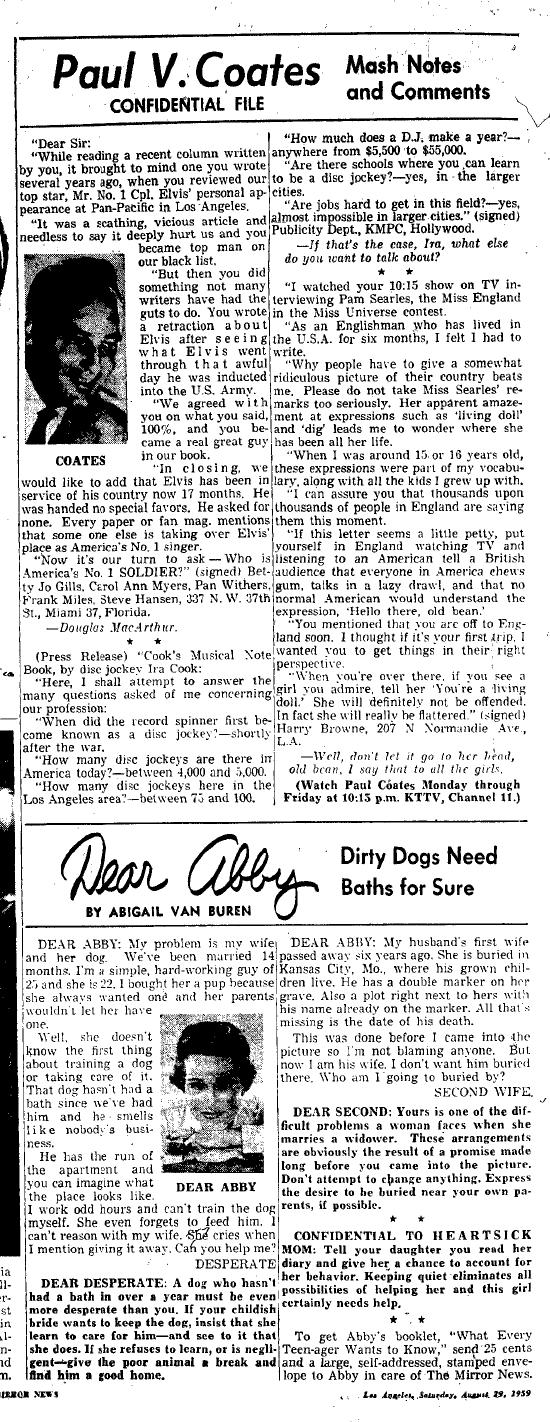
Mash Notes and Comments

Paul Coates, in coat and tie“Dear Mr. Coates:

“You are my court of last resort. I’ve tried everything but my mind will not rest.

“On June 12, we went into a pet shop in Inglewood, as a friend of mine told me they had a 2-month-old bobcat kitten for sale for $75. She knew we had been watching for one.

“I first phoned the pet shop and the owner told me this was so. So when my husband came home from work we went right over to purchase the kitten. There was a large sign on the cage: FOR SALE, 2-month-old BOB CAT, $75 (male).

“So when my husband wanted to buy it and take it home, the owner said he’d like to clean it up a bit and keep it for a few days for attraction.

Continue reading

Posted in Columnists, Paul Coates | Comments Off on Paul V. Coates — Confidential File, Aug. 1, 1959

President Backs U.S. Coal Over Foreign Oil; KTLA Cuts Commercials

1979_0801_cover_thumb

Aug. 1, 1979: Gas rationing … the energy crisis … and SALT II. "I would rather burn a ton of Kentucky coal than see our nation become dependent by buying another barrel of OPEC oil," President Carter says.

Aug. 1, 1979, TV

Don Galloway hosts "The Guinness Game," a syndicated show about attempts to make or break world records.

Fewer commercials? Were they nuts?

Don Page's column headlined the news that Channel 5 would cut back
commercials during their prime time movies by 25%. And most movies
would run full length.

In other news about Channel 5, which like The Times is now owned by
the Tribune Co., "Kung Fu" and "The Dick Van Dyke Show" were dropped
from the fall schedule. –Keith Thursby

Aug. 1, 1979, Amityville

"The Amityville Horror!"

Posted in broadcasting, Environment, Television | Comments Off on President Backs U.S. Coal Over Foreign Oil; KTLA Cuts Commercials

A Kinder, Simpler Time Dept.: Your Comics

  Aug. 1, 1949, Nancy
Ernie Bushmiller's "Nancy," Aug. 1, 1949.

Posted in art and artists | Comments Off on A Kinder, Simpler Time Dept.: Your Comics

U.S. to Accept Division of South Vietnam; Airport Proposed at Anaheim Stadium

Aug. 1, 1969, Cover

NASA says a manned trip to Mars could be possible by 1981 … Dist. Atty. Edmund Dinis wants an inquest into the death of Mary Jo Kopechne, who drowned when Sen. Edward Kennedy's car went off a narrow bridge on Chappaquiddick Island, Mass. Other authorities have said the case was closed … and the Nixon administration is ready to accept the division of South Vietnam as part of the price for settling the Vietnam war.  


Aug. 1, 1969, Sports The Angels hoped a plan to build a runway in the Anaheim Stadium parking lot never got off the ground.

The proposal surfaced at a meeting between Angels officials and city
administrators. According to a story in The Times, the project would
include a passenger terminal and possible facilities for air freight.
Needless to say, the Angels didn't like the idea of flights coming and
going while they were trying to play baseball.

The Angels were the primary tenants of the ballpark but weren't
exactly making millions in 1969. The air plan certainly would bring in
more revenue to the city. Who cares if you couldn't watch the game
because you were too busy worrying about the traffic patterns above
your seat.

Safety was one worry but parking was another. City officials
estimated about 2,000 spaces would be lost if the runway was built. The
Angels were guaranteed 12,000 spaces on game days

–Keith Thursby

Posted in Current Affairs, Front Pages, Politics, Richard Nixon, Science, Sports, UFOs | Comments Off on U.S. to Accept Division of South Vietnam; Airport Proposed at Anaheim Stadium

Lightning Sets Wildfires; Dodgers Seek Coliseum Deal

Aug. 1, 1959, Cover

Aug. 1, 1959: The Times begins experimenting with a two-column news summary.

The Dodgers' new ballpark in Chavez Ravine was nowhere in sight so
the team started talking about returning to the Coliseum for the 1960
season.

The Times' Frank Finch reported that owner Walter O'Malley wanted
the same deal as in 1959, with the Dodgers paying 5% of ticket sales
for rent plus the concessions from 11 games during the season. The
Dodgers had an option to stay in the Coliseum in 1960 but the rent
would increase to 10% and the Coliseum Commission would get all
concessions profits. That's a huge difference.

Finch expected O'Malley's proposal to be received coolly by the commission.

–Keith Thursby

Aug. 1, 1959, Sports

Posted in City Hall, Dodgers, Downtown, Politics, Richard Nixon | Comments Off on Lightning Sets Wildfires; Dodgers Seek Coliseum Deal

Man Addicted to Books Kills Himself

  
Aug. 1, 1899, Suicide

Aug. 1, 1899: A man kills himself after taking elaborate precautions to prevent being identified. He writes: "I read books every day. They act on me as a narcotic. I dope myself with them. They make me forget for a moment, for there is a continual struggle going on — to be or not to be…. I have tried to get opium but failed."

Posted in books, Suicide | 1 Comment

Doctor as Crazy as a March Hare

   Aug. 1, 1889, Jim Jams


Aug. 1, 1889: "The doctor's mania is of a rather peculiar character in that he imagines he is surrounded by beautiful women and is discovering them in all sorts of places."

Posted in #courts, Suicide | Comments Off on Doctor as Crazy as a March Hare

LAPD Charged With Racism

June 23, 1959, NAACP

June 23, 1959: The NAACP urges the City Council to investigate allegations of police brutality toward blacks and Mexicans.

In March 1959, Municipal Judge David Williams made headlines by dismissing charges against 25 African Americans with accusations that the LAPD selectively enforced gambling laws. His action brought an immediate denial and strong criticism from Police Chief William H. Parker.

The controversy was underscored by the resignation of Police Commissioner Herbert Greenwood, the only African American on the board, out of frustration over being criticized by the city's black newspapers and being stonewalled by officials in trying to investigate allegations of brutality against blacks.

On a recent trip to the city archives, Daily Mirror intern Devon McReynolds and I found these original documents in City Council file 89512
showing the exchange between Williams, the first African American federal judge west of the Mississippi, and Parker.

April 1, 1959, David Williams

April 1, 1959, David Williams

April 1, 1959: Judge Williams writes a personal letter to Herb Schurter in response to Schurter's criticism of dismissing charges against blacks.

"I feel that when police officials instruct their subordinate officers
to arrest only Negroes on a given charge, it will not be long before
their newly gained power will prompt them to enforce other statutes
only against certain other groups."

April 13, 1959, Chief Parker

April 13, 1959: Parker to Williams:

"In that I have no knowledge of any such instruction issued in this department ether orally or in writing, by any officer in authority, I believe I am entitled to the facts upon which you base such statements."

April 21, 1959, Judge Williams
April 21, 1959: Williams to Parker:

"Every person conversant with the true facts knows that vice officers ignore gambling elsewhere and concentrate mainly on Negroes. It is not denied that Negroes gamble, but gambling goes on  rampant in every section of the city and arrests should be made where it is conducted. This is not being done."

June 18, 1959, Wyman
June 18, 1959,

Police Commissioner Herbert Greenwood resigns and the Police, Fire and Traffic Committee moves to examine Williams' charges and Greenwood's resignation.

July 6, 1959, Williams
July 6, 1959

The Police, Fire and Traffic Committee invites Williams to discuss his allegations.

July 9, 1959, Davdi Williams, Page 4

July 9, 1959, Williams writes:

"During the greater portion of the last three and one-half years I have served in one or another of the divisions that heard all petty gambling cases, either on arraignment or for trial. I have noticed that the vast majority of the defendants appearing before these courts are Negroes and that the straggling few Caucasians are those caught in Negro games.

"I became very curious as to the reasons for this …."

July 9, 1959, Page 3

 Page 2:

"I am not urging the police to cease making arrests in Negro districts but only that they enforce the law equally in all districts. I hold strongly to the belief that when the public knows there is equal enforcement of the law resulting in all offenders being subject to arrest, there will be less resentment of the police as an authority figure and the courts will gain more respect."

July 9, 1959, David Williams, Page 2

Page 3

"May I suggest you ask the chief … If the imbalance between the number of Negro arrests and the number of Caucasian arrests for gambling as shown by the department's 1957-1958 statistics are to be taken as indicating that Negroes, who constitute approximately ten percent of the population, actually do about ninety percent of the gambling?"

July 9, 1959, David Williams, Page 1

Page 4

"I appreciate very much your willingness to entertain this matter and I deeply regret that my duties prevent me from personally attending your meeting."

–David W. Williams

July 10, 1959, Holland

July 10, 1959, the Police, Fire and Traffic Committee urges the Police Commission to review the matter.

July 22, 1959, Police Commission

July 22, 1959, the Police Commission notes that Williams' actions were overturned by the appellate department of the Superior Court and says:

"The position of this board is that subject file does not contain sufficient substance to justify exhaustive and time-consuming inquiry. This conclusion is also based on the board's personal knowledge of the policies and activities of the Police Department. It is, therefore, recommended the matter be filed."

Aug. 6, 1959, Commission

Aug. 6, 1959, Police Commission to the City Council:

"Judge Williams' letter consists of a rehash of public statements attributed to him and ignores the fact that the Board of Police Commissioners determines Police Department policy and is its Charter designated head. His repeated reference to the chief of police in a personal vein tends to indicate a personal attack rather than an official inquiry. This entire matter was carefully reviewed by the Police Commission with its general manager at the time of the judge's public utterances and no evidence was discovered to support his allegations."

Sept. 2, 1959, Council

Sept. 2, 1959, the Police, Fire and Traffic Committee moves that the matter be filed. The matter was closed. The Watts riots were six years away.

Parker died in 1966; Williams died in 2000.

Posted in #courts, Countdown to Watts, LAPD | 1 Comment

Found on EBay — Quiet Birdmen


Note: This is an encore post from 2009.

This Quiet Birdmen belt buckle has been listed on EBay.
Continue reading

Posted in Fashion, Science, Transportation | Comments Off on Found on EBay — Quiet Birdmen

Matt Weinstock, July 31, 1959

Responsibility Law

Matt WeinstockEvery motorist has heard of the financial responsibility law. Today a man named Tom furnishes a horrible example of how it can work.

On May 20 he stopped in the left lane at Sepulveda Blvd. and Vose St., Van Nuys, behind a car which was signaling a left turn.

As he waited, a third car, driven by a woman, crashed with terrific impact into his rear, jamming his car into the car ahead. The skid marks measured 60 ft. before the crash, according to the police report.

Tom suffered a serious whiplash of the neck and lower spine. He has been under treatment since the accident. Curiously enough, he was the only person injured. He has lost 10 weeks’ work and his car, although partially repaired, is still a mess.

Continue reading

Posted in Columnists, Matt Weinstock | Comments Off on Matt Weinstock, July 31, 1959

Paul V. Coates — Confidential File, July 31, 1959

Confidential File

‘Stop the Press,’ Cries Flash Reporter Joe

Paul Coates, in coat and tieTo you, the Laurel Canyon fire may be old news.

But I just heard about it.

And I’ve got to admit that it’s a matter of special embarrassment to me, because I should have been the first to know.

I happen to be the only newspaper columnist in the world with a bona fide personal news correspondent in Laurel Canyon. His name is Joe Oliveira. His age is, roughly, 12.

His loyalty, however, is divided between me and a mimeographed weekly neighborhood sheet which he publishes himself, called The Little Press.

Ordinarily,
Joe keeps me up-to-the-minute on Canyon activities, ranging from stray
cats and broken windows to juvenile plots to extort fudge bars from
Sam, the Ice Cream Man.

Continue reading

Posted in Columnists, Paul Coates | Comments Off on Paul V. Coates — Confidential File, July 31, 1959

A Kinder, Simpler Time Dept.: Your Movies

July 31, 1953, Movies
July 31, 1953: "Ride Vaquero!" has a giant, full-stage screen. And it's not on Netflix.

Posted in Film, Hollywood | Comments Off on A Kinder, Simpler Time Dept.: Your Movies

Movie Star Mystery Photo


 July 27, 2009, Mystery Photo

 Los Angeles Times file photo

July 6, 1960: Barry Atwater in "Alcoa Presents: The Day the World Wept — the Lincoln Story."

Update: As many people guessed, this is Barry Atwater, who died in 1978.

Just
a
reminder on how this works: I post the mystery photo on Monday and
reveal the answer on Friday … or on Saturday if I have a hard time
picking only five pictures — sometimes it's difficult to choose. To
keep the mystery photo from getting
lost in the other entries, I move it from Monday to Tuesday to
Wednesday, etc., adding a photo every day.

I have to approve
all comments, so if your guess is posted immediately, that means you're
wrong. (And if a wrong guess has already been submitted by someone
else, there's no point in submitting it again.) If you're right, you
will have to wait until Friday. There's no need to submit your guess
five times. Once is enough. The only prize is bragging rights. 

The answer to last week's mystery star: Grace Bradley!

July 28, 2009, Mystery Photo

Los Angeles Times file photo

Update: Barry Atwater in "The Reach of a Giant" on "Medic," Oct. 1, 1956.

Here's another photo of our mystery guest, without his Abe Lincoln makeup–just the usual "white goop" treatment from The Times' art department. Please congratulate Carmen, Nick and Don Danard for identifying him!

July 29, 2009, Mystery Photo

Los Angeles Times file photo

Barry Atwater, Nov. 2, 1961.

And another photo of our mystery guest–slathered with goop by The Times' art department. Please congratulate Annie Frye, Michael Ryerson, Lisa Mateas, Margie and Dewey Webb for identifying him.

July 30, 2009, Mystery Photo

Los Angeles Times file photo

Barry Atwater in the play "Uncle Marston," May 5, 1963.

Here's another photo of our mystery guest. Please congratulate Thom, Lee and Megan, Ted Mark, "Laura" fan Waldo Lydecker, Greg Clancey, Barbara Klein, Roget-L.A. and Mike Hawks for identifying him.

July 31, 2009, Mystery Photo

Los Angeles Times file photo

Update: A badly wrinkled picture of Barry Atwater promoting his appearance in a production of "A Man for All Seasons," 1965. Please congratulate Mary Mallory and Cynthia K. for identifying him!

Posted in Film, Hollywood, Mystery Photo | 55 Comments

Pilgrimage Play Opens

May 31, 1920, Pilgrimage Play  

May 31, 1920: Preparations are underway in El Camino Real Canyon for "The National Pilgrimage Play."

Aug. 26, 1938, Nuestro Pueblo  

Aug. 26, 1938: Joe Seewerker and Charles Owens visit what was then Pilgrimage Play Theater for Nuestro Pueblo. The play wasn't presented in 1938 because the theater was being used for a production of "Faust."

July 31, 1939, Pilgrimage Play

July 31, 1939: Jesus cures a leper in a scene from "The Pilgrimage Play."

July 1, 1939, Pilgrimage Play July 31, 1939, Pilgrimage Play

Until the early 1960s, when a legal ruling ended its government funding, "The Pilgrimage Play" was one of the more enduring fixtures in The Times' drama pages, along with "The Mission Play" and "The Drunkard."

Originally called "The National Pilgrimage Play" in hopes that people from across the U.S. would come to Los Angeles to see the annual production, the play was "transcribed from the Scriptures by Mrs. W. Yorke Stevenson, with assistance from Brander Matthews, Clayton Hamilton, Sheldon Cheney and Prof. Baker of Harvard," The Times said in 1920. 

The script consisted of 14 scenes, divided into a prologue, two acts and an epilogue. The original production was directed by Stevenson and H. Ellis Reed.

The play was presented every summer until a fire destroyed the original structure in 1929. After a two-year gap for construction what is now known as the John Anson Ford Amphitheatre in honor of the former county supervisor, production resumed, with another gap during World War II. In 1943, the property was deeded to Los Angeles County.

Construction of the Hollywood Freeway once again interrupted productions, which resumed in 1955 under John Arnold Ford, the son of John Anson Ford. 

In 1961, Atty. Gen. Stanley Mosk ruled that the play could not receive city or county funding on the principle of the separation of church and state. A privately funded production was given in 1964 and John Arnold Ford presented some scenes in 1978.

Nov. 4, 1978, Pilgrimage Play

Nov. 4, 1978: John Arnold Ford presents scenes from "The Pilgrimage Play." A movie version, partially shot at the amphitheater with some segments filmed on  leftover sets from "Joan of Arc," was released in 1949.

Posted in Parks and Recreation, Religion, Stage | Comments Off on Pilgrimage Play Opens

Nuestro Pueblo — San Pedro

July 31, 1939, Nuestro Pueblo

July 31, 1939: Nuestro Pueblo visits San Pedro and encounters an irascible lighthouse keeper, Irving Conklin. "Some idiot will write a story with a lighthouse in it," Conklin says of filmmakers. "It doesn't matter if the lighthouse is in the Mediterranean or in Siberia. Down they will come and shoot ours."

Posted in art and artists, Nuestro Pueblo | Comments Off on Nuestro Pueblo — San Pedro

For Men Only

July 31, 1899, Men Only  

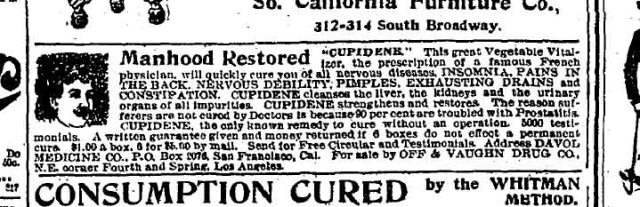
July 31, 1899: Dr. Talcott for whatever ails men. Private entrance.

Posted in health | Comments Off on For Men Only