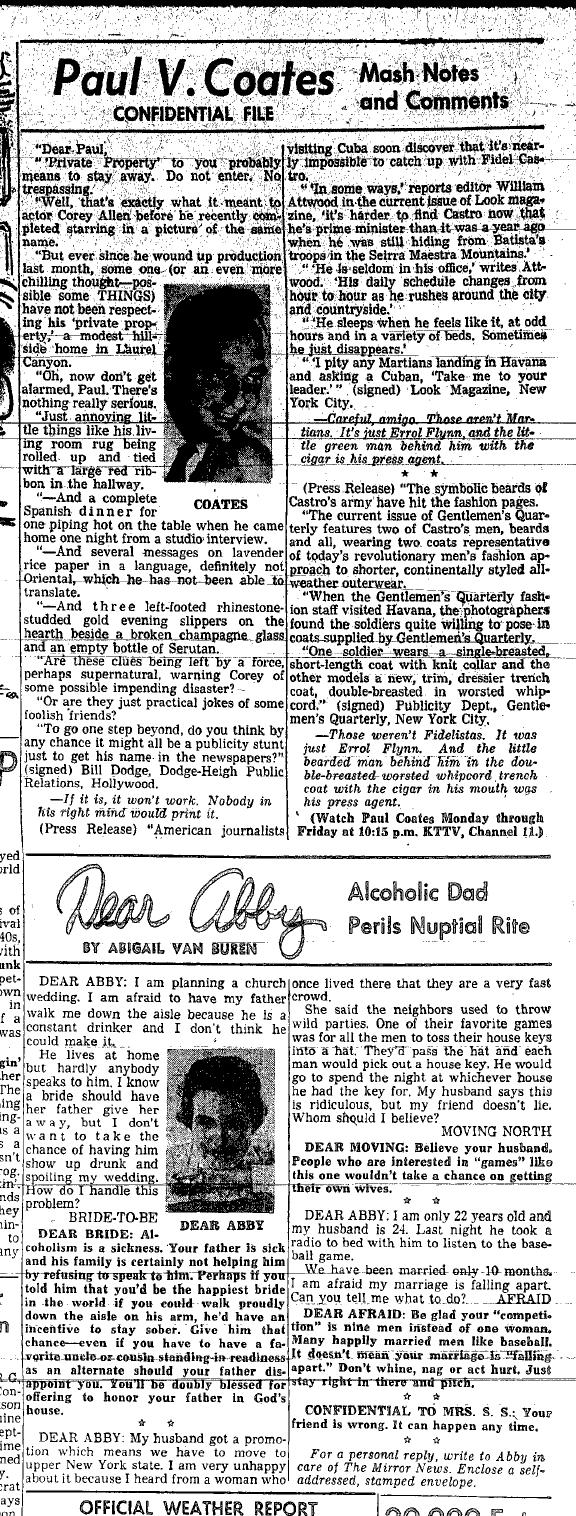
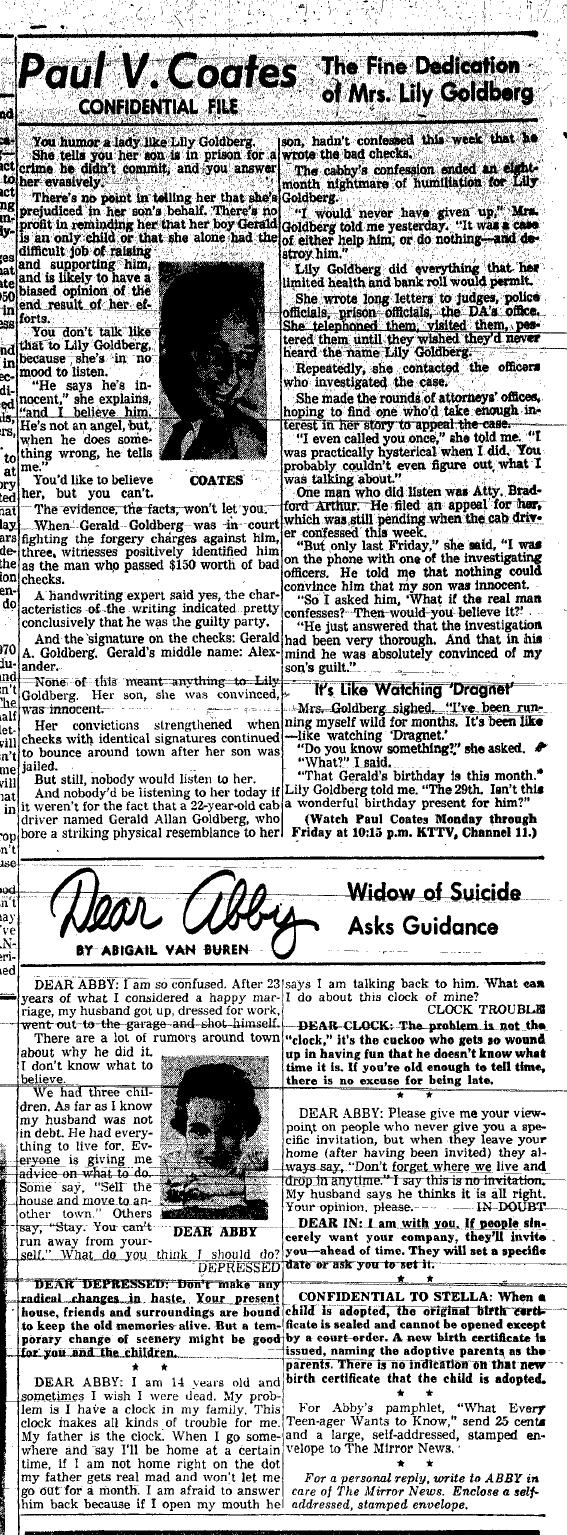
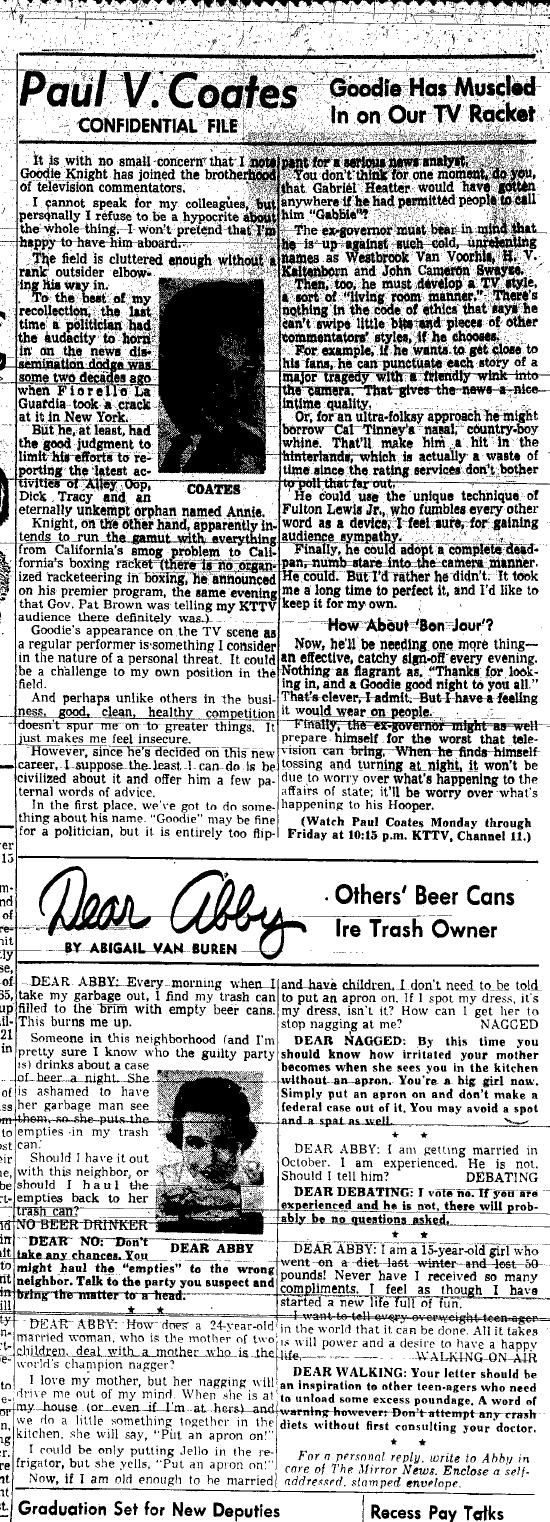
Paul V. Coates — Confidential File, Aug. 7, 1959

Confidential File

This May Make You Really Flip Fedora

Paul Coates, in coat and tieOne of the more humiliating aspects of my personality is that I am hopelessly under the influence of advertising slogans.

The persuasive power of Madison Avenue guides my destiny and shatters my ego.

And that’s the way it’s been since my tenderest years.

I felt, for example, that I suffered from the creeping darkness of 5 o’clock Shadow years before I was even ready for my first shave.

When research scientists at the Listerine Laboratories announced to the world that they had discovered a brand new social disease called Halitosis, it suddenly dawned on me that girls were always friendly at first but when the evening was over they never asked me for another date.

Continue reading

Posted in #gays and lesbians, Columnists, Paul Coates | Comments Off on Paul V. Coates — Confidential File, Aug. 7, 1959

A Kinder, Simpler Time Dept.: Your Comics

Aug. 7, 1955, Nancy

Ernie Bushmiller's "Nancy," Aug. 7, 1955.

Posted in art and artists, Comics | Comments Off on A Kinder, Simpler Time Dept.: Your Comics

Movie Star Mystery Photo


 Aug. 3, 2009, Mystery Photo

 Los Angeles Times file photo

Update: This is Wallace MacDonald, who had a long career as an actor, writer, director and producer. Above, an undated photo of MacDonald in makeup as an old man.

Just
a
reminder on how this works: I post the mystery photo on Monday and
reveal the answer on Friday … or on Saturday if I have a hard time
picking only five pictures — sometimes it's difficult to choose. To
keep the mystery photo from getting
lost in the other entries, I move it from Monday to Tuesday to
Wednesday, etc., adding a photo every day.

I have to approve
all comments, so if your guess is posted immediately, that means you're
wrong. (And if a wrong guess has already been submitted by someone
else, there's no point in submitting it again.) If you're right, you
will have to wait until Friday. There's no need to submit your guess
five times. Once is enough. The only prize is bragging rights. 

The answer to last week's mystery star: Barry Atwater

2009_0804_mystery_photo

Los Angeles Times file photo

Update: MacDonald about 1912.

Here's another picture of our mystery guest. Please congratulate Mike Hawks for identifying him!

Aug. 5, 2009, Mystery Photo

Los Angeles Times file photo

Update: March 22, 1925, MacDonald and Norma Talmadge in "The Lady."

Here's our mystery guest with a mystery companion. Please congratulate Mary Mallory, Sue, Suzy Q, Carmen and Laura Aikens Goeller for identifying him.

Aug. 6, 2009, Mystery Photo

Los Angeles Times file photo

Update: MacDonald in a photo published June 13, 1926.

Here's another picture of our mystery guest. Please congratulate Claire Lockhart and Cinnamon Carter for identifying him.

Aug. 7, 2009, Mystery Photo Los Angeles Times file photo

Update: McDonald and Betty Compson in "New Lives for Old."

Posted in Film, Hollywood, Mystery Photo | 41 Comments

L.A. Cyclists Study Bike Path to Santa Monica

 Aug. 7, 1889, Bicycle Path

Aug. 7, 1899: "Most of the city wheelmen think that a path to Santa Monica is sure to come in time and are ready to take hold and help in its construction…."

"One of the best paths of the kind in the country is the cycleway that runs from Denver, Colo., to Palmer Lake, a distance of about fifty miles…. When the Denver path was constructed there was some opposition from the farmers along the line of the proposed road, who thought that some depredations would be committed by the bicycle riders. It is reported that no such opposition will be met here as the residents of Ballona have already signified their intention of assisting in the construction of such a path." 

Posted in Transportation | Comments Off on L.A. Cyclists Study Bike Path to Santa Monica

Doctor Held as Cocaine Fiend

 Aug. 7, 1889, Fiend

Aug.
7,
1889: "Swigart is a complete wreck from the use of the drugs, his condition being really pitiable."

 
Posted in #courts, LAPD | Comments Off on Doctor Held as Cocaine Fiend

Director John Hughes

Feb. 20, 1985, John Hughes

Feb. 20, 1985: The former National Lampoon writer is one of the few filmmakers in today's teen-crazed Hollywood who's candid enough to admit that his films — like Trix cereal — are made strictly for kids.
Feb. 2, 1985, John Hughes

Hughes' legendary work habits — he's been known to churn out a screenplay in a matter of days — are matched only by his growing reputation as an aging Dennis the Menace, who indulged in temper tantrums and arguments on the set of "Weird Science," a film he recently completed.

Posted in Uncategorized | 1 Comment

Found on EBay — Everett Ruess

Desert Magazine EBay

A copy of the September 1938 issue of Desert magazine with an article about Everett Ruess has been listed on EBay. Ruess was a Los Angeles artist who disappeared while roaming Utah in 1934. Bidding starts at $49.
Posted in art and artists, books | Comments Off on Found on EBay — Everett Ruess

Matt Weinstock, Aug. 6, 1959

August 6, 1959: Alley Oop panel. Alley exclaims "Ooola!" at woman standing in water. Of Men and Machines

Matt WeinstockMan’s dependence on mechanical devices was chaotically demonstrated again the other day in a huge market in San Fernando Valley.

A motorist rammed into a power pole outside the store, disrupting the electricity inside. Suddenly the customers were groping around in semidarkness, grabbing cabbages when they wanted lettuces.

Amid frantic phoning to get the power restored, a few crank handles were found to operate the registers manually. The rest of the cashiers had to get back to basic pencil-and-paper arithmetic.

All in all, it was a harrowing reminder that life without juice is not sweet.


Continue reading

Posted in Columnists, Matt Weinstock | Comments Off on Matt Weinstock, Aug. 6, 1959

Paul V. Coates — Confidential File, Aug. 6, 1959

August 6, 1959: Preston Sturges Dies

Confidential File

Here Is How Stupid One Can Easily Get

Paul Coates, in coat and tieAn old “fad” is making a comeback among Southern California teen-agers.

It’s a seemingly harmless kick, but unless the kids are wised up, and fast, tragedy could very easily be the result.

The fad — inhaling gasoline fumes and fumes from glue-soaked rags — sounds ridiculously innocuous. But it isn’t.

It can be as fatal as Russian roulette.

Just how widespread it has become, I don’t know.

But I do know that during the last week I’ve received a few calls with the information that the kids are at it again.

Continue reading

Posted in Columnists, Paul Coates | Comments Off on Paul V. Coates — Confidential File, Aug. 6, 1959

A Kinder, Simpler Time Dept.: Your Comics

Aug. 6, 1954, Nancy

Ernie Bushmiller's "Nancy," Aug. 6, 1954.

Posted in art and artists, Comics | Comments Off on A Kinder, Simpler Time Dept.: Your Comics

Preston Sturges Dies


Preston Sturges, Oct. 2, 1932

Preston Sturges by Bruce Russell, 1932

Feb. 12, 1942, Sullivan's Travels

"Sullivan's Travels" and "Mr. Bug Goes to Town," Feb. 12, 1942.

 
Aug. 7, 1959, Preston Sturges

Aug. 7, 1959 in The Times: Preston Sturges, renowned Hollywood film producer-writer-director and Broadway playwright, died of a heart attack yesterday in his New York hotel room. He would have been 61 Aug. 28.

Sturges, who left Hollywood nearly 10 years ago after a series of reverses, had been living for several months in New York's Hotel Algonquin, a favorite of theatrical folk.


Aug. 7, 1959, Preston Sturges

Sturges was credited with introducing the flashback technique in "The Power and the Glory."

Oct. 2, 1932, Preston Sturges

Lee Shippey interviews Preston Sturges, Oct. 2, 1932: Thus a young man who previously had been notable only for the invention of a "twenty-four-hour lipstick" suddenly became one of the most interesting figures in American drama."

"Nothing surprising about that," he avers. "Playwriting is simply invention. Inventing a lipstick or an engine or a play is very similar work. I have invented an engine, too, for which I have great hopes."

At right, Philip K. Scheuer on Sturges, Aug. 7, 1959.

Aug. 7, 1959, Preston Sturges

Posted in Film, Hollywood, Obituaries, Stage | 1 Comment

A Curious Family Tree Rooted in the Old South

 Aug. 6, 1899, Slave

Aug.
6,
1899: "You'se a lady …. You'se fum one er de fust famblys in Ferginy, an' you ain't a gwine to work long as I'se got two han's. Ef you'll des behave yo-seff, an be a lady, I'll be yo servant. I'll pay all you' bills, an' take keer er you, 'cause I ain't a gwinter se any er my old marster's blood er workin' out like no 'count po' white folks."

OK, the dialect is pretty repulsive and I suspect this passage seems cryptic to someone who isn't a native English speaker. But really, don't you sense there's more to the story of Mattie Adams?  I wonder if her loving devotion isn't all that hard to figure out 110 years later.

Posted in Obituaries | Comments Off on A Curious Family Tree Rooted in the Old South

Man Accused of Stalking Ex-Girlfriend

 Aug. 6, 1889, Stalker

Aug.
6, 1889: "Judge Owens has but little patience with offenders of his class. Miss Wolf, the complainant, is a handsome young woman, employed in the City of Paris dressmaking establishment, and resides at home with her parents."

 
Posted in #courts, LAPD | Comments Off on Man Accused of Stalking Ex-Girlfriend

Budd Schulberg and Sammy Glick

There's Something About 'Sammy.'

* Hollywood May Finally Be Ready for 'What Makes Sammy Run?', Author Budd Schulberg's Scathing Indictment of the Film Industry. It's About Time.

September 6, 1998

By MARY MELTON, Mary Melton is the magazine's research editor

What
have you done? Samuel Goldwyn, his face flushed with rage, had just
ordered the young screenwriter into his office. What have you done? For
a brief, naive moment, Budd Schulberg shrugged it off. Sure, most of the folks in Hollywood couldn't stand the gruff producer: Goldwyn was outrageous, tantrums were de rigueur. But Schulberg liked him just fine. At least Goldwyn seemed happy with his work. In fact, he'd sent Schulberg to Ensenada the month before to take a load off and tinker with the sequel to "Stagecoach."

But on this afternoon, Goldwyn was hot–much hotter than Schulberg had ever seen him before. What have you done?

Schulberg's equilibrium was upset by a creeping sense of terror. What in the world provoked the old man?

"I'm
talking about that horrible book you wrote!" Goldwyn shouted. The book.
That scathing Hollywood diatribe about the fictional Samuel Glickstein, a Jewish ragamuffin from New York who Americanizes his name and claws his way up to studio mogul. That savage saga that Schulberg
wrote on the side while under contract to Goldwyn–no longer a studio
head but still a producing force to be reckoned with. That
just-published novel titled–uh oh–"What Makes Sammy Run?"

Schulberg
thought fast. Goldwyn couldn't have read the book–that's what
underlings are paid to do–so someone must have told him, wrongly, that
"Sammy" was based solely on Samuel Goldwyn, the former Samuel Goldfish.
Schulberg launched a weak defense: "Sammy" was a mere composite,
"Sammy" was a work of fiction, "Sammy" wasn't Samuel. Goldwyn, his face
now purple with anger, was unimpressed. The screenwriter was quickly
unemployed.
 
Schulberg, 27 and fired, skulked off the Warner Hollywood lot that afternoon in 1941 and headed to Chasen's
for a scotch and soda. Though he downed a few drinks, he still could
see through the alcohol haze. Patrons showed him the backs of their
heads.
 
The Goldfishes who'd reinvented themselves as the Goldwyns still reigned over the studios. The transformation of Samuel Glickstein to Sammy Glick–from
overeager copy boy to none-too-bright newspaper columnist, plagiarizing
screenwriter, conniving producer and inevitably, thanks to a
well-plotted marriage to the boss's daughter, studio head–wasn't taken
metaphorically. A short time after the Goldwyn episode, gossip
columnist Hedda Hopper bumped into Schulberg at Lucy's, the Paramount
hangout, and stormed out with a "Humph!" Lifelong friends stopped
talking to him. Then–as now–there's no sound more deafening than
silence in Hollywood.

B.P. Schulberg, Budd's producer-father,
had urged his son not to publish "Sammy." He admired the book, thought
it was good stuff, professional, solidly written. But he worried that
it would hurt his own career–and Budd's. This particular book, the
elder Schulberg insisted, would be too scandalous. Bury that manuscript in a desk drawer, Buddy. Take a shot at another first novel. 

"It
might have been good practical advice," the 84-year-old son muses
today, as he finds himself still struggling to turn "What Makes Sammy
Run?", arguably the best novel ever written about the film industry,
into a feature film.

From "Sunset Boulevard" to "Wag the Dog,"
Hollywood has held a cracked mirror up to itself with critical and
financial success. Other books that skewered the studio system–F.
Scott Fitzgerald's "The Last Tycoon," Michael Tolkin's "The
Player"–have been made into films by the likes of Elia Kazan and
Robert Altman. Even Nathanael West's "The Day of the Locust," possibly
the most disturbing of the lot, made it to the screen, directed by John
"Midnight Cowboy" Schlesinger.
 
So what's the hold-up on this
one? It can't be a taste issue. This is the industry that can make art
of splattered brain matter, sinking ships and severed horse heads, the
same industry that gets sentimental over '70s porn. And yet Hollywood
has still found little Sammy Glick from the Lower East Side too vile to stomach. 

Until now.

Fifty-seven years after its publication, "Sammy" may finally emerge from turnaround.


"I
get up in the morning and look out at those palm trees and the other
big houses and I say to myself, Sammy, how did it all happen?"

–"What Makes Sammy Run?"


For the first time in four decades, Budd Schulberg's
got a bestseller. Its name is "What Makes Sammy Run?", a title that
suddenly re-materialized last month for one week on The Los Angeles
Times' bestseller list. How does this happen to a book written before
Pearl Harbor? By the same strange mechanisms that jettison a sorter
from the William Morris mail room into the studio's stratosphere:
Sammy's got buzz.

The source of that buzz is "Sammy's" new
champion: a 32-year-old director, writer and actor named Ben Stiller
who's not too unlike Budd Schulberg at the time he wrote "Sammy"–young,
ironic and Jewish, parents in the business, the product of a New
York-Hollywood education. Stiller's completed a third draft of the
"What Makes Sammy Run?" screenplay. He's been hammering it out for two
years ("Sammy" has been in and out of development at Warner Bros. since
1987). Stiller, co-star of the summer hit "There's Something About
Mary," has his own buzz right now, and in Hollywood, where any success
is a lubricant, Stiller's is giving "Sammy" the extra nudge. "I want to
see this film made while Budd's still around," Stiller says. "As a
filmmaker, you hear stories about guys who stuck with something, and
for Budd, it has been 50 years."

Schulberg has at least one
thing to show for those 50 years: Though he never became a mogul, he
radiates a mogul's aura. It's not this year's model; there is no
studied casual baseball cap or omnipresent bottled water. Nor is Schulberg steeped in the coarse mannerisms of a Samuel Goldwyn. But, lounging on the brick patio of his Quogue, Long Island, home, dressed in powder blue Hush Puppies and his trademark Mexican Guayavera shirt, sipping a Dos Equis beer and swatting mosquitoes, Schulberg
exudes the studio system. (He'd hate hearing that, since it's a system
that broke down his father and shut Budd out for decades, but we'll get
to that later.) It's his physical presence–the barrel chest and at
once piercing, at once searching pale blue eyes, the bright white hair
and nose as wide as a fist, the hand grip to the listener's shoulder to
punctuate an important point–that gives off a confidence his father
must have possessed. You can put him in a lobster bib at a Westhampton seafood bar and he still looks like he might have once run MGM. 

Like
the moguls, he exudes a vitality unusual for his age. Maybe it's the
morning swims with his golden retriever. Maybe it's keeping up with his
two teenagers, or engaging in lively debates on the phone with his
younger sister Sonya, who lives in Westchester County, or socializing with writer-friends in the Hamptons–the Kurt Vonneguts and Betty Friedans. "Budd," says Betsy, wife No. 4, "has more energy than all of us." 
 
He's
warm, a bit flirtatious, somewhat of a social animal. All this despite
a bad stammer that has hounded him since he was 4. He's wary of tape
recorders; the pauses–part of his careful speech–might seem like a
loss for words. Usually he lets his elegant prose ("Sammy," "The
Disenchanted," "The Harder They Fall," and the screenplays to "On the
Waterfront" and "A Face in the Crowd") speak for itself. Undiminished
is the Schulberg charm that swept him into four marriages: two when he
was young that produced three children; a third, beloved union with
actress and photographer Geraldine Brooks, who died of cancer and is
buried on the grounds of the understated clapboard home he now shares
with Betsy and their teens, Benn and Jessie. (He remains close to his
older children, Victoria, who lives on a farm in Idaho; David, a
sculptor in San Diego; and Steven, who recently moved to Westhampton.) 

Schulberg was born at 120th
Street in Harlem, but he grew up in a sprawling Hancock Park house
presided over by his father, B.P. and his mother, Ad, one of
Hollywood's first agents. As a child, Budd spent Sundays with the Louis
B. Mayers, was pecked on the cheek by Mary Pickford, romped over the chariots and around the racetrack on the "Ben-Hur" set–the silent version. Truly a native son. 

The
young Budd witnessed his father's affairs with starlets and subsequent
downward career spiral amid a sea of sharks. "I saw all these Sammys
circling around my father," he says. "In that sense, I started thinking
about this when I was a kid. It was impossible not to." What Budd saw
happening to his father and what he overheard at cocktail parties only
spawned more ideas of Sammy: "It was very common for writers to say,
'Jeez, I can't believe what happened. The little son of a bitch, I told
him this idea, and I swear to God the next day he went in there and
sold it.' "

In 1941, books about Hollywood didn't sell. "Locust," written by Schulberg's
pal Nathanael West, came out the year before Sammy and didn't even make
back its $500 advance. But Random House was hot on "Sammy." Bennett
Cerf, the founder and president of that company, championed the novel,
told Budd it was great. Think of it, Budd Schulberg , a 27-year-old
upstart! Dorothy Parker and John O'Hara and F. Scott Fitzgerald told
him it was great. Despite his father's warning, Budd just had to take
the chance.

Charges of anti-Semitism plagued "Sammy's" publication, though Schulberg
felt it was "a whole Jewish world that Sammy is exploiting. The people
he displaces are Jewish." But Sammy's story, composite or not, was the
story of the moguls who built Hollywood–Warner,Cohn ,
Mayer–indifferent, or at times belligerent, to the Judaism they were
raised in; shrewd though largely uneducated; ruthless in their
ambition; obsessive, angry, profane and hugely successful, yet somehow
still dissatisfied. "I don't think Sammy enjoys life as much as he
seems to,"Schulberg says. "He's a prisoner of his own compulsions." 

And he has yet to be the focus of a major motion picture.

Schulberg has his own theory about why "Sammy" remained forbidden fruit: "I think it took a second or third generation to be forgiven."


"One hopeful thing about Hollywood is that they are getting away from the Sammy Glicks because it is more and more realized that the story is the most important part of the movie . . . the Glicks are bound to fade."

–Budd Schulberg
 in an interview with the New York Times Book Review, 1941

*

"I don't know what I was drinking that day."

–Budd Schulberg, 1998


Schulberg
wrote "Sammy" in an age when novelists didn't envision blockbuster
screen rights sold before the ink on the galley is dry. He was just
striving to be taken as a "serious" novelist. He never considered
"Sammy" as a film–Margaret Mitchell didn't write "Gone With the Wind"
thinking "Wouldn't this be a great movie?"–until he started to "get
nibbles" on adapting it nearly 10 years after its publication.
Independent producer types came calling. Sammy was up.

We think we can get Mickey Rooney for Sammy!

But Schulberg didn't hear from them again. Sammy was down.

A decade after Goldwyn called him on the carpet, Schulberg
remained at a great distance from the studio machine. He had spent the
years after "Sammy" in the Navy, in charge of photographic evidence for
the Nuremberg trials. He then settled in a Pennsylvania farmhouse to
write novels during his Hollywood exile. By 1949, his father, B.P., who
brought in half a million a year during the Depression as Paramount's
production head, was still in Hollywood. Only now, he took full-page
"Job Wanted" ads in the trades. Why the hell would Budd Schulberg want to come back–if he could come back–to face Hollywood? He hated the place. 

That fear and disgust hindered a "Sammy" adaptation deal that MGM pursued in 1950. It was around the time that Schulberg ticked off many of his colleagues–some of them permanently–when he voluntarily testified before the House Un-American
Activities Committee, which was investigating Hollywood's ties to the
Communist Party. He'd renounced communism in the late '30s; the party
had given "Sammy" a hard time, calling it not representative of the
progressive forces in Hollywood. "I felt I had no choice, I couldn't
take the fifth, I had written and spoken about it,"Schulberg says.
Though he's always been quick to say he didn't reveal any names that
hadn't been revealed before, he was branded a traitor, a coward. Of
those who continue to hold a grudge, he says, "For some, it was a
position that became frozen in that moment, that became their reason
for living, to avenge that, and nothing happened after that to change
it. I think it closed their minds to anything else, including the evils
of Stalinism, which equaled those of Hitler." 

Ring Lardner Jr., the Academy Award-winning screenwriter of "Woman of the Year," knew Schulberg well, had proofread a copy of "Sammy" for him ("Budd's a bad speller"), had even reworked the ending of "A Star is Born" with Schulberg
when both young men were script doctors for David O. Selznick. "I felt
Budd did it because he was afraid of getting blacklisted, which he
shouldn't have been," Lardner, the last surviving member of the
blacklisted Hollywood Ten who did not cooperate with the committee,
recalls of Schulberg's testifying. "By that time he had a couple of
books, he didn't need Hollywood." Lardner couldn't write under his own
name for 15 years; he and Schulberg have run into each other since the hearings but were never close again. 

Nonetheless, Schulberg's
anti-communist stance might have softened the staunchly conservative
studio heads, because Louis B. Mayer's former empire suddenly launched
an offensive to adapt "Sammy." It surprised Schulberg . He didn't trust
MGM, how they'd do it, how true they'd be to the book. MGM, anxious to
release a "Hollywood" film, instead produced "The Bad and the
Beautiful" in 1951. It won four Oscars. "I always felt it was kind of a
rip-off," Schulberg says. "An effective film, but I felt [MGM]
definitely got together and said, 'Well, screw him if he doesn't want
to do it, we'll do our own Sammy.' "

In 1953, after spending a year on the Jersey docks, Schulberg
delivered the script for "On the Waterfront." The studios weren't
exactly aching to do the project. Before "Waterfront" sold to
independent producer Sam Spiegel, it was rejected by Warner Bros., Paramount, MGM, Columbia (twice) and Fox, where production chief Darryl Zanuck informed Schulberg
and director Elia Kazan, "I'm afraid, boys, all you've got here is a
lot of sweaty longshoremen." The film ranked No. 8 on the American Film
Institute's recent list of the 100 greatest movies; Schulberg's "Waterfront" screenwriting Oscar now stands a tarnished dull gold on his mantelpiece.

Television took a gamble on "Sammy" in 1959. Schulberg
and his brother Stuart adapted the book into a two-part "NBC Sunday
Showcase," sponsored by Crest and interrupted by an ongoing fluoride
toothpaste test of 600 Minnesota boys and girls. From television, it
segued, quite bizarrely, to Broadway in a 1964 musical that starred
Steve Lawrence and ran 540 performances. Schulberg stayed busy: writing the prophetic screenplay for "A Face in the Crowd" (Spike Lee ran into Schulberg
at the fights one night and told him it was his favorite movie), living
in Mexico, starting a writer's workshop, penning an autobiography,
"Moving Pictures: Memories of a Hollywood Prince."

Sammy was down.

In 1987 Schulberg
sat in the office of Bill Gerber, then-vice president of theatrical
production at Warner Bros., discussing a remake of "A Face in the
Crowd." Gerber stopped Schulberg on his way out the door. "By the way, Budd, who owns Sammy?" 

"Well, I do, I guess," Schulberg responded.

"I'd like to think about that," he told him. "Maybe it's time to do it."


"I've known Glicks before," she said."My first producer out here was a Glick. And so was the agent I just got rid of . . ."

"God rest their souls," I said.

–"What Makes Sammy Run?"


No sooner had Warner Bros. bought the option than Schulberg completed a screenplay. He was hopeful, with good reason. Sammy was up. At a production meeting in 1990, Sidney Lumet, the director of "Network" and "Dog Day Afternoon," was interested. We think we can get Tom Cruise for Sammy! But then Lumet was sidetracked by another film. Gene Kirkwood, the producer of "Rocky" and set to produce "Sammy," thought Lumet should have jumped in and had the film made. Kirkwood was ticked. Sammy was down.

Then Sammy was up. Michael Caton-Jones sent for Schulberg to visit the set of "Doc Hollywood" in 1991. Caton-Jones was interested. We think we can get Michael J. Fox for Sammy! A few months later, Schulberg picked up Variety, saw that Caton-Jones was on another project, and called his agent to find out what was going on. "I usually get an embarrassing answer," Schulberg admits, "because it's such a silly question." Sammy was down.

Then
Sammy was up. Ben Stiller had read the novel and loved it, wanted to
write it, direct it, maybe star in it. In 1996, he called Schulberg, who was staying in town at the Westwood Marquis. They met. Schulberg liked him, found him smart and appealing. A tease in Liz Smith's column followed. We think we can get Jim Carrey for Sammy! Then "The Cable Guy," which Stiller directed, laid an egg and he had to stick to acting for a while. Sammy was down. 

Then Sammy was up. With his collaborator, former television writer Jerry Stahl (Stiller is playing Stahl
in this month's "Permanent Midnight"), Stiller wrote a draft of "Sammy"
as a period film with flashbacks and narration. "I had to go off and do
a draft totally on my own, come back and bring it to Budd," Stiller
says. "It was the only way." Schulberg read it: "I liked its energy and
humor; it had a rather original approach to the material." He'd be
lying if he said he wasn't disappointed that his own script had been
scrapped, but "being versatile helps me an awful lot, instead of just
sitting here suffering and saying, 'Jesus, I'm not doing 'Sammy,' I'm
going to kill myself.' I'm so used to it, to the town, even if I'm not
there. In some ways, part of me never left it." On his second draft,
Warner gave Stiller positive notes and a working budget. But they
cooled, didn't move fast enough for Schulberg and Stiller. Schulberg ,
"a little less patient in my waiting than I was before," wrote Warner
Bros. a personal letter asking for the option back, and the studio
complied. Sammy was down.

Budd Schulberg, an octogenarian
Academy Award-winning screenwriter, began pitching the same first novel
that skewered the company town to the company town. "It's kind of
obvious, but it's hard for these people to actually say, 'We're going
to commit 20 million dollars to a movie about how screwed up our
industry is,' " Stiller says. Kirkwood, itchy to get Sammy off the
ground, said last spring that he was considering going "to the guy who
owns Nate-N-Al's–anybody!" to finance it.

Then Sammy was up. Bill Gerber, now an independent producer on the Warner lot, heard this summer that Schulberg
and Stiller were talking to Paramount about backing and, like running
into an ex-wife with a new boyfriend and deciding she looked too happy,
asked for Sammy back. Since Gerber wasn't working within the confines
of the studio, Schulberg thought they'd have a better chance and said
OK. "We haven't closed it with him, but are at the nuts and bolts phase
of going over a new budget,"Schulberg says. "We're very close to a done
deal." Though Gerber's working out financing (Stiller's being hot right
now will "definitely help" secure it, he says), Stiller and Schulberg
aren't going on to a fourth draft until the T's are crossed on said
deal. So the Sammy project remains, however tentatively, in turnaround.

And who knows if it's a place he'll stay. Will the book ever be made into a movie, or does a residual reverence for the Mayers and the Goldwyns
persist, a spirit of sanctimony that reigns each year not only at the
Academy Awards, but at the countless opportunities the film business
has created to bestow ever more honors upon itself? The public might
perceive Hollywood as a place where shrewdness eternally wins out
against intelligence and talent, but Sammy's studio mogul descendants,
awash in million-dollar bonuses and stock options and Gulfstreams ,
might take umbrage at the savaging of their merit system. Meteoric
ascents the likes of Sammy's still happen. David Geffen and Michael Ovitz started out as mailboys. Does Sammy Glick, 57 years after his birth, still hit close to home? 

Andrew Sarris, critic and Columbia University film professor, says the Hollywood Sammy Glick
inhabits "is a world of big studios, and that world doesn't exist in
that form anymore. There's still a lot of stupidity around, it's just
not as well synchronized." Todd Boyd, professor at the USC School of
Cinema-Television, thinks, if anything, that Sammy's world might be
outdated. "Hollywood is much more interested in the present as opposed
to the past. What may be considered scathingly critical in one era may
seem laughable in another."

"It's so big now," Schulberg says. "Whether it's Sony or Murdoch, no one quite knows who's running it. At least we knew Harry Cohn ran Columbia." Will Hollywood ever be less fearful about offending its centers of power? Please, Schulberg says, a greater fear probably exists today because "it is so mysterious as to where this power is."

"Maybe people in Hollywood don't like seeing themselves," says Richard Gladstein,
executive producer of such indie hits as "Jackie Brown" and "Pulp
Fiction." "There is obviously a fascination with Hollywood and making
movies. With 'Entertainment Weekly' and 'Premiere,' the public clearly
has an appetite for what goes on behind the scenes." At the same time,
he says, as producer of the upcoming "Hurlyburly," starring Sean Penn
and Kevin Spacey and set in Hollywood: "It was a difficult film to
finance, and it only cost $10 million. 'Oh, they work in the film
business?' That doesn't seem to be a positive thing."

"Look at all the cameos in 'The Player,' everybody wanted to be a part of that movie," says Robert Rosen,
dean of the UCLA School of Theater, Film and Television. "These are
people who have some sense of social conscience, some sense of liberal
values, who are also aware of the shortcomings of the industry they
work in. They want an opportunity to exorcise the guilt."

Jack
Valenti, president of the Motion Picture Assn. of America, says that
anyone who believes moviegoers aren't interested in Hollywood "has been
living in a cave. Other movies were scathing about Hollywood. This
movie is not breaking virginal ground here." So Sammy's disagreeable,
he says, "so was Gordon Gecko, so was Charles Foster Kane. Sammy Glick is no worse than any of them. He's a metaphor for someone who pursues ambition with a malignant fidelity." 

"This
story is not about the film business, but about people and human
nature," Bill Gerber says. "I think Sammy is very sympathetic." Has he
ever known any Sammys? "Yeah," he says. "Real well." 

Budd Schulberg
approaches the town with a paranoid reluctance, still surrounded by
sharks. "Anyone who knows Hollywood knows Sammy is not just a dinosaur
of the '30s and '40s," the author says. "Sammy's children and
grandchildren are walking the streets."


"I saw Sammy Glick
on a battlefield where every soldier was his own cause, his own army
and his own flag, and I realized that I had singled him out not because
he had been born into the world any more selfish, ruthless and cruel
than anybody else, even though he had become all three, but because in
the midst of a war that was selfish, ruthless and cruel Sammy was
proving himself the fittest, the fiercest and the fastest."

–"What Makes Sammy Run?"


When Schulberg speaks of Sammy Glick, he speaks of two Sammy Glicks:

There
is Sammy the character, the creature to his Victor Frankenstein. He's
the Sammy who keeps outrunning him, who haunts his life "like a bad
brother." He's the Sammy who's the subject of, on average, 20 letters a
month in Schulberg's mailbox. "They say, 'I just read "What Makes Sammy
Run?", and I've read your other books and think it's the best book
you've ever written.' It gives me pause. Jesus Christ, did I really
peak at 26?"

Then there is Sammy the film, the project he
remains "guardedly hopeful" about, the one he grows less and less
patient with as he grows less and less young. It's the Sammy that can
almost make a Sammy out of him, prodding the studios to move faster
with the deal. It's the project he refers to when he says that on his
last day on earth, he will leave some work unfinished.

The
writer sinks into a couch too small for his large frame. With a legal
pad and pencil, he likes to let the words flow, to let them go, not to
come back and look at them until time has passed. Lately, though, when
he's in his office working on pieces for a boxing magazine or answering
correspondence, Budd Schulberg will become distracted. The Hollywood
prince is still haunted by the question he first posed nearly six
decades ago, as a much, much younger man with far less experience,
lacking what critics call "perspective." What is it that still makes
Sammy run so damn fast and so damn well? Is he chasing Sammy or is
Sammy chasing him? And who's going to hit the finish line first?

"Hollywood
is an ideal playing field for people who know how to operate. That
might, in some cases, be their only talent, but it can be major and
take them all the way to the top. That has not changed. That is why, I
think, Sammy is still working, still running." Budd Schulberg recognizes the pun, and cracks an apologetic smile. "Forgive me."

Posted in books, Budd Schulberg, Film, Hollywood, Obituaries | Comments Off on Budd Schulberg and Sammy Glick

Budd Schulberg on Watts


July 2, 1967, Budd Schulberg on Watts  

By Budd Schulberg, July 2, 1967: Johnie Scott, coming home from Stanford for this summer's vacation, returns to a world bordered by 92nd Street and Imperial Highway on the north and south, by Central Avenue and Alameda on the west and east, a ghetto within a ghetto, where more than 450 of the 550 who left Edwin Markham Junior High School with him never made it through high school and where those who did finished with a D-minus average and a 6th-grade reading level.
July 2, 1967, Budd Schulberg on Watts

White Los Angeles and her middle-class Negro allies nod contentedly and ask, What do they want? Are they never satisfied?

July 2, 1967, Budd Schulberg on Watts

"What the white people call improvement is nothing but tokenism. It's like the patient is in danger of bleeding to death and all the Man can think of is to apply another Band-Aid."

Posted in Budd Schulberg, Countdown to Watts, Obituaries | Comments Off on Budd Schulberg on Watts

By Budd Schulberg


Feb. 17, 1952, Budd Schulberg

By Budd Schulberg, Feb. 17, 1952: "You know how married couples get after a while if they're not careful….."
Feb. 17, 1952, Budd Schulberg

When they all dined out together it was traditional to separate wives and husbands, but in the case of the Springers this courtesy had to be jettisoned.

 "What God has brought together let no dinner party split asunder," Jack had laughed and squeezed Charlene's hand.

Feb. 17, 1952, Budd Schulberg

As she turned from the phone, she noticed on the end table the book on "Marriage: Life Sentence or Prolonged Love Affair?" that Charlene had forgotten.

"Of all the nonsense," she thought, and suddenly she was profoundly, explosively happy. "Of all the naive, immature nonsense."

Posted in books, Budd Schulberg, Obituaries | 2 Comments

Found on EBay — Oriental Rugs

Oriental Rugs, EBay

May 28, 1911, A.M. Enfiajian
Ever wonder where wealthy Angelenos got those Oriental rugs? Some of them came from A.M. Enfiajian, 516 S. Hill St. Bidding starts at $7.99.

Posted in Architecture, art and artists, Fashion | Comments Off on Found on EBay — Oriental Rugs

Matt Weinstock, Aug. 5, 1959

Aug. 4, 1959, Comics

Russian Dancers

Matt Weinstock Audiences who
saw the Russian dancers at Hollywood Bowl over the week end remain
enchanted by their agility and precision. Meanwhile, the Russians,
although friendly, remain an enigma.

There was, for instance, the thing Tom Cassidy of KFAC, who narrates the bowl events, ran into while walking along the corridor under the stage.

As
he approached a dressing room he heard an odd sound coming from the
open door. As he walked past he glanced in and saw and heard half a
dozen male dancers chanting in unison the incongruous phrase, "Only you
can prevent forest fires!"

He could only guess that the
Russians, in traveling about the country, have picked up the line and
are using it to try to improve their English. But he got the impression
that they didn't know what they were saying but were merely imitating
an inscrutable phrase out of undisciplined America because they liked
its sound.

Aug. 4, 1959, Deathbed In any event it's a tribute to the power of American advertising.

::

THE TV stations
continue to grind out the reruns in which bare-breasted, war-painted,
bow-and-arrow-shooting Hollywood Indians harass the grim settlers who
have invaded their lands.

Mike Molony ran into a different kind
of drama the other day while having a cooling drink in the San Carlos
Hotel bar in Yuma. A handsome young Indian, strictly Joe College, came
in and said to the bartender, "Want um firewater, with beer chaser —
ugh!" Obviously he was a regular of the place and this is his way of
kidding the palefaces.

::

TEMPORARY BLISS
Tell we not in mournful numbers
Of the tax hikes I must pay,
Let me revel on in ignorance
Till that dratted payment day.
    — ESTHER STONE

::

PROBABLY nothing will come of it. But humor writer H. Allen Smith (latest book: "Don't Get Perconel
With a Chicken") started something on CBS radio a few days ago that
bears watching — a crusade against finger snapping. It seems to be on
the upgrade.

Worst offenders, he said, are girl singers who
apparently don't know what to do with their hands. It is possible they
were overly impressed with Charleston dancers in their youth.

"On
the dance floor," he told Mitch Miller, "I understand they are now
snapping to Strauss waltzes. And I heard of an American girl standing
on the sidewalk in London while a funeral passed. The band played a
dirge and she stood there and snapped."

All those who disapprove of synthetic enthusiasm will please prepare to view with alarm.

::

ANOTHER word
game has cropped up in the always provocative Rocky Mountain News of
Denver. This one was devised by Vincent L. Eaton of the Library of
Congress in Washington. The idea is to figure out new definitions for
old words. Examples:

INCOMPARABLE — A yarn you tell the tax collector.

SOLECISM — Mercury, Venus, Mars, etc.

MARIGOLD — A chorus girl's ambition.

SURREPTITIOUS — Waffles, pancakes and the like.

::

ITEM NO. 38 — In
the list of government surplus property for sale by bid at the Long
Beach Naval Shipyard is, "Sale, with carrying handles. No serial or ID
numbers. Closed, cannot be opened. Condition: Used, poor."

So if you're thinking of jumping off a pier and want to stay down, John Threlkeld says here's the buy of the week.

::

AROUND TOWN — Eeriest sight any 7:40 a.m., says Harold Mallon, is coming upon the 707 jets at International Airport on their way to the gate as they cross Sepulveda
Blvd. at bloodshot eye level . . . During a preview of a movie in which
the muscular hero takes up his spear against a huge dinosaur a man in
the audience yelled, "Don't kill it, you fool! They don't make them
like that any more!" Brought down the house. 

Posted in Columnists, Matt Weinstock | Comments Off on Matt Weinstock, Aug. 5, 1959

Paul V. Coates — Confidential File, Aug. 5, 1959

Aug. 5, 1959, Mirror Cover
Confidential File

Tijuana's Smell Not Like Peach Orchard

Paul CoatesWhile Baja
California was busy electing a new governor this weekend, a drama
enacted in Tijuana's city jail and crammed with international intrigue
went unnoticed by the press.

The central figures were John
Moore, 24, a British comedian who's been working the clubs in San
Francisco, and his fiancee, Kerstin Schelin , 18, a blond, brown-eyed
Swedish girl who immigrated to the United States a couple of months
ago. They drove from San Francisco to Tijuana last Friday, with
intentions of spending a week's vacation on the Baja California seashore.

After relaxing most of Saturday on the beach south of Rosarito, they stopped in a small restaurant on the highway for an early dinner.

It
was there that circumstances began to work against them. A few
individuals who had spent too much time at the bar took a liking to
Miss Schelin.

 Immediately, they wanted to dance with her. Moore
and his fiance had no strenuous objections, so she accommodated the
gentlemen with a few dances.

But when the strangers suggested
that the couple accompany them to their "ranch" up in the hills, they
said no. And when the strangers began insisting they decided to get out
and head back to the border.

This, they did. They climbed into
their car and aimed it north. But the four men climbed into another car
and began following them. They'd follow for a while, then speed up and
try to run the couple's car off the road. Three times they tried it.

Aug. 5, 1959, Khrushchev Finally, at Rosarito, the strangers turned off the highway — and Moore breathed easily.

He
was within a mile of Tijuana when a black sedan pulled alongside of him
and edged his car onto the shoulder. Two men stepped out, identified
themselves as Tijuana police officers and said the couple were wanted
for questioning at the jail.

One of the officers climbed into Moore's car: the other followed in the sedan. And off to jail they went.

From
8 p.m., when they arrived, until 3 a.m. Sunday, they answered question
after question. They sat in a small room in front of the jail. They
could hear a tape-recorder going. And the questions — they were
strange,weird.

Where's the boat? How did they get to Rosarito? Who drove the car into Mexico for them?

The officers studied the couple's passports and visas and papers. They read the comedy scripts which Moore was writing.

On one page was Moore's satire "Weekly Report to the Queen." It mentioned Eisenhower and golf. Was that code?

They found Moore's pilot wings. He had served in the RAF. Where was his plane, they demanded.

Repeatedly,
the couple begged to know what the questioning was all about. So
finally, the officers told them: They were suspected of being Russian
spies. A man from Rosarito had called the police and reported that a
submarine had surfaced offshore. A man and a woman had rowed to the
beach and climbed into the exact '41 Buick, with the exact license
plates, which they were driving.

Aug. 5, 1959, Abby Immediately, the couple connected the anonymous call to the men whose friendship they had spurned. They were very much relieved.

But
the police weren't. They refused to release the couple. And when Moore
suggested that Tijuana had "a bloody poor police department," they
found a nice cell for him, crowded with hypes going through withdrawal.

Tourists Are White Meat

By Sunday afternoon, Moore and his fiancee managed — on their own initiative — to get in touch with some Mexican immigration officers. They were "cleared" right away.

By this time, of course, they'd lost the $150 they entered jail with — $100 to an alleged attorney and $50 stolen from Miss Schelin's purse, which she was ordered to leave on the sergeant's desk when she was led out of the room for a few minutes.

But we've known all along that Tijuana police will steal tourists blind.

What's comforting to find out is that they'll do the same thing to suspected Russian spies.

Posted in Columnists, Paul Coates | Comments Off on Paul V. Coates — Confidential File, Aug. 5, 1959

A Kinder, Simpler Time Dept.: Your Comics

Aug. 5, 1953, Nancy

Ernie Bushmiller's "Nancy," Aug. 5, 1953.

Posted in art and artists, Comics | Comments Off on A Kinder, Simpler Time Dept.: Your Comics