
Here’s Boxie and I with this month’s “Ask Me Anything” on George Hodel.
In this video, I discussed my experiences fact-checking Steve Hodel and, in response to Wikipedia Guy, the differences between ad hominem attacks and factual rebuttals.
Here’s Boxie and I with this month’s “Ask Me Anything” on George Hodel.
In this video, I discussed my experiences fact-checking Steve Hodel and, in response to Wikipedia Guy, the differences between ad hominem attacks and factual rebuttals.
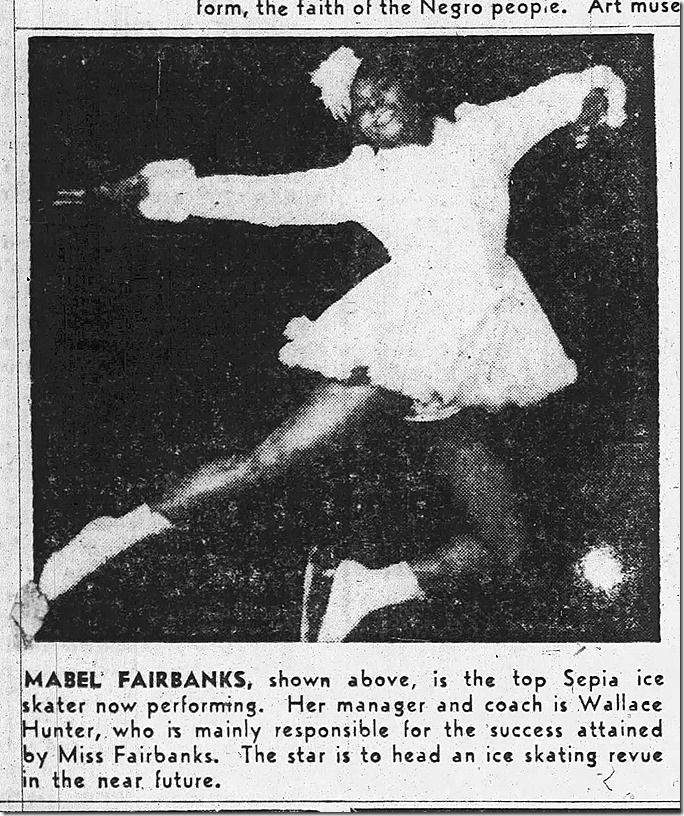
Mabel Fairbanks in the California Eagle, Nov. 8, 1945.
Note: This is an encore post from 2022.
Knockout African American ice skater Mabel Fairbanks wowed audiences from the 1940s through the 1960s. A true natural, she exuded joy and happiness twirling and gliding upon the ice. While extremely talented, Fairbanks was never able to develop her talents to the fullest because of prejudices of the period that prevented her from belonging to skating clubs, trying out for the United States Olympics team, or performing in major ice shows.
Fairbanks was born November 14, 1923, (per Social Security Records) in Jacksonville Florida, to a large family that struggled. By the age of eight, she was an orphan, losing her African American father and her Native American mother. Fairbanks endured racism and poverty in Florida before following an older sister to New York City in 1939 and taking a business course.
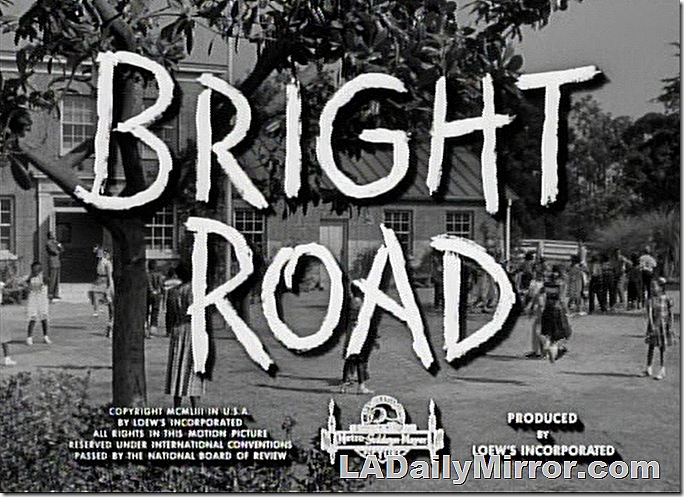
This week’s mystery movie was the 1953 MGM film Bright Road, with Dorothy Dandridge, Henry Belafonte and Philip Hepburn. Continue reading
Reminder: Boxie and I will be doing a live “Ask Me Anything” on George Hodel and Steve Hodel on Tuesday, February 18, at 10 a.m. Pacific time exclusively on YouTube. No more Instagram.
Can’t make the live session? Email me your questions and I’ll answer them! The video will be posted once the session ends so you can watch it later. Remember, this is ask me anything, so please remember to ask questions rather than make comments. Thanks!
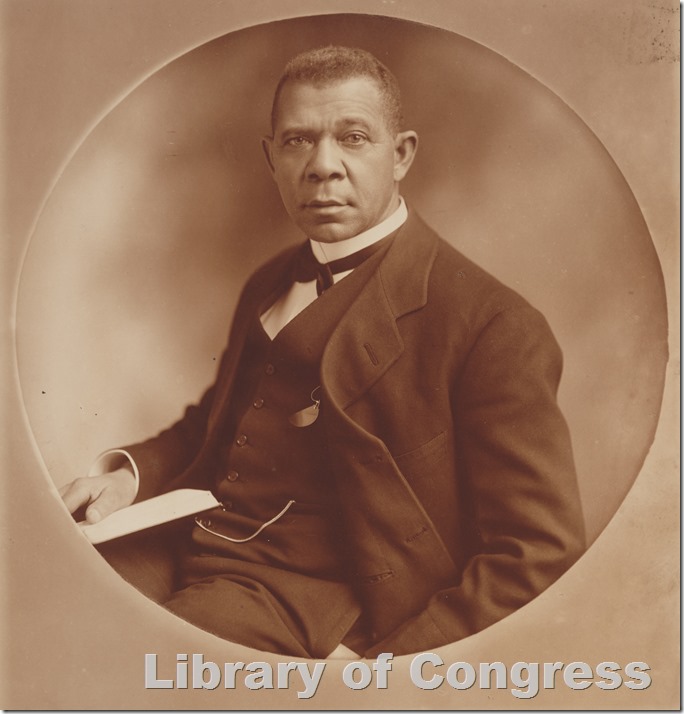
Booker T. Washington, photographed by Peter P. Jones, Chicago, about 1910, from the Library of Congress.
Note: This is an encore post from 2024.
During the early decades of the 1900s, few African Americans participated or worked for major moving picture studios in leading positions in front or behind the camera. In order to participate or function creatively, they were mostly forced to form their own companies. Long forgotten pioneer Peter Platenberg Jones, however was the first African American film stills photographer and studio executive at a major production studio. Respected by several major players in the film industry, he would be the only African American to serve as head of a department during the first two decades of the American film industry.
Census records provide a cloudy portrait of Jones’ early days. While records do show his parents as Louis Jones and Matilda Platenberg Jones and born in 1877, some records list his birth in Alabama, some in Michigan, and records variously list him as white, mulatto, and black. Virtually nothing exists to show his life pre-marriage 1901 to Alice Jenkins. The marriage record lists him as photographer, his profession and passion throughout his life. Continue reading
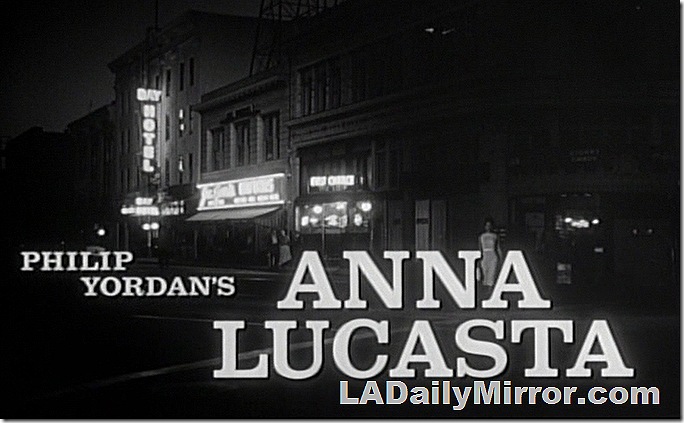
This week’s mystery movie was the 1958 film Anna Lucasta, with Eartha Kitt, Frederick O’Neal, Henry Scott, Rex Ingram, James Edwards, Isabelle Cooley, Rosetta Le Noire, Georgia Burke, Claire Leyba, Alvin Childress, John Proctor, Charles Swain, Isaac Jones, Eileen Harley and Sammy Davis Jr. Continue reading
In the February 2025 Ask Me Anything on the Black Dahlia case, I talk about my work in progress, Heaven Is HERE! and my current focus on the autopsy of Elizabeth Short. I also discussed William Mann’s forthcoming book on the Black Dahlia case.
WARNING: I am the “grumpiest man in the world” according to Last Podcast on the Left.
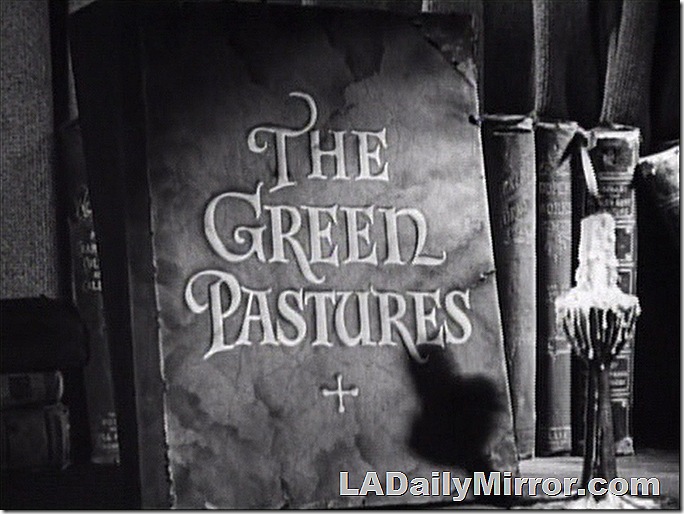
This week’s mystery movie was the 1936 Warner Bros. film The Green Pastures, A Fable by Marc Connelly.
With Rex Ingram, Oscar Polk, Eddie Anderson, Frank Wilson, George Reed, Abraham Gleaves, Myrtle Anderson, Al Stokes, Edna M. Harris, James Fuller, George Randol, Ida Forsyne, Ray Martin, Chas. Andrews, Dudley Dickerson, Jimmy Burress, William Cumby, George Reed, Ivory Williams, David Bethea, Ernest Whitman, Reginald Henderson, Slim Thompson and Clinton Rosamond. Continue reading
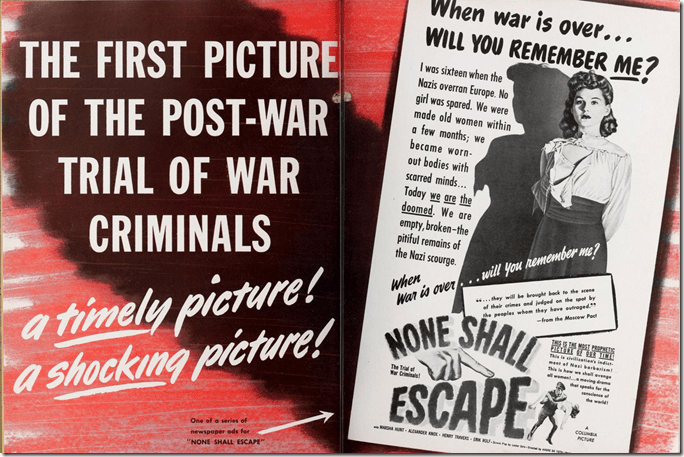
“None Shall Escape” in The Film Daily, 1944.
Note: This is an encore post from 2018.
On Friday, April 27, the TCM Classic Film Festival presents the rarely screened 1944 film “None Shall Escape,” a thoughtful film ahead of its time, as relevant today as when it was produced. The first film to depict the Holocaust as well as to examine post World War II and the punishment of Nazis for their war crimes, it features an appearance by its legendary star Marsha Hunt, who has fought for justice and honor for all for decades. Sadly, it depicts many of the same hateful attitudes once again on the rise.
In 1943, Columbia Studios hired German exile writer Alfred Neumann, author of historical novels and the 1928 silent “The Patriot,” as a scriptwriter. Neumann’s writings had been banned in Germany by the Nazis, forcing him to flee to America, where he arrived in 1941. Following the maxim of writing what you know, Neumann created a story detailing the Nazis mistreatment of those it overpowered, and their ultimate punishment for it, the first to predict American victory and the triumph of good over evil. Screenwriter Lester Cole, one of the Hollywood Nine blacklisted for his beliefs, adapted the story for the screen.
Mary Mallory’s latest book, “Living With Grace: Life Lessons from America’s Princess,” will be released June 1.

Note: This blog post was originally published in 2008.
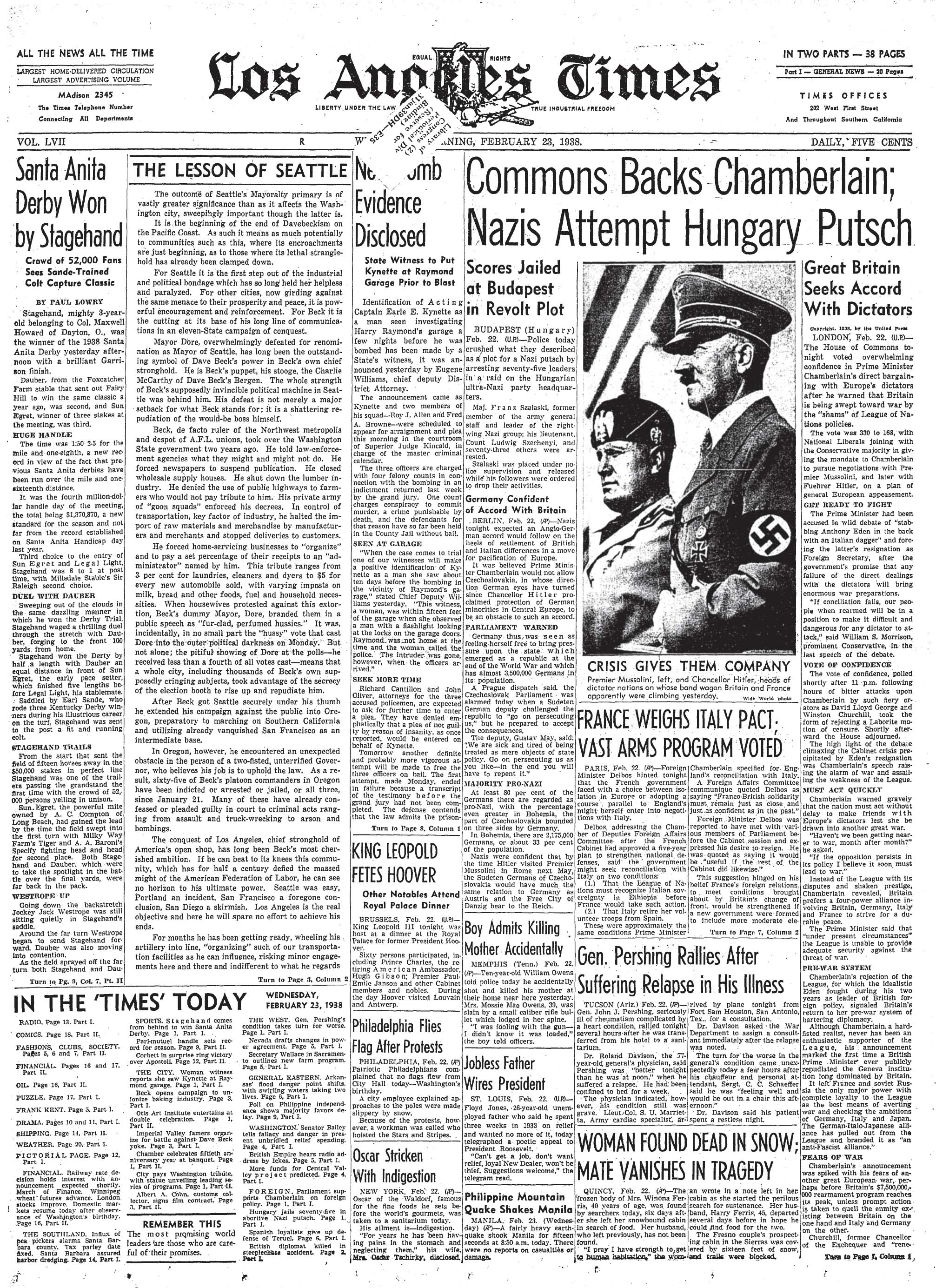
As noted elsewhere, I usually don’t republish editorials because they are often outdated and are frequently embarrassing. This one is an especially good example. The Times takes the position that the nation doesn’t need a federal anti-lynching law. Speaking of editorials, here’s a front-page diatribe against union leader Dave Beck … A witness says Capt. Earle Kynette was near Harry Raymond’s garage before the bombing that nearly killed him … Racing at Santa Anita … And Neville Chamberlain says that Britain must act without delay to “make friends” with Mussolini and Hitler lest it be drawn into another Great War. On the jump, San Quentin selects a pig to be the first victim of its new gas chamber, the new method of execution that will replace hanging.
Quote of the day: “The time is coming when Britain must make a stand and I pray to God that, because of our unwise past, we will not be left to make that stand alone.” Winston Churchill
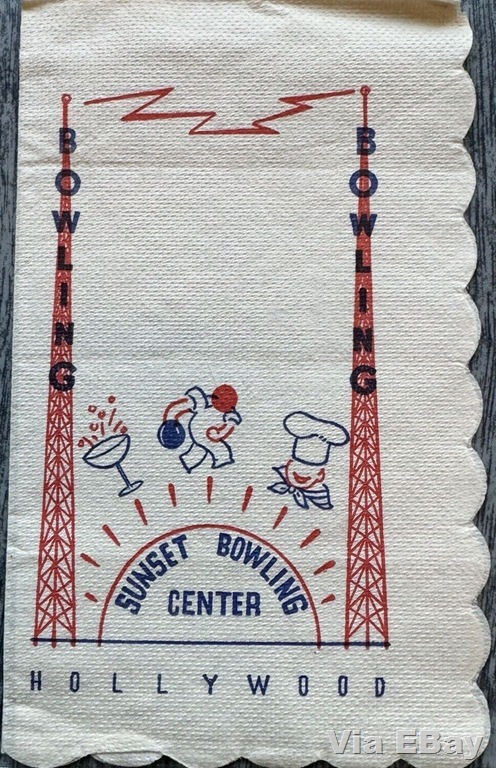
A napkin from Sunset Bowling Center, 5842 Sunset Blvd.
A collection of vintage Los Angeles (mostly) cocktail napkins has been listed on EBay, priced at $274.99 or best offer. Nightspots include many favorite watering holes of the past: Sardi’s, the Nickodell, Mike Lyman’s, and Clara Bow’s “IT” Cafe. All of them are excellent examples of graphic design from the 1940s-50s. As with anything on EBay, an item and vendor should be evaluated thoroughly before submitting a bid. Continue reading
Boxie and I will be doing a live “Ask Me Anything” on the Black Dahlia case Tuesday, February 4, at 10 a.m. Pacific time, on YouTube. I have discontinued my videos on Instagram. Continue reading
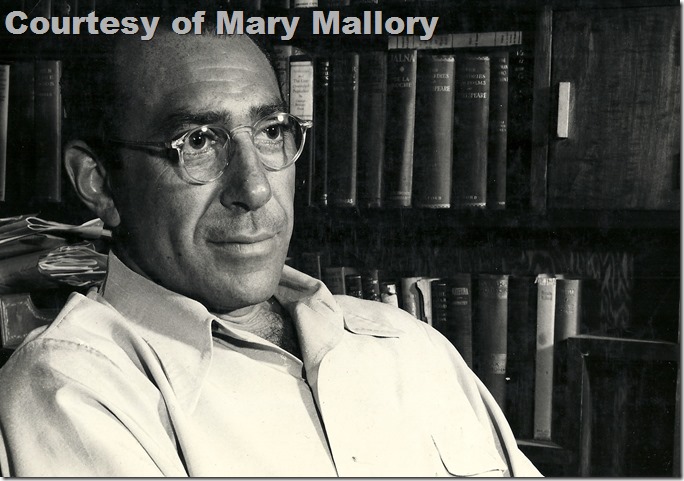
Herbert Biberman, one of the Hollywood 10, courtesy of Mary Mallory.
Note: This is an encore post from 2014.
In times of social uncertainty and economic malaise, those in fear often turn to discriminating, finger pointing, blame and stonewalling, claiming “the other” is destroying livelihoods, ways of life, and social beliefs just by speaking out. These “others” become the scapegoats for all that is wrong: drought, job insecurity, national security concerns, discrimination, etc.
After the conclusion of World War II, when the Allies defeated the Nazis, Japanese and Axis, thus bringing to an end annihilation, genocide, starvation and imprisonment to so many, everything seemed to turn for a short time to hope, peace, freedom, welcome and acceptance. Unfortunately, demagogues quickly saw the bogeyman again with the Soviets’ takeover of Eastern Europe, which the Allies had allowed in order for a quicker end to World War II. Anyone questioning the role of government, demanding free speech and asking for social justice, was suddenly judged a turncoat, evildoer, overthrower. Many in the United States government would soon ape the policies of totalitarian countries they claimed to abhor by scapegoating those deemed “different,” blocking free speech, destroying lives and careers.
Mary Mallory’s “Hollywoodland: Tales Lost and Found” is available for the Kindle.
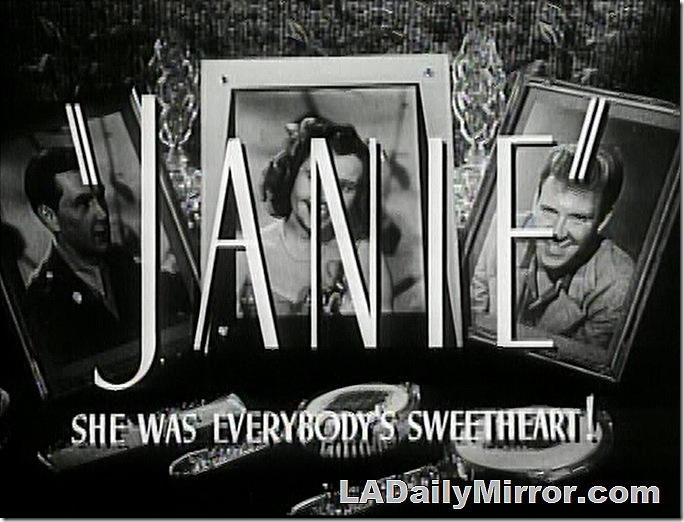
This week’s mystery movie was the 1944 Warner Bros. film Janie, with Robert Hutton, Edward Arnold, Ann Harding, Alan Hale, Robert Benchley, Clare Foley, Barbara Brown, Hattie McDaniel, Dick Erdman, Jackie Moran, Ann Gillis, Ruth Tobey, Virginia Patton, Colleen Townsend, William Frambes, and presenting Joyce Reynolds as Janie.
Here’s Boxie and I with this month’s “Ask Me Anything” on George Hodel.
In this session, I went over the basics of Steve Hodel’s claims about his father in deference to any new subscribers I may have picked up from Reddit.
I emphasized that everything people think they know about George Hodel comes from one source: Steve Hodel, either directly through Steve’s books and interviews or indirectly through articles about Steve’s claims — all them based on what Steve says.
I also talked about Steve Hodel’s “apology” to the family of Walter Bayley, noting that if Steve is going to go around making apologies, he can start with his own family and all the people he’s harmed with his bogus claims. And then apologize to the Short family.
I will be waiting for that one.
Continue reading
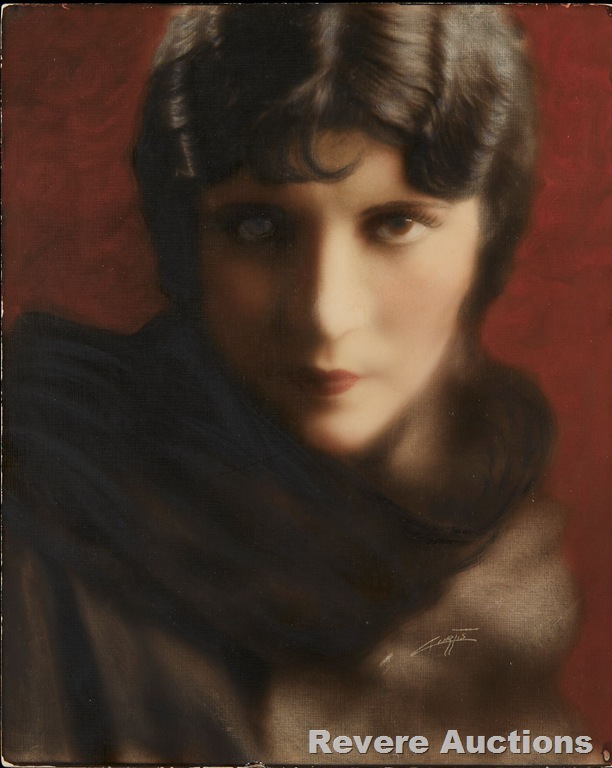
Olive Borden / Edward Curtis, hand-colored by Emma G. Hoffman, courtesy of Revere Auctions.
Early cinema captured the attention of filmgoers through its realistic depiction of everyday life, enhanced by gorgeously crafted images and heart tugging acting. It grew out of what was called real photo postcards, those providing a documentary look at a place and people, as well as stereoptican cards and lantern slides, which offered a more visceral means of storytelling. To enhance these static images, color was often applied, adding beauty and vivacity but also accentuating the important story element of the image. Mostly men served as photographers and cinematographers in these first decades, but forgotten women behind the scenes applied the hand coloring which dazzled audiences with its visual impact and beauty.
The detailed, meticulous work handcoloring postcards, lantern slides, and 35mm film frame by frame was accomplished by the exhausting work of women artists, who dominated this trade at the end of the nineteenth century. Just like with cutting film later, they headlined these fields due to what many called their attention to detail and their preciseness. As a trade story noted, “Lantern slide coloring should offer special opportunities to women, ‘for it requires a delicacy of handling and a keenness for artistic perception which are more easily met with in women than in man… .” As another story put it, “There is no limit of age for this work, but it is essential that a lantern slide colorist should possess good eyesight and steady, sensitive hands. Indeed, it is apparently work peculiarly suitable for women.’ Continue reading
This week’s mystery movie was the 1943 RKO film Forever and a Day with a cast so large that it’s beyond me to list everyone!
Today is Jan. 15, the anniversary of Elizabeth Short’s death. As is the custom, the Daily Mirror will be dark.
Trim your roses in her memory.
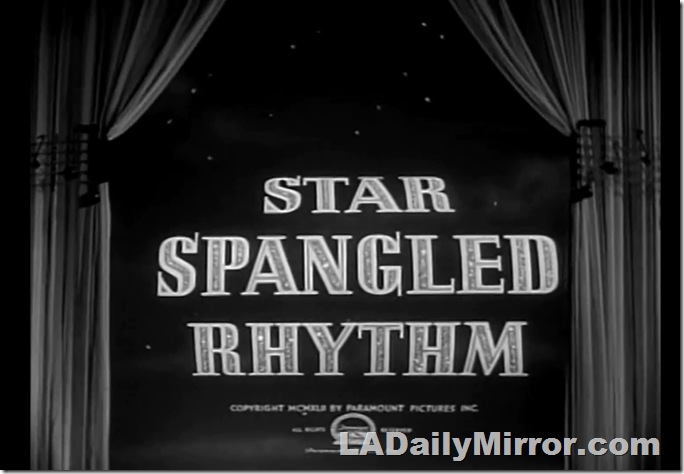
This week’s mystery movie was the 1942 Paramount film Star Spangled Rhythm, with Bing Crosby, Bob Hope, Fred MacMurray, Franchot Tone, Ray Milland, Victor Moore, Dorothy Lamour, Paulette Goddard, Vera Zorina, Mary Martin, Dick Powell, Betty Hutton, Eddie Bracken, Veronica Lake, Alan Ladd, Rochester, William Bendix, Jerry Colonna, MacDonald Carey, Walter Abel, Susan Hayward, Marjorie Reynolds, Betty Rhodes, Dona Drake, Lynne Overman, Gary Crosby, Johnnie Johnston, Gil Lamb, Cass Daley, Ernest Truex, Katherine Dunham, Arthur Treacher, Walter Catlett, Sterling Holloway, the Golden Gate Quartette, Walter Dare Wahl and Company, Cecil B. DeMille, Preston Sturges and Ralph Murphy. Continue reading
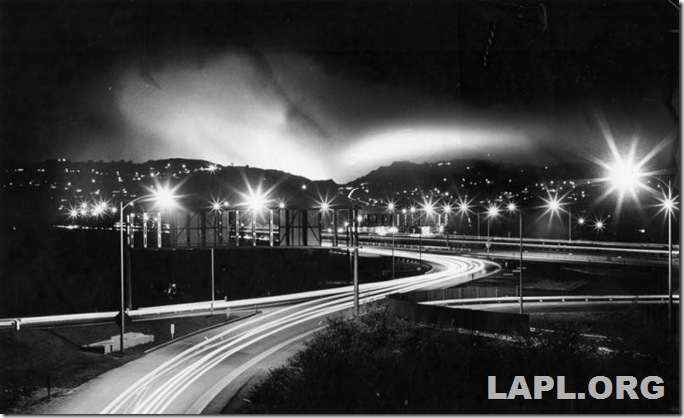
The 1961 Bel-Air fire in a time exposure. Photo by Alan Hyde/Valley Times Collection, courtesy of the Los Angeles Public Library.
Sadness and disbelief pervade Los Angeles looking over the tragic remains of the devastating Palisades and Eaton fires. People have been wondering, how could this happen? It already had, 64 years before in the cataclysmic 1961 Bel-Air fire, which burned more than 4,000 acres and over 450 homes, considered the most disastrous brush fire in Los Angeles history until this week’s blazes.
Dry chaparral, drought, overtaxed water pipes and supplies, narrow, winding canyon roads, rocky terrain, and high winds led to a massive fire that swept from Bel-Air to Mandeville Canyon over 35 hours, mirroring much of what has happened this week. A fire swept Topanga Canyon at the same time, threatening to push through canyons to Malibu and over canyon walls into the San Fernando Valley. Perhaps society should look and learn from its past to try and prevent disasters rather than pointing fingers at politicians and terminology. Continue reading
 ladailymirror.com