Police Commission to Select New Chief

Jan. 29, 1910, Police Chief 
 
Jan. 29, 1910: The Times reports on possible candidates to replace Police Chief Edward F. Dishman, who was removed without explanation by the Police Commission on Jan. 25, 1910. Dishman was succeeded by Police Chief Alexander Galloway. Galloway remained chief until Jan. 2, 1911,and died Aug. 25, 1915, at the age of 65.

Posted in City Hall, LAPD, Politics | Comments Off on Police Commission to Select New Chief

Matt Weinstock, Jan. 28, 1960

Jan. 28, 1960, Redwood

Leap Year Pitch

Matt Weinstock

    For a while it appeared we might tiptoe into 1960 without arousing the usual corny, anachronistic nonsense about leap year and the girls chasing the boys, object matrimony.  No such luck.  The subject was merely dormant.  Now it has busted loose all over, not merely among TV emcees and night club comedians specializing in double-entendre.

    A press release from Chicago traces the origin to Scotland where in 1288 it was decreed that ladies "of bothe highe and lowe estait" could propose during leap years.  If a man refused he was fined, unless he could prove that another woman had a prior claim on his affections.  The purpose was to put money in the treasury and take spinsters off the welfare rolls.

    And where do we learn all this?  In an encyclopedia the press release is plugging.  Yes, even leap year is only an excuse to sell something.

::

image     AS ALWAYS DURING EPIDEMICS, the City Health Department has received dozens of calls and letters with  suggestions for halting the flu.

    One man stated he never got the flu, although everyone around him did, because he was very careful about keeping flies off his person.  This he accomplished by chewing raw garlic.

    Another man was surprised the health people had never heard of his preventative — putting a slice of raw onion in each shoe every day.

::

    ONLY IN L.A. — After searching vainly through the stationery stock in a notions store, David K. Williams asked the clerk if she had any graph paper.  She assured him it was on the counter he'd just inspected.  He said all the paper there had lines running only one way.  "Well, on our graph paper," she said proudly, "the lines only run one way!"

::

Jan. 28, 1960, Honor Student     SMILE, MAN
He's only a clothier's
    dummy,
A part of the window trim,
With a  wooden sneer to
    remind me
My suit looked good on him.
        –SHELDON WHITE

::


    "PEOPLE DON'T
  have fun anymore," a man I know deplored the other day.  Exception, please.  Publicist Paul Snell, with a log record of practical jokery.  He used to order 20 bales of hay delivered anonymously to friends' homes and things like that.

    His most recent effort had to do with his wife's yearning to raise baby chicks.  He got over 20 of them and arranged with the poultry dealer to exchange them weekly with day-old chicks without her knowledge.  She couldn't understand for months how they could keep eating and not grow.

::

    YESTERDAY I received a cigarette lighter (Made in Japan) with an ad for a Las Vegas gambling joint all over it.  An accompanying business card from publicist Hank Kovell has imprinted on it the horrid word "Payola," indicating a new era of truth and honesty may have arrived.  But thank goodness I remain pure.  The lighter doesn't work.

::

    AHEM DEPT. — The public address system at the Sports Arena has outlets in all sorts of nooks and crannies so no one will miss  a thing.  Which will explain the case of the nervous woman who rushed out of the powder room during a recent event.  She heard a man's voice and thought she was in the wrong place.

::


    AT RANDOM —
A Santa Monica lady named Margie, who lets her parakeet Tweet (its one word vocabulary) fly around the room, reports it crawls under the covers with her these cold nights . . . Another TV cliche rapidly rising to the top 40:  "I didn't say that!" . . . Among the most frustrated persons in town is a newsman recovering from a  bad cold.  He went to the Smell-O- Vision movie, "Scent of Mystery," the other night and didn't smell a thing . . . Comedian Ray Hastings took a group of youngsters to the mountain last week end and as they neared the summit one boy said, "Hey, if we go much higher we're going to run out of sky" . . . A lady named Sylvia reports that a Lido Isle dress shop which for a long time has advertised a "Slight Sale" now announces a "Beeg Sale."

Jan. 28, 1960, Abby 
Posted in Columnists, Downtown, Food and Drink, Homicide, Matt Weinstock, Nightclubs | Comments Off on Matt Weinstock, Jan. 28, 1960

Paul V. Coates – Confidential File, Jan. 28, 1960

Jan. 28, 1960, Mirror

Petite Con Lady Now Flipping Owl Feathers

Paul Coates    She's 70, at least.  She likes wide-brimmed owl-feather hats, bright chiffon scarves and Oriental necklaces.

    She always wears these to compliment her outlandish 1920 outfits when she goes to pull a  job.

    Her trade — or maybe it's just her hobby — is conning people out of their money.

    When I first heard of her, she worked her gimmick by answering classified ads.  She's pick out the "class" ads, those seeking investors with $20,000 or $30,000 in hard, ready cash.

    She'd answer the ads representing herself as a rich widow and set up a luncheon date "to talk things over."

    Always, the individual who placed the ad would try to impress her by dining her in the best restaurants.  Always, she'd select the most expensive entree.  Always, the advertiser would pick up the tab.

Jan. 28, 1960, Parker     After a luncheon engagement or two, she had a habit of vanishing.

    In the old days, that was the extent of her little game.  Her profit was a full stomach.

    But, long about 1957, she began expanding and polishing her performances.  She'd approach architects with plans to build expensive desert winter retreats.  She'd visit exclusive antique shops and take a fancy to a 17th century bed with a $1,000 price tag on it.  She'd drop in on the town's top interior decorators with promises of placing major orders.

    She never spent less than two hours in any of the establishments.  She talked.  She loved to talk.  Ballet.  Theater.  The arts.   She told of her pleasure trips through Central and South America, of her expansive residences in Santa Barbara and the desert.

    The rub — the con — came every time, just as she was leaving, after she had promised to consummate the "deal" tomorrow.

    Her standard tactic was to pick up her purse, open it, and scream:

    "My money!"

    Then, trembling with embarrassment, she'd explain that her brother (who was here on a  business trip from the East) had dropped her off in town and she was to meet him for dinner in Newport Beach.  She'd planned to take a cab there but she'd left her money in her other purse.  Or, sometimes she'd say that she lost it.

    In the past year or two, I've talked to at least a dozen people who have been approached by her with the same story.

    Each gave her anywhere from $5 to $10 so she could catch a bus.  They never heard from her again, of course.

    Not one of them complained about it, though.  Her little scheme was so elaborate, and her take was so small.  All of her pigeons were successful businessmen.  They regarded her with a combined fascination and pity.

    She was kind of a latter-day, aged, female version of Robin Hood.  Taking from them, the rich, and giving to herself, the poor.

    They always marveled at her technique.  Her "culture."  And so did I, until two months ago, when I was called by a Hollywood interior decorator, who reported that she was losing her touch.

    "She took me once with her story about six years ago," he said.  "This week, she came again with the same pitch and didn't even remember me.

    "Hardly very professional of her," he added critically.

    Then yesterday, I was talking with Bill Dodge, a local press agent.

    "I've got this new account on the hook," he told me.  "A little old lady in an owl-feather hat who's opening an exclusive gift shop in Palm Springs.  Nothing but expensive imports.  She wants to pay me a fantastic fee."

This Will Learn Him

    Bill went on to describe how the elderly prospective client just happened to drop into his Hollywood office, how she'd been all over South America and how she owned homes in Santa Barbara and Palm Desert.

Jan. 28, 1960, Rat Pack

    "The poor woman," he said.  "When she left, she discovered she'd lost the wallet out of her purse.  Her — with all that wealth — and I had to lend her $3 to catch a bus to Newport Beach."

    After being her fan for years, suddenly I'm disillusioned.  Let her con wealthy architects and antique dealers and interior decorators.

    But when she starts mulcting poor, struggling, underpaid press agents, I draw the line.
   

Posted in Columnists, Front Pages, LAPD, Paul Coates | 1 Comment

A Kinder, Simpler Time Dept.: Your Movie Columnist

 Jan. 28, 1939, Hedda Hopper 
image 

Jan. 28, 1939: Hedda Hopper writes a few lines about “You Can’t Cheat an Honest Man.” She says the picture is right on schedule. Of Clark Gable and Carole Lombard, Hopper says: “No one can say Carole busted up Clark's marriage, which was over long before he ever got to know her.”

Posted in Columnists, Film, Hollywood | Comments Off on A Kinder, Simpler Time Dept.: Your Movie Columnist

President Visits L.A.!

Jan. 28, 1960, Dick Tracy
“It’s a Letter From Washington.”

Jan. 28, 1960, Cover

Jan. 28, 1960: ALGIERS (UPI) “Police and troops opened fire today on hundreds of Moslems who surged into the streets of the western Algerian city of Mostaganem shouting 'long live De Gaulle.'

“The shooting was reported as insurgent European 'colons' — unmolested by the French army or police — exuded growing confidence in their defiant stand behind the Algiers barricades.

“French army headquarters in Oran issued a communique confirming that shots had been fired during the demonstration and listing 20 injured. It said none of the injuries came from gunfire. It said the demonstration started because local Moslems were afraid they would lose their jobs, with the market place closing down.

“It was the first time the Moslem population had entered the picture in force in Algeria since European settlers rose in bloody revolt in Algiers Sunday against De Gaulle's policy of self-determination for the Algerians.”

Jan. 28, 1960, Eisenhower

President Eisenhower arrives for a fundraising dinner at the Pan-Pacific Auditorium that was carried on closed-circuit TV at fundraisers across the country.

Jan. 28, 1960, Eisenhower 

Jan. 28, 1960, Nixon 

Vice President Richard Nixon opens his presidential campaign – but the Page 1 portion of the story wasn’t microfilmed, so all we have is the runover. Citing education as one of his priorities, Nixon says "the American system is the best in the world, 'but inadequate classrooms, underpaid teachers and flabby standards are weaknesses we must constantly strive to eliminate.’ "

Jan. 28, 1960, Holmes Alexander

Here’s something you don’t see terribly often: A column that has good things to say about John F. Kennedy and Sen. Joe McCarthy.

Jan. 28, 1960, Horoscope

Jan. 28, 1960: The interesting child born today is the type who feels that the best way of attaining anything is to make a big noise and fuss, plus using physical force, if necessary.

Jan. 28, 1960, Sports

Pete Rozelle’s secret desire: to be The Times’ sports editor.

Jan. 28, 1960: All quiet in the Finch case. Stay tuned, it’s a long, long trial.

Posted in Comics, Front Pages, JFK, Politics, Richard Nixon, Sports | 1 Comment

Borax King Testifies

Jan. 28, 1920, Thorkildsen 

Jan. 28, 1920: Borax king Thomas Thorkildsen changes color and acts as though he’s going to get off the witness stand and threaten his wife’s attorney during testimony in their divorce case.

Posted in #courts | Comments Off on Borax King Testifies

School for Shoplifters

 
 Jan. 28, 1920, Briggs
“When a Feller Needs a Friend,” by Clare Briggs.

Jan. 28, 1920, Shoplifters
 

Jan. 28, 1920: George Sutton is charged with teaching his wife and daughters how to shoplift. According to The Times, Sutton’s wife, Elsie, and daughters Dessie and Doretta would enter a department store and distract the clerk at the silk counter while Sutton stole whatever he could grab at the other end of the counter.

Posted in #courts, Comics, LAPD | Comments Off on School for Shoplifters

Sham, Shame and Sorrow

Jan. 28, 1910, Cover 
Ja. 28, 1910, Quadruplets 


Jan. 28, 1910: In an emotionally charged story, The Times tells of Mrs. Wilson, a woman unable to have children who collected four unwanted infants and passed them off as her own. In the courtroom where Judge Wilbur was trying to untangle the case, Hilda Linquist, 25, who said she was engaged, reclaimed her baby and named her Agnes.

Posted in #courts | Comments Off on Sham, Shame and Sorrow

Matt Weinstock, Jan. 27, 1960

image
Jan. 27, 1960, Peanuts

Costly Wrong Number


Matt Weinstock     Mrs. Margaret Guevara, 742 W 144th St., was going about her household chores the other day when her daughter Diana, 9, called, "Mommy,  a lady on the phone wants to talk to you."

    The lady on the line said, "My phone rang and your little boy just kept saying 'Hi' so I asked to speak to someone else.  I knew it was a toll call and I thought you'd want to know about it."
 
    "Where are you?" Mrs. Guevara asked.  "In Torrance or Long Beach?"
 
    "No, I live over here in the Bronx," was the reply, "Where are you?"
  
     "I'm over here in Gardena," Mrs. Guevara said.
 
    "Gardena, where's that?"
 
    "In California.  Where's the Bronx?"
 
    "You know, the Bronx — New York."
 
    TO GET TO the point, Charles Guevara, 2 years 8 months old, had playfully picked up the phone and dialed directly a sequence of numbers with a Fairbanks exchange that gave him the Bronx lady.
 
 Jan. 27, 160, Plane    The phone company hasn't yet tabulated the call but inasmuch as Charles probably said 'Hi' for five minutes before his mother caught up with him, Mrs. Guevara fears it will probably come to $15 to $25.  She is getting a lock for the phone.
 
::
 
Jan. 27, 1960, LAPD Bias     ONLY IN L.A. — Bill Boeckman addressed a letter to Nuestra Senora La Reina de Los Angeles de Porciuncula — el peublo's original name — but it was returned with the notice "No such city."
 
::
 
    GET LOST!
It takes diabolical genius,
Shrewd minds almost sharp
    as ice cream,
To design small, illegible
    street signs,
And post them where no
    one can see 'm.
        –ED LYTLE
 
::
 
    RADIO RIPOSTES — A KMPC newscaster giving a business review quoted a National Airlines official as saying, "Despite recent accidents, traffic between New York and Miami is booming."  Made Don Welty wince . . . Pat McGuirk of CBS asks friends, "Did you hear about the fellow who bought an overcoat in Hong Kong.  Two hours later he was cold."  They don't get it.  It's a switch on an oldie, "The only trouble with eating Chinese food is that two hours later you're hungry again!" . . . Disc jockey Bob Gage of KBIG, Catalina, received a fan letter stating, "You're good enough to be promoted to Hollywood.  And the walk would do you good."
 
::
 
    A NICE MAN named Joe Glaston, who hangs out in Palm Springs but pretends to issue hot bulletins from the Mt. Kenya Safari Club in what used to be darkest Africa — he works for Ray Ryan and William Holden, who own it — thus describes an evening at the club: "The atmosphere is electric with excitement . . . Slowly the fascinating wildlife ambles to the fringes of the club's beautifully landscaped grounds . . . Suddenly one is transported from the atomic age back to ancient times.  It's the haunting, irresistible call of the East African wild. Elephants and excitement.  Lions and liqueurs.  Cheetahs and coffee.  Rhinos and rumors.  Hippos and happiness.  Monkeys and memories."
 
    And man and typewriter.
 
::
 
    I'VE BEEN refuted, which incidentally is not hard to do.  Two gals stormed into the office and announced soberly that the liquor chain letter, scoffed at here, was on the up and up.  They'd received copies and done what the letter instructed — phone the person at the top of the list, given him a fifth of whisky, and put their names and phone numbers at the bottom.  Result:  One received 16 bottles, the other 13.
 
    I don't understand it but there it is.  Wonder if it would work with egg foo yong.
 
::
 
    AT RANDOM — Someone is circulating tiny printed tabs stating, "Protest Bus Fair Raise.  Pay Fair in Pennies."  That, unfortunately, merely makes it tough on the busy drivers . . . You know the TV commercial that inquires if you are "smoking more and enjoying it less?"  Ray Southworth knows an absentminded fellow who, instead of changing brands, switched to smoking less and enjoying it more.
    Jan. 27, 1960, Yale
 
Posted in #courts, Columnists, Comics, LAPD, Matt Weinstock | Comments Off on Matt Weinstock, Jan. 27, 1960

Paul V. Coates – Confidential File, Jan. 27, 1960

 Jan. 27, 1960, Mirror Cover

Case of Go for Broke, Caryl Chessman Says 

Paul Coates    Caryl Chessman's legal fight to beat the gas chamber resumes tomorrow.
 
    The 38-year-old senior statesman of San Quentin's Death Row (he's been there 11 1/2 years) returns to the courts for another hearing in an effort to beat his Feb. 19 appointment with the cyanide pills.
 
    But the courtroom battle could be just a prelude to a split in purpose that's building between the author-convict and some of the groups which have been supporting him in his fight-for-life.
 
    The majority of those who took up Chessman's cause here in the United States did so because (1) they felt he wasn't given a fair opportunity to appeal his trial conviction, and (2) the kidnapping offenses for which he was sentenced to die weren't "kidnapping" in the intended legal sense of the word.  The prosecution, they felt, took advantage of a technical interpretation of the law.
 
    Many others joined the battle because they felt that nearly 12 years on Death Row was punishment enough for his crimes.
 
    Their goal, first, has been to get Chessman out of Death Row, and second, to get a new trial for him.
 
Jan. 27, 1960, Barrymore     But now, politely, he's brushing them off.
 
    Through Atty. Rosalie Asher, he has told the Friends' Committee on Legislation — the Quaker group which has been circulating clemency petitions requesting Gov. Brown and President Eisenhower to spare his life — that he wants nothing to do with their campaign.
 
    Presumably, they'd be willing, for the present, at least, to accept life imprisonment without possibility of parole as reasonable mercy.
 
    This, Chessman doesn't want.
 
    Yesterday my assistant returned from a three-hour visit with the convicted Red Light Bandit in San Quentin.
 
    "When I leave Death Row," Chessman told him, "I either want to go free or go straight to the gas chamber.
 
    "I have no intention of going back out into the prison courtyard and fighting my case from there," he added.
 
    My assistant asked him about the Friend's Committee and their clemency petitions.
 
    "I appreciate their motives — what they've done," he answered, "but I don't want anything to do with any clemency moves.  The way I feel now, I've had it.  I want a new trial.  Or I want to walk to the gas chamber."
 
    A new trial, he maintained, would be the answer to all of his problems.  Chessman has claimed from the day he was arrested that he was innocent of all charges against him.
 
    Caught in the middle of the clash is Atty. Asher, who passed his message along to the Friends.  One of the leaders in the campaign to save his life feels that she's the force behind his decision to sever connections with the clemency campaign.
 
    This, Chessman denied to my assistant.
 
    "The decision is my own," he insisted.  "I feel it would be inconsistent for an innocent man to ask for mercy."
 
    Chessman's current attitude could also cause problems for him with his legions of international followers.
 
    Clemency movements have been organized by private citizens — some with strong support of newspapers — in France, England, Denmark, Switzerland, Norway, New Zealand, Canada, Uruguay, Brazil, Portugal, Ceylon and Italy.
 
    A Brazilian industrialist, who was instrumental in obtaining 2,600,000 signatures on petitions for Chessman, was recently turned down by the convicted kidnap-rapist when he volunteered to instigate a Brazilian boycott of U.S. goods in protest.
 
He Studies Fingernails
 
    "If you do win your freedom," my assistant asked Chessman, "what do you plan to do?"
 
    The Death Row inmate studied his finely manicured nails for a moment.
 
    "I've got an offer to go to Brazil," he said.  "I might go there.  Or I might go to one of the Scandinavian countries.  I want to continue writing.
 
    "Understand me," he added.  "I'd prefer to remain in the United States, but I'm afraid that life would be made too difficult for me here."  
 
Jan. 27, 1960, Abby
   

Posted in Caryl Chessman, Columnists, Film, Hollywood, Paul Coates | Comments Off on Paul V. Coates – Confidential File, Jan. 27, 1960

A Kinder, Simpler Time Dept.: Your Movie Columnist

Jan. 27, 1965, Hedda Hopper 

Jan. 27, 1965: Rex Harrison will star in a musical version of “Goodbye, Mr. Chips,” Hedda Hopper says. The movie was finally made with Peter O’Toole. 

Posted in Columnists, Film, Hollywood | Comments Off on A Kinder, Simpler Time Dept.: Your Movie Columnist

Joseph Wambaugh on the ‘Onion Field’ [Updated]


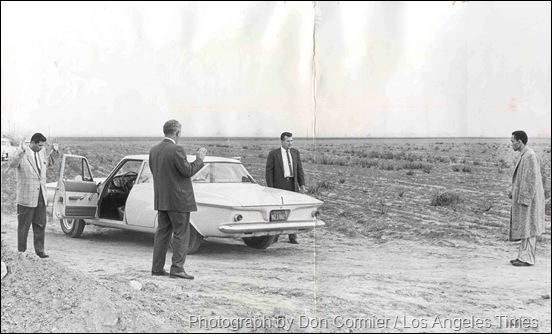
Photograph by Don Cormier / Los Angeles Times

March 11, 1963: Jimmy Lee Smith returns to the crime scene to reenact the “Onion Field” killing. From left, Sgt. Danny Galindo as Officer Karl Hettinger;  Sgt. G.H. Bates as Officer Ian Campbell;  Sgt. Pierce Brooks  as Gregory Powell and Smith.

Retired Police Lt. Max Hurlbut’s recent post on the “Onion Field” incident brought this response from Joseph Wambaugh:

What I basically said in my posting (sorry, but I don’t know how to  handle computers and probably screwed up) is that I was perplexed by Max Hurlbut’s opening line about “the rest of the story…not known to Joe Wambaugh.”  Then he refers to the disarming and kidnap of Inglewood officers who survived their ordeal unharmed.Well, not only was it known to me but I mentioned it and other similar incidents in The Onion Field book.  My point was that the disarming and even brief kidnapping of local cops had happened several times and no officer had ever been harmed prior to the onion field killing.  That time when it went terribly wrong, the blame placed on Hettinger by  second guessing LAPD brass, who were not out there on that Hollywood street, was not only  wrongheaded, it was unforgivably ignorant and incredibly cruel.

I’m sure that Max Hurlbut would agree that the overwhelming guilt inflicted on Karl Hettinger by the LAPD nearly drove him to suicide and probably led to his untimely death from cirrhosis.

The weird part of Max’s narrative had to do with the racial business involving black suspects, crime statistics, etc. The race of the suspects had nothing whatever to do with the reason that Powell and Hettinger [Update: Smith] were stopped.

Max describes Powell as being of mixed race and Smith as black.  Well, I can assure you that Jimmy Smith was the one of mixed race: white father, black mother.  And in fact, when Hettinger was rescued he described Smith as being “possibly Mexican American.”  Look at  Smith’s  photo and you will see why Hettinger was uncertain.

As to Gregory Powell, I not only interviewed him but I met and spoke with his mother, father and brother.  I can assure your readers that he is as white as Conan O’Brien or even Max Hurlbut.  There is no race card to be played here.

Joe Wambaugh

Posted in books, Film, Hollywood, Homicide, LAPD | 2 Comments

Nixon Leads Stevenson, Kennedy in Poll

Jan. 27, 1960, Finch Trial

Jan. 27, 1960: A letter by the Finch family’s maid to her mother in Sweden recounts a conversation with victim Barbara Jean Finch:  “During the night, Dr. Finch tried to kill Mrs. Finch, who now absolutely wanted to have her divorce. Mrs. Finch told me everything in the morning.”

Jan. 27, 1960, Finch Trial

Jan. 27, 1960, Finch Trial
Jan. 27, 1960, Finch Trial 

Jan. 27, 1960, Parker

Describing Police Chief William H. Parker’s statement before the Federal Commission on Civil Rights, The Times says: "The chief remarked that Los Angeles is flooded with persons from all over the country, many of them with little or no resources when they arrive, 'many of them deliberately shipped here by officials of other localities who want to get rid of them.' "

Jan. 27, 1960, Nixon Poll

Jan. 27, 1960: Vice President Richard Nixon leads Adlai Stevenson 55%-45% in the latest Gallup poll. The results are a bit closer between Nixon and Sen. John F. Kennedy (D-Mass.), 53%-47%. The poll also finds that Stevenson does better than Kennedy against Nixon in the South

Posted in #courts, Countdown to Watts, Homicide, JFK, LAPD, Politics, Richard Nixon | Comments Off on Nixon Leads Stevenson, Kennedy in Poll

Nuestro Pueblo, Plummer Park

 Sept. 23, 1938, Nuestro Pueblo

View Larger Map 


Sept. 23, 1938: Joe Seewerker and Charles Owens visit Plummer Park in Hollywood. The original run of Nuestro Pueblo ended in 1939, so I’m going back and picking up the ones I missed last year.

Posted in art and artists, Hollywood, Nuestro Pueblo, Parks and Recreation | 1 Comment

‘Borax King’ to Testify in Hot Divorce Trial

Jan. 27, 1920, RCA Dog

“I Know I Shall Go Mad Very Soon.”

Jan. 27, 1920, Briggs

“Wonder What a German Dog Thinks About?” by Clare Briggs.

Jan. 27, 1920, Borax King

Jan. 27, 1920: "Considerable time was taken up yesterday reading the deposition of Miss Henrietta Gant, one of the merry party last June in the home of Walter D. Willitt, 200 Pearson St., Chicago, where Mr. Thorkildsen, it is charged, made violent and open love to Mrs. Smith and occupied a 'twin bed' with her."

Posted in #courts, Comics | Comments Off on ‘Borax King’ to Testify in Hot Divorce Trial

Through the Lens: Aviation Meet

1910 Aviation Meet
Los Angeles Times file photo
January 1910: A crowd of people watches an airplane (marked by the black arrow) from the roof of the Virginia Hotel in Long Beach.

Posted in Photography, Transportation | Comments Off on Through the Lens: Aviation Meet

Matt Weinstock, Jan. 26, 1960


Patient's Prescription


Matt Weinstock     A doctor who has been overworked treating flu patients came down himself the other day with the old virus.  He was home in bed, sniffing and coughing, when a woman patient phoned through his exchange and asked for him.
 
    "I'm sorry," the doctor's wife said, "he's ill, he's resting now."

    "That's too bad," the caller said, "I hope it's nothing serious."
 
    "I guess it's the same virus everyone else has," the wife said.
 
    "Are you taking care of him?"
 
    "Yes."
 
    "Well, uh," the caller said hesitantly, "I wouldn't give him any of the medicine he prescribed for me — it didn't help!"
 
 image     These are the conditions which prevail — the patients are now prescribing for the doctors.
 
::
 
    A UCLA professor was invited recently by the Board of Education to lecture on an institute program, for which he would receive $35.  He learned, however he would be required, as a paid participant on the program, to sign a loyalty oath.  He declined, on principle.  He had already signed such an oath.
 
    But he remains astonished by a statement in a letter he received from the board.  Not signing the oath, the letter stated, did  not preclude his "participation in the Institute as an unpaid service."  In other words, the Board of Education would accept potentially disloyal speakers provided they gave their services free — only paid participants must sign the loyalty oath.
 
::
 
    LIKE INDELIBLE
No ribbons, please, for my
    memory book,
My requirements there are
    much baser.
I don't need a pencil to add
    to the tale.
What I need, I admit's, an
    eraser.
    –VIRGINIA DONOHUE
 
::
 
    THE WAY Charley Wathey heard it in the Hall of Records, a clergyman was advised by his physician to take up golf to compensate for his heavy work schedule.  The clergyman was reluctant but after considerable urging he agreed to try.
 
    To his surprise he found he was a fine golfer.  Furthermore he kept improving, finally reaching the point that he knew he was likely to break par the next time out.  In his excitement he was seized with a compulsion to play the following Sunday.  To do this he called on a substitute to take over his congregation that day.
 
    On his fateful round he was even par as he came to the 18th tee.  As he prepared to drive, St. Peter and an angel appeared on the 18th green.
 
    "He must be punished," the angel said.  St. Peter nodded.  Just then the clergyman let go with a  beautiful drive.  The ball hit the green and dribbled into the cup for a hole in one and a score under par.
 
    "Now he'll never be punished," the angel moaned.
 
    "He is punished," St. Peter said.  "He'll never be able to talk about it."
 
::
 
    A PRO AND CON appraisal of Police Chief Parker by Al Stump in the Feb. Coronet has this paragraph:  "Parker sees Los Angeles as a sleeping pushover for a vast criminal army.  'The Mafia has moved here in a big way,' he says.  'Right now I need a 110% increase in personnel to meet the mob menace.  A Chicago of the '20s is developing in Los Angeles, yet my enemies — many in high place — block me.  I'm convinced that a widespread plot exists to destroy police authority in the name of 'liberalism' and break down the wall that protects society from the hoodlum.'"
 
    Ho hum.
 
::
 
    AT RANDOM — Oops, the tiny handsome wooden donkey and elephant emblems gotten out by Zoo-Line on N La Brea have imprinted on the matchbox size containers, "Made in Japan"  . . . A publicity man for  a TV personality — let's call him Jack — refers to himself as "Jack's other head."  Off the top of which, presumably, he does his thinking . . . Jack Kelly speared a virulent cliche in Sunday's "Maverick."  The sheriff, urging him to remain in town after he'd killed or captured the villains, said, "We could use some new blood around here." Jack retorted, "I'm not bleeding."
Posted in Columnists, Countdown to Watts, LAPD, Matt Weinstock | Comments Off on Matt Weinstock, Jan. 26, 1960

Paul V. Coates – Confidential File, Jan. 26, 1960

Jan. 26, 1960, Mirror

Diana Barrymore was in love with Tennessee Williams and wanted to marry him, the Mirror's Earl Wilson says. 

Jn. 26, 1960, Diana Barrymore

We Quiz Quiz Guy Who Blew $64,000

 
Paul Coates    Al Einfrank isn't exciting news copy.  Not any more.

    Three years ago, he was.
 
    Then — according to Nielsen, a man who counts people who sit in front of television sets — the $83-a-week Los Angeles truck driver was a national idol.
 
    People loved Al Einfrank. At 57, he was a pleasantly homely little man with the gravel voice of a train conductor, a vocabulary which ranged from "ain't" to multi-syllable words which would choke professors, and a vast knowledge of world geography.
 
    The quiz show craze was raging, and the stubby ex-seaman was swept fondly into its madness.  And Al Einfrank, the common man's common man, loved every minute of it.
 
Jan. 26, 1960, Finch Trial     In five weeks on "The $64,000 Question," he cleaned up $32,000.  On the sixth week, he gambled it all and lost.  His consolation prize was a Cadillac, which he sold for $6,000, pocketing half of it and investing the other in an automobile which wouldn't look out of place in his neighborhood.
 
    Net cash profit:  $3,000.  But the people loved Al, so six months later he was invited to reappear on "The $64,000 Challenge."  This time he went three weeks, built his bankroll to $16,000, and retired.
 
    On a  second appearance on the Challenge he was at $8,000 going for $16,000 and he missed.  Consolation money was $1,000.
 
    Totaled up, the quiz show craze was good to Al to the tune of roughly $16,000.
 
    I first met Al when he took the $16,000 gamble and lost — and reportedly, in the process, almost lost his happy home of 33 years.  ("The wife's a little upset," he said.  "She wanted me to stop at $32,000.")
 
    Our next contact came — not surprisingly — when the quiz scandals broke.  I called him to find out if he'd been "fixed."
 
    His answer was no.  It was a "no" supported by the circumstantial fact that he lost the big question.
 
    After that, I talked with Einfrank a few times.  He was the kind of man whom it's a pleasure to keep in touch with.
 
    He'd tell me the news- that he was back at Douglas' El Segundo plant as a dispatcher, that his relatives were still bugging him about not taking the $32,000 and quitting, but that his wife had forgiven him.
 
    Yesterday, Al dropped by the office again. 
 
     He wore his patent smile and in the course of the conversation mentioned that he'd been laid off at work.
 
    "Seven years I been there," he said.  "Things are really slow."
 
    I asked him if he was hurting.
 
    "No," he laughed.  "Don't be silly.  I got unemployment and my Navy pension."
 
    Jan. 26, 1960, Abby

The $16,000 was long gone, he admitted.  "What we did," he said, "we lived $5,000 above our income for three years.  Vacationed in Honolulu.  Things like that.

 
    "The future doesn't bother me," he said.  "It's just the idleness.  It's been almost a month.  I been looking every day — truck driver jobs, warehouseman, dispatcher, guard.  Physically, I'm in great shape.
 
    "But," he added, "I'm 59."
 
    I asked Al, "If you  had that $16,000 cash again, what would you do with it?"
 
    Einfrank leaned forward, frowning.  "I'd take it," he said, "and invest it in a little business.  A little store.  A small trucking operation.  Something to make sure the wife and I would be provided for.
 
Yes, We Don't Believe Him
 
    "You believe me, don't you?"  he added, almost in a whisper.
 
    I started to nod that I did when he interrupted me with his grating laugh.
 
    "What I'd do," he started again, "I'd see some of this geography I've read so much about.  Mexico first.  Then the U.S. and Canada.
 
    "I'd buy us a camper truck.  Fully equipped. That's $3,000. I know just where I can get one, too.  A friend of mine . . . "
 
    His words trailing behind him, Mr. Geography was out the door, laughing all the way.
   
Posted in #courts, Columnists, Film, Front Pages, Hollywood, Obituaries, Paul Coates | Comments Off on Paul V. Coates – Confidential File, Jan. 26, 1960

A Kinder, Simpler Time Dept.: Your Movie Columnist

Jan. 26, 1964, Hedda Hopper 

Jan. 26, 1964: Hedda Hopper’s profile of Evadne Baker was far more interesting than I expected. A quick check of imdb reveals that she died Jan. 17, 1995 … but wait. She was born Nov. 27, 1897? That would have made her 66 years old when this article appeared.

I think not.

To be sure, the Social Security Death Index lists an Evadne A. Baker (1897 –1995) but it’s evidently someone else.  A trip to Factiva reveals some interesting information.

Notice that in Hopper’s interview, Baker says she was born in Cape Town, South Africa. According to a Dec, 29, 1996, Agence France-Presse article, Evadne [“Bonnie”  or “Bonny”]  Baker, then 14,  was seduced by author Sir Laurens van der Post during a three-week sea voyage from South Africa to England, where she was to study with the Sadler’s Wells Ballet, probably about 1952-53

Van der Post, a family friend, was entrusted to be Baker’s guardian because he was engaged to her sister Fleur, according to the AFP article, which is based on an account from the Johannesburg Sunday Times.

The article says that Baker became pregnant and gave birth to a daughter, Cari Mostert, who
was raised by her grandmother Jessie Kohler-Baker. The family explained that Mostert’s mother was her older sister, according to other news reports. 

Nov. 27, 1965, Laurens van der Post The AFP story says the grandmother took the baby girl to London and confronted Van der Post, who agreed to support the girl until she turned 18. The girl was told the truth when she was 10 and evidently she came to live with her mother in Los Angeles.

When Mostert was 12, Baker introduced her to Van der Post, who burst into tears, the article says. (According to a 2002 New York Times article, Van der Post was in Los Angeles for a speaking engagement. At right, a Times article from Nov. 27, 1965, about his appearance at Monrovia High School).

In 1989,  when the author visited South Africa, Mostert took her family to the airport to meet him, but he rebuffed them, the AFP report says. The story says: “When she asked him to at least take a look at his grandchildren, he replied: ‘Very wonderful children, my dear, but I don't see what this has to do with me … This is a money-making business.’ ”

After Van der Post died in 1996, Mostert sued his estate. According to the 2002 New York Times article on Van der Post, Baker was then living outside New York City under a different name.  After an account of the relationship was published in Van der Post’s authorized biography, Mostert developed ties with Van der Post’s family, according to a 2001 article in The Times of London by his biographer, J.D.F. Jones.

Posted in books, Columnists, Film, Hollywood | Comments Off on A Kinder, Simpler Time Dept.: Your Movie Columnist

Diana Barrymore Dies at 38

Jan. 26, 1960, Cover

Jan. 26, 1960, Diana Barrymore

Jan. 26, 1960, Kennedy 

Nice headline – does that make the nun a college girl? And I guess Kennedy isn’t a headline name yet.

Jan. 26, 1960, Finch Trial

Jan. 26, 1960, Finch Trial

Jan. 26, 1960, Finch Trial

Jan. 26, 1960: The trial of Dr. R. Bernard Finch and Carole Tregoff in the killing of Barbara Jean Finch focuses on what Tregoff said during a discussion in the judge’s chambers at Finch’s preliminary hearing. “Miss Tregoff burst into tears when she was asked on the witness stand last July 29 if she had been intimate with Dr. Finch. Judge Miller called a recess and invited her into his chambers,” The Times’ Gene Blake wrote.

Posted in #courts, books, Film, Front Pages, Hollywood, Homicide, JFK, Obituaries, Politics, Stage | Comments Off on Diana Barrymore Dies at 38