
| |
|
July 28, 1960: Paul Coates is on vacation until Aug. 8 |
| |
|
July 28, 1960: Paul Coates is on vacation until Aug. 8 |
|
Tom Treanor, who was killed covering World War II for The Times, looks back at the use of dirigibles in the Great War.
|
|
July 28, 1941: Robert Cummings, a captain in the United States Air Corps Reserve, has been ordered to pack duffel for an emergency call to duty, Jimmie Fidler says. |
Photograph by Rick Meyer / Los Angeles Times Among Eric Malnic’s many accomplishments at The Times was becoming a specialist on airplane crashes and he was proud of getting a pilot’s license as part of the beat.
|
| Former Times city editor and columnist Bill Boyarsky says:
The news of Eric's death, while not unexpected, is sad. He fought hard to live. I met Eric when I came to the Times in 1970 and he was one of the young reporters and their families who greeted the Boyarskys, strangers from Sacramento, with friendship, inviting us to parties, making us feel we were part of something. Nancy and I often recall those days. They were like our family. We worked together over the years, drank at the Redwood and shared the camaraderie of a wonderful newsroom. I got to know Eric even better when I became city editor. I was thrown into the job with limited editing and executive experience. Eric was immediately most supportive with advice and with his excellent and steady work.
He was covering the aviation industry and pursued those complex plane crash investigations with intensity, speed and great success. He was, as you know, one of the great rewrites, and when there was a big story, Eric was there to do it. During the 2000 Democratic convention our then infant website wanted frequent updates from the streets and convention hall. This was the new journalism that requiring the speed and skill of the old journalism. I asked Eric if he was interested. He grabbed the assignment and whipped out his many updates quickly and accurately, with the mixture of calm and excitement required of a good rewrite person. Ed Boyer, another top rewrite man, writer and editor, shared the assignment. It was just great watching them work every day. Eric's career reached back to the old Times. I'm sure he worked for Smoky Hale, the legendary old time city editor. From there, he transitioned into the new Times of Bill Thomas, growing professionally, becoming a valued member of Thomas' eclectic collection of talents. Through it all, Eric was the complete professional–loyal to the paper but never blindly, willing to undertake any assignment, considerate and fair to his colleagues, helpful to newcomers and young people on their way up. He represented the best in journalism.
|
| Los Angeles Times file photo July 28, 1960: Republican presidential nominee Richard Nixon and his wife, Pat, wave to delegates.
Times editorial cartoonist Bruce Russell shows that Richard Nixon has experienced hair. I mean, is this a joke or what? Readers must have been wondering what happened when Paul Conrad arrived at The Times.
|
|
July 28, 1960: The Times brings out an extra on Richard Nixon’s nomination at the Republican National Convention and publishes an editorial endorsing him. On the jump, The Times’ cover, photos, Times Political Editor Kyle Palmer on Nixon and James Reston of the New York Times on President Eisenhower. |
| |
|
July 27, 1960: Matt Weinstock on a man who found the County Jail’s drunk tank to be a friendly place. CONFIDENTIAL TO A NEIGHBOR WHO IS WISE TO HER: A new broom sweeps clean. Buy one. And start with your own doorstep. |
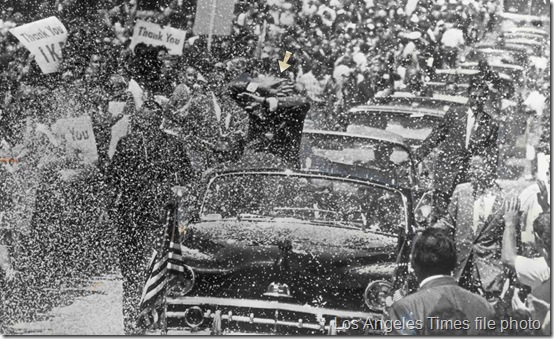
July 27,1960: Eisenhower motorcade / Los Angeles Times file photo
President Eisenhower covers his head under a storm of confetti as he arrives in Chicago to address the Republican National Convention.
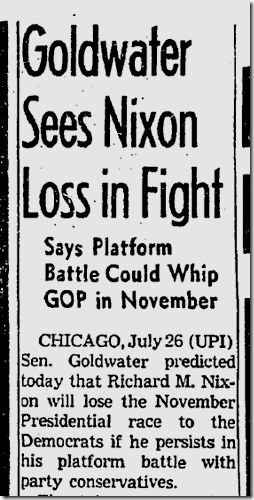
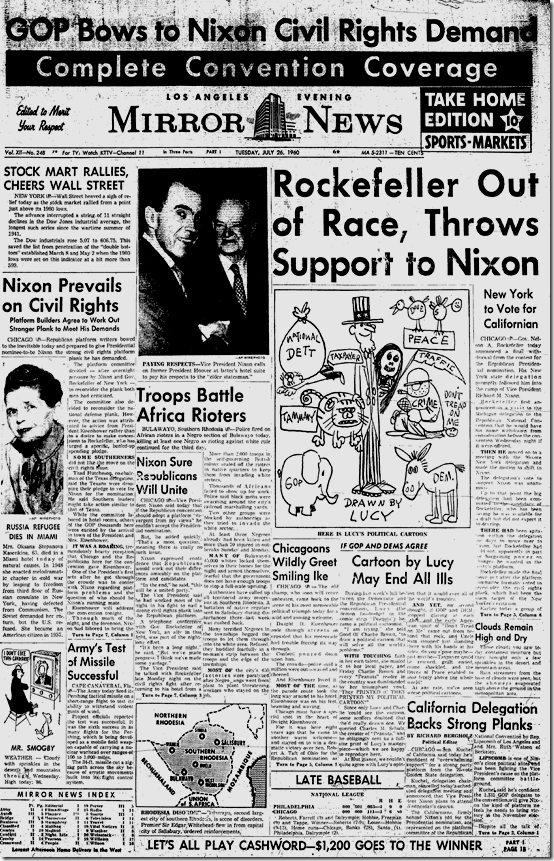
| July 27, 1960: Vice President Richard Nixon wins some – but not all – of what he wants on a civil rights plank for his 1960 presidential campaign.
Arizona Sen. Barry Goldwater says: “If a liberal civil rights plank is adopted, the South will leave the party this year. I don’t know what Nixon is thinking of. I don’t think he can get elected if he keeps on doing what he is doing.” On the jump, the entire text of the Republicans’ revised civil rights statement, photos, and analysis by Times Political Editor Kyle Palmer and James Reston of the New York Times. |
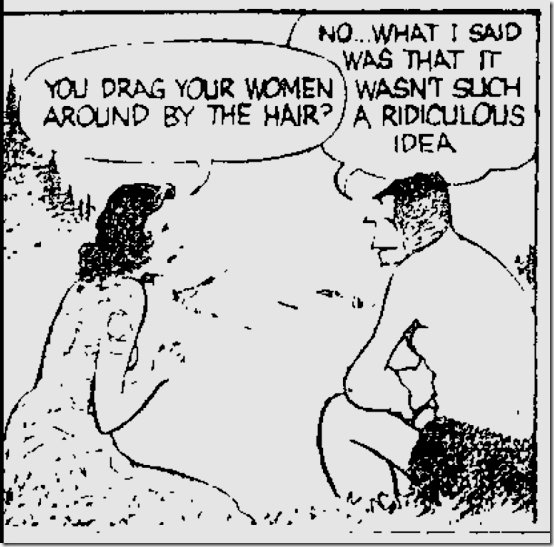
| July 26, 1960: Is the standing ovation really necessary? Most of the time, it’s not, Matt Weinstock says.
CONFIDENTIAL TO SORRY SARI: Next time a fellow asks you up to see his etchings, skip the art and look for the handwriting on the wall, Abby says. |
 |
| July 26, 1960: The “Peanuts” story line involved Lucy drawing a political cartoon and submitting it to a newspaper. Because readers never saw the cartoon, the Mirror asked artist Charles Schulz what it looked like. Here’s his answer.
Paul Coates is on vacation. |
|
Tom Treanor, who died covering World War II for The Times, files a report from Portugal on trying to interview the Duke and Duchess of Windsor.
|
|
July 26, 1940: Jimmie Fidler says “The Marx Brothers and MGM are tiffing, with the studio insisting the freres' next pic be made for $800,000 or LESS!” I was sure Fidler had already run the item on Joan Crawford and the New York doorman who refused to let her rain-drenched fans into the lobby but I can’t find it. Sound familiar? Preview tonight: “The Drive by Night!” |
All I knew about this movie going in was that it had been remade with Mark Hamill in 1995 (the remake also starred Christopher Reeve and Kirstie Alley, and was respectably directed by John Carpenter, but in 1995 all my friends and I cared about was Mark Hamill). I had the impression that the whole idea of a town full of evil kids was fairly corny. I did not expect the original "Village of the Damned" to be so down-to-earth, and so very unsettling.
Things begin quietly — very quietly — as everyone in the village of Midwich, England, suddenly and collectively passes out one afternoon. Tractors crash into trees, record players run down, bathtubs overflow, irons burn holes in shirts … even the animals are out cold. Britain's military rolls in and is standing there wondering what to do when suddenly everyone in Midwich wakes up again. There seem to be no ill effects (well, except for the poor guy who fell asleep flying a plane).
And then, two months later, all the Midwich women of childbearing age realize they're pregnant.
The movie's adapted from "The Midwich Cuckoos," a novel by John Wyndham — who also wrote the wonderful "Day of the Triffids," another tale of mayhem lurking just beneath the peaceful British countryside. Here the action moves at a fairly tranquil pace, introducing an array of mostly likable, relateable characters inhabiting Midwich.
Our heroes are scientist Gordon Zellaby (George Sanders) and his wife, Anthea (Barbara Shelley), with Anthea's brother Alan (Michael Gwynn) providing a military connection. After the mass loss of consciousness, everyone pretty much just dusts themselves off and says "Mustn't grumble" and gets back to work.
| Los Angeles Times file photo
|
|
July 26, 1960: Vice President Richard Nixon helps his wife, Pat, from a car as they are surrounded by a crowd at the Sheraton-Blackstone Hotel in Chicago. The relatively light security, compared to what we know today, is stunning. On the jump, the Republicans skirmish over their campaign platform, photos from the convention, the Rev. Martin Luther King Jr. marches for civil rights, and pieces by Times Political Editor Kyle Palmer and James Reston of the New York Times. |

|
|
July 25, 1960: The Mirror overhauls its comics lineup and layout, introducing Johnny Hart’s “B.C.,” Cal Alley’s “The Ryatts” and Bill Hoest’s “My Son John.” Gone are “Priscilla’s Pop,” “Out Our Way” “Day Shift” and “Earth People.” Coming up in August, the Mirror will change its nameplate as part of a gradual redesign. Matt Weinstock writes about a trial in which jurors found a driver guilty of killing a pedestrian after reenacting the incident (which you’re not supposed to do, folks!) CONFIDENTIAL TO PARENTS IN A QUANDARY: Give your daughter the same educational advantages as your son. An old Chinese proverb — and a good one to apply: "To raise a son without learning is raising an ass; to raise a daughter without learning is raising a pig." |
| Los Angeles Times file photo Here’s another picture of our mystery fellow! Update: Saturday’s picture is Mark Damon and "Diane" Cannon in a publicity photo for "This Rebel Breed," published March 20, 1960.
Sunday’s picture is Mark Damon "fem heartthrob" in a publicity photo for "In Times Like These," published Feb. 22, 1956. Please congratulate Dewey Webb and Pat in Michigan for identifying the mystery fellow and his mystery companion; Mike Hawks and Mary Mallory for identifying our mystery man; and Barbara Klein for identifying the mystery woman. |
|
I had hoped to have a special Republican National Convention edition of the mystery photo – but alas, there are no photos of movie folks at the convention. Instead we have our mystery fellow with a mystery companion. Last week’s mystery woman was Helen Parrish! Her mystery companion was Jerry Giesler. |
| Los Angeles Times file photo July 25, 1960: Vice President Nixon greets well-wishers in Chicago.
Cartoonist Bruce Russell is sure the GOP has the election in the bag. |
|
July 25, 1960: "The issues that shaped the Republican Convention were those forced on it by Nelson A. Rockefeller…. whether he meant to or not, Nelson Rockefeller was summoning the Republican Party to repudiate the administration and policies of Dwight D. Eisenhower before the Party faced the nation in November." — Theodore H. White, "The Making of the President 1960" (Page 191)
Times Political Editor Kyle Palmer says: “The transition from Eisenhower On the jump, a caption writer pokes humor at some Native Americans who were honored at the GOP convention. Plus more photos and an item by James Reston of the New York Times. |
|
|
|
July 24, 1940: Jimmie Fidler asks, “Wot's this about Marjorie Rambeau getting out of hand on ‘Tugboat Annie Returns’ and Warner Bros. mulling discontinuation of plans to make an ‘Annie’ series? |
| Los Angeles Times file photo July 24, 1960: Young Republican members Lloyd LeMere of Oak Park, Ill., and Chris Economos of Berwyn set up a sign painting shop at the convention center in Chicago.
|
| July 24, 1960: Vice President Richard Nixon and New York Gov. Nelson Rockefeller meet to draft a platform for the presidential campaign – and Arizona Sen. Barry Goldwater calls it a “Munich” for the Republican Party. Goldwater accuses Nixon of selling out on every point that separated him from Rockefeller, whom Goldwater describes as the "leader of the Republican left."
The Nixon-Rockefeller platform says, in part: Our program for civil rights must assure aggressive action to remove the remaining vestiges of segregation or discrimination in all areas of national life — voting and housing, schools and jobs. It will express support for the objectives of the sit-in demonstrators and will commend the action of those businessmen who have abandoned the practice of refusing to serve food at their lunch counters to their Negro customers and will urge all others to follow their example. “Our program for health insurance for the aged shall provide insurance on a sound financial basis through a contributory system under which beneficiaries have the option of purchasing private health insurance.” On the jump, pieces by Kyle Palmer, James Reston, Goldwater and Rockefeller’s text of the platform. |
| |
|
July 23, 1960: A redhead (why is it always redheads?) beats a traffic ticket … The Democrats need a good song and the Republicans draft campaign “blanks.” CONFIDENTIAL TO ED: If you are willing to admit you are all wrong when you are all wrong, then you are all right. |
| Los Angeles Times file photo |
|
July 23, 1960: The Republicans are gathering in Chicago to select their choice in the 1960 presidential campaign. Stay tuned to the Daily Mirror…. |


