
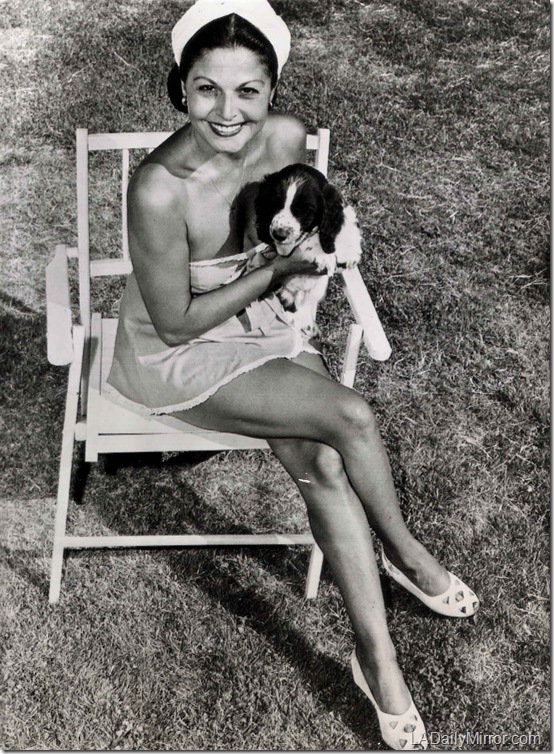
[Update: This is Lina Basquette]
Here’s a mystery gal with a mystery companion, courtesy of Steven Bibb.
[Update: This is Lina Basquette]
Here’s a mystery gal with a mystery companion, courtesy of Steven Bibb.

A suitcase from J.W. Robinson’s has been listed on EBay and the vendor says it belonged to popular mystery writer Erle Stanley Gardner (note the E.S.G. monogram). Bidding starts at $55.
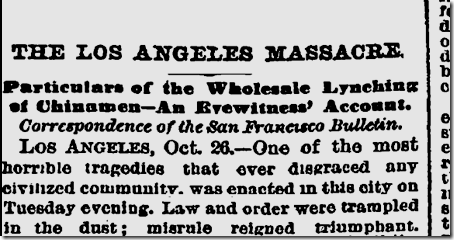
The San Francisco Bulletin’s Oct. 26, 1871, account of the lynching was published in the New York Times.
Los Angeles, although boasting of being the City of the Queen of the Angels, is cursed with such another hotbed of crime and depravity, in its Negro Alley, as San Francisco has in its Barbary Coast and Chinatown.
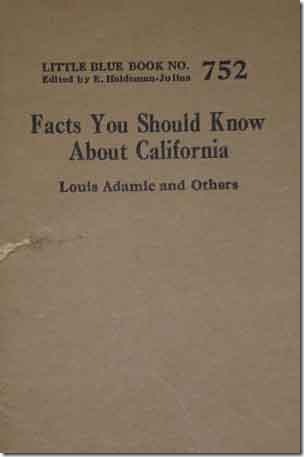
A copy of Little Blue Book No. 752 has been listed on EBay. The Haldeman-Julius publication “Facts You Should Know About California” contains Louis Adamic’s “The Bright Side of Los Angeles” and “Paganism in Los Angeles,” plus Walter Watrous’ “Behind the Scenes in Los Angeles.”
As I noted in another post when the Daily Mirror was at latimes.com:
At his best, Adamic is a keen observer and in his essay “The Bright Side of Los Angeles,” he describes riding on horseback through the Hollywood Hills as a fire lookout.
“Every so often I rode on the night watch, which I preferred to the day shift. I used to like to ride or lead my horse to the crest of Mount Hollywood and from there watch the myriad lights below and listen to the remote rumble of traffic. There was, at that distance, something vaguely fascinating, beautiful almost, in that confusion of lights, in those flashing signs and advertisements, in those streams and rivulets of motor headlights on the boulevards; a rhythm in the distant roar of the city as it reached my ears; and down at San Pedro harbor the battleships had frequent searchlight drills, making the sky to the south gay and fantastic with long, slender shafts of white light. Toward midnight, the noise gradually subsided until there came to me but a faint murmur that remained unchanged for several hours, that at times I could not hear it at all. There was a charm to the city in the distance at night.”
Bidding on the booklet starts at $2.19 or Buy It Now for $5.99.
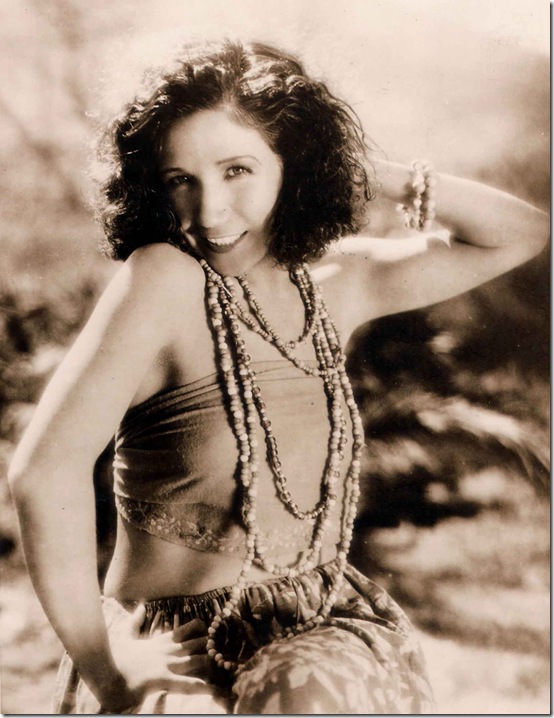
[Update: I’m tempted to give half credit to Cold in Phoenix, who guessed that this is Lupe Velez. It’s actually her sister Reina.]
Here’s today’s mystery lady, courtesy of Steven Bibb.
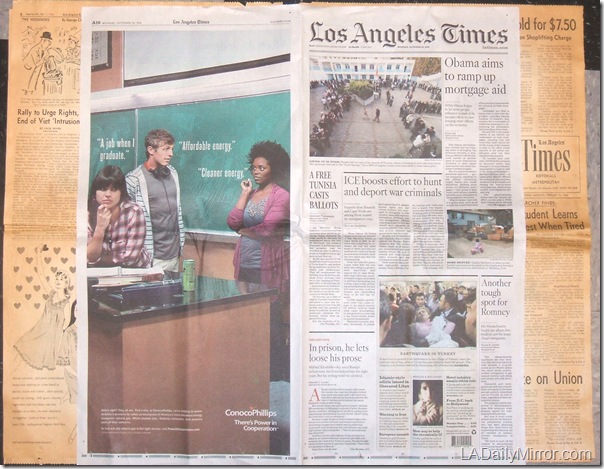
Most people know that newspapers have reduced the size of their pages (or what we used to mean when we talked about “the web”) to save newsprint, but unless you have a lot of old papers lying around the house (ahem), you may not realize how much has been cut.
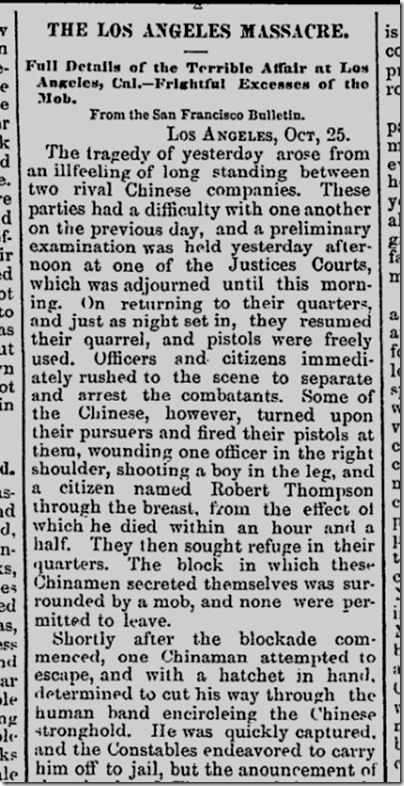
Here’s the San Francisco Bulletin’s Oct. 25, 1871, coverage of the massacre, as republished in the Carroll (Iowa) Herald on Nov. 22, 1871. [This link works now but it may be broken eventually as Google tinkers with its newspaper archives]. Until these newspapers were digitized, it was almost impossible to read any coverage of the incident – all the average person had is what was written about it later in books.
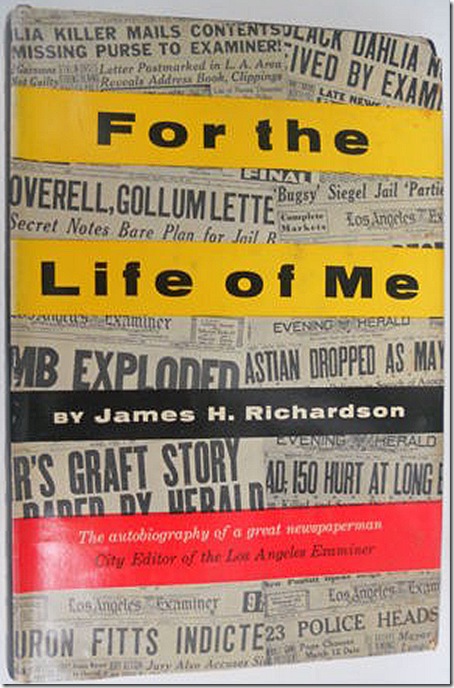
A copy of Jim Richardson’s flawed autobiography “For the Life of Me” has been listed on EBay. Richardson was the notorious city editor of the Examiner who orchestrated its coverage of the Black Dahlia case. He was legendary for his demeaning abuse of reporters and was a reformed alcoholic who lectured everyone about drinking. His attitude in “For the Life of Me” can be summed up as: “I was a better reporter drunk than you are sober and don’t ever forget it.”
Even worse, Richardson relied on his liquor-clouded memory for many aspects of the book rather than checking his facts, so details of numerous famous incidents are scrambled.
Richardson’s problems with alcohol eventually became so bad that no paper would have him, and he briefly embarked on a career as a movie publicist, so there is a Hollywood aspect to the book as well. I have read that Richardson also had a small role as a newspaper editor in “Elmer Gantry,” but I have never had the patience to track it down.
I don’t recommend this as the first book to read about Los Angeles in the 1940s, but it’s worth a look if only for the attitude it reflects. Bidding on this copy starts at $7.99.
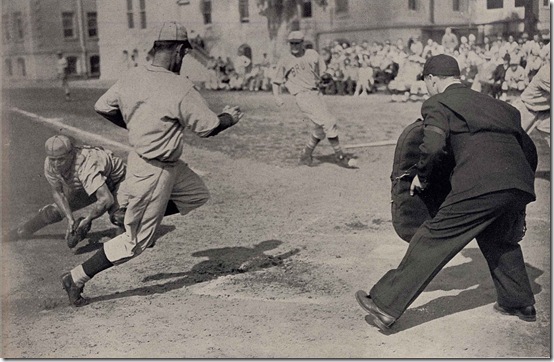
Photo: Tom Phelps scores for USC in a 1946 game against UCLA at Bovard Field. Credit: El Rodeo, 1946
Jane Leavy of the New York Times examines the search for historic baseball diamonds, including USC’s Bovard Field, where Mickey Mantle hit two legendary home runs during a 1951 exhibition game between the Trojans and the Yankees.
She writes:
For a baseball biographer, documenting the landscape is an essential part of holding myth accountable to history.
Too often, the places at the heart of the game go unmarked, unnoticed and untended.
“Baseball fans are concerned with who and how many,” said John Thorn, baseball’s official historian. “Place matters — that’s where our great ghosts come to life.”
Pedro Moura also revisited Mantle’s homers for ESPN.
History – at least to crossword puzzle fans – was made last week by Patrick Berry, who challenged New York Times readers with a series of six puzzles that had to be put in order to solve a final mystery. Deb Amlen has more in the New York Times’ Wordplay blog. (And yes, I’m proud to say I cracked the meta-challenge.)
The L.A. Daily Mirror and L.A. Crime Beat curated from only the finest Twitter feeds by the discerning bots at paper.li.
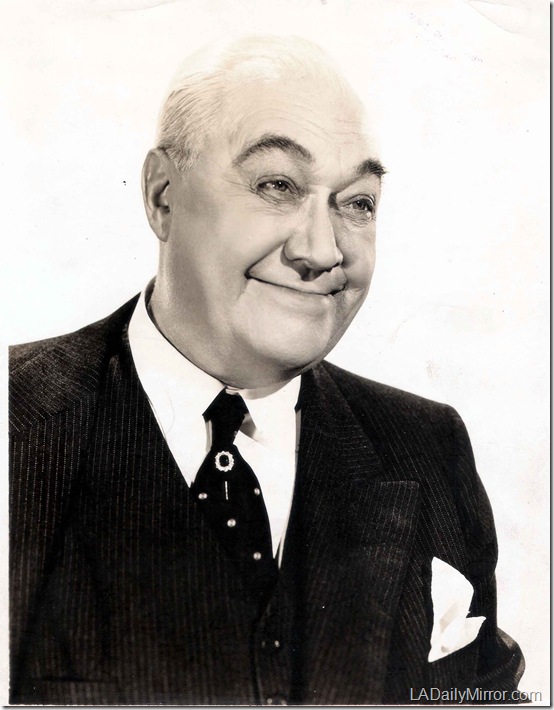
[Update: This is George Barbier (d. 1945). Please congratulate Eve Golden, Mary Mallory, Mike Hawks, Don Danard, “Maltese Falcon” fan Floyd Thursby, and Megan Lee and Thom for identifying him.
Here’s another mystery photo, courtesy of Steven Bibb.
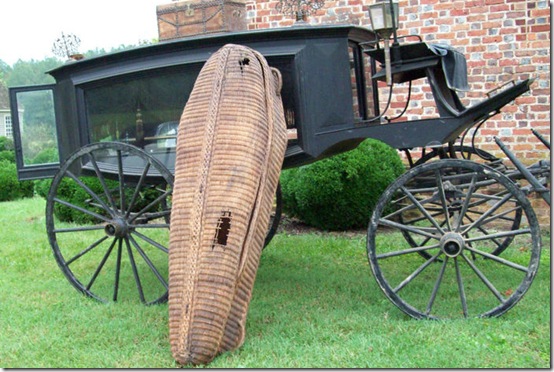
Horse-drawn hearse for sale on EBay – listed as Buy It Now for $8,000.
Queen of the Dead—dateline October 24, 2011
• A 68-year-old literary scholar and media theorist died on Oct. 18, which is very sad, of course, but which is mostly notable for our column because the man was saddled with the remarkable and unfortunate name Friedrich Adolf Kittler. He was indeed born in Germany in 1943, which makes one raise an eyebrow, but he managed to overcome his name and work on numerous university media theory departments, write several books, and win several scholastic awards. Yet when you Google “Kittler,” you are directed to a fabulous website of Cats That Look Like Hitler. I like to think that a media theorist would be amused by this.
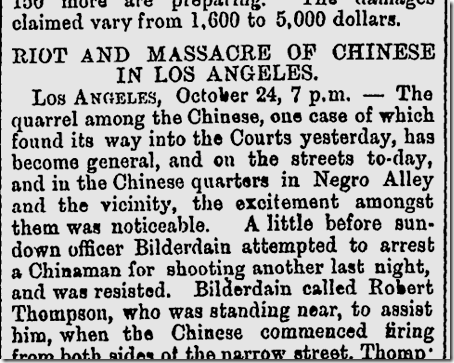
I hadn’t planned to get into the Chinese Massacre until I wrapped up the Zoot Suit Riots, but Google’s recent changes in its news archives pressed me to get the material online before the newspapers disappear.
For decades, the average reader has had no recourse but later accounts of the 1871 Chinese Massacre. Recent innovations in digitized newspapers, however, allow anyone with a computer — and lots of patience — to access the original stories.
Several months ago, in rummaging around in online newspapers, I found this stunning coverage of the massacre, filed as it occurred, with breaking updates. In reading these paragraphs, the intervening 140 years evaporates and the slaughter becomes fresh and immediate once again.
Even more incredible, the story appears in the Daily Southern Cross of Auckland, New Zealand, Dec. 9, 1871, which shows just how far newspapers were circulated in the 19th century.
Here’s a sample:
Horrible beyond description has been the history of these last few hours. Chinamen, helpless, torn and mangled, more dead than alive, have been dragged by an infuriated, senseless and reckless crowd, through our peaceable streets, in the very face of the better portion of the community, to finish what little was left of their agonized existence at the end of the rope, amidst the exultant shouts and jeers of the mob.
Notice the references to “Negro Alley,” where the massacre occurred.
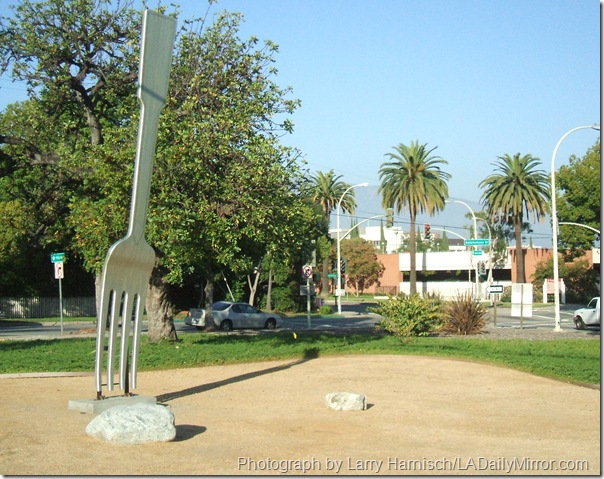
Pasadena’s famous “Fork in the Road” has returned!
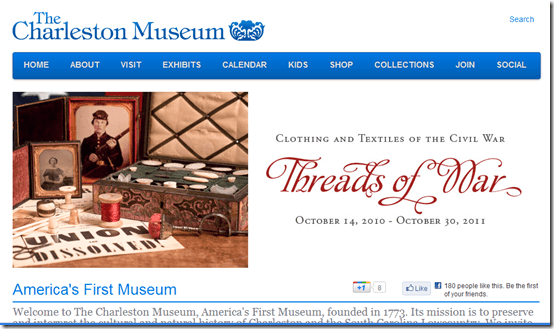
Image: The Charleston Museum, where Michael L. Miller was arrested on charge of having sex at 3 a.m.
Neale Gulley of Reuters reports that the Buffalo Transportation Pierce Arrow Museum in Buffalo, N.Y., is building Frank Lloyd Wright’s 1927 design for a gas station for $15 million. It won’t be a functioning gas station (those overhead gas tanks are a problem) and will be indoors, so we’ll never find out if the roof leaks – like some of Wright’s other buildings.
Robin Pogrebin of the New York Times writes about the renewed interest in Latin American Art.
“Latin America is hot, whether you’re talking about Bogotá, Colombia; São Paulo, Brazil; or Buenos Aires, Argentina,” said Glenn D. Lowry, the director of MoMA. “You’ve got institutions with a longstanding interest, biennials, art fairs, new collectors and other institutions that have become increasingly aware of how important Latin America is to any global conversation.”
Joy Wallace Dickinson of the Orlando Sentinel looks at the history — and the future — of plastic lawn flamingos. And the new colors are Divine!
Scott Streater of Greenwire (via the New York Times) uses the closure of the Indian Arts Museum in Grand Teton National Park to examine the Park Service’s care of Native American Artifacts.
A report issued last summer by the nonprofit National Parks Conservation Association noted that more than half of the Park Service’s 80 million museum artifacts were uncataloged, and that another 28 million objects were at risk of decay or loss.
The L.A. Daily Mirror and L.A. Crime Beat curated by the tireless bots a paper.li Continue reading
Oct. 24, 1871: Riot and Massacre of Chinese in Los Angeles. Daily Southern Cross of Auckland, New Zealand, Dec. 9, 1871
Coming up this week on the Daily Mirror:
On Monday, Eve Golden has a roundup of unusual obituaries in Queen of the Dead and Mary Mallory looks at Hugh Herbert, Hollywood’s original Woo Hoo man, in Hollywood Heights.
I’ll also be running original accounts from 1871 for the 140th anniversary of the Chinese Massacre, which occurred Oct. 24, 1871.
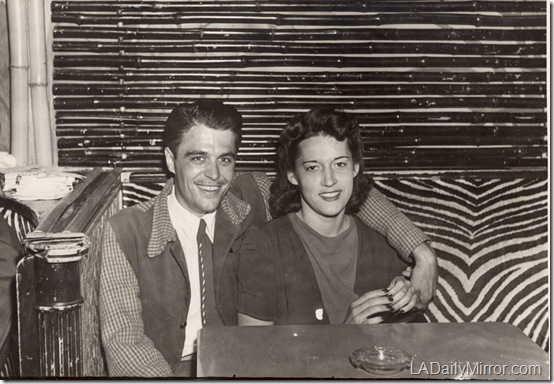
Photo: A happy couple in the Zanzibar Room of the Florentine Gardens, Sept. 6, 1944.
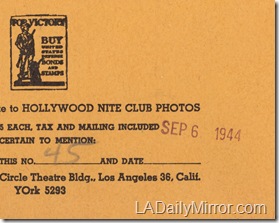 In case you’re wondering, I contacted the vendor of the bogus EBay picture I recently acquired. He said he got it from an estate in Los Angeles and in compensation, sent me this one, a better image that shows the zebra-skin upholstery and bamboo–covered walls of the Zanzibar Room. The Zanzibar Room was the cocktail lounge where the club usually booked African American acts like the Mills Brothers.
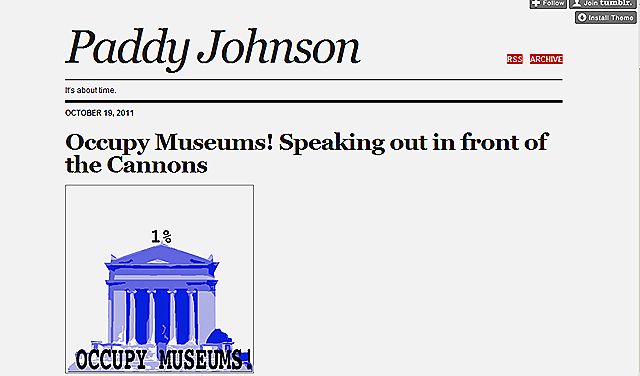
Maura Judkis of the Washington Post writes about a new trend in the Occupy movement: Occupy Museums. Protesters had planned demonstrations Thursday at the Museum of Modern Art, the Frick Collection and New Museum. Philip Boroff and Katya Kazakina of Bloomberg have an update, via the San Francisco Chronicle.
Brandi Grissom of the Texas Tribune writes that DNA tests in another killing have reopened a cold case in North Austin, Texas.
The L.A. Daily Mirror and L.A. Crime Beat curated by the bots at Occupy paper.li.
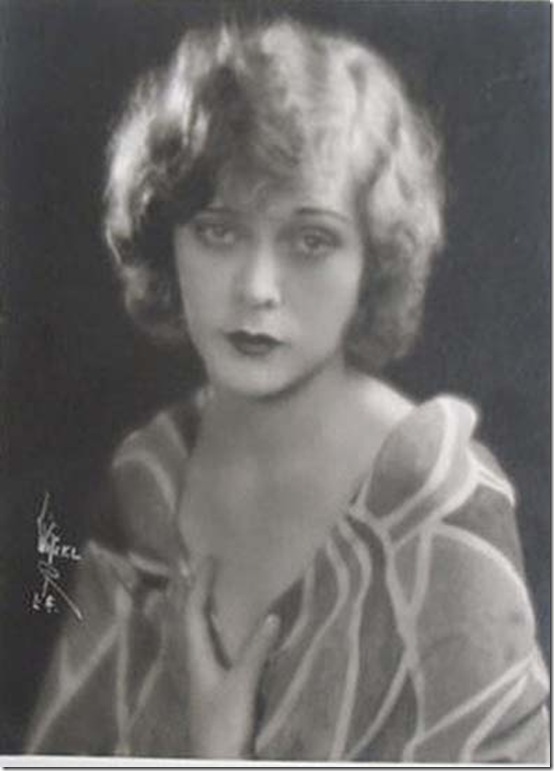
This unidentified Witzel photo has been listed on EBay. The vendor has no idea who this actress is, which makes it a perfect mystery photo. Bidding, by the way, starts at $9.99.
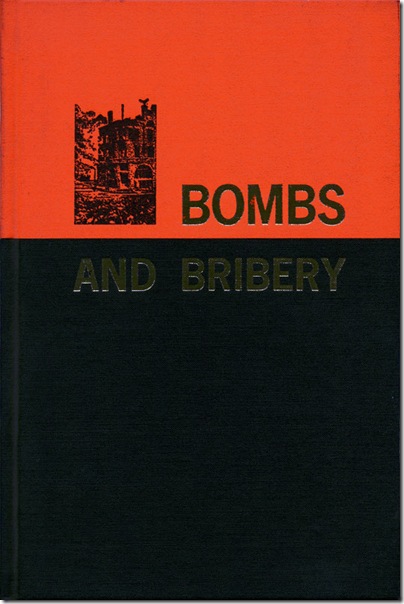
W.W. Robinson is probably my favorite Los Angeles historian. He isn’t as flashy as some writers but he is scrupulously accurate – and that counts for a lot. “Bombs and Bribery” is a small volume on the 1910 Times bombing published in 1969. His essay is adapted from a chapter on the bombing in his 1959 book “Lawyers of Los Angeles.” Although publication was limited to 300 copies, it’s easy to find one in a local library and I would never recommend paying the vendor’s asking price of $99. 99. (The vendor also has a “make offer” button, which is a little more sensible.) You can find it in any number of local libraries.
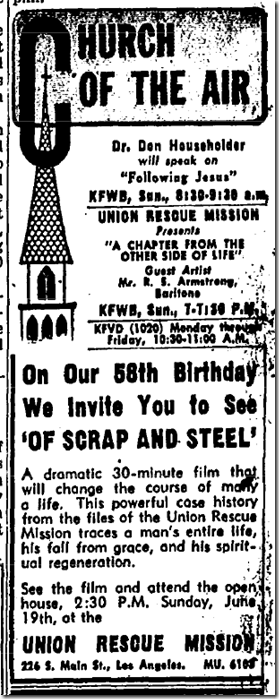
June 18, 1949: “Of Scrap and Steel” is shown at the Union Rescue Mission.
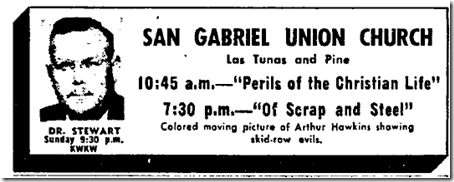
Aug. 2, 1952: “Of Scrap and Steel” is shown at San Gabriel Union Church.
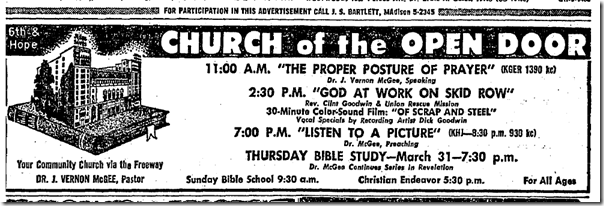
March 26, 1960: “Of Scrap and Steel” is shown at the Church of the Open Door.
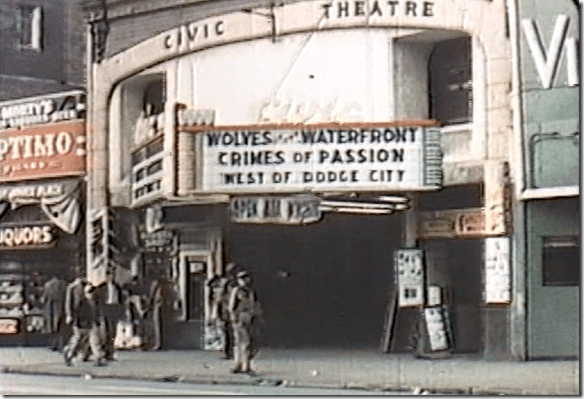
Photo: “Wolves of the Waterfront” (a 1923 silent picture?) playing at the Civic Theatre in “Of Scrap and Steel.”
LAVA is presenting a free showing on Thursday of the 1949 short “Of Scrap and Steel,” which was produced by the Union Rescue Mission and features character actor Porter Hall.
The film will be shown on on the roof of the Union Rescue Mission, 545 S. San Pedro. Doors open at 6 p.m., with remarks by the Rev. Andy Bales of the mission, and my pals from Esotouric, Nathan Marsak and Richard Schave. The film will be shown at 7:30 p.m., followed by a Q&A. Admission is free but reservations are requested.

